
State Innovation Model SIM IDD Provider Workforce Development
- Slides: 30
State Innovation Model (SIM) I/DD Provider Workforce Development Nancy Cronin Executive Director Maine Dev Disabilities Council Todd Goodwin Executive Director Community Partnership Inc. December 6, 2016
Approach Ø Background: Medical and community professionals who work with Individuals with Developmental Disabilities (DD) do not have the information and tools needed to ensure that patients with DD have access to coordinated, comprehensive healthcare. Ø Approach/Hypothesis: If medical and community professionals receive training and tools to identify behavior as an indicator of underlying medical conditions, then they will be more likely to treat co-morbid health issues earlier as opposed to automatically interpret challenging behavior as a mental health condition.
Implementation Ø Data indicates that medical and community professionals who received training changed their behavior and were able to assess the underlying health concerns of individuals with DD who exhibited potentially challenging behaviors. – Trainings that have been presented have been received extremely well. – Participants were made more aware of behaviors as a communication of pain, and how to evaluate pain. – New methods of communications were recognized by many providers, case managers, and direct support staff. – Symptoms of the most common producers of pain in the person with DD were identified for the learners, as well as common behaviors associated with them. – This new knowledge allows for quicker recognition, management and medical care for the individual with DD.
Implementation (cont. ) Ø Provided guidelines for Caseworkers, Direct Support Providers, Employers, Advocates, and Medical Practitioners on caring for and communicating with individuals with DD. Ø Allowed for increased knowledge in how to approach health care providers on behalf of the person with DD, advocating for their healthcare needs. Ø Decreased mental health and crisis visits. Ø Placed the burden of proof on the medical provider to rule out medical conditions causing behaviors not normally seen in the individual.
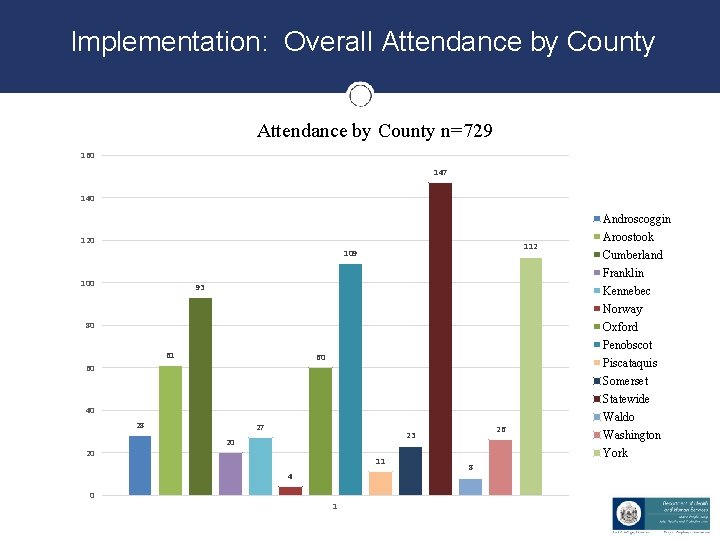
Implementation: Overall Attendance by County n=729 160 147 140 Androscoggin 120 112 109 Aroostook Cumberland Franklin 100 93 Kennebec Norway 80 Oxford 61 Penobscot 60 60 Piscataquis Somerset Statewide 40 28 20 27 23 20 11 4 0 26 1 Waldo Washington York 8
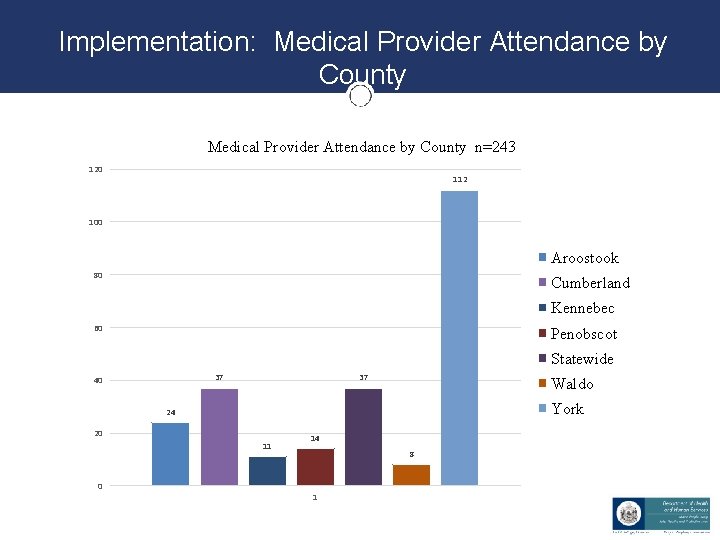
Implementation: Medical Provider Attendance by County n=243 120 112 100 Aroostook 80 Cumberland Kennebec 60 Penobscot Statewide 37 40 37 Waldo York 24 20 11 0 14 8 1
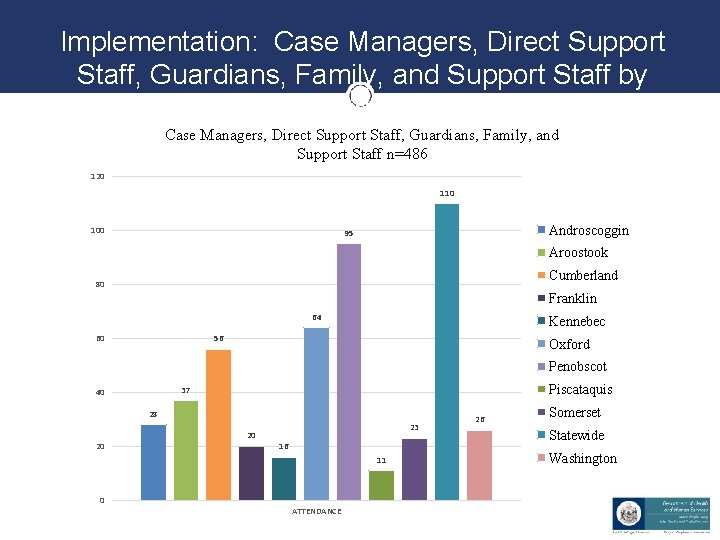
Implementation: Case Managers, Direct Support Staff, Guardians, Family, and Support Staff by County Case Managers, Direct Support Staff, Guardians, Family, and Support Staff n=486 120 110 100 Androscoggin 95 Aroostook Cumberland 80 Franklin 64 Kennebec 56 60 Oxford Penobscot Piscataquis 37 40 28 20 20 23 16 11 0 ATTENDANCE 26 Somerset Statewide Washington
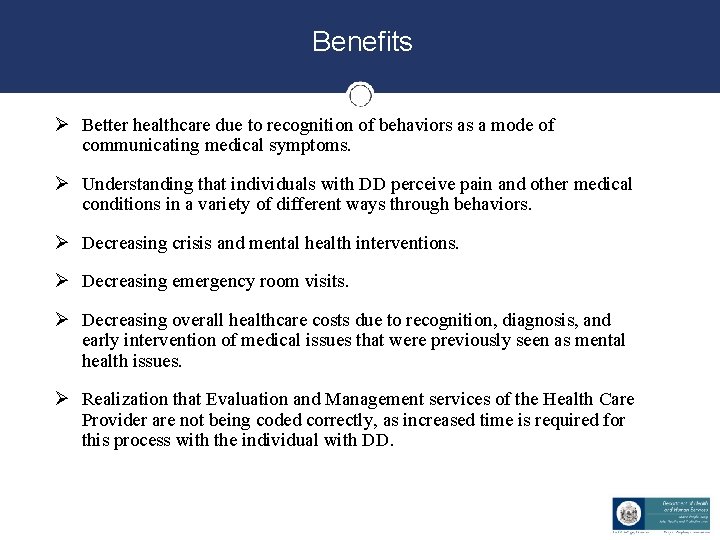
Benefits Ø Better healthcare due to recognition of behaviors as a mode of communicating medical symptoms. Ø Understanding that individuals with DD perceive pain and other medical conditions in a variety of different ways through behaviors. Ø Decreasing crisis and mental health interventions. Ø Decreasing emergency room visits. Ø Decreasing overall healthcare costs due to recognition, diagnosis, and early intervention of medical issues that were previously seen as mental health issues. Ø Realization that Evaluation and Management services of the Health Care Provider are not being coded correctly, as increased time is required for this process with the individual with DD.
Benefits (cont. . ) Ø Educating ALL levels of service providers and medical practitioners regarding how diseases, symptoms, and comorbidities manifest themselves in individuals with DD. Ø The need for medical and nursing professionals working with individuals with DD to have specialty certification(s). Ø Looking at the differences in the manifestations of chronic conditions in the individual with DD.
Lessons Learned/Survey Results
Perceived Barriers in Implementing Changes? Ø “Cost, Lack of support” Ø “Reimbursement issues, Lack of being listened to from many providers” Ø “Patient compliance” Ø “Lack of insurance, cost, no dental available – consumer receives Social Security and can’t afford dental” Ø “Lack of services in the area, only one psychiatrist. No dentist that accepts Maine. Care, lack of adaptive equipment” Ø “There is all together not enough money set aside for the social work, caretakers, and healthcare. All of those things are barriers but I will do my best to work around it”
Information gained changed the way you deliver care to patients? Ø 90% of attendees agreed that this training would change the way that they provided care, (participant comments). − “Yes, there are so many amazing points made” − “Yes, absolutely” − “Yes, be more aware of pain management” − “Yes, I will be more caring and compassionate” − “Yes, it will influence me but no change since I am not practicing” − “Yes, just knowing to include a better physical exam when patients have a poorer communication and ask questions that are important to their health, including sexual health. This talk opened up eyes to a misconception I had made” − “Yes, Making sure to look a the patient as a patient and not a disability”
Information gained change the way you deliver care to patients? Ø 10% of attendees stated that this would NOT change the way that they provided care. - “No, it just reinforces the care I give” - “Not directly, but it was very interesting” - “Not especially, it is common sense”
3 Month Follow Up
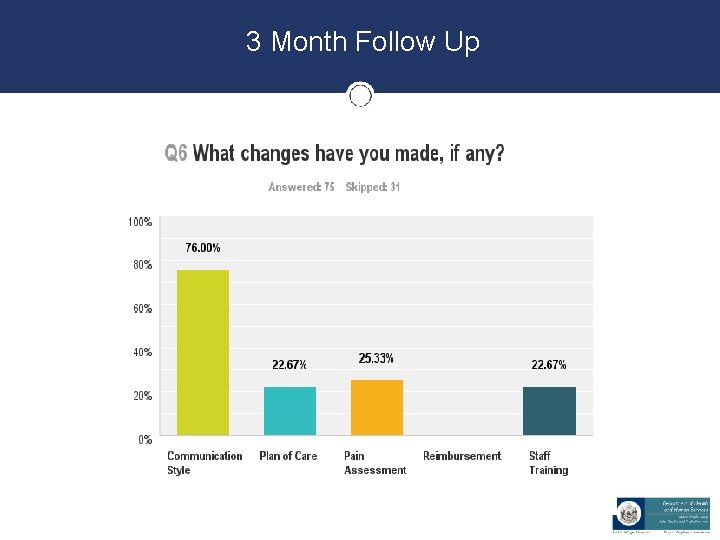
3 Month Follow Up
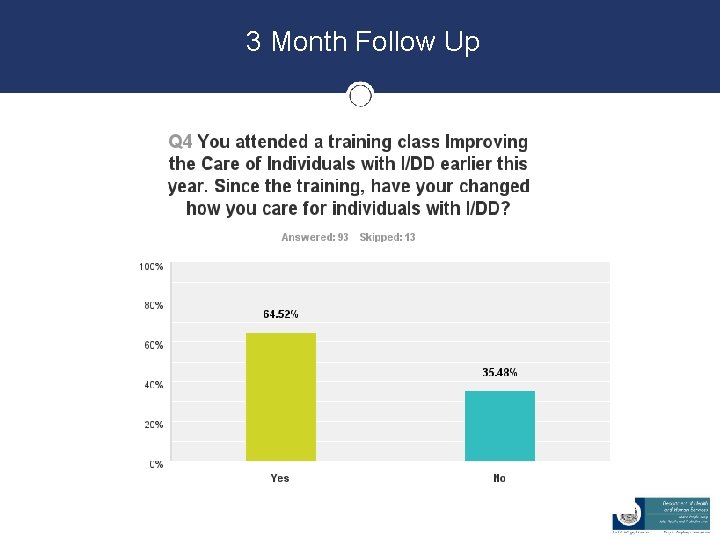
3 Month Follow Up
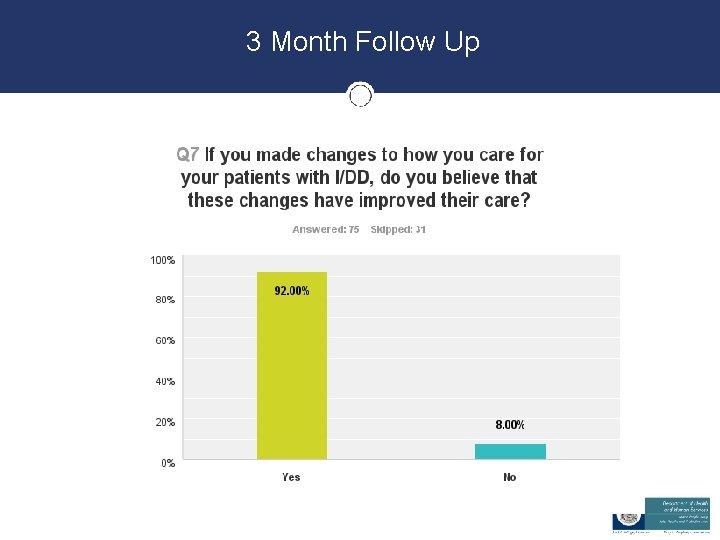
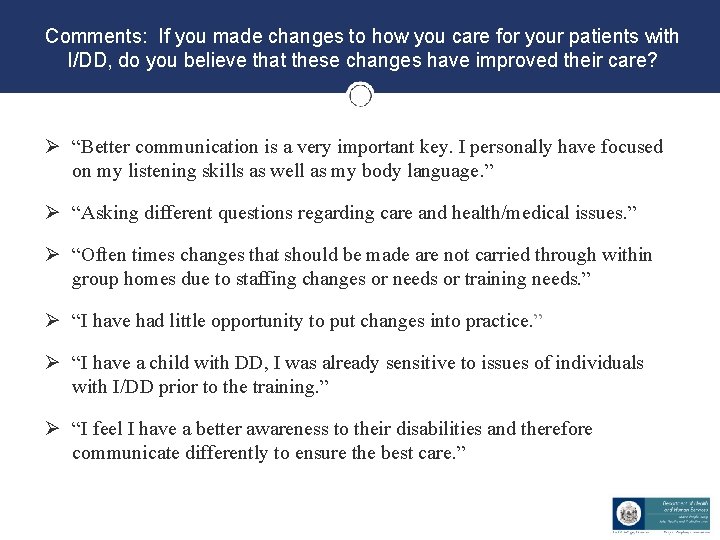
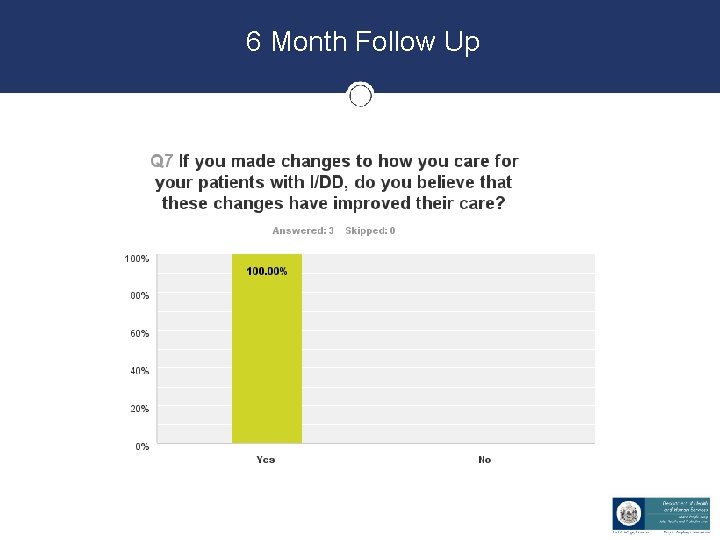
Comments: If you made changes to how you care for your patients with I/DD, do you believe that these changes have improved their care? Ø “Better communication is a very important key. I personally have focused on my listening skills as well as my body language. ” Ø “Asking different questions regarding care and health/medical issues. ” Ø “Often times changes that should be made are not carried through within group homes due to staffing changes or needs or training needs. ” Ø “I have had little opportunity to put changes into practice. ” Ø “I have a child with DD, I was already sensitive to issues of individuals with I/DD prior to the training. ” Ø “I feel I have a better awareness to their disabilities and therefore communicate differently to ensure the best care. ”
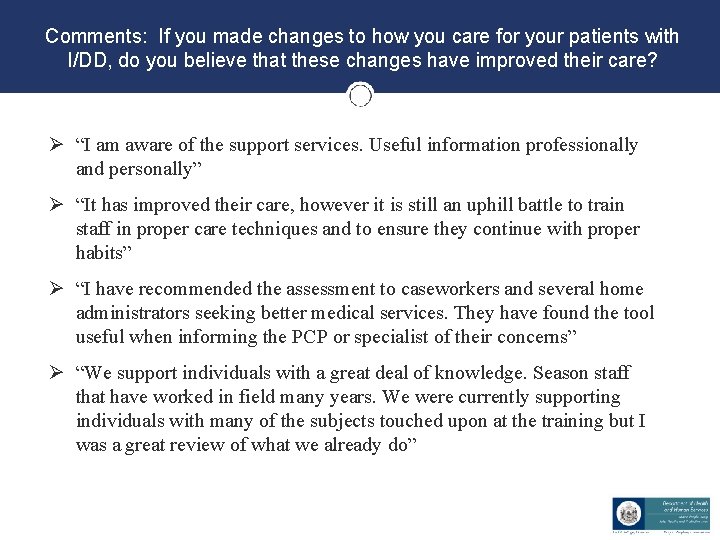
Comments: If you made changes to how you care for your patients with I/DD, do you believe that these changes have improved their care? Ø “I am aware of the support services. Useful information professionally and personally” Ø “It has improved their care, however it is still an uphill battle to train staff in proper care techniques and to ensure they continue with proper habits” Ø “I have recommended the assessment to caseworkers and several home administrators seeking better medical services. They have found the tool useful when informing the PCP or specialist of their concerns” Ø “We support individuals with a great deal of knowledge. Season staff that have worked in field many years. We were currently supporting individuals with many of the subjects touched upon at the training but I was a great review of what we already do”
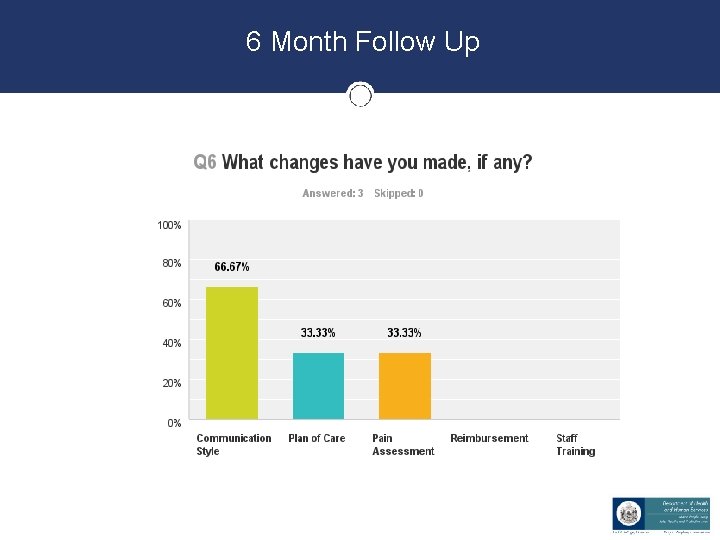
6 Month Follow Up
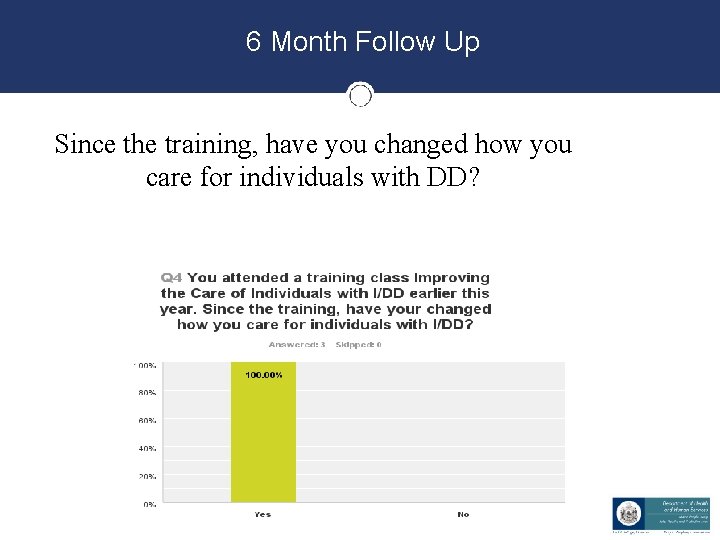
6 Month Follow Up Since the training, have you changed how you care for individuals with DD?
6 Month Follow Up
Other Ø In the creation and training of this work, a number of actions have occurred: - The formulation of a “Core Expectations” committee to determine what is needed, within the scope of the current expectations, for the development of a PCCMH-DD. - Checklist committee to formulate a universal checklist for individuals with DD who require Emergency Department visits. - Training modules for Dementia. - New video modules to improve communication at medical visits. - Training modules for Diabetes. - Training modules for Transition of youth to adult medical services - Alternatives to pain medication for the individual with DD. - Online resource manual to assist families, caregivers, staff, and practitioners with information regarding medical issues pertaining to the individual with DD.
Future Recommendations Ø Begin work with colleges and universities to enhance the education of health care professionals with regard to the care and management of individuals with DD. Ø Form closer bonds with medical schools to assist in educating future Healthcare Providers. Ø Find better ways to reach and involve practicing healthcare providers. Ø Education for DSP’s regarding medical issues and care of individuals with DD. Ø Encourage a better payment rate for HCP’s who are caring for individuals with DD according to specific criteria.
Future Recommendations (cont. ) Ø Billing and coding education for office managers and coders regarding E&M codes. Ø Continue to work on DD health issues: – Develop modules for training in acute and chronic conditions for individuals with DD. – Provide a sound curriculum for support staff, case managers, and practitioners.
Future Recommendations (cont. ) Ø Continue to work on finding and capturing funding and funding sources for the work. Ø Strive for more DD Certified nurses and practitioners in the state. Ø Collaborate closely with stakeholders. Ø Collaborate with the Department to ensure that the needs of case managers are being met.
Future Recommendations (cont. ) Ø Continue to work on finding and capturing funding and funding sources for the work. Ø Strive for more DD Certified nurses and practitioners in the state. Ø Collaborate closely with stakeholders. Ø Collaborate with the Department to ensure that the needs of case managers are being met.
Future Recommendations (cont. ) Ø Creating medical training modules for direct support personnel that include checklists for use by them when dealing with a medical issue with the person who has DD. Ø Formulate modules for insertion into case management training dealing specifically targeting medical issues with the individual with DD. Ø Include work on reducing benzodiazepine/opiate dependence to include individuals with DD.
Future Recommendations (cont. ) Ø Continue this work with more information and training regarding healthcare issues for individuals with DD. Ø Make training available in a number of different presentation formats such as: - On-line, self directed with checks and balances. - Webinars. - In person. - Podcasts. Ø Continue to try and integrate this information into medical and nursing education throughout the state.
Future Recommendations (cont. ) Ø Continue to offer the training to providers, case managers, and support staff. Ø Make the training available to the “on-line” community. Ø Continue Technical Assistance Ø Continue the bridge construction between HCP and the DD community to provide better, more collaborative care. Ø Continue with developing training modules that will educate the larger community regarding health issues and care for the individuals with DD. Ø Forge inroads to education for teaching and training of interdisciplinary education of health issues for individuals with DD.
Slide Title Questions?