
State Factor Model of Soil and Ecosystem Formation
- Slides: 10
State Factor Model of Soil and Ecosystem Formation • Idea that soils form predictably in response to environmental factors attributable to Dokuchaev in ~ 1880 • Hans Jenny (1920’s to 1930’s) transformed conceptual model to a more quantitative theory following tenets of physical chemistry
State Factor Model Concepts • Earth surface a continuum of objects –Soils and ecosystems are human constructs • Continuum broken into systems for study –Size is arbitrary –System has the following properties • Open to surroundings • Can exchange matter and energy • Properties at any time depend on surroundings • Sytem properties depend on – 1. Initial state of system – 2. External conditions – 3. Age of system
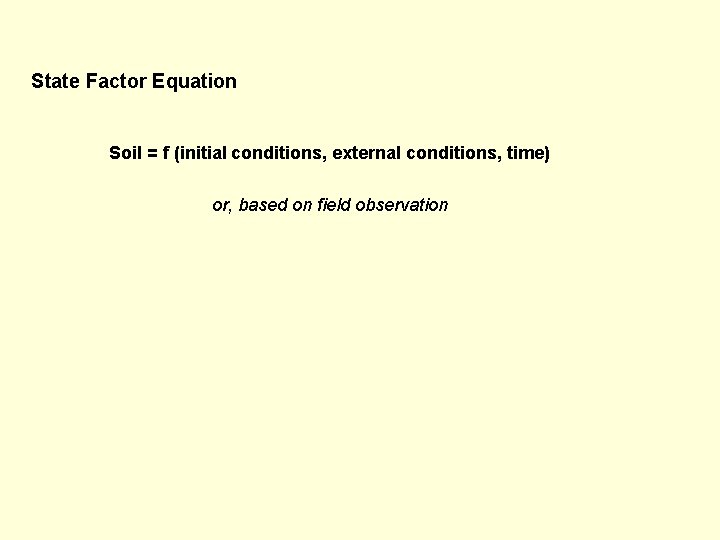
State Factor Equation Soil = f (initial conditions, external conditions, time) or, based on field observation
Key Concepts of State Factor Theory • Factors are independent of system –System is small relative to surroundings • Factors may be independent of each other –Climate not always independent of time for example –If a variable is independent, sites can be selected along a gradient of the variable (a soil sequence) • Since state factor assemblage defines a soil or ecosystem, a change in variables defines a new system –Leads to recognition that there are essentially an infinite number of soils
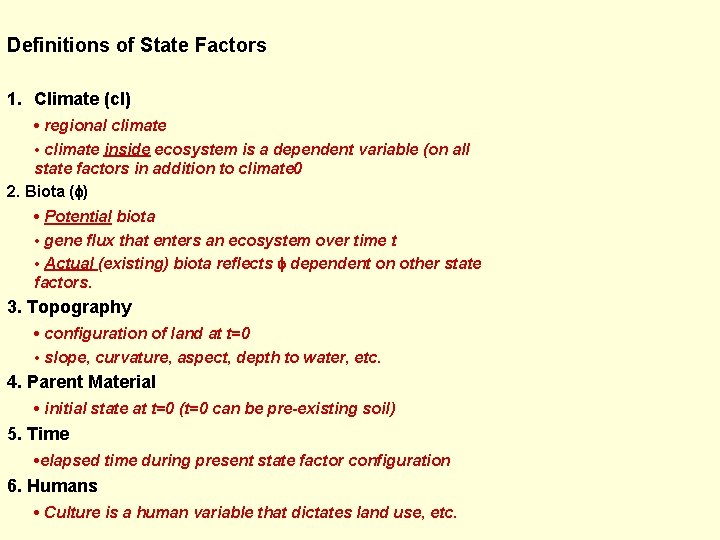
Definitions of State Factors 1. Climate (cl) • regional climate • climate inside ecosystem is a dependent variable (on all state factors in addition to climate 0 2. Biota ( ) • Potential biota • gene flux that enters an ecosystem over time t • Actual (existing) biota reflects dependent on other state factors. 3. Topography • configuration of land at t=0 • slope, curvature, aspect, depth to water, etc. 4. Parent Material • initial state at t=0 (t=0 can be pre-existing soil) 5. Time • elapsed time during present state factor configuration 6. Humans • Culture is a human variable that dictates land use, etc.
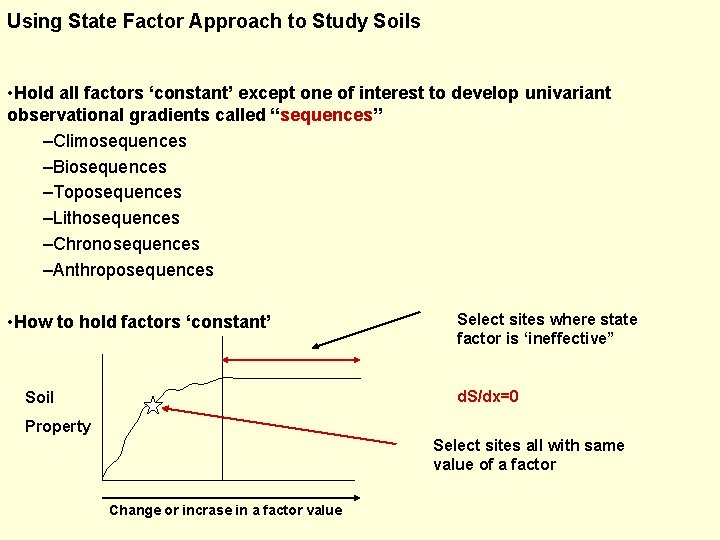
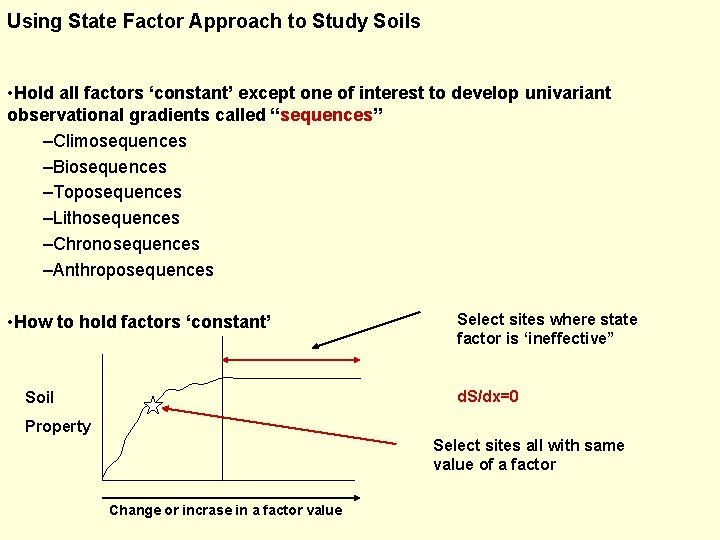
Using State Factor Approach to Study Soils • Hold all factors ‘constant’ except one of interest to develop univariant observational gradients called “sequences” –Climosequences –Biosequences –Toposequences –Lithosequences –Chronosequences –Anthroposequences • How to hold factors ‘constant’ Select sites where state factor is ‘ineffective” d. S/dx=0 Soil Property Select sites all with same value of a factor Change or incrase in a factor value
Using State Factor Approach to Study Soils • Hold all factors ‘constant’ except one of interest to develop univariant observational gradients called “sequences” –Climosequences –Biosequences –Toposequences –Lithosequences –Chronosequences –Anthroposequences • How to hold factors ‘constant’ Select sites where state factor is ‘ineffective” d. S/dx=0 Soil Property Select sites all with same value of a factor Change or incrase in a factor value
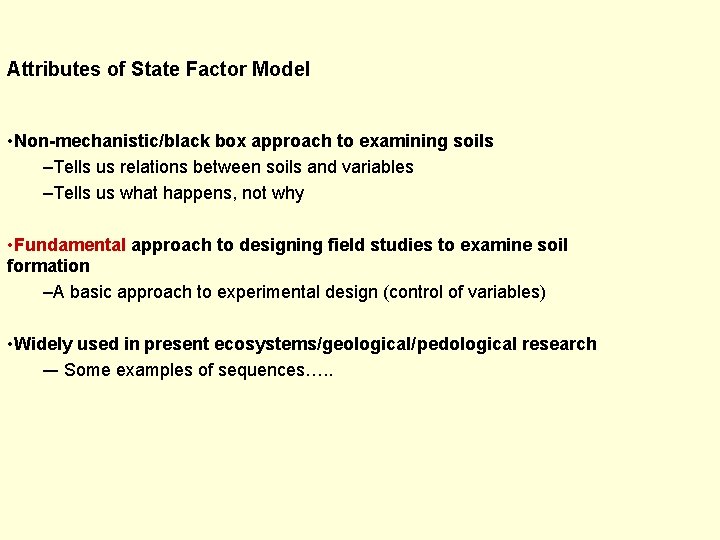
Attributes of State Factor Model • Non-mechanistic/black box approach to examining soils –Tells us relations between soils and variables –Tells us what happens, not why • Fundamental approach to designing field studies to examine soil formation –A basic approach to experimental design (control of variables) • Widely used in present ecosystems/geological/pedological research –- Some examples of sequences…. .
Climosequences West slope of Sierra Nevada as an analogue for how soil C responds to climate change • PM = granitic • Topo = similar slope, aspect • Biotic = constant • Age/residence time= similar • Climate= varies with elevation
Chronosequences Hawaiian Island Chain • PM = basalt/tephra • Climate= constant • Topo= same (level flows) • Biota=constant • Time= variable (102 to >4 Ma)