
State Apprenticeship Expansion Building State Capacity to Expand
State Apprenticeship Expansion “Building State Capacity to Expand Apprenticeship through Innovation” ETA-TEGL-15 -19 SAE 2020 August 5, 2020 GRANTEE ORIENTATION
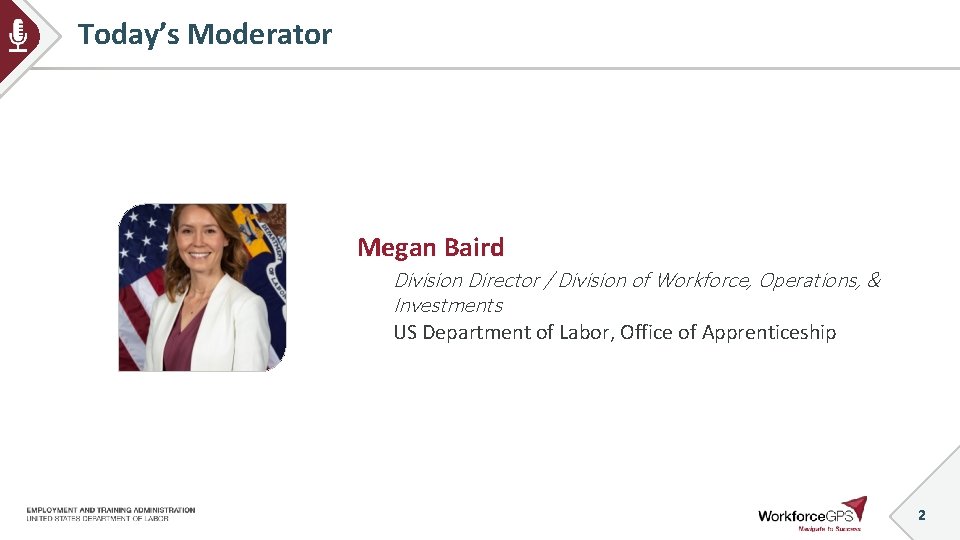
Today’s Moderator Megan Baird Division Director / Division of Workforce, Operations, & Investments US Department of Labor, Office of Apprenticeship 2
AGENDA Purpose of Grant Program Agency Offices and Roles Definitions and Allowable Grant Activities Reporting Requirements SAE, ASE, and SAE 2020 Similarities and Differences Technical Assistance Grant Agreement and Award Package Evaluation Resources Questions Agency Contacts 3
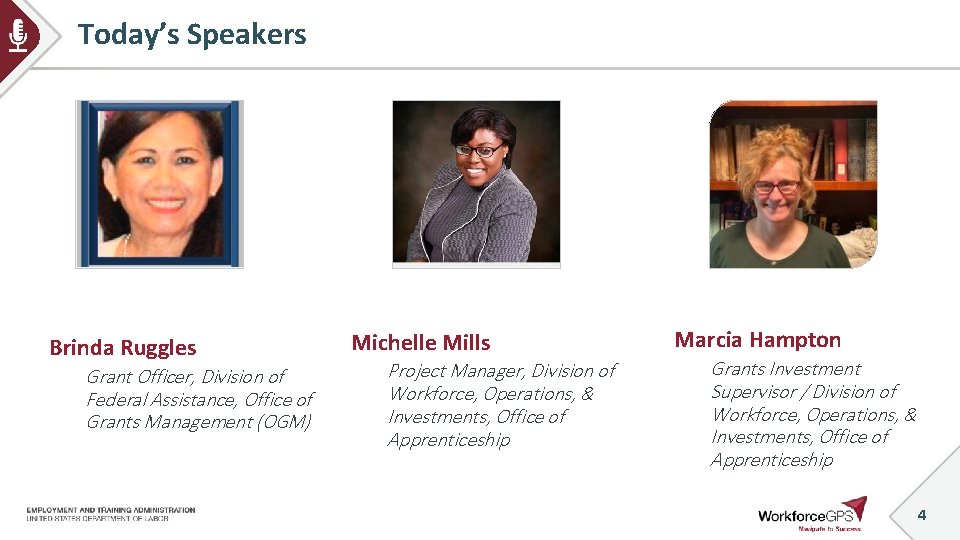
Today’s Speakers Brinda Ruggles Grant Officer, Division of Federal Assistance, Office of Grants Management (OGM) Michelle Mills Project Manager, Division of Workforce, Operations, & Investments, Office of Apprenticeship Marcia Hampton Grants Investment Supervisor / Division of Workforce, Operations, & Investments, Office of Apprenticeship 4
Where Are You? Please enter your location in the chat window (lower left of screen) 5
Grant Purpose Overview of Tiered Funding Approach 6
Grant Purpose Build State Capacity & Promote Innovate to Expand RAPs The goal of these funds is to expand the national Registered Apprenticeship system by funding baseline activities that improve States’ ability to serve, improve, and strategically scale the Registered Apprenticeship Program (RAP) model described in 29 C. F. R. parts 29, Subpart A, and 29 C. F. R. 30; and to fund innovations aimed at using RAPs as a tool for developing the economy and building infrastructure. 7
Tiered Funding Activities Tier I: Baseline Goals and Activities (Required): Every State applying that meets the application requirements will receive a base amount of funding ($450, 000 for States and $300, 000 for U. S. territories) to engage in activities to strengthen the structures supporting RAPs in their State. National Apprenticeship System Building. States must spend base funding on developing structures that ensure that all RAPs in the State have the features of high-quality apprenticeship described in 29 C. F. R. parts 29 (Subpart A) and 30. System Alignment for Apprenticeship Expansion. States must spend base funding to build state-wide capacity to increase the number and quality of Registered Apprenticeships through stronger alignment with the education and workforce systems. Activities must demonstrate coordination with secondary education CTE programs, local workforce development programs, and post-secondary educational institutions. Improving Data Sharing and Data Integrity. States must commit to improving data sharing and data integrity regarding registration activities. 8
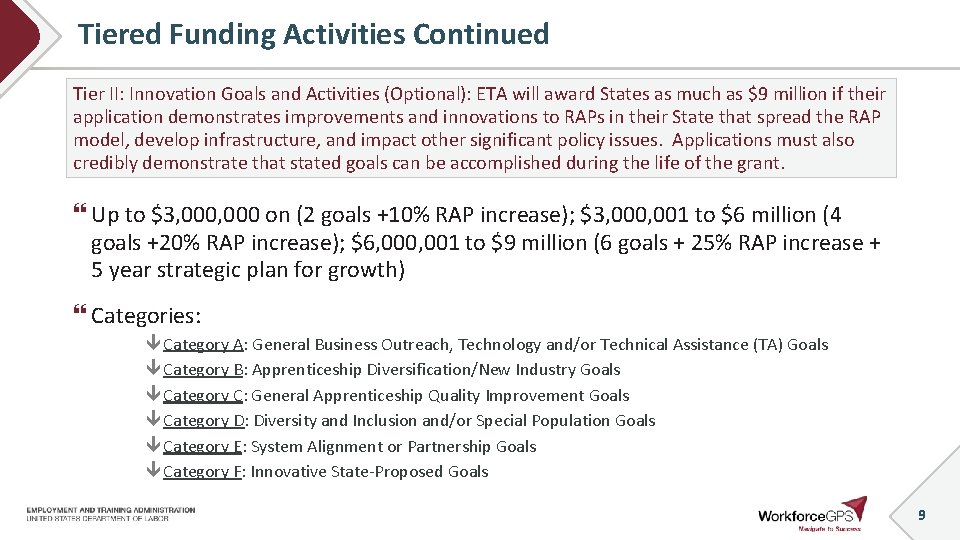
Tiered Funding Activities Continued Tier II: Innovation Goals and Activities (Optional): ETA will award States as much as $9 million if their application demonstrates improvements and innovations to RAPs in their State that spread the RAP model, develop infrastructure, and impact other significant policy issues. Applications must also credibly demonstrate that stated goals can be accomplished during the life of the grant. Up to $3, 000 on (2 goals +10% RAP increase); $3, 000, 001 to $6 million (4 goals +20% RAP increase); $6, 000, 001 to $9 million (6 goals + 25% RAP increase + 5 year strategic plan for growth) Categories: Category A: General Business Outreach, Technology and/or Technical Assistance (TA) Goals Category B: Apprenticeship Diversification/New Industry Goals Category C: General Apprenticeship Quality Improvement Goals Category D: Diversity and Inclusion and/or Special Population Goals Category E: System Alignment or Partnership Goals Category F: Innovative State-Proposed Goals 9
Role and Responsibilities Roles and Responsibilities between OGM, OA and Regional Offices 10

Employment and Training Administration (ETA) National Office Program Office – Office of Apprenticeship (OA) Grant Office – Office of Grants Management (OGM) Regional Office Federal Project Officer (FPO) Office of Apprenticeship (OA) Subject Matter Experts (SME) 11
National Office – OGM The office of Grants Management provides: Policy Guidance Provides fiscal and administrative requirements The Grant Officer performs official grant duties including: Reviews and executes grant modifications Ensures adherence to Federal Statues and Regulations, grant terms and conditions, fiscal and administrative requirements Maintains the official grant file (actions and documentations such as modifications, no-cost extensions) Is the official with final approval for grant activities when there is a question 12
National Office – OA The Program Office has several functions, including: Provides support to Federal Project Officers (FPOs) Provides clarification and guidance on ETA policy Provides Technical Assistance (with support from the external TA provider) Creates Learning Opportunities Collects and Analyzes performance data Provides Apprenticeship policy guidance in coordination with Regional OA Staff Develops and delivers performance guidance Reviews some grant modifications prior to OGM approval Periodically requests additional information about your grant Looks at nationwide program trends 13
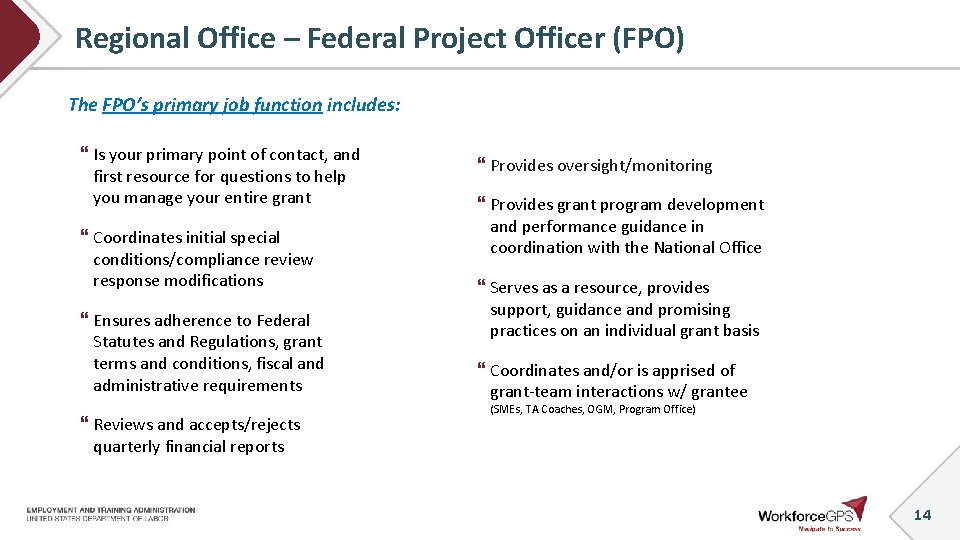
Regional Office – Federal Project Officer (FPO) The FPO’s primary job function includes: Is your primary point of contact, and first resource for questions to help you manage your entire grant Coordinates initial special conditions/compliance review response modifications Ensures adherence to Federal Statutes and Regulations, grant terms and conditions, fiscal and administrative requirements Reviews and accepts/rejects quarterly financial reports Provides oversight/monitoring Provides grant program development and performance guidance in coordination with the National Office Serves as a resource, provides support, guidance and promising practices on an individual grant basis Coordinates and/or is apprised of grant-team interactions w/ grantee (SMEs, TA Coaches, OGM, Program Office) 14
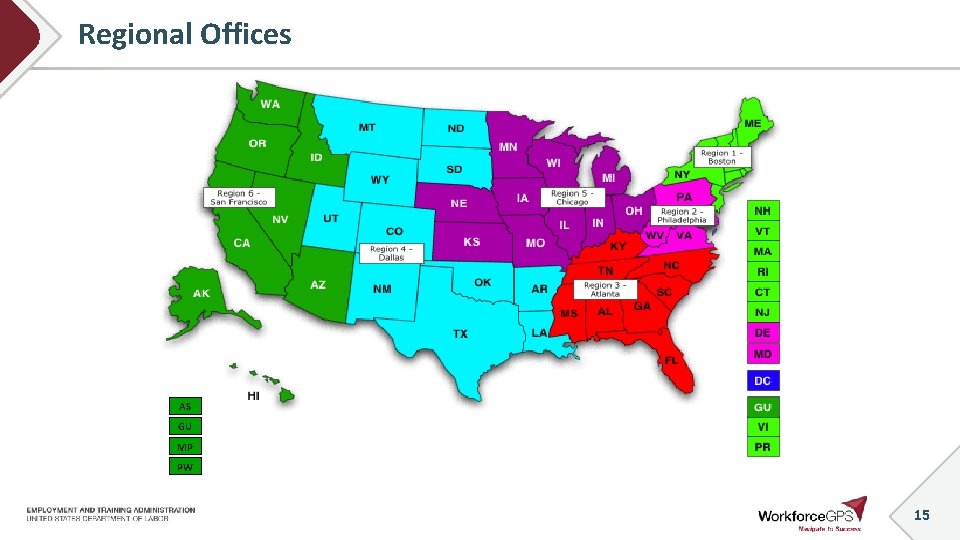
Regional Offices AS GU MP PW 15
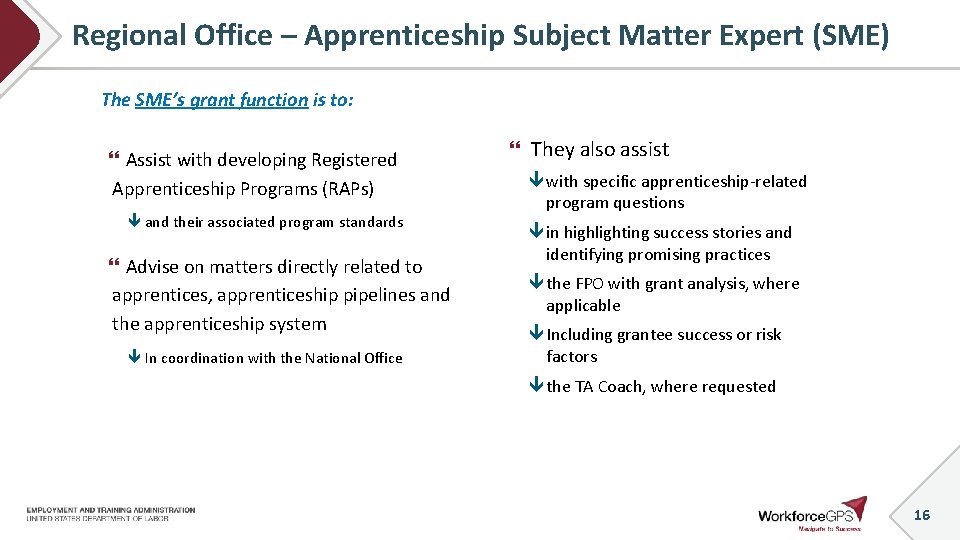
Regional Office – Apprenticeship Subject Matter Expert (SME) The SME’s grant function is to: Assist with developing Registered Apprenticeship Programs (RAPs) and their associated program standards Advise on matters directly related to apprentices, apprenticeship pipelines and the apprenticeship system In coordination with the National Office They also assist with specific apprenticeship-related program questions in highlighting success stories and identifying promising practices the FPO with grant analysis, where applicable Including grantee success or risk factors the TA Coach, where requested 16
Allowable Grant Activities Definition on Pre-Apprenticeship, Restrictions to RAP only, and Funding Restrictions 17
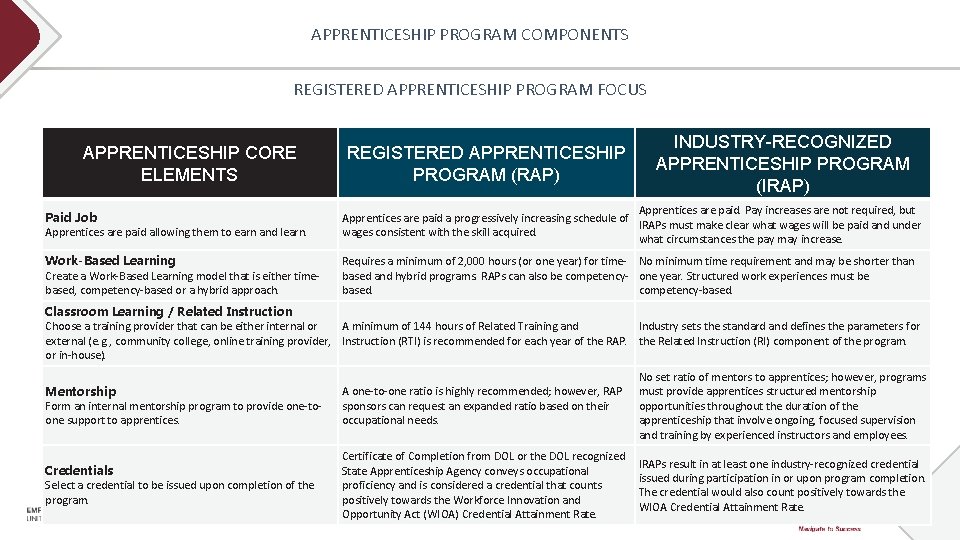
APPRENTICESHIP PROGRAM COMPONENTS REGISTERED APPRENTICESHIP PROGRAM FOCUS APPRENTICESHIP CORE ELEMENTS REGISTERED APPRENTICESHIP PROGRAM (RAP) INDUSTRY-RECOGNIZED APPRENTICESHIP PROGRAM (IRAP) Paid Job Apprentices are paid allowing them to earn and learn. Apprentices are paid. Pay increases are not required, but Apprentices are paid a progressively increasing schedule of IRAPs must make clear what wages will be paid and under wages consistent with the skill acquired. what circumstances the pay may increase. Work-Based Learning Create a Work-Based Learning model that is either timebased, competency-based or a hybrid approach. Requires a minimum of 2, 000 hours (or one year) for time- No minimum time requirement and may be shorter than based and hybrid programs. RAPs can also be competency- one year. Structured work experiences must be based. competency-based. Classroom Learning / Related Instruction Choose a training provider that can be either internal or A minimum of 144 hours of Related Training and Industry sets the standard and defines the parameters for external (e. g. , community college, online training provider, Instruction (RTI) is recommended for each year of the RAP. the Related Instruction (RI) component of the program. or in-house). Mentorship Form an internal mentorship program to provide one-toone support to apprentices. A one-to-one ratio is highly recommended; however, RAP sponsors can request an expanded ratio based on their occupational needs. No set ratio of mentors to apprentices; however, programs must provide apprentices structured mentorship opportunities throughout the duration of the apprenticeship that involve ongoing, focused supervision and training by experienced instructors and employees. Credentials Select a credential to be issued upon completion of the program. Certificate of Completion from DOL or the DOL recognized State Apprenticeship Agency conveys occupational proficiency and is considered a credential that counts positively towards the Workforce Innovation and Opportunity Act (WIOA) Credential Attainment Rate. IRAPs result in at least one industry-recognized credential issued during participation in or upon program completion. The credential would also count positively towards the WIOA Credential Attainment Rate.
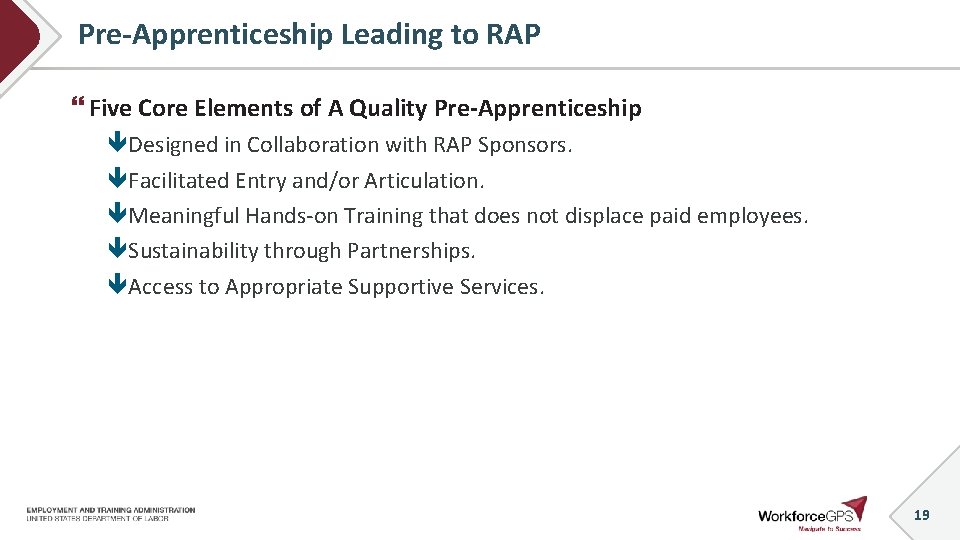
Pre-Apprenticeship Leading to RAP Five Core Elements of A Quality Pre-Apprenticeship Designed in Collaboration with RAP Sponsors. Facilitated Entry and/or Articulation. Meaningful Hands-on Training that does not displace paid employees. Sustainability through Partnerships. Access to Appropriate Supportive Services. 19
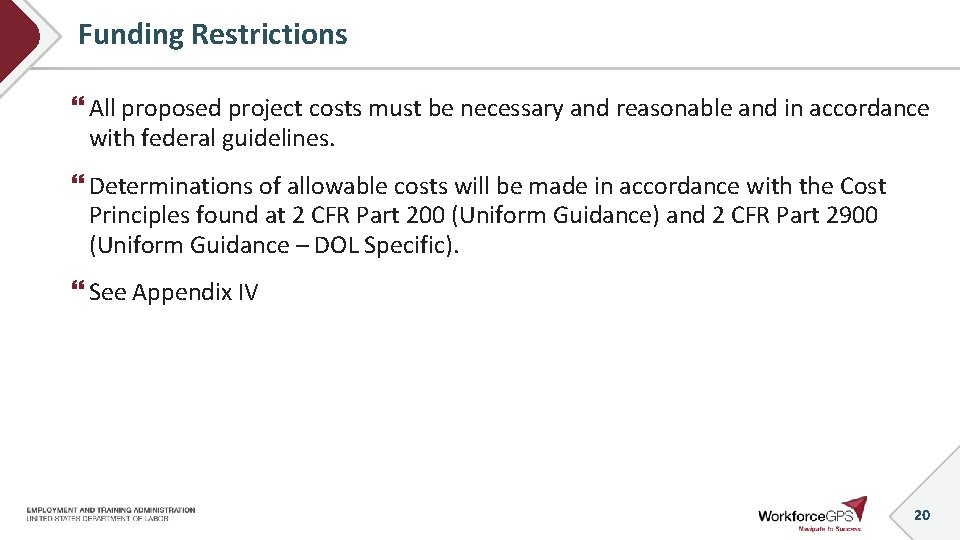
Funding Restrictions All proposed project costs must be necessary and reasonable and in accordance with federal guidelines. Determinations of allowable costs will be made in accordance with the Cost Principles found at 2 CFR Part 200 (Uniform Guidance) and 2 CFR Part 2900 (Uniform Guidance – DOL Specific). See Appendix IV 20
SAE, ASE, and SAE 2020 Similarities and Differences All State Grants with Same Overarching Purpose With Some Differences in Strategies and Implementation 21
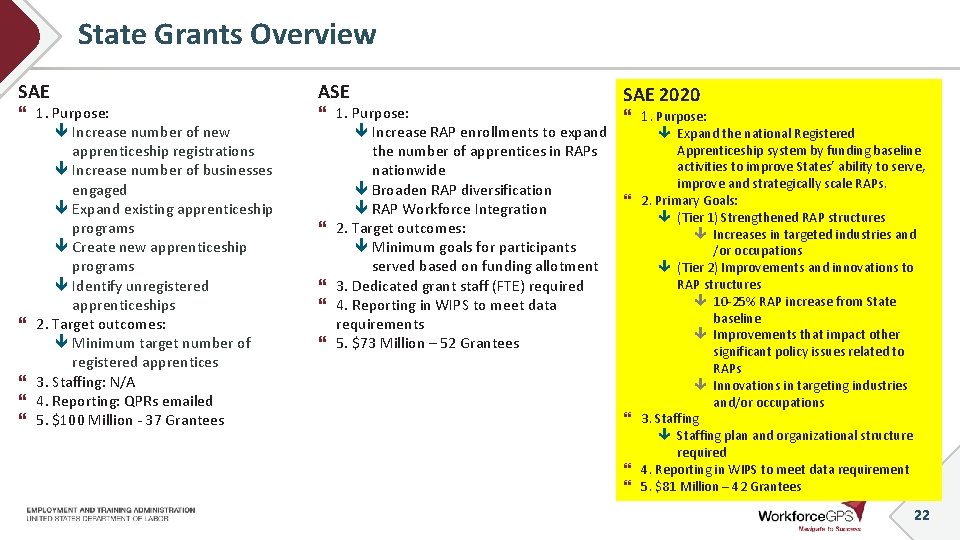
State Grants Overview SAE 1. Purpose: Increase number of new apprenticeship registrations Increase number of businesses engaged Expand existing apprenticeship programs Create new apprenticeship programs Identify unregistered apprenticeships 2. Target outcomes: Minimum target number of registered apprentices 3. Staffing: N/A 4. Reporting: QPRs emailed 5. $100 Million - 37 Grantees ASE SAE 2020 1. Purpose: Increase RAP enrollments to expand Expand the national Registered Apprenticeship system by funding baseline the number of apprentices in RAPs activities to improve States’ ability to serve, nationwide improve and strategically scale RAPs. Broaden RAP diversification 2. Primary Goals: RAP Workforce Integration (Tier 1) Strengthened RAP structures 2. Target outcomes: Increases in targeted industries and Minimum goals for participants /or occupations served based on funding allotment (Tier 2) Improvements and innovations to RAP structures 3. Dedicated grant staff (FTE) required 10 -25% RAP increase from State 4. Reporting in WIPS to meet data baseline requirements Improvements that impact other 5. $73 Million – 52 Grantees significant policy issues related to RAPs Innovations in targeting industries and/or occupations 3. Staffing plan and organizational structure required 4. Reporting in WIPS to meet data requirement 5. $81 Million – 42 Grantees 22
Reporting Requirements QFRs, QPRs, and DOL-Only PIRL 23
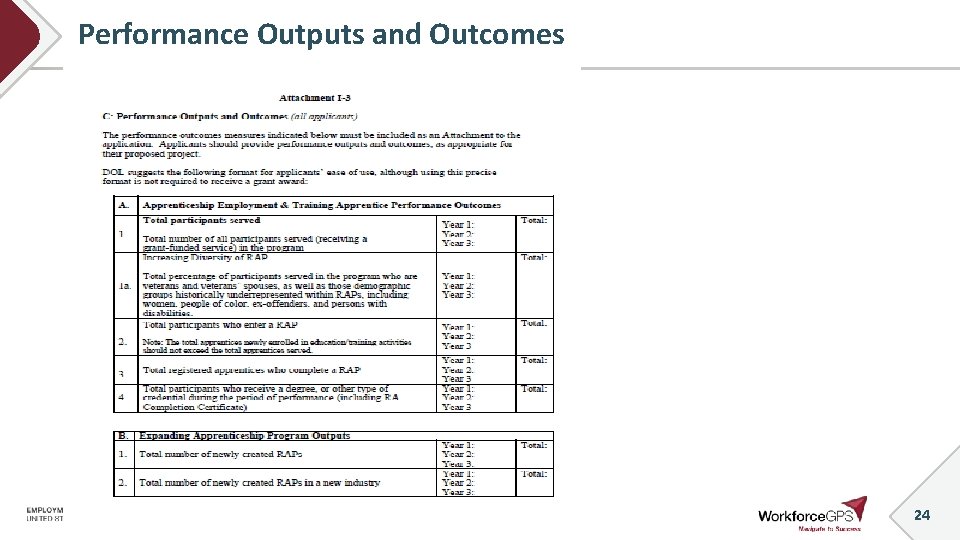
Performance Outputs and Outcomes 24
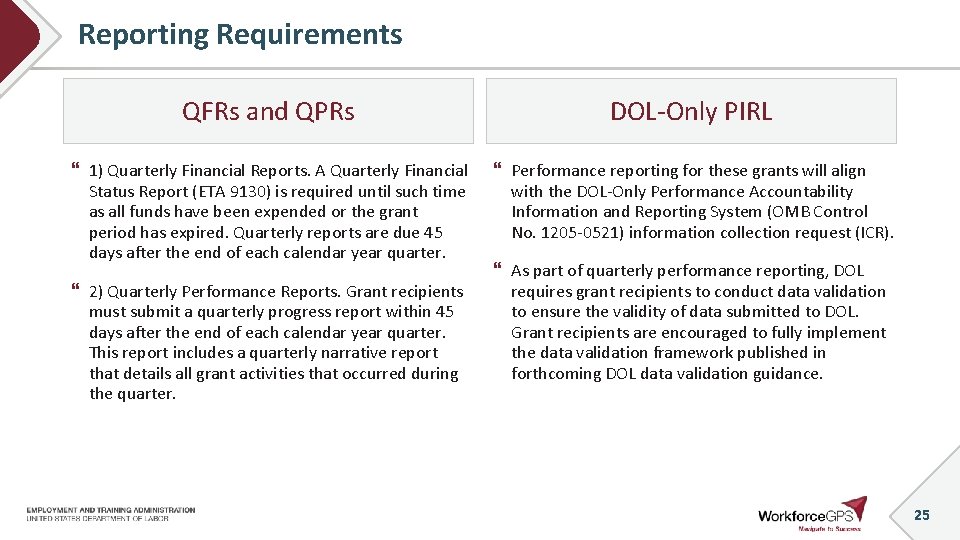
Reporting Requirements QFRs and QPRs DOL-Only PIRL 1) Quarterly Financial Reports. A Quarterly Financial Status Report (ETA 9130) is required until such time as all funds have been expended or the grant period has expired. Quarterly reports are due 45 days after the end of each calendar year quarter. Performance reporting for these grants will align with the DOL-Only Performance Accountability Information and Reporting System (OMB Control No. 1205 -0521) information collection request (ICR). 2) Quarterly Performance Reports. Grant recipients must submit a quarterly progress report within 45 days after the end of each calendar year quarter. This report includes a quarterly narrative report that details all grant activities that occurred during the quarter. As part of quarterly performance reporting, DOL requires grant recipients to conduct data validation to ensure the validity of data submitted to DOL. Grant recipients are encouraged to fully implement the data validation framework published in forthcoming DOL data validation guidance. 25
Technical Assistance TA Contractor – Maher and Maher 26
Technical Assistance – Maher & Maher and Workforce. GPS Maher & Maher will continue to provide technical assistance (TA) to state grants under SAE 2020. Maher & Maher TA will include: Subject matter expertise and customized support One-on-one coaching by a dedicated TA coach who will provide grantees with personalized support to address challenges Individual or small-group conversations with experts in the field designed to inform strategy and address challenges Intensive TA provided on-site or virtually by coaches and subject matter experts Community of Practice (COP): Provides an on-line collection of apprenticeship information, tools, resources, and best practices. Apprenticeship Connections Monthly Newsletter: Provides shared resources, best practices, grants management tools, and announces upcoming events. 27
Grant Award Package & Modifications 28
The Grant Award Package Grant Award Letter Grant Agreement: Special Conditions of Award Page Signature Page / Notice of Award (NOA) Terms and Conditions Application for Federal Assistance Budget Statement of Work (SOW) Indirect Cost Rate Agreement (if applicable) 29
Grant Award Letter Acknowledgement of Award Payment Management System – Information and forms on www. doleta. gov/grants under Manage your Awarded Grant ETA’s on-line Grantee Financial Reporting System – ETA 9130 – Information to access system on www. doleta. gov/grants under Manage your Awarded Grant Passwords/PINs are sent separately after supplying the necessary information Once you receive this please DO NOT LOSE IT! 30
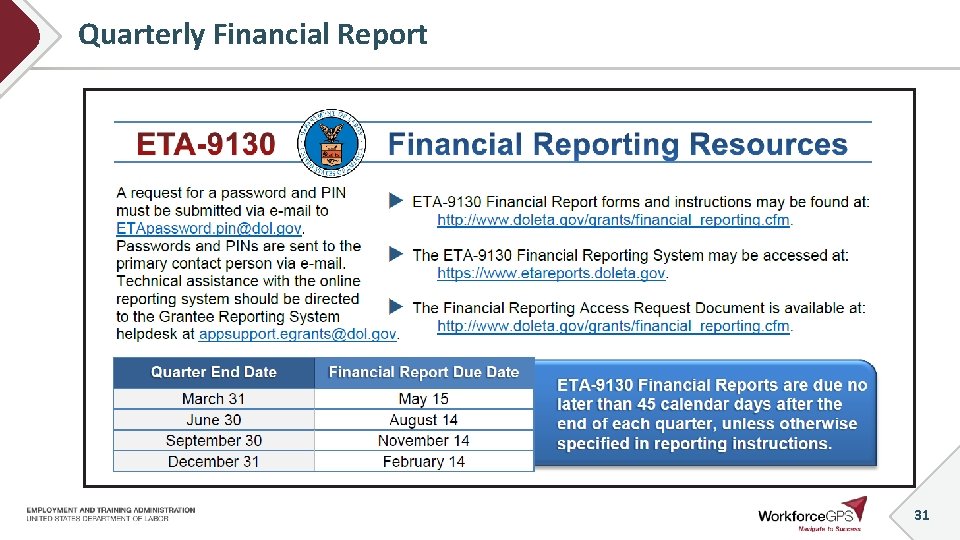
Quarterly Financial Report 31
Grantee Handbook A general resource designed to orient grantees to the grant process in ETA. It contains pertinent information grantees need to know regarding the goals and expectations for managing ETA grants. 32
Grant Agreement Notice of Award Project Title – Apprenticeship State Expansion Grant Awardees' Identifying Information Federal Award Identification Number (FAIN) – Grant Number # AP-33 XXX-19 -60 -A-XX Period of Performance – July 1, 2020 to June 30, 2023 Award Amount Uniform Administrative Requirements Cost Principles Signatures 33
Notice of Award Regulations Ø 2 CFR Part 200 (Uniform Guidance) o Uniform Administrative Requirements o Cost Principles, and o Audit Requirements for Federal Awards Ø 2 CFR Part 2900 o DOL Exceptions to the Uniform Guidance Ø Terms and Conditions of Award 34
Budget Review and Statement of Work Review of Budget Documents Program Compliance Notification Letter 35
Grant Agreement Conditions of Award & Terms Order of Precedence TEGL-17 -18 and Amendments (incorporated by reference) 36
Grant Agreement Terms • FPO Contact Information • Indirect Cost Rates • Audit Requirements • Pre-Award Costs • Reporting Requirements • Procurement • Intellectual Property Rights 37
Terms to Note Ø 12. E: EQUIPMENT v Equipment purchases are not an allowable cost for these grants Ø 12. F: FEDERAL FUNDING ACCOUNTABILITY AND TRANSPARENCY ACT (FFATA) v A prime grantee (these grants) must report any sub-awards (sub-grants and/or contracts) which are $25, 000 or more through the FFATA Subaward Reporting System (FSRS) Ø 12. I: PERSONALLY IDENTIFIABLE INFORMATION v Award recipients must meet the requirements in Training and Employment Guidance letter (TEGL) 39 -11, Guidance on the Handling and Protection of Personally Identifiable Information (PII)), found at http: //wdr. doleta. gov/directives/corr_doc. cfm? DOCN=7872 38
Terms to Note Ø 14. L: RESTRICTION ON LOBBYING /ADVOCACY v “… no federal funds may be used by a grant recipient, other than for normal and recognized executivelegislative relationships, to engage in lobbying or advocacy activities related to the enactment of federal, state, or local legislation, regulation, appropriations, order, or other administrative action, except in presentation to Congress or a State or local legislature itself …” Ø 14. O: SALARY AND BONUS LIMITATIONS v Places a limit on the amount of Federal funds which can be paid individuals either as direct costs or as indirect costs, at a rate in excess of Executive Level II. Ø 14. G: VETERANS’ PRIORITY PROVISIONS v The Jobs for Veterans Act (Public Law 107 -288) requires recipients to provide priority service to veterans and spouses of certain veterans 39
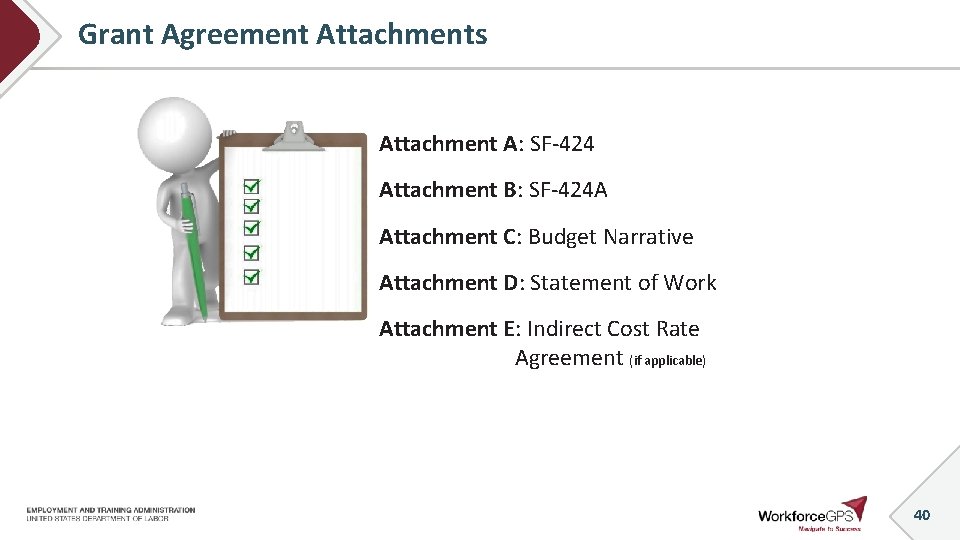
Grant Agreement Attachments Attachment A: SF-424 Attachment B: SF-424 A Attachment C: Budget Narrative Attachment D: Statement of Work Attachment E: Indirect Cost Rate Agreement (if applicable) 40
Budget and Statement of Work Budget Information – SF-424 A – Budget Narrative Grantee’s original proposal – Project Narrative – Timeline/Workplan – Performance Outcome Measures Table – Governor’s Letter – Project Attestation Confirmation 41
Indirect Cost Rate Agreement • Only applicable to those claiming indirect costs • If grantee is claiming indirect costs but did not provide agreement, placed on 90 -day temporary rate • Applicants missing indirect cost rate or CAP agreements (or submitting expired ones) are limited to lesser of either total claimed indirect costs or 10% of total Personnel budget 42
Grant Modifications What is a modification? Why do a modification? What are modification indicators? FPO Modification Analysis Reasonable Performance Best interest of the government 43
What is a Grant Modification? Mechanism to CHANGE the Terms of the Grant Agreement 44
Why Do A Modification? Change of Scope {Very rare & only minor changes will be considered} • Program Design üService Area üChange in Partners üKey Personnel Changes • Performance Outcomes üOutcome Measures 45
Why Do A Modification? • Budget Re-alignment üTransfer of funds among direct cost categories if cumulative amount of such transfer exceeds or expected to exceed 10% of the total budget • Change in Period of Performance • Change Indirect Cost Rate • Change Authorized Representative 46
FPO Modification Analysis • Grant Quality üServices üStaffing • Grant Efficiency üTimely üCost Effective • Grant Performance üEnrollments üExpenditures 47
Required Documentation for Modification Requests • Must be submitted with letter on Organization’s Letterhead • Must be signed by the Authorized Representative • Provide the purpose • Why it’s necessary • How the change will benefit the program • Appropriate documentation to support Modification 48
How to Submit a Modification? ALL requests for modifications should be submitted to your FPO See the grantee hand book for details The FPO will review and 1) recommend approval to the Grant Officer; or 2) request revisions; or 3) recommend another course of action 49
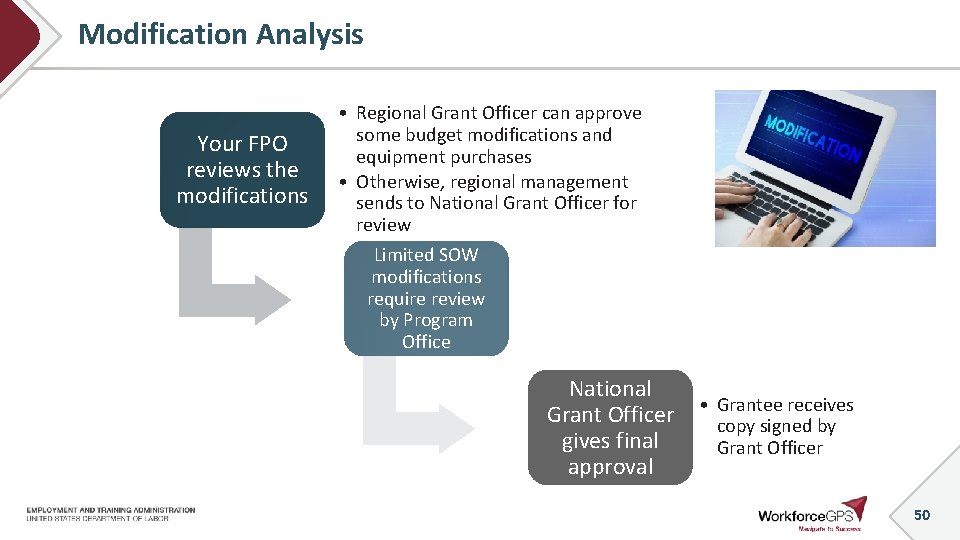
Modification Analysis Your FPO reviews the modifications • Regional Grant Officer can approve some budget modifications and equipment purchases • Otherwise, regional management sends to National Grant Officer for review Limited SOW modifications require review by Program Office National Grant Officer • Grantee receives copy signed by gives final Grant Officer approval 50
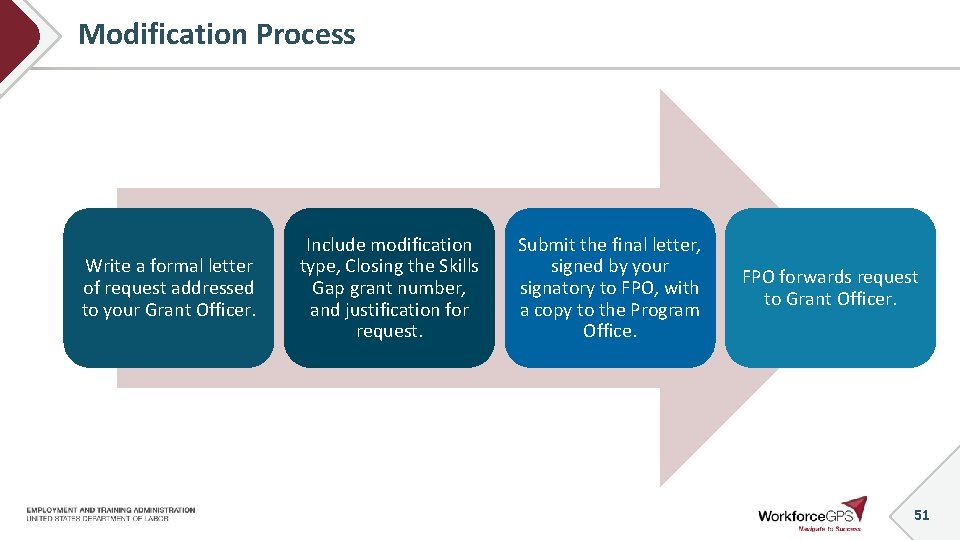
Modification Process Write a formal letter of request addressed to your Grant Officer. Include modification type, Closing the Skills Gap grant number, and justification for request. Submit the final letter, signed by your signatory to FPO, with a copy to the Program Office. FPO forwards request to Grant Officer. 51
ETA Evaluation As a condition of grant award, grantees are required to participate in an evaluation, if undertaken by DOL. The evaluation may include an implementation assessment across grantees, an impact and/or outcomes analysis of all or selected sites within or across grantees, and a benefit/cost analysis or assessment of return on investment. 52
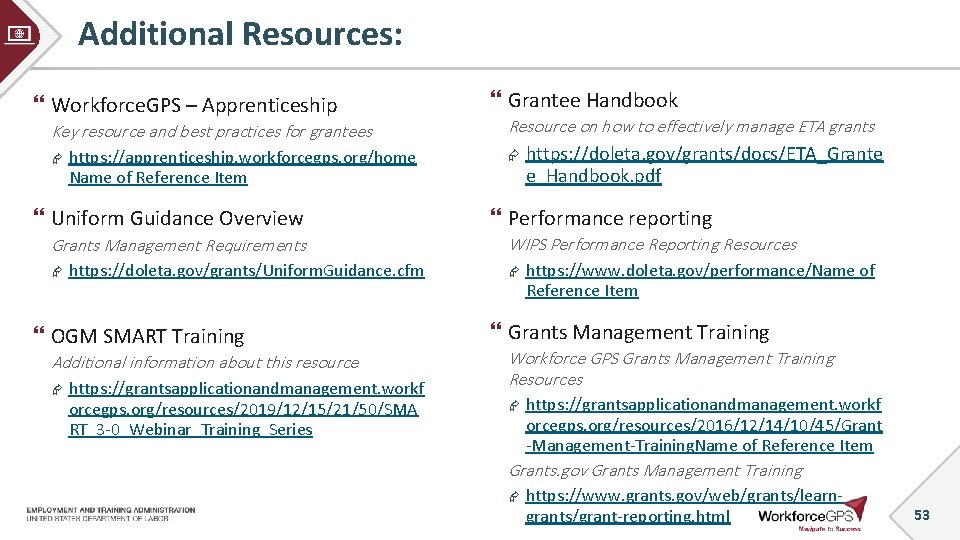
Additional Resources: Grantee Handbook Workforce. GPS – Apprenticeship Key resource and best practices for grantees https: //apprenticeship. workforcegps. org/home Name of Reference Item Uniform Guidance Overview Grants Management Requirements https: //doleta. gov/grants/Uniform. Guidance. cfm OGM SMART Training Additional information about this resource https: //grantsapplicationandmanagement. workf orcegps. org/resources/2019/12/15/21/50/SMA RT_3 -0_Webinar_Training_Series Resource on how to effectively manage ETA grants https: //doleta. gov/grants/docs/ETA_Grante e_Handbook. pdf Performance reporting WIPS Performance Reporting Resources https: //www. doleta. gov/performance/Name of Reference Item Grants Management Training Workforce GPS Grants Management Training Resources https: //grantsapplicationandmanagement. workf orcegps. org/resources/2016/12/14/10/45/Grant -Management-Training. Name of Reference Item Grants. gov Grants Management Training https: //www. grants. gov/web/grants/learngrants/grant-reporting. html 53

Any Questions? 54
Contact Us Marcia Hampton Grants Investment Supervisor USDOL, ETA, DWOI Hampton. Marcia@dol. gov 202. 693. 2626 Brinda Ruggles Grant Officer USDOL, ETA, OGM Ruggles. Brinda@dol. gov 202. 693. 3437 Michelle Mills Project Manager USDOL, ETA, DWOI Mills. michelle. v@dol. gov 202. 693. 3998 55
Thank You! Grant related questions? Email: Apprenticeship. grants@dol. gov Need help? Email: Support@workforce. GPS. org
- Slides: 56