
State and Local Tax 2017 Developments Including Quill
























- Slides: 196
State and Local Tax 2017 Developments, Including Quill TEI Denver Chapter May 24, 2017 Jeff Friedman Partner Michele Borens Partner © 2017 Eversheds Sutherland (US) LLP All Rights Reserved. This communication is for general informational purposes only and is not intended to constitute legal advice or a recommended course of action in any given situation. This communication is not intended to be, and should not be, relied upon by the recipient in making decisions of a legal nature with respect to the issues discussed herein. The recipient is encouraged to consult independent counsel before making any decisions or taking any action concerning the matters in this communication. This communication does not create an attorney-client relationship between Eversheds Sutherland (US) LLP and the recipient. Eversheds Sutherland (US) LLP is part of a global legal practice, operating through various separate and distinct legal entities, under Eversheds Sutherland. For a full description of the structure and a list of offices, please visit www. eversheds-sutherland. com.
Agenda − U. S. Supreme Court − Physical Presence Under Fire − Other Nexus Controversies − Transfer Pricing − Alternative Apportionment − Apportionment - Sourcing Developments − Apportionment – Other Developments − Deductions − State Tax Implications of US Federal Tax Reform Eversheds Sutherland
U. S. Supreme Court Eversheds Sutherland
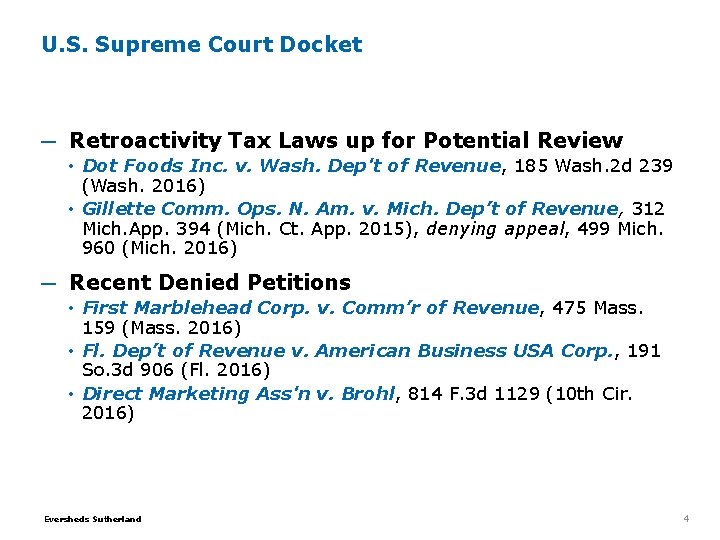
U. S. Supreme Court Docket ─ Retroactivity Tax Laws up for Potential Review • Dot Foods Inc. v. Wash. Dep't of Revenue, 185 Wash. 2 d 239 (Wash. 2016) • Gillette Comm. Ops. N. Am. v. Mich. Dep’t of Revenue, 312 Mich. App. 394 (Mich. Ct. App. 2015), denying appeal, 499 Mich. 960 (Mich. 2016) ─ Recent Denied Petitions • First Marblehead Corp. v. Comm’r of Revenue, 475 Mass. 159 (Mass. 2016) • Fl. Dep’t of Revenue v. American Business USA Corp. , 191 So. 3 d 906 (Fl. 2016) • Direct Marketing Ass'n v. Brohl, 814 F. 3 d 1129 (10 th Cir. 2016) Eversheds Sutherland 4
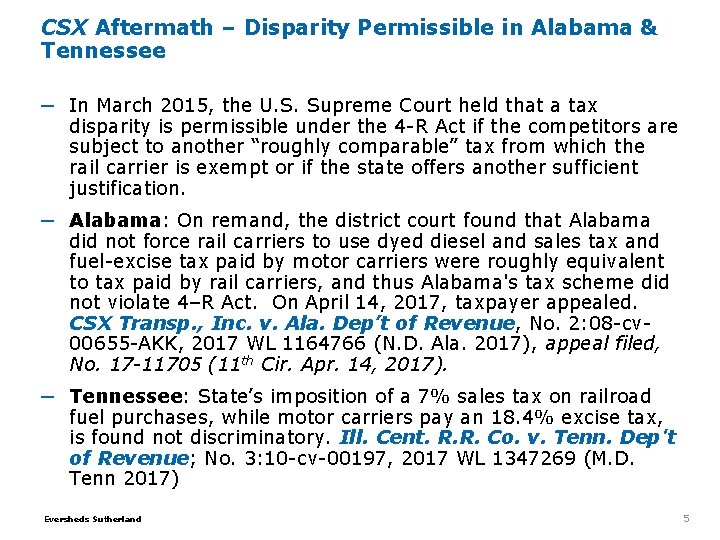
CSX Aftermath – Disparity Permissible in Alabama & Tennessee ─ In March 2015, the U. S. Supreme Court held that a tax disparity is permissible under the 4 -R Act if the competitors are subject to another “roughly comparable” tax from which the rail carrier is exempt or if the state offers another sufficient justification. ─ Alabama: On remand, the district court found that Alabama did not force rail carriers to use dyed diesel and sales tax and fuel-excise tax paid by motor carriers were roughly equivalent to tax paid by rail carriers, and thus Alabama's tax scheme did not violate 4–R Act. On April 14, 2017, taxpayer appealed. CSX Transp. , Inc. v. Ala. Dep’t of Revenue, No. 2: 08 -cv 00655 -AKK, 2017 WL 1164766 (N. D. Ala. 2017), appeal filed, No. 17 -11705 (11 th Cir. Apr. 14, 2017). ─ Tennessee: State’s imposition of a 7% sales tax on railroad fuel purchases, while motor carriers pay an 18. 4% excise tax, is found not discriminatory. Ill. Cent. R. R. Co. v. Tenn. Dep't of Revenue; No. 3: 10 -cv-00197, 2017 WL 1347269 (M. D. Tenn 2017) Eversheds Sutherland 5
Taxpayers’ 1 st Amendment Right to Pass Through Fees Expressions Hair Design v. Schneiderman, 137 S. Ct. 1144 (Mar. 29, 2017) ─ On March 29, 2017, in a unanimous ruling, the U. S. Supreme Court ruled that a New York statute, which prohibits identifying a surcharge to customers for credit card payments, regulates speech and is therefore subject to heightened scrutiny. ─ Case remanded to the U. S. Court of Appeals for the Second Circuit to determine whether New York’s statute violates the First Amendment. ─ Decision likely implicates state and local tax laws that either prohibit, or require, taxpayers to identify taxes and fees in customer invoices. Eversheds Sutherland 6
Physical Presence Under Fire Eversheds Sutherland
Physical Presence Under Fire Direct Marketing Association v. Brohl, 135 S. Ct. 1124 (2015) ─ Direct Marketing Association (DMA) asked for an injunction to prevent enforcement of Colorado’s notice and reporting obligations for out-of-state retailers. ─ In 2012, the federal district court in Colorado declared the law unconstitutional and issued a permanent injunction. ─ In 2013, the 10 th Circuit Court of Appeals reversed the injunction and held that the Tax Injunction Act (TIA) bars federal jurisdiction. ─ In 2015, the US Supreme Court held that the notice and reporting requirements do not violate TIA. ─ In 2016, the 10 th Circuit Court of Appeals held that the notice and reporting requirements did not violate the Commerce Clause. ─ On December 12, 2016, the U. S. Supreme Court denied review. ─ On February 22, 2017, the parties settled the matter, allowing the state to enforce the reporting requirements beginning July 1, 2017. Eversheds Sutherland 8
Physical Presence Under Fire Justice Kennedy’s Concurrence ─ In DMA, Justice Anthony Kennedy went out of his way to invite reconsideration of Quill. • “Given these changes in technology and consumer sophistication, it is unwise to delay any longer a reconsideration of the Court’s holding in Quill. A case questionable even when decided, Quill now harms States to a degree far greater than could have been anticipated earlier…. It should be left in place only if a powerful showing can be made that its rationale is still correct. ” ─ In response, states have taken legislative efforts to force remote vendors to collect sales tax. Eversheds Sutherland 9
Physical Presence Under Fire Statutory and Regulatory Challenges ─ South Dakota’s Statutory Challenge • S. B. 106 asserts nexus against remote sellers with $100, 000 gross revenue from annual sales in the state or 200 separate transactions involving delivery into the state. • Positioned for an expedited appeals process. • South Dakota v. Wayfair, Inc. , et al. , No. 32 CIV 16 -00092 (6 th Judicial Cir. , S. D. 2017) • State trial court found the remote sales tax law to be unconstitutional under Quill. • Am. Catalog Mailers Ass’n v. Gerlach, No. 32 CIV 16 -___ (6 th Judicial Cir. , S. D. ) ─ Alabama’s Regulatory Challenge • Rule 810 -6 -2 -. 90. 03 asserts nexus against remote sellers with at least $250, 000 in annual sales in the state. • Newegg Inc. v. Ala. Dep’t of Revenue, No. S 16 -613 (Ala. Tax Tribunal) Eversheds Sutherland 10
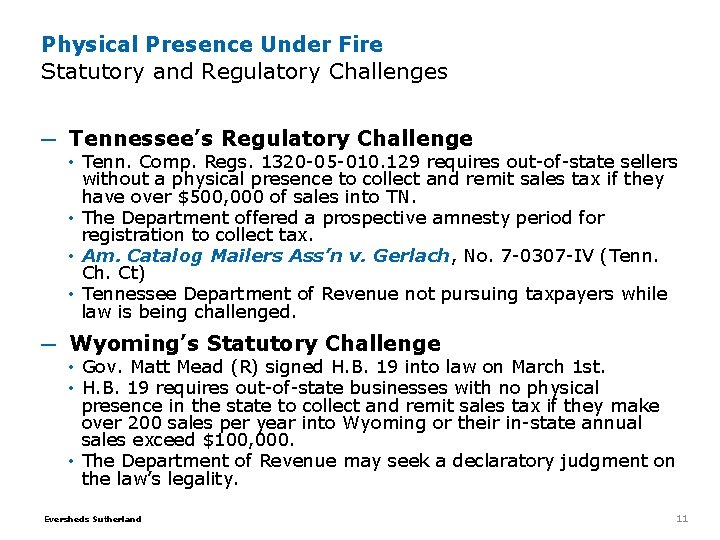
Physical Presence Under Fire Statutory and Regulatory Challenges ─ Tennessee’s Regulatory Challenge • Tenn. Comp. Regs. 1320 -05 -010. 129 requires out-of-state sellers without a physical presence to collect and remit sales tax if they have over $500, 000 of sales into TN. • The Department offered a prospective amnesty period for registration to collect tax. • Am. Catalog Mailers Ass’n v. Gerlach, No. 7 -0307 -IV (Tenn. Ch. Ct) • Tennessee Department of Revenue not pursuing taxpayers while law is being challenged. ─ Wyoming’s Statutory Challenge • Gov. Matt Mead (R) signed H. B. 19 into law on March 1 st. • H. B. 19 requires out-of-state businesses with no physical presence in the state to collect and remit sales tax if they make over 200 sales per year into Wyoming or their in-state annual sales exceed $100, 000. • The Department of Revenue may seek a declaratory judgment on the law’s legality. Eversheds Sutherland 11
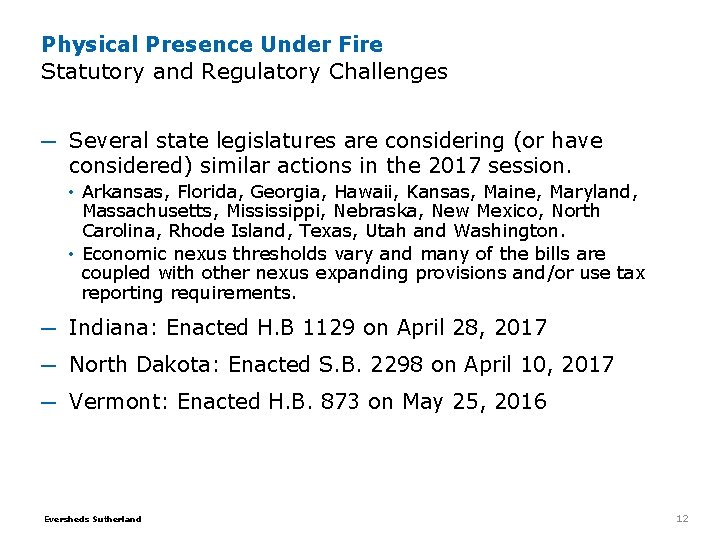
Physical Presence Under Fire Statutory and Regulatory Challenges ─ Several state legislatures are considering (or have considered) similar actions in the 2017 session. • Arkansas, Florida, Georgia, Hawaii, Kansas, Maine, Maryland, Massachusetts, Mississippi, Nebraska, New Mexico, North Carolina, Rhode Island, Texas, Utah and Washington. • Economic nexus thresholds vary and many of the bills are coupled with other nexus expanding provisions and/or use tax reporting requirements. ─ Indiana: Enacted H. B 1129 on April 28, 2017 ─ North Dakota: Enacted S. B. 2298 on April 10, 2017 ─ Vermont: Enacted H. B. 873 on May 25, 2016 Eversheds Sutherland 12
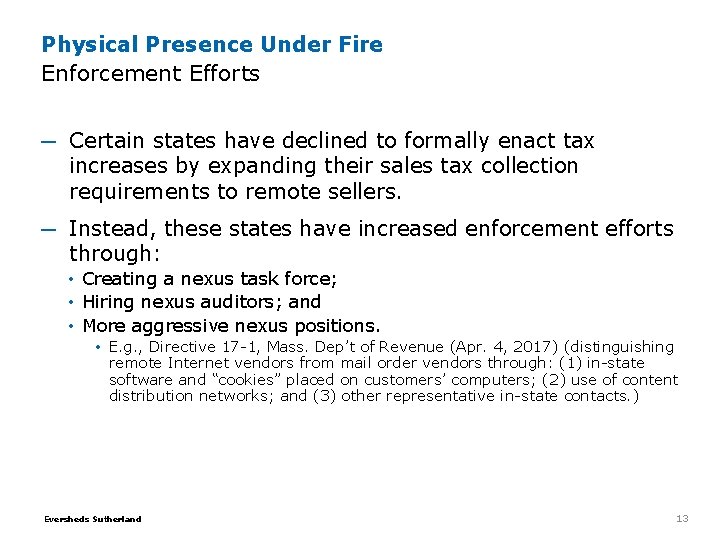
Physical Presence Under Fire Enforcement Efforts ─ Certain states have declined to formally enact tax increases by expanding their sales tax collection requirements to remote sellers. ─ Instead, these states have increased enforcement efforts through: • Creating a nexus task force; • Hiring nexus auditors; and • More aggressive nexus positions. • E. g. , Directive 17 -1, Mass. Dep’t of Revenue (Apr. 4, 2017) (distinguishing remote Internet vendors from mail order vendors through: (1) in-state software and “cookies” placed on customers’ computers; (2) use of content distribution networks; and (3) other representative in-state contacts. ) Eversheds Sutherland 13
Other Nexus Controversies Eversheds Sutherland
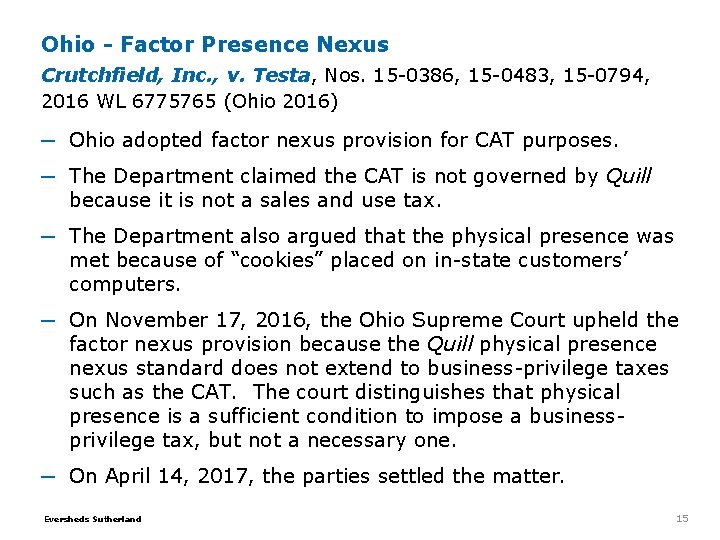
Ohio - Factor Presence Nexus Crutchfield, Inc. , v. Testa, Nos. 15 -0386, 15 -0483, 15 -0794, 2016 WL 6775765 (Ohio 2016) ─ Ohio adopted factor nexus provision for CAT purposes. ─ The Department claimed the CAT is not governed by Quill because it is not a sales and use tax. ─ The Department also argued that the physical presence was met because of “cookies” placed on in-state customers’ computers. ─ On November 17, 2016, the Ohio Supreme Court upheld the factor nexus provision because the Quill physical presence nexus standard does not extend to business-privilege taxes such as the CAT. The court distinguishes that physical presence is a sufficient condition to impose a businessprivilege tax, but not a necessary one. ─ On April 14, 2017, the parties settled the matter. Eversheds Sutherland 15
Washington – No Transactional Nexus Needed Avnet, Inc. v. Wash. Dep’t of Revenue, 187 Wash. 2 d 44 (Wash. 2016) ─ The Washington Supreme Court held that drop shipments and sales from out-of-state are subject to the Washington business and occupation (B&O) tax even when an in-state office was not involved in placing or completing the sales. ─ The taxpayer sold products through its Arizona headquarters and its regional sales offices, including one in Washington, but excluded its national and drop-shipped sales from its B&O tax liabilities. ─ The dormant Commerce Clause was satisfied because the Washington employees’ activities (i. e. , providing Washington market intelligence, meeting with sales teams and suppliers, and working with customers for product improvement) were associated with establishing and maintaining a Washington market for the sale of its products. Eversheds Sutherland 16
Iowa – Nexus Creating Activities Myria Holdings Inc. v. Iowa Dep’t of Revenue, No. 15 -0296, 2017 WL 1103175 (Iowa 2017) ─ On March 24, 2017, the Iowa Supreme Court found that a group's parent company could not be joined in the filing of a consolidated Iowa income tax return because it lacked nexus with Iowa. ─ In addressing the creation of nexus, the court determined that: • The parent company’s management and administration activities performed on behalf of the subsidiaries doing business in Iowa do not create nexus; and • Ownership of subsidiary stock and money from reimbursements fell within the ownership and control safe harbor. Eversheds Sutherland 17
Oregon – No Physical Presence Needed Capital One Auto Fin. Inc. v. Or. Dep’t. of Revenue, No. TC 5197, 2016 WL 7429522 (Or. Tax Ct. 2016) ─ The Oregon Tax Court held that physical presence in Oregon is not required to be subject to the state's corporate income tax or corporate excise tax. ─ The court found that two banking subsidiaries have substantial nexus in the state based on their extensive economic activities - lending money to and charging fees from Oregon customers through the banking subsidiaries’ credit cards, consumer loans, and deposit products. Eversheds Sutherland 18
Maryland – Enterprise Dependency = Nexus Petition of Staples Inc. and Staples the Office Superstore, LLC, and the Decision of the Md. Tax Court, No. C-02 -CV-15002009 (Md. Cir. Ct. 2016) ─ Affirmed that enterprise dependency with in-state affiliates created nexus for out-of-state entities. ─ Affirmed the Comptroller’s application of an alternative apportionment formula because the out-of-state entities failed to carry their burden of proving that the Comptroller’s non-statutory formula “produced a tax liability out of all appropriate proportion to the business transacted in Maryland or led to a ‘grossly distorted result. ’” • Comptroller used an alternative apportionment method identical to used in Gore. Eversheds Sutherland 19
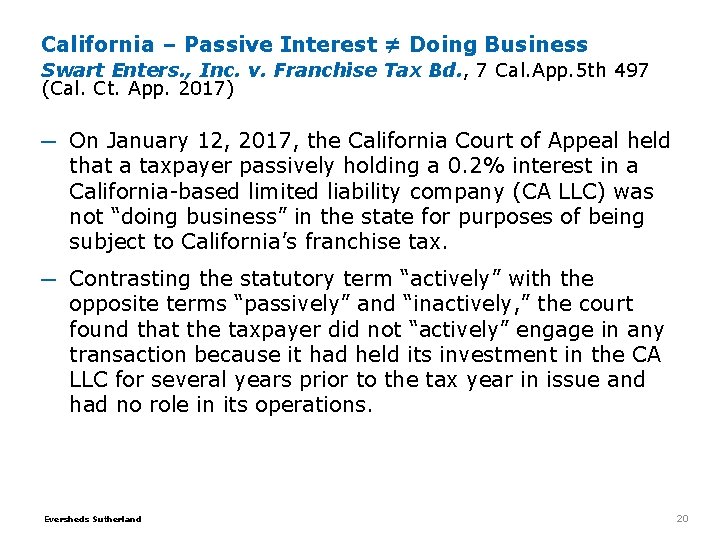
California – Passive Interest ≠ Doing Business Swart Enters. , Inc. v. Franchise Tax Bd. , 7 Cal. App. 5 th 497 (Cal. Ct. App. 2017) ─ On January 12, 2017, the California Court of Appeal held that a taxpayer passively holding a 0. 2% interest in a California-based limited liability company (CA LLC) was not “doing business” in the state for purposes of being subject to California’s franchise tax. ─ Contrasting the statutory term “actively” with the opposite terms “passively” and “inactively, ” the court found that the taxpayer did not “actively” engage in any transaction because it had held its investment in the CA LLC for several years prior to the tax year in issue and had no role in its operations. Eversheds Sutherland 20
Transfer Pricing Eversheds Sutherland
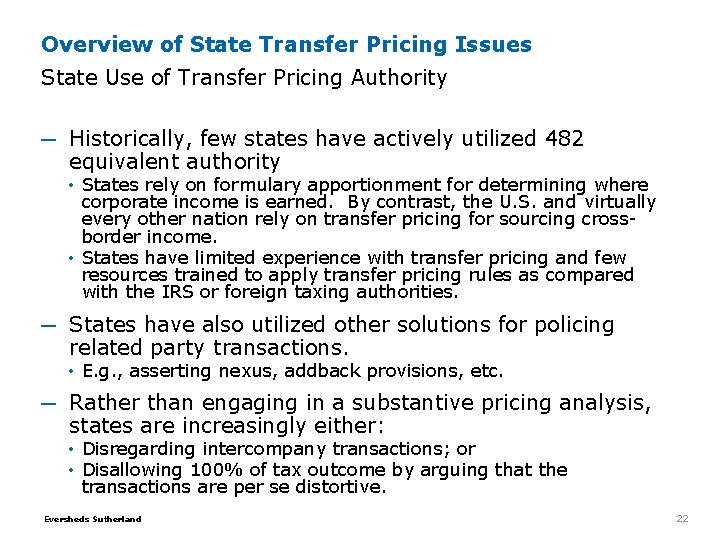
Overview of State Transfer Pricing Issues State Use of Transfer Pricing Authority ─ Historically, few states have actively utilized 482 equivalent authority • States rely on formulary apportionment for determining where corporate income is earned. By contrast, the U. S. and virtually every other nation rely on transfer pricing for sourcing crossborder income. • States have limited experience with transfer pricing and few resources trained to apply transfer pricing rules as compared with the IRS or foreign taxing authorities. ─ States have also utilized other solutions for policing related party transactions. • E. g. , asserting nexus, addback provisions, etc. ─ Rather than engaging in a substantive pricing analysis, states are increasingly either: • Disregarding intercompany transactions; or • Disallowing 100% of tax outcome by arguing that the transactions are per se distortive. Eversheds Sutherland 22
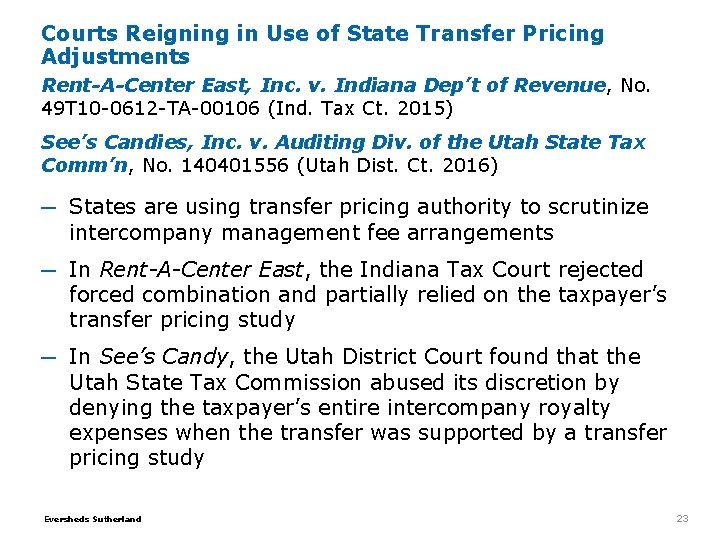
Courts Reigning in Use of State Transfer Pricing Adjustments Rent-A-Center East, Inc. v. Indiana Dep’t of Revenue, No. 49 T 10 -0612 -TA-00106 (Ind. Tax Ct. 2015) See’s Candies, Inc. v. Auditing Div. of the Utah State Tax Comm’n, No. 140401556 (Utah Dist. Ct. 2016) ─ States are using transfer pricing authority to scrutinize intercompany management fee arrangements ─ In Rent-A-Center East, the Indiana Tax Court rejected forced combination and partially relied on the taxpayer’s transfer pricing study ─ In See’s Candy, the Utah District Court found that the Utah State Tax Commission abused its discretion by denying the taxpayer’s entire intercompany royalty expenses when the transfer was supported by a transfer pricing study Eversheds Sutherland 23
Alternative Apportionment Eversheds Sutherland
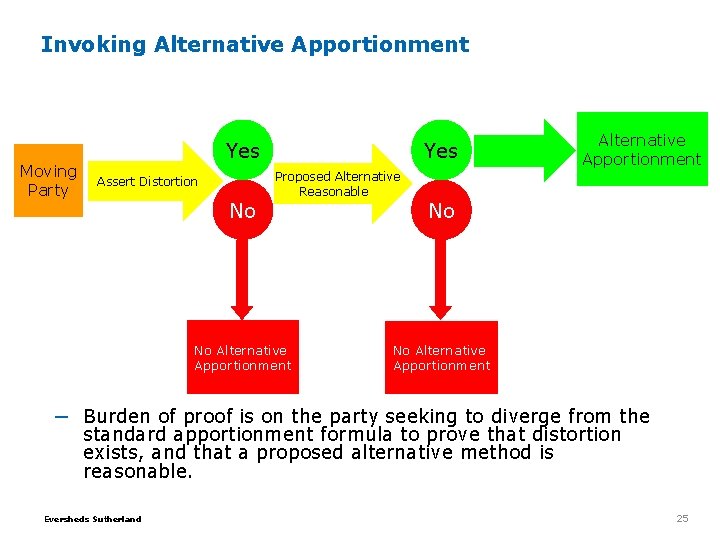
Invoking Alternative Apportionment Moving Party Yes Assert Distortion No Yes Proposed Alternative Reasonable No Alternative Apportionment No No Alternative Apportionment ─ Burden of proof is on the party seeking to diverge from the standard apportionment formula to prove that distortion exists, and that a proposed alternative method is reasonable. Eversheds Sutherland 25
Massachusetts – Burden of Proposed Amendments to Alternative Apportionment Regulation ─ Massachusetts Department of Revenue Released Proposed Amendments to Alternative Apportionment Regulation, 830 CMR 63. 42. 1, in December 2016. ─ Timing • Taxpayer must request alternative apportionment at the time it files its tax return but must pay tax using statutory method and wait for Commissioner's subsequent determination with respect to the application. • If the application is granted, taxpayer must seek a refund • Application deemed denied after 9 months. • Commissioner will look at overall combined group’s apportioned income in determining whether individual member entitled to alternative apportionment. ─ Disparate burdens of proof • Taxpayer must show by clear and cogent evidence that statutory method does not fairly reflect its in-state business activities. • Commissioner uses his judgment in deciding whether to grant taxpayer’s application but is otherwise not subject to any standards. Eversheds Sutherland 26
Colorado – Improper Use of Alternative Apportionment Target Brands, Inc. v. Dep’t of Revenue, No. 2015 CV 33831 (Colo. 2 nd Dist. Ct. 2017) ─ On Jan. 20, 2017, a Colorado district court found that despite lacking any physical presence in state, subsidiary that managed company’s brands had substantial nexus in Colorado because its IP licenses were used there. ─ However, Department of Revenue’s use of its alternative apportionment authority to exclude subsidiary’s substantial out-of-state property and payroll from apportionment factors was unreasonable. Eversheds Sutherland 27
Minnesota – Alternative Apportionment Struck Down Associated Bank, N. A. v. Comm’r Revenue, No. 8851 -R , 2017 WL 1430657 (Minn. Tax Reg. Div. 2017) ─ The Minnesota Tax Court found that the Commissioner could not invoke alternative apportionment to include interest income and intangible property in the apportionment factor of LLCs subject to the general apportionment formula, which excludes these items from the factors. ─ The taxpayer’s lawful business structure could not be disregarded. Eversheds Sutherland 28
Apportionment - Sourcing Developments Eversheds Sutherland
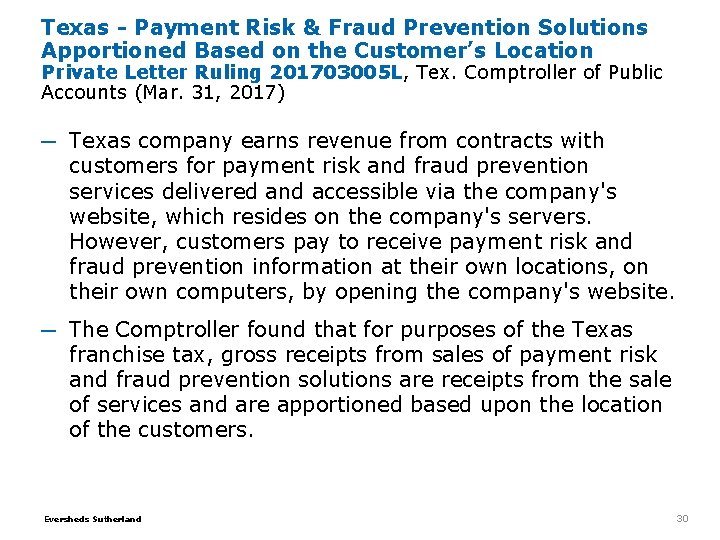
Texas - Payment Risk & Fraud Prevention Solutions Apportioned Based on the Customer’s Location Private Letter Ruling 201703005 L, Tex. Comptroller of Public Accounts (Mar. 31, 2017) ─ Texas company earns revenue from contracts with customers for payment risk and fraud prevention services delivered and accessible via the company's website, which resides on the company's servers. However, customers pay to receive payment risk and fraud prevention information at their own locations, on their own computers, by opening the company's website. ─ The Comptroller found that for purposes of the Texas franchise tax, gross receipts from sales of payment risk and fraud prevention solutions are receipts from the sale of services and are apportioned based upon the location of the customers. Eversheds Sutherland 30
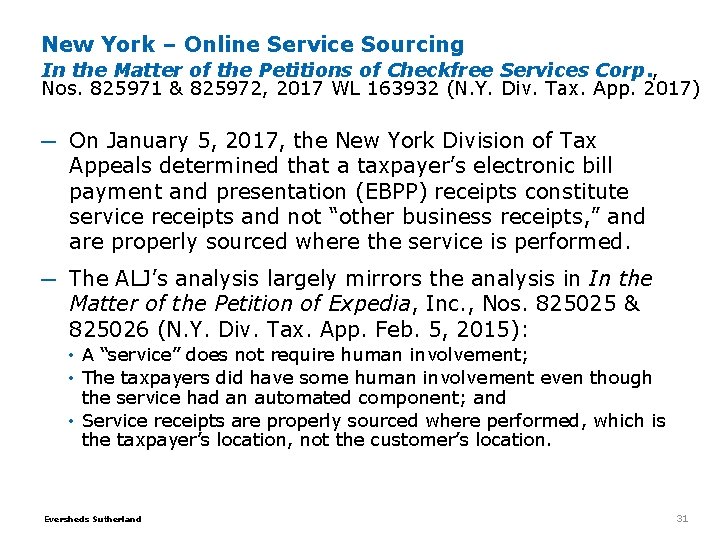
New York – Online Service Sourcing In the Matter of the Petitions of Checkfree Services Corp. , Nos. 825971 & 825972, 2017 WL 163932 (N. Y. Div. Tax. App. 2017) ─ On January 5, 2017, the New York Division of Tax Appeals determined that a taxpayer’s electronic bill payment and presentation (EBPP) receipts constitute service receipts and not “other business receipts, ” and are properly sourced where the service is performed. ─ The ALJ’s analysis largely mirrors the analysis in In the Matter of the Petition of Expedia, Inc. , Nos. 825025 & 825026 (N. Y. Div. Tax. App. Feb. 5, 2015): • A “service” does not require human involvement; • The taxpayers did have some human involvement even though the service had an automated component; and • Service receipts are properly sourced where performed, which is the taxpayer’s location, not the customer’s location. Eversheds Sutherland 31
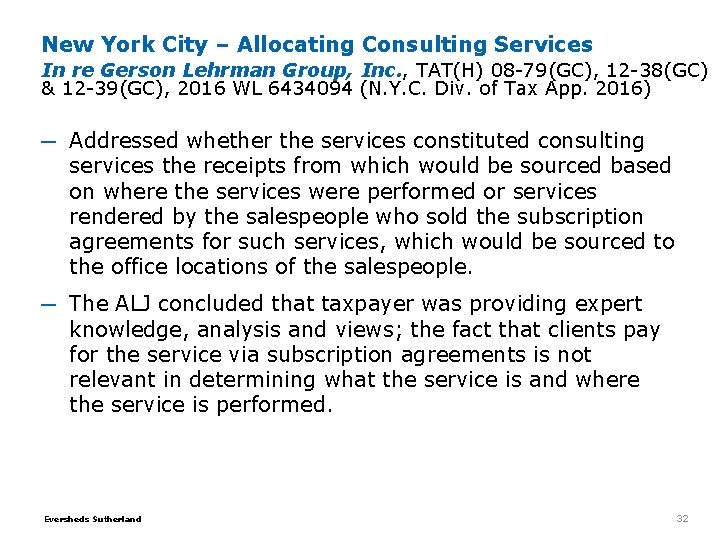
New York City – Allocating Consulting Services In re Gerson Lehrman Group, Inc. , TAT(H) 08 -79(GC), 12 -38(GC) & 12 -39(GC), 2016 WL 6434094 (N. Y. C. Div. of Tax App. 2016) ─ Addressed whether the services constituted consulting services the receipts from which would be sourced based on where the services were performed or services rendered by the salespeople who sold the subscription agreements for such services, which would be sourced to the office locations of the salespeople. ─ The ALJ concluded that taxpayer was providing expert knowledge, analysis and views; the fact that clients pay for the service via subscription agreements is not relevant in determining what the service is and where the service is performed. Eversheds Sutherland 32
Apportionment – Other Developments Eversheds Sutherland
California – Unitary Relationship & Business Income Com. Con Prod. Serv. I Inc. v. Cal. Franchise Tax Bd. , No. B 259619, 2016 WL 7229830 (Cal. Ct. App. 2016) ─ The California Court of Appeals affirmed that Comcast did not establish a unitary relationship with its 57% owned subsidiary, QVC, because Mobil Oil’s three hallmarks of a unitary relationship – centralized management, functional integration, and economies of scale – were not present. ─ On the second issue, the court held that Comcast’s receipt of a $1. 5 billion termination fee from its failed mergers with Media. One Group, Inc. constituted apportionable business income. Eversheds Sutherland 34
New Jersey – Gain From 338(h)(10) Is Nonbusiness Xylem Dewatering Solutions, Inc. v. Dir. , Division of Taxation, No. 011704– 2015, 000056– 2016, 000057– 2016, 2017 WL 1326505 (N. J. Tax Ct. 2017) ─ Gain from a deemed asset sale under I. R. C. § 338(h)(10) recognized by a New Jersey-based S corporation was nonoperational (nonbusiness) income. ─ Treated as nonbusiness income, the receipts are 100% allocable to New Jersey, rather than subject to apportionment. Eversheds Sutherland 35
New Jersey – Throwout Rule Clarification Elan Pharmaceuticals, Inc. v. Dir. , Div. of Taxation, No. 010589– 2010, 2017 WL 510542 (N. J. Tax Ct. 2017) ─ The taxpayer included sales of tangible personal property shipped from locations outside New Jersey to states in which the taxpayer was immune from tax under P. L. 86272 in its sales factor denominator. ─ On February 6, 2017, the New Jersey Tax Court rejected the Division of Taxation’s attempt to apply the throwout rule to these receipts. ─ The court found it irrelevant whether the receipts were actually included in the numerator of a sales factor of another state. Eversheds Sutherland 36
Deductions Eversheds Sutherland
Virginia – “Subject to Tax” Addback Kohl’s Dep’t Stores, Inc. v. Virginia Dep’t of Taxation, 91 Va. Cir. 499 (Va. 13 th Jud. Cir. Ct. 2016) ─ On February 3, 2016, a Virginia trial court held that royalties paid to related members must be added back to a taxpayer’s federal taxable income unless such payments are subject to actual income taxation to the related member. ─ Even where the royalties are reported by the related members to other states, such royalties do not qualify for the exception to the corporate income tax addback statute if the other states do not impose tax on such royalties. ─ Virginia Supreme Court granted cert. on October 31, 2016. Eversheds Sutherland 38
Texas – Narrowing the Cost of Goods Sold Deduction American Multi-Cinema Inc. v. Hegar, No. 03 -14 -00397 -CV, 2017 WL 74416 (Tex. App. 2017) ─ In April 2015, the Texas Court of Appeals held that film exhibition costs are includable in the cost of goods sold (COGS) deduction because the films met the definition of “tangible personal property” in that they were “perceptible to the senses. ” ─ In June 2015, the Comptroller filed a motion for rehearing and published an article concluding that the expanded COGS deduction had a fiscal impact of $1. 5 billion each year. ─ In January 2017, the Texas Court of Appeals released a substituted opinion resulting in the same outcome, but a different reasoning. The court held that the film exhibition costs are includable because films and other media products that are “mass-distributed” meet the definition of “tangible personal property. ” Eversheds Sutherland 39
State Tax Implications of US Federal Tax Reform Eversheds Sutherland
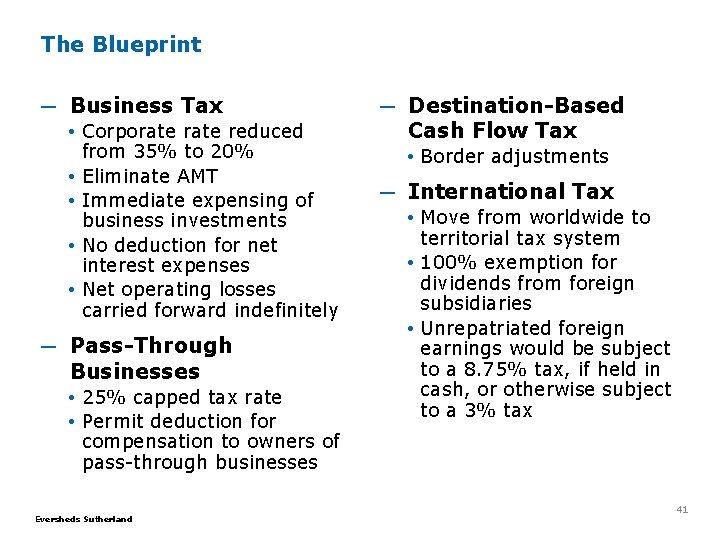
The Blueprint ─ Business Tax • Corporate reduced from 35% to 20% • Eliminate AMT • Immediate expensing of business investments • No deduction for net interest expenses • Net operating losses carried forward indefinitely ─ Pass-Through Businesses • 25% capped tax rate • Permit deduction for compensation to owners of pass-through businesses Eversheds Sutherland ─ Destination-Based Cash Flow Tax • Border adjustments ─ International Tax • Move from worldwide to territorial tax system • 100% exemption for dividends from foreign subsidiaries • Unrepatriated foreign earnings would be subject to a 8. 75% tax, if held in cash, or otherwise subject to a 3% tax 41
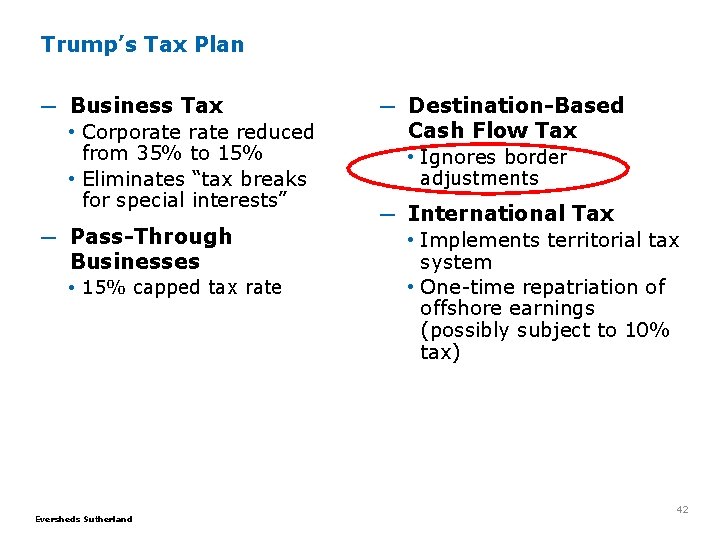
Trump’s Tax Plan ─ Business Tax • Corporate reduced from 35% to 15% • Eliminates “tax breaks for special interests” ─ Pass-Through Businesses • 15% capped tax rate Eversheds Sutherland ─ Destination-Based Cash Flow Tax • Ignores border adjustments ─ International Tax • Implements territorial tax system • One-time repatriation of offshore earnings (possibly subject to 10% tax) 42
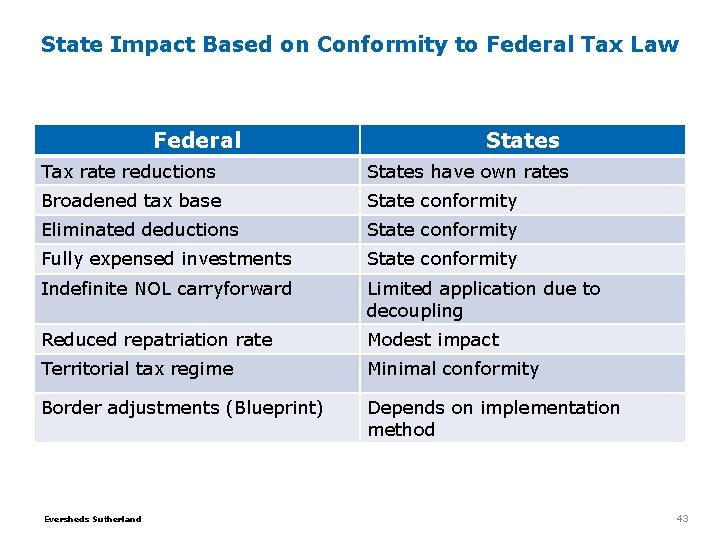
State Impact Based on Conformity to Federal Tax Law Federal States Tax rate reductions States have own rates Broadened tax base State conformity Eliminated deductions State conformity Fully expensed investments State conformity Indefinite NOL carryforward Limited application due to decoupling Reduced repatriation rate Modest impact Territorial tax regime Minimal conformity Border adjustments (Blueprint) Depends on implementation method Eversheds Sutherland 43
Questions? Eversheds Sutherland 44
Connect with us! Download the Eversheds Sutherland SALT Shaker app today Be sure to also submit your pet through our app to be featured as Pet of the Month! ─ Apple App Store ─ Google Play ─ Amazon Appstore @ESsaltlaw Eversheds Sutherland 45
Contact us Jeff Friedman Partner Eversheds Sutherland (US) LLP 202. 383. 0718 Jeff. Friedman@evershedssutherland. com Michele Borens Partner Eversheds Sutherland (US) LLP 202. 383. 0936 Michele. Borens@evershedssutherland. com stateandlocaltax. com eversheds-sutherland. com © 2017 Eversheds Sutherland (US) LLP All rights reserved. This communication cannot be used for the purpose of avoiding any penalties that may be imposed under federal, state or local tax law.
Pass the SAAS – Sales Tax Considerations of Cloud Computing TEI Denver Chapter May 24, 2017 Michele Borens Partner Marc Simonetti Partner © 2017 Eversheds Sutherland (US) LLP All Rights Reserved. This communication is for general informational purposes only and is not intended to constitute legal advice or a recommended course of action in any given situation. This communication is not intended to be, and should not be, relied upon by the recipient in making decisions of a legal nature with respect to the issues discussed herein. The recipient is encouraged to consult independent counsel before making any decisions or taking any action concerning the matters in this communication. This communication does not create an attorney-client relationship between Eversheds Sutherland (US) LLP and the recipient. Eversheds Sutherland (US) LLP is part of a global legal practice, operating through various separate and distinct legal entities, under Eversheds Sutherland. For a full description of the structure and a list of offices, please visit www. eversheds-sutherland. com.
Background Eversheds Sutherland
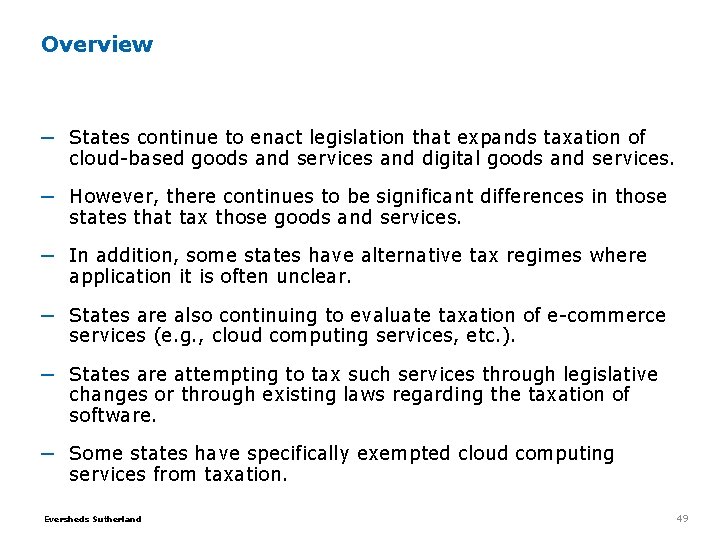
Overview ─ States continue to enact legislation that expands taxation of cloud-based goods and services and digital goods and services. ─ However, there continues to be significant differences in those states that tax those goods and services. ─ In addition, some states have alternative tax regimes where application it is often unclear. ─ States are also continuing to evaluate taxation of e-commerce services (e. g. , cloud computing services, etc. ). ─ States are attempting to tax such services through legislative changes or through existing laws regarding the taxation of software. ─ Some states have specifically exempted cloud computing services from taxation. Eversheds Sutherland 49
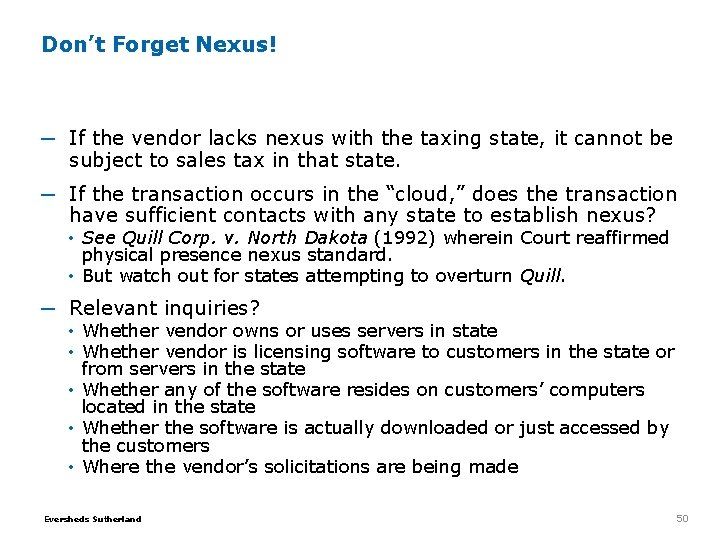
Don’t Forget Nexus! ─ If the vendor lacks nexus with the taxing state, it cannot be subject to sales tax in that state. ─ If the transaction occurs in the “cloud, ” does the transaction have sufficient contacts with any state to establish nexus? • See Quill Corp. v. North Dakota (1992) wherein Court reaffirmed physical presence nexus standard. • But watch out for states attempting to overturn Quill. ─ Relevant inquiries? • Whether vendor owns or uses servers in state • Whether vendor is licensing software to customers in the state or from servers in the state • Whether any of the software resides on customers’ computers located in the state • Whether the software is actually downloaded or just accessed by the customers • Where the vendor’s solicitations are being made Eversheds Sutherland 50
Cloud Computing Eversheds Sutherland
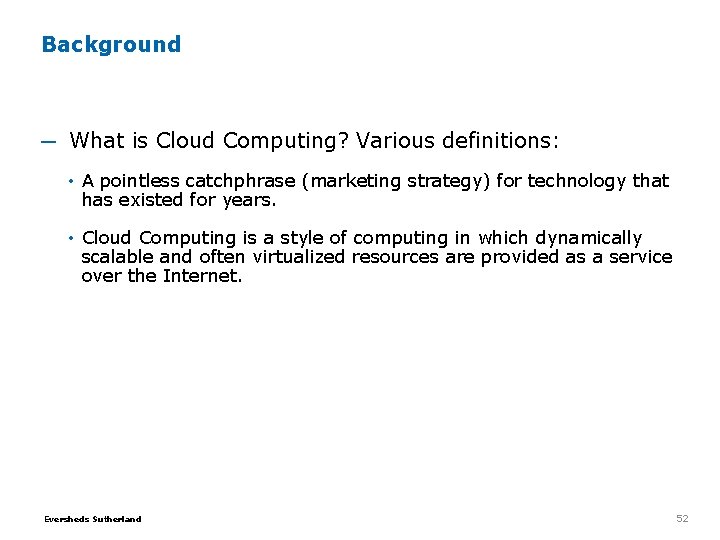
Background ─ What is Cloud Computing? Various definitions: • A pointless catchphrase (marketing strategy) for technology that has existed for years. • Cloud Computing is a style of computing in which dynamically scalable and often virtualized resources are provided as a service over the Internet. Eversheds Sutherland 52
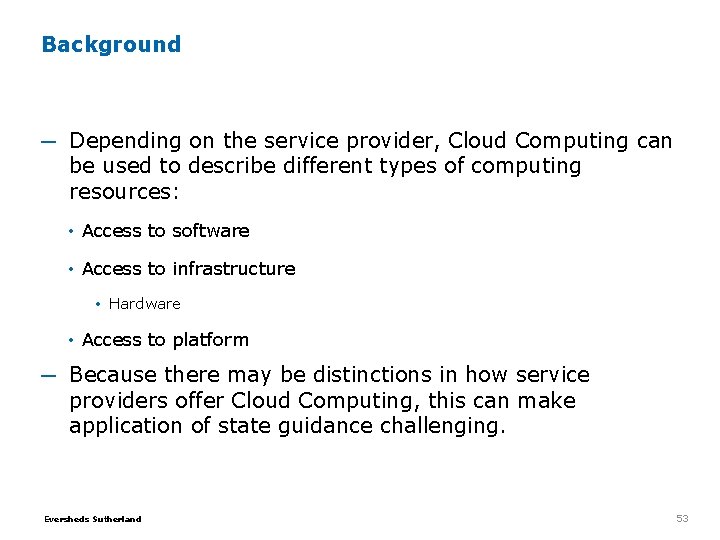
Background ─ Depending on the service provider, Cloud Computing can be used to describe different types of computing resources: • Access to software • Access to infrastructure • Hardware • Access to platform ─ Because there may be distinctions in how service providers offer Cloud Computing, this can make application of state guidance challenging. Eversheds Sutherland 53
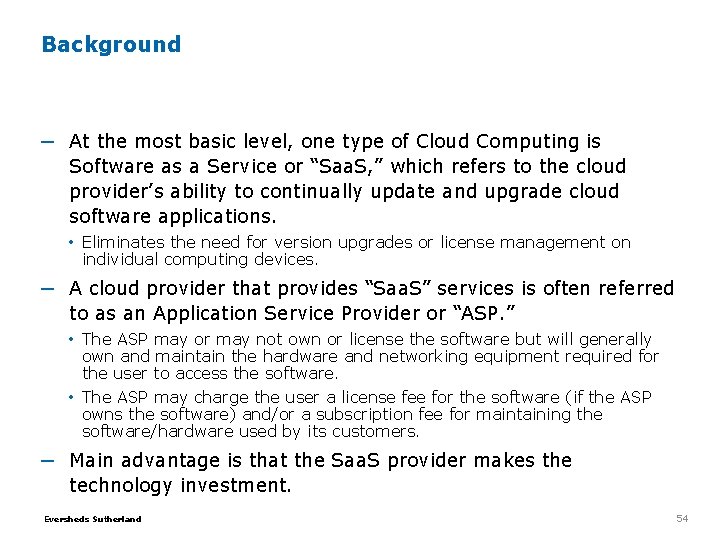
Background ─ At the most basic level, one type of Cloud Computing is Software as a Service or “Saa. S, ” which refers to the cloud provider’s ability to continually update and upgrade cloud software applications. • Eliminates the need for version upgrades or license management on individual computing devices. ─ A cloud provider that provides “Saa. S” services is often referred to as an Application Service Provider or “ASP. ” • The ASP may or may not own or license the software but will generally own and maintain the hardware and networking equipment required for the user to access the software. • The ASP may charge the user a license fee for the software (if the ASP owns the software) and/or a subscription fee for maintaining the software/hardware used by its customers. ─ Main advantage is that the Saa. S provider makes the technology investment. Eversheds Sutherland 54
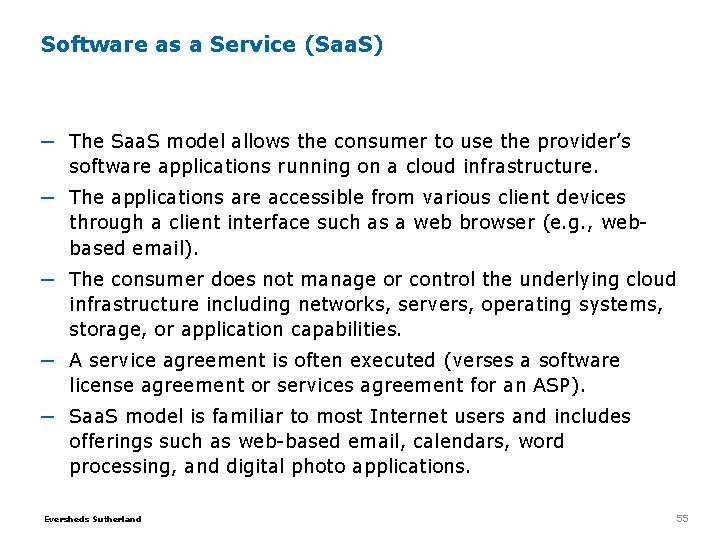
Software as a Service (Saa. S) ─ The Saa. S model allows the consumer to use the provider’s software applications running on a cloud infrastructure. ─ The applications are accessible from various client devices through a client interface such as a web browser (e. g. , webbased email). ─ The consumer does not manage or control the underlying cloud infrastructure including networks, servers, operating systems, storage, or application capabilities. ─ A service agreement is often executed (verses a software license agreement or services agreement for an ASP). ─ Saa. S model is familiar to most Internet users and includes offerings such as web-based email, calendars, word processing, and digital photo applications. Eversheds Sutherland 55
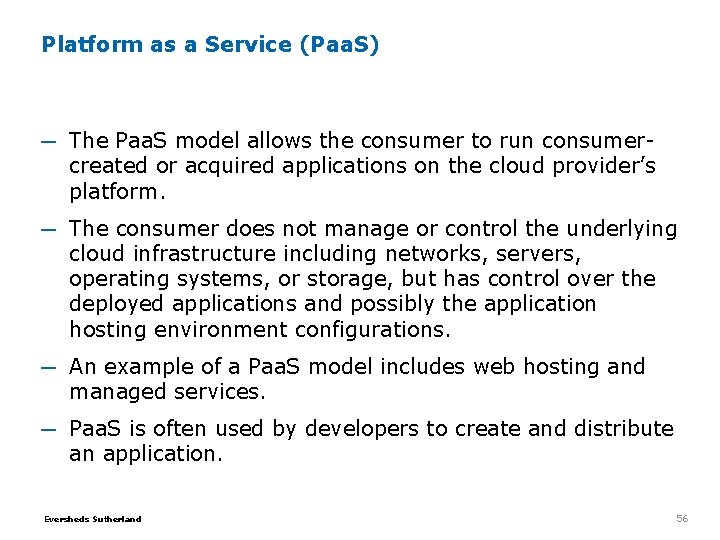
Platform as a Service (Paa. S) ─ The Paa. S model allows the consumer to run consumercreated or acquired applications on the cloud provider’s platform. ─ The consumer does not manage or control the underlying cloud infrastructure including networks, servers, operating systems, or storage, but has control over the deployed applications and possibly the application hosting environment configurations. ─ An example of a Paa. S model includes web hosting and managed services. ─ Paa. S is often used by developers to create and distribute an application. Eversheds Sutherland 56
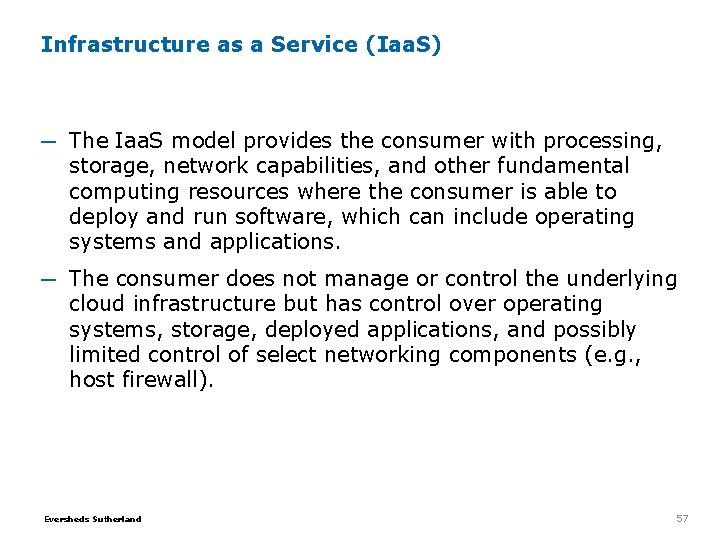
Infrastructure as a Service (Iaa. S) ─ The Iaa. S model provides the consumer with processing, storage, network capabilities, and other fundamental computing resources where the consumer is able to deploy and run software, which can include operating systems and applications. ─ The consumer does not manage or control the underlying cloud infrastructure but has control over operating systems, storage, deployed applications, and possibly limited control of select networking components (e. g. , host firewall). Eversheds Sutherland 57
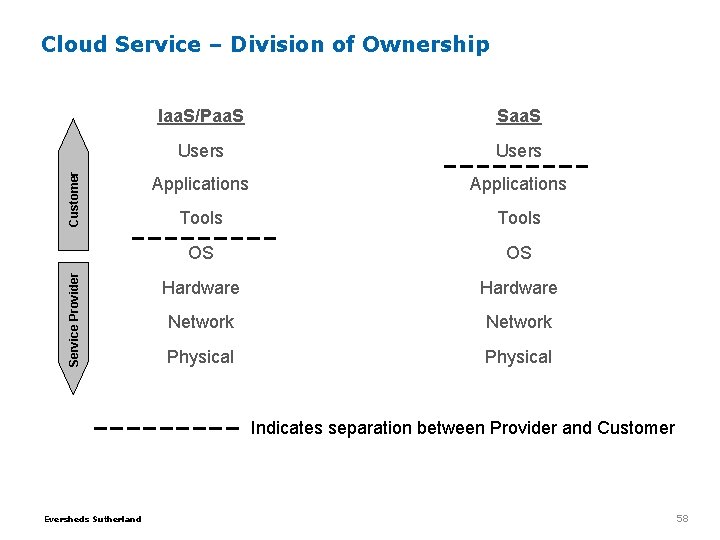
Service Provider Customer Cloud Service – Division of Ownership Iaa. S/Paa. S Saa. S Users Applications Tools OS OS Hardware Network Physical Indicates separation between Provider and Customer Eversheds Sutherland 58
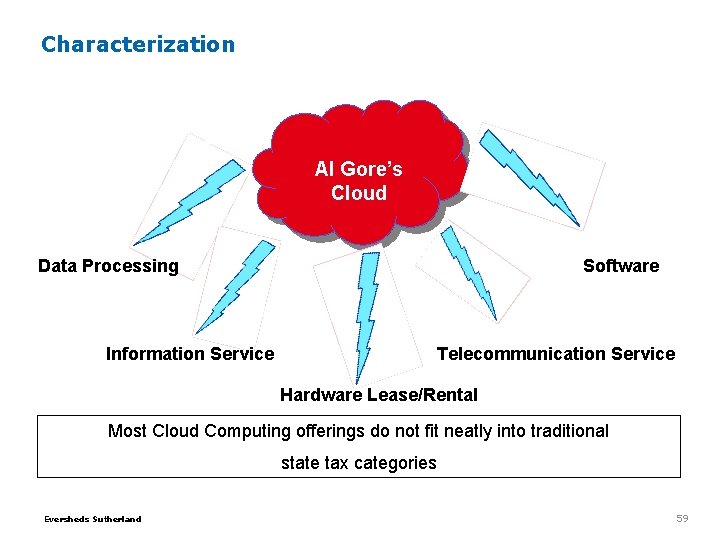
Characterization Al Gore’s Cloud Data Processing Information Service Software Telecommunication Service Hardware Lease/Rental Most Cloud Computing offerings do not fit neatly into traditional state tax categories Eversheds Sutherland 59
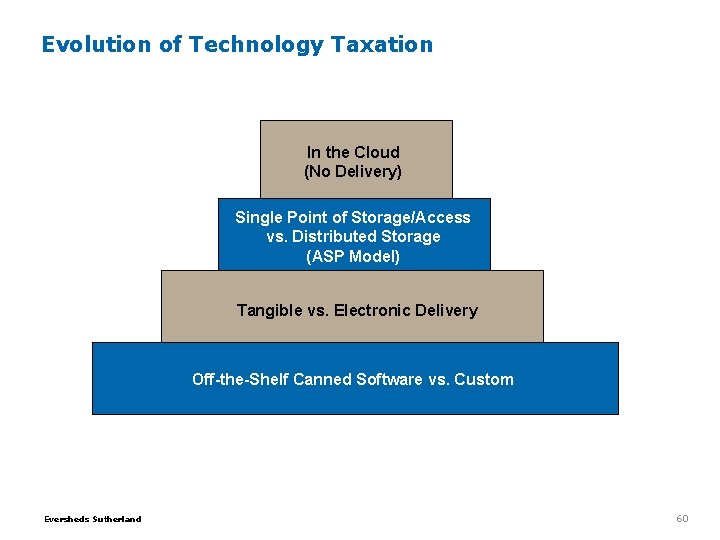
Evolution of Technology Taxation In the Cloud (No Delivery) Single Point of Storage/Access vs. Distributed Storage (ASP Model) Tangible vs. Electronic Delivery Off-the-Shelf Canned Software vs. Custom Eversheds Sutherland 60
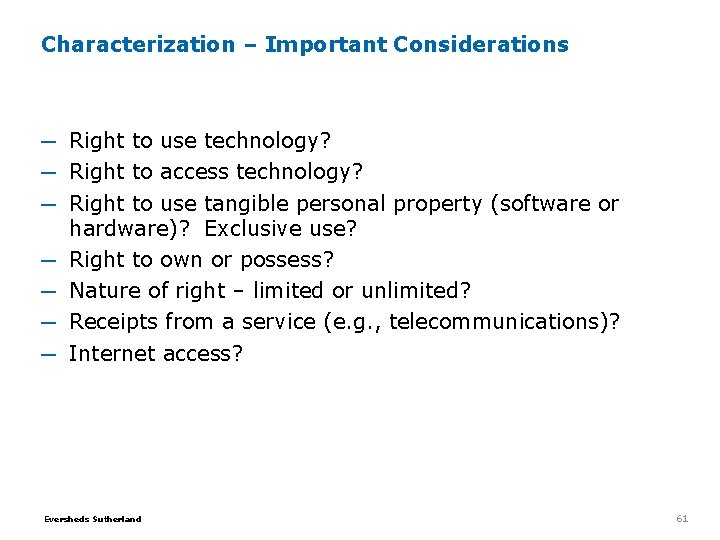
Characterization – Important Considerations ─ Right to use technology? ─ Right to access technology? ─ Right to use tangible personal property (software or hardware)? Exclusive use? ─ Right to own or possess? ─ Nature of right – limited or unlimited? ─ Receipts from a service (e. g. , telecommunications)? ─ Internet access? Eversheds Sutherland 61
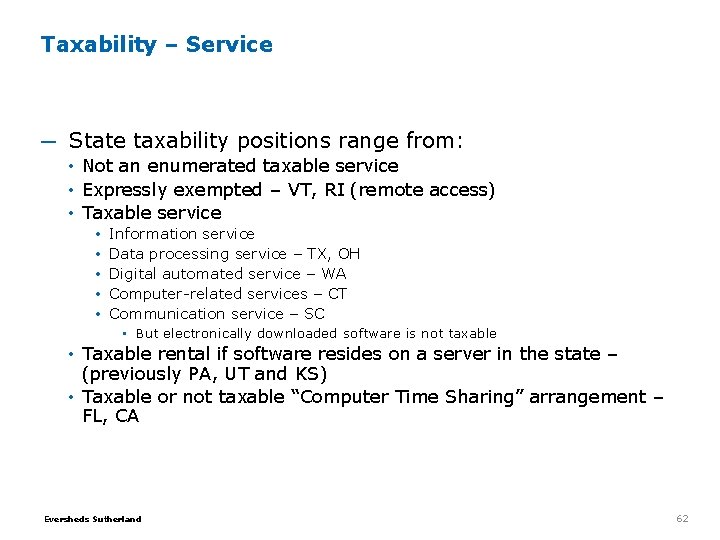
Taxability – Service ─ State taxability positions range from: • Not an enumerated taxable service • Expressly exempted – VT, RI (remote access) • Taxable service • • • Information service Data processing service – TX, OH Digital automated service – WA Computer-related services – CT Communication service – SC • But electronically downloaded software is not taxable • Taxable rental if software resides on a server in the state – (previously PA, UT and KS) • Taxable or not taxable “Computer Time Sharing” arrangement – FL, CA Eversheds Sutherland 62
Taxability – Software Transfer ─ Many states tax the electronic transfer of software. ─ Some states have chosen not to tax electronic transfers if the information is located on a server outside the state (Kansas). ─ Other states have attempted to tax the electronic transfer using different theories, including: • A taxable transfer is effected by any means, including electronic access (Illinois and several others). • A taxable transfer occurs when there is a remote access (Massachusetts, Washington). • A taxable transfer occurs when there is a license to use the software. • Constructive Possession: A taxable transfer occurs when a customer has the right to control, use, or direct the use of software (New York). • But what constitutes “use”? Eversheds Sutherland 63
Taxability – Infrastructure as a Service ─ Outsourcing or “rental” of storage, processing, network, and other computing resources • Does customer have right to designate server location? • Does customer have right to specified amount of server space? ─ Controversial area of taxation – outdated tax statutes and regulations often do not address Infrastructure as a Service (Iaa. S) ─ Commonly includes provision of various service components that are commonly subject to sales/use tax, including but not limited to: • Hardware maintenance, software maintenance, repair labor, security services, electricity ─ Non-possessory interest in the underlying hardware and service components • Cannot separately state • True object/bundling Eversheds Sutherland 64
Taxability – Sale for Resale ─ Cloud Computing providers may sell services to other thirdparty companies that sell global computing solutions. ─ Taxability and nexus would depend on whether the sale is characterized as a true sale for resale, or whether the third party is characterized as acting as the Cloud Computing company’s agent. ─ Further complications arise if the third party bundles its own services or software with the Cloud Computing provider’s services or software. ─ Consider Paa. S, in which a developer accesses platform and then makes applications available to its customers. Eversheds Sutherland 65
Sourcing – Sales Tax ─ If Cloud Computing transactions are taxable, in which state or states should the transaction be taxed? ─ States generally use one of two methods for sales tax sourcing: • Origin-based sourcing – sourced to the location where the product or service originates • Destination-based sourcing – sourced to the location where the product or service is ultimately consumed ─ The very nature of Cloud Computing makes origin-based sourcing difficult to measure • Multiple locations for infrastructure • Network of computers and software ─ Mobile access to cloud services presents unresolved issues for destination sourcing • Will states come up with a system similar to that implemented by Congress for mobile phones that defaults to home address? • Some states (e. g. , New York) have issued guidance which indicates that services are presumed to be sourced to state – presumption can be rebutted by proving where the user is located. Eversheds Sutherland 66
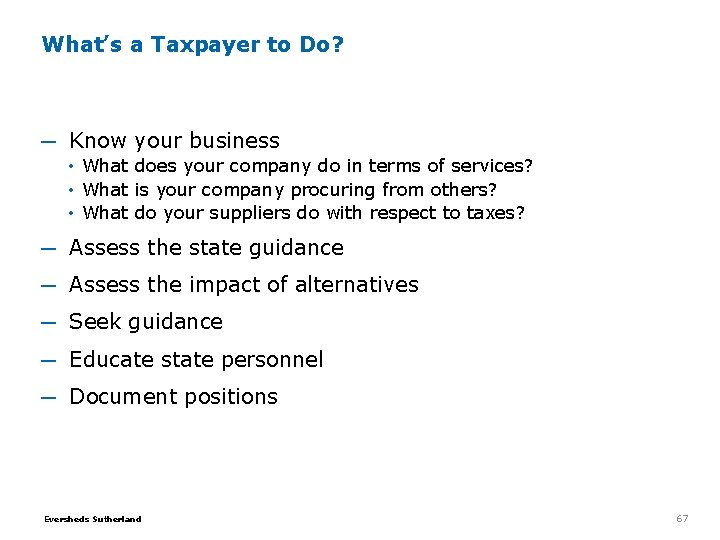
What’s a Taxpayer to Do? ─ Know your business • What does your company do in terms of services? • What is your company procuring from others? • What do your suppliers do with respect to taxes? ─ Assess the state guidance ─ Assess the impact of alternatives ─ Seek guidance ─ Educate state personnel ─ Document positions Eversheds Sutherland 67
Cloud Computing Updates Eversheds Sutherland
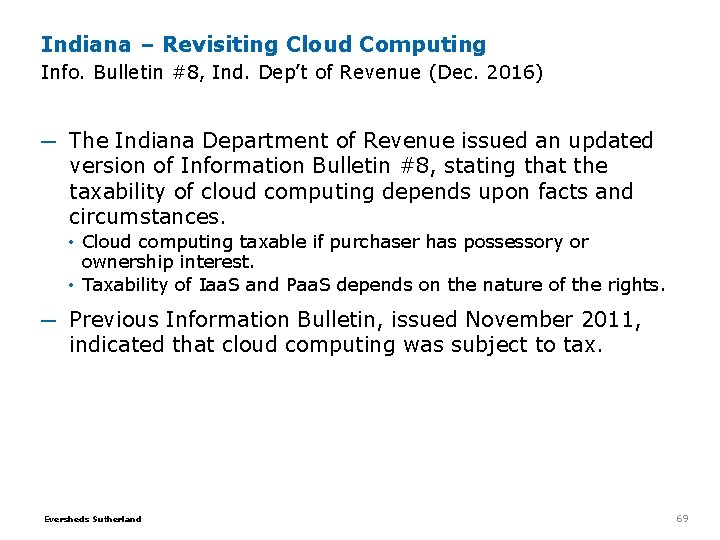
Indiana – Revisiting Cloud Computing Info. Bulletin #8, Ind. Dep’t of Revenue (Dec. 2016) ─ The Indiana Department of Revenue issued an updated version of Information Bulletin #8, stating that the taxability of cloud computing depends upon facts and circumstances. • Cloud computing taxable if purchaser has possessory or ownership interest. • Taxability of Iaa. S and Paa. S depends on the nature of the rights. ─ Previous Information Bulletin, issued November 2011, indicated that cloud computing was subject to tax. Eversheds Sutherland 69
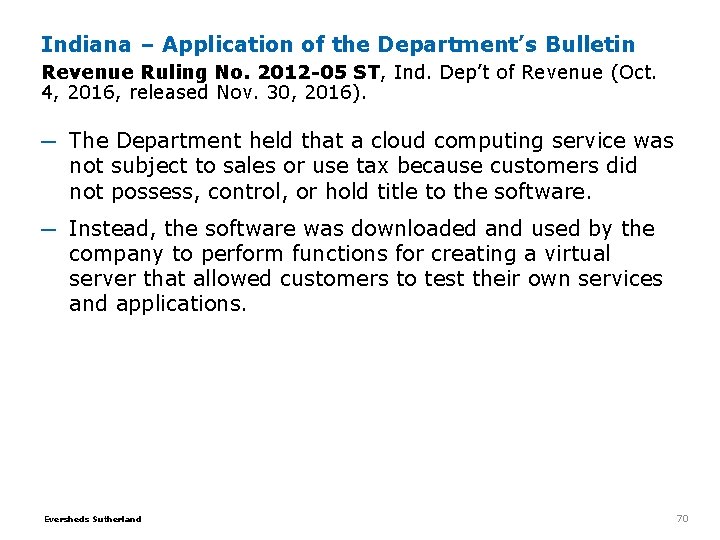
Indiana – Application of the Department’s Bulletin Revenue Ruling No. 2012 -05 ST, Ind. Dep’t of Revenue (Oct. 4, 2016, released Nov. 30, 2016). ─ The Department held that a cloud computing service was not subject to sales or use tax because customers did not possess, control, or hold title to the software. ─ Instead, the software was downloaded and used by the company to perform functions for creating a virtual server that allowed customers to test their own services and applications. Eversheds Sutherland 70
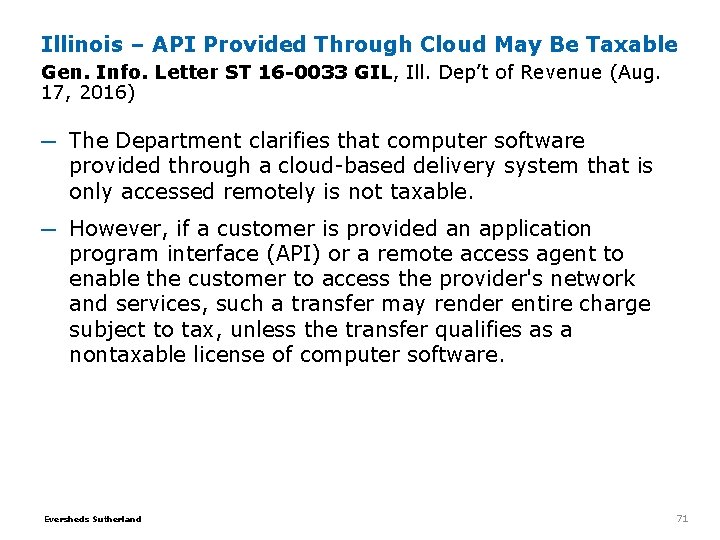
Illinois – API Provided Through Cloud May Be Taxable Gen. Info. Letter ST 16 -0033 GIL, Ill. Dep’t of Revenue (Aug. 17, 2016) ─ The Department clarifies that computer software provided through a cloud-based delivery system that is only accessed remotely is not taxable. ─ However, if a customer is provided an application program interface (API) or a remote access agent to enable the customer to access the provider's network and services, such a transfer may render entire charge subject to tax, unless the transfer qualifies as a nontaxable license of computer software. Eversheds Sutherland 71
Arizona – Recurring Payment Provider Not Taxable Taxpayer Info. Ruling LR 16 -011, Ariz. Dep’t of Revenue (Sept. 23, 2016) ─ A subscription billing and recurring payment provider was not taxable under the personal property rental classification for transaction privilege tax (TPT) purposes. ─ Taxpayer’s clients uploaded their customer information to the taxpayer’s server through the Application Program Interface (API), which is cloud-based, and were able to access transaction data through a web-portal. ─ Although the Department has frequently ruled that using remotely hosted software constitutes a lease of tangible personal property, the Department found that the clients did not have sufficient control and use of the API and portal to constitute a rental. Eversheds Sutherland 72
Tennessee – Nontaxable Document Management Solutions Letter Ruling 16 -12, Tenn. Dep’t of Revenue (Dec. 16, 2016) ─ The Department ruled that a taxpayer’s charges for webbased document management and compliance solutions are not taxable. ─ Taxpayer’s clients have the ability to upload, store, manage, and view digital copies of their documents and create information reports on the taxpayer’s cloud-based storage database. ─ Although remote web-based access to software is taxable, the Department found that the true object of the transactions was data storage services and access to the web-based portal was incidental. Eversheds Sutherland 73
New York – Taxable Retail Pricing Information Services In the Matter of the Petition of Retail. Data, LLC, No. 825334 (N. Y. Div. of Tax App. 2016) ─ “Competitive price audits” did not constitute the nontaxable furnishing of information which is personal or individual in nature and which is not substantially incorporated in reports furnished to other persons. ─ The Tribunal’s decision turned on the source of the raw data rather than the existence of a customized request from the customer. Eversheds Sutherland 74
Utah – Taxable Bundled Dashboard and Website Private Letter Ruling 15 -008, Utah State Tax Comm’r (July 20, 2016) ─ Taxpayer’s fee for a distributor dashboard and personal website is taxable, unless the fee for the dashboard is separately stated. ─ Taxpayer sold nutritional, dietary, and skin care products through a network of independent distributors. ─ Dashboard: • The distributor dashboard granted the taxpayer’s distributors online access to their customers and down-line distributors. Similar information could be received by phone or printed statement. • The Commission found that though there was use of software, the essence of the transaction was nontaxable information access. ─ Personal website: • The personal website could be shared with a distributor’s customers and down-line distributors. • The Commission found that the sale of a personal website was taxable as prewritten software because these websites were not individual sites for each distributor, but customizations of a standard website. Eversheds Sutherland 75
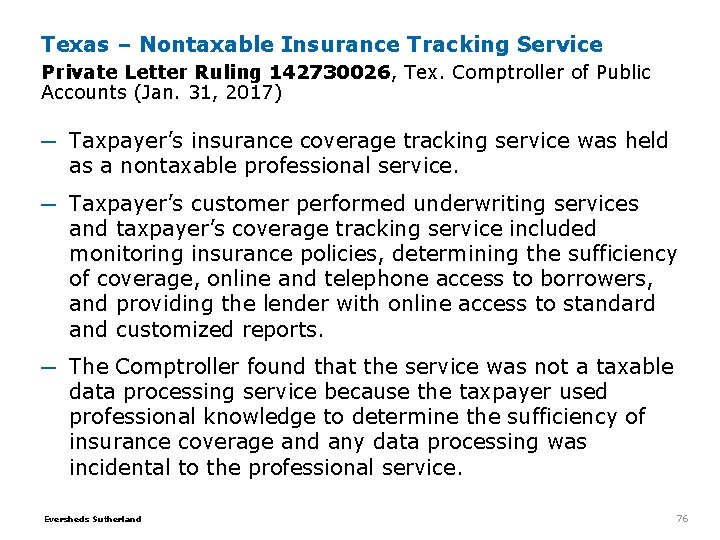
Texas – Nontaxable Insurance Tracking Service Private Letter Ruling 142730026, Tex. Comptroller of Public Accounts (Jan. 31, 2017) ─ Taxpayer’s insurance coverage tracking service was held as a nontaxable professional service. ─ Taxpayer’s customer performed underwriting services and taxpayer’s coverage tracking service included monitoring insurance policies, determining the sufficiency of coverage, online and telephone access to borrowers, and providing the lender with online access to standard and customized reports. ─ The Comptroller found that the service was not a taxable data processing service because the taxpayer used professional knowledge to determine the sufficiency of insurance coverage and any data processing was incidental to the professional service. Eversheds Sutherland 76
Questions? Eversheds Sutherland 77
Connect with us! Download the Eversheds Sutherland SALT Shaker app today Be sure to also submit your pet through our app to be featured as Pet of the Month! ─ Apple App Store ─ Google Play ─ Amazon Appstore @ESsaltlaw Eversheds Sutherland 78
Contact us Michele Borens Partner Eversheds Sutherland (US) LLP 202. 383. 0936 Michele. Borens@evershedssutherland. com Marc Simonetti Partner Eversheds Sutherland (US) LLP 212. 389. 5015 Marc. Simonetti@evershedssutherland. com stateandlocaltax. com eversheds-sutherland. com © 2017 Eversheds Sutherland (US) LLP All rights reserved. This communication cannot be used for the purpose of avoiding any penalties that may be imposed under federal, state or local tax law.
Prove It: Market-Based Sourcing Methodologies TEI Denver Chapter May 24, 2017 Jeff Friedman Partner Marc Simonetti Partner © 2017 Eversheds Sutherland (US) LLP All Rights Reserved. This communication is for general informational purposes only and is not intended to constitute legal advice or a recommended course of action in any given situation. This communication is not intended to be, and should not be, relied upon by the recipient in making decisions of a legal nature with respect to the issues discussed herein. The recipient is encouraged to consult independent counsel before making any decisions or taking any action concerning the matters in this communication. This communication does not create an attorney-client relationship between Eversheds Sutherland (US) LLP and the recipient. Eversheds Sutherland (US) LLP is part of a global legal practice, operating through various separate and distinct legal entities, under Eversheds Sutherland. For a full description of the structure and a list of offices, please visit www. eversheds-sutherland. com.
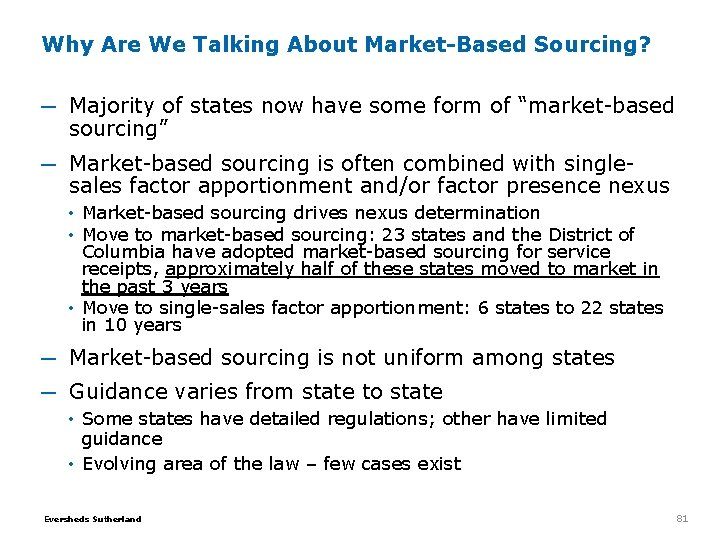
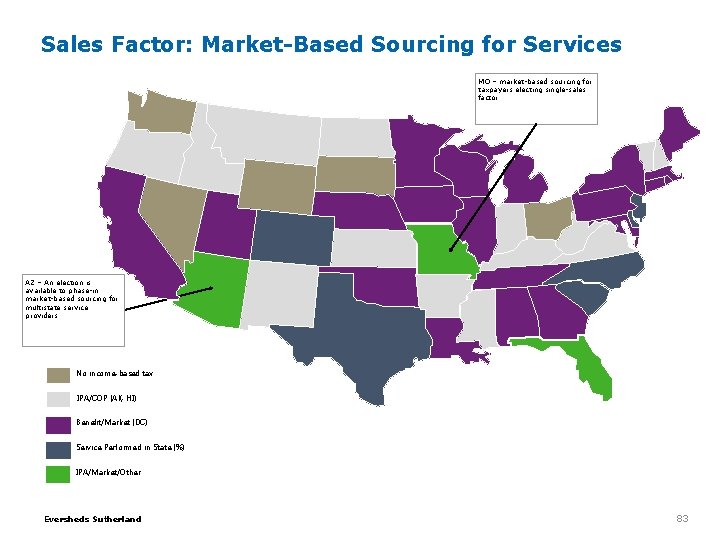
Why Are We Talking About Market-Based Sourcing? ─ Majority of states now have some form of “market-based sourcing” ─ Market-based sourcing is often combined with singlesales factor apportionment and/or factor presence nexus • Market-based sourcing drives nexus determination • Move to market-based sourcing: 23 states and the District of Columbia have adopted market-based sourcing for service receipts, approximately half of these states moved to market in the past 3 years • Move to single-sales factor apportionment: 6 states to 22 states in 10 years ─ Market-based sourcing is not uniform among states ─ Guidance varies from state to state • Some states have detailed regulations; other have limited guidance • Evolving area of the law – few cases exist Eversheds Sutherland 81
Why Are States Moving to Market-Based Sourcing? ─ Challenges in applying the IPA/COP test ─ Wanting to move away from an “all or nothing” approach ─ Desire to reduce burden on in-state businesses Eversheds Sutherland 82
Sales Factor: Market-Based Sourcing for Services MO – market-based sourcing for taxpayers electing single-sales factor AZ – An election is available to phase-in market-based sourcing for multistate service providers No income-based tax IPA/COP (AK, HI) Benefit/Market (DC) Service Performed in State (%) IPA/Market/Other Eversheds Sutherland 83
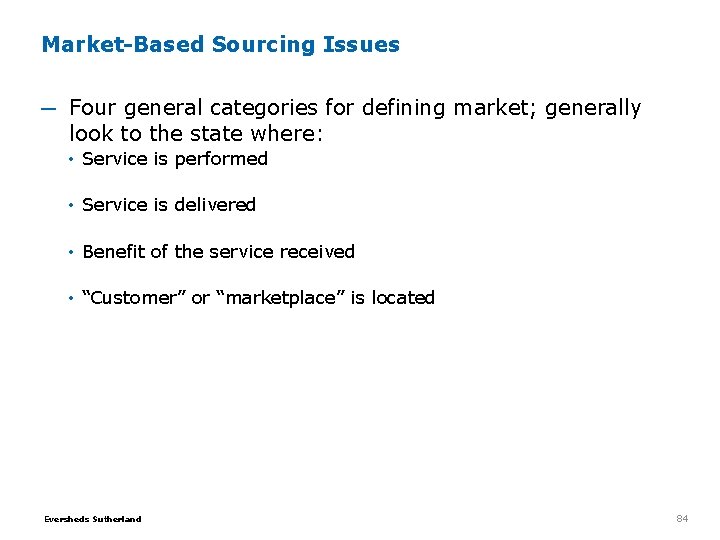
Market-Based Sourcing Issues ─ Four general categories for defining market; generally look to the state where: • Service is performed • Service is delivered • Benefit of the service received • “Customer” or “marketplace” is located Eversheds Sutherland 84
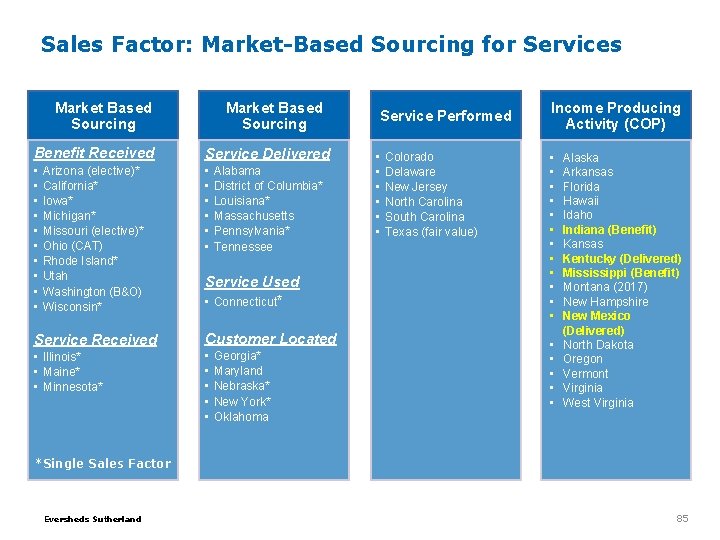
Sales Factor: Market-Based Sourcing for Services Market Based Sourcing Benefit Received Service Delivered • • • • Arizona (elective)* California* Iowa* Michigan* Missouri (elective)* Ohio (CAT) Rhode Island* Utah Washington (B&O) Wisconsin* Alabama District of Columbia* Louisiana* Massachusetts Pennsylvania* Tennessee Service Used • Connecticut* Service Received Customer Located • Illinois* • Maine* • Minnesota* • • • Georgia* Maryland Nebraska* New York* Oklahoma Service Performed • • • Colorado Delaware New Jersey North Carolina South Carolina Texas (fair value) Income Producing Activity (COP) • • • • • Alaska Arkansas Florida Hawaii Idaho Indiana (Benefit) Kansas Kentucky (Delivered) Mississippi (Benefit) Montana (2017) New Hampshire New Mexico (Delivered) North Dakota Oregon Vermont Virginia West Virginia *Single Sales Factor Eversheds Sutherland 85
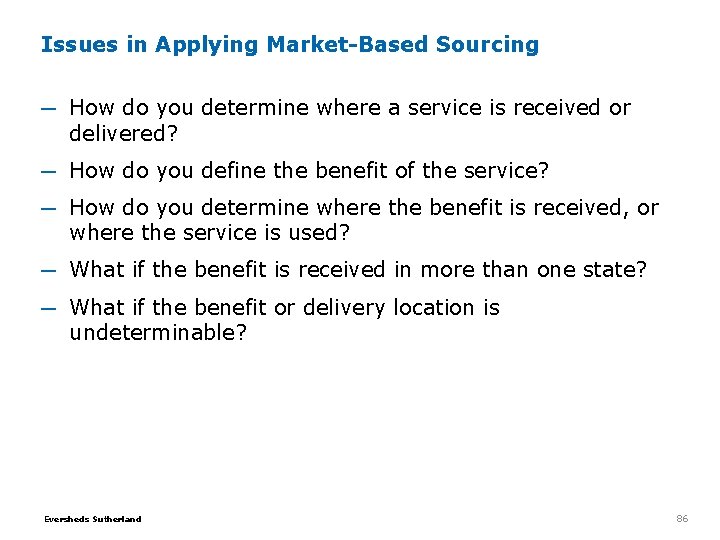
Issues in Applying Market-Based Sourcing ─ How do you determine where a service is received or delivered? ─ How do you define the benefit of the service? ─ How do you determine where the benefit is received, or where the service is used? ─ What if the benefit is received in more than one state? ─ What if the benefit or delivery location is undeterminable? Eversheds Sutherland 86
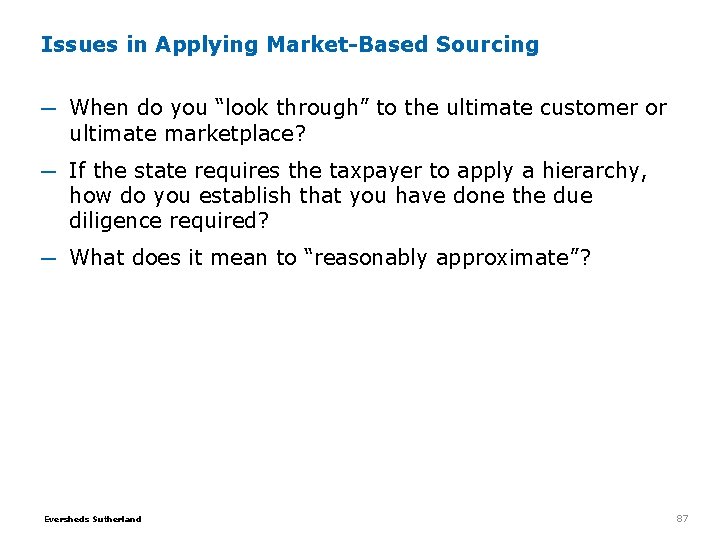
Issues in Applying Market-Based Sourcing ─ When do you “look through” to the ultimate customer or ultimate marketplace? ─ If the state requires the taxpayer to apply a hierarchy, how do you establish that you have done the due diligence required? ─ What does it mean to “reasonably approximate”? Eversheds Sutherland 87
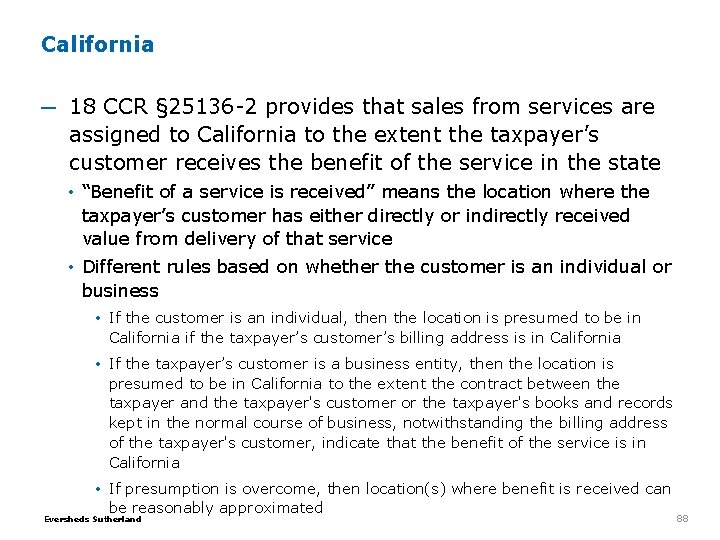
California ─ 18 CCR § 25136 -2 provides that sales from services are assigned to California to the extent the taxpayer’s customer receives the benefit of the service in the state • “Benefit of a service is received” means the location where the taxpayer’s customer has either directly or indirectly received value from delivery of that service • Different rules based on whether the customer is an individual or business • If the customer is an individual, then the location is presumed to be in California if the taxpayer’s customer’s billing address is in California • If the taxpayer’s customer is a business entity, then the location is presumed to be in California to the extent the contract between the taxpayer and the taxpayer's customer or the taxpayer's books and records kept in the normal course of business, notwithstanding the billing address of the taxpayer's customer, indicate that the benefit of the service is in California • If presumption is overcome, then location(s) where benefit is received can be reasonably approximated Eversheds Sutherland 88
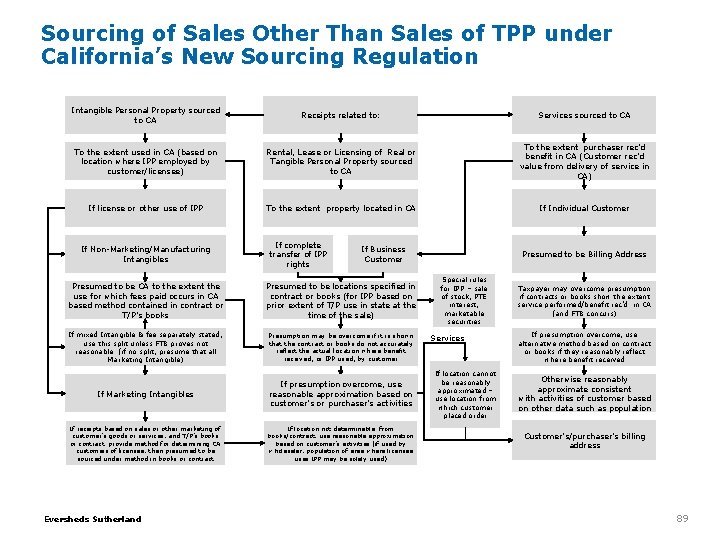
Sourcing of Sales Other Than Sales of TPP under California’s New Sourcing Regulation Intangible Personal Property sourced to CA Receipts related to: Services sourced to CA To the extent used in CA (based on location where IPP employed by customer/licensee) Rental, Lease or Licensing of Real or Tangible Personal Property sourced to CA To the extent purchaser rec’d benefit in CA (Customer rec’d value from delivery of service in CA) If license or other use of IPP To the extent property located in CA If Individual Customer If Non-Marketing/Manufacturing Intangibles If complete transfer of IPP rights If Business Customer Presumed to be CA to the extent the use for which fees paid occurs in CA based method contained in contract or T/P’s books Presumed to be locations specified in contract or books (for IPP based on prior extent of T/P use in state at the time of the sale) If mixed Intangible & fee separately stated, use this split unless FTB proves not reasonable (if no split, presume that all Marketing Intangible) Presumption may be overcome if it is shown that the contract or books do not accurately reflect the actual location where benefit received, or IPP used, by customer If Marketing Intangibles If presumption overcome, use reasonable approximation based on customer’s or purchaser’s activities If receipts based on sales or other marketing of customer’s goods or services, and T/P’s books or contract provide method for determining CA customers of licensee, then presumed to be sourced under method in books or contract If location not determinable from books/contract, use reasonable approximation based on customer’s activities (if used by wholesaler, population of area where licensee uses IPP may be solely used) Eversheds Sutherland Presumed to be Billing Address Special rules for IPP – sale of stock, PTE interest, marketable securities Services If location cannot be reasonably approximated – use location from which customer placed order Taxpayer may overcome presumption if contracts or books show the extent service performed/benefit rec’d in CA (and FTB concurs) If presumption overcome, use alternative method based on contract or books if they reasonably reflect where benefit received Otherwise reasonably approximate consistent with activities of customer based on other data such as population Customer’s/purchaser’s billing address 89
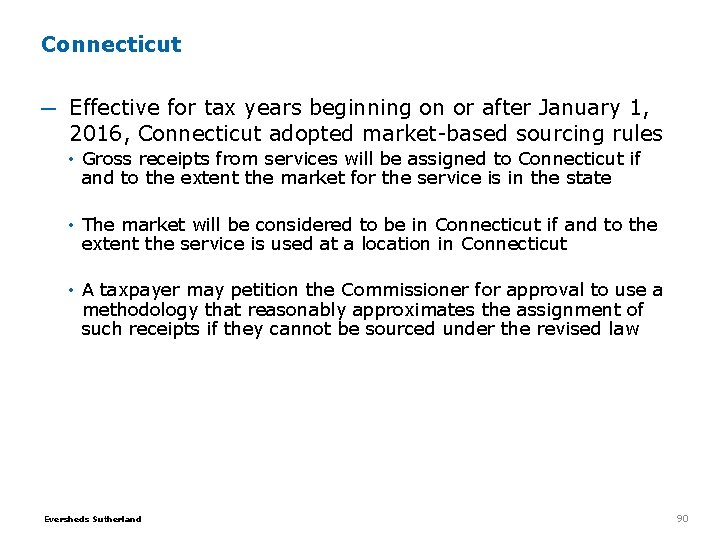
Connecticut ─ Effective for tax years beginning on or after January 1, 2016, Connecticut adopted market-based sourcing rules • Gross receipts from services will be assigned to Connecticut if and to the extent the market for the service is in the state • The market will be considered to be in Connecticut if and to the extent the service is used at a location in Connecticut • A taxpayer may petition the Commissioner for approval to use a methodology that reasonably approximates the assignment of such receipts if they cannot be sourced under the revised law Eversheds Sutherland 90
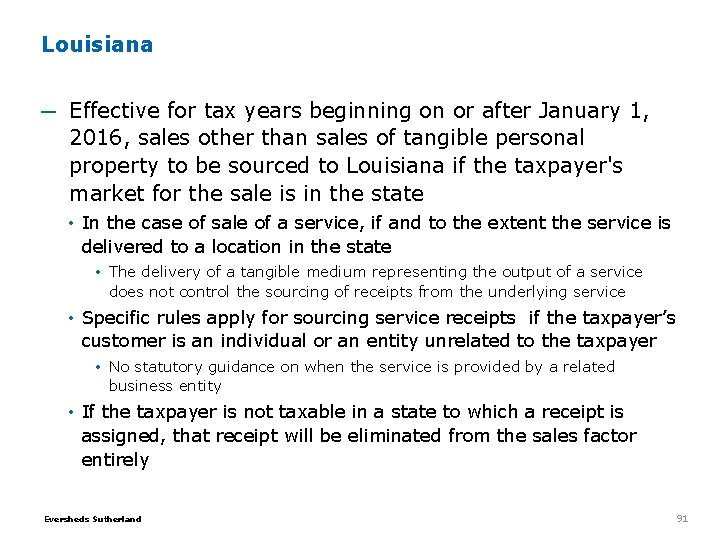
Louisiana ─ Effective for tax years beginning on or after January 1, 2016, sales other than sales of tangible personal property to be sourced to Louisiana if the taxpayer's market for the sale is in the state • In the case of sale of a service, if and to the extent the service is delivered to a location in the state • The delivery of a tangible medium representing the output of a service does not control the sourcing of receipts from the underlying service • Specific rules apply for sourcing service receipts if the taxpayer’s customer is an individual or an entity unrelated to the taxpayer • No statutory guidance on when the service is provided by a related business entity • If the taxpayer is not taxable in a state to which a receipt is assigned, that receipt will be eliminated from the sales factor entirely Eversheds Sutherland 91
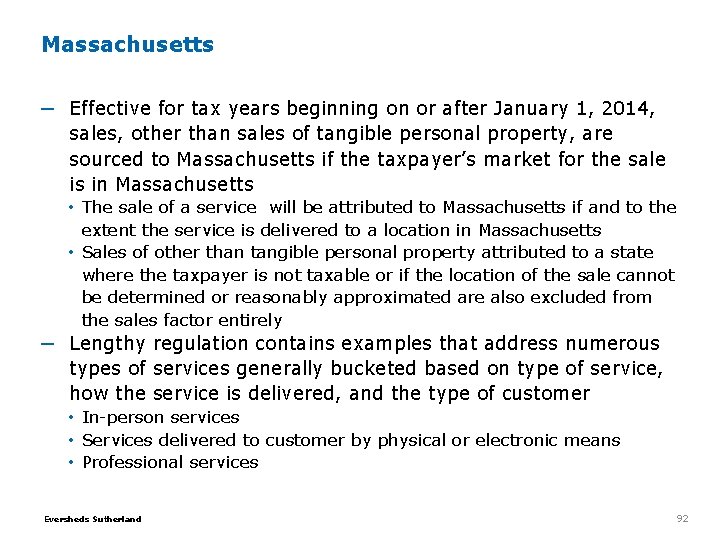
Massachusetts ─ Effective for tax years beginning on or after January 1, 2014, sales, other than sales of tangible personal property, are sourced to Massachusetts if the taxpayer’s market for the sale is in Massachusetts • The sale of a service will be attributed to Massachusetts if and to the extent the service is delivered to a location in Massachusetts • Sales of other than tangible personal property attributed to a state where the taxpayer is not taxable or if the location of the sale cannot be determined or reasonably approximated are also excluded from the sales factor entirely ─ Lengthy regulation contains examples that address numerous types of services generally bucketed based on type of service, how the service is delivered, and the type of customer • In-person services • Services delivered to customer by physical or electronic means • Professional services Eversheds Sutherland 92
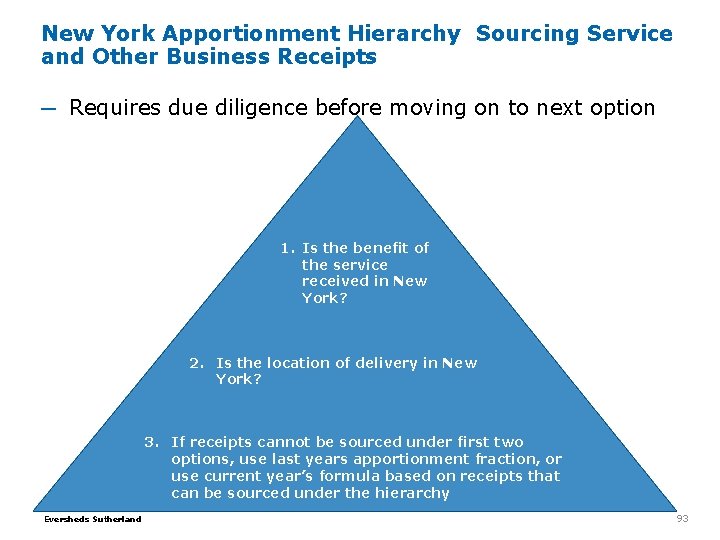
New York Apportionment Hierarchy Sourcing Service and Other Business Receipts ─ Requires due diligence before moving on to next option 1. Is the benefit of the service received in New York? 2. Is the location of delivery in New York? 3. If receipts cannot be sourced under first two options, use last years apportionment fraction, or use current year’s formula based on receipts that can be sourced under the hierarchy Eversheds Sutherland 93
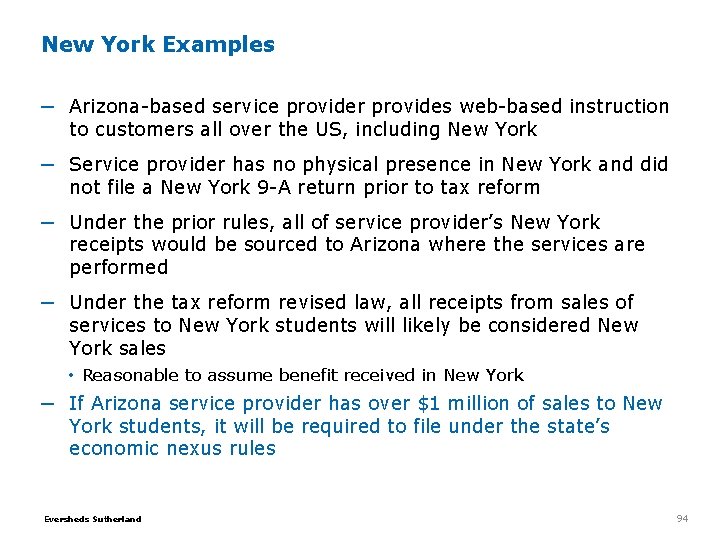
New York Examples ─ Arizona-based service provider provides web-based instruction to customers all over the US, including New York ─ Service provider has no physical presence in New York and did not file a New York 9 -A return prior to tax reform ─ Under the prior rules, all of service provider’s New York receipts would be sourced to Arizona where the services are performed ─ Under the tax reform revised law, all receipts from sales of services to New York students will likely be considered New York sales • Reasonable to assume benefit received in New York ─ If Arizona service provider has over $1 million of sales to New York students, it will be required to file under the state’s economic nexus rules Eversheds Sutherland 94
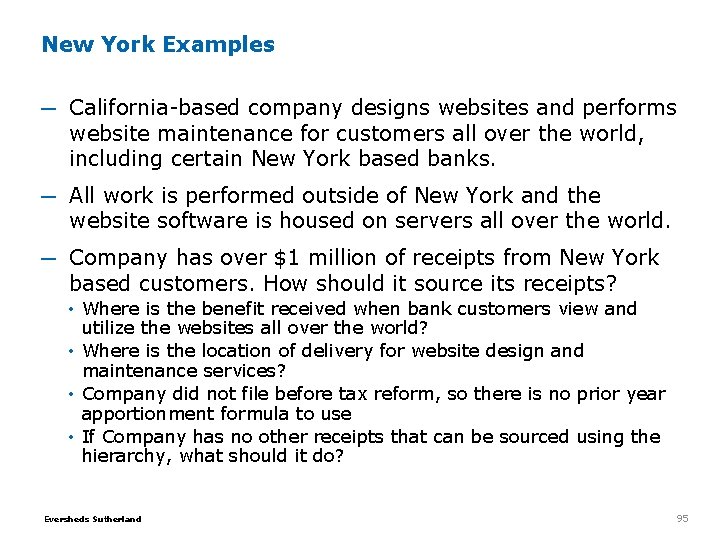
New York Examples ─ California-based company designs websites and performs website maintenance for customers all over the world, including certain New York based banks. ─ All work is performed outside of New York and the website software is housed on servers all over the world. ─ Company has over $1 million of receipts from New York based customers. How should it source its receipts? • Where is the benefit received when bank customers view and utilize the websites all over the world? • Where is the location of delivery for website design and maintenance services? • Company did not file before tax reform, so there is no prior year apportionment formula to use • If Company has no other receipts that can be sourced using the hierarchy, what should it do? Eversheds Sutherland 95
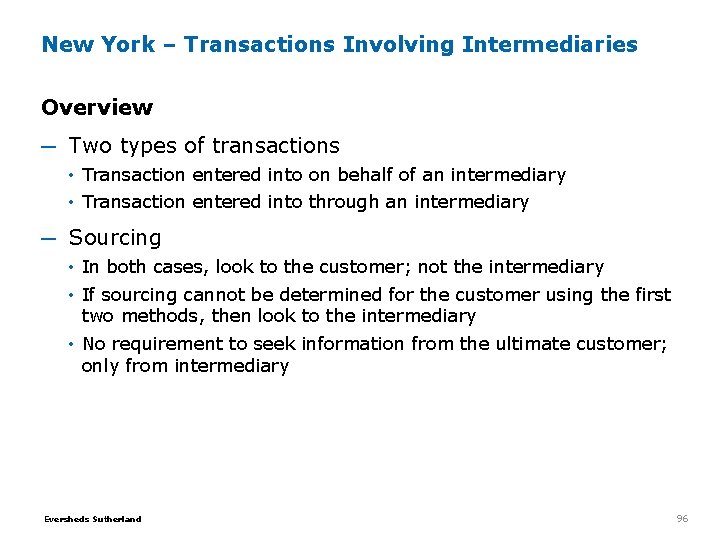
New York – Transactions Involving Intermediaries Overview ─ Two types of transactions • Transaction entered into on behalf of an intermediary • Transaction entered into through an intermediary ─ Sourcing • In both cases, look to the customer; not the intermediary • If sourcing cannot be determined for the customer using the first two methods, then look to the intermediary • No requirement to seek information from the ultimate customer; only from intermediary Eversheds Sutherland 96
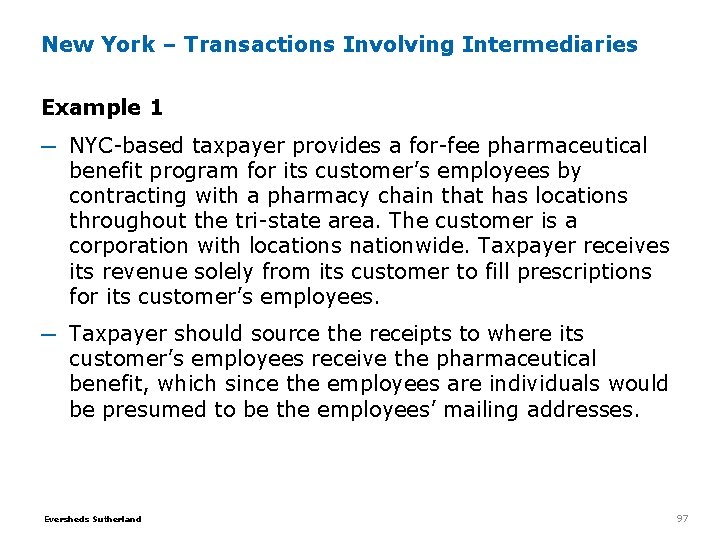
New York – Transactions Involving Intermediaries Example 1 ─ NYC-based taxpayer provides a for-fee pharmaceutical benefit program for its customer’s employees by contracting with a pharmacy chain that has locations throughout the tri-state area. The customer is a corporation with locations nationwide. Taxpayer receives its revenue solely from its customer to fill prescriptions for its customer’s employees. ─ Taxpayer should source the receipts to where its customer’s employees receive the pharmaceutical benefit, which since the employees are individuals would be presumed to be the employees’ mailing addresses. Eversheds Sutherland 97
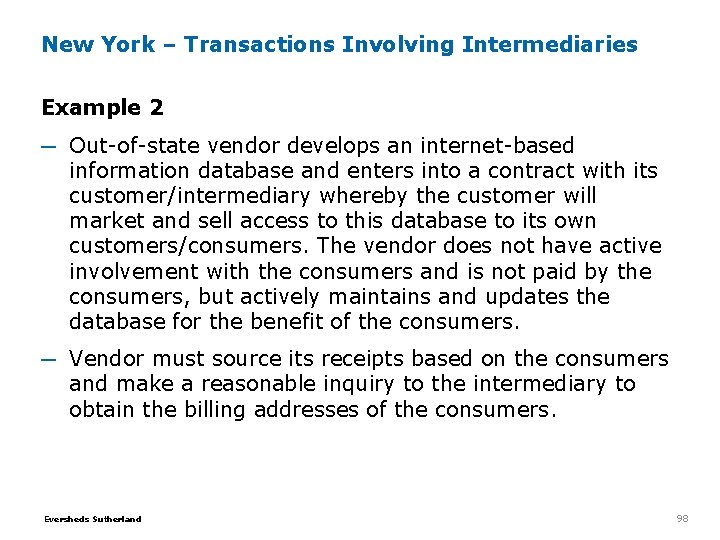
New York – Transactions Involving Intermediaries Example 2 ─ Out-of-state vendor develops an internet-based information database and enters into a contract with its customer/intermediary whereby the customer will market and sell access to this database to its own customers/consumers. The vendor does not have active involvement with the consumers and is not paid by the consumers, but actively maintains and updates the database for the benefit of the consumers. ─ Vendor must source its receipts based on the consumers and make a reasonable inquiry to the intermediary to obtain the billing addresses of the consumers. Eversheds Sutherland 98
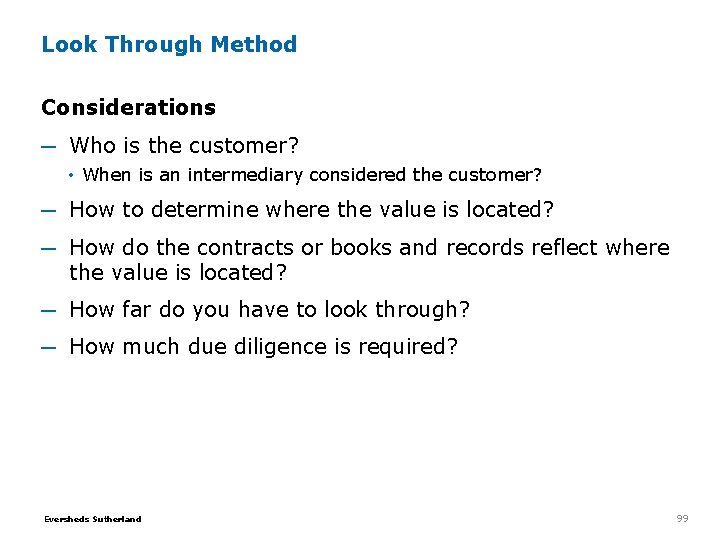
Look Through Method Considerations ─ Who is the customer? • When is an intermediary considered the customer? ─ How to determine where the value is located? ─ How do the contracts or books and records reflect where the value is located? ─ How far do you have to look through? ─ How much due diligence is required? Eversheds Sutherland 99
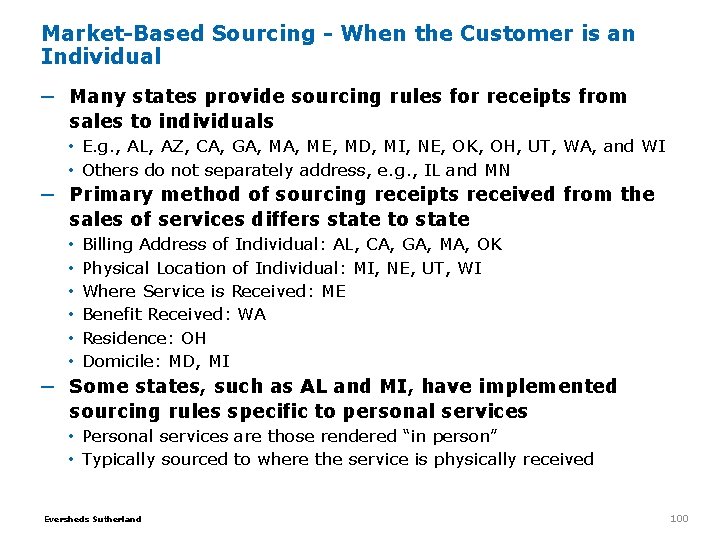
Market-Based Sourcing - When the Customer is an Individual ─ Many states provide sourcing rules for receipts from sales to individuals • E. g. , AL, AZ, CA, GA, ME, MD, MI, NE, OK, OH, UT, WA, and WI • Others do not separately address, e. g. , IL and MN ─ Primary method of sourcing receipts received from the sales of services differs state to state • • • Billing Address of Individual: AL, CA, GA, MA, OK Physical Location of Individual: MI, NE, UT, WI Where Service is Received: ME Benefit Received: WA Residence: OH Domicile: MD, MI ─ Some states, such as AL and MI, have implemented sourcing rules specific to personal services • Personal services are those rendered “in person” • Typically sourced to where the service is physically received Eversheds Sutherland 100
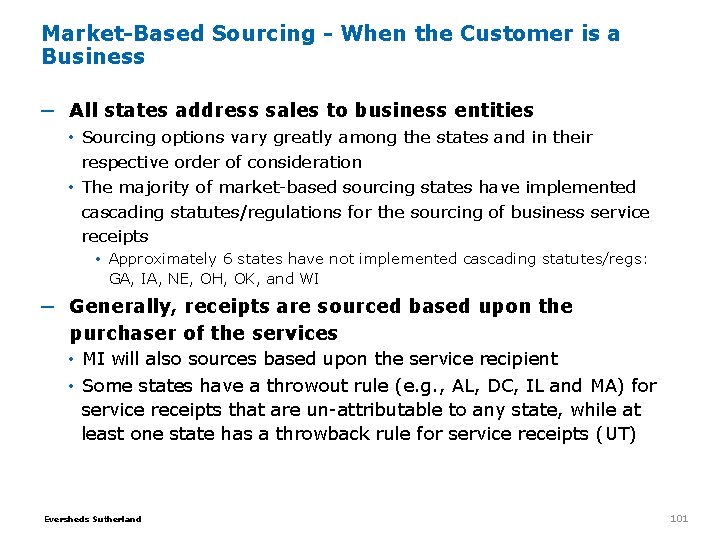
Market-Based Sourcing - When the Customer is a Business ─ All states address sales to business entities • Sourcing options vary greatly among the states and in their respective order of consideration • The majority of market-based sourcing states have implemented cascading statutes/regulations for the sourcing of business service receipts • Approximately 6 states have not implemented cascading statutes/regs: GA, IA, NE, OH, OK, and WI ─ Generally, receipts are sourced based upon the purchaser of the services • MI will also sources based upon the service recipient • Some states have a throwout rule (e. g. , AL, DC, IL and MA) for service receipts that are un-attributable to any state, while at least one state has a throwback rule for service receipts (UT) Eversheds Sutherland 101
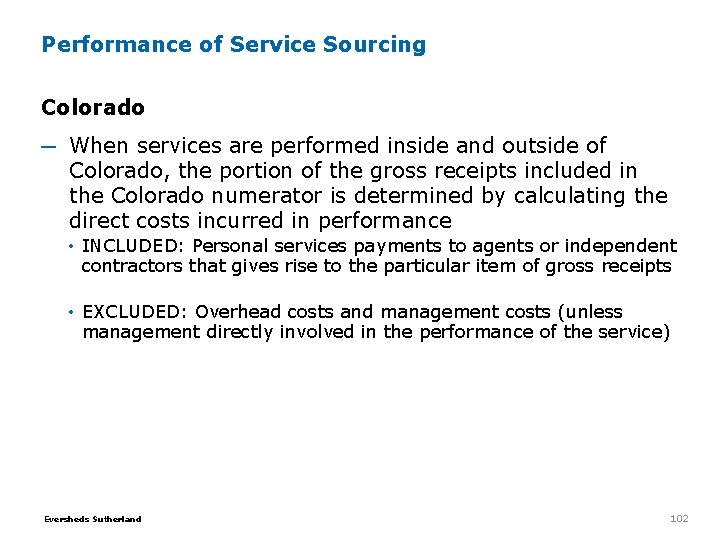
Performance of Service Sourcing Colorado ─ When services are performed inside and outside of Colorado, the portion of the gross receipts included in the Colorado numerator is determined by calculating the direct costs incurred in performance • INCLUDED: Personal services payments to agents or independent contractors that gives rise to the particular item of gross receipts • EXCLUDED: Overhead costs and management costs (unless management directly involved in the performance of the service) Eversheds Sutherland 102
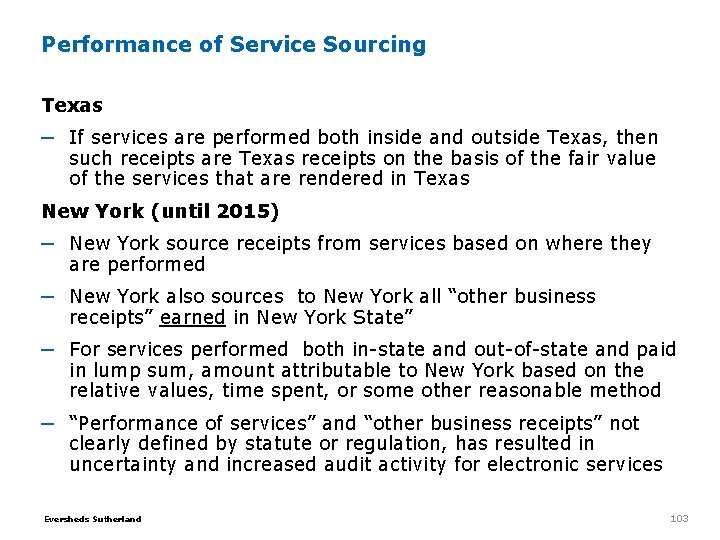
Performance of Service Sourcing Texas ─ If services are performed both inside and outside Texas, then such receipts are Texas receipts on the basis of the fair value of the services that are rendered in Texas New York (until 2015) ─ New York source receipts from services based on where they are performed ─ New York also sources to New York all “other business receipts” earned in New York State” ─ For services performed both in-state and out-of-state and paid in lump sum, amount attributable to New York based on the relative values, time spent, or some other reasonable method ─ “Performance of services” and “other business receipts” not clearly defined by statute or regulation, has resulted in uncertainty and increased audit activity for electronic services Eversheds Sutherland 103
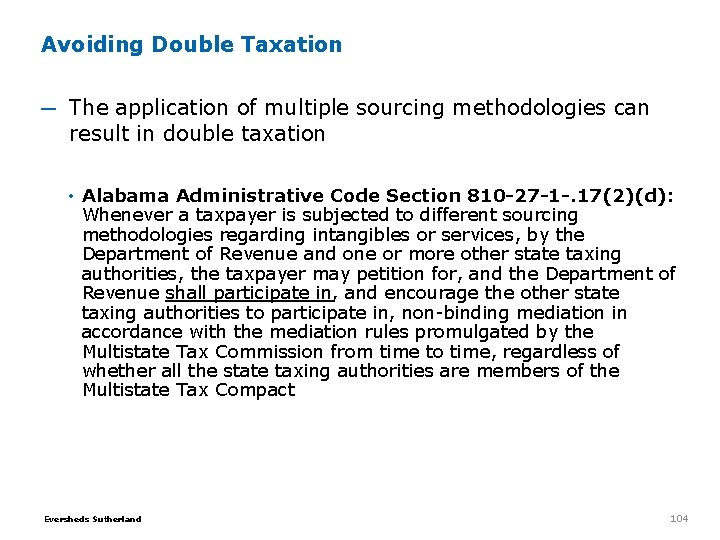
Avoiding Double Taxation ─ The application of multiple sourcing methodologies can result in double taxation • Alabama Administrative Code Section 810 -27 -1 -. 17(2)(d): Whenever a taxpayer is subjected to different sourcing methodologies regarding intangibles or services, by the Department of Revenue and one or more other state taxing authorities, the taxpayer may petition for, and the Department of Revenue shall participate in, and encourage the other state taxing authorities to participate in, non-binding mediation in accordance with the mediation rules promulgated by the Multistate Tax Commission from time to time, regardless of whether all the state taxing authorities are members of the Multistate Tax Compact Eversheds Sutherland 104
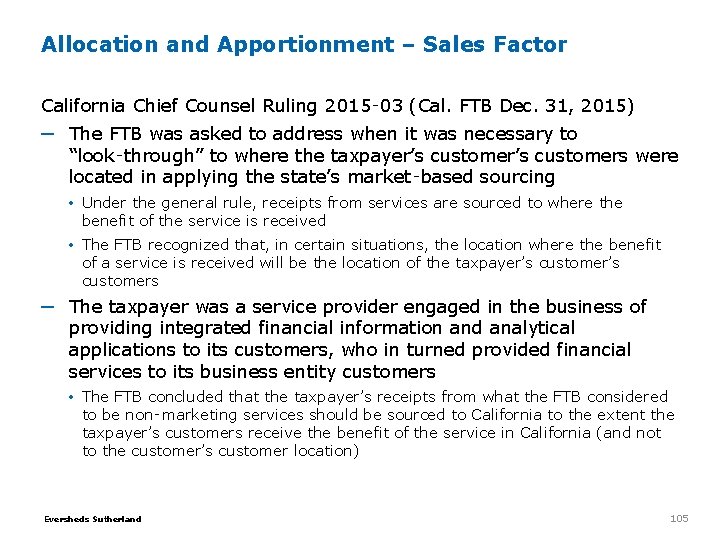
Allocation and Apportionment – Sales Factor California Chief Counsel Ruling 2015‑ 03 (Cal. FTB Dec. 31, 2015) ─ The FTB was asked to address when it was necessary to “look‑through” to where the taxpayer’s customers were located in applying the state’s market‑based sourcing • Under the general rule, receipts from services are sourced to where the benefit of the service is received • The FTB recognized that, in certain situations, the location where the benefit of a service is received will be the location of the taxpayer’s customers ─ The taxpayer was a service provider engaged in the business of providing integrated financial information and analytical applications to its customers, who in turned provided financial services to its business entity customers • The FTB concluded that the taxpayer’s receipts from what the FTB considered to be non‑marketing services should be sourced to California to the extent the taxpayer’s customers receive the benefit of the service in California (and not to the customer’s customer location) Eversheds Sutherland 105
Allocation and Apportionment – Sales Factor Cal. Code Regs. § 25136 -2 (approved Sept. 15, 2016) ─ The regulation provides guidance on items that were not addressed in the first iteration of the regulation • Defines “marketable securities” and provides guidance on sourcing sales of marketable securities • Addresses how to source interest as a gross receipt from intangible property • Provides that dividends and goodwill be sourced using rules for sales of stock or sales of ownership interests in pass-through entities ─ Example adopting a “look-through” approach for asset management fees were pulled from the final regulation leaving the sourcing of such fees somewhat unclear • The amendments to the regulation are effective for tax years beginning on or after January 1, 2015 • A taxpayer may elect to apply the amendments retroactively to tax years beginning on or after January 1, 2012, if those years are open under the statute of limitations Eversheds Sutherland 106
Questions? Eversheds Sutherland 107
Connect with us! Download the Eversheds Sutherland SALT Shaker app today Be sure to also submit your pet through our app to be featured as Pet of the Month! ─ Apple App Store ─ Google Play ─ Amazon Appstore @ESsaltlaw Eversheds Sutherland 108
Contact us Jeff Friedman Partner Eversheds Sutherland (US) LLP 202. 383. 0718 Jeff. Friedman@evershedssutherland. com Marc Simonetti Partner Eversheds Sutherland (US) LLP 212. 389. 5015 Marc. Simonetti@evershedssutherland. com stateandlocaltax. com eversheds-sutherland. com © 2017 Eversheds Sutherland (US) LLP All rights reserved. This communication cannot be used for the purpose of avoiding any penalties that may be imposed under federal, state or local tax law.
ASC 450: The Ins and Outs of Loss Contingencies and Accruals Denver TEI May 24, 2017 Saylor Sims, Managing Director, State and Local Tax, Phoenix, AZ Saylor. Sims@us. gt. com Metisse Lutz, Manager, Indirect State and Local Tax, Denver, CO Metisse. Lutz@us. gt. com © Grant Thornton LLP. All rights reserved.
Learning objectives ─ Summarize the application of ASC 450 to taxes imposed by state and local governments ─ Recognize thresholds contained in ASC 450 that are to be applied to determine if an accrual must be established for the potential exposure or if a disclosure is sufficient. ─ Identify typical state and local tax exposure areas that must be considered for ASC 450 purposes.
Agenda ─ Overview of ASC 450 ─ Accrual and Disclosure Requirements ─ Threshold Comparison of ASC 450 Disclosures and Accruals ─ Loss Contingencies and Establishing Reserves
ASC 450: Overview ─ ASC 450 (formerly FAS 5) determines whether a loss contingency must be: • Accrued • Disclosed
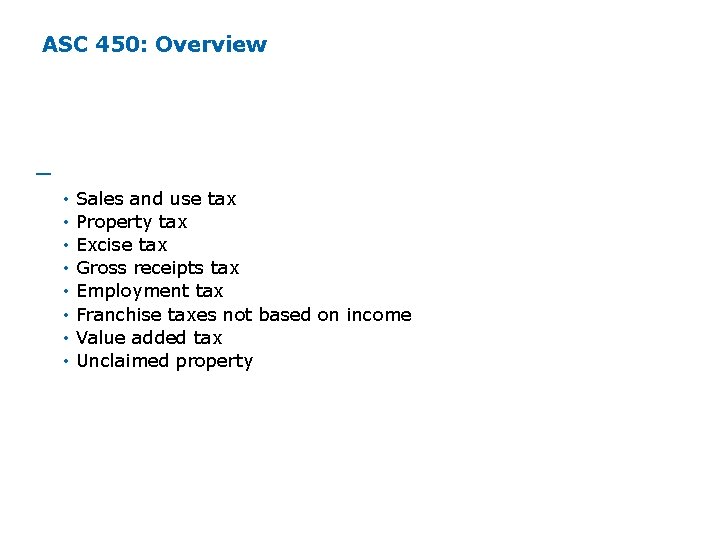
ASC 450: Overview ─ Governs non-income tax exposures • • Sales and use tax Property tax Excise tax Gross receipts tax Employment tax Franchise taxes not based on income Value added tax Unclaimed property
ASC 450: Overview ─ What is considered to be a "contingency"? • An existing condition, situation, or set of circumstances involving uncertainty as to possible gain or loss that will ultimately be resolved when one or more future events occur or fail to occur
ASC 450: Overview ─ What is not considered to be a "contingency"? • Liabilities • Mistakes or known exposures are liabilities and not ASC 450 contingencies • No "uncertainty" exists NOTE: Indirect taxes are not contingencies if the laws of the taxing jurisdiction(s) clearly apply to the transaction(s)
ASC 450: Overview ─ Potential Basis for Contingencies • Nexus • Change in business activities • Expansion of market • New hires • New products • Change in state laws • Click-Through/Affiliate Nexus • Economic Nexus
ASC 450: Overview ─ Potential Basis for Contingencies (Cont'd) • Business Acquisition/Reorganization • Existing/legacy sales and use tax liabilities of the target • Timing of discovering liabilities will affect disclosure and reserve decision process • Taxability of Specific Items • Advertising and promotional items – taxation/sourcing/use may be uncertain • Software purchased for use in multiple locations/locations uncertain at time of purchase/license
ASC 450: Overview ─ Potential Basis for Contingencies (Cont'd) • Exemptions • Are administrative requirements followed? • Qualification for exemption is not clear or exemption is subsequently disallowed
ASC 450: Overview ─ Potential Basis for Contingencies • Frequently encountered examples of tax positions & audit assessments creating contingencies Colorado: Home rule taxability of sales/services Pennsylvania: Taxation of cleaning/waste removal services Florida: Commercial Rent/License to use Real Property
ASC 450: Overview ─ Potential Basis for Contingencies • Frequently encountered examples of tax positions & audit assessments creating contingencies Illinois: Chicago – Software Purchases Arizona: Taxation of Construction/MMRA Contracts California: Occasional Sale Exemption
ASC 450: Overview ─ Compare to ASC 740 • Addresses effects of income taxes that result from a company's activities during the current and preceding years. • • • Nexus Issues Apportionment/Sourcing Net Operating Losses Related Party Expense Addback Legislative & Regulatory Changes Federal vs. State Differences (State Adjustments)
ASC 450: Overview ─ Compare to ASC 740 (Cont'd) • Objectives of ASC 740 are to recognize: • The amount of income taxes payable or refundable for the current year; and • Deferred tax liabilities and assets for future tax consequences of events that have been recognized in an enterprise’s financial statements or tax returns.
ASC 450: Overview Tax Uncertain Positions and Loss Contingencies: ASC 740. 10 and ASC 450 ─ The evaluation of the adequacy of a client’s tax exposure reserves represents one of the most sensitive and judgmental areas of tax ─ ASC 740. 10 establishes specific “ground rules” and methodologies for the identification and analysis of income tax positions, including contingent gains ─ ASC 450 establishes specific “ground rules” and methodologies for the identification and analysis of non-income tax positions, including contingent gains ─ ASC 740. 10 assumes all income tax returns are examined by the relevant taxing authorities and those authorities have full knowledge of all relevant information. • Detection risk is not to be considered
Agenda ─ Overview of ASC 450 ─ Accrual and Disclosure Requirements ─ Threshold Comparison of ASC 450 Disclosures and Accruals ─ Loss contingencies and Establishing Reserves
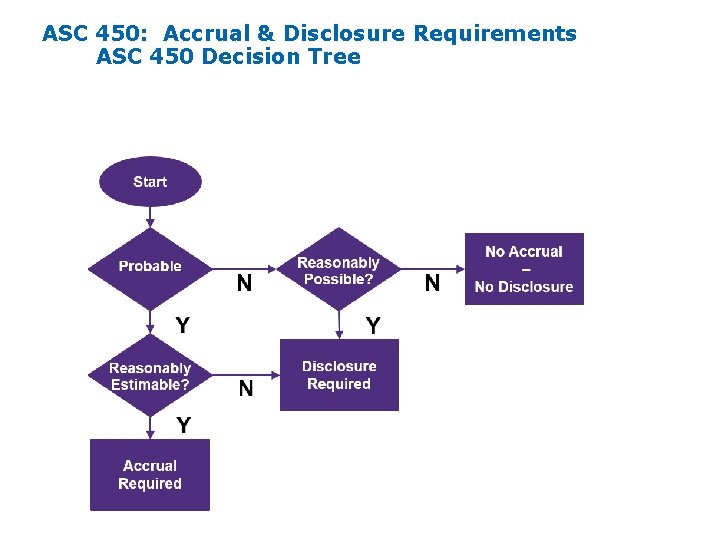
ASC 450: Accrual & Disclosure Requirements ASC 450 requires a loss contingency be accrued only when it is: • Probable the liability has been incurred, and • The amount of the loss can be reasonably estimated.
ASC 450: Accrual & Disclosure Requirements ─ If the reasonable estimate of the loss is a range, and some amount within the range appears to be a better estimate than any other amount within the range, that amount should be accrued. ─ When no amount within the range appears to be a better estimate than any other amount within the range, the minimum amount should be accrued.
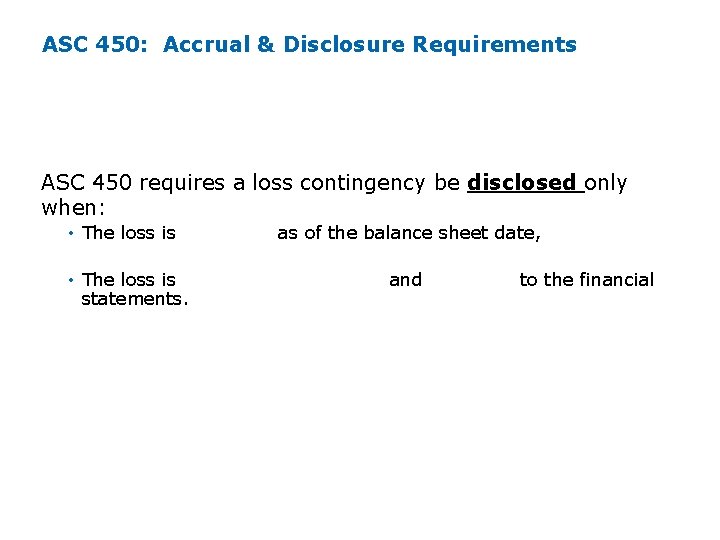
ASC 450: Accrual & Disclosure Requirements ASC 450 requires a loss contingency be disclosed only when: • The loss is probable as of the balance sheet date, or • The loss is reasonably possible and material to the financial statements.
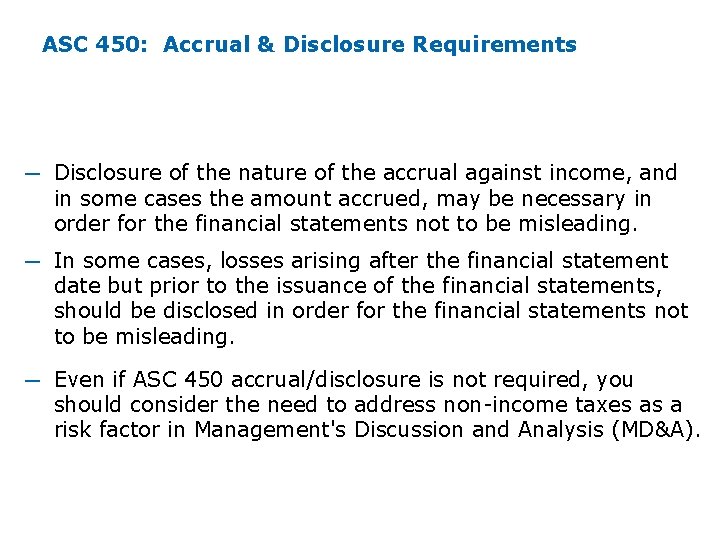
ASC 450: Accrual & Disclosure Requirements ─ Disclosure of the nature of the accrual against income, and in some cases the amount accrued, may be necessary in order for the financial statements not to be misleading. ─ In some cases, losses arising after the financial statement date but prior to the issuance of the financial statements, should be disclosed in order for the financial statements not to be misleading. ─ Even if ASC 450 accrual/disclosure is not required, you should consider the need to address non-income taxes as a risk factor in Management's Discussion and Analysis (MD&A).
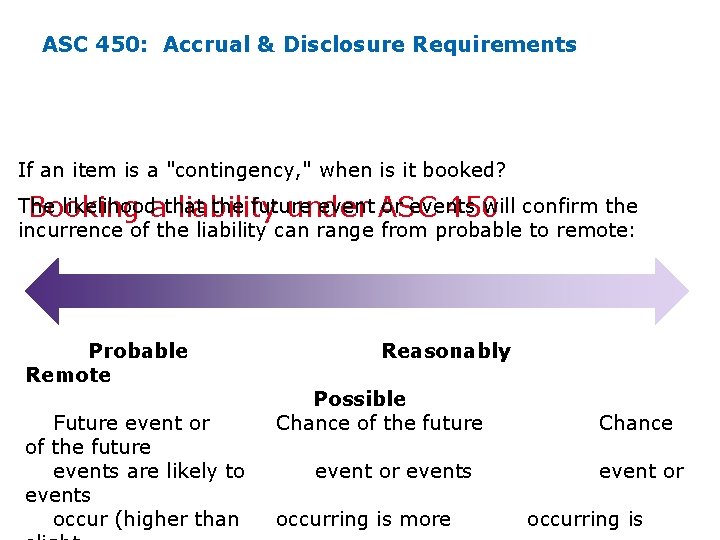
ASC 450: Accrual & Disclosure Requirements If an item is a "contingency, " when is it booked? The likelihood that the future event or events will confirm the Booking a liability under ASC 450 incurrence of the liability can range from probable to remote: Probable Remote Reasonably Possible Chance of the future Future event or Chance of the future events are likely to event or events occur (higher than occurring is more occurring is
ASC 450: Accrual & Disclosure Requirements ASC 450 Decision Tree
Agenda ─ Overview of ASC 450 ─ Accrual and Disclosure Requirements ─ Threshold Comparison of ASC 450 Disclosures and Accruals ─ Loss contingencies and Establishing Reserves
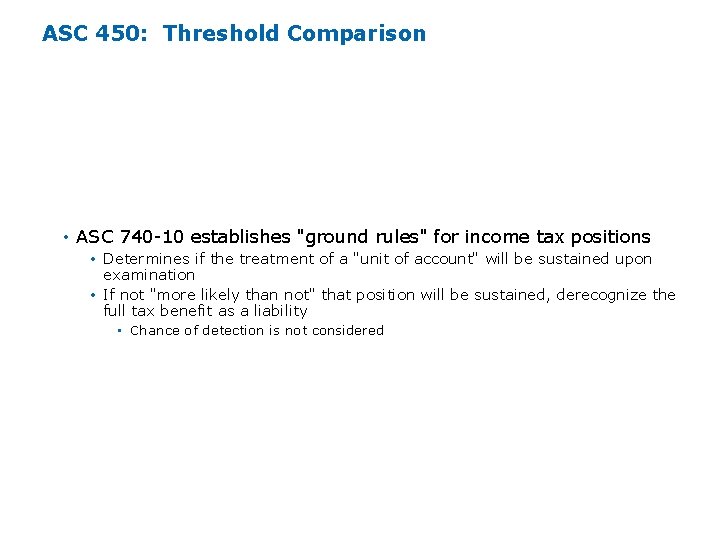
ASC 450: Threshold Comparison Putting the standards into perspective with ASC 740 -10: "Probable" and "Reasonably Possible" • ASC 740 -10 establishes "ground rules" for income tax positions • Determines if the treatment of a "unit of account" will be sustained upon examination • If not "more likely than not" that position will be sustained, derecognize the full tax benefit as a liability • Chance of detection is not considered
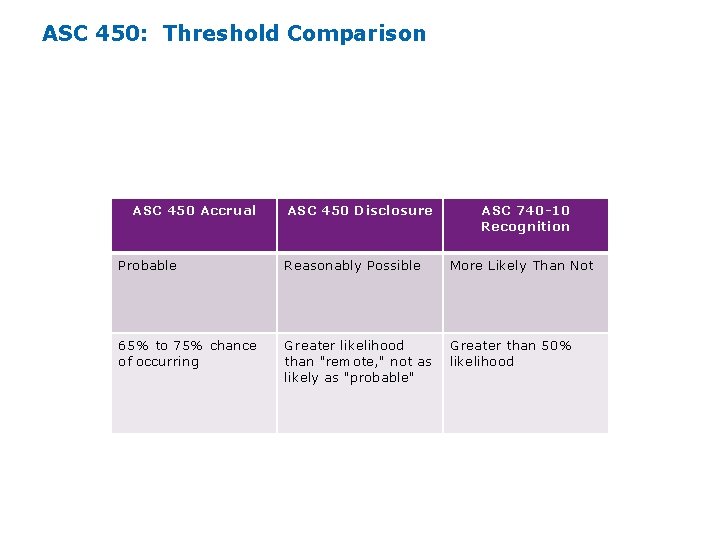
ASC 450: Threshold Comparison ASC 450 Accrual ASC 450 Disclosure ASC 740 -10 Recognition Probable Reasonably Possible More Likely Than Not 65% to 75% chance of occurring Greater likelihood Greater than 50% than "remote, " not as likelihood likely as "probable"
Agenda ─ Overview of ASC 450 ─ Accrual and Disclosure Requirements ─ Threshold Comparison of ASC 450 Disclosures and Accruals ─ Loss contingencies and Establishing Reserves
ASC 450: Loss contingencies ─ What about unasserted claims? • Unasserted claims meet the definition of a contingency. • Unasserted claims are essentially “potential claims. ” • They are potential because the claim has yet to be made, but the entity has a risk of loss due to their prior actions. • Unasserted claims or assessments are those claims where the claimant has not yet notified the company of their claim. ─ A judgment must first be made whether assertion of the claim is probable or reasonably possible.
ASC 450: Loss contingencies ─ Detection Risk, as defined by International Auditing Standards: "The risk that the procedures performed by the auditor to reduce audit risk to an acceptably low level will not detect a misstatement that exists and that could be material, either individually or when aggregated with other misstatements. " ─ During its FIN 48 deliberations, the FASB concluded that detection risk does not apply to a self-assessment and self-reporting tax system.
ASC 450: Loss contingencies Situations that may Drive Loss Contingencies • Audits in Progress/Significant Audit Assessments • Audits in Appeals or Litigation • Under collection (system) errors • Failure to obtain/maintain exemption certificates • Inadequate tax decisions
ASC 450: Loss Contingencies Situations that may Drive Loss Contingencies (Cont'd): • Non-filing/uncertain nexus positions • Buyer Due Diligence • Business Expansion • Business Acquisitions/Dispositions • Evolution of state laws (nexus, sourcing, product taxability)
ASC 450: Loss Contingencies Considerations: • Materiality • Statute of Limitations • Penalties and Interest • Refund offsets • Supporting Documentation • Customer Indemnifications/Remedial actions
ASC 450: Releasing reserves ─ Generally occurs when there is a change in circumstances, such as: − Changes in the applicable laws − Audit adjustments − Statute of limitations close, if applicable − Voluntary Disclosures − Confirmation/documentation of customer payments
Any final questions?
State Tax Implications of Federal Tax Reform May 24, 2017
Agenda 1. The proposals 2. State tax law conformity 3. Destination-based tax / border adjustment 4. Full expensing of capital investments 5. Elimination of deduction for interest expense 6. Repatriation 7. NOL deductions 8. Other state tax issues 144
─1 The Proposals
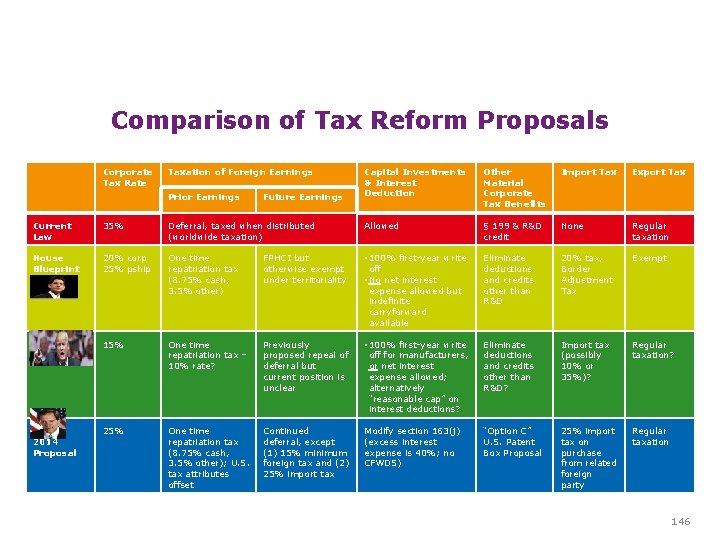
Comparison of Tax Reform Proposals Corporate Tax Rate Taxation of Foreign Earnings Prior Earnings Future Earnings Capital Investments & Interest Deduction Other Material Corporate Tax Benefits Import Tax Export Tax Current Law 35% Deferral, taxed when distributed (worldwide taxation) Allowed § 199 & R&D credit None Regular taxation House Blueprint 20% corp 25% pship One time repatriation tax (8. 75% cash, 3. 5% other) FPHCI but otherwise exempt under territoriality • 100% first-year write Eliminate deductions and credits other than R&D 20% tax, Border Adjustment Tax Exempt Trump Plan 15% One time repatriation tax – 10% rate? Previously proposed repeal of deferral but current position is unclear • 100% first-year write Eliminate deductions and credits other than R&D? Import tax (possibly 10% or 35%)? Regular taxation? Camp 2014 Proposal 25% One time repatriation tax (8. 75% cash, 3. 5% other); U. S. tax attributes offset Continued deferral, except (1) 15% minimum foreign tax and (2) 25% import tax Modify section 163(j) (excess interest expense is 40%; no CFWDS) “Option C” U. S. Patent Box Proposal 25% import tax on purchase from related foreign party Regular taxation off • No net interest expense allowed but indefinite carryforward available off for manufacturers, or net interest expense allowed; alternatively “reasonable cap” on interest deductions? 146
─2 State Tax Law Conformity
State Tax Law Conformity 1. Almost all states begin the computation of state taxable income with federal taxable income 2. Methods for states to conform with IRC a)State taxable income begins with federal taxable income (most states) b)Rolling date conformity (i. e. , adopt IRC as currently in effect for tax year) c)Fixed date conformity (i. e. , conform with IRC “as of” a certain date, e. g. , CA) d)Specific adoption of IRC sections 3. States with gross receipts taxes (NV, OH, WA) will not be impacted 148
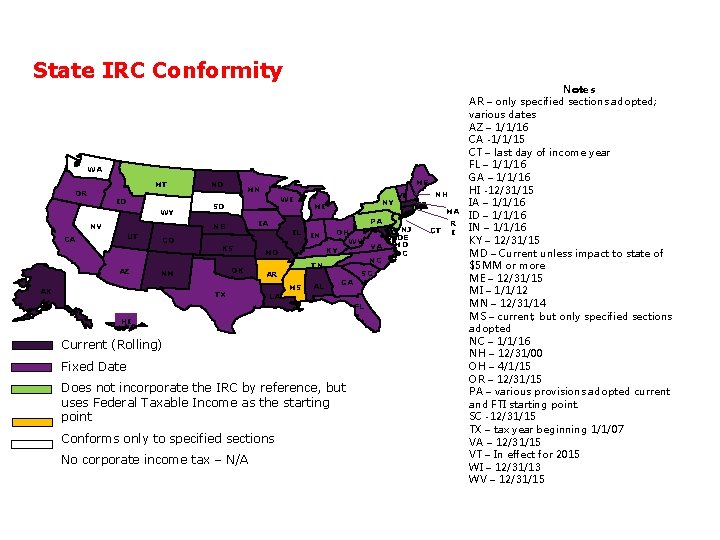
State IRC Conformity WA MT OR ID WY NV CA ND WI SD AZ CO KS OK NM AK IA NE UT ME MN TX IL IN MO TN AR LA MS NY MI AL PA OH WV KY SC GA FL HI Current (Rolling) Fixed Date Does not incorporate the IRC by reference, but uses Federal Taxable Income as the starting point Conforms only to specified sections No corporate income tax – N/A VA NC VT NH MA NJ DE MD DC CT R I Notes AR – only specified sections adopted; various dates AZ – 1/1/16 CA -1/1/15 CT – last day of income year FL – 1/1/16 GA – 1/1/16 HI -12/31/15 IA – 1/1/16 ID – 1/1/16 IN – 1/1/16 KY – 12/31/15 MD – Current unless impact to state of $5 MM or more ME – 12/31/15 MI – 1/1/12 MN – 12/31/14 MS – current, but only specified sections adopted NC – 1/1/16 NH – 12/31/00 OH – 4/1/15 OR – 12/31/15 PA – various provisions adopted current and FTI starting point. SC -12/31/15 TX – tax year beginning 1/1/07 VA – 12/31/15 VT – In effect for 2015 WI – 12/31/13 WV – 12/31/15
─3 Destination-Based Tax / Border Adjustment
Destination-Based Tax / Border Adjustment 1. Destination-Based Cash Flow Tax (Blueprint) a)Jurisdiction to tax would follow the location of consumption rather than the location of production b)Exported goods and services would be excluded from taxable receipts while imported items would be included 2. “Border Adjustment Tax” (Blueprint) a)No deduction for costs of goods/services (COGS) incurred outside of U. S. b)Permits a deduction for COGS incurred inside the U. S. c)Controversial for several reasons, including: • Potential WTO and tax treaty violations • Creates winners and losers among different industries 151
Destination-Based Tax / Border Adjustment 1. State conformity with the border adjustment tax may violate the Foreign Commerce Clause a)Disallowing a foreign COGS deduction while allowing a domestic COGS may run afoul of Kraft v. Iowa Department of Revenue, 505 U. S. 71 (1992) b)In Kraft, Iowa violated the Foreign Commerce Clause by allowing a deduction for dividends received from domestic subsidiaries while disallowing a deduction for dividends received from foreign subsidiaries c)Federal government may discriminate against foreign commerce, but states cannot even if conforming to federal/IRC treatment, absent Congressional approval/authorization d)Violation would occur immediately for states that start with federal taxable income when defining state taxable income or with rolling date conformity. e)States may need to decouple from border adjustment by either: • allowing COGS deduction for domestic and foreign costs, or • denying COGS deduction altogether 152
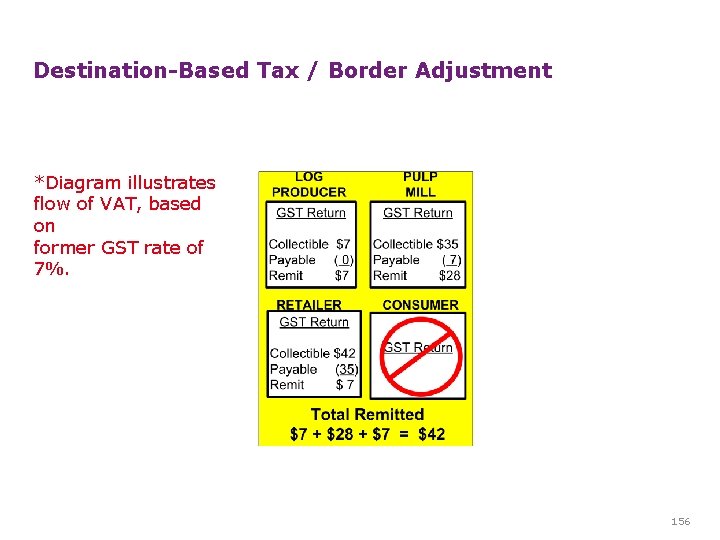
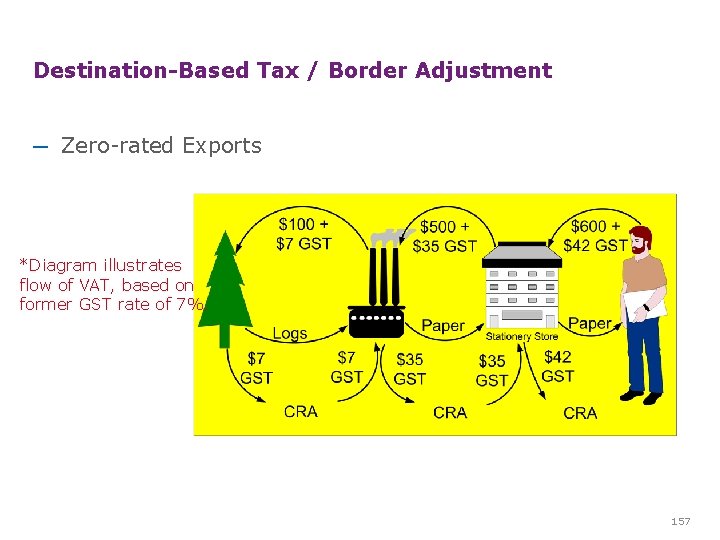
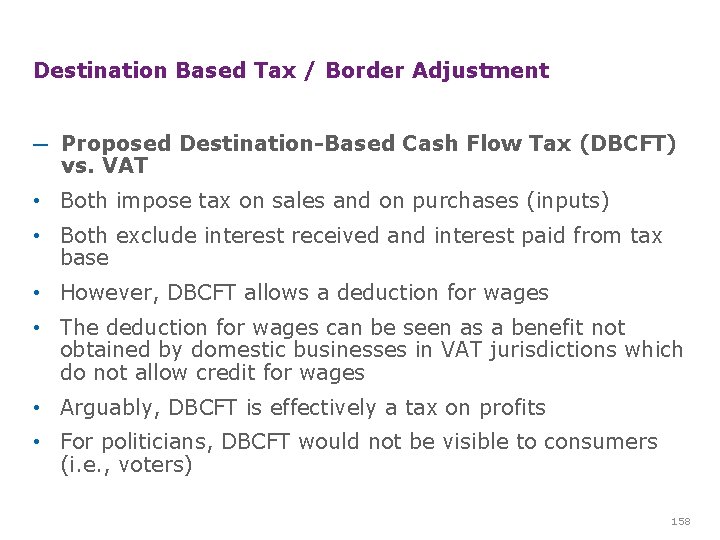
Destination-Based Tax / Border Adjustment ─ WTO Concerns: • Prohibition against export subsidies and “discriminatory” import taxes • Border adjustments acceptable for indirect taxes (i. e. , consumption taxes, such as VAT and excise taxes) but not for direct taxes (e. g. , income taxes) • Is the proposed Destination Based Cash Flow Tax a VAT? • • VAT is a tax levied at each stage of production and distribution on a firm’s value added Value added is the difference between a firm’s sales and the firm’s purchased inputs 153
Destination-Based Tax / Border Adjustment ─ Tax on consumption which is ultimately borne by the final consumer ─ Two main types of VATs 1. Credit Invoice Method: Firms show VAT separately on all sales invoices through the production and distribution process ─ Firms at each level calculate VAT collected on sales and subtract VAT paid on purchases and remit difference to government 2. Subtraction Method: Firms subtract cost of taxed inputs from sales and determine VAT liability by multiplying the difference by the VAT rate ─ Nearly all jurisdictions with VAT use the credit invoice method (including Canada) 154
Destination Based Tax / Border Adjustment ─ Diagram of a VAT ─ *Diagram illustrates ─ flow of VAT, based on ─ former GST rate of 7%. 155
Destination-Based Tax / Border Adjustment *Diagram illustrates flow of VAT, based on former GST rate of 7%. 156
Destination-Based Tax / Border Adjustment ─ Zero-rated Exports *Diagram illustrates flow of VAT, based on former GST rate of 7%. 157
Destination Based Tax / Border Adjustment ─ Proposed Destination-Based Cash Flow Tax (DBCFT) vs. VAT • Both impose tax on sales and on purchases (inputs) • Both exclude interest received and interest paid from tax base • However, DBCFT allows a deduction for wages • The deduction for wages can be seen as a benefit not obtained by domestic businesses in VAT jurisdictions which do not allow credit for wages • Arguably, DBCFT is effectively a tax on profits • For politicians, DBCFT would not be visible to consumers (i. e. , voters) 158
─4 Full Expensing of Capital Investments
Full Expensing of Capital Investments 1. Full and immediate expensing a)Blueprint calls for full and immediate expensing of capital investments relating to both tangible and intangible property b)During the campaign, Trump proposed allowing manufacturers to choose between full expensing or the deductibility of interest paid, but not both 2. States may choose to decouple a)Change could decrease state tax revenues in the short-term b)Proposal is similar to bonus depreciation at federal level from which many states decouple c)States may decouple by requiring an addback in the initial year followed by subtraction modifications in later years 160
─5 Elimination of Deduction for Interest Expense
Elimination of Deduction for Interest Expense 1. Elimination of interest expense deduction a)As part of move to full and immediate expensing, the Blueprint would eliminate the deduction for interest expense b)Interest expense would be netted against interest income, carried forward, and allowed as a deduction only against net interest income in future years 2. Trump’s proposal is unlikely to eliminate interest expense deduction 3. Senate Finance Committee may limit interest expense deductibility 4. State conformity with any elimination of the interest expense deduction would broaden/increase the state tax base/revenues 162
Elimination of Deduction for Interest Expense 1. Many states disallow deductions for interest paid to related parties through an addback. Under Blueprint, addback statute may become unnecessary for these intercompany interest expenses 2. Different members of a federal consolidated group may be able to deduct interest expense against the interest income of other members. This offsetting could not occur in separate return states 163
─6 Repatriation
Repatriation 1. Repatriation of deferred foreign earnings a)Blueprint imposes a mandatory one-time, reduced tax rate on deferred and non-patriated foreign earnings of corporations at a rate of 8. 75% on cash/cash equivalents and 3. 5% on all other accumulated foreign earnings b)A previous/similar repatriation occurred through a 85% dividendsreceived deduction 2. Most states provide full exclusion foreign dividends through subtraction modification or DRD; potential windfall for states that do not 3. States cannot violate Foreign Commerce Clause with their DRDs / must be consistent with foreign and domestic DRDs (See Kraft) 4. Business vs. non-business income classification of repatriated earnings 5. Tax on foreign earnings would be eliminated going forward (i. e. unlimited DRD deduction and repeal of subpart F rules) 165
─7 NOL Deductions
NOL Deductions 1. Blueprint NOL Deductions a)NOLs could be carried forward indefinitely, but not carried back b)NOL carryforward limited to 90% of net taxable income 2. Most states already do not conform to federal NOL rules a)Many states compute state-specific NOLs that are subject to state-specific carryback and carryforward periods b)Little incentive for states to conform to federal NOL changes given high level of nonconformity in this area 167
─8 Other State Tax Issues
Other State Tax Issues 1. State/local tax itemized deduction – while not affecting states’ revenues, the proposal to eliminate the state/local taxes paid deduction would affect highincome individuals in states like CA and NY 2. Estate tax – repeal of federal estate tax would create conformity/administration issues for the handful of states with estate taxes 3. Conformity decisions – state legislatures will need to meet, analyze the federally adopted tax changes and determine whether to conform/decouple 4. Tax base impacts – state tax bases will likely be broader, but some provisions (immediate and full expensing of capital investments) may decrease state taxes collected 5. Rate reductions – do states follow Congress’ lead and reduce rates? 169
─9 TEI’s Tax Reform Task Force
TEI’s Tax Reform Task Force 1. Will evaluate, on an industry-by-industry basis, legislative proposals for substantive tax impacts and the administrative implications of federal tax reform 2. Objective is to allow TEI to make meaningful and constructive contributions to the tax reform debate, serve all of its members to promote sound, fair tax administration while avoid pitting one industry group versus another 3. Contact asktei@tei. org for more information or get involved! 171
Questions? 172
Maria Eberle Baker & Mc. Kenzie LLP maria. eberle@bakermckenzie. com (212) 626 -4414 Pilar Mata Tax Executives Institute pmata@tei. org (202) 464 -8346 www. bakermckenzie. com Baker & Mc. Kenzie Compliance Consulting LLC provides compliance management and support services and does not provide legal advice or services. Baker & Mc. Kenzie Compliance Consulting LLC is a corporation wholly owned by Baker & Mc. Kenzie LLP, a member firm of Baker & Mc. Kenzie International, a Swiss Verein with member law firms around the world. In accordance with the common terminology used in professional service organizations, reference to a "partner" means a person who is a partner, or equivalent, in such a law firm. Similarly, reference to an "office" means an office of any such law firm. This may qualify as “Attorney Advertising” requiring notice in some jurisdictions. Prior results do not guarantee a similar outcome. © 2017 Baker & Mc. Kenzie Compliance Consulting LLC
Routes to Early Issue Resolution Shirley Sicilian, KPMG, LLP Dan De Jong, KPMG LLP TEI Denver Chapter May 24, 2017
Notice — The following information is not intended to be “written advice concerning one or more Federal tax matters” subject to the requirements of section 10. 37(a)(2) of Treasury Department Circular 230. — The information in this presentation is of a general nature and based on authorities that are subject to change. Applicability of the information to specific situations should be determined through consultation with your tax adviser. © 2017 KPMG LLP, a Delaware limited liability partnership and the U. S. member firm of the KPMG network of independent member firms affiliated with KPMG International Cooperative (“KPMG International”), a Swiss entity. All rights reserved. 175
Agenda — Introduction — Examples of Early Resolution Options — Strategies for Best Utilizing Early Resolution Programs — Closing Thoughts © 2017 KPMG LLP, a Delaware limited liability partnership and the U. S. member firm of the KPMG network of independent member firms affiliated with KPMG International Cooperative (“KPMG International”), a Swiss entity. All rights reserved. 176
Effects of uncertainty — Bell. South Advertising & Publishing Corp. v. Chumley, 308 S. W. 3 d 350 (Tenn. Ct. App. 2009) - Court sustained assessment of $10 million and interest of $3 million based on application of alternative apportionment — Hess Corporation, Exxon Mobil Oil Corporation, and Shell Oil Company v. D. C. Office of Tax & Revenue - Years-long litigation regarding transfer pricing assessments — Delhaize Am. , Inc. v. Lay, No. COA 11 -868 (N. C. Ct. App. 2012) - Court sustained assessment of millions in tax and penalties based on forced combination of Delhaize and its IHC — National Grid USA Service Company, Inc. v. Commissioner of Revenue, 89 Mass. App. Ct. 522 (Mass. App. Ct. 2016) - Court ruled that certain transactions did not constitute bona fide debt, and further, that closing agreement between the taxpayer and IRS which allowed a portion of the interest deduction did not bind Massachusetts. © 2017 KPMG LLP, a Delaware limited liability partnership and the U. S. member firm of the KPMG network of independent member firms affiliated with KPMG International Cooperative (“KPMG International”), a Swiss entity. All rights reserved. 177
Effects of uncertainty — New Mexico Tax. & Rev. Dep’t v. Barnesandnoble. com LLC, No. 33, 627 (N. M. 2013) - Court upheld assessment, ruling that taxpayer had nexus with the state based on the in-state activities of an affiliate — Charging sales tax on Saa. S - E. g. , Comptroller Decision No. 112, 865 (Tex. Comptroller of Public Accounts July 5, 2016) - upheld assessment on taxpayer providing internet-based supply chain and purchasing services as taxable data processing — Illinois qui tam lawsuits regarding improper sales and use tax collection - For example, lawsuits against Target, wine retailers, others, for not collecting sales tax — Class action lawsuit against AT&T for collecting taxes on internet access charges © 2017 KPMG LLP, a Delaware limited liability partnership and the U. S. member firm of the KPMG network of independent member firms affiliated with KPMG International Cooperative (“KPMG International”), a Swiss entity. All rights reserved. 178
Early resolution: Prior to filing the return – Letter rulings What’s in a name? — Nearly all states provide some type of letter ruling process, but understanding the details of and differences between those programs are critical — Colorado Private Letter Rulings - Binding on the Department for the taxpayer who requested the ruling - Addresses specific facts provided by taxpayer regarding planned or completed transaction - Request for ruling may be done anonymously (initially) - Fees apply (starting at $500 that can exceed $10, 000) based on complexity of ruling request — Colorado General Information Letters - Not binding on the Department - Address general questions from taxpayers about application of tax law - Does not address specific taxpayer facts - No fee © 2017 KPMG LLP, a Delaware limited liability partnership and the U. S. member firm of the KPMG network of independent member firms affiliated with KPMG International Cooperative (“KPMG International”), a Swiss entity. All rights reserved. 179
Early resolution: Prior to filing the return – Letter rulings California – Chief Counsel Rulings (FTB Notice 2009 -08) — Similar to a federal private letter ruling from the IRS — Issues on which rulings will not be given: - Federal and state law is the same - Weighing of multiple factors with specific facts (e. g. , existence of unitary business) — Requires identification of taxpayer in request for ruling — Only named taxpayer can rely on the ruling — Barclays Bank PLC v. Franchise Tax Bd. of Cal. , 512 U. S. 298 (1994) – rules allowing taxpayers to seek advance determination of the tax consequences for a proposed course of action as a factor in favor of allowing "reasonable approximations" for calculating worldwide income in the case of a worldwide combined return. — Chief Counsel Ruling 2015 -03 – application of “reasonable approximation” for sales factor market-based sourcing of certain services © 2017 KPMG LLP, a Delaware limited liability partnership and the U. S. member firm of the KPMG network of independent member firms affiliated with KPMG International Cooperative (“KPMG International”), a Swiss entity. All rights reserved. 180
Early resolution: Prior to filing the return – Voluntary Disclosure Agreements Typical benefits — Limited look-back period (typically 3 -4 years) and “closure” of trailing nexus — Penalty relief and—in limited cases—partial interest relief — Anonymous participation negotiated by representative (available in most states) - Especially important for “big name” companies — Multiple state VDAs (30+ participating states) can be obtained simultaneously through Multistate Tax Commission Traps for the unwary — Potential post-amnesty penalties — Taxpayer may be disqualified from VDA participation if: - Already registered for that tax type - Received a notice from the state taxing authority related to that tax type — In some states (e. g. , California), even receipt of a prior mass mailing from state taxing authority will disqualify the taxpayer from VDA participation — Streamlined Sales Tax State and Local Advisory Council approved practice of notifying sellers whether registration in the Streamlined System could adversely affect a VDA - In an overall loss position for the VDA period, for corporate income tax purposes © 2017 KPMG LLP, a Delaware limited liability partnership and the U. S. member firm of the KPMG network of independent member firms affiliated with KPMG International Cooperative (“KPMG International”), a Swiss entity. All rights reserved. 181
Early resolution: Prior to filing the return - Amnesty Programs PA: 4/21/2017 – 6/19/2017 VA: Not yet specified SC: Not yet specified Upcoming or Ongoing State Tax Amnesty Program has Closed No Recent State Tax Amnesty © 2017 KPMG LLP, a Delaware limited liability partnership and the U. S. member firm of the KPMG network of independent member firms affiliated with KPMG International Cooperative (“KPMG International”), a Swiss entity. All rights reserved. 182
Early resolution: Prior to filing the return - Amnesty Programs State Penalties abated? Interest abated? Amnesty period Applies to Taxes Due and Payable for Waive appeal rights? Applies to outstanding assessments? PA Yes 50% 4/21/2017 – 6/19/2017 Taxes on which the taxpayer was delinquent as of 12/31/2015, with a 5 year limited lookback for “unknown liabilities” Yes SC Yes Not yet specified No Yes VA Yes 50% Not yet specified Tax years beginning before 1/1/16 or taxes assessments dated at least 90 days prior to the start of the amnesty program No Yes © 2017 KPMG LLP, a Delaware limited liability partnership and the U. S. member firm of the KPMG network of independent member firms affiliated with KPMG International Cooperative (“KPMG International”), a Swiss entity. All rights reserved. 183
Early resolution: Prior to filing the return – VDA vs. Amnesty Consideration VDA Amnesty Penalty and/or Interest Relief Penalty relief (but rarely any interest relief) Penalty and usually 50% or 100% interest relief Look-back Typically 3 -4 years Typically all prior nexus years (though some amnesty programs have limited look-back), but that could be beneficial for establishing and carrying forward NOLs Timing Typically 3 -6 months from start to finish, with returns and payment due 60 -90 days after VDA signed Typically 60 -90 days to prepare and file all returns and pay amount due (some states allow a payment plan) • Not all taxpayers have the data to be able to prepare all required returns / schedules in such a short timeframe Anonymous Participation Available in most states Generally not permitted; must disclose identity to participate Post-amnesty penalty Might apply (e. g. , Indiana) N/A Requirement to continue filing Generally N/A • Can stop filing if no nexus • Can do closed period VDA Could apply (e. g. , Missouri 2015 amnesty program – taxpayers had to agree to continue filing for 8 years or risk clawback) © 2017 KPMG LLP, a Delaware limited liability partnership and the U. S. member firm of the KPMG network of independent member firms affiliated with KPMG International Cooperative (“KPMG International”), a Swiss entity. All rights reserved. 184
Early resolution: After filing return, but prior to audit Massachusetts – Voluntary Disclosure Program for Settlement of Uncertain Tax Issues (Administrative Procedure 637) — Applies to uncertain tax issues for which a reserve is generally required under ASC 740 -10 and the tax at issue is $100, 000 or more — Issues for years currently under audit are not eligible — Initial contact with Department may be anonymous — If accepted into the program, penalties will be waived — Taxpayer can decide not to participate within 45 days of notice from the Department that issue has been accepted into the program — Taxpayer must provide a settlement proposal for the issue — Settlement proposal may include provision on resolution of future tax years — Signed settlement agreement cannot be reopened absent fraud or material misrepresentation or omission — If no settlement reached, Department can audit and use information obtained through program © 2017 KPMG LLP, a Delaware limited liability partnership and the U. S. member firm of the KPMG network of independent member firms affiliated with KPMG International Cooperative (“KPMG International”), a Swiss entity. All rights reserved. 185
Early resolution: During an audit Massachusetts – Early Mediation Program (Administrative Procedure 635) — Jointly administered by Audit Division, Legal Division, and Office of Appeals — Representative of Office of Appeals serves as mediator (but parties can agree to use a third party mediator that taxpayer pays for) — Mediator may recommend settlement — Recommended Settlement not binding — Limited to cases with tax at issue in excess of $250, 000 — Initiated any time after issue fully developed but no later than 30 after Notice of Intent to Assess — May be proposed by taxpayer or Audit Division — Requires filing of SOL extension — First mediation session within 3 months of filing application — Used about 7 times per year with an 80 percent settlement rate © 2017 KPMG LLP, a Delaware limited liability partnership and the U. S. member firm of the KPMG network of independent member firms affiliated with KPMG International Cooperative (“KPMG International”), a Swiss entity. All rights reserved. 186
Early resolution: During an audit New York — May permit taxpayers to request a ruling from the legal affairs division on a set of facts during an audit — Similar to a federal Technical Advisement Memorandum — Faster resolution of audits — Department briefs taxpayer on key material issues of the audit — Taxpayer submits analysis of its position on the issue — Involvement of legal affairs on an issue increases likelihood that audit of large business will conclude within 18 -24 months © 2017 KPMG LLP, a Delaware limited liability partnership and the U. S. member firm of the KPMG network of independent member firms affiliated with KPMG International Cooperative (“KPMG International”), a Swiss entity. All rights reserved. 187
Early resolution: Closing an audit Closing agreements* — Avoid using only the Department’s standard terms — Consider benefits and detriments to binding treatment for future years - Can be beneficial for issues that will reoccur in future years - Can cut against taxpayer if settlement is merely negotiated amount rather than determination of an issue — Determine goals on confidentiality (both taxpayer and Department goals) — Address whether the agreement closes all issues for the year or only those identified in the audit — Note where tax attributes have been adjusted to ensure proper calculation and use in future years *See Peter L. Faber, Negotiating a Closing Agreement with a Department of Revenue, State Tax Today (June 15, 2015) © 2017 KPMG LLP, a Delaware limited liability partnership and the U. S. member firm of the KPMG network of independent member firms affiliated with KPMG International Cooperative (“KPMG International”), a Swiss entity. All rights reserved. 188
Early resolution: Alternative dispute resolution alternatives – Multistate Tax Commission – Alternative Dispute Resolution Program — “The purposes of this compact are to: (1) Facilitate proper determination of State and local tax liability of multistate taxpayers, including the equitable apportionment of tax bases and settlement of apportionment disputes. …(4) Avoid duplicative taxation. ” Multistate Tax Compact, Art. I. — Developed jointly with COST — Bylaw 14 of the MTC provides general conditions of program — Not mandatory binding arbitration (all parties must agree to participate) — Parties can elect to have decision be binding or non-binding — Confidentiality — Statement of Specific Procedures for Initiation and Conduct of Multistate Alternative Dispute Resolution Process (MTCACR Form 100 (November 1995)) — Taxpayer must continue to preserve and perfect any appeal rights in states — Typically used after receiving an assessment, but could be used at any stage © 2017 KPMG LLP, a Delaware limited liability partnership and the U. S. member firm of the KPMG network of independent member firms affiliated with KPMG International Cooperative (“KPMG International”), a Swiss entity. All rights reserved. 189
Early resolution: Alternative dispute resolution alternatives – Multistate MTC – contained in new model sales sourcing regs. In response to ABA Tax Section recommendation. — Per model regulation, Whenever a taxpayer is subjected to different sourcing methodologies regarding intangibles or services, by the [State Tax Agency] and one or more other state taxing authorities, the taxpayer may petition for, and the [State Tax Agency] may participate in, and encourage the other state taxing authorities to participate in, non-binding mediation in accordance with the alternative dispute resolution rules promulgated by the Multistate Tax Commission from time to time, regardless of whether all the state taxing authorities are members of the Multistate Tax Compact. Louisiana — Per statute, taxpayers may petition for mediation where Louisiana and another state apply different sales factor sourcing rules for services and intangibles: “Whenever a taxpayer is subjected to different sourcing methodologies regarding intangibles or services by the department and one or more other state taxing authorities, the taxpayer may petition for, and the department shall participate in, and encourage the other state taxing authorities to participate in, non-binding mediation in accordance with rules promulgated in accordance with the Administrative Procedures Act. ” La. Rev. Stat. Ann. 47: 287. 95(L)(5) (effective for tax periods beginning on and after January 1, 2016). © 2017 KPMG LLP, a Delaware limited liability partnership and the U. S. member firm of the KPMG network of independent member firms affiliated with KPMG International Cooperative (“KPMG International”), a Swiss entity. All rights reserved. 190
Early resolution: Alternative dispute resolution alternatives – Multistate Alabama — Per regulation, taxpayers may petition for mediation in a similar manner: — “Whenever a taxpayer is subjected to different sourcing methodologies regarding intangibles or services, by the Department of Revenue and one or more other state taxing authorities, the taxpayer may petition for, and the Department of Revenue shall participate in, and encourage the other state taxing authorities to participate in, non-binding mediation in accordance with the mediation rules promulgated by the Multistate Tax Commission from time to time, regardless of whether all the state taxing authorities are members of the Multistate Tax Compact. ” Ala. Admin. Code Regs. 810 -27 -1 -4 -. 17. 01(d). © 2017 KPMG LLP, a Delaware limited liability partnership and the U. S. member firm of the KPMG network of independent member firms affiliated with KPMG International Cooperative (“KPMG International”), a Swiss entity. All rights reserved. 191
Strategies for utilizing early resolution Transfer pricing — See's Candies Inc. v. Utah State Tax Commission, Case No. 140401556, Fourth Judicial District Court (October 7, 2016) - Transfer pricing not solely an issue for separate company states — Columbia Sportswear USA Corp. v. Dep't of State Revenue, Cause No. 49 T 10 -1104 TA-00032, Indiana Tax Court (December 18, 2015) - Work on the front-end can pay off in the end (state transfer pricing report) — Federal Competent Authority Agreement - Can result in an APA - Does it trigger/allow a state RAR? — MTC ADR program as State “Competent Authority” © 2017 KPMG LLP, a Delaware limited liability partnership and the U. S. member firm of the KPMG network of independent member firms affiliated with KPMG International Cooperative (“KPMG International”), a Swiss entity. All rights reserved. 192
Strategies for best utilizing early resolution Apportionment – Sales Factor Example: California Chief Counsel Ruling 2015 -03 – Sales Factor Reasonable Approximation — Taxpayer was a service provider engaged in providing “integrated financial information and analytical applications” — Customers were investment managers and investment bankers that used taxpayer’s services to provide services to their customers — Two questions: - Should sales be sourced to the location where the customer receives the benefit of the services or where the customer’s customers receive the benefit? - In the absence of contracts or books and records identifying the location where the benefit of the taxpayer’s services are received, could the taxpayer use relative CPU usage as a reasonable approximation? — Getting either of these questions wrong could have resulted in significant assessments that could have been replicated for years — Taxpayer will need to monitor its service offerings and the manner in which it provides those services to avoid the ruling becoming obsolete — Taxpayer could consider use of non-binding mediation under the MTC ADR program or as provided for in Alabama and Louisiana © 2017 KPMG LLP, a Delaware limited liability partnership and the U. S. member firm of the KPMG network of independent member firms affiliated with KPMG International Cooperative (“KPMG International”), a Swiss entity. All rights reserved. 193
Closing thoughts Look for a procedure. No procedure? Ask Anyway. Know when to walk away — Understand issues on which states will not issue rulings — Associated Bank, N. A. v. Comm’r of Revenue, Docket No. 8551 -R, Minnesota Tax Court (April 18, 2017) - Tax Court held that Commissioner improperly applied alternative apportionment to require inclusion of interest in unitary combined report - Consider how this decision could affect taxpayers requesting alternative apportionment Beware of cruise control — Triple S Management Corp. v. Municipal Revenue Collection Center - Retroactive revocation of property tax exemption reaching back 15 years - Tax at issue was approximately $5. 3 million - Courts determined that ruling granting exemption had been given in contravention of the clear language of the applicable statute - Statute of limitations did not apply to revocation of ruling © 2017 KPMG LLP, a Delaware limited liability partnership and the U. S. member firm of the KPMG network of independent member firms affiliated with KPMG International Cooperative (“KPMG International”), a Swiss entity. All rights reserved. 194
Thank you Shirley Sicilian KPMG LLP 202. 533. 3466 ssicilian@kpmg. com Dan De Jong KPMG LLP 202. 533. 3548 ddejong@kpmg. com
kpmg. com/socialmedia The information contained herein is of a general nature and is not intended to address the circumstances of any particular individual or entity. Although we endeavor to provide accurate and timely information, there can be no guarantee that such information is accurate as of the date it is received or that it will continue to be accurate in the future. No one should act on such information without appropriate professional advice after a thorough examination of the particular situation. © 2017 KPMG LLP, a Delaware limited liability partnership and the U. S. member firm of the KPMG network of independent member firms affiliated with KPMG International Cooperative (“KPMG International”), a Swiss entity. All rights reserved. NDPPS 554455 The KPMG name and logo are registered trademarks or trademarks of KPMG International.