
State Accountability System CDE Dashboard Overview Local District
State Accountability System CDE Dashboard Overview Local District Northeast Title 1 Coordinators Meeting May 25, 2017
A Decade of Accountability �Annual Yearly Progress (AYP) Federal: 18 to 22 criteria including proficiency rates, participation rates, graduation rate, API …. �Program Improvement (PI) �Academic Performance Index (API) Statediscontinued March 2014 �Alternative Schools Accountability Model (ASAM) �Academic Growth Over Time (AGT) – Deasy �School Accountability Report Card (SARC) �School Quality Improvement Index (SQII)
LCFF LCAP Local Control and Accountability Plan � 100% Graduation � (grad. rate, A-G Rate, AP exam pass with a ‘ 3’ or better rate, A-G awareness) � 100% Proficiency for All (Subgroup Rates) � (grad. rate, A-G courses pass rate, EAP rate of exceeding college readiness standard, CST science rate of proficient or advanced, Progress on CELDT, Reclassification rate, LTEL rate, SRI basic or higher rate) � 100% Attendance � Staff & student 96% + proficiency rate (<8 days) , Chronic absence rate (>15 Days) � Parent, Student, Community Engagement � School Experience Survey participation and responses)
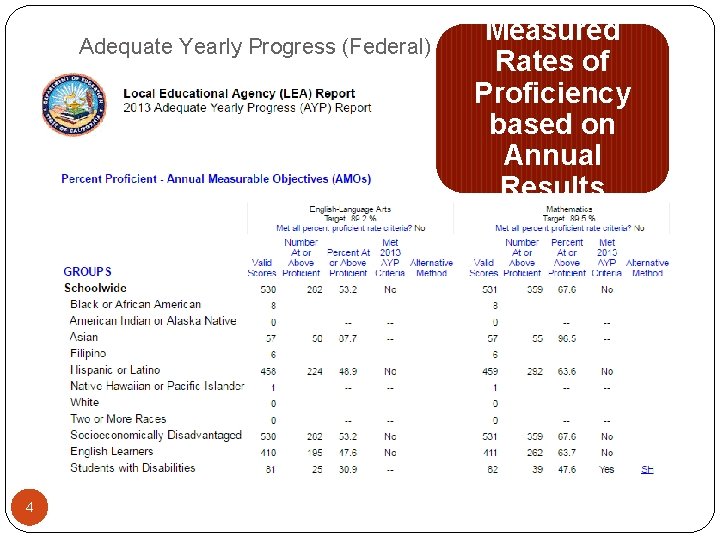
Adequate Yearly Progress (Federal) 4 Measured Rates of Proficiency based on Annual Results
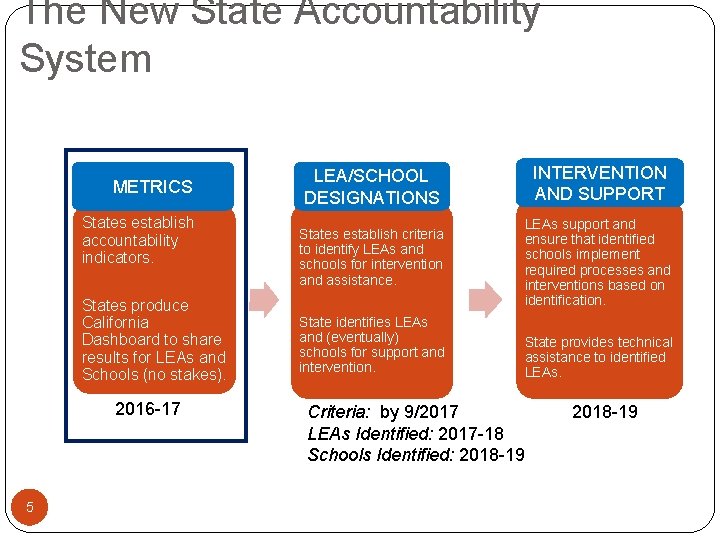
The New State Accountability System METRICS States establish accountability indicators. States produce California Dashboard to share results for LEAs and Schools (no stakes). 2016 -17 5 LEA/SCHOOL DESIGNATIONS INTERVENTION AND SUPPORT States establish criteria to identify LEAs and schools for intervention and assistance. LEAs support and ensure that identified schools implement required processes and interventions based on identification. State identifies LEAs and (eventually) schools for support and intervention. State provides technical assistance to identified LEAs. Criteria: by 9/2017 LEAs Identified: 2017 -18 Schools Identified: 2018 -19
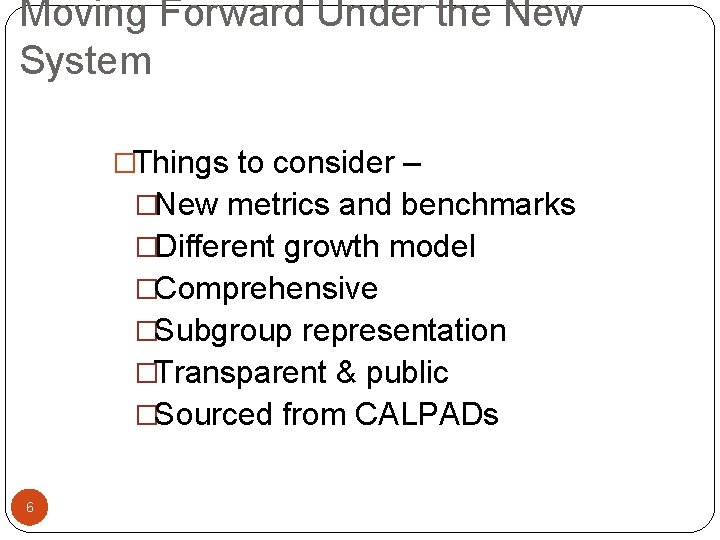
Moving Forward Under the New System �Things to consider – �New metrics and benchmarks �Different growth model �Comprehensive �Subgroup representation �Transparent & public �Sourced from CALPADs 6
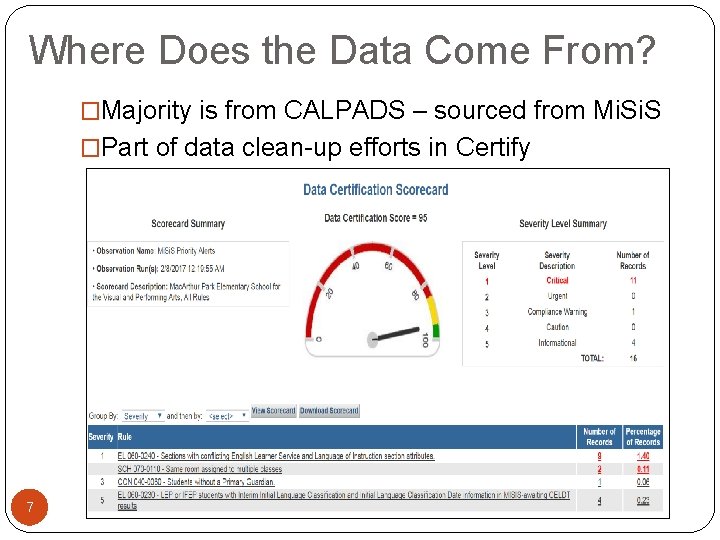
Where Does the Data Come From? �Majority is from CALPADS – sourced from Mi. S �Part of data clean-up efforts in Certify 7
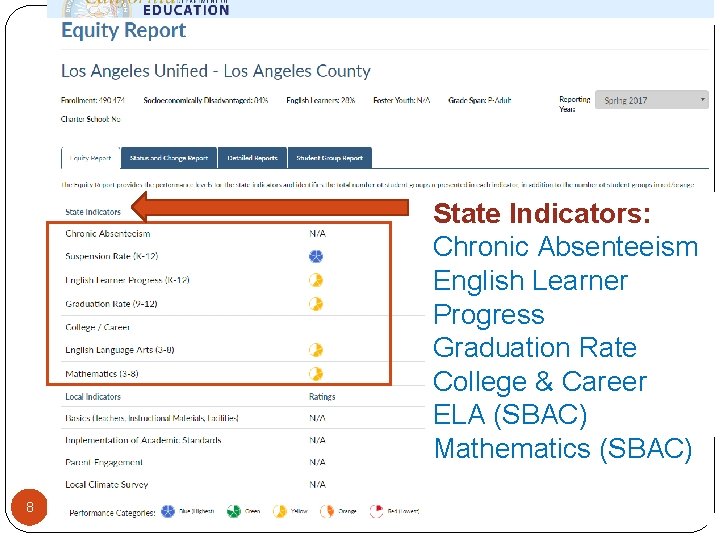
State Indicators: Chronic Absenteeism English Learner Progress Graduation Rate College & Career ELA (SBAC) Mathematics (SBAC) 8
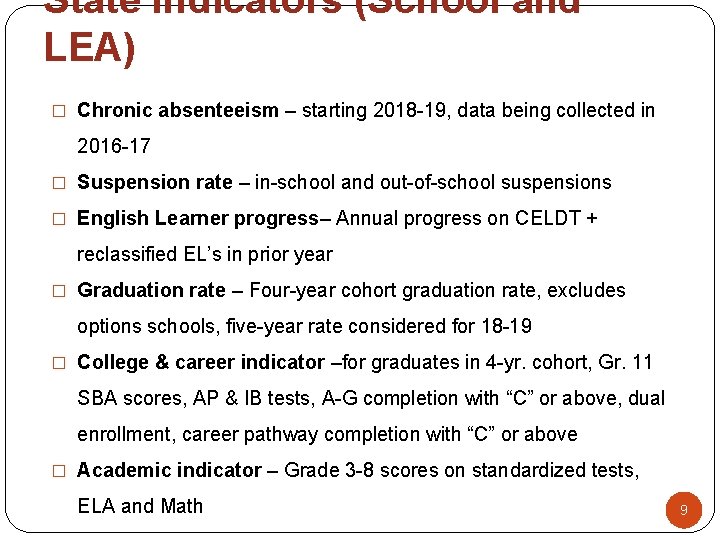
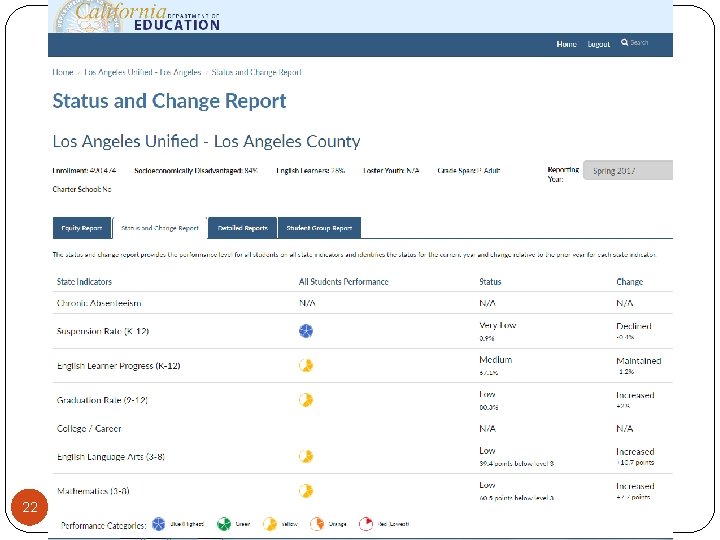
State Indicators (School and LEA) � Chronic absenteeism – starting 2018 -19, data being collected in 2016 -17 � Suspension rate – in-school and out-of-school suspensions � English Learner progress– Annual progress on CELDT + reclassified EL’s in prior year � Graduation rate – Four-year cohort graduation rate, excludes options schools, five-year rate considered for 18 -19 � College & career indicator –for graduates in 4 -yr. cohort, Gr. 11 SBA scores, AP & IB tests, A-G completion with “C” or above, dual enrollment, career pathway completion with “C” or above � Academic indicator – Grade 3 -8 scores on standardized tests, ELA and Math 9
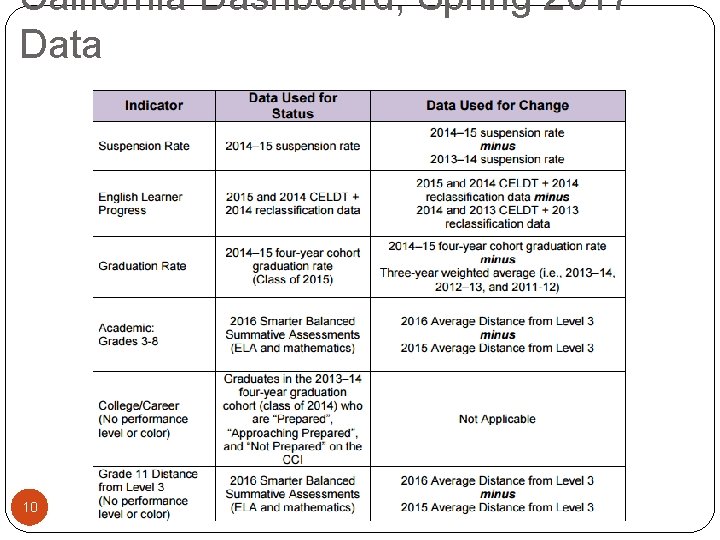
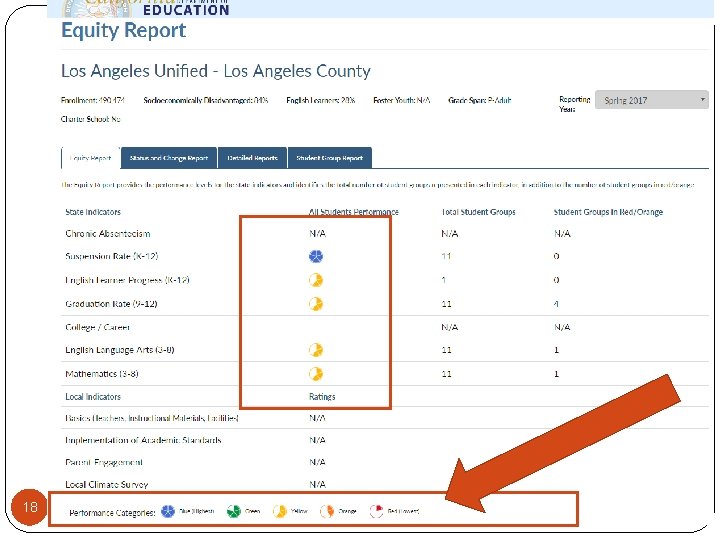
California Dashboard, Spring 2017 Data 10
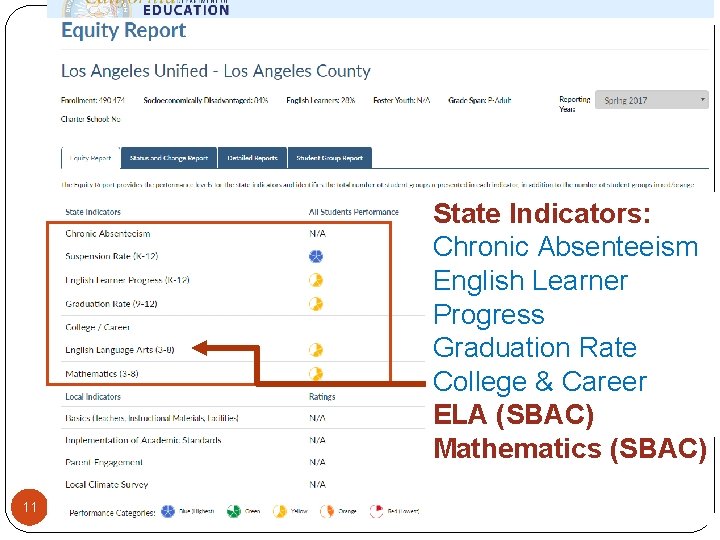
State Indicators: Chronic Absenteeism English Learner Progress Graduation Rate College & Career ELA (SBAC) Mathematics (SBAC) 11
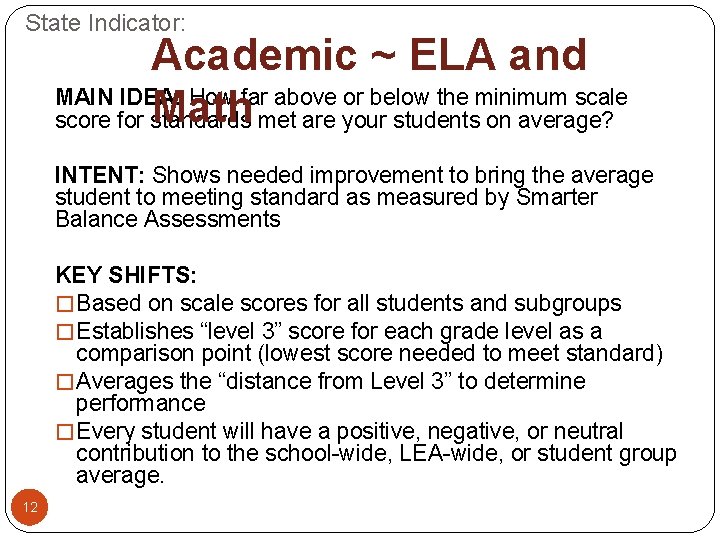
State Indicator: Academic ~ ELA and MAIN IDEA: How far above or below the minimum scale Math met are your students on average? score for standards INTENT: Shows needed improvement to bring the average student to meeting standard as measured by Smarter Balance Assessments KEY SHIFTS: � Based on scale scores for all students and subgroups � Establishes “level 3” score for each grade level as a comparison point (lowest score needed to meet standard) � Averages the “distance from Level 3” to determine performance � Every student will have a positive, negative, or neutral contribution to the school-wide, LEA-wide, or student group average. 12
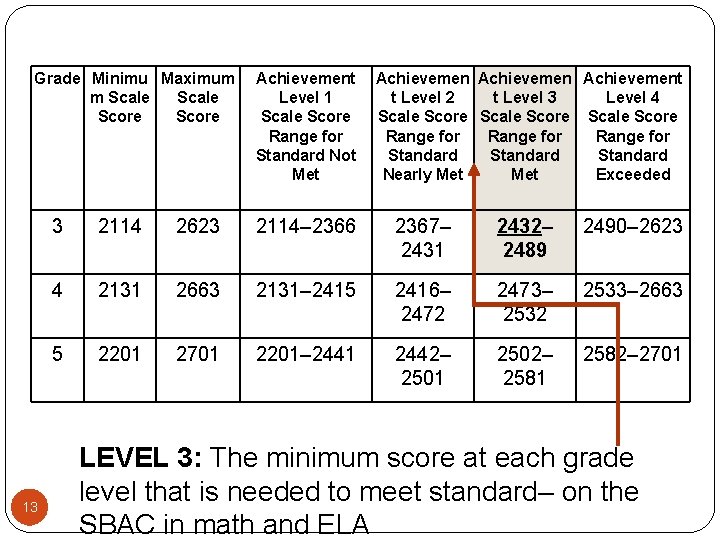
Grade Minimu Maximum m Scale Score 13 Achievement Level 1 Scale Score Range for Standard Not Met Achievement t Level 2 t Level 3 Level 4 Scale Score Range for Standard Nearly Met Exceeded 3 2114 2623 2114– 2366 2367– 2431 2432– 2489 2490– 2623 4 2131 2663 2131– 2415 2416– 2472 2473– 2532 2533– 2663 5 2201 2701 2201– 2441 2442– 2501 2502– 2581 2582– 2701 LEVEL 3: The minimum score at each grade level that is needed to meet standard– on the SBAC in math and ELA
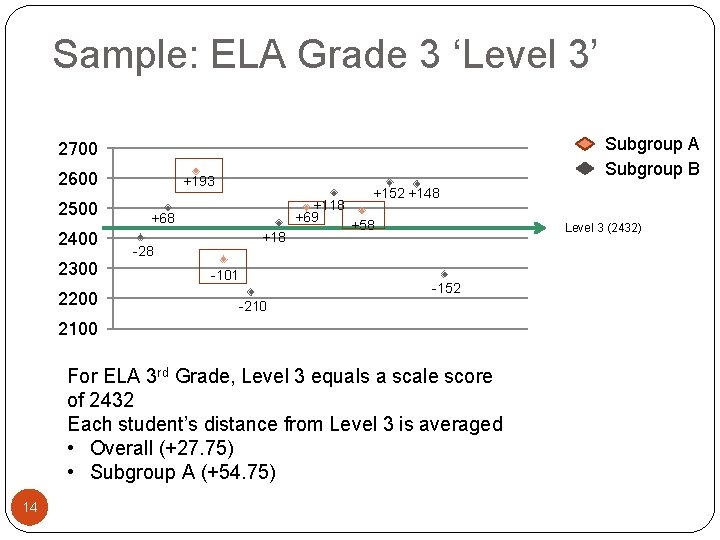
Sample: ELA Grade 3 ‘Level 3’ Subgroup A Subgroup B 2700 2600 2500 2400 2300 2200 +193 +118 +69 +68 +18 -28 -101 +152 +148 +58 Level 3 (2432) -152 -210 2100 For ELA 3 rd Grade, Level 3 equals a scale score of 2432 Each student’s distance from Level 3 is averaged • Overall (+27. 75) • Subgroup A (+54. 75) 14
Distance From Level 3 �All scale score ranges are set by the Smarter Balanced Assessment Consortium and won’t change �All students in the same grade across 15 California are measured against the same scale score �All grade 6 students across California are measured against the 2531 scale score for ELA.
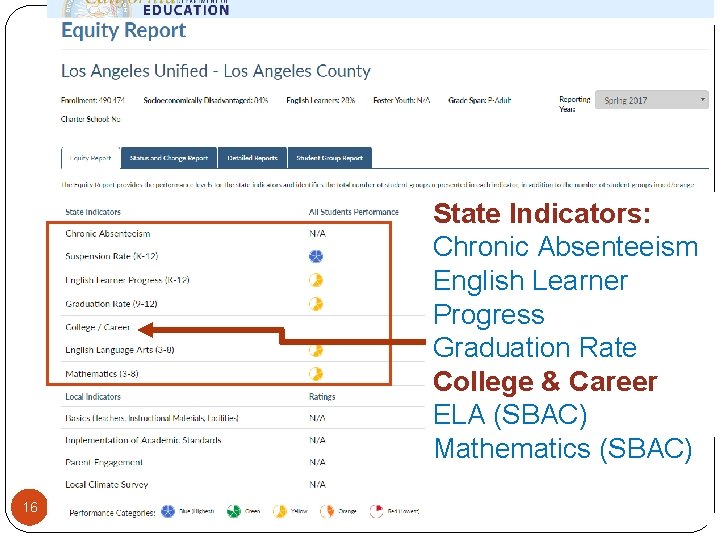
State Indicators: Chronic Absenteeism English Learner Progress Graduation Rate College & Career ELA (SBAC) Mathematics (SBAC) 16
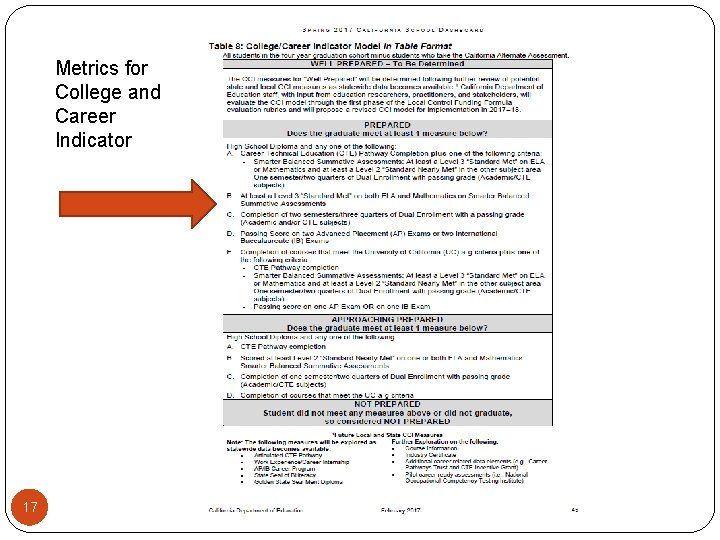
Metrics for College and Career Indicator 17
18
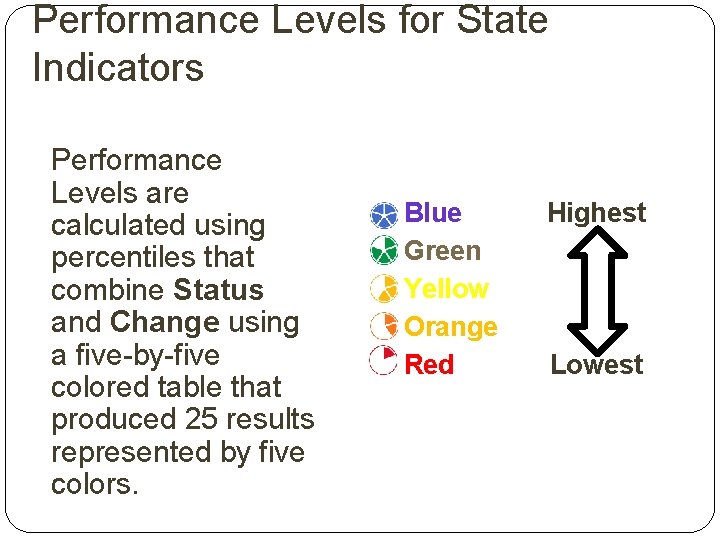
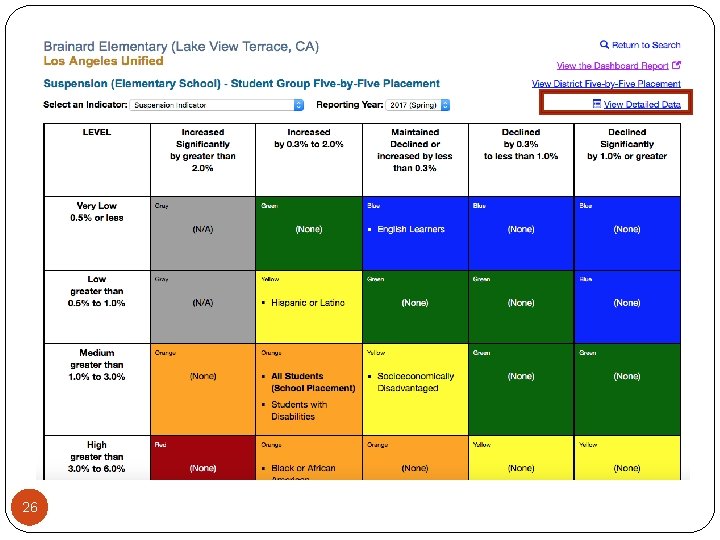
Performance Levels for State Indicators Performance Levels are calculated using percentiles that combine Status and Change using a five-by-five colored table that produced 25 results represented by five colors. Blue Green Yellow Orange Red Highest Lowest
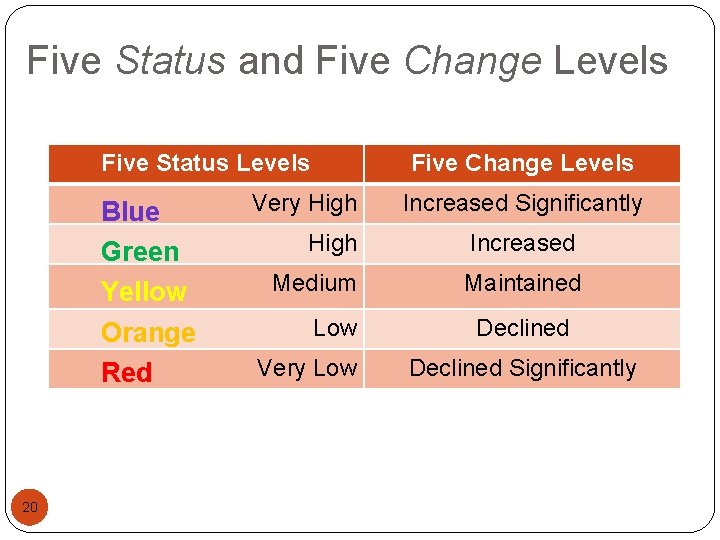
Five Status and Five Change Levels Five Status Levels Blue Green Yellow Orange Red 20 Five Change Levels Very High Increased Significantly High Increased Medium Maintained Low Very Low Declined Significantly
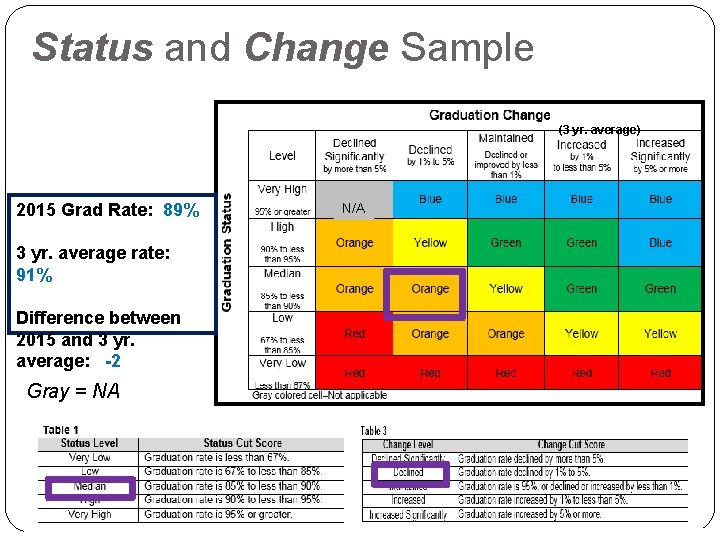
Status and Change Sample (3 yr. average) 2015 Grad Rate: 89% 3 yr. average rate: 91% Difference between 2015 and 3 yr. average: -2 Gray = NA N/A
22
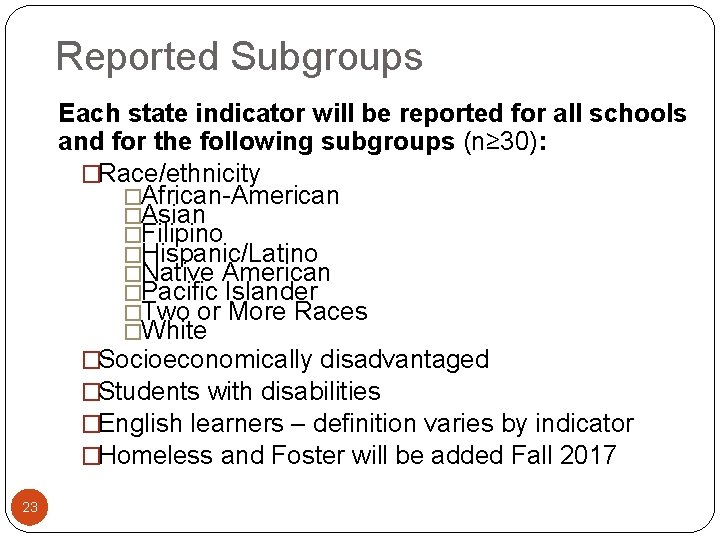
Reported Subgroups Each state indicator will be reported for all schools and for the following subgroups (n≥ 30): �Race/ethnicity �African-American �Asian �Filipino �Hispanic/Latino �Native American �Pacific Islander �Two or More Races �White �Socioeconomically disadvantaged �Students with disabilities �English learners – definition varies by indicator �Homeless and Foster will be added Fall 2017 23
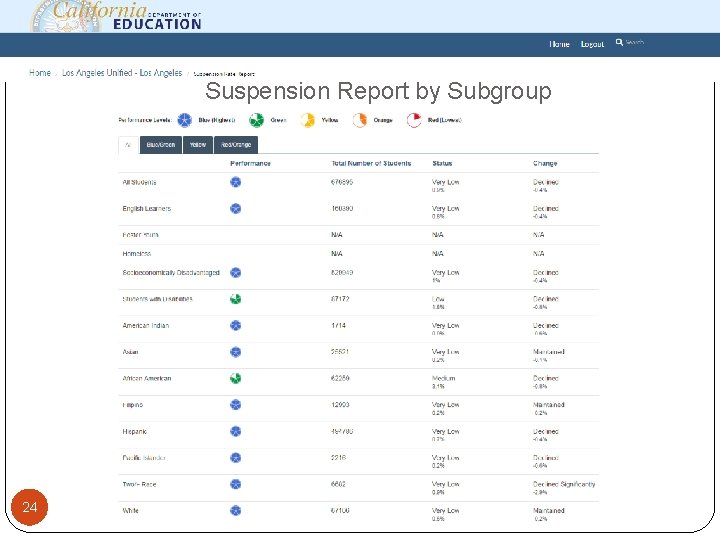
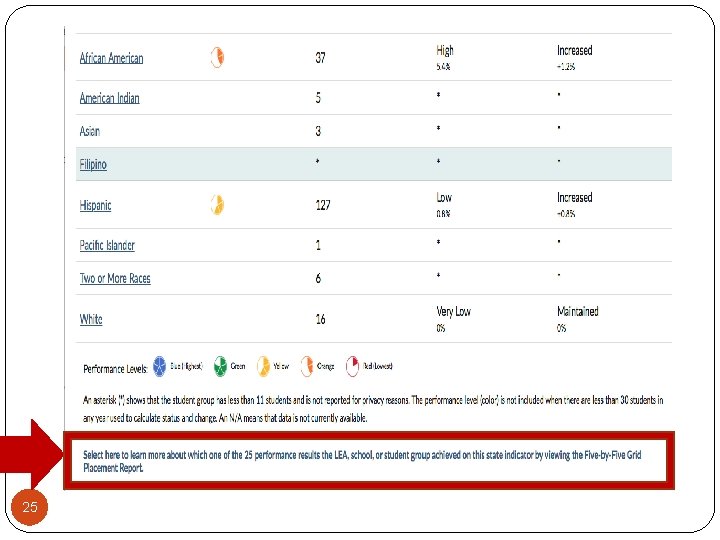
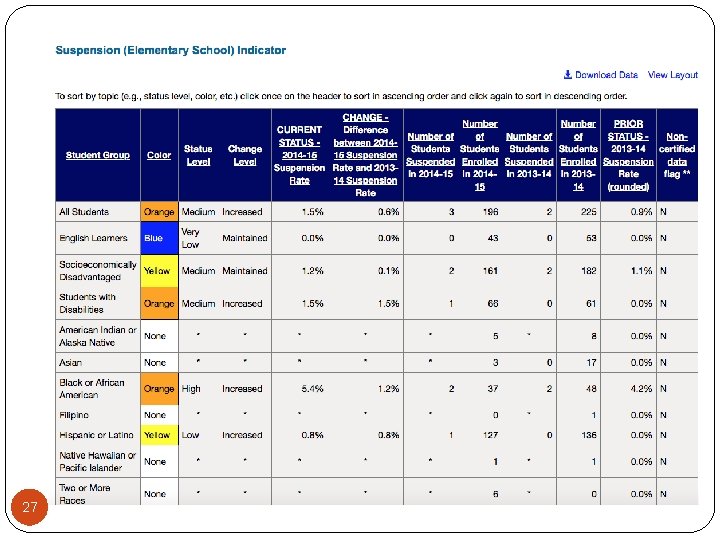
Suspension Report by Subgroup 24
25
26
27
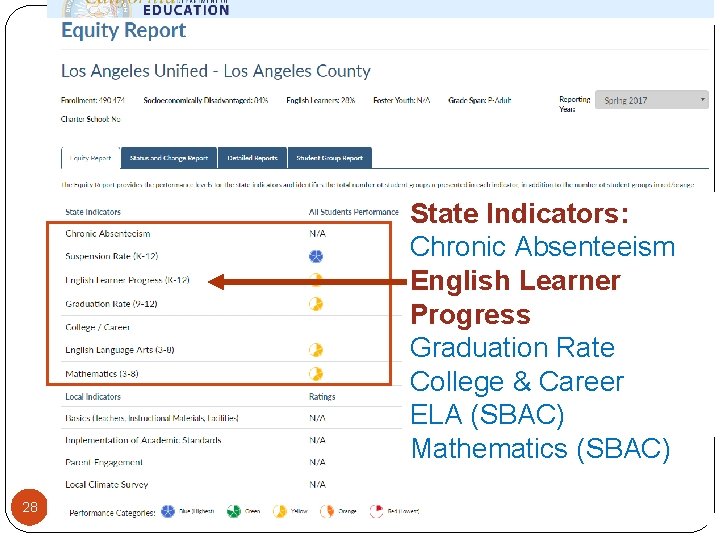
State Indicators: Chronic Absenteeism English Learner Progress Graduation Rate College & Career ELA (SBAC) Mathematics (SBAC) 28
The English Learner Progress Indicator ELPI measures the percent of EL students who are making progress toward language proficiency from one year to the next on the California English Language Development Test (CELDT) and the number of ELs who were reclassified from EL to fluent English 29
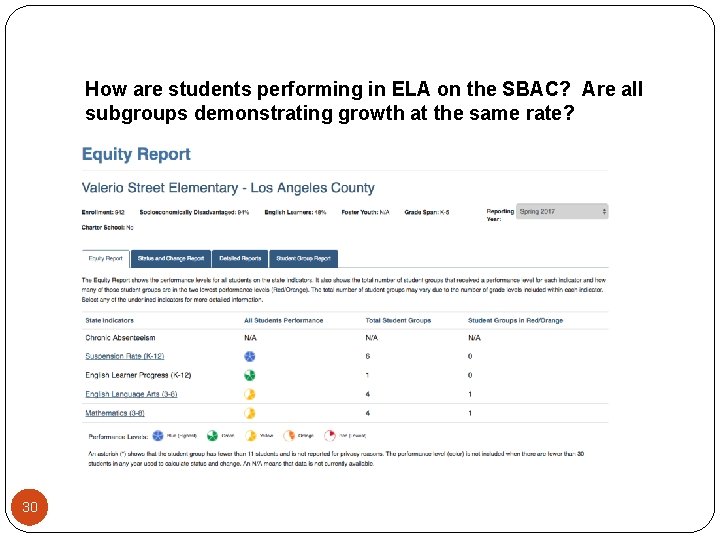
How are students performing in ELA on the SBAC? Are all subgroups demonstrating growth at the same rate? 30
Grade 3 – Grade 8 �How well are students and subgroups at my school meeting ELA standards? 31
High School �How well are students and subgroups at my school meeting ELA standards? �Are students graduating College and Career Ready? 32
Resources �The CDE’s Dashboard Website includes comprehensive resources, sample presentations & letters, technical guides, video overviews, and metrics used to determine the indicators: http: //www. cde. ca. gov/ta/ac/cm/index. asp �Calculation questions on state indicators, the college/career indicator, and grade distance from level 3: aau@cde. ca. gov tel. 916. 319. 0863 33
- Slides: 33