
State Accountability Overview 1 Performance Index Framework For
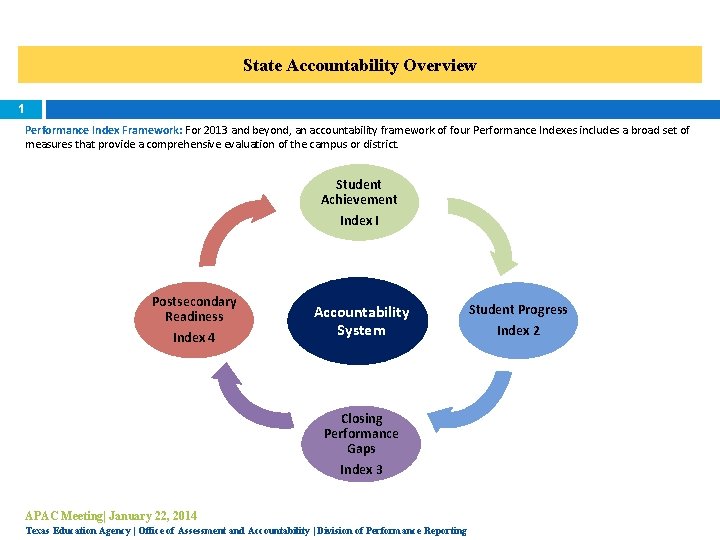
State Accountability Overview 1 Performance Index Framework: For 2013 and beyond, an accountability framework of four Performance Indexes includes a broad set of measures that provide a comprehensive evaluation of the campus or district. Student Achievement Index I Postsecondary Readiness Index 4 Accountability System Closing Performance Gaps Index 3 APAC Meeting| January 22, 2014 Texas Education Agency | Office of Assessment and Accountability | Division of Performance Reporting Student Progress Index 2
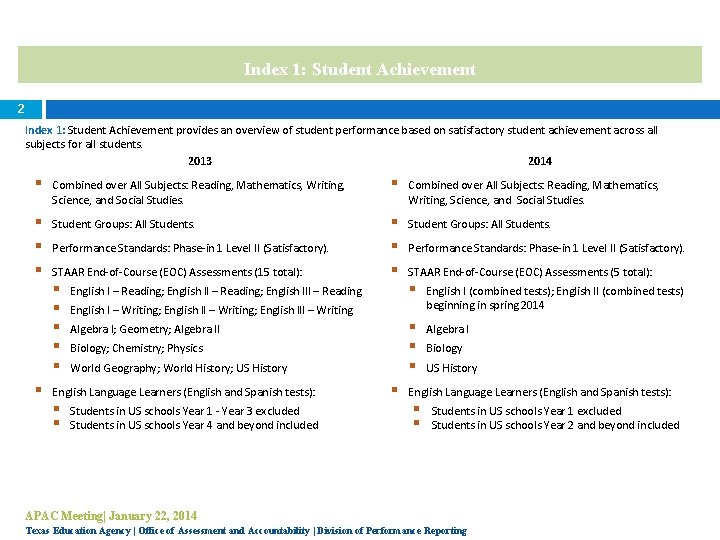
Index 1: Student Achievement 2 Index 1: Student Achievement provides an overview of student performance based on satisfactory student achievement across all subjects for all students. 2013 2014 § Combined over All Subjects: Reading, Mathematics, Writing, Science, and Social Studies. § § § Student Groups: All Students. § Performance Standards: Phase-in 1 Level II (Satisfactory). STAAR End-of-Course (EOC) Assessments (15 total): § § § English l – Reading; English lll – Reading English l – Writing; English lll – Writing Algebra l; Geometry; Algebra ll Biology; Chemistry; Physics World Geography; World History; US History English Language Learners (English and Spanish tests): § § Students in US schools Year 1 - Year 3 excluded Students in US schools Year 4 and beyond included § Performance Standards: Phase-in 1 Level II (Satisfactory). STAAR End-of-Course (EOC) Assessments (5 total): § English l (combined tests); English ll (combined tests) beginning in spring 2014 § § § Algebra l Biology US History English Language Learners (English and Spanish tests): § § Students in US schools Year 1 excluded Students in US schools Year 2 and beyond included APAC Meeting| January 22, 2014 Texas Education Agency | Office of Assessment and Accountability | Division of Performance Reporting
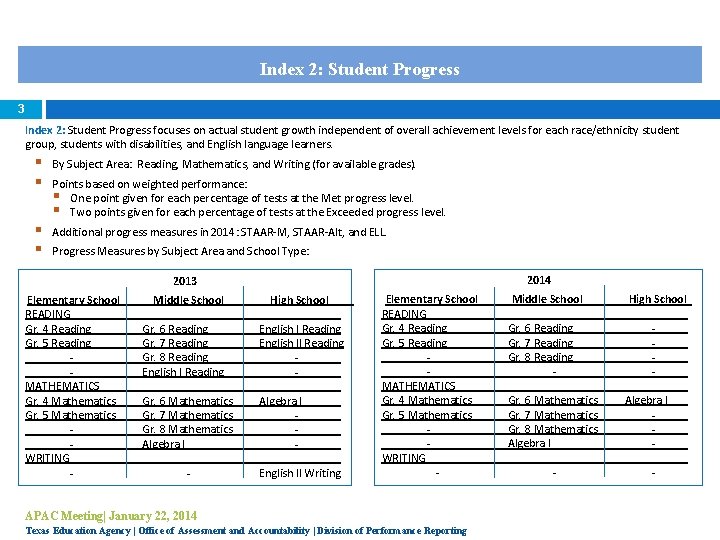
Index 2: Student Progress 3 Index 2: Student Progress focuses on actual student growth independent of overall achievement levels for each race/ethnicity student group, students with disabilities, and English language learners. § § By Subject Area: Reading, Mathematics, and Writing (for available grades). Points based on weighted performance: § One point given for each percentage of tests at the Met progress level. § Two points given for each percentage of tests at the Exceeded progress level. Additional progress measures in 2014: STAAR-M, STAAR-Alt, and ELL. Progress Measures by Subject Area and School Type: 2014 2013 Elementary School READING Gr. 4 Reading Gr. 5 Reading MATHEMATICS Gr. 4 Mathematics Gr. 5 Mathematics WRITING - Middle School High School Gr. 6 Reading Gr. 7 Reading Gr. 8 Reading English ll Reading - Gr. 6 Mathematics Gr. 7 Mathematics Gr. 8 Mathematics Algebra l - - English ll Writing Elementary School READING Gr. 4 Reading Gr. 5 Reading MATHEMATICS Gr. 4 Mathematics Gr. 5 Mathematics WRITING - APAC Meeting| January 22, 2014 Texas Education Agency | Office of Assessment and Accountability | Division of Performance Reporting Middle School Gr. 6 Reading Gr. 7 Reading Gr. 8 Reading Gr. 6 Mathematics Gr. 7 Mathematics Gr. 8 Mathematics Algebra l - High School Algebra l -
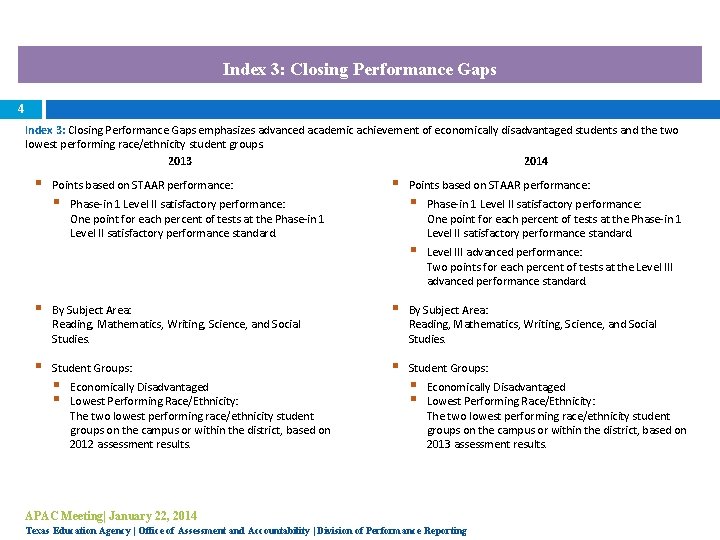
Index 3: Closing Performance Gaps 4 Index 3: Closing Performance Gaps emphasizes advanced academic achievement of economically disadvantaged students and the two lowest performing race/ethnicity student groups. 2014 2013 § Points based on STAAR performance: § § Phase-in 1 Level II satisfactory performance: One point for each percent of tests at the Phase-in 1 Level II satisfactory performance standard. Level III advanced performance: Two points for each percent of tests at the Level III advanced performance standard. § By Subject Area: Reading, Mathematics, Writing, Science, and Social Studies. § Student Groups: § § Economically Disadvantaged Lowest Performing Race/Ethnicity: The two lowest performing race/ethnicity student groups on the campus or within the district, based on 2012 assessment results. § § Economically Disadvantaged Lowest Performing Race/Ethnicity: The two lowest performing race/ethnicity student groups on the campus or within the district, based on 2013 assessment results. APAC Meeting| January 22, 2014 Texas Education Agency | Office of Assessment and Accountability | Division of Performance Reporting
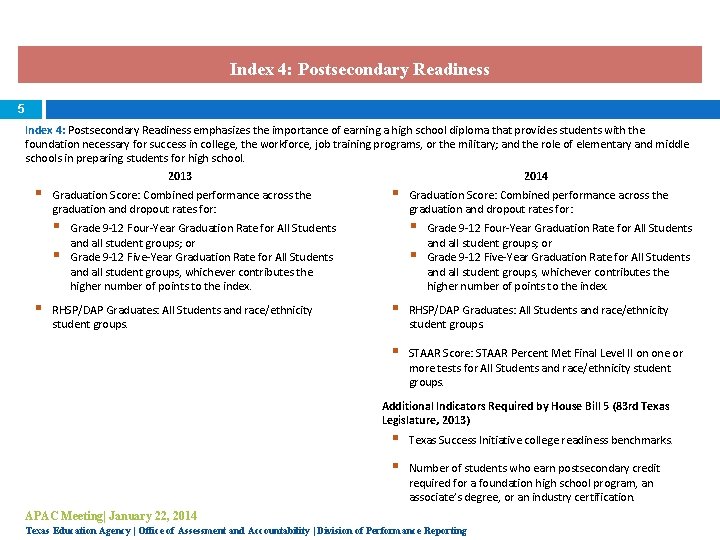
Index 4: Postsecondary Readiness 5 Index 4: Postsecondary Readiness emphasizes the importance of earning a high school diploma that provides students with the foundation necessary for success in college, the workforce, job training programs, or the military; and the role of elementary and middle schools in preparing students for high school. 2013 2014 § Graduation Score: Combined performance across the graduation and dropout rates for: § § § Grade 9 -12 Four-Year Graduation Rate for All Students and all student groups; or Grade 9 -12 Five-Year Graduation Rate for All Students and all student groups, whichever contributes the higher number of points to the index. RHSP/DAP Graduates: All Students and race/ethnicity student groups. Graduation Score: Combined performance across the graduation and dropout rates for: § Grade 9 -12 Four-Year Graduation Rate for All Students and all student groups; or Grade 9 -12 Five-Year Graduation Rate for All Students and all student groups, whichever contributes the higher number of points to the index. § RHSP/DAP Graduates: All Students and race/ethnicity student groups. § STAAR Score: STAAR Percent Met Final Level ll on one or more tests for All Students and race/ethnicity student groups. Additional Indicators Required by House Bill 5 (83 rd Texas Legislature, 2013) § Texas Success Initiative college readiness benchmarks. § Number of students who earn postsecondary credit required for a foundation high school program, an associate’s degree, or an industry certification. APAC Meeting| January 22, 2014 Texas Education Agency | Office of Assessment and Accountability | Division of Performance Reporting
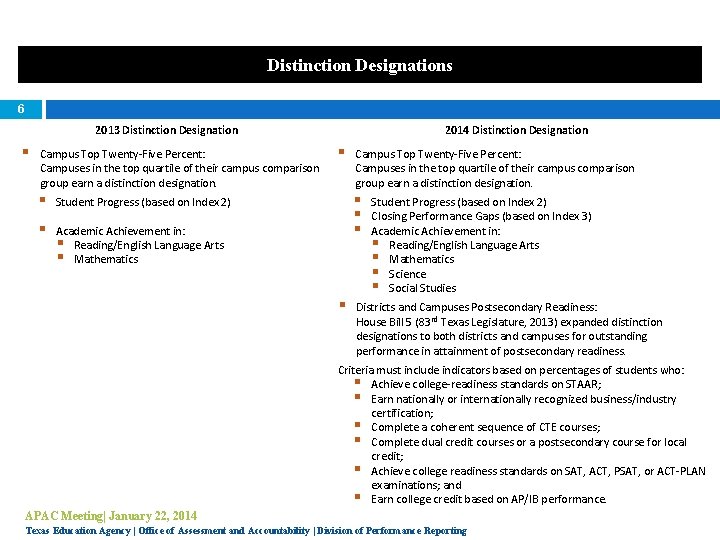
Distinction Designations 6 2013 Distinction Designation § Campus Top Twenty-Five Percent: Campuses in the top quartile of their campus comparison group earn a distinction designation. § Student Progress (based on Index 2) § Academic Achievement in: § Reading/English Language Arts § Mathematics 2014 Distinction Designation § Campus Top Twenty-Five Percent: Campuses in the top quartile of their campus comparison group earn a distinction designation. § § Student Progress (based on Index 2) Closing Performance Gaps (based on Index 3) Academic Achievement in: § Reading/English Language Arts § Mathematics § Science § Social Studies Districts and Campuses Postsecondary Readiness: House Bill 5 (83 rd Texas Legislature, 2013) expanded distinction designations to both districts and campuses for outstanding performance in attainment of postsecondary readiness. Criteria must include indicators based on percentages of students who: § Achieve college-readiness standards on STAAR; § Earn nationally or internationally recognized business/industry certification; § Complete a coherent sequence of CTE courses; § Complete dual credit courses or a postsecondary course for local credit; § Achieve college readiness standards on SAT, ACT, PSAT, or ACT-PLAN examinations; and § Earn college credit based on AP/IB performance. APAC Meeting| January 22, 2014 Texas Education Agency | Office of Assessment and Accountability | Division of Performance Reporting
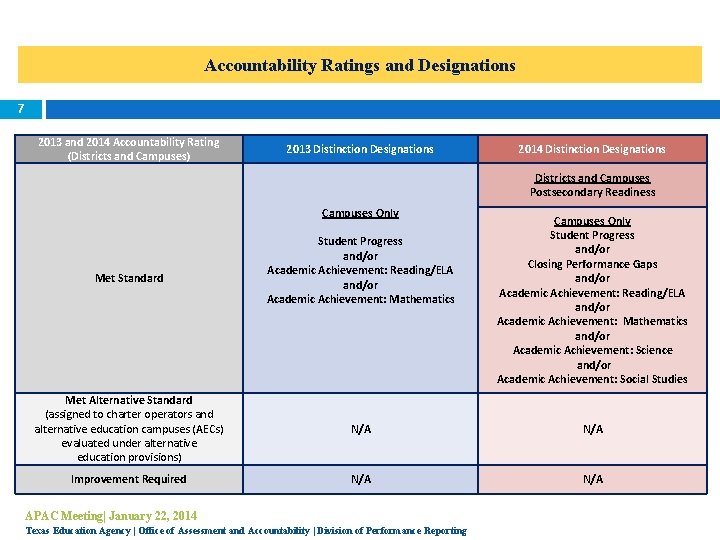
Accountability Ratings and Designations 7 2013 and 2014 Accountability Rating (Districts and Campuses) 2013 Distinction Designations 2014 Distinction Designations Districts and Campuses Postsecondary Readiness Campuses Only Met Standard Student Progress and/or Academic Achievement: Reading/ELA and/or Academic Achievement: Mathematics Campuses Only Student Progress and/or Closing Performance Gaps and/or Academic Achievement: Reading/ELA and/or Academic Achievement: Mathematics and/or Academic Achievement: Science and/or Academic Achievement: Social Studies Met Alternative Standard (assigned to charter operators and alternative education campuses (AECs) evaluated under alternative education provisions) N/A Improvement Required N/A APAC Meeting| January 22, 2014 Texas Education Agency | Office of Assessment and Accountability | Division of Performance Reporting
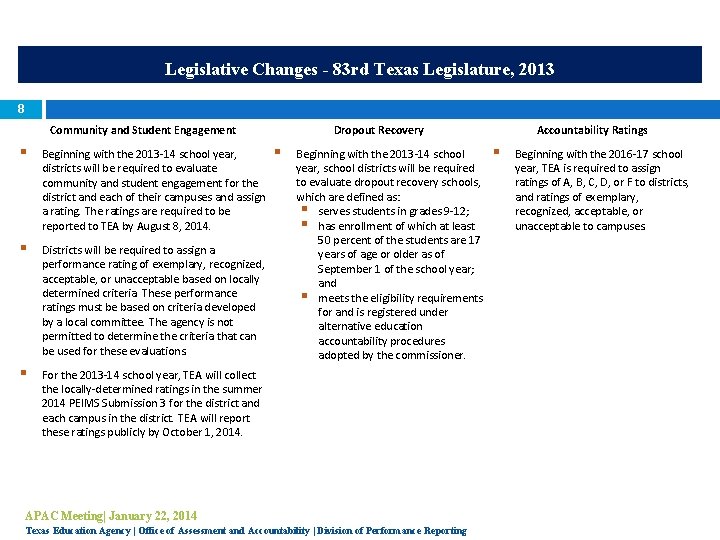
Legislative Changes - 83 rd Texas Legislature, 2013 8 Dropout Recovery Community and Student Engagement § Beginning with the 2013 -14 school year, districts will be required to evaluate community and student engagement for the district and each of their campuses and assign a rating. The ratings are required to be reported to TEA by August 8, 2014. § Districts will be required to assign a performance rating of exemplary, recognized, acceptable, or unacceptable based on locally determined criteria. These performance ratings must be based on criteria developed by a local committee. The agency is not permitted to determine the criteria that can be used for these evaluations. § For the 2013 -14 school year, TEA will collect the locally-determined ratings in the summer 2014 PEIMS Submission 3 for the district and each campus in the district. TEA will report these ratings publicly by October 1, 2014. § Beginning with the 2013 -14 school year, school districts will be required to evaluate dropout recovery schools, which are defined as: § serves students in grades 9 -12; § has enrollment of which at least 50 percent of the students are 17 years of age or older as of September 1 of the school year; and § meets the eligibility requirements for and is registered under alternative education accountability procedures adopted by the commissioner. APAC Meeting| January 22, 2014 Texas Education Agency | Office of Assessment and Accountability | Division of Performance Reporting Accountability Ratings § Beginning with the 2016 -17 school year, TEA is required to assign ratings of A, B, C, D, or F to districts, and ratings of exemplary, recognized, acceptable, or unacceptable to campuses.
- Slides: 8