
STAT 1510 BINOMIAL POISSON DISTRIBUTIONS Agenda 2 The
STAT 1510 BINOMIAL & POISSON DISTRIBUTIONS
Agenda 2 The Binomial Setting and Binomial Distributions in Statistical Sampling Binomial Probabilities Binomial Mean and Standard Deviation The Normal Approximation to Binomial Distributions Poisson Distribution

The Binomial Setting 3 When the same chance process is repeated several times, we are often interested in whether a particular outcome does or doesn’t happen on each repetition. In some cases, the number of repeated trials is fixed in advance and we are interested in the number of times a particular event (called a “success”) occurs. A binomial setting arises when we perform several independent trials of the same chance process and record the number of times that a particular outcome occurs. The four conditions for a binomial setting are: B • Binary? The possible outcomes of each trial can be classified as “success” or “failure. ” I • Independent? Trials must be independent; that is, knowing the result of one trial must not have any effect on the result of any other trial. N • Number? The number of trials n of the chance process must be fixed in advance. S • Success? On each trial, the probability p of success must be the same.
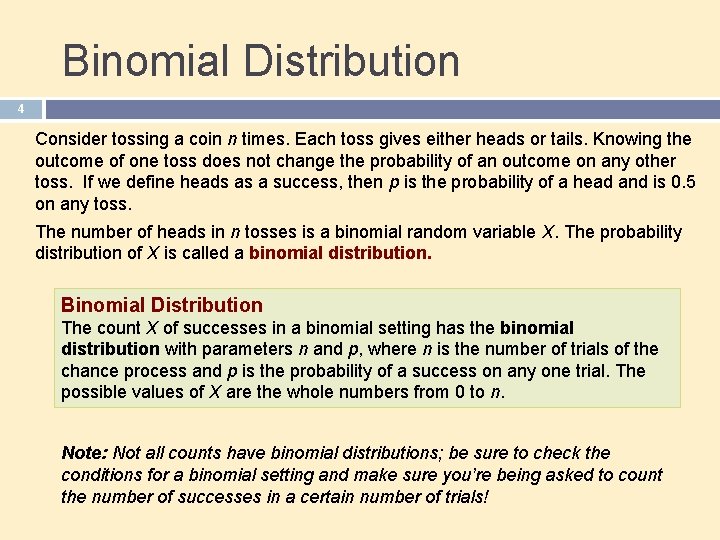
Binomial Distribution 4 Consider tossing a coin n times. Each toss gives either heads or tails. Knowing the outcome of one toss does not change the probability of an outcome on any other toss. If we define heads as a success, then p is the probability of a head and is 0. 5 on any toss. The number of heads in n tosses is a binomial random variable X. The probability distribution of X is called a binomial distribution. Binomial Distribution The count X of successes in a binomial setting has the binomial distribution with parameters n and p, where n is the number of trials of the chance process and p is the probability of a success on any one trial. The possible values of X are the whole numbers from 0 to n. Note: Not all counts have binomial distributions; be sure to check the conditions for a binomial setting and make sure you’re being asked to count the number of successes in a certain number of trials!
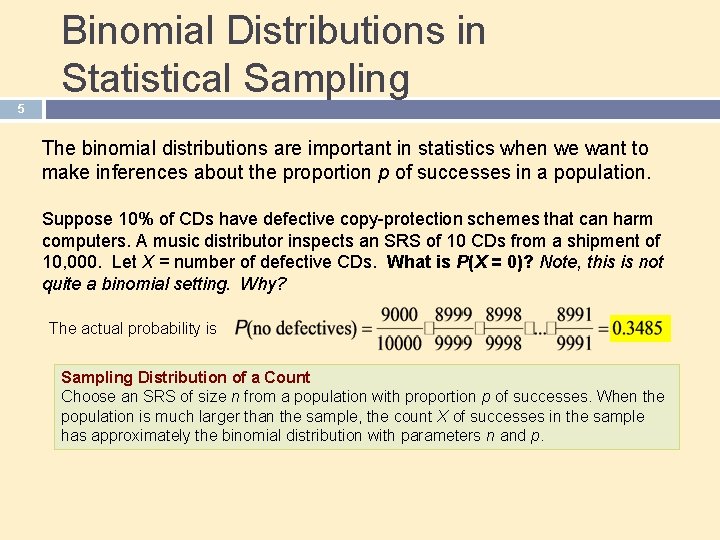
Binomial Distributions in Statistical Sampling 5 The binomial distributions are important in statistics when we want to make inferences about the proportion p of successes in a population. Suppose 10% of CDs have defective copy-protection schemes that can harm computers. A music distributor inspects an SRS of 10 CDs from a shipment of 10, 000. Let X = number of defective CDs. What is P(X = 0)? Note, this is not quite a binomial setting. Why? The actual probability is Sampling Distribution of a Count Choose an SRS of size n from a population with proportion p of successes. When the population is much larger than the sample, the count X of successes in the sample has approximately the binomial distribution with parameters n and p.
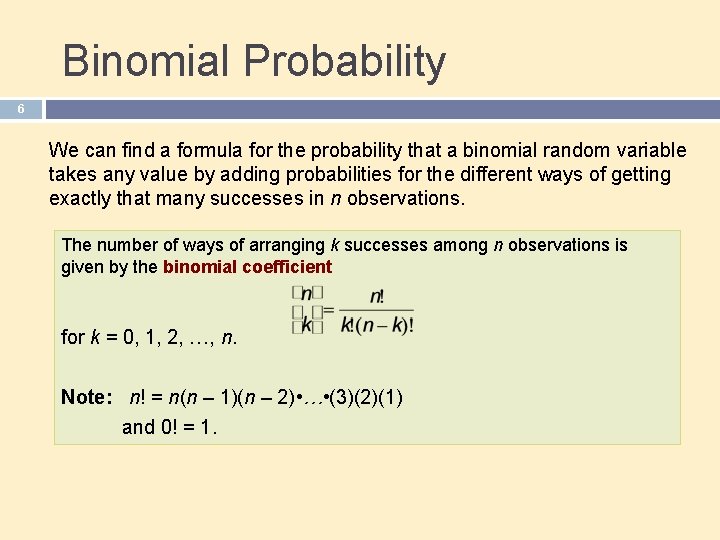
Binomial Probability 6 We can find a formula for the probability that a binomial random variable takes any value by adding probabilities for the different ways of getting exactly that many successes in n observations. The number of ways of arranging k successes among n observations is given by the binomial coefficient for k = 0, 1, 2, …, n. Note: n! = n(n – 1)(n – 2) • … • (3)(2)(1) and 0! = 1.
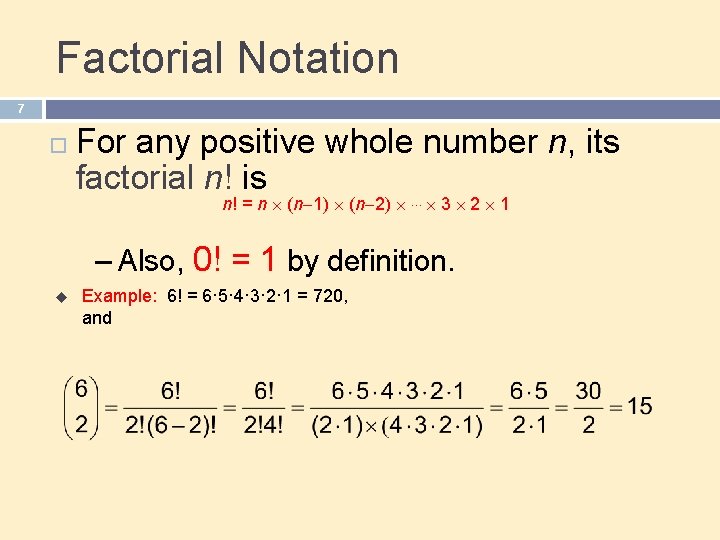
Factorial Notation 7 For any positive whole number n, its factorial n! is n! = n (n 1) (n 2) 3 2 1 – Also, 0! = 1 by definition. u Example: 6! = 6· 5· 4· 3· 2· 1 = 720, and
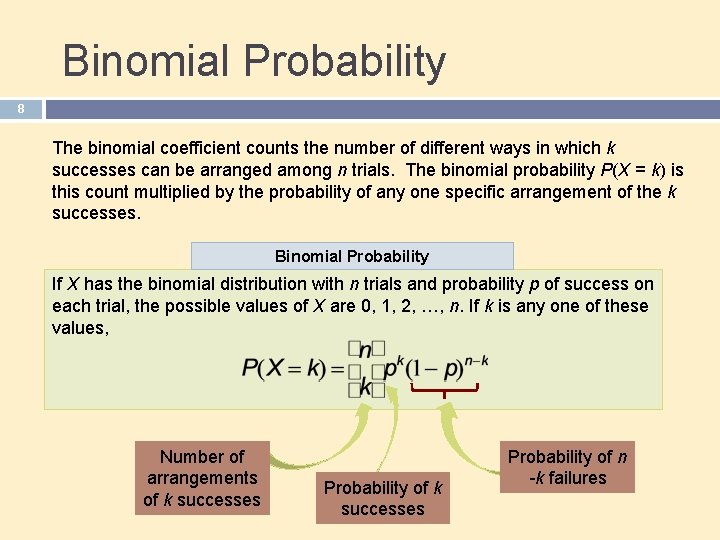
Binomial Probability 8 The binomial coefficient counts the number of different ways in which k successes can be arranged among n trials. The binomial probability P(X = k) is this count multiplied by the probability of any one specific arrangement of the k successes. Binomial Probability If X has the binomial distribution with n trials and probability p of success on each trial, the possible values of X are 0, 1, 2, …, n. If k is any one of these values, Number of arrangements of k successes Probability of n -k failures
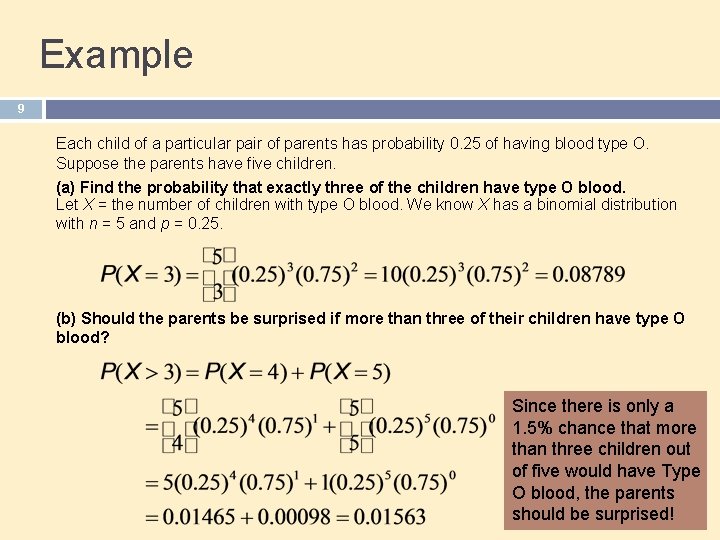
Example 9 Each child of a particular pair of parents has probability 0. 25 of having blood type O. Suppose the parents have five children. (a) Find the probability that exactly three of the children have type O blood. Let X = the number of children with type O blood. We know X has a binomial distribution with n = 5 and p = 0. 25. (b) Should the parents be surprised if more than three of their children have type O blood? Since there is only a 1. 5% chance that more than three children out of five would have Type O blood, the parents should be surprised!
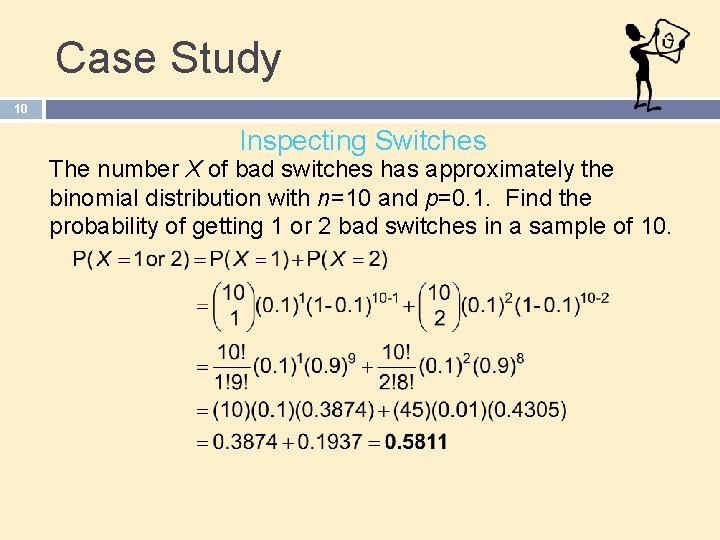
Case Study 10 Inspecting Switches The number X of bad switches has approximately the binomial distribution with n=10 and p=0. 1. Find the probability of getting 1 or 2 bad switches in a sample of 10.

11 Binomial Mean and Standard Deviation If a count X has the binomial distribution based on n observations with probability p of success, what is its mean µ? In general, the mean of a binomial distribution should be µ = np. Here are the facts: Mean and Standard Deviation of a Binomial Random Variable If a count X has the binomial distribution with number of trials n and probability of success p, the mean and standard deviation of X are: Note: These formulas work ONLY for binomial distributions. They can’t be used for other distributions!
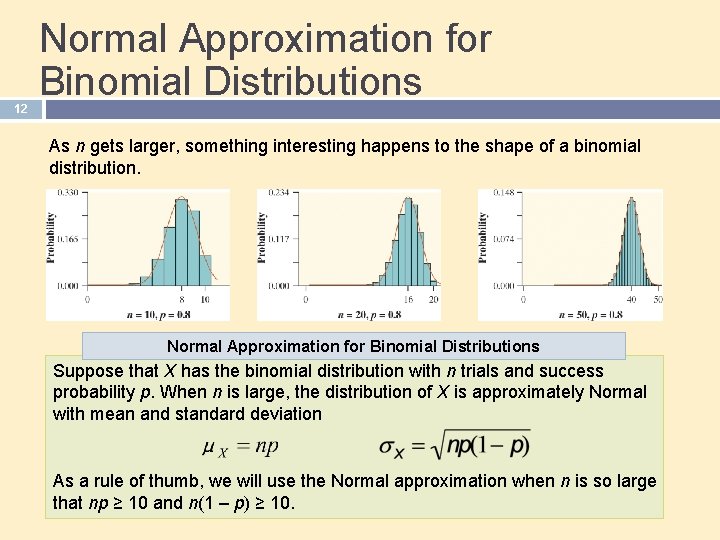
12 Normal Approximation for Binomial Distributions As n gets larger, something interesting happens to the shape of a binomial distribution. Normal Approximation for Binomial Distributions Suppose that X has the binomial distribution with n trials and success probability p. When n is large, the distribution of X is approximately Normal with mean and standard deviation As a rule of thumb, we will use the Normal approximation when n is so large that np ≥ 10 and n(1 – p) ≥ 10.
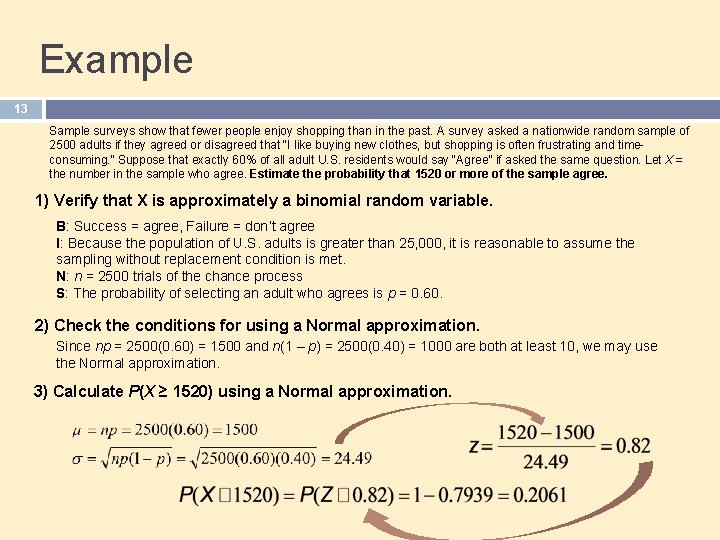
Example 13 Sample surveys show that fewer people enjoy shopping than in the past. A survey asked a nationwide random sample of 2500 adults if they agreed or disagreed that “I like buying new clothes, but shopping is often frustrating and timeconsuming. ” Suppose that exactly 60% of all adult U. S. residents would say “Agree” if asked the same question. Let X = the number in the sample who agree. Estimate the probability that 1520 or more of the sample agree. 1) Verify that X is approximately a binomial random variable. B: Success = agree, Failure = don’t agree I: Because the population of U. S. adults is greater than 25, 000, it is reasonable to assume the sampling without replacement condition is met. N: n = 2500 trials of the chance process S: The probability of selecting an adult who agrees is p = 0. 60. 2) Check the conditions for using a Normal approximation. Since np = 2500(0. 60) = 1500 and n(1 – p) = 2500(0. 40) = 1000 are both at least 10, we may use the Normal approximation. 3) Calculate P(X ≥ 1520) using a Normal approximation.
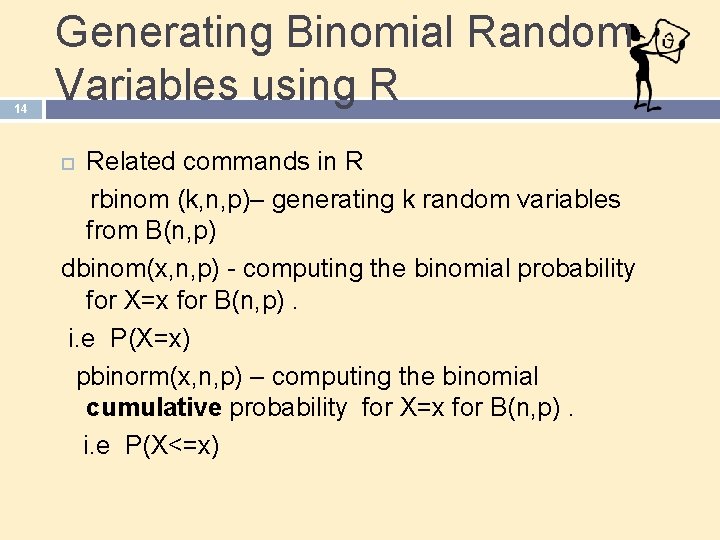
14 Generating Binomial Random Variables using R Related commands in R rbinom (k, n, p)– generating k random variables from B(n, p) dbinom(x, n, p) - computing the binomial probability for X=x for B(n, p). i. e P(X=x) pbinorm(x, n, p) – computing the binomial cumulative probability for X=x for B(n, p). i. e P(X<=x)
Poisson Distribution 15 We have studied the discrete random variables (yes or no type) and its distribution. There are situations where the response of interest is discrete and it can take values 0, 1, 2, 3, …. For example, consider the number of accidents in TCH 1? Number of customer calls in a call center on a particular day
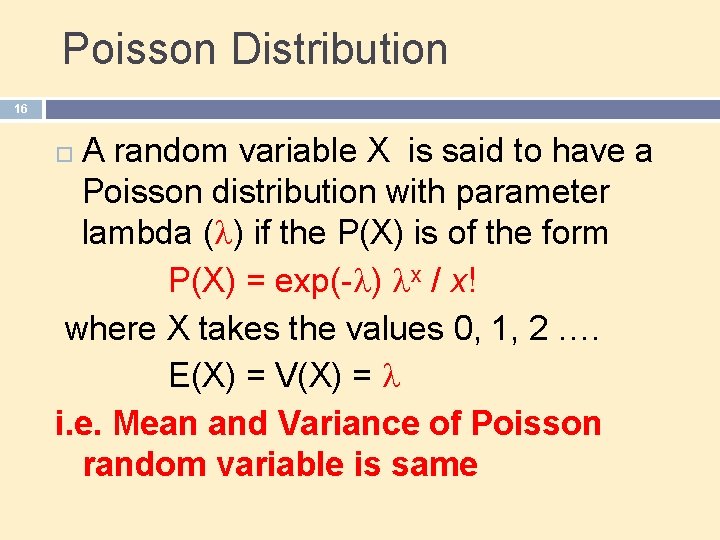
Poisson Distribution 16 A random variable X is said to have a Poisson distribution with parameter lambda (l) if the P(X) is of the form P(X) = exp(-l) lx / x! where X takes the values 0, 1, 2 …. E(X) = V(X) = l i. e. Mean and Variance of Poisson random variable is same
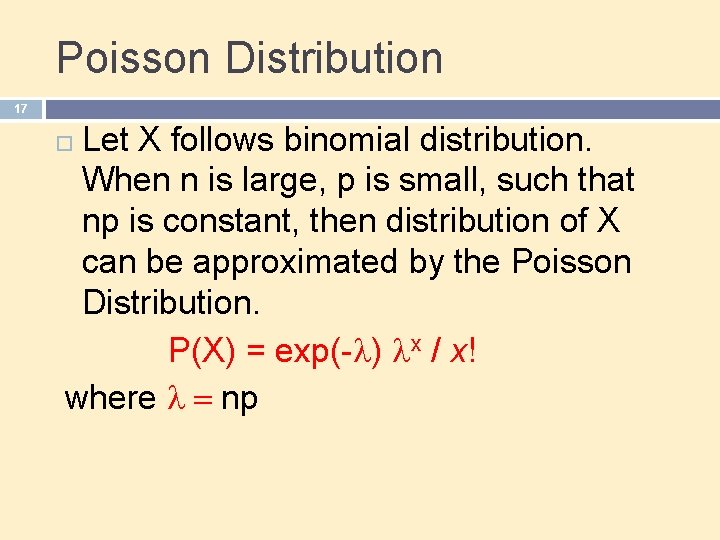
Poisson Distribution 17 Let X follows binomial distribution. When n is large, p is small, such that np is constant, then distribution of X can be approximated by the Poisson Distribution. P(X) = exp(-l) lx / x! where l = np
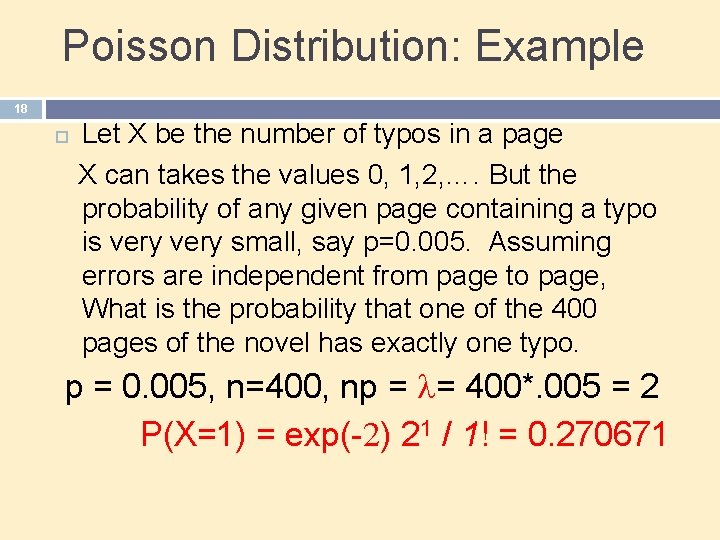
Poisson Distribution: Example 18 Let X be the number of typos in a page X can takes the values 0, 1, 2, …. But the probability of any given page containing a typo is very small, say p=0. 005. Assuming errors are independent from page to page, What is the probability that one of the 400 pages of the novel has exactly one typo. p = 0. 005, n=400, np = l= 400*. 005 = 2 P(X=1) = exp(-2) 21 / 1! = 0. 270671
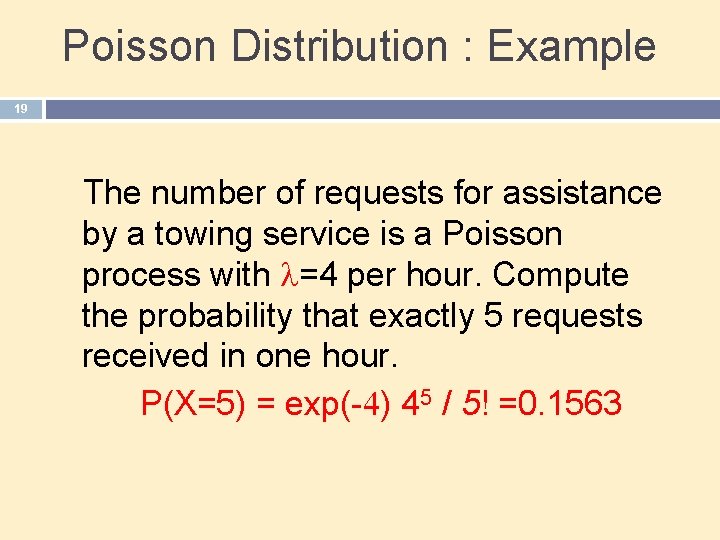
Poisson Distribution : Example 19 The number of requests for assistance by a towing service is a Poisson process with l=4 per hour. Compute the probability that exactly 5 requests received in one hour. P(X=5) = exp(-4) 45 / 5! =0. 1563
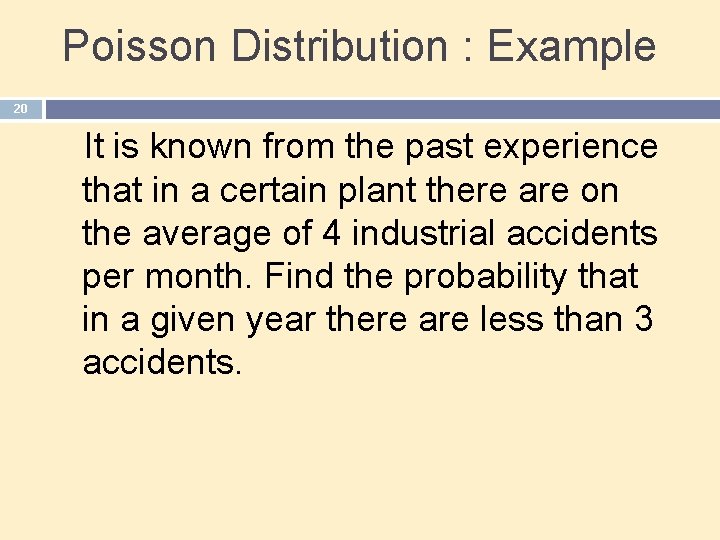
Poisson Distribution : Example 20 It is known from the past experience that in a certain plant there are on the average of 4 industrial accidents per month. Find the probability that in a given year there are less than 3 accidents.
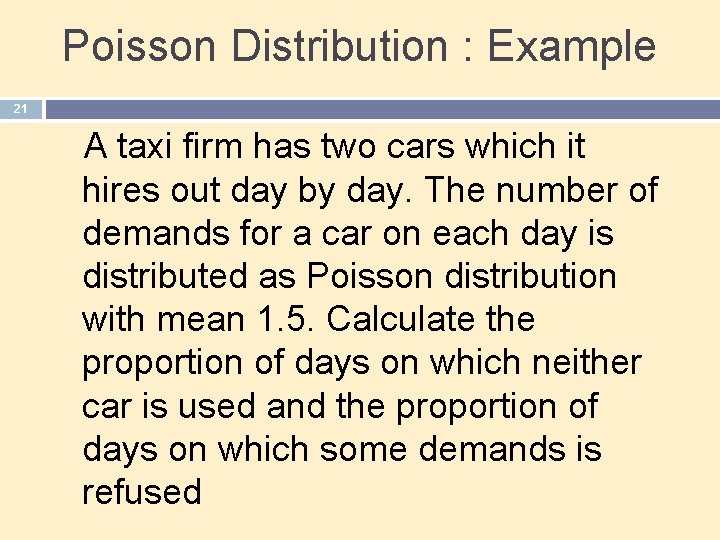
Poisson Distribution : Example 21 A taxi firm has two cars which it hires out day by day. The number of demands for a car on each day is distributed as Poisson distribution with mean 1. 5. Calculate the proportion of days on which neither car is used and the proportion of days on which some demands is refused
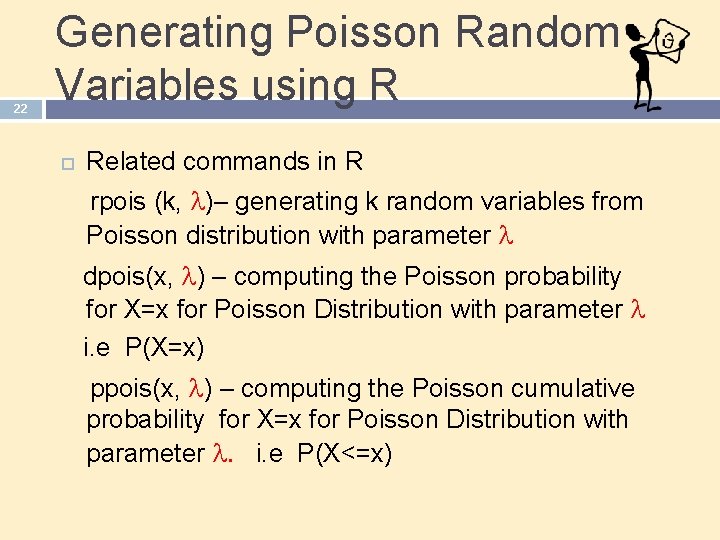
22 Generating Poisson Random Variables using R Related commands in R rpois (k, l)– generating k random variables from Poisson distribution with parameter l dpois(x, l) – computing the Poisson probability for X=x for Poisson Distribution with parameter l i. e P(X=x) ppois(x, l) – computing the Poisson cumulative probability for X=x for Poisson Distribution with parameter l. i. e P(X<=x)
- Slides: 22