
STAT 101 Day 5 Descriptive Statistics II 13012
- Slides: 33
STAT 101: Day 5 Descriptive Statistics II 1/30/12 • One Quantitative Variable (continued) • Quantitative with a Categorical Variable • Two Quantitative Variables Section 2. 3, 2. 4, 2. 5 Professor Kari Lock Morgan Duke University
Clicker Registration To register your clicker, just press the letter that appears next to your name, then press the second letter that appears next to your name
What are The Odds That Stats Would Be This Popular? - New York Times, 1/26/12 There are billions of bytes generated daily, not just from the Internet but also from sciences like genetics and astronomy. Companies like Google and Facebook, as well as product marketers, risk analysts, spies, natural philosophers and gamblers are all scouring the info, desperate to find a new angle on what makes us and the world tick. … What no one has are enough people to figure out the valuable patterns that lie inside the data. …
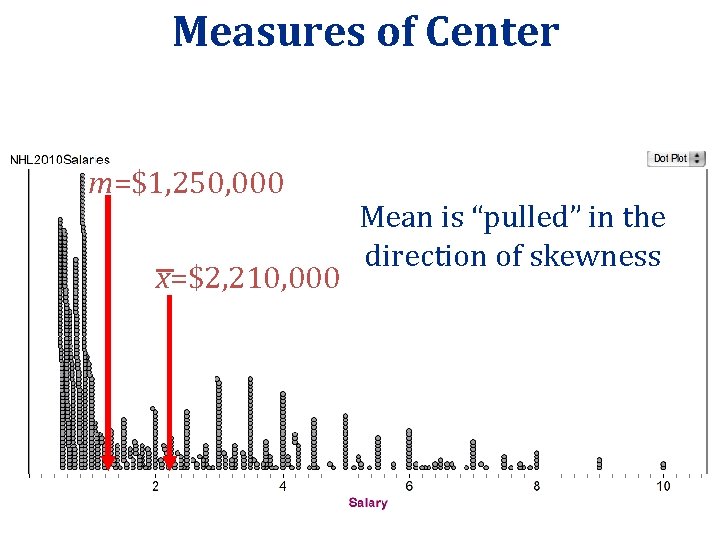
Measures of Center m=$1, 250, 000 x=$2, 210, 000 Mean is “pulled” in the direction of skewness
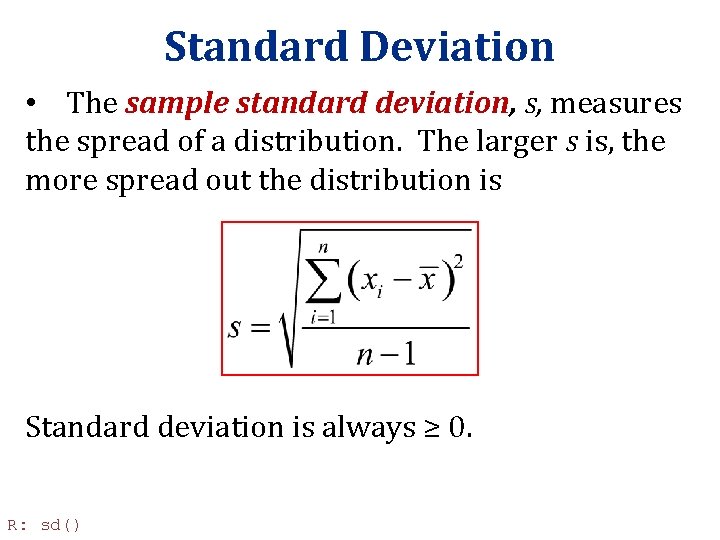
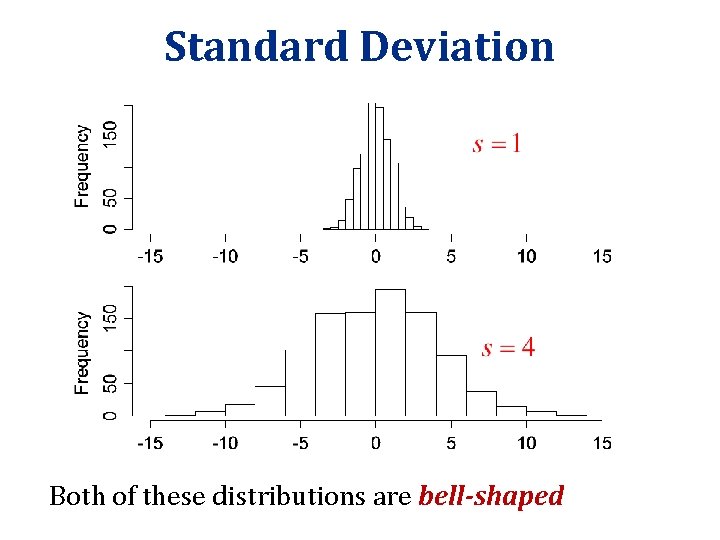
Standard Deviation • The sample standard deviation, s, measures the spread of a distribution. The larger s is, the more spread out the distribution is Standard deviation is always ≥ 0. R: sd()
Standard Deviation Both of these distributions are bell-shaped
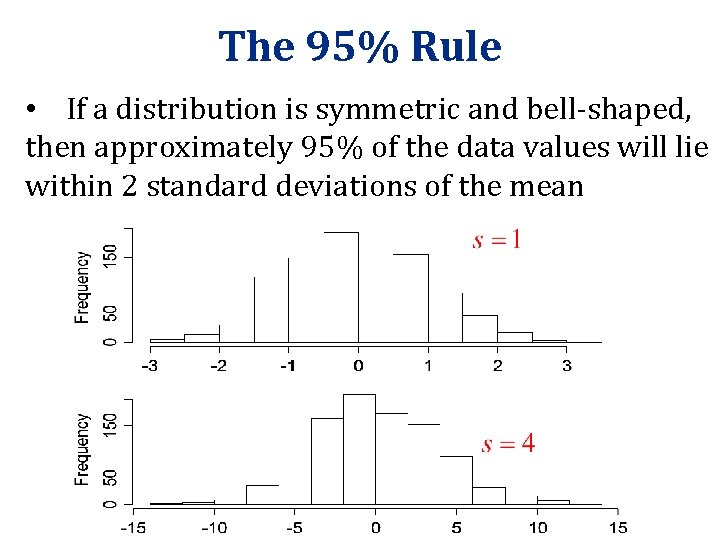
The 95% Rule • If a distribution is symmetric and bell-shaped, then approximately 95% of the data values will lie within 2 standard deviations of the mean
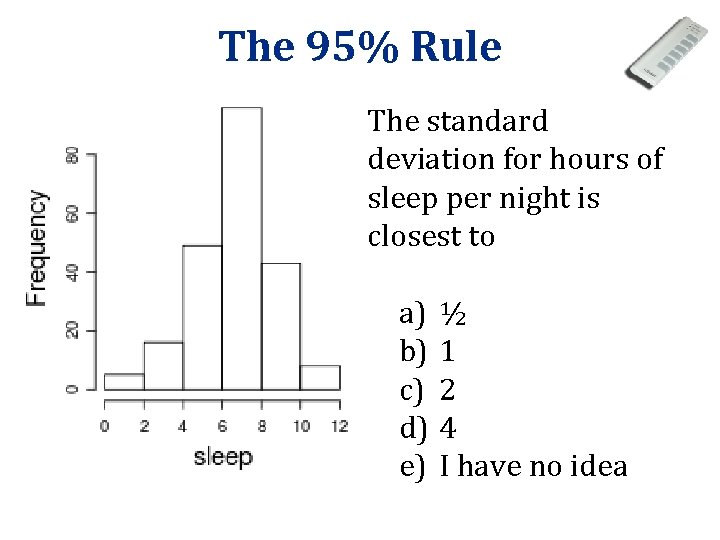
The 95% Rule The standard deviation for hours of sleep per night is closest to a) b) c) d) e) ½ 1 2 4 I have no idea
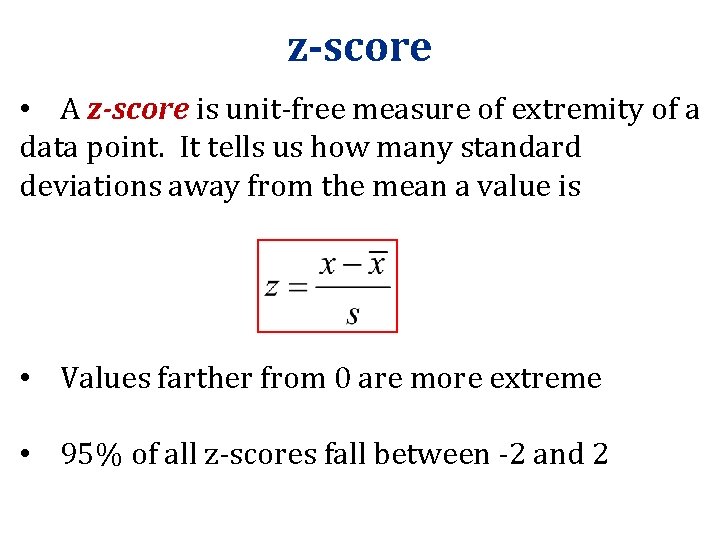
z-score • A z-score is unit-free measure of extremity of a data point. It tells us how many standard deviations away from the mean a value is • Values farther from 0 are more extreme • 95% of all z-scores fall between -2 and 2
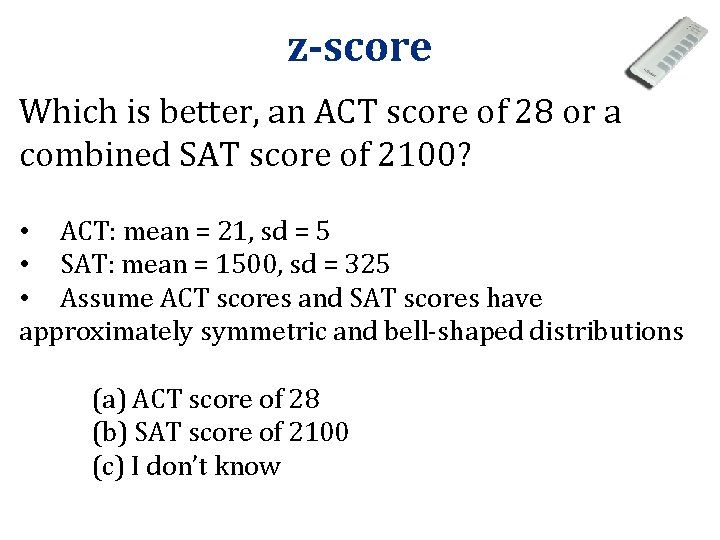
z-score Which is better, an ACT score of 28 or a combined SAT score of 2100? • ACT: mean = 21, sd = 5 • SAT: mean = 1500, sd = 325 • Assume ACT scores and SAT scores have approximately symmetric and bell-shaped distributions (a) ACT score of 28 (b) SAT score of 2100 (c) I don’t know
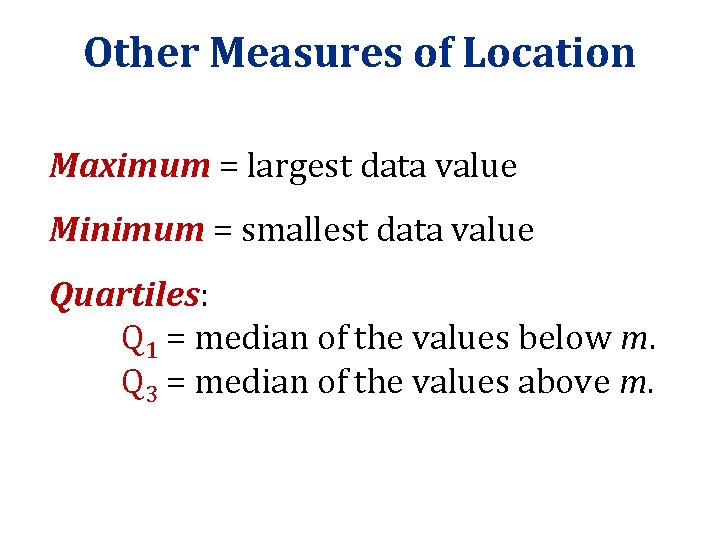
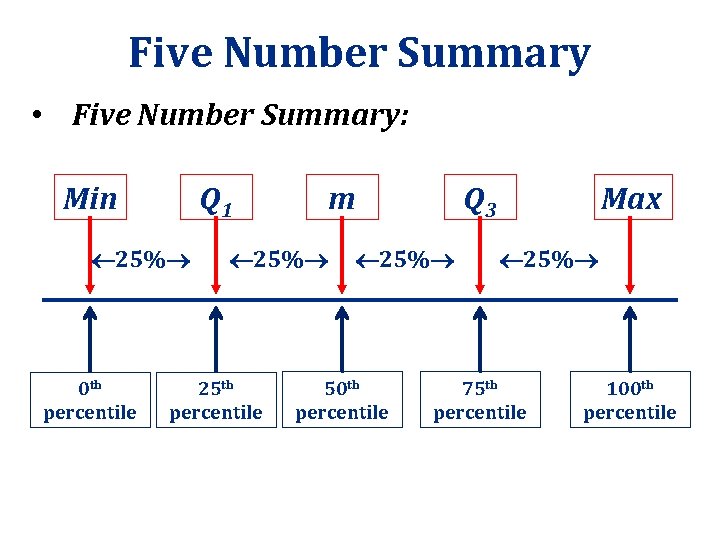
Other Measures of Location Maximum = largest data value Minimum = smallest data value Quartiles: Q 1 = median of the values below m. Q 3 = median of the values above m.
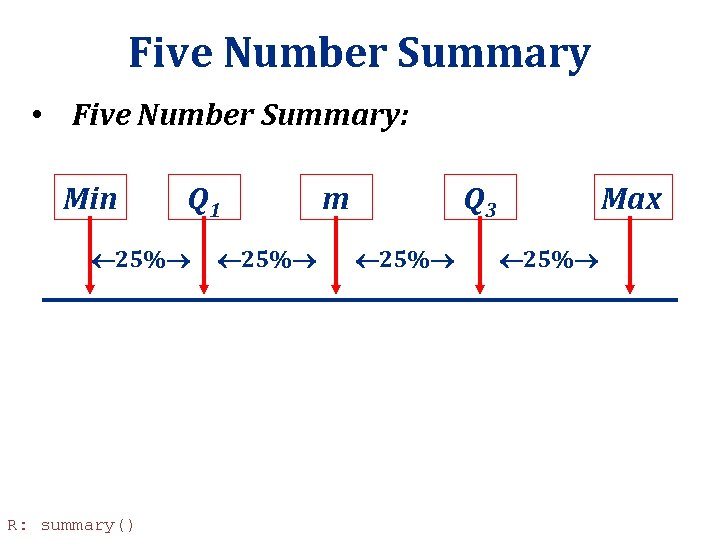
Five Number Summary • Five Number Summary: Min Q 1 25% R: summary() 25% m Q 3 25% Max 25%
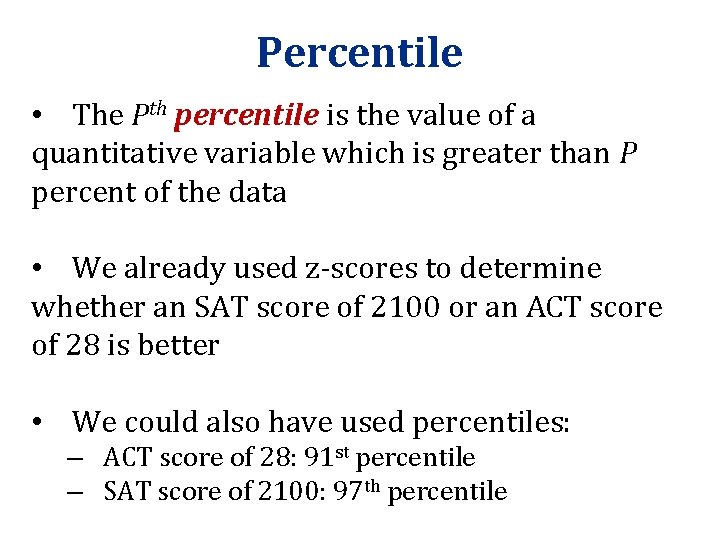
Percentile • The Pth percentile is the value of a quantitative variable which is greater than P percent of the data • We already used z-scores to determine whether an SAT score of 2100 or an ACT score of 28 is better • We could also have used percentiles: – ACT score of 28: 91 st percentile – SAT score of 2100: 97 th percentile
Five Number Summary • Five Number Summary: Min Q 1 25% 0 th percentile m 25% 25 th percentile Q 3 25% 50 th percentile Max 25% 75 th percentile 100 th percentile
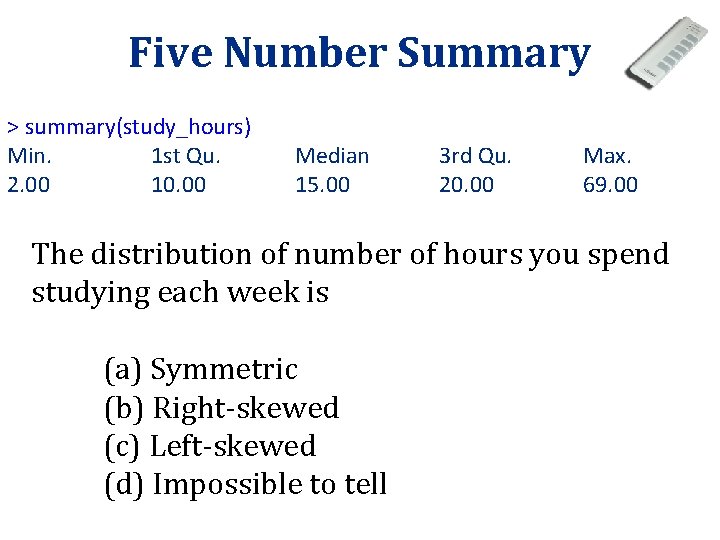
Five Number Summary > summary(study_hours) Min. 1 st Qu. 2. 00 10. 00 Median 15. 00 3 rd Qu. 20. 00 Max. 69. 00 The distribution of number of hours you spend studying each week is (a) Symmetric (b) Right-skewed (c) Left-skewed (d) Impossible to tell
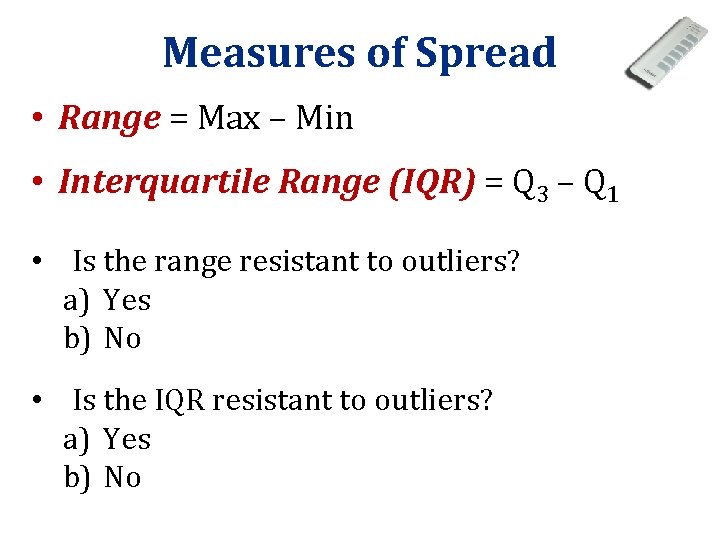
Measures of Spread • Range = Max – Min • Interquartile Range (IQR) = Q 3 – Q 1 • Is the range resistant to outliers? a) Yes b) No • Is the IQR resistant to outliers? a) Yes b) No
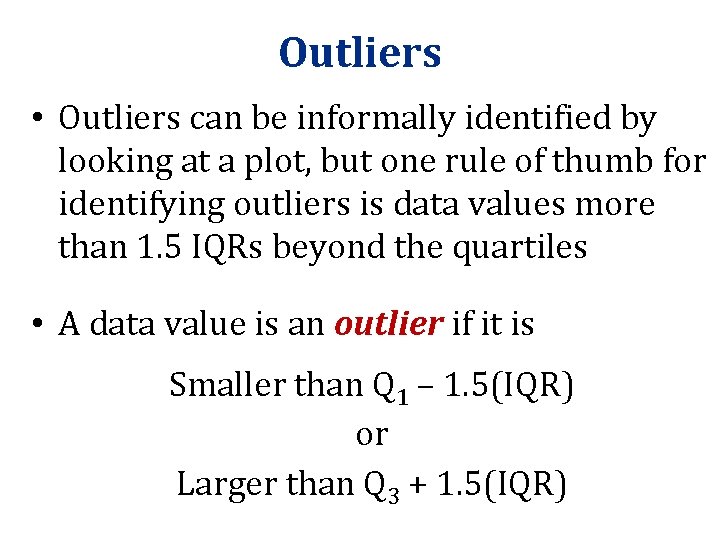
Outliers • Outliers can be informally identified by looking at a plot, but one rule of thumb for identifying outliers is data values more than 1. 5 IQRs beyond the quartiles • A data value is an outlier if it is Smaller than Q 1 – 1. 5(IQR) or Larger than Q 3 + 1. 5(IQR)
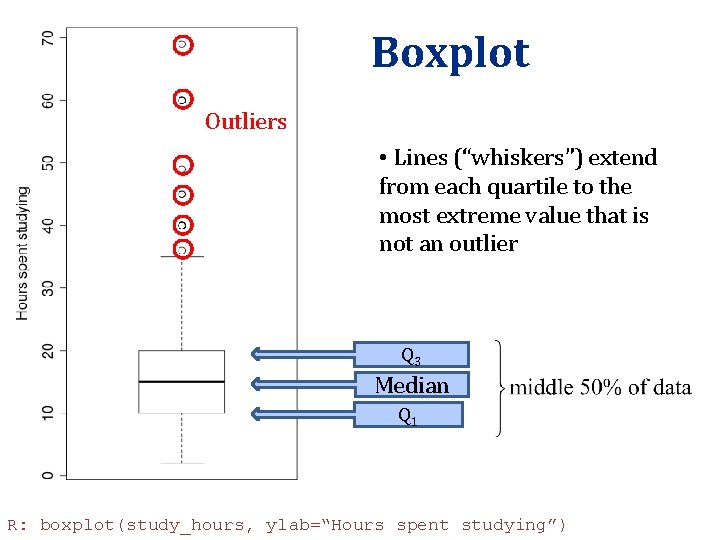
Boxplot Outliers • Lines (“whiskers”) extend from each quartile to the most extreme value that is not an outlier Q 3 Median Q 1 R: boxplot(study_hours, ylab=“Hours spent studying”)
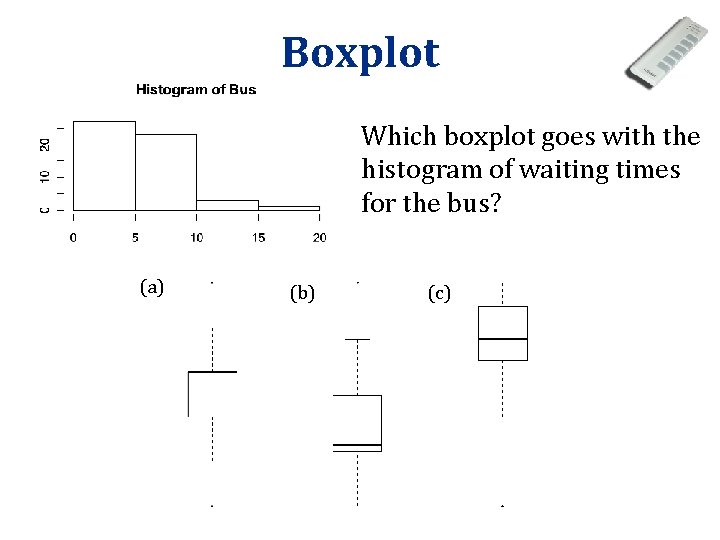
Boxplot Which boxplot goes with the histogram of waiting times for the bus? (a) (b) (c)
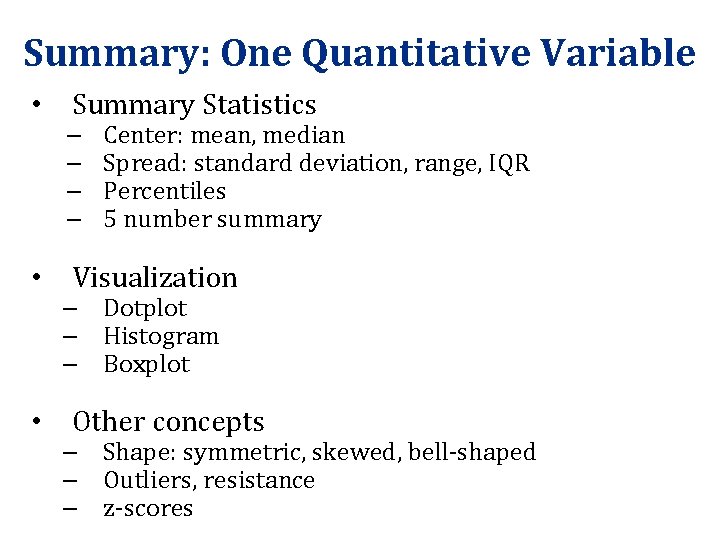
Summary: One Quantitative Variable • Summary Statistics – – Center: mean, median Spread: standard deviation, range, IQR Percentiles 5 number summary • Visualization – Dotplot – Histogram – Boxplot • Other concepts – Shape: symmetric, skewed, bell-shaped – Outliers, resistance – z-scores
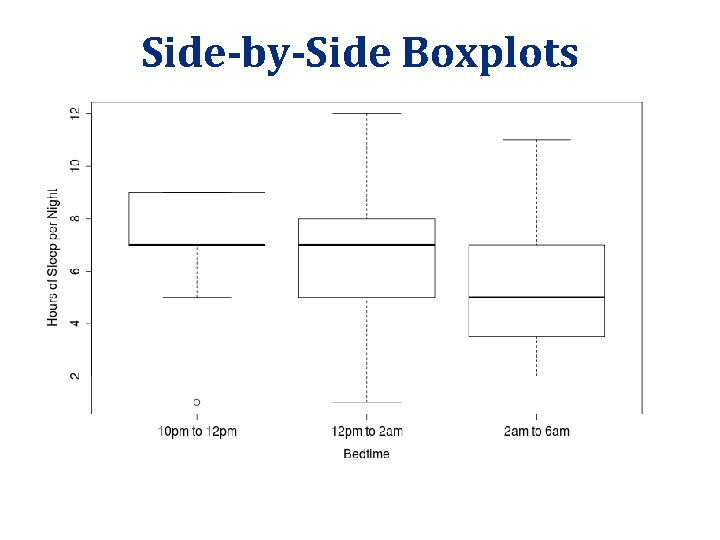
Quantitative and Categorical Relationships • Boxplots are particularly useful for comparing distributions of a quantitative variable across different levels of a categorical variable
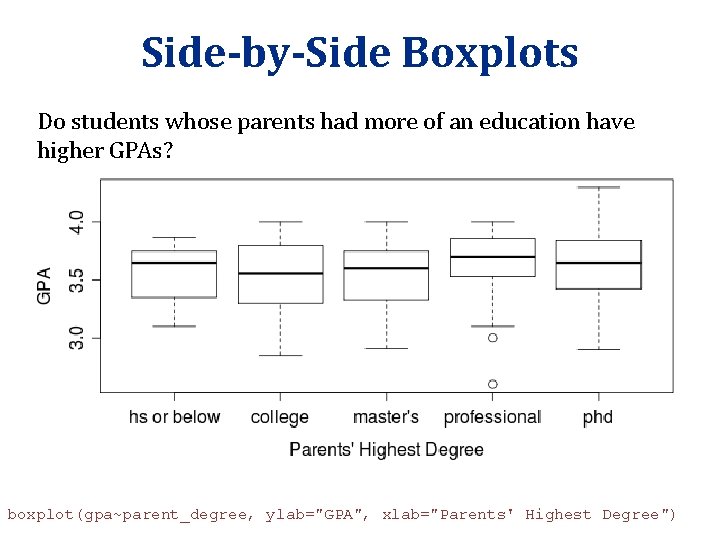
Side-by-Side Boxplots Do students whose parents had more of an education have higher GPAs? boxplot(gpa~parent_degree, ylab="GPA", xlab="Parents' Highest Degree")
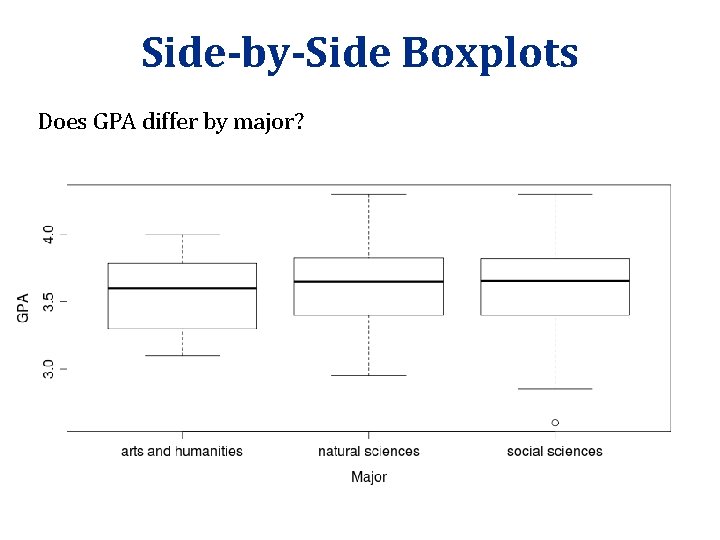
Side-by-Side Boxplots Does GPA differ by major?
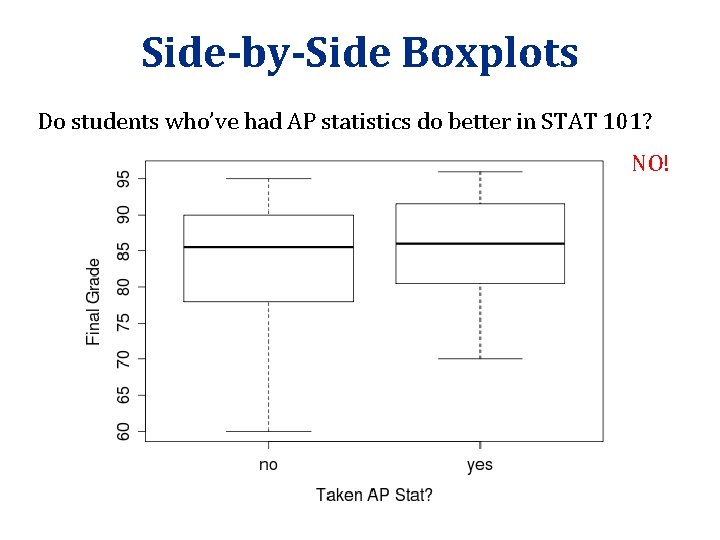
Side-by-Side Boxplots Do students who’ve had AP statistics do better in STAT 101? NO!
Side-by-Side Boxplots
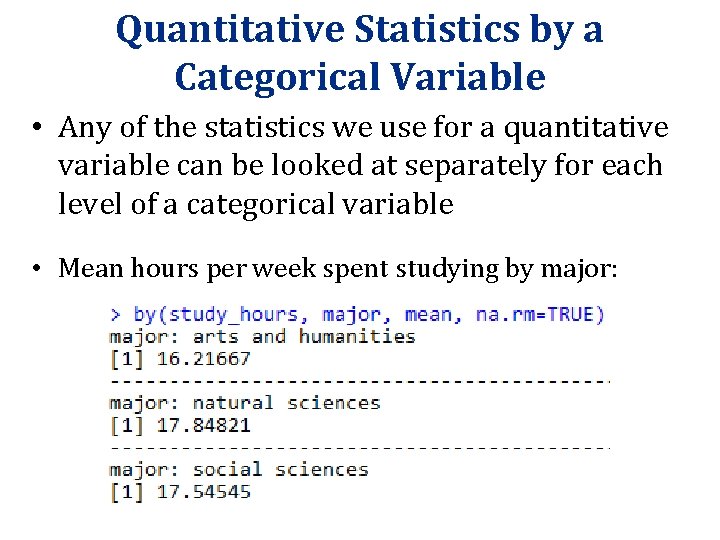
Quantitative Statistics by a Categorical Variable • Any of the statistics we use for a quantitative variable can be looked at separately for each level of a categorical variable • Mean hours per week spent studying by major:
Summary: One Quantitative and One Categorical • Summary Statistics – Any summary statistics for quantitative variables, broken down by each level of the categorical variable • Visualization – Side-by-side boxplots
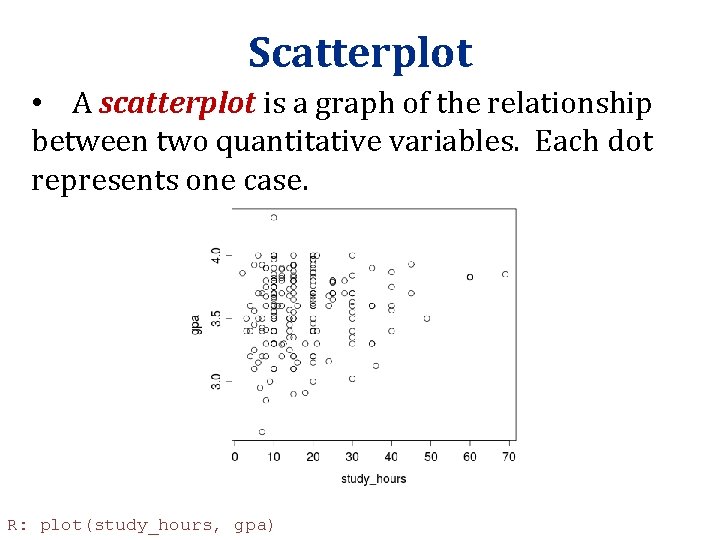
Scatterplot • A scatterplot is a graph of the relationship between two quantitative variables. Each dot represents one case. R: plot(study_hours, gpa)
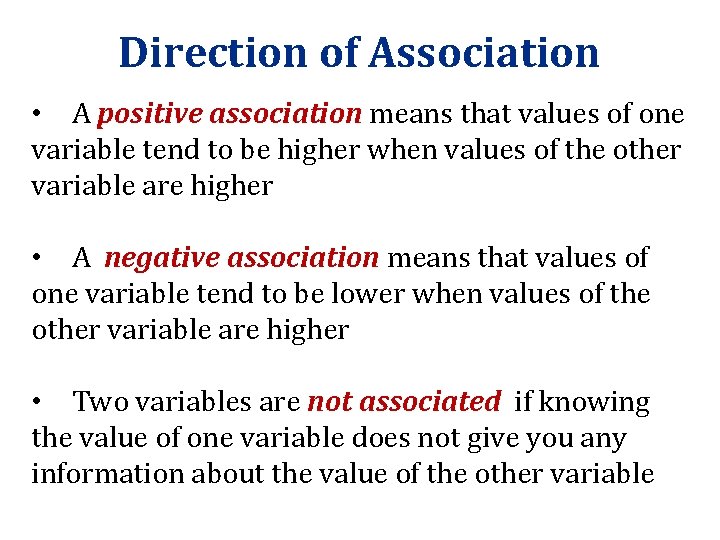
Direction of Association • A positive association means that values of one variable tend to be higher when values of the other variable are higher • A negative association means that values of one variable tend to be lower when values of the other variable are higher • Two variables are not associated if knowing the value of one variable does not give you any information about the value of the other variable
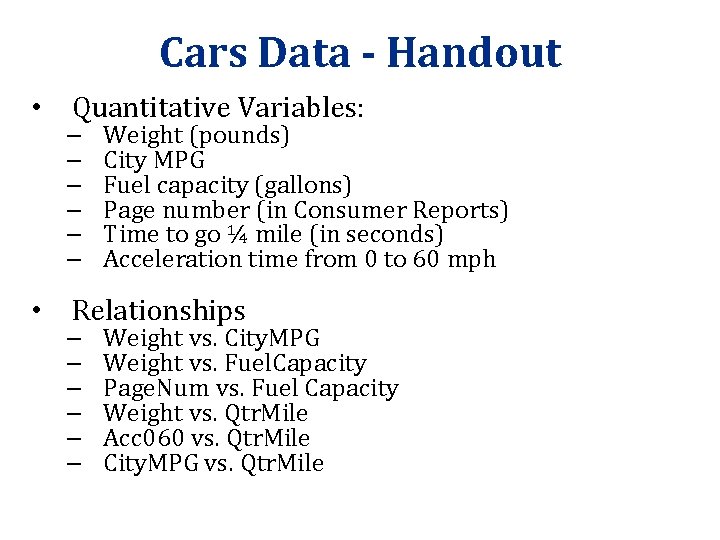
Cars Data - Handout • Quantitative Variables: – – – Weight (pounds) City MPG Fuel capacity (gallons) Page number (in Consumer Reports) Time to go ¼ mile (in seconds) Acceleration time from 0 to 60 mph • Relationships – – – Weight vs. City. MPG Weight vs. Fuel. Capacity Page. Num vs. Fuel Capacity Weight vs. Qtr. Mile Acc 060 vs. Qtr. Mile City. MPG vs. Qtr. Mile
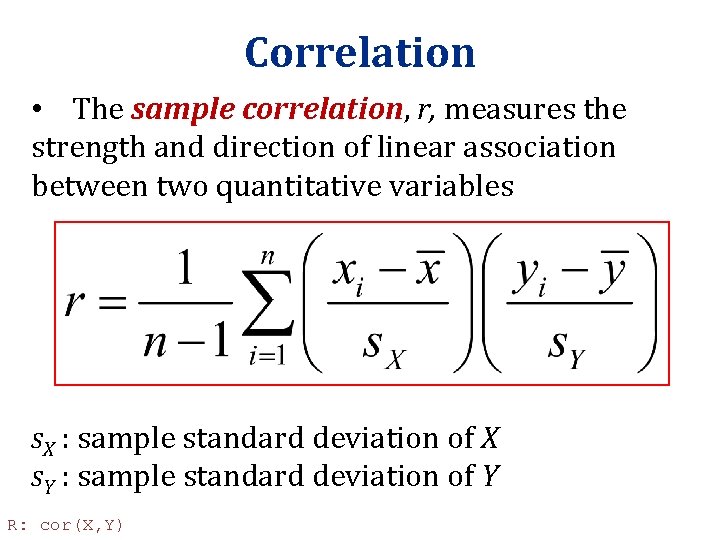
Correlation • The sample correlation, r, measures the strength and direction of linear association between two quantitative variables s. X : sample standard deviation of X s. Y : sample standard deviation of Y R: cor(X, Y)
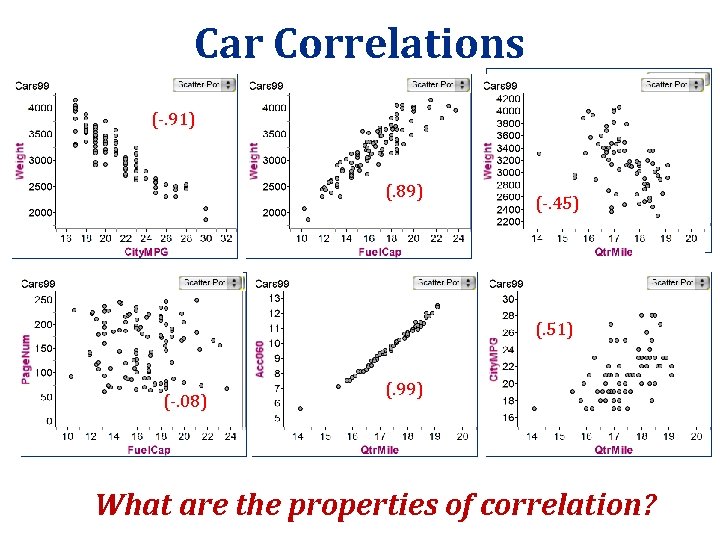
Car Correlations (-. 91) (. 89) (-. 45) (. 51) (-. 08) (. 99) What are the properties of correlation?
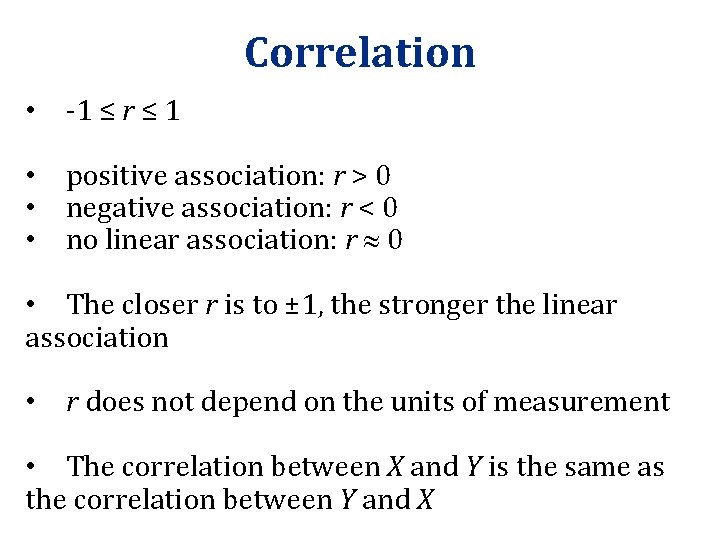
Correlation • -1 ≤ r ≤ 1 • positive association: r > 0 • negative association: r < 0 • no linear association: r 0 • The closer r is to ± 1, the stronger the linear association • r does not depend on the units of measurement • The correlation between X and Y is the same as the correlation between Y and X