
STARTING YOUR RESEARCH Preparing to Write Your Research





- Slides: 22
STARTING YOUR RESEARCH
Preparing to Write Your Research Paper • A Research Paper is NOT… • A rearrangement or summary of information from different sources • A report that could be included in a general encyclopedia • A matter of cutting and pasting together from different resources • A result of one quick Google search
A Research Paper is… • Your own analysis of information discovered from academic resources • A chance to demonstrate to others what you have learned, and express your thoughts on a work of literature in an organized, scholarly manner
Stages of Research: • Choosing and Narrowing a Topic • Gathering Material and Research • Keeping a Bibliography and Avoiding Plagiarism • Integrating Sources: Direct Quotation, Paraphrasing, Summarizing • Works Cited Page
Formulating a Research Question • A successful research question will: – Narrow an issue related to the work of literature down to a manageable question for a 6 -8 page paper. – Be specific. – Invite discussion about the answer to the question.
General Internet Research: Work with Caution • You can also get more accurate research on Google if you learn to use Google’s filters on the side bar. (“News” is sometimes a useful filter) • Also, you can search for scholarly articles by going to http: //scholar. google. com. Keep in mind these may be too long/complex. But check it out anyway! • Do not ever cite Wikipeida as a source. It is NOT considered a reliable or academic source. • If you absolutely cannot find the information anywhere else, you may look at a Wikipedia entry for ONE PURPOSE ONLY: To use their citation system to find the ORIGINAL SOURCE of the information. When you see a number link in a wiki article, click and it will take you to a citation at the bottom of the page. You may use this to go to the original source. • If the claim or information is not cited, it cannot be fully trusted. Do not use it, or search for it elsewhere.
So what are some Reputable Sources? • Peer reviewed academic journals • find through library website • Reputable websites and articles from reliable news sources, websites run by trustworthy organizations • Treat some websites with caution. The internet contains a wealth of information, but unless you know the credentials of the person posting the opinions/interpretations of a work, tread carefully. Come see me if you have any questions. • Articles or Material from any of our library databases
Research: LAMC Library Resources • Frequently Asked Research Questions Answered by LAMC Librarians • http: //www. lamission. edu/library/faq. aspx#internet • Where to start: • http: //www. lamission. edu/library/ • Database Resources: • http: //www. lamission. edu/library/resources. aspx • Do several sample searches, show students how to use keywords and how to find sources in most helpful databases: • EBESCOHost - general • Academic One. File – general • Ebook Collection
Doing Research on a Schedule • Don’t put it off until the last minute! • It is an extremely bad idea to put off your research to the last minute. • Research can help you narrow your topic • In fact, research can help you determine if the topic is even right for you! • Set a schedule. • If you have a schedule-keeper or a calendar, you might want to get it out and consult it as you put together this schedule for yourself. • If you don’t have a calendar or schedule keeper, I highly suggest you get one! It’s an academic essential!
Keep Records as You Go! • • When gathering information from sources, be sure to cite your sources carefully (author, title, page numbers, publisher, publication date) and mention whether you are quoting the source word-for-word (direct quotation) or summarizing a source’s ideas in your own words. Build your Works Cited page as you research, DON’T leave it until the last.
Example of Applying Literary Criticism to a Work of Literature: The Hunger Games
Applying Marxist Criticism to The Hunger Games • Questions: • What social and economic issues are at work in District 12 and in Panem at large? • What assumptions do these characters make about social class and access to food, clothing, etc? • What are the tesserae and how does this play a role in social class? What kind of families usually have to apply for tesserae and who does not? • In what ways does this book challenge or support the system that it describes? • What comment do you feel the book is making about American entertainment and capitalism?
More on Marxist Criticism and THG • What additional insights do you think that Marxist Criticism might offer us? – Consider issues of power and money – who has them, and how do those people treat Katniss and the other people from District 12? – Consider the significance of the so-called “Career Tributes”. What do their districts have the others do not? How does this affect their willing participation in the Games? – Are the Career Tributes and District 1 and 2 actually happy with the Games and the Capitol, or is this a survival tactic in an inherently unfair economic system? – How is entertainment seen as a tool of oppression in these books?
What Other Literary Theories Might Fit Well When Examining The Hunger Games ? • Consider the Characters: • What kind of a person is Katniss Everdeen? • What is the significance of her name? • Can you think of any other significant names in this book? • This book is full of complicated relationships. • What is Katniss’s relationship to her mother? With her sister? Gale? Peeta? Haymitch? What about her prep team? • How are these relationships complicated by the economic and social tyranny the Capital has over the Districts?
The Hunger Games and Feminist Criticism In 2010, Katie Roiphe wrote a review of “Mockingjay” that described Katniss as “a great character without being exactly likable”: Katniss is bossy, moody, bratty, demanding, prickly. She treats the world with an explosive aggression that is a little out of the ordinary, to say the least…In short, she belongs to a recent tribe of popular heroines: the small, difficult teenage girl who manifests enormous physical and moral strength. She is both murderer and victim, somehow representing female strength and female vulnerability all mingled and entwined, dangerously, ambiguously, into one. • How might we read Katniss’s portrayal as “not exactly likable” through a feminist lens? • Is Katniss unusual when we compare her with heroines from other novels, movies, and tv shows? • How does Katniss compare with various male heroes in books, movies, and tv? Do we have different standards for “likability” when it comes to the genders? • What does it say about our society that we expect our female heroines to always be “likeable”, whereas often male heroes are allowed to antiheroes who are morally “grey” and complex?
Perspectives on a Feminist Reading of Katniss and Beauty • “Interestingly, a critical part of making Katniss into a compliant participant in the Capitol’s oppressive enterprise is remaking Katniss into a feminine character both physically and behaviorally; these are simultaneously the moments when she is made the most vulnerable. On the one hand, these feminine moments may invite girl readers to identify with her anxieties, vulnerability, and, sometimes, her pleasure at embracing the trappings of physical beauty; on the other hand, they seem to reinforce the idea that Katniss is most powerful when she embraces masculine ways. Collins further complicates this narrative maneuver by allowing Katniss alternating feelings of rejection of the artificial beauty expectations imposed by the Capitol and acceptance of them. ” • “Perhaps readers — girl readers, in particular — connect with the beauty artifice the heroine is subjected to, recognizing in it their own familiarity with cultural expectations. Such artifice can arouse public sentiment (much like the Mockingjay image that Katniss emblematizes) but is without substance. ” • Is it without substance? What do you think? • What might a feminist reading that takes the opposite position on this point look like?
Quote from “Killer Katniss and Loverboy Peeta: In Defiance of Gendered Genre Reading” • “Besides blood relations, the novel also centers on surrogate families, whose members display loyalty and selfless love even at great personal risk. Haymitch, the man with no wife or children of his own, acts in this capacity and becomes integral to Katniss’s survival just as Katniss takes care of Rue, both by sharing food and shelter and by honoring her death with flowers and song. When he was himself a child, Peeta once risked physical violence to give bread to a starving eleven-yearold Katniss. • By including these powerful interactions between characters’ families and even virtual strangers, Collins touches on values that are not inscribed with gender ideology. Like the Greek myths that served as part of Collins’s inspiration, The Hunger Games emphasizes primal connections between people who exist outside social influence. As a result, the novel and its sequels reach a wide and diverse audience both in terms of gender and generation. ”
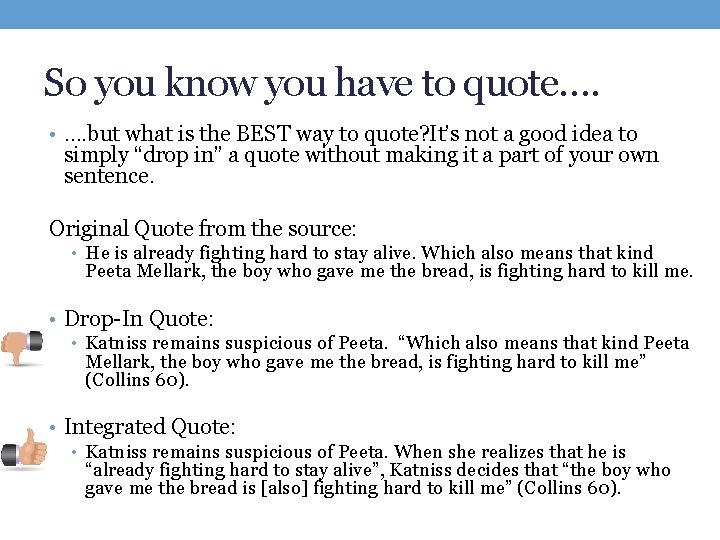
So you know you have to quote…. • …. but what is the BEST way to quote? It’s not a good idea to simply “drop in” a quote without making it a part of your own sentence. Original Quote from the source: • He is already fighting hard to stay alive. Which also means that kind Peeta Mellark, the boy who gave me the bread, is fighting hard to kill me. • Drop-In Quote: • Katniss remains suspicious of Peeta. “Which also means that kind Peeta Mellark, the boy who gave me the bread, is fighting hard to kill me” (Collins 60). • Integrated Quote: • Katniss remains suspicious of Peeta. When she realizes that he is “already fighting hard to stay alive”, Katniss decides that “the boy who gave me the bread is [also] fighting hard to kill me” (Collins 60).
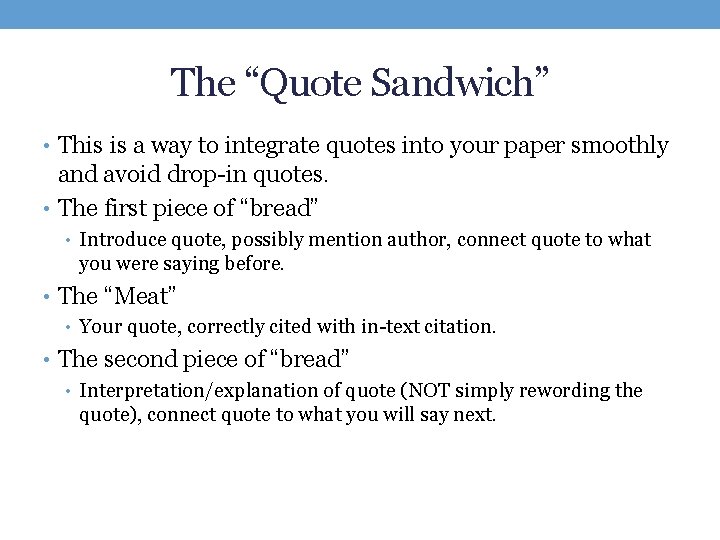
The “Quote Sandwich” • This is a way to integrate quotes into your paper smoothly and avoid drop-in quotes. • The first piece of “bread” • Introduce quote, possibly mention author, connect quote to what you were saying before. • The “Meat” • Your quote, correctly cited with in-text citation. • The second piece of “bread” • Interpretation/explanation of quote (NOT simply rewording the quote), connect quote to what you will say next.
Use the Quote Sandwich method to structure paragraphs! By using a detailed quote sandwich, we can write whole paragraphs using only one quote/point
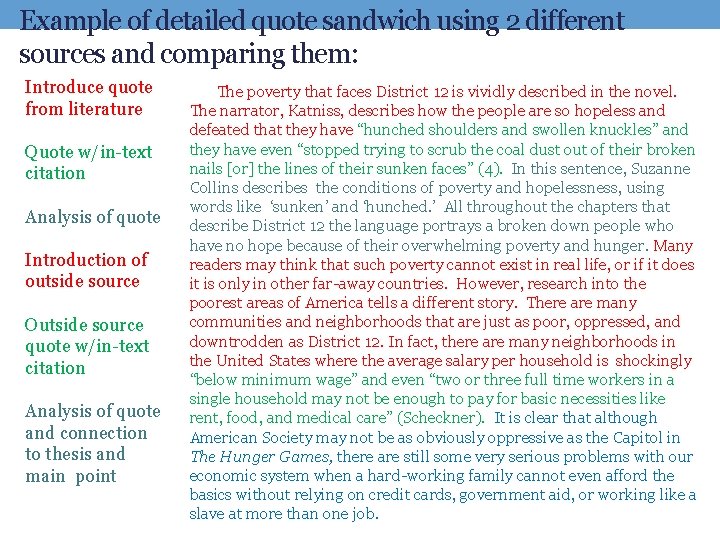
Example of detailed quote sandwich using 2 different sources and comparing them: Introduce quote from literature Quote w/in-text citation Analysis of quote Introduction of outside source Outside source quote w/in-text citation Analysis of quote and connection to thesis and main point The poverty that faces District 12 is vividly described in the novel. The narrator, Katniss, describes how the people are so hopeless and defeated that they have “hunched shoulders and swollen knuckles” and they have even “stopped trying to scrub the coal dust out of their broken nails [or] the lines of their sunken faces” (4). In this sentence, Suzanne Collins describes the conditions of poverty and hopelessness, using words like ‘sunken’ and ‘hunched. ’ All throughout the chapters that describe District 12 the language portrays a broken down people who have no hope because of their overwhelming poverty and hunger. Many readers may think that such poverty cannot exist in real life, or if it does it is only in other far-away countries. However, research into the poorest areas of America tells a different story. There are many communities and neighborhoods that are just as poor, oppressed, and downtrodden as District 12. In fact, there are many neighborhoods in the United States where the average salary per household is shockingly “below minimum wage” and even “two or three full time workers in a single household may not be enough to pay for basic necessities like rent, food, and medical care” (Scheckner). It is clear that although American Society may not be as obviously oppressive as the Capitol in The Hunger Games, there are still some very serious problems with our economic system when a hard-working family cannot even afford the basics without relying on credit cards, government aid, or working like a slave at more than one job.
Example of detailed quote sandwich using 2 different sources and comparing them: Katniss thoughts on the very real hunger in District 12 are shocking: “Starvation's not an uncommon fate in District 12 […] you come upon them sitting motionless against a wall or dying in the Meadow, you hear the wails from a house, and the Peacekeepers are called in to retrieve the body. Starvation is never the cause of death officially. It's always the flu, or exposure, or pneumonia. But that fools no one” (p. 28). This passage tells us that the people of District 12 do not receive enough resources to sustain the population and that those in charge turn a blind eye to the cause of so many deaths. Later, the reader learns that the Capitol is full of gluttonous people who waste food that could have easily saved thousands of lives across Panem. The overabundance of food and people's wastefulness are especially clear in Catching Fire, in which it is revealed that citizens of the Capitol drink a liquid that makes them throw up, effectively emptying their bellies, so that they can continue to gorge on delicacies provided at a feast. As Katniss witnesses this spectacle, she thinks, "all I can think of is the emaciated bodies of the children on our kitchen table as my mother prescribes what the parents can't give. More food" (p. 80). The irony of starving children lying on the kitchen table, a place associated with bounty and reserved for meals, is not lost on the reader and adds to the horror of the image while magnifying the wastefulness of the Capitol. Collins revealed in an interview that "the sociopolitical overtones of The Hunger Games were very intentionally created to characterize current and past world events, including the use of hunger as a weapon to control populations" (Blasingame & Collins, 2009, p. 726). Still, hunger as a method of control is not what initially disturbs the adolescent and adult in the United States; it is the blatant waste of food while others starve that makes our stomachs twist. Why does it make us so uncomfortable? Because if we look at patterns of wastefulness in the United States, we are more closely associated with the Capitol, the bad guys, than with the districts. For example, we over-consume food, which contributes to the country's high obesity rate, but waste vast quantities at the same time. According to the U. S. Environmental Protection Agency (2012), in 2010 approximately 34 million tons of food were thrown away. These facts force us to question how our standard of living affects others and the environment.