
Starter What will be the nth term of


Starter What will be the nth term of these sequences? 7, 11, 15, 19, 23, … 3, 10, 17, 24, 31, … 5, 11, 17, 23, 29, … 8, 14, 20 , 26 , 32, … 4, 10 , 16, 22 , 28, … 4 n + 3 7 n - 4 6 n - 1 6 n + 2 6 n - 2 What will be the nth term of these sequences? 4½, 6, 7½, 9, 10½, … 11, 22, 33, 44, 55, … 0. 4, 0. 6, 0. 8, 1. 0, 1. 2, … 14, 36, 58, 80, 102, … -4, 10, 24, 38, 52, … 1½n + 3 11 n 0. 2 n + 0. 2 22 n - 8 14 n – 18 Now work out the 20 th term of each sequence.
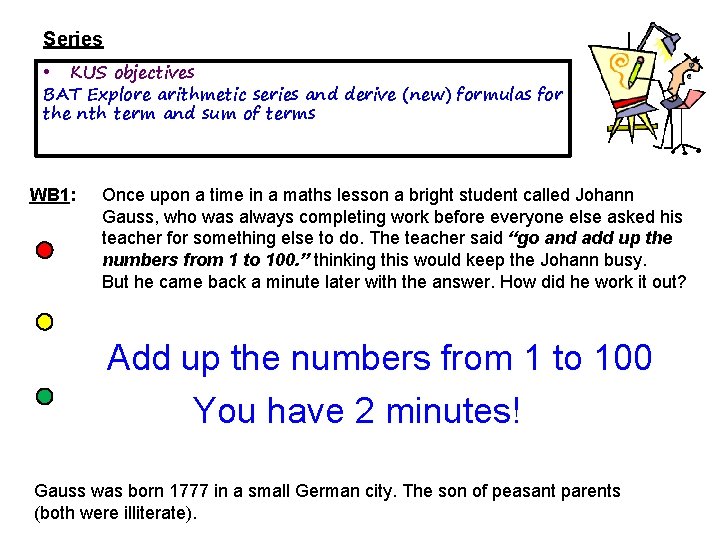
Series • KUS objectives BAT Explore arithmetic series and derive (new) formulas for the nth term and sum of terms WB 1: Once upon a time in a maths lesson a bright student called Johann Gauss, who was always completing work before everyone else asked his teacher for something else to do. The teacher said “go and add up the numbers from 1 to 100. ” thinking this would keep the Johann busy. But he came back a minute later with the answer. How did he work it out? Add up the numbers from 1 to 100 You have 2 minutes! Gauss was born 1777 in a small German city. The son of peasant parents (both were illiterate).
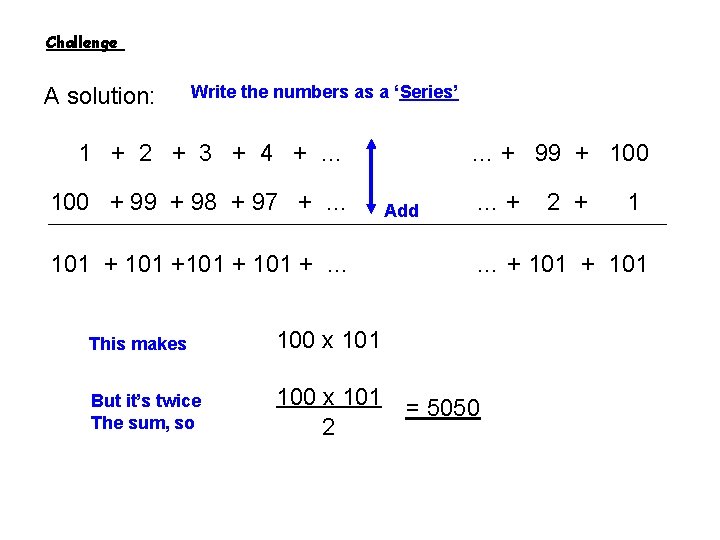
Challenge A solution: Write the numbers as a ‘Series’ 1 + 2 + 3 + 4 + … 100 + 99 + 98 + 97 + … 101 +101 + … This makes 100 x 101 But it’s twice The sum, so 100 x 101 2 … + 99 + 100 Add …+ 2 + 1 … + 101 = 5050
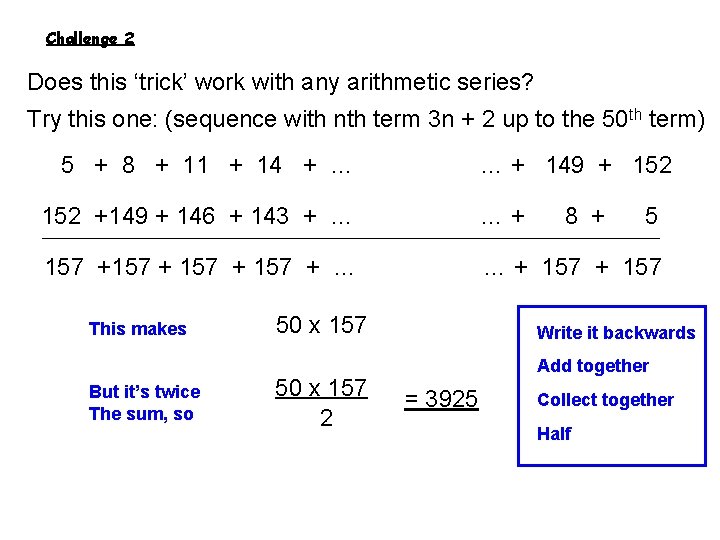
Challenge 2 Does this ‘trick’ work with any arithmetic series? Try this one: (sequence with nth term 3 n + 2 up to the 50 th term) 5 + 8 + 11 + 14 + … … + 149 + 152 +149 + 146 + 143 + … …+ 157 + … … + 157 This makes But it’s twice The sum, so 50 x 157 2 8 + 5 Write it backwards Add together = 3925 Collect together Half
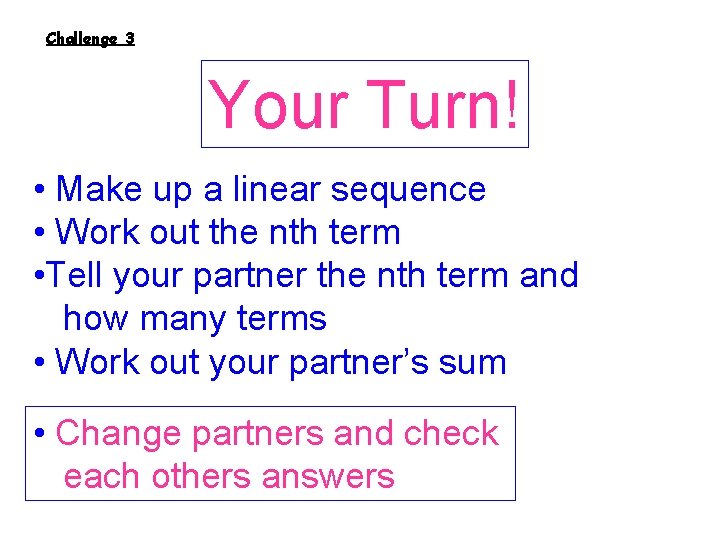
Challenge 3 Your Turn! • Make up a linear sequence • Work out the nth term • Tell your partner the nth term and how many terms • Work out your partner’s sum • Change partners and check each others answers
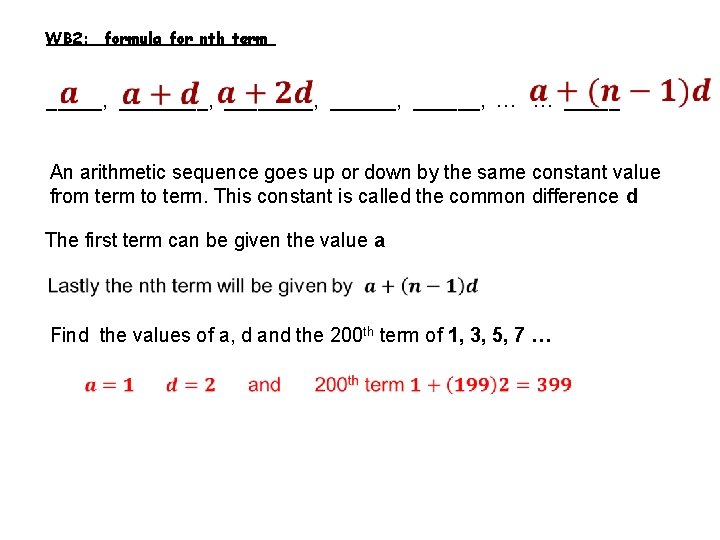
WB 2: formula for nth term _____, ________, … … _____ An arithmetic sequence goes up or down by the same constant value from term to term. This constant is called the common difference d The first term can be given the value a Find the values of a, d and the 200 th term of 1, 3, 5, 7 …
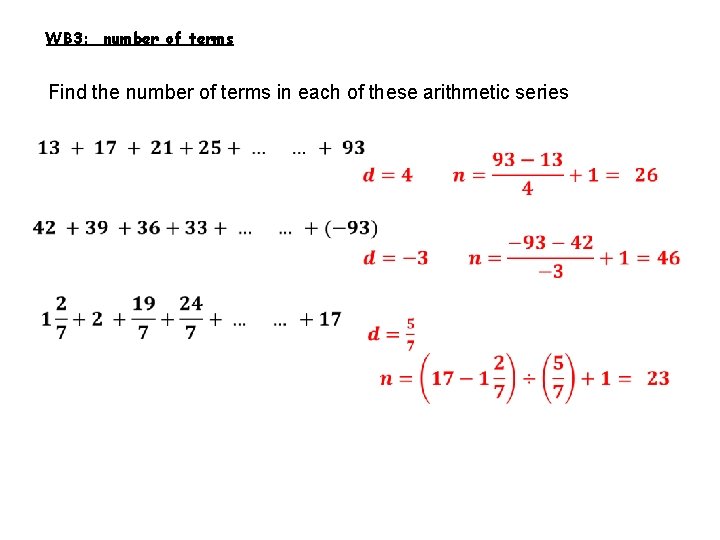
WB 3: number of terms Find the number of terms in each of these arithmetic series
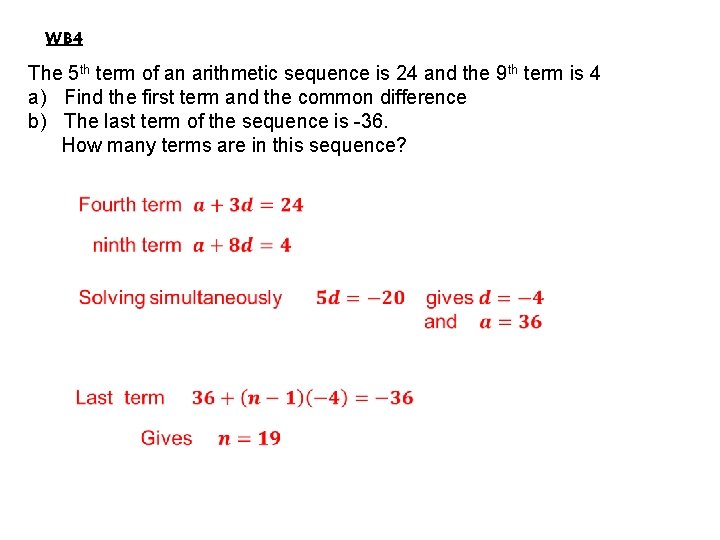
WB 4 The 5 th term of an arithmetic sequence is 24 and the 9 th term is 4 a) Find the first term and the common difference b) The last term of the sequence is -36. How many terms are in this sequence?
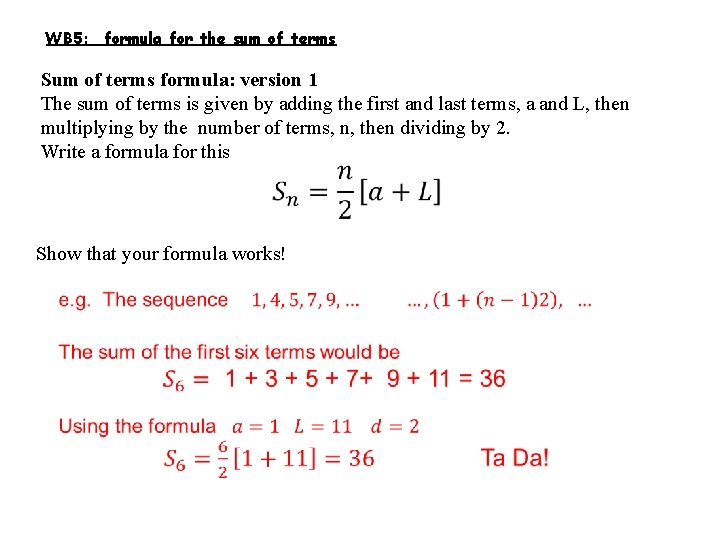
WB 5: formula for the sum of terms Sum of terms formula: version 1 The sum of terms is given by adding the first and last terms, a and L, then multiplying by the number of terms, n, then dividing by 2. Write a formula for this Show that your formula works!
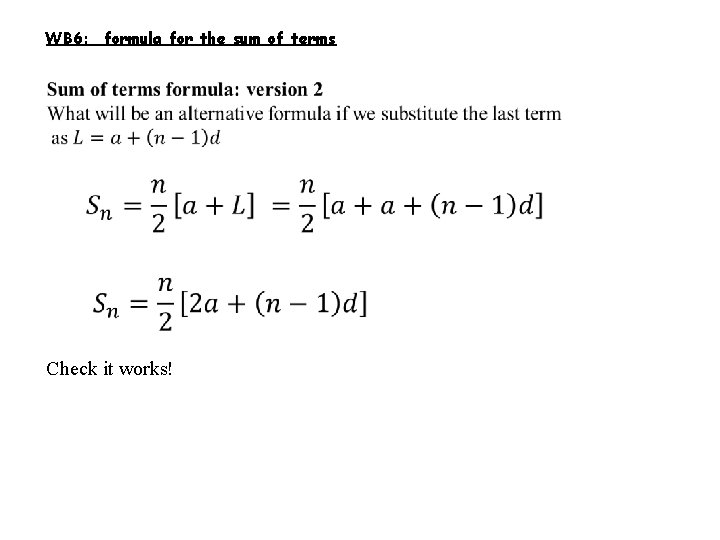
WB 6: formula for the sum of terms Check it works!
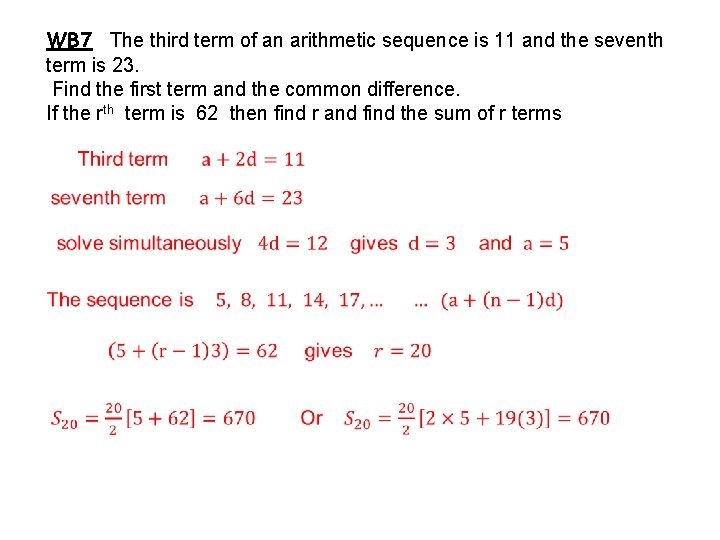
WB 7 The third term of an arithmetic sequence is 11 and the seventh term is 23. Find the first term and the common difference. If the rth term is 62 then find r and find the sum of r terms
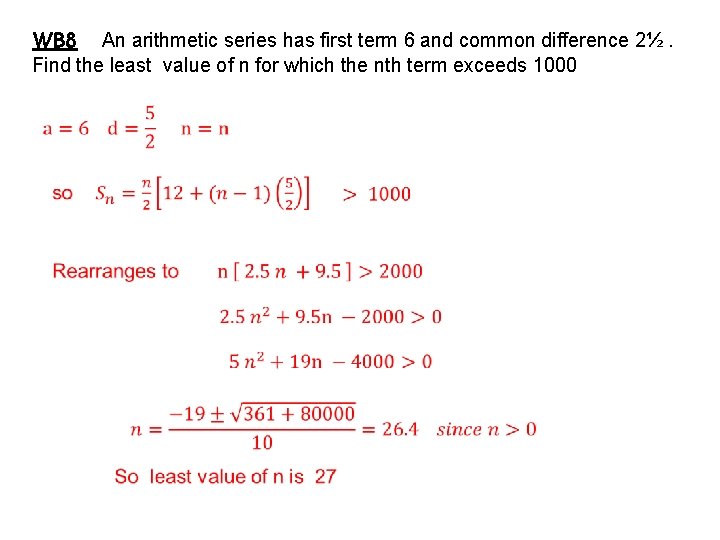
WB 8 An arithmetic series has first term 6 and common difference 2½. Find the least value of n for which the nth term exceeds 1000
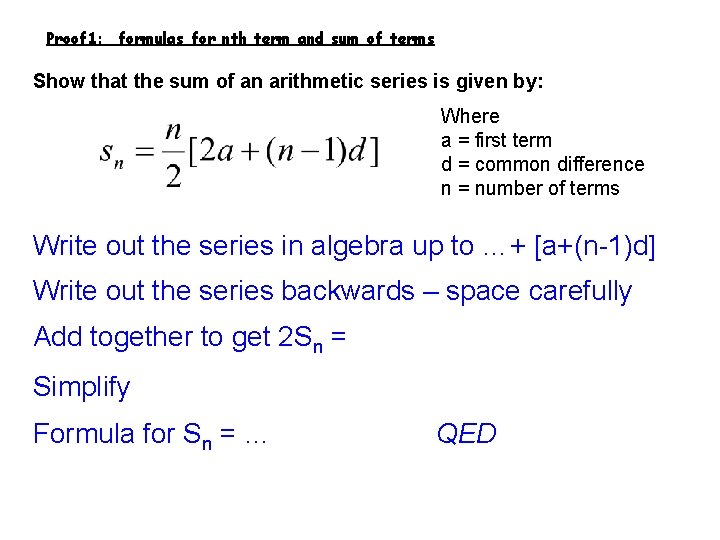
Proof 1: formulas for nth term and sum of terms Show that the sum of an arithmetic series is given by: Where a = first term d = common difference n = number of terms Write out the series in algebra up to …+ [a+(n-1)d] Write out the series backwards – space carefully Add together to get 2 Sn = Simplify Formula for Sn = … QED
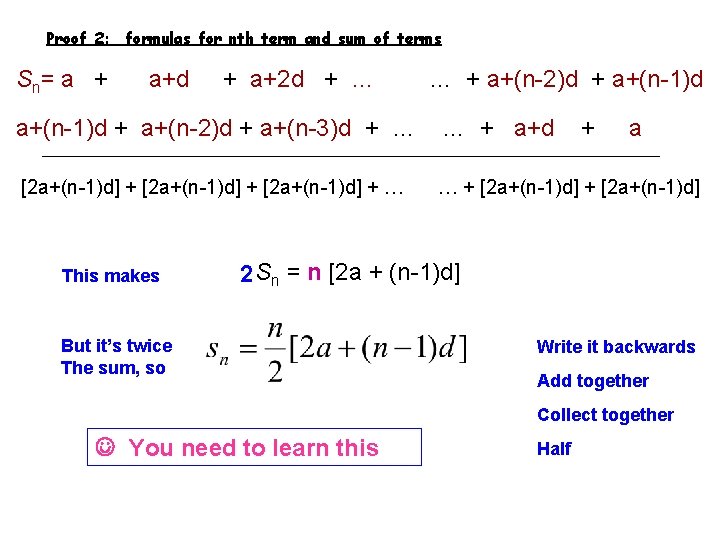
Proof 2: formulas for nth term and sum of terms S n= a + a+d + a+2 d + … … + a+(n-2)d + a+(n-1)d + a+(n-2)d + a+(n-3)d + … … + a+d [2 a+(n-1)d] + … … + [2 a+(n-1)d] This makes + a 2 Sn = n [2 a + (n-1)d] But it’s twice The sum, so Write it backwards Add together Collect together You need to learn this Half
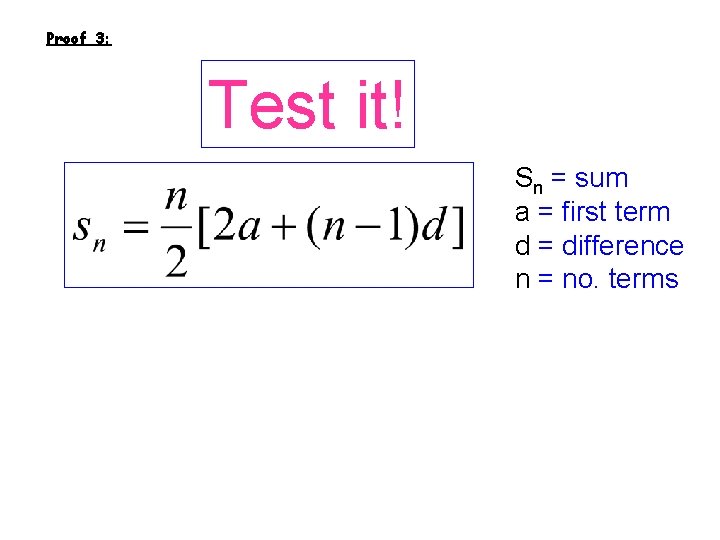
Proof 3: Test it! Sn = sum a = first term d = difference n = no. terms
• KUS objectives BAT Explore arithmetic series and derive (new) formulas for the nth term and sum of terms self-assess One thing learned is – One thing to improve is –

END
- Slides: 20