
Starter Learning Check Questionnaires What is a questionnaire
- Slides: 13
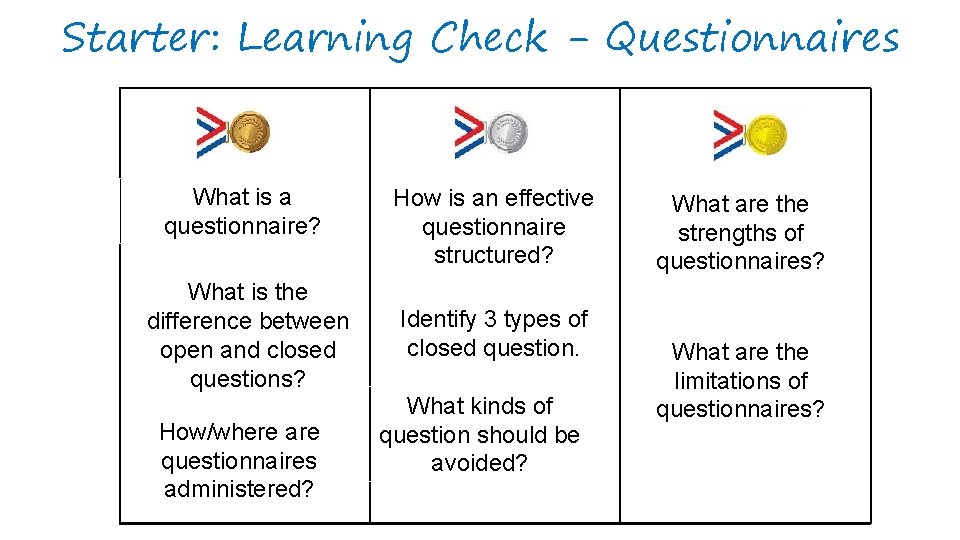
Starter: Learning Check - Questionnaires What is a questionnaire? What is the difference between open and closed questions? How/where are questionnaires administered? How is an effective questionnaire structured? Identify 3 types of closed question. What kinds of question should be avoided? What are the strengths of questionnaires? What are the limitations of questionnaires?
Using the criteria for effective questionnaires (page 6 of last week’s handout), analyse the design of the sample of questionnaires you have been given. For each questionnaire, identify at least one strength and one limitation. Challenge: Rewrite and/or re -order the questions to make the questionnaire more effective.
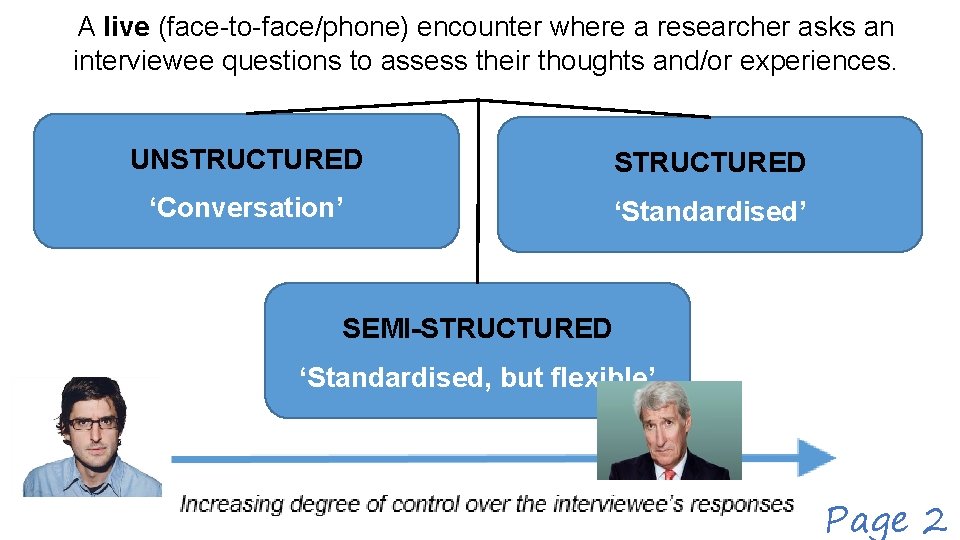
A live (face-to-face/phone) encounter where a researcher asks an interviewee questions to assess their thoughts and/or experiences. UNSTRUCTURED ‘Conversation’ ‘Standardised’ SEMI-STRUCTURED ‘Standardised, but flexible’ Page 2
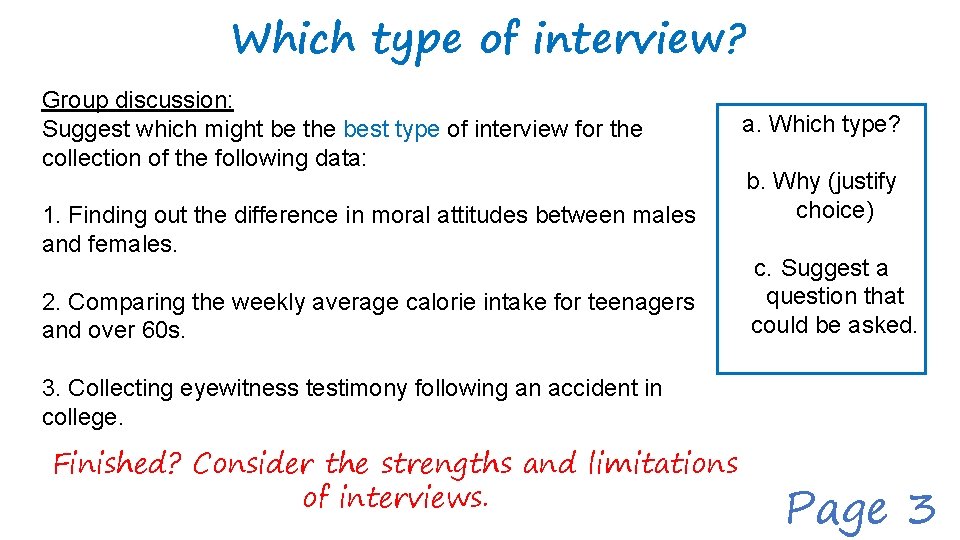
Which type of interview? Group discussion: Suggest which might be the best type of interview for the collection of the following data: 1. Finding out the difference in moral attitudes between males and females. 2. Comparing the weekly average calorie intake for teenagers and over 60 s. a. Which type? b. Why (justify choice) c. Suggest a question that could be asked. 3. Collecting eyewitness testimony following an accident in college. Finished? Consider the strengths and limitations of interviews. Page 3
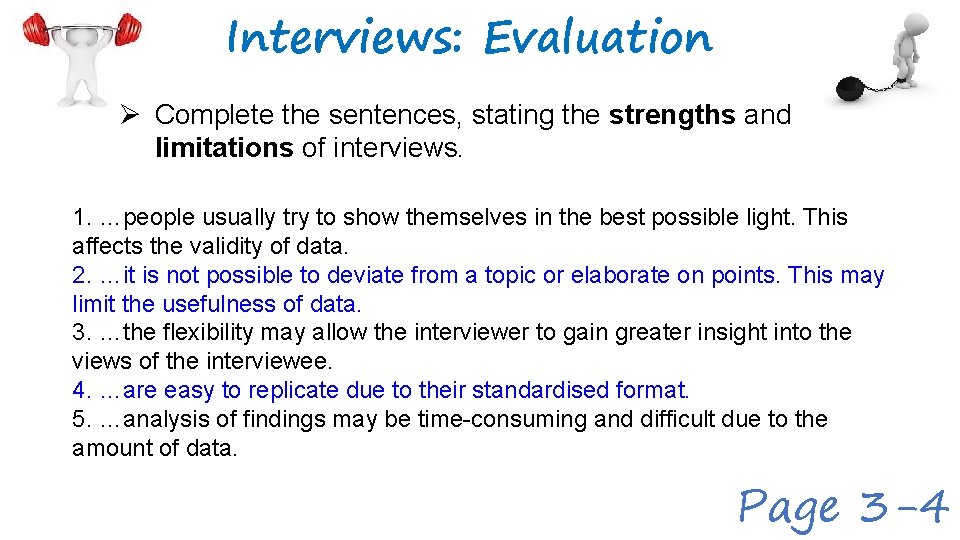
Interviews: Evaluation Ø Complete the sentences, stating the strengths and limitations of interviews. 1. …people usually try to show themselves in the best possible light. This affects the validity of data. 2. …it is not possible to deviate from a topic or elaborate on points. This may limit the usefulness of data. 3. …the flexibility may allow the interviewer to gain greater insight into the views of the interviewee. 4. …are easy to replicate due to their standardised format. 5. …analysis of findings may be time-consuming and difficult due to the amount of data. Page 3 -4
Designing Interviews ØAnswer the questions below using the guidance on page 4 and 5 of the handout: 1. What is an ‘interview schedule’? 2. How should you begin an interview? Why? 3. Why might audio- or video-recording an interview be better than making notes during an interview? 4. What is interviewer bias? 5. Could you demonstrate appropriate body language for an interviewer? 6. What ethical issues are raised by the interview method? Page 4 -5
Task: Design an interview: In pairs/threes: ØDesign an interview schedule with a maximum of 10 questions. The aim of the interview is to obtain information about the thoughts and experiences of students at the College, although the particular choice of topic is down to you. Page 5 -6
ØUndertake/participate in a pilot interview with another pair/three. ØAfter, evaluate your interview and your findings. Finished? Consider the questions on questionnaires and interviews on page 7.
Questionnaires vs. Interviews 1. What is the difference between a questionnaire and an interview? A questionnaire is a written set of questions whereas an interview takes place live – for example, either face-to-face or over the phone. 2. What advantage might a questionnaire have over an interview? It might be more cost effective when collecting from large samples because many can be given out in minutes and filled in simultaneously. 3. What advantage might an interview have over a questionnaire? Interviews can be more flexible – for example, in unstructured or even semi-structured ones the interviewer has the option to follow up on interesting aspects of responses and gain a deeper Page understanding. 7
Exam Practice Your choice: ØComplete the questions on page 8 -9. Articulate ØDescribe the words on the cards without using the words. ØNote any terms of which you are unsure.
Plenary: 3, 2, 1 Write 3 sentences summarising what you have learned about self-report techniques. … Now reduce that to 2 pictures… 1. 2. 3. And finally to 1 word…