
starter Jot down everything you know about VECTORS

starter Jot down everything you know about VECTORS magnitude notation equal negative Add and subtract Multiply by a scalar zero Parallel Perpendicular
Statics Force diagrams Force Diagrams Hot air balloon Use trigonometry to find the components of a vector (or magnitude and direction) Find the resultant of two or more forces, as the sum of components Starter: think of a situation in real life that these terms would be used Air Resistance Weight Force resolving magnitude direction
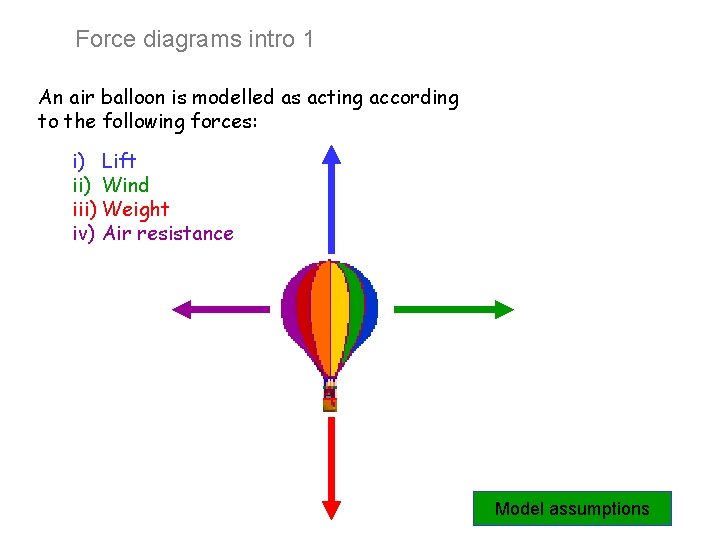
Force diagrams intro 1 An air balloon is modelled as acting according to the following forces: i) Lift ii) Wind iii) Weight iv) Air resistance Model assumptions
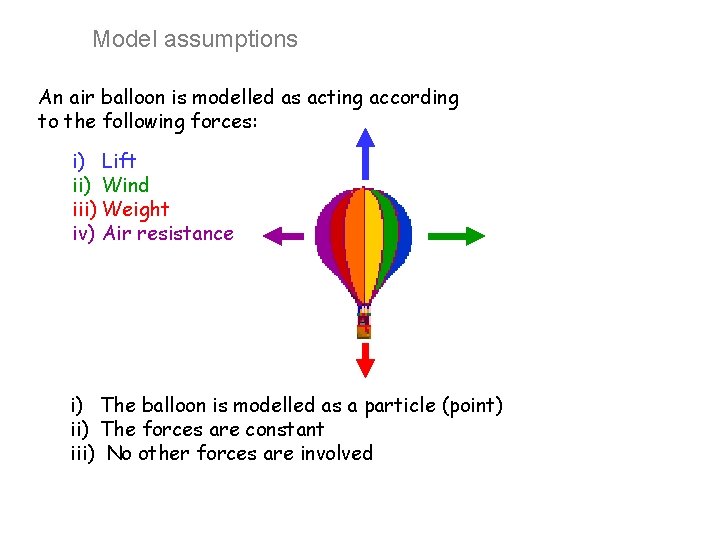
Model assumptions An air balloon is modelled as acting according to the following forces: i) Lift ii) Wind iii) Weight iv) Air resistance i) The balloon is modelled as a particle (point) ii) The forces are constant iii) No other forces are involved
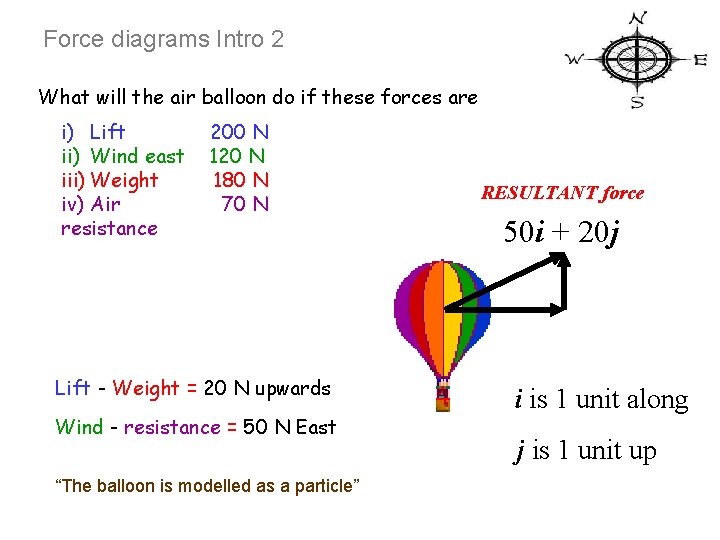
Force diagrams Intro 2 What will the air balloon do if these forces are i) Lift ii) Wind east iii) Weight iv) Air resistance 200 N 120 N 180 N 70 N Lift - Weight = 20 N upwards Wind - resistance = 50 N East “The balloon is modelled as a particle” RESULTANT force 50 i + 20 j i is 1 unit along j is 1 unit up
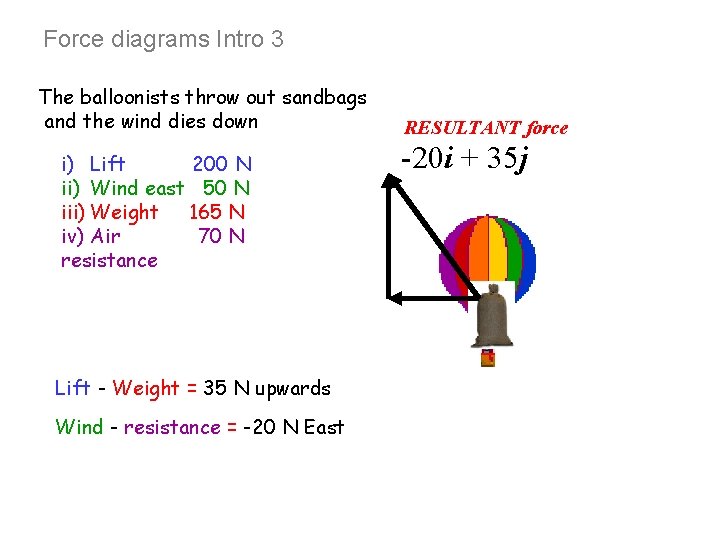
Force diagrams Intro 3 The balloonists throw out sandbags and the wind dies down i) Lift 200 N ii) Wind east 50 N iii) Weight 165 N iv) Air 70 N resistance Lift - Weight = 35 N upwards Wind - resistance = -20 N East RESULTANT force -20 i + 35 j
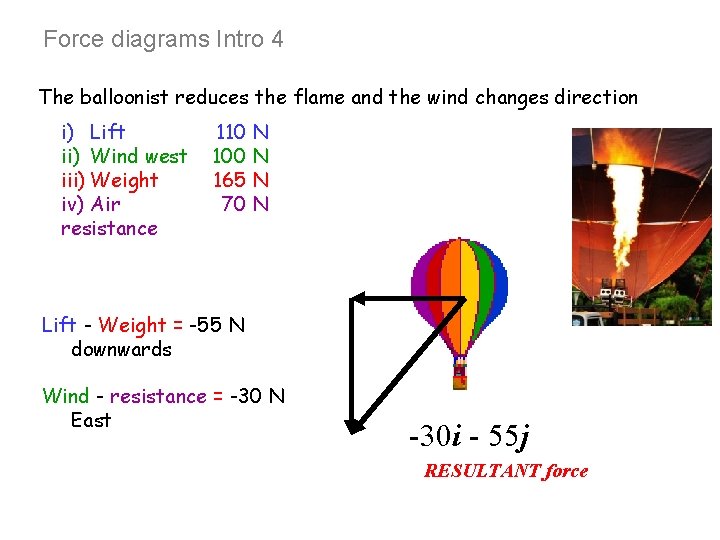
Force diagrams Intro 4 The balloonist reduces the flame and the wind changes direction i) Lift ii) Wind west iii) Weight iv) Air resistance 110 N 100 N 165 N 70 N Lift - Weight = -55 N downwards Wind - resistance = -30 N East -30 i - 55 j RESULTANT force
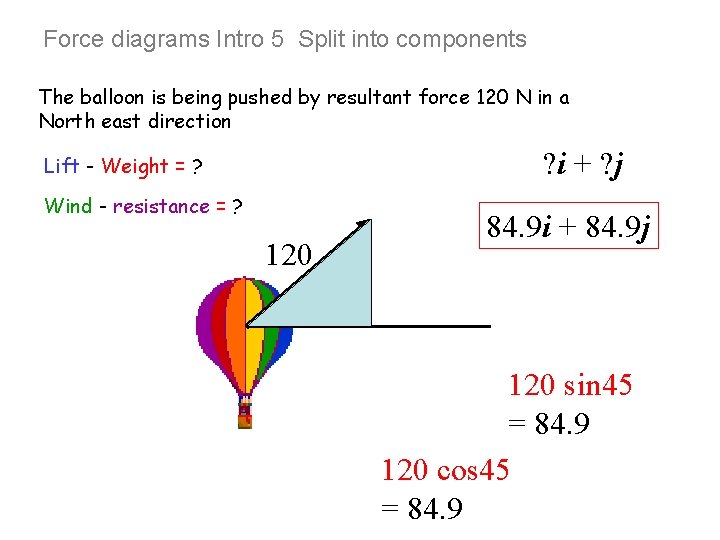
Force diagrams Intro 5 Split into components The balloon is being pushed by resultant force 120 N in a North east direction ? i + ? j Lift - Weight = ? Wind - resistance = ? 120 84. 9 i + 84. 9 j 450 120 sin 45 = 84. 9 120 cos 45 = 84. 9
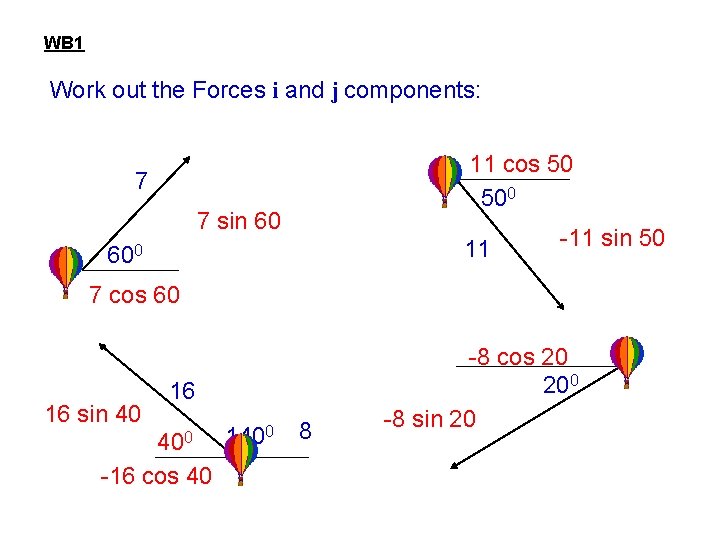
WB 1 Work out the Forces i and j components: 11 cos 50 500 7 7 sin 60 11 600 -11 sin 50 7 cos 60 16 sin 40 16 0 400 140 -16 cos 40 8 -8 cos 20 200 -8 sin 20
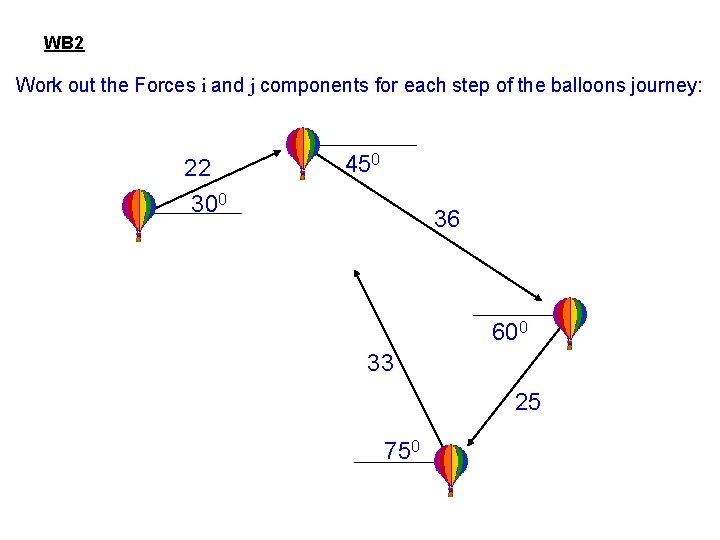
WB 2 Work out the Forces i and j components for each step of the balloons journey: 22 300 450 36 600 33 25 750
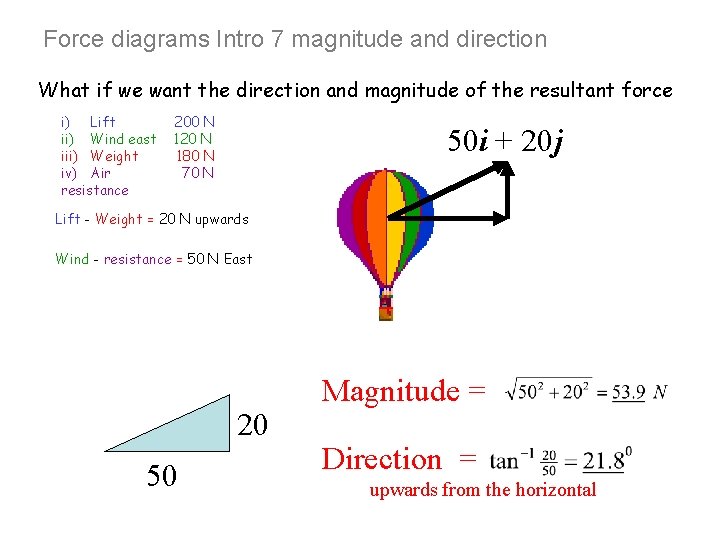
Force diagrams Intro 7 magnitude and direction What if we want the direction and magnitude of the resultant force i) Lift ii) Wind east iii) Weight iv) Air resistance 200 N 120 N 180 N 70 N 50 i + 20 j Lift - Weight = 20 N upwards Wind - resistance = 50 N East 20 50 Magnitude = Direction = upwards from the horizontal
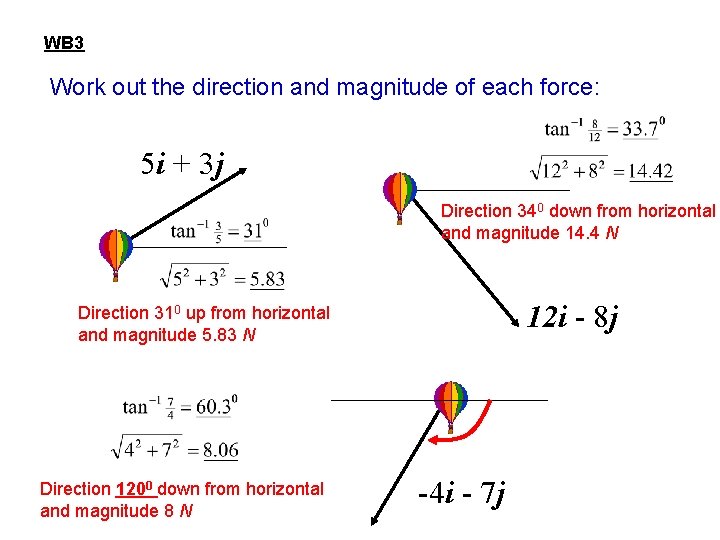
WB 3 Work out the direction and magnitude of each force: 5 i + 3 j Direction 340 down from horizontal and magnitude 14. 4 N 12 i - 8 j Direction 310 up from horizontal and magnitude 5. 83 N Direction 1200 down from horizontal and magnitude 8 N -4 i - 7 j
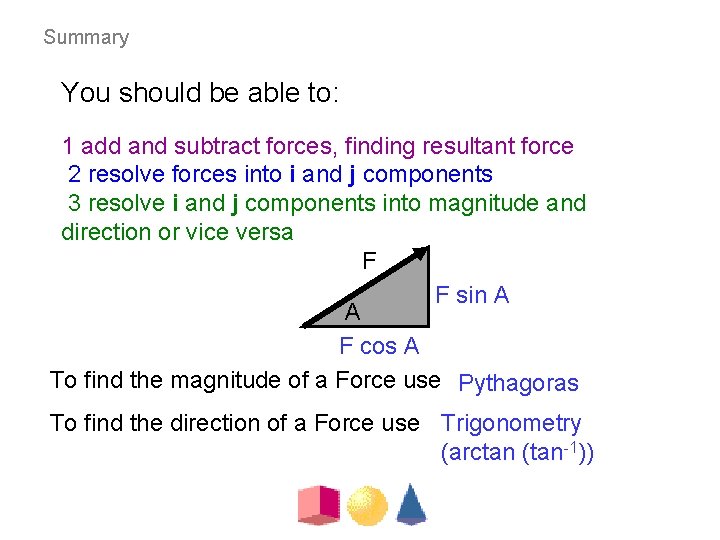
Summary You should be able to: 1 add and subtract forces, finding resultant force 2 resolve forces into i and j components 3 resolve i and j components into magnitude and direction or vice versa F F sin A A F cos A To find the magnitude of a Force use Pythagoras To find the direction of a Force use Trigonometry (arctan (tan-1))
Plenary Discuss: In what context will we find Forces? What type of problems? ® engineering and building: strengths of materials holding up walls, floors, bridges … ® sailing: forces = currents in the water and drive of the engine ® connected objects: car pulling a caravan; objects suspended by cables from cranes …
Force Diagrams Hot air balloon Use trigonometry to find the components of a vector (or magnitude and direction) Find the resultant of two or more forces, as the sum of components self-assess One thing learned is – One thing to improve is –
END
- Slides: 17