
Starter 2222010 1 Rocks are made of m
- Slides: 57
Starter 2/22/2010 1. Rocks are made of m____ and m_____ are made of compounds which contain 2 or more e_____. 2. Where do the Earth’s rocks come from? 3. What are the 3 layers of the geosphere?
Prentice Hall EARTH SCIENCE Tarbuck Lutgens
Chapter 3 Rocks 3. 1 Define the term rock. 3. 2 Identify the three major types of rocks 3. 2 a Explain how they differ. 3. 3 Describe the rock cycle. 3. 4 List the forces that power Earth’s rock cycle.
Chapter 3 Rocks NC Competency Goals 2. 03 Investigate and analyze the processes responsible for the rock cycle: • Analyze the origin, texture and mineral composition of rocks. • Trace the path of elements through the rock cycle. • Relate rock formation to plate tectonics. • Identify forms of energy that drive the rock cycle. • Analyze the relationship between the rock cycle and processes in the atmosphere and hydrosphere.
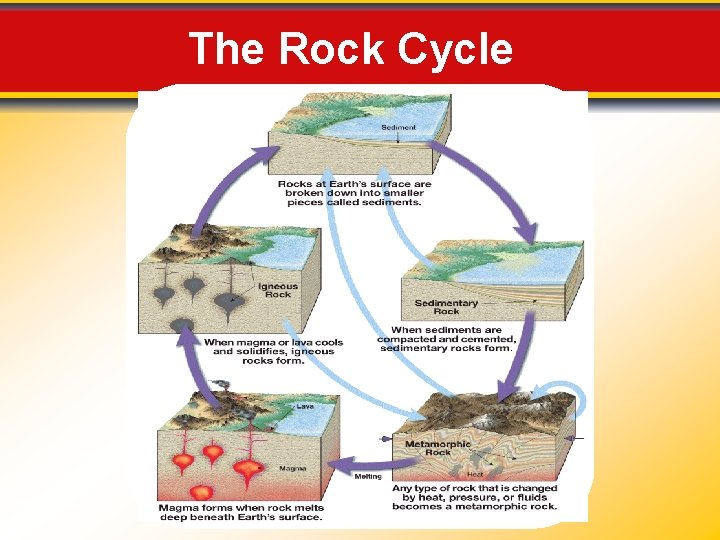
3. 1 The Rock Cycle Rocks are any solid mass of mineral or mineral-like matter occurring naturally as part of our planet. There are Three Types of Rocks classified by how they were formed.
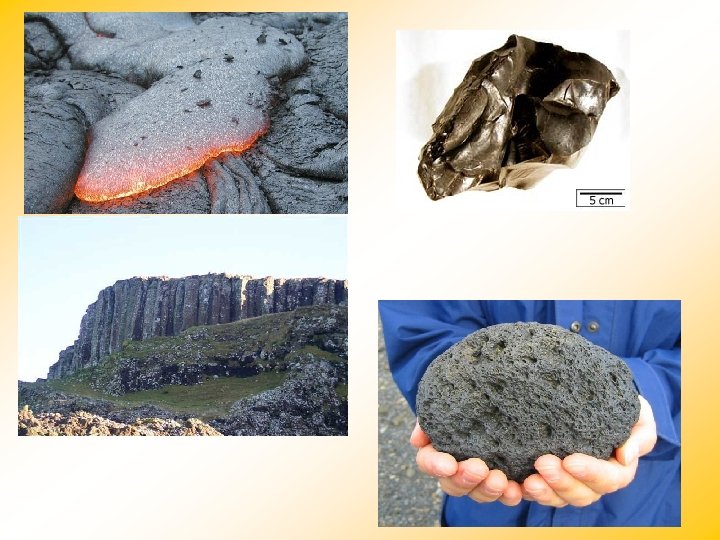
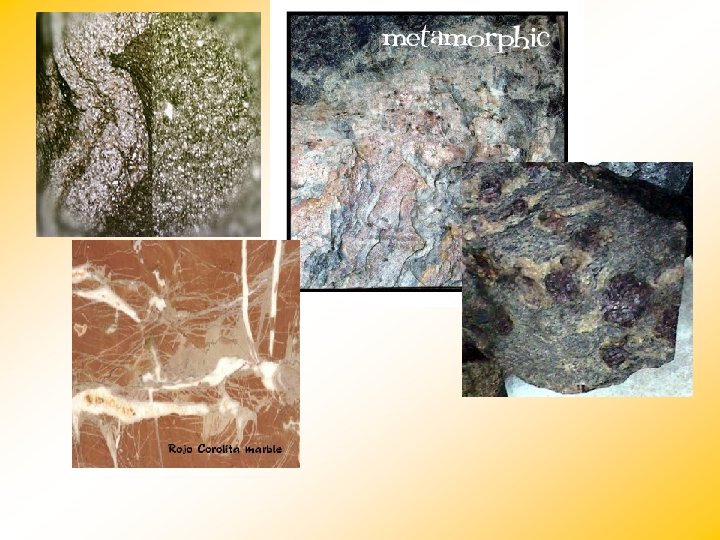
3 Types of Rocks 1. Igneous rock is formed by the crystallization of molten magma (lava). 2. Sedimentary rock is formed from the weathered products of preexisting rocks that have been transported, deposited, compacted, and cemented. 3. Metamorphic rock is formed by the alteration of pre-existing rock deep within Earth (but still in the solid state) by heat, pressure, and/or chemically active fluids
3. 1 The Rock Cycle Shows the interrelationships among the three rock types, igneous, sedimentary, and metamorphic. Remember, the Earth is a closed system. Minerals must cycle to create new rocks.
3. 1 The Rock Cycle Vocabulary: Magma is molten material that forms deep beneath the Earth’s surface. Lava is magma that reaches the surface. Weathering is a process in which rocks are broken down by water, air, and living things. Sediment is weathered pieces of Earth elements. • Compact means to put pressure on or squeeze. • Cement means to glue together with minerals.
The Rock Cycle
Check you understanding… 1. Which type of rock did not require heat to form? Igneous, Sedimentary, or Metamorphic? 2. The _____ Cycle is a representation of how one type of rock _____ into another. 3. Pieces of rock broken away by weathering are called _____.
3. 1 The Rock Cycle Energy That Drives the Rock Cycle Processes driven by heat from the Earth’s interior are responsible forming both igneous rock and metamorphic rock. Weathering and the movement of weathered materials, (sediment) are external processes powered by energy from the sun. These external processes produce sedimentary rocks.
3 Types of Rocks 1. Igneous rock is formed by the crystallization of molten magma (lava).
3. 1 The Rock Cycle Rocks Types of Rocks 2. Sedimentary rock is formed from the weathered products of preexisting rocks that have been transported, deposited, compacted, and cemented. .
3. 1 The Rock Cycle Rocks Types of Rocks 3. Metamorphic rock is formed by the alteration of pre-existing rock deep within the Earth (but still in the solid state) by heat, pressure, and/or chemically active fluids.
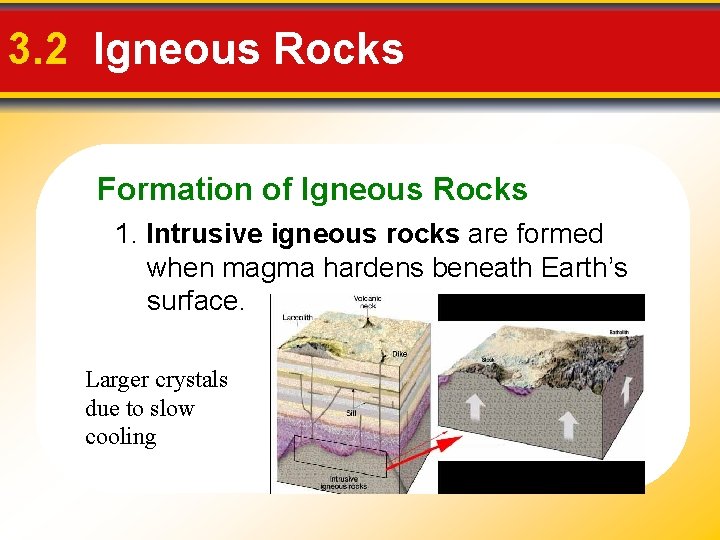
3. 2 Igneous Rocks Formation of Igneous Rocks 1. Intrusive igneous rocks are formed when magma hardens beneath Earth’s surface. Larger crystals due to slow cooling
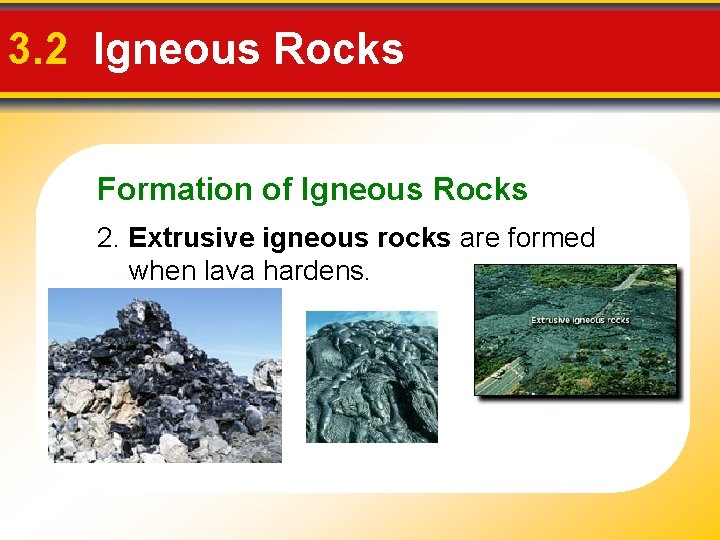
3. 2 Igneous Rocks Formation of Igneous Rocks 2. Extrusive igneous rocks are formed when lava hardens.
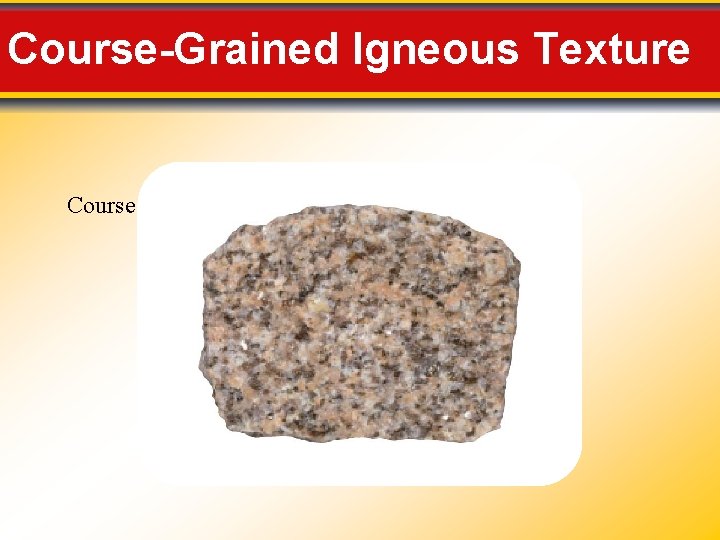
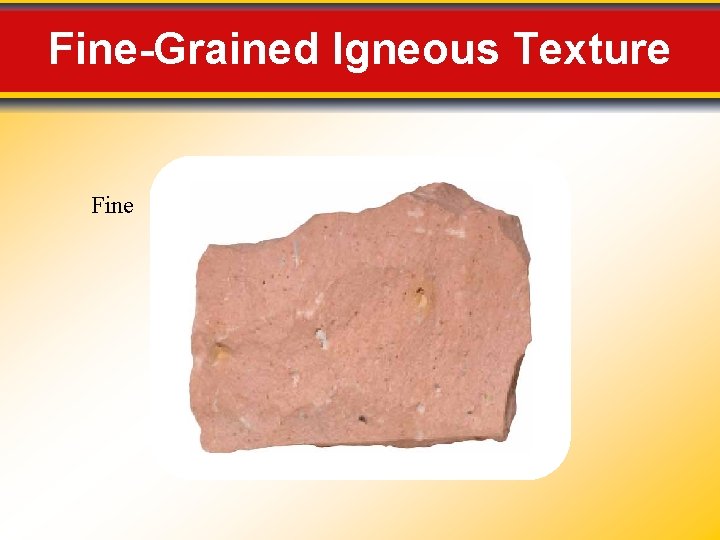
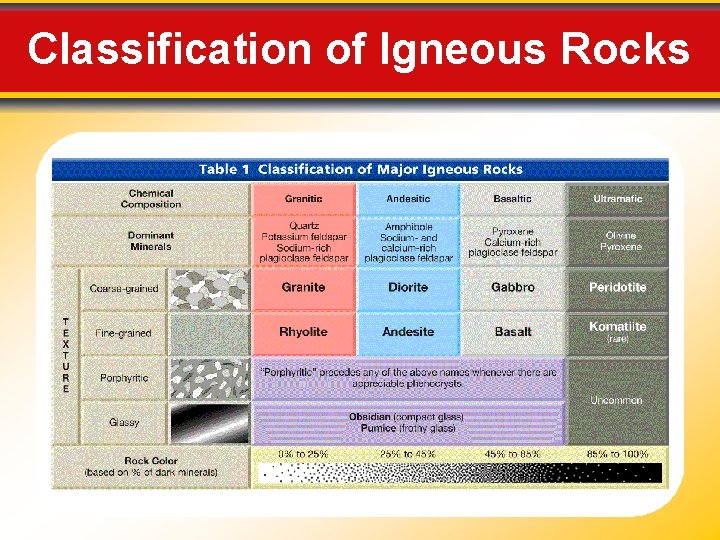
3. 2 Igneous Rocks Classification of Igneous Rocks Igneous rocks can be classified based on their composition and texture. 1. Texture • Coarse-grained texture is caused by slow cooling resulting in larger crystals. • Fine-grained texture is caused by rapid cooling resulting in smaller, interconnected mineral grains.
Course-Grained Igneous Texture Course
Fine-Grained Igneous Texture Fine
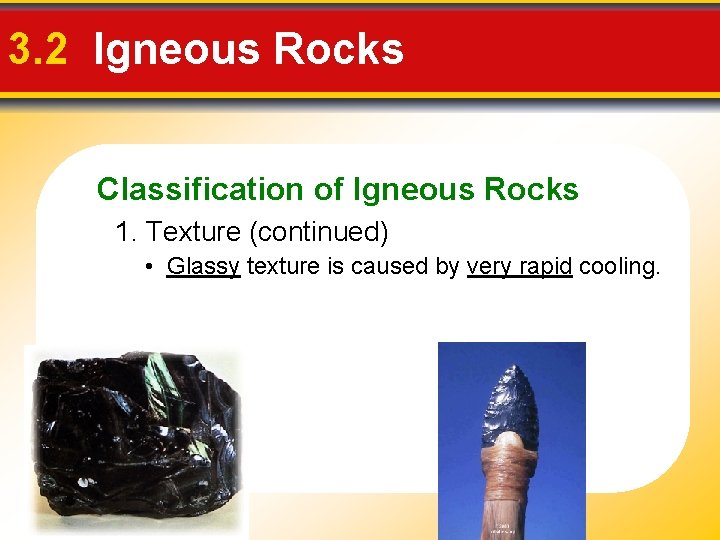
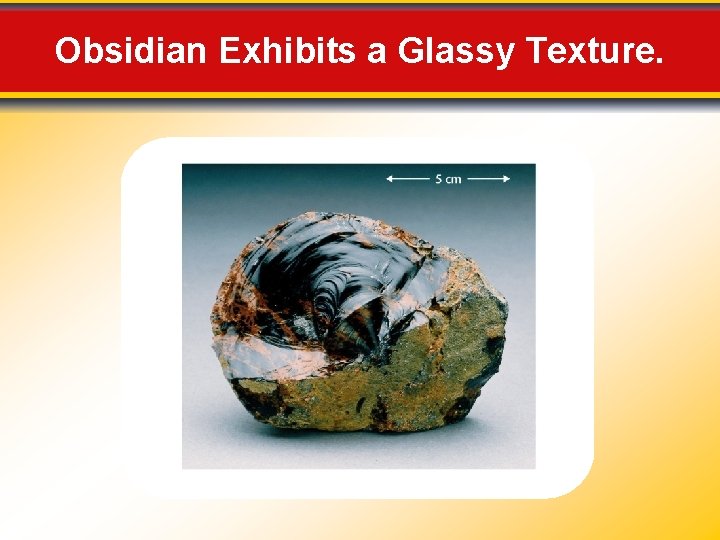
3. 2 Igneous Rocks Classification of Igneous Rocks 1. Texture (continued) • Glassy texture is caused by very rapid cooling.
Obsidian Exhibits a Glassy Texture.
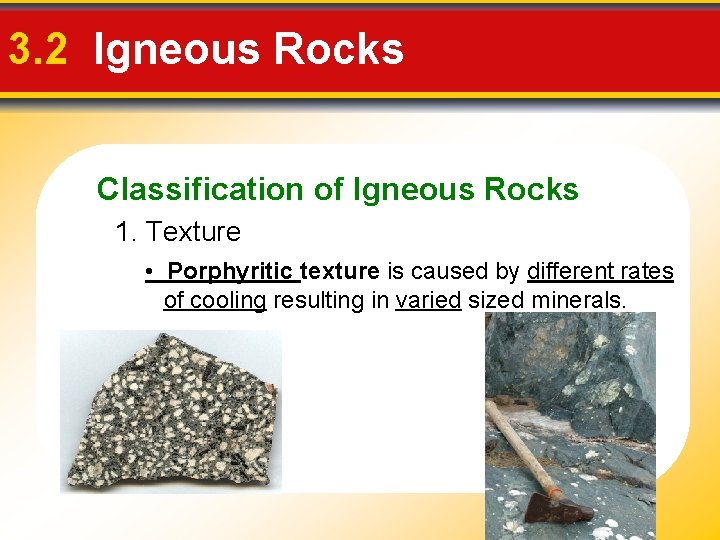
3. 2 Igneous Rocks Classification of Igneous Rocks 1. Texture • Porphyritic texture is caused by different rates of cooling resulting in varied sized minerals.
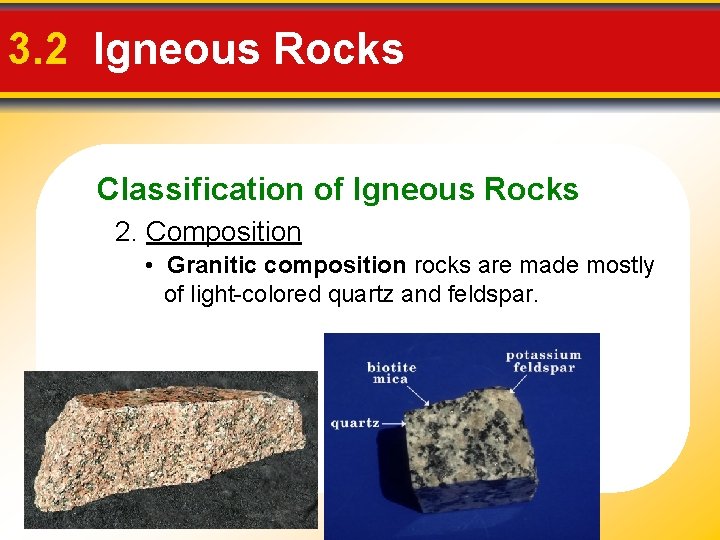
3. 2 Igneous Rocks Classification of Igneous Rocks 2. Composition • Granitic composition rocks are made mostly of light-colored quartz and feldspar.
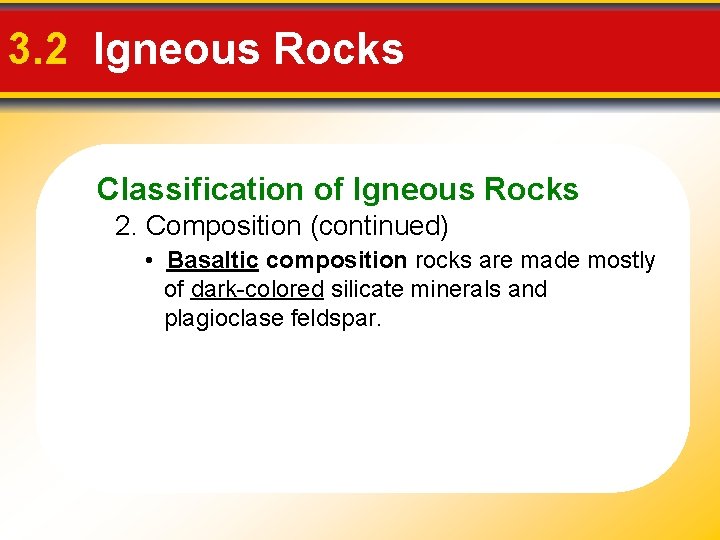
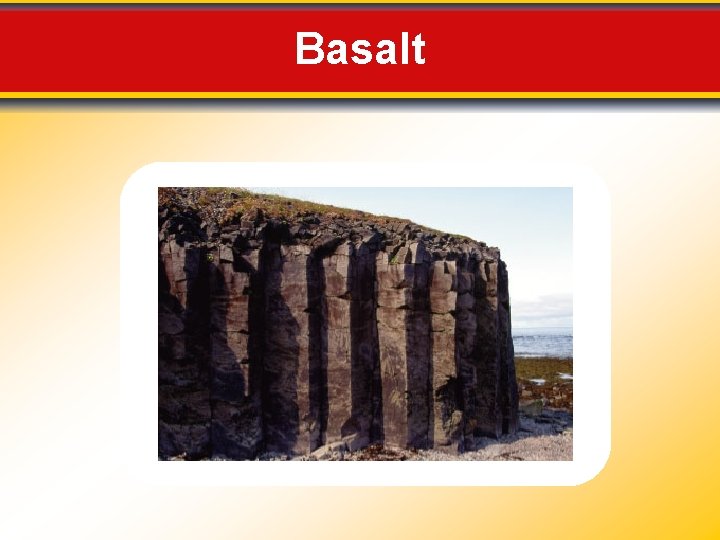
3. 2 Igneous Rocks Classification of Igneous Rocks 2. Composition (continued) • Basaltic composition rocks are made mostly of dark-colored silicate minerals and plagioclase feldspar.
Basalt
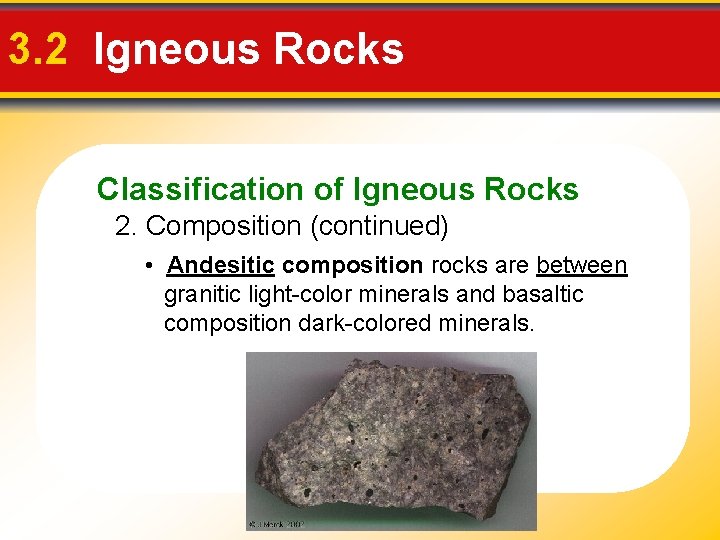
3. 2 Igneous Rocks Classification of Igneous Rocks 2. Composition (continued) • Andesitic composition rocks are between granitic light-color minerals and basaltic composition dark-colored minerals.
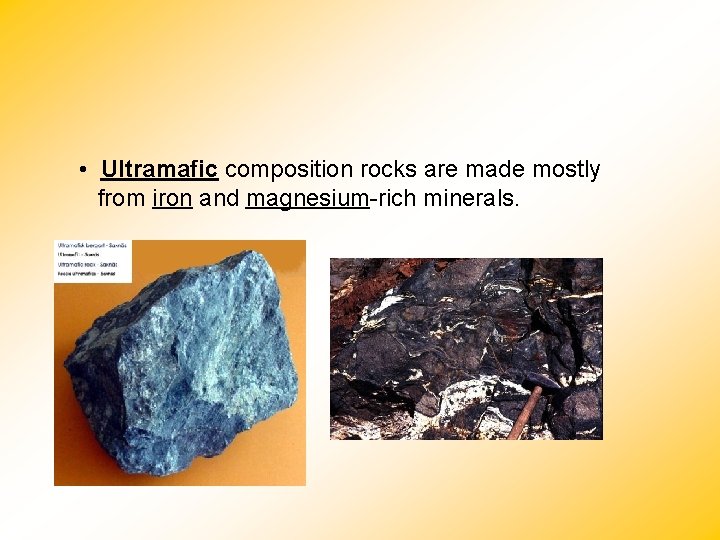
• Ultramafic composition rocks are made mostly from iron and magnesium-rich minerals.
Classification of Igneous Rocks
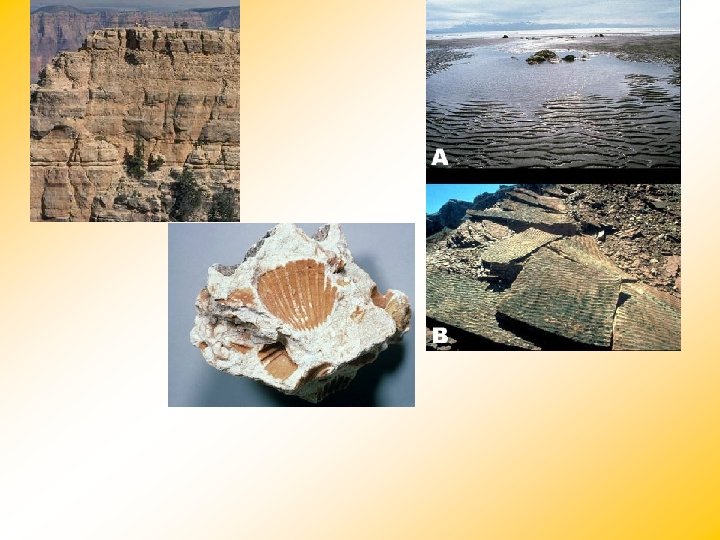
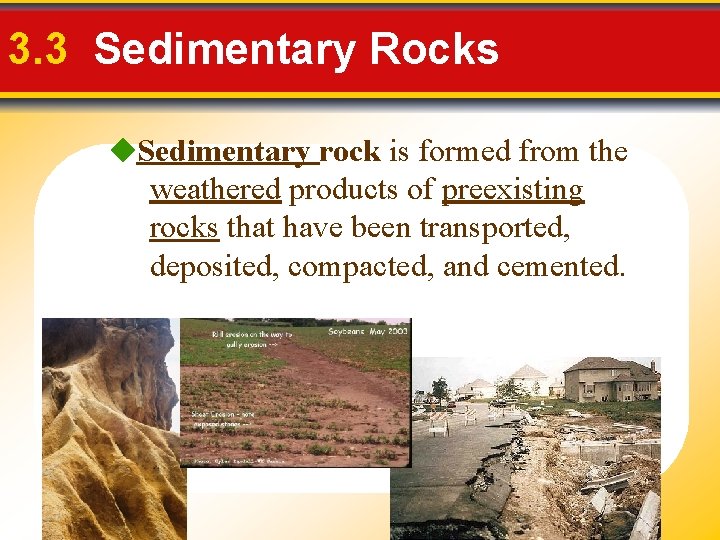
3. 3 Sedimentary Rocks Sedimentary rock is formed from the weathered products of preexisting rocks that have been transported, deposited, compacted, and cemented.
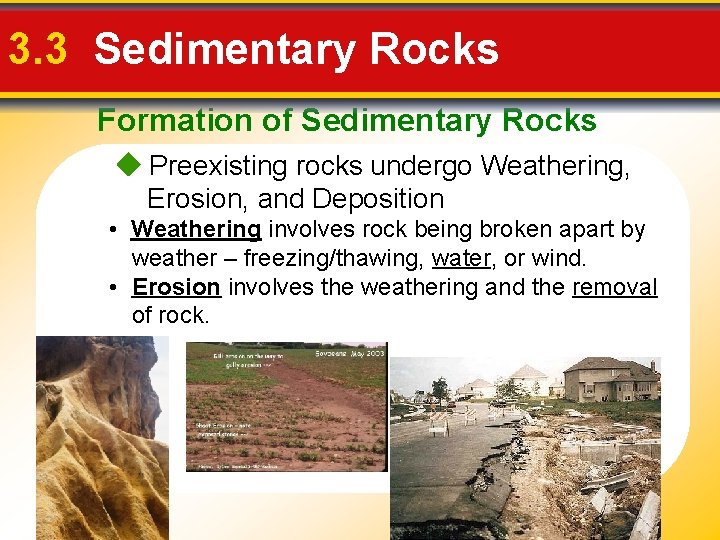
3. 3 Sedimentary Rocks Formation of Sedimentary Rocks Preexisting rocks undergo Weathering, Erosion, and Deposition • Weathering involves rock being broken apart by weather – freezing/thawing, water, or wind. • Erosion involves the weathering and the removal of rock.
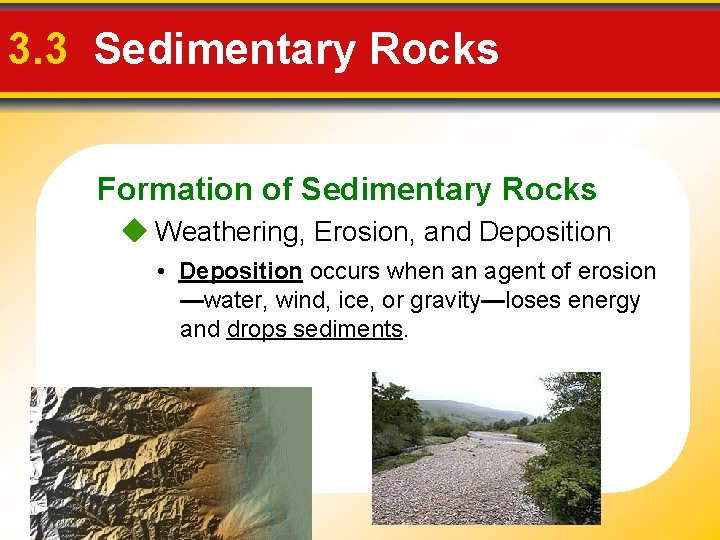
3. 3 Sedimentary Rocks Formation of Sedimentary Rocks Weathering, Erosion, and Deposition • Deposition occurs when an agent of erosion —water, wind, ice, or gravity—loses energy and drops sediments.
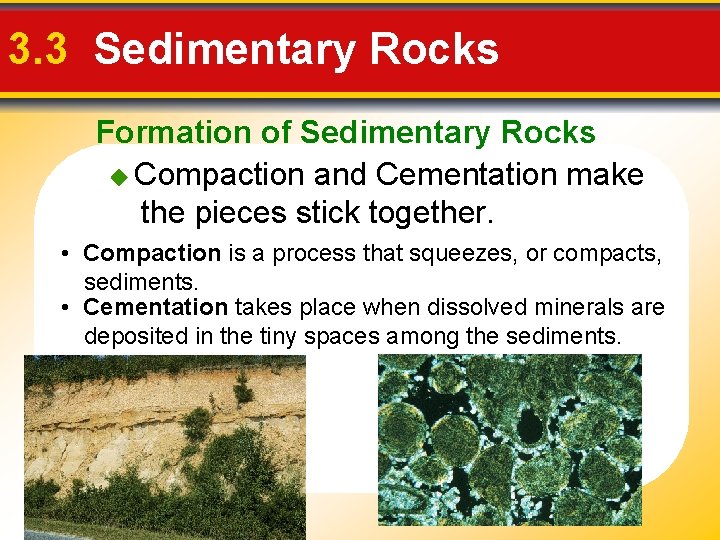
3. 3 Sedimentary Rocks Formation of Sedimentary Rocks Compaction and Cementation make the pieces stick together. • Compaction is a process that squeezes, or compacts, sediments. • Cementation takes place when dissolved minerals are deposited in the tiny spaces among the sediments.
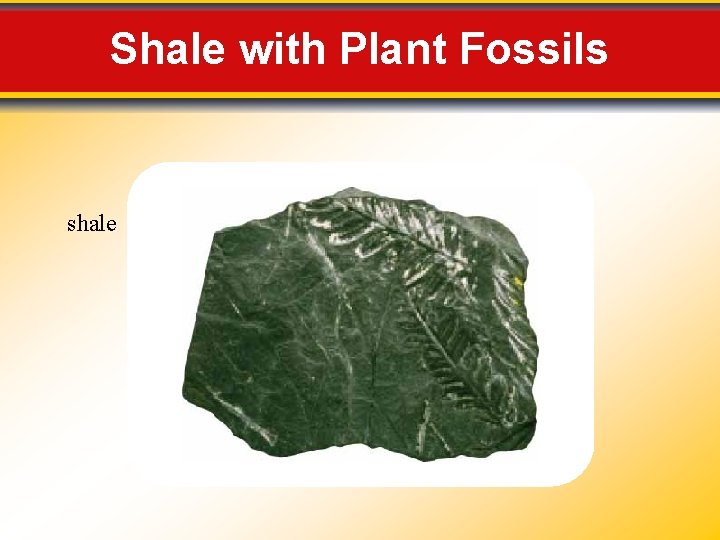
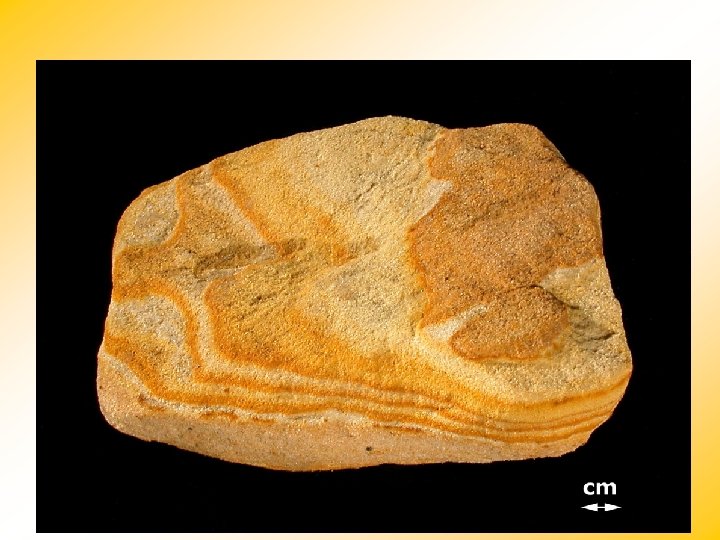
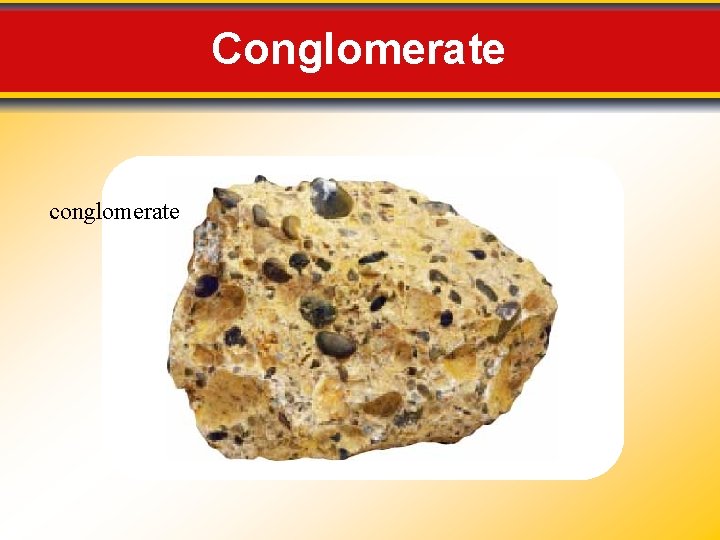
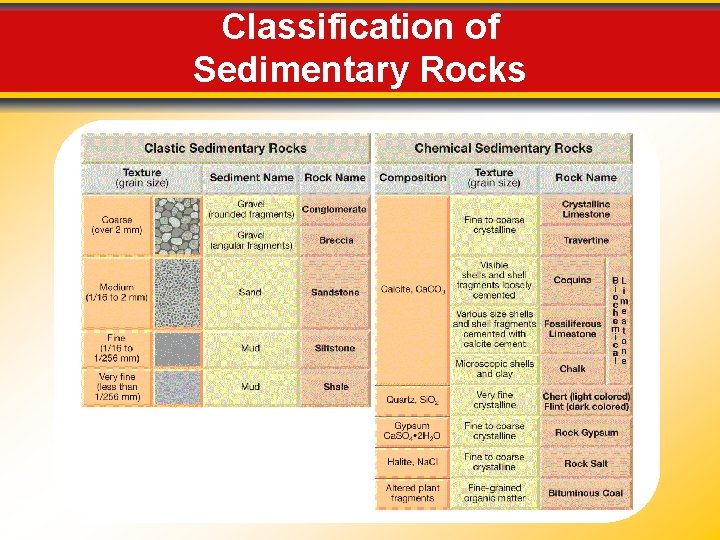
3. 3 Sedimentary Rocks Classification of Sedimentary Rocks Two Main Groups 1. Clastic sedimentary rocks are composed of weathered bits of rocks and minerals. • Classified by particle size • Common rocks include - Shale (most abundant) - Sandstone - Conglomerate
Shale with Plant Fossils shale
Conglomerate conglomerate
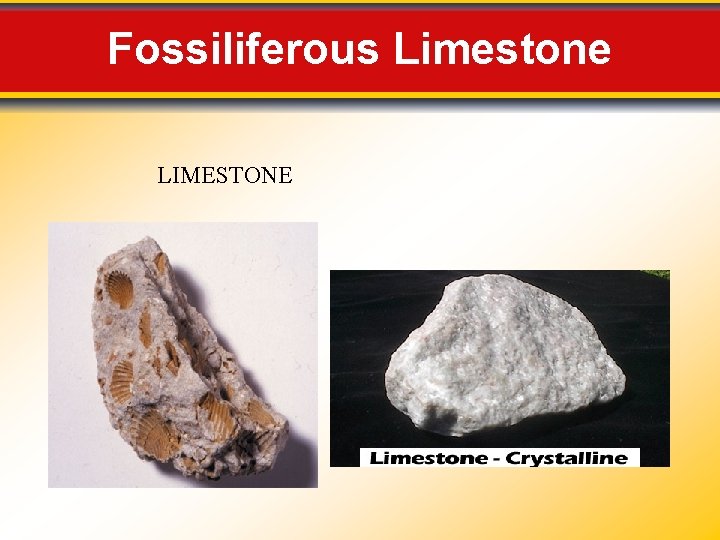
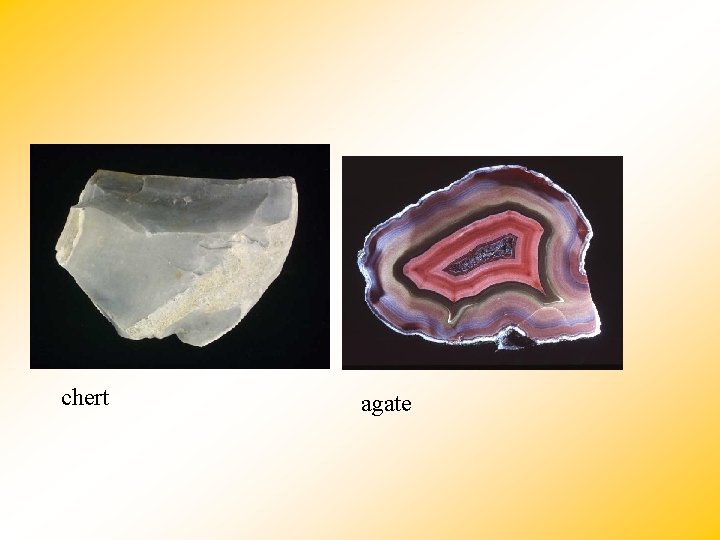
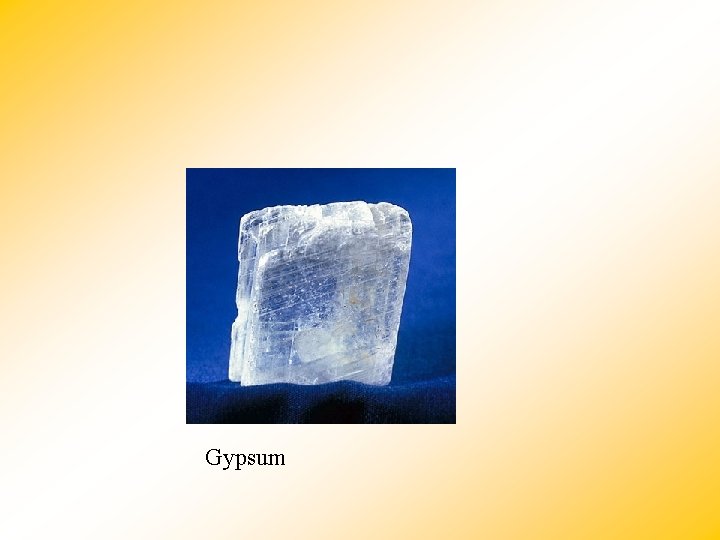
3. 3 Sedimentary Rocks Classification of Sedimentary Rocks Two Main Groups 2. Chemical sedimentary rocks form when dissolved substances precipitate, or separate from water. • Common rocks include - limestone—most abundant chemical rock - microcrystalline quartz known as chert, flint, jasper, or agate - evaporites such as rock salt or gypsum - coal
Fossiliferous Limestone LIMESTONE
chert agate
Gypsum
Classification of Sedimentary Rocks
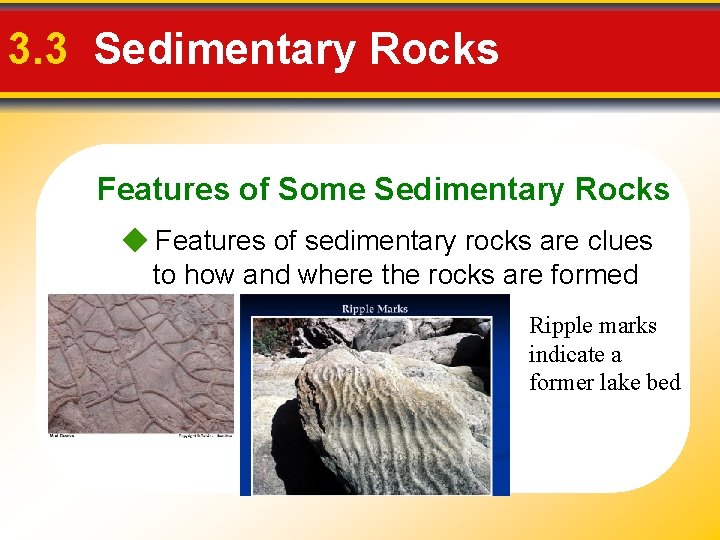
3. 3 Sedimentary Rocks Features of Some Sedimentary Rocks Features of sedimentary rocks are clues to how and where the rocks are formed Ripple marks indicate a former lake bed
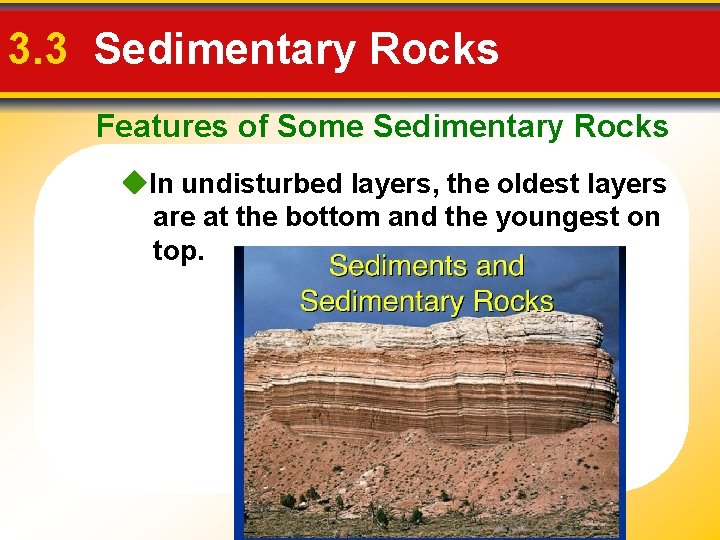
3. 3 Sedimentary Rocks Features of Some Sedimentary Rocks In undisturbed layers, the oldest layers are at the bottom and the youngest on top.
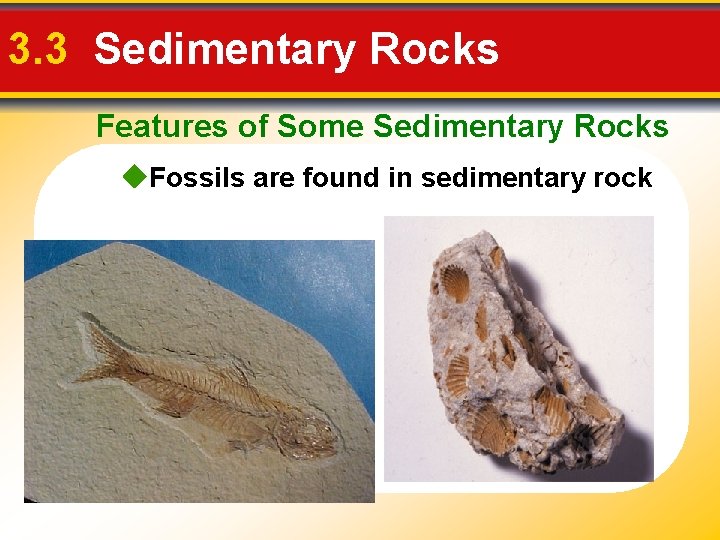
3. 3 Sedimentary Rocks Features of Some Sedimentary Rocks Fossils are found in sedimentary rock
3. 4 Metamorphic Rocks Formation of Metamorphic Rocks Metamorphism means “to change form. ” Most metamorphic changes occur at elevated temperatures and pressures. Conditions formation are found a few kilometers below the Earth’s surface and extend into the upper mantle.
3. 4 Metamorphic Rocks Formation of Metamorphic Rocks Contact metamorphism occurs when magma moves into rock. • Occurs near a body of magma • Changes are driven by a rise in temperature.
3. 4 Metamorphic Rocks Formation of Metamorphic Rocks Regional metamorphism results from large-scale deformation (folding) and high-grade metamorphism. • Directed pressures and high temperatures occur during mountain building. • Produces the greatest volume of metamorphic rock
3. 4 Metamorphic Rocks Agents of Metamorphism Heat • Provides the energy needed to drive chemical reactions Pressure • Causes a more compact rock with greater density
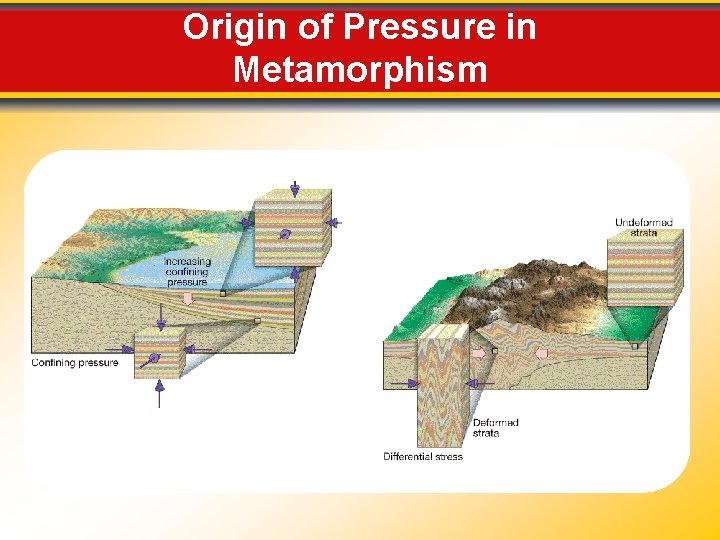
Origin of Pressure in Metamorphism
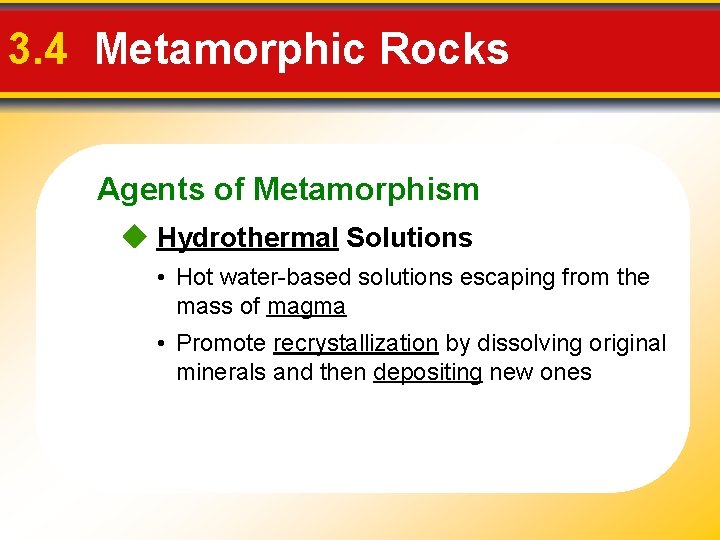
3. 4 Metamorphic Rocks Agents of Metamorphism Hydrothermal Solutions • Hot water-based solutions escaping from the mass of magma • Promote recrystallization by dissolving original minerals and then depositing new ones
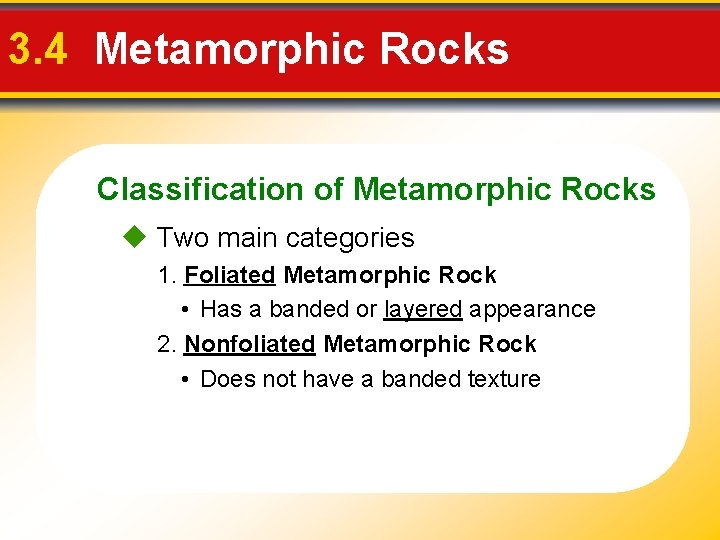
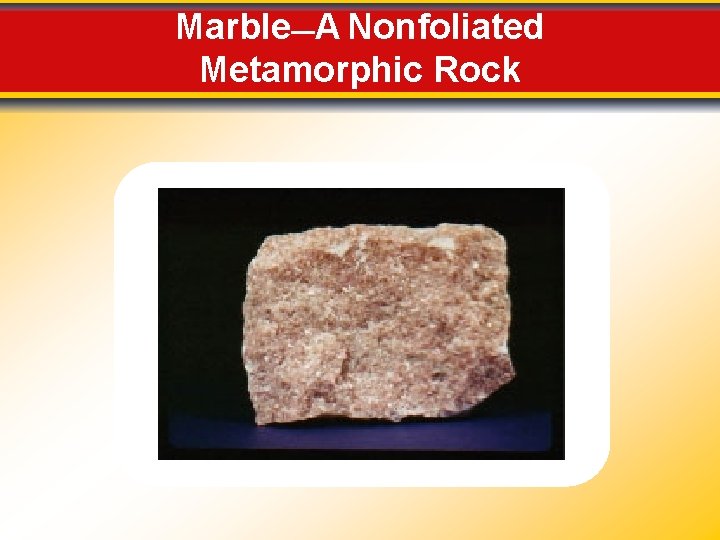
3. 4 Metamorphic Rocks Classification of Metamorphic Rocks Two main categories 1. Foliated Metamorphic Rock • Has a banded or layered appearance 2. Nonfoliated Metamorphic Rock • Does not have a banded texture
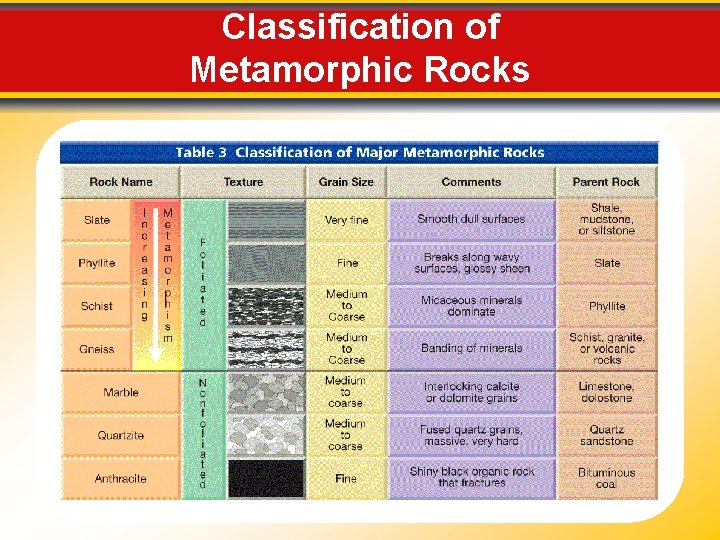
Classification of Metamorphic Rocks
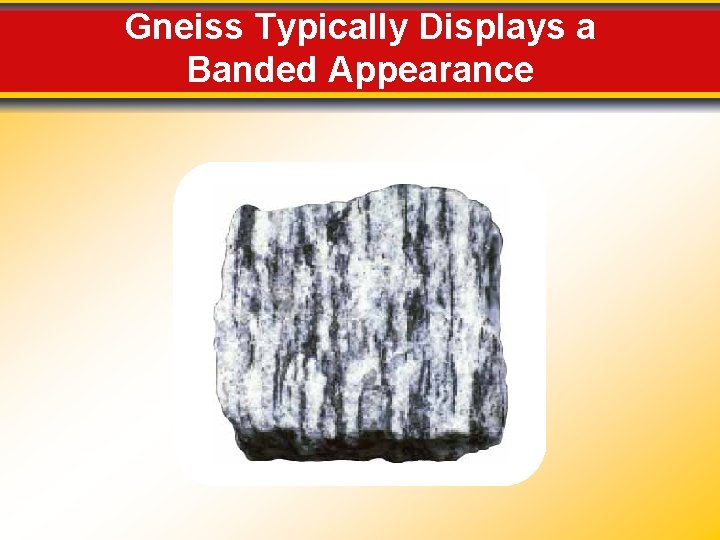
Gneiss Typically Displays a Banded Appearance
Marble—A Nonfoliated Metamorphic Rock