
Starter 1 What is the difference between Crime
Starter 1. • What is the difference between Crime and Deviance? • Provide examples of both. • All crime is deviant but not all deviance is crime? Discuss. • Why do Sociologists suggest that crime is a social construct?
Crime – OED “breaking the laws of society” • Who makes the laws? • Is the same behaviour always judged criminal? • What is a crime changes across time, culture, age of perpetrator, location e. g. • Crime is a social construct. • Fear that crime is getting worse.
Deviance – “actions which differ from the accepted norms and values of society” • Broader term than crime. • Deviance is socially constructed – depends on the society and historical time period. • All crime is deviant but not all deviance is criminal (e. g mental illness and suicide).
Who are the criminals? • Depends on your theoretical viewpoint. • Official statistics suggest criminals are mostly men and working class. • Prisons have a disproportionate number of Afrocarribbeans. • Does the criminal justice system target these people? • Are the ‘real’ criminals wearing suits?

Crime Deviance Any act which breaks the laws of society, such as murder or rape. Behaviour which moves away from conventional norms and values such as burping and farting in public. Social control is enforced by agencies such as police and the courts. Biological explanations Early criminologists like Cesare Lombroso sort to find physical criminal characteristics like long arms or sloping foreheads. Sociologists find such ‘born bad’ determinism dangerous and prefer to normalise crime by reminding us that we all commit crime and there are social factors which influence our behaviour. Deviant not criminal Deviant and criminal Burping, not queuing Criminal not deviant Rape, murder, paedophilia Speeding, parking on yellow lines Definitions and explanations Crime as socially constructed If what is consider to be crime and deviance changes it can’t be inherently wrong but must be culturally specific. This means crime and deviance is socially constructed i. e. created and defined by the people of that society and not universal. Crime and deviance as relative Crime and deviance is relative (changing) in relation to time, place and culture. What one society may see as a crime another may not, such as polygamy (many wives). Other examples are homosexuality and suicide.
The Functionalist Approach to Crime

What is the organic analogy? • What problem does crime solve? • How does crime protect the organism?
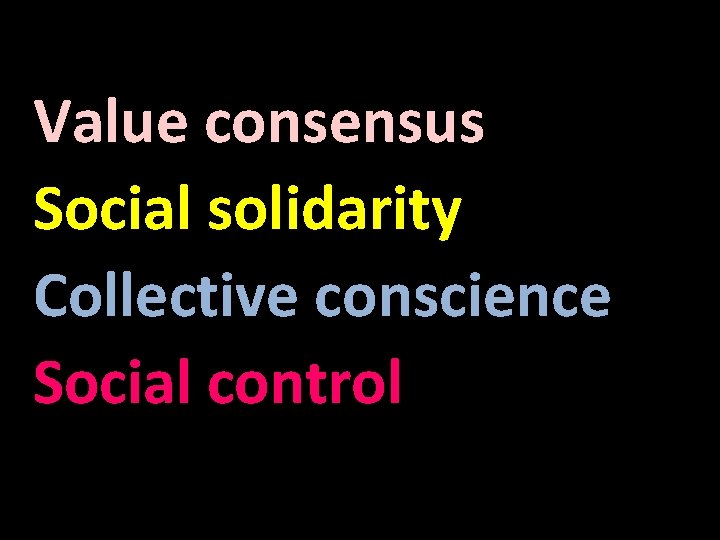
Value consensus Social solidarity Collective conscience Social control
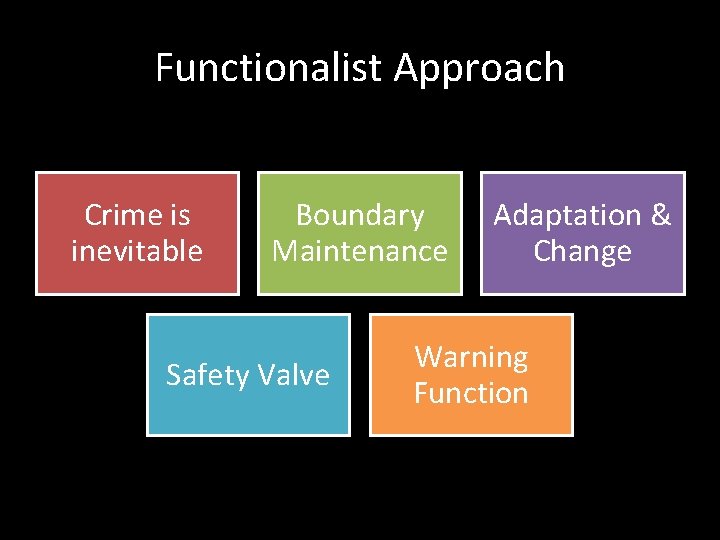
Functionalist Approach Crime is inevitable Boundary Maintenance Safety Valve Adaptation & Change Warning Function
Complete the sentence … Crime is functional because … However …
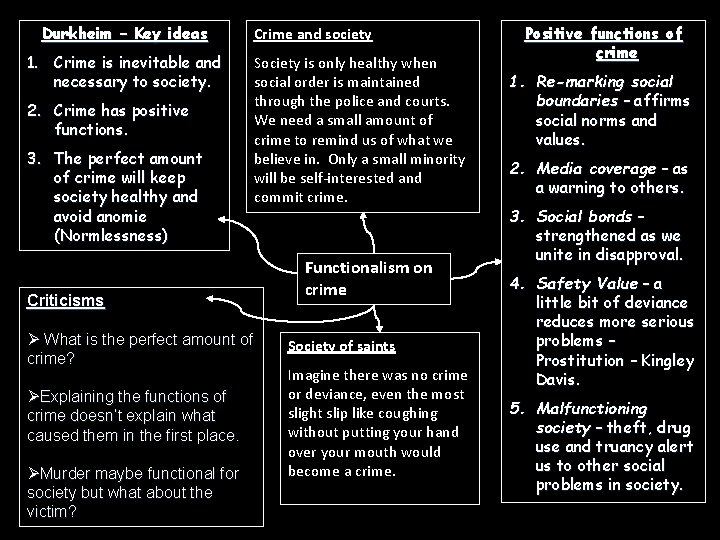
Durkheim – Key ideas 1. Crime is inevitable and necessary to society. 2. Crime has positive functions. 3. The perfect amount of crime will keep society healthy and avoid anomie (Normlessness) Crime and society Society is only healthy when social order is maintained through the police and courts. We need a small amount of crime to remind us of what we believe in. Only a small minority will be self-interested and commit crime. Criticisms Ø What is the perfect amount of crime? ØExplaining the functions of crime doesn’t explain what caused them in the first place. ØMurder maybe functional for society but what about the victim? Functionalism on crime Society of saints Imagine there was no crime or deviance, even the most slight slip like coughing without putting your hand over your mouth would become a crime. Positive functions of crime 1. Re-marking social boundaries – affirms social norms and values. 2. Media coverage – as a warning to others. 3. Social bonds – strengthened as we unite in disapproval. 4. Safety Value – a little bit of deviance reduces more serious problems – Prostitution – Kingley Davis. 5. Malfunctioning society – theft, drug use and truancy alert us to other social problems in society.
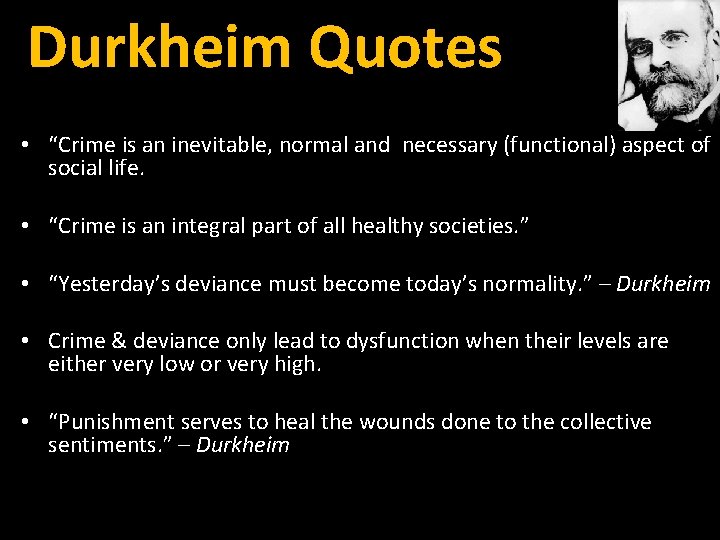
Durkheim Quotes • “Crime is an inevitable, normal and necessary (functional) aspect of social life. • “Crime is an integral part of all healthy societies. ” • “Yesterday’s deviance must become today’s normality. ” – Durkheim • Crime & deviance only lead to dysfunction when their levels are either very low or very high. • “Punishment serves to heal the wounds done to the collective sentiments. ” – Durkheim
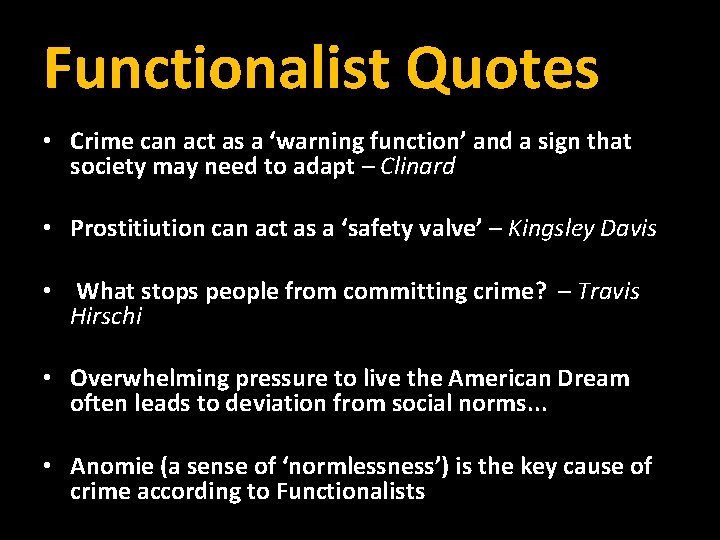
Functionalist Quotes • Crime can act as a ‘warning function’ and a sign that society may need to adapt – Clinard • Prostitiution can act as a ‘safety valve’ – Kingsley Davis • What stops people from committing crime? – Travis Hirschi • Overwhelming pressure to live the American Dream often leads to deviation from social norms. . . • Anomie (a sense of ‘normlessness’) is the key cause of crime according to Functionalists
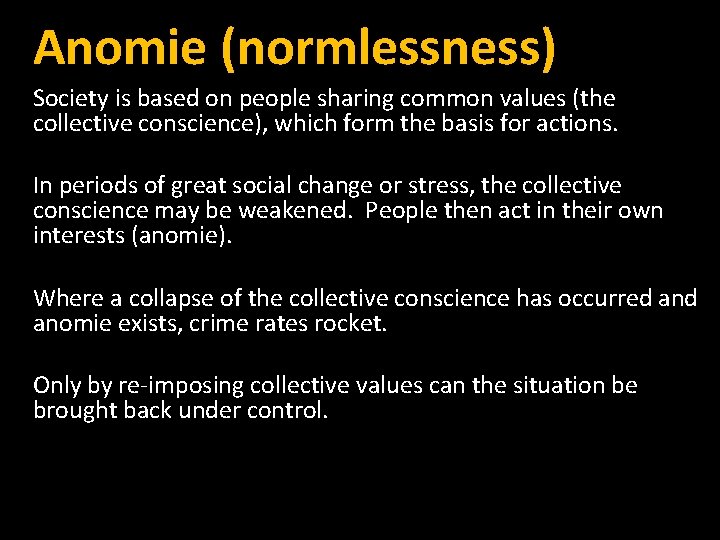
Anomie (normlessness) Society is based on people sharing common values (the collective conscience), which form the basis for actions. In periods of great social change or stress, the collective conscience may be weakened. People then act in their own interests (anomie). Where a collapse of the collective conscience has occurred anomie exists, crime rates rocket. Only by re-imposing collective values can the situation be brought back under control.
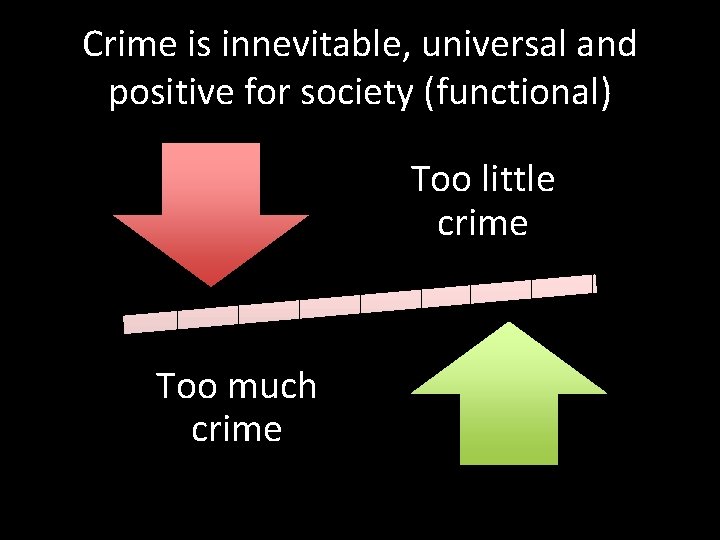
Crime is innevitable, universal and positive for society (functional) Too little crime Too much crime
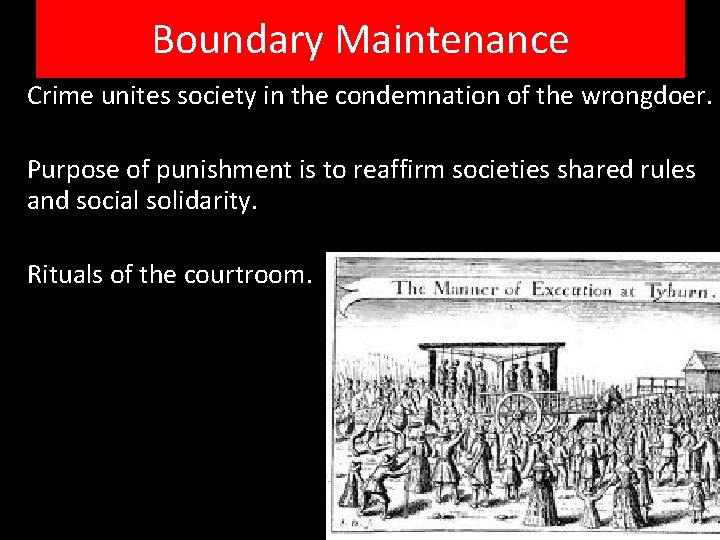
Boundary Maintenance Crime unites society in the condemnation of the wrongdoer. Purpose of punishment is to reaffirm societies shared rules and social solidarity. Rituals of the courtroom.
Even in a ‘society of saints’ with no crime at all, such high standards of behaviour would make even the smallest deviant act (like burping) stand out like a sore thumb – so deviance is inevitable & it will always be present in society.
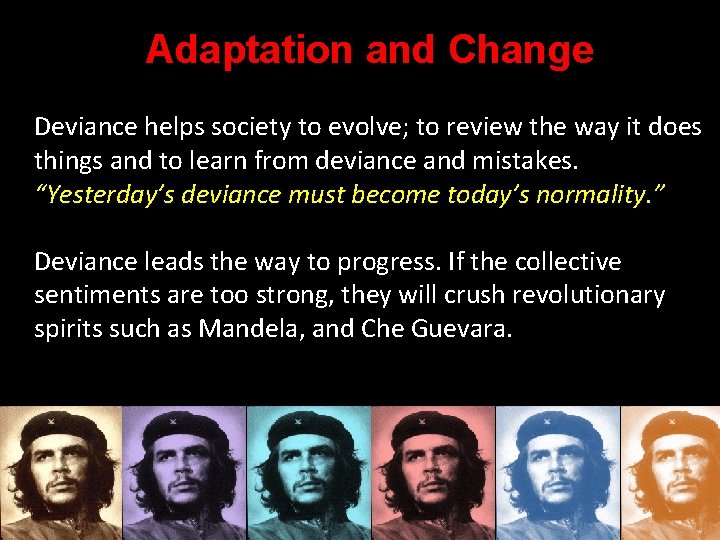
Adaptation and Change Deviance helps society to evolve; to review the way it does things and to learn from deviance and mistakes. “Yesterday’s deviance must become today’s normality. ” Deviance leads the way to progress. If the collective sentiments are too strong, they will crush revolutionary spirits such as Mandela, and Che Guevara.
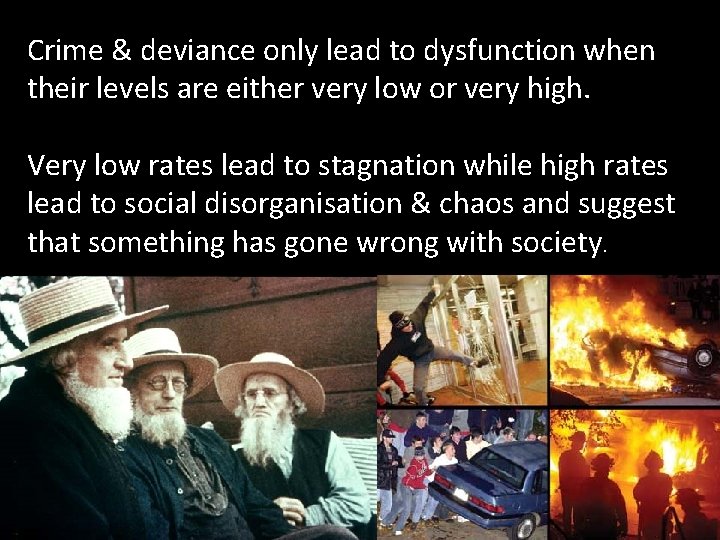
Crime & deviance only lead to dysfunction when their levels are either very low or very high. Very low rates lead to stagnation while high rates lead to social disorganisation & chaos and suggest that something has gone wrong with society.
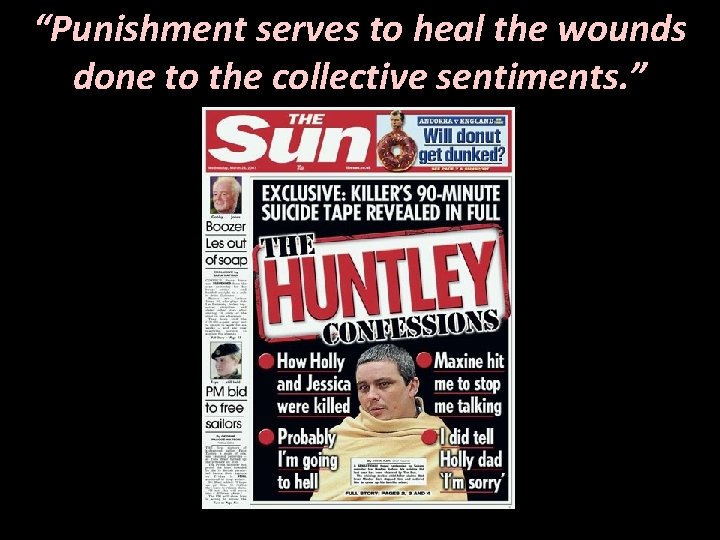
“Punishment serves to heal the wounds done to the collective sentiments. ”
Clinard (1974) Warning Function Clinard suggested that some forms of crime and deviance ‘may serve as a signal or warning that there is some defect in the social organisation’ which may ‘lead to changes that enhance efficiency and morality’. This is a typical functionalist response: Functionalists like to use an organic analogy, meaning they see the world like the way the human body operates. In that case, a warning sign (such as a mass protest) may be a ‘symptom’ that society is unwell and needs surgery (changing).
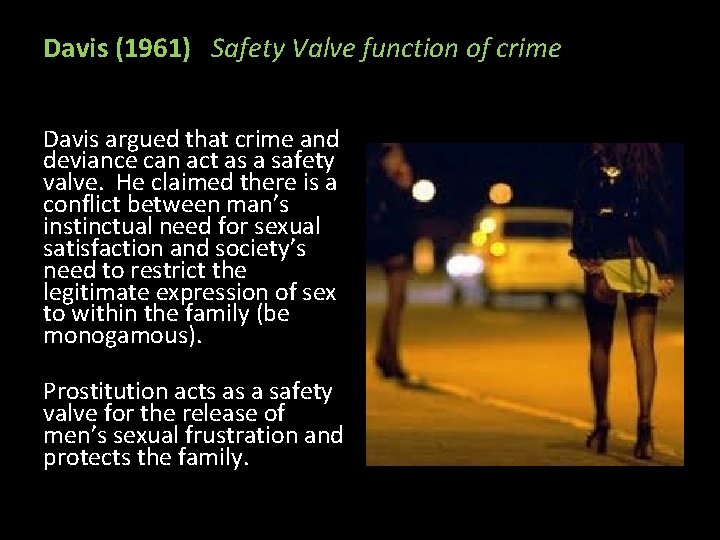
Davis (1961) Safety Valve function of crime Davis argued that crime and deviance can act as a safety valve. He claimed there is a conflict between man’s instinctual need for sexual satisfaction and society’s need to restrict the legitimate expression of sex to within the family (be monogamous). Prostitution acts as a safety valve for the release of men’s sexual frustration and protects the family.
Ned Polsky (1967) Pornography safely channels a variety of sexual desires away from alternatives such as adultery which would threaten the family.
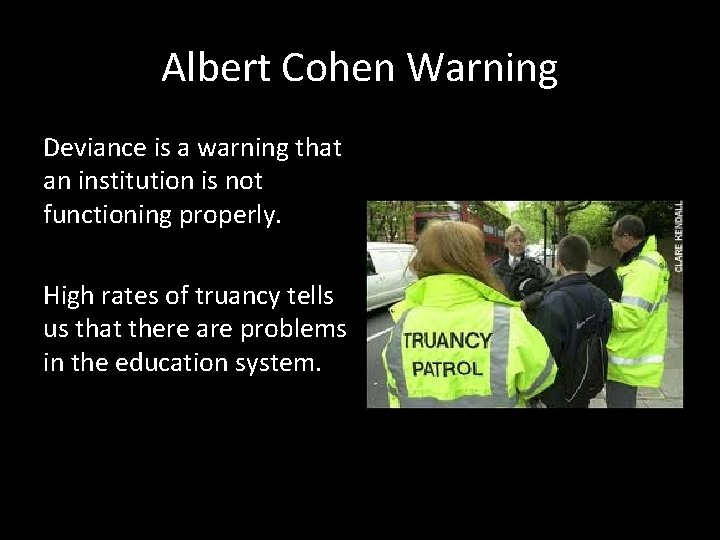
Albert Cohen Warning Deviance is a warning that an institution is not functioning properly. High rates of truancy tells us that there are problems in the education system.
Travis Hirschi Another key sociologist to be influenced by Emile Durkheim and the concept of anomie is Travis Hirschi. To answer this, he argues, He asks the we need to understand question: why don't what forces maintain more people commit crime than conformity for most people in society. they do? Rather than the factors that drive a minority into deviant behaviour.
Hirschi’s ‘Bonds of Attachment’ He identified four bonds of attachment that help bind society together: Attachment: the extent to which we care about other people's opinions and desires. Commitment: the personal investment we put into our lives; in other words, what we have to lose if we turn to crime and get caught. Involvement: how integrated are we so that we neither have the time nor inclination to behave in a deviant/criminal way. Crime and Deviance Chapter 5: Functionalist and Subcultural Theory 26 Belief: how committed are individuals to upholding society's rules and laws? 07/03/2021
Activity • Today you decided to come to my class, pick up a pen and write. You chose this instead of picking up a baseball bat and smashing up a bus stop or mugging a frail elderly person. Why? • Brainstorm the reasons from a Functionalist point of view
Evaluation of Durkheim Deviance can have hidden functions for society and is not always bad. How much is the right amount of crime? Why does crime exist in the first place? Society does not create crime to increase solidarity? Crime is not ‘functional’ for the victim. Crime does not always promote solidarity – fear of crime keeps people isolated. Why do certain groups commit crime? Marxists argue he underestimates the level of inequality and conflict in society.
Home Learning 15. 09. 15 Assess the view that some crime in society can be functional (21 marks) Remember: • PERCy (critique) • 3 -4 key points – well explained, with theorists and examples Activity: Have a look at your essay. Annotate A 01 / A 02. Looking at the markscheme identify a grade boundary.
Functionalism: Strain Theory What does strain mean?
The American Dream https: //www. youtube. com/watch? v =Ao 8 c. GLIMtvg What is the American Dream? Why did this come about? Is this a goal in other countries?
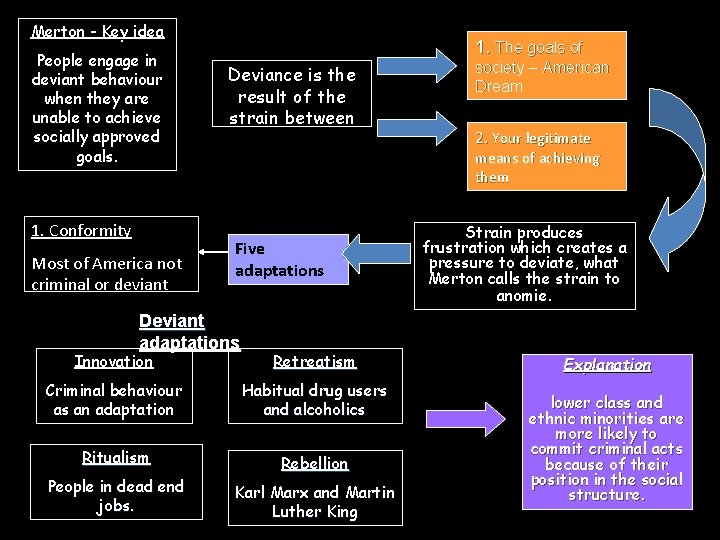
Merton - Key idea People engage in deviant behaviour when they are unable to achieve socially approved goals. 1. Conformity Most of America not criminal or deviant 1. The goals of Deviance is the result of the strain between 2. Your legitimate means of achieving them Five adaptations Deviant adaptations Innovation Retreatism Criminal behaviour as an adaptation Habitual drug users and alcoholics Ritualism Rebellion People in dead end jobs. society – American Dream Karl Marx and Martin Luther King Strain produces frustration which creates a pressure to deviate, what Merton calls the strain to anomie. Explanation lower class and ethnic minorities are more likely to commit criminal acts because of their position in the social structure.
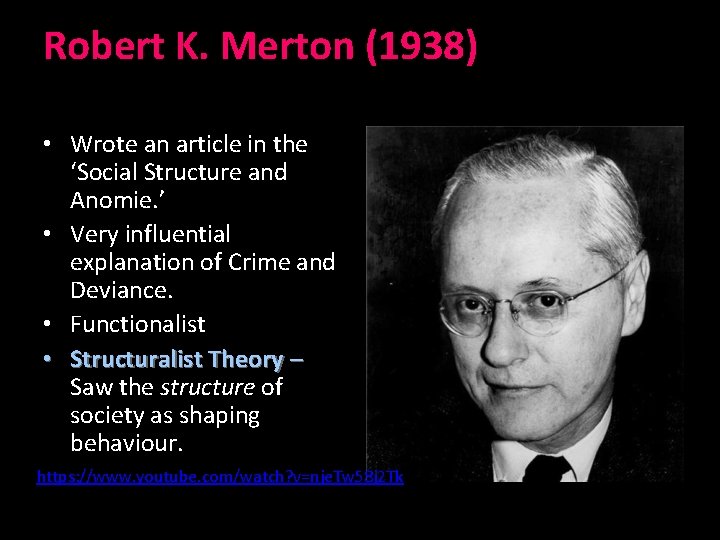
Robert K. Merton (1938) • Wrote an article in the ‘Social Structure and Anomie. ’ • Very influential explanation of Crime and Deviance. • Functionalist • Structuralist Theory – Saw the structure of society as shaping behaviour. https: //www. youtube. com/watch? v=nje. Tw 58 j 2 Tk
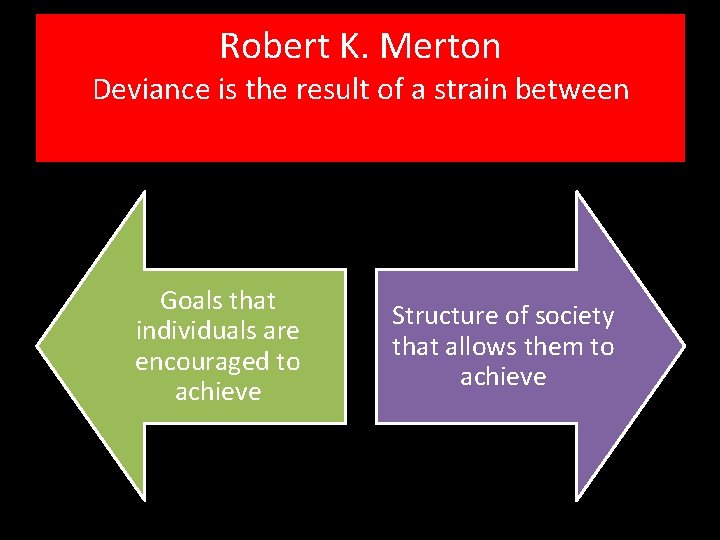
Robert K. Merton Deviance is the result of a strain between Goals that individuals are encouraged to achieve Structure of society that allows them to achieve


. . . and there are institutionalised means of achieving those goals; chiefly education and career (big pay packet). Now we can afford BOTOX!
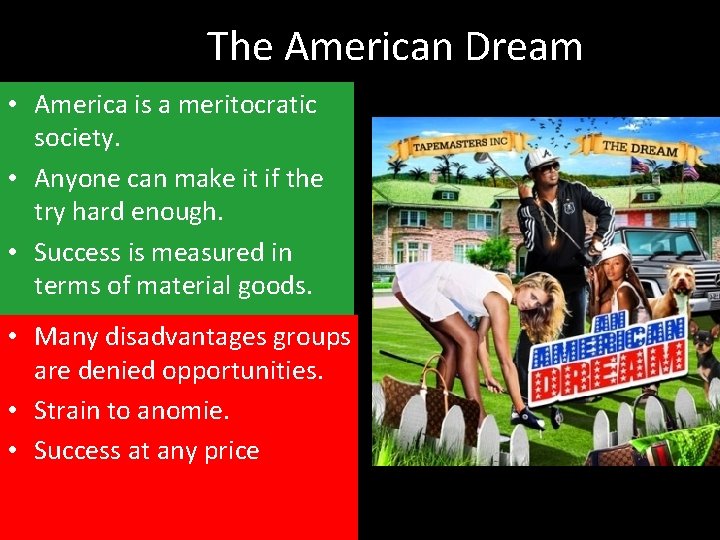
The American Dream • America is a meritocratic society. • Anyone can make it if the try hard enough. • Success is measured in terms of material goods. • Many disadvantages groups are denied opportunities. • Strain to anomie. • Success at any price
Culture and Norms • American culture attaches great importance to success. • Measured in terms of money and material possessions. • There are norms which define legitimate means for achieving success Gaining Skills Qualifications Career Advancement
Strain to Anomie • So much emphasis is placed on material success that many people experience pressure to deviate away from these norms and values. • Deviance occurs when they reject the goal of success (eg, being wealthy) and/or the legitimate means of meeting that goal. • Most keenly felt by those at the bottom.
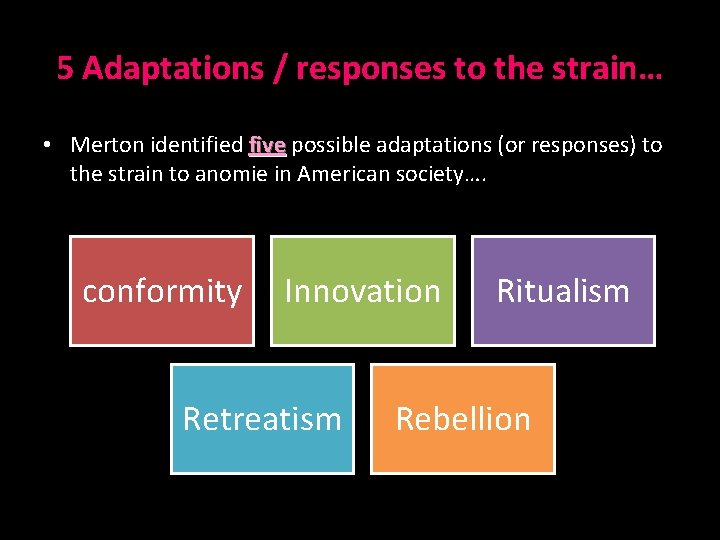
5 Adaptations / responses to the strain… • Merton identified five possible adaptations (or responses) to the strain to anomie in American society…. conformity Innovation Retreatism Ritualism Rebellion
Conformity • According to Merton, most people conform despite the strain to anomie. • Even if they don’t make it, they continue with the normative means of getting there.

My route to the top was pretty traditional
Innovation • People who accept the goal of success – but have little chance or means to access it. • They ‘innovate’ and find alternative ways to get there (crime) • The pressure to follow this route is most felt at the bottom of the class ladder.

This’ll pay for the family holiday to Majorca and this months mortgage
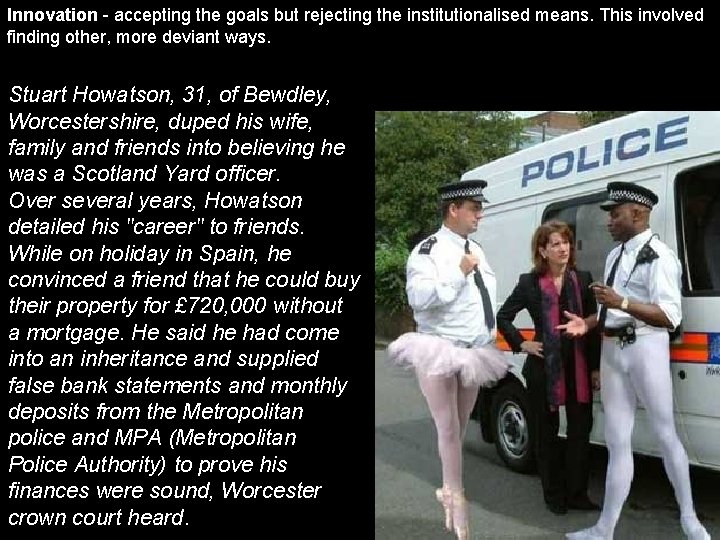
Innovation - accepting the goals but rejecting the institutionalised means. This involved finding other, more deviant ways. Stuart Howatson, 31, of Bewdley, Worcestershire, duped his wife, family and friends into believing he was a Scotland Yard officer. Over several years, Howatson detailed his "career" to friends. While on holiday in Spain, he convinced a friend that he could buy their property for £ 720, 000 without a mortgage. He said he had come into an inheritance and supplied false bank statements and monthly deposits from the Metropolitan police and MPA (Metropolitan Police Authority) to prove his finances were sound, Worcester crown court heard.
Ritualism • People who follow this deviant route abandon the goal of success – but stick rigidly to the normative rules. • Eg – blue-collar workers in ‘dead-end’ jobs.

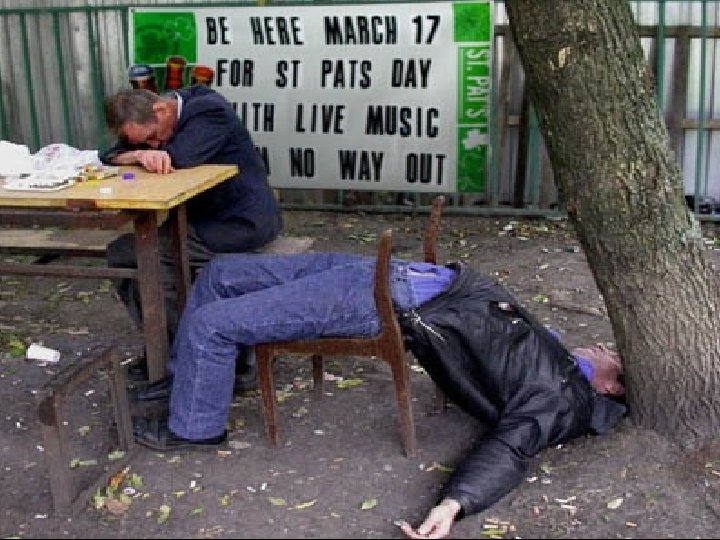
Retreatism • This involves a rejection of the goal of success and of the normative means of getting there/achieving it (eg – unemployment) • Often associated with people labelled ‘drop -outs’ (homeless, drug-addicts, alcoholics)
Rebellion n A total rejection of cultural goals and of the norms associated with achieving it. n These are replaced with alternatives. n Those who seek to revolutionise and change society would fit into this category.
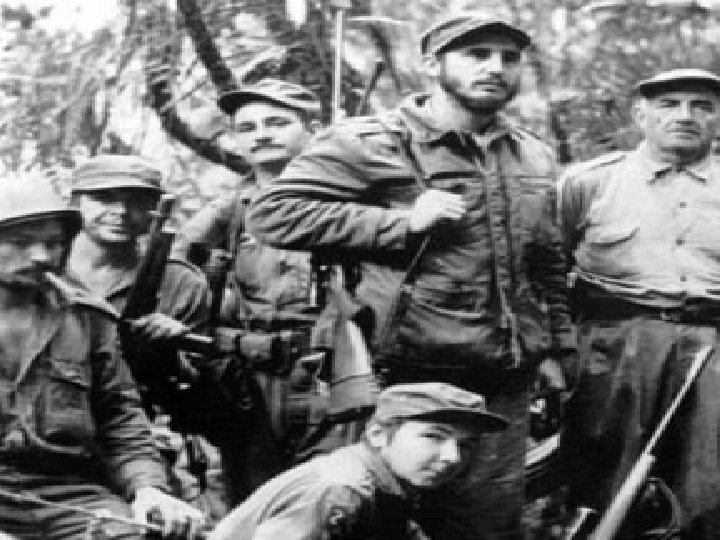
Rebellion - is a response that seeks to replace the cultural goals and institutionalised means with new ones that meet the norms and values of their particular group or culture.
People are not criminals – they are innovators! https: //www. youtube. com/watch? v=1 fs. TFx 6 x. Z 2 M
Jock Young (2009) The Vertigo of Late Modernity • Key institutions in UK stress meritocracy. • This is a myth – the chaos of inequality rewards big business and celebrity whilst hard-working people find things difficult. • Contradition between a culture which focuses on monetary success and material goods but fails to deliver material success for most people. • This produces anomie and much violent criminality.
Merton – Positive Evaluation Early attempt at explaining crime in terms of culture and society and offered an alternative to biological or ‘born’ criminal theories. Criminals are not different to law-abiding citizens, they have the same goals. Most crime is property crime as US values material wealth. Lower class crime rates are higher as they have less opportunities. Spurred on lots of later sociological theories
Merton - Critique Takes official stats at face value. These over-represent WC crime. Deterministic – not all WC people deviate and commit crime. Fails to explain why some people commit crime while others conform, retreat or rebel. Does not explain violent, sexual crimes. White collar crime arises from access to opportunities rather than denial of them. Who benefits from a K society? Ruling classes make and enforce the laws. Assumes there is a value consensus on ‘money success’. Ignores the role of the group and delinquent subcultures. Theoretical study – no empirical evidence.
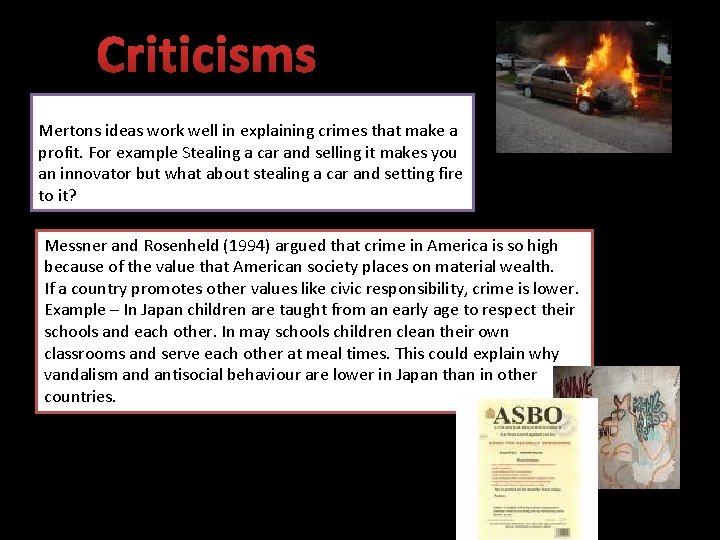
Criticisms Mertons ideas work well in explaining crimes that make a profit. For example Stealing a car and selling it makes you an innovator but what about stealing a car and setting fire to it? Messner and Rosenheld (1994) argued that crime in America is so high because of the value that American society places on material wealth. If a country promotes other values like civic responsibility, crime is lower. Example – In Japan children are taught from an early age to respect their schools and each other. In may schools children clean their own classrooms and serve each other at meal times. This could explain why vandalism and antisocial behaviour are lower in Japan than in other countries.
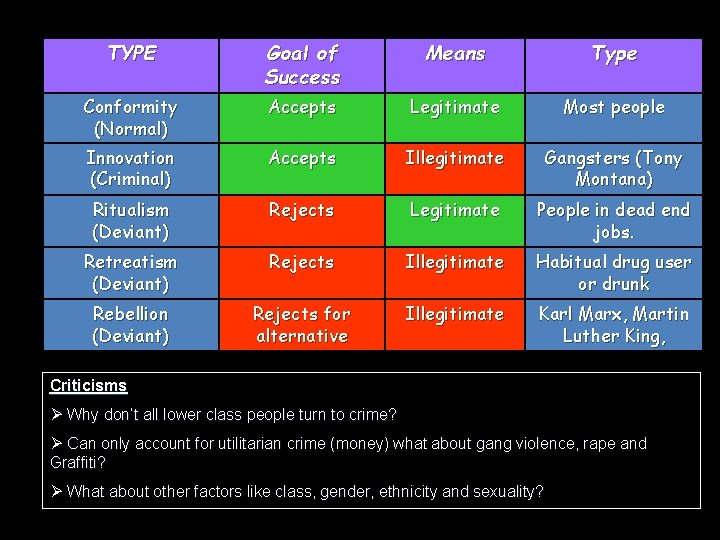
TYPE Goal of Success Means Type Conformity (Normal) Accepts Legitimate Most people Innovation (Criminal) Accepts Illegitimate Gangsters (Tony Montana) Ritualism (Deviant) Rejects Legitimate People in dead end jobs. Retreatism (Deviant) Rejects Illegitimate Habitual drug user or drunk Rebellion (Deviant) Rejects for alternative Illegitimate Karl Marx, Martin Luther King, Criticisms Ø Why don’t all lower class people turn to crime? Ø Can only account for utilitarian crime (money) what about gang violence, rape and Graffiti? Ø What about other factors like class, gender, ethnicity and sexuality?
Structural theories left some unanswered questions. • Why do some people commit crime but not others? • How can we theorise collective as opposed to individual deviance? • How can we explain non-materialistic deviance?
Subcultural Theory Chicago school developed as a response to Merton
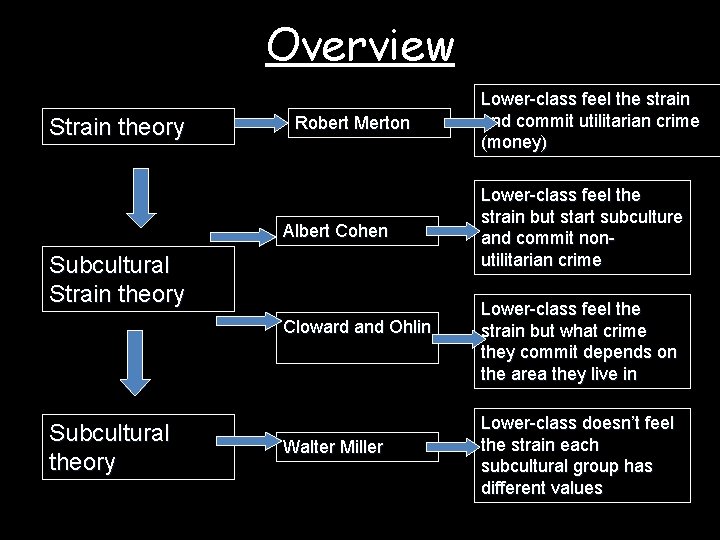
Overview Strain theory Robert Merton Albert Cohen Subcultural Strain theory Cloward and Ohlin Subcultural theory Walter Miller Lower-class feel the strain and commit utilitarian crime (money) Lower-class feel the strain but start subculture and commit nonutilitarian crime Lower-class feel the strain but what crime they commit depends on the area they live in Lower-class doesn’t feel the strain each subcultural group has different values
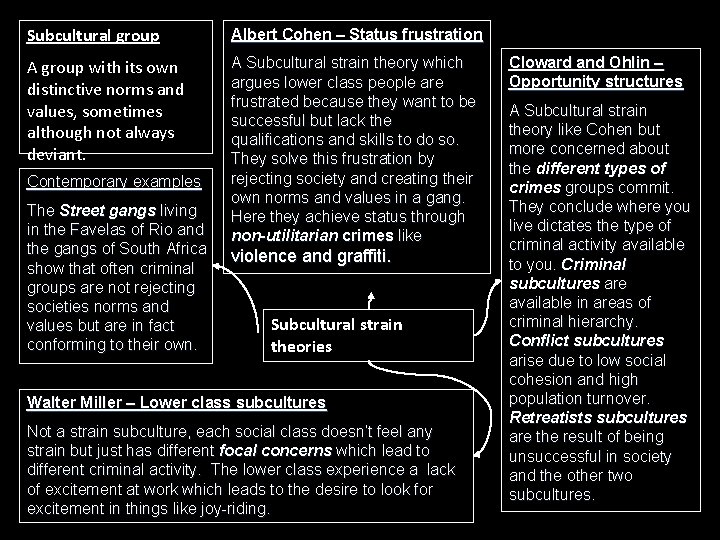
Subcultural group Albert Cohen – Status frustration A group with its own distinctive norms and values, sometimes although not always deviant. A Subcultural strain theory which argues lower class people are frustrated because they want to be successful but lack the qualifications and skills to do so. They solve this frustration by rejecting society and creating their own norms and values in a gang. Here they achieve status through non-utilitarian crimes like Contemporary examples The Street gangs living in the Favelas of Rio and the gangs of South Africa show that often criminal groups are not rejecting societies norms and values but are in fact conforming to their own. violence and graffiti. Subcultural strain theories Walter Miller – Lower class subcultures Not a strain subculture, each social class doesn’t feel any strain but just has different focal concerns which lead to different criminal activity. The lower class experience a lack of excitement at work which leads to the desire to look for excitement in things like joy-riding. Cloward and Ohlin – Opportunity structures A Subcultural strain theory like Cohen but more concerned about the different types of crimes groups commit. They conclude where you live dictates the type of criminal activity available to you. Criminal subcultures are available in areas of criminal hierarchy. Conflict subcultures arise due to low social cohesion and high population turnover. Retreatists subcultures are the result of being unsuccessful in society and the other two subcultures.
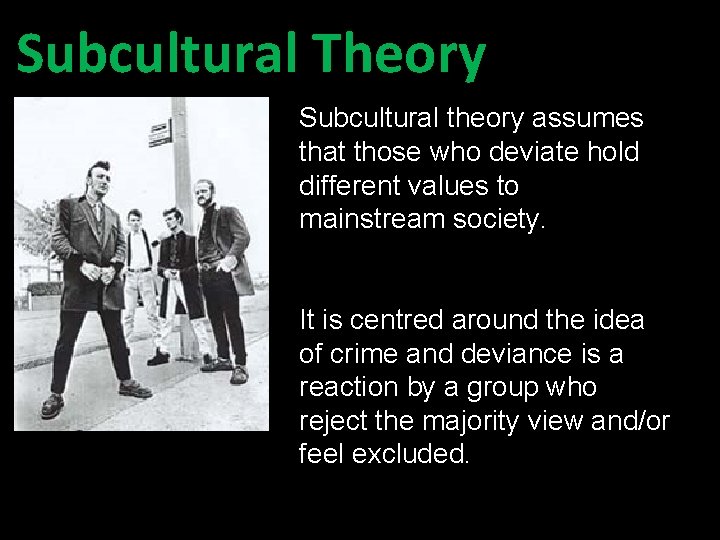
Subcultural Theory Subcultural theory assumes that those who deviate hold different values to mainstream society. It is centred around the idea of crime and deviance is a reaction by a group who reject the majority view and/or feel excluded. Crime and Deviance Chapter 5: Functionalist and Subcultural Theory 62 07/03/2021
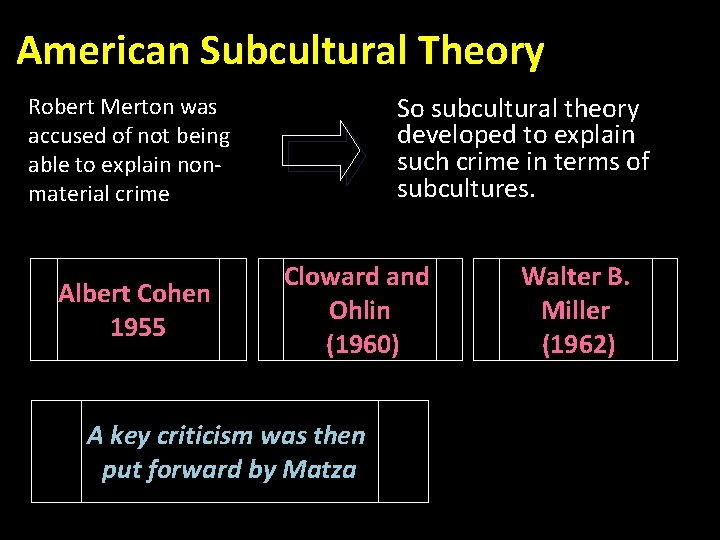
American Subcultural Theory So subcultural theory developed to explain such crime in terms of subcultures. Robert Merton was accused of not being able to explain nonmaterial crime Albert Cohen 1955 Cloward and Ohlin (1960) A key criticism was then put forward by Matza Walter B. Miller (1962)
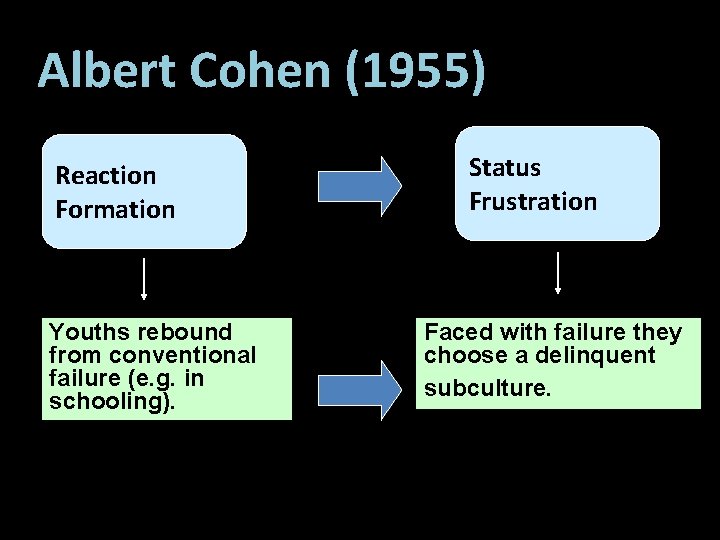
Albert Cohen (1955) Reaction Formation Youths rebound from conventional failure (e. g. in schooling). Status Frustration Faced with failure they choose a delinquent subculture.
This Is England https: //www. youtube. com/watch? v=H 0 jkv 2 b. RF g. Q https: //www. youtube. com/watch? v=u 2_q. Ll 00 L M 0 Subcultural Theory = Crime is functional.
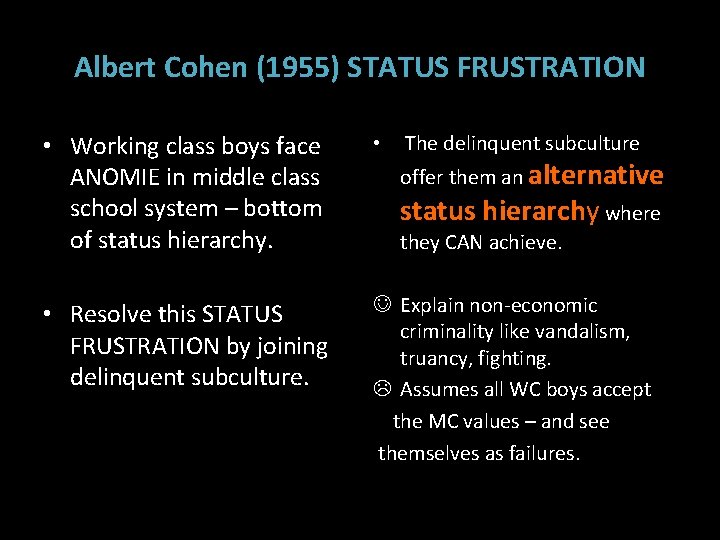
Albert Cohen (1955) STATUS FRUSTRATION • Working class boys face ANOMIE in middle class school system – bottom of status hierarchy. • The delinquent subculture • Resolve this STATUS FRUSTRATION by joining delinquent subculture. Explain non-economic criminality like vandalism, truancy, fighting. Assumes all WC boys accept the MC values – and see themselves as failures. offer them an alternative status hierarchy where they CAN achieve.
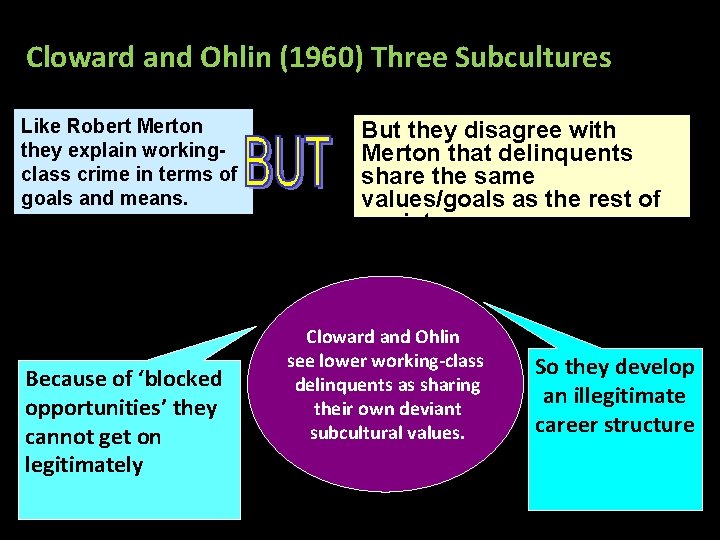
Cloward and Ohlin (1960) Three Subcultures Like Robert Merton they explain workingclass crime in terms of goals and means. Because of ‘blocked opportunities’ they cannot get on legitimately Crime and Deviance Chapter 5: Functionalist and Subcultural Theory But they disagree with Merton that delinquents share the same values/goals as the rest of society. Cloward and Ohlin see lower working-class delinquents as sharing their own deviant subcultural values. So they develop an illegitimate career structure 07/03/2021
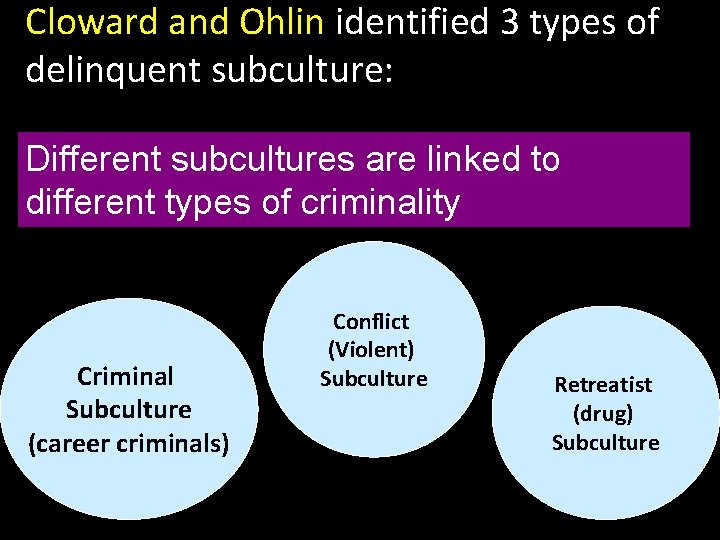
Cloward and Ohlin identified 3 types of delinquent subculture: Different subcultures are linked to different types of criminality Criminal Subculture (career criminals) Conflict (Violent) Subculture Retreatist (drug) Subculture
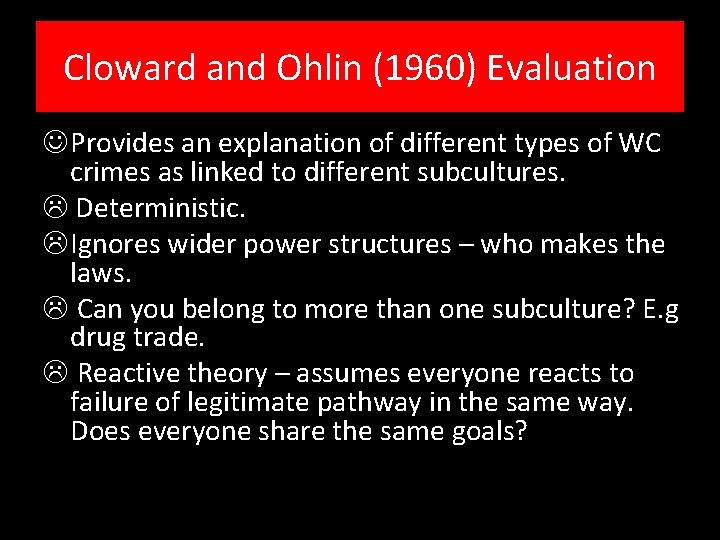
Cloward and Ohlin (1960) Evaluation Provides an explanation of different types of WC crimes as linked to different subcultures. Deterministic. Ignores wider power structures – who makes the laws. Can you belong to more than one subculture? E. g drug trade. Reactive theory – assumes everyone reacts to failure of legitimate pathway in the same way. Does everyone share the same goals?
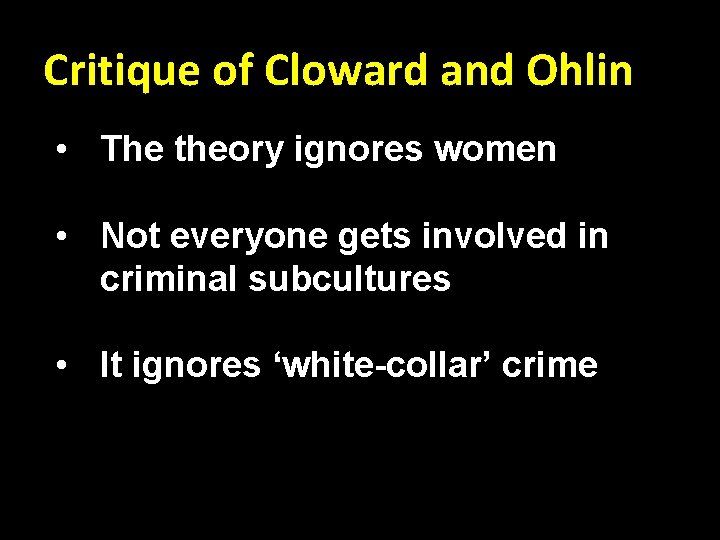
Critique of Cloward and Ohlin • The theory ignores women • Not everyone gets involved in criminal subcultures • It ignores ‘white-collar’ crime Crime and Deviance Chapter 5: Functionalist and Subcultural Theory 70 07/03/2021
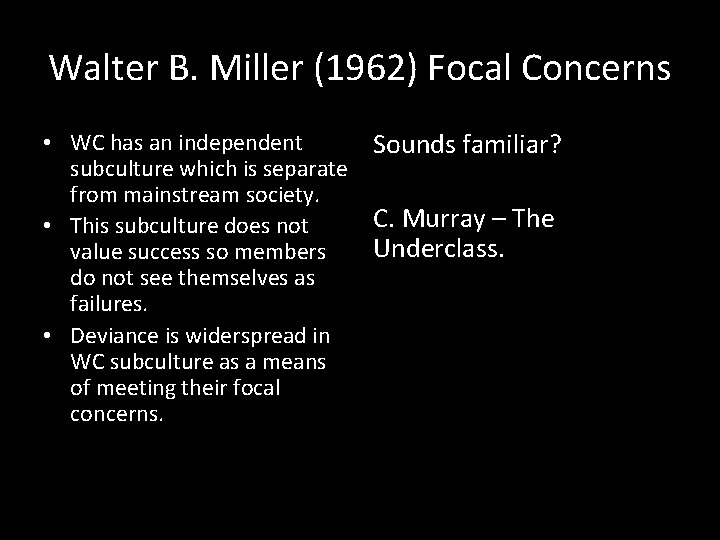
Walter B. Miller (1962) Focal Concerns • WC has an independent Sounds familiar? subculture which is separate from mainstream society. C. Murray – The • This subculture does not Underclass. value success so members do not see themselves as failures. • Deviance is widerspread in WC subculture as a means of meeting their focal concerns.
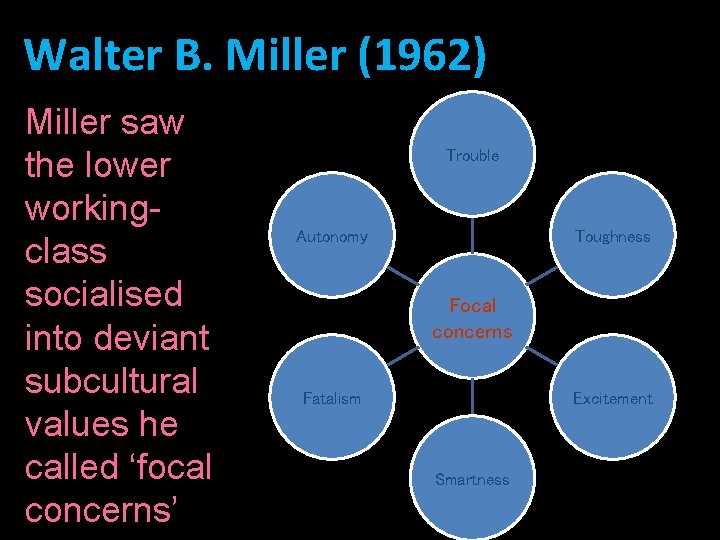
Walter B. Miller (1962) Miller saw the lower workingclass socialised into deviant subcultural values he called ‘focal concerns’ Crime and Deviance Chapter 5: Functionalist and Subcultural Theory Trouble Autonomy Toughness Focal concerns Fatalism Excitement Smartness 72 07/03/2021
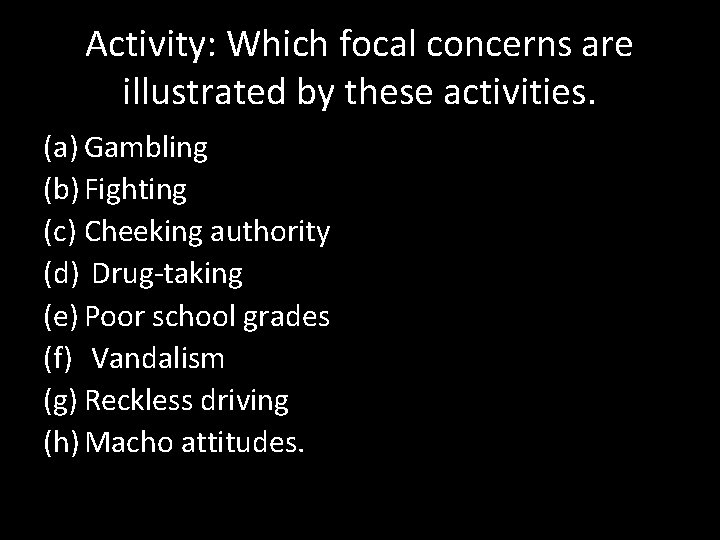
Activity: Which focal concerns are illustrated by these activities. (a) Gambling (b) Fighting (c) Cheeking authority (d) Drug-taking (e) Poor school grades (f) Vandalism (g) Reckless driving (h) Macho attitudes.
Walter B. Miller (1962) Focal Concerns WC delinquency due to deviant nature of WC subculture. Focal concerns dictate behaviour. E. g. A heightened sense of masculinity – sees violence as an acceptable problem-solving device.
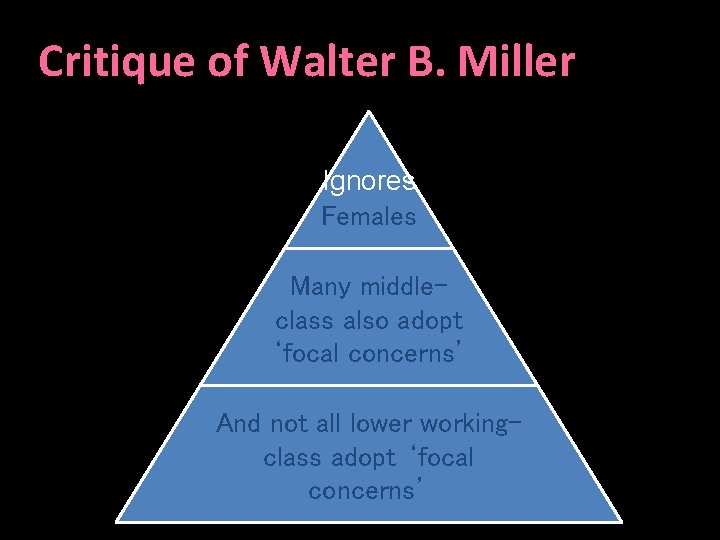
Critique of Walter B. Miller Ignores Females Many middleclass also adopt ‘focal concerns’ And not all lower workingclass adopt ‘focal concerns’

Matza: Delinquency and Drift (1964) Matza rejects Cohen’s view that delinquents are different, that they have a distinctive subculture in opposition to mainstream society. Matza argues that delinquent behaviour is often directed by subterranean values which are found throughout society (at all class levels, amongst ALL people)
Matza interviewed 100 delinquents in detention centres and found that a surprising large number of them disproved of most crimes, and were only partially committed to subcultural norms. Many expressed guilt and shame for their delinquent acts. This suggests at least some commitment to mainstream norms and values. He concluded that delinquents did not on the whole strongly reject society’s values. Rather than forming a subculture that directly opposes dominant norms and values the delinquent drift in and out of deviant activity.
Messner and Rosenfields (2001) Institutional Anomie Theory American obsession with individual money success produces anomie and delinquency. ‘Winner takes all’ and ‘anything goes’ society. In Capitalist societies with little welfare provision high rates of crime are innevitable. Societies that spend more on welfare have lower rates of imprisonment. Eastern European countries experienced a rise in crime as the moved from communism to K.
Do Subcultures Explain Crime in Britain Today? Howard Parker (1974) found evidence of ‘focal concerns’ in his study of working-class youth in Liverpool Leisure values Dissociation However, David Downes (1966) found limited evidence of subcultural values in his study of working-class youth in East London Instead he found them dissociated from mainstream values of long-term employment, instead focused on leisure and hedonism
Critique of subcultural theory • Uses official statistics – assume that most crime is carried out by young working class men, often in gangs. • Matza – deterministic, young people drift in and out of delinquency. • Social action theorists argue young men are targeted and picked by the police. Labelling! • Marxists – real criminals are big business.
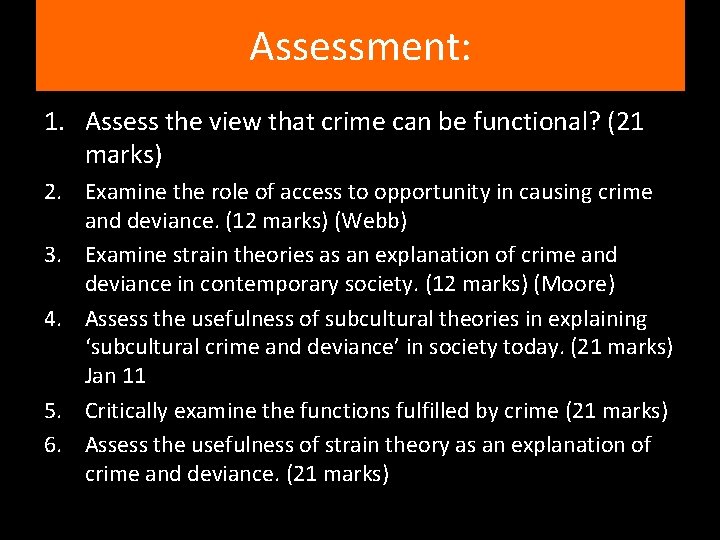
Assessment: 1. Assess the view that crime can be functional? (21 marks) 2. Examine the role of access to opportunity in causing crime and deviance. (12 marks) (Webb) 3. Examine strain theories as an explanation of crime and deviance in contemporary society. (12 marks) (Moore) 4. Assess the usefulness of subcultural theories in explaining ‘subcultural crime and deviance’ in society today. (21 marks) Jan 11 5. Critically examine the functions fulfilled by crime (21 marks) 6. Assess the usefulness of strain theory as an explanation of crime and deviance. (21 marks)
- Slides: 81