
START SMART Structuring Investment Securities For Startups April


- Slides: 62
START SMART Structuring Investment Securities For Start-ups April 11, 2012
START Joint. SMART program offered by Innovation Practice Institute University of Pittsburgh School of Law Project Olympus Carnegie Mellon University Open to all students, law students, entrepreneurs and the startup community
START SMART Starnataught by lawyers and business START SMART Seminars : Legal and business seminars taught by lawyers and business professionals on subjects relevant to entrepreneurs and technology start-ups. IPI Workshops: Where appropriate, after a START SMART seminar, law students can opt to work with entrepreneurs to provide individualized legal guidelines.
START SMART Past Seminars and Workshops • Formation Basics Seminar and Workshop • Equity and Employees • Employment/Employees and Founders: Protecting the Company Assets • Structuring and Leveraging Partner Arrangements • Starting a Business on an F-1 Student Visa • Profit with a Purpose: Starting a Social Enterprise
START SMART Fall 2012 Workshops and Seminars (tentative) Worst mistakes made by Entrepreneurs The JOBS Act: Implications for Startups Import/Export Legal Issues for Startups
Pitt Law’s Innovation Practice Institute Justine Kasznica Executive Director �We train highly marketable lawyers uniquely positioned to participate in 21 st century innovation �We collaborate with the practicing bar, local innovators and entrepreneurs, and the regional innovation community � Our programs include cutting edge research, new classroom models, hands-on mentoring of law students, and community engagement
Our Vision �INNOVATION is the ENGINE of ECONOMIC GROWTH �IPI LAWYERS are critical ENABLERS of INNOVATION �IPI LAWYERS are INNOVATORS and LEADERS �IPI LAWYERS are DRIVERS of ECONOMIC GROWTH
Our Mission �LAW STUDENTS: Provide hands-on training and mentoring, as well as community engagement and high level networking opportunities for students �LAWYERS: Develop a culture of mentorship amongst the practicing bar �COMMUNITY: Enable innovation through strategic partnerships, student-led legal research and assistance for innovators, and educational and relationship-building opportunities for the innovation community
Contact Information Justine Kasznica Executive Director Innovation Practice Institute University of Pittsburgh School of Law 412 -648 -5966 781 -413 -1230 (mobile) kasznica@pitt. edu
Kit Needham Senior Business Advisor We help CMU faculty and students commercialize their World-Class Research/Innovation. • Incubator Space and Equipment • Access and Visibility • Advice, Education, Assistance, • Connections, Mentors, Contacts • Micro-grants and Matching Funds
Olympus is looking for students who…. …have some ideas for potential businesses but don’t know whether they are good ones? …. want to start a business …. want to work in a start up …. want to get start-up experience via a project …. want to find out what it is all about …. want to start a socially responsible enterprise
Benefits of being a PROBE • Incubator Space and Equipment • Access and Visibility • Advice, Education, Assistance, • Connections, Mentors, Contacts • Micro-grants and Matching Funds
CONNECTS Are you looking for team mates? Are you looking for a team to join? Do you need any advice or help? Any announcements? www. olympus. cmu. edu
Understanding Investment Securities for Start-Ups David J. Lehman April 11, 2012 Copyright © 2011 by K&L Gates LLP. All rights reserved.
Agenda § § § § § Introduction Debt Warrants Common Equity (and valuation) Preferred Equity (and common protections) Convertible Debt Approval Rights Summary and Advice Questions and Answers 14
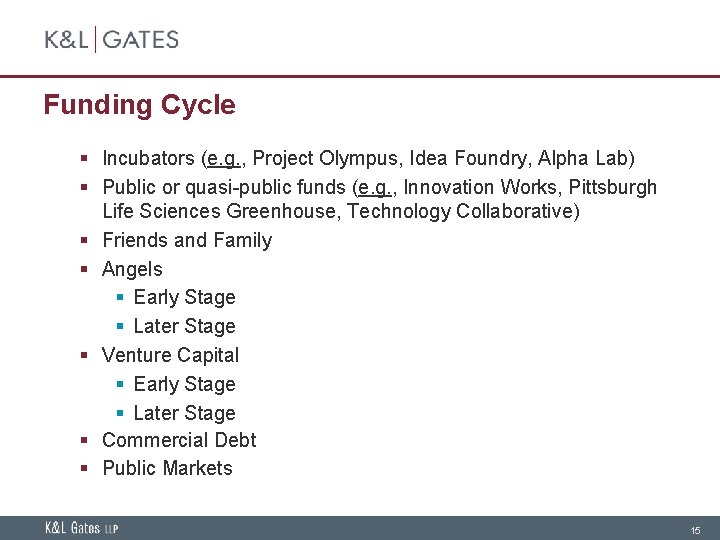
Funding Cycle § Incubators (e. g. , Project Olympus, Idea Foundry, Alpha Lab) § Public or quasi-public funds (e. g. , Innovation Works, Pittsburgh Life Sciences Greenhouse, Technology Collaborative) § Friends and Family § Angels § Early Stage § Later Stage § Venture Capital § Early Stage § Later Stage § Commercial Debt § Public Markets 15
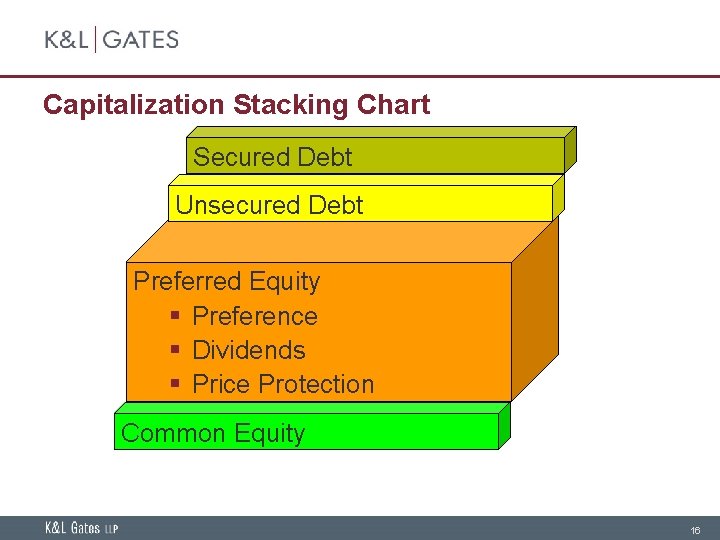
Capitalization Stacking Chart Secured Debt Unsecured Debt Preferred Equity § Preference § Dividends § Price Protection Common Equity 16
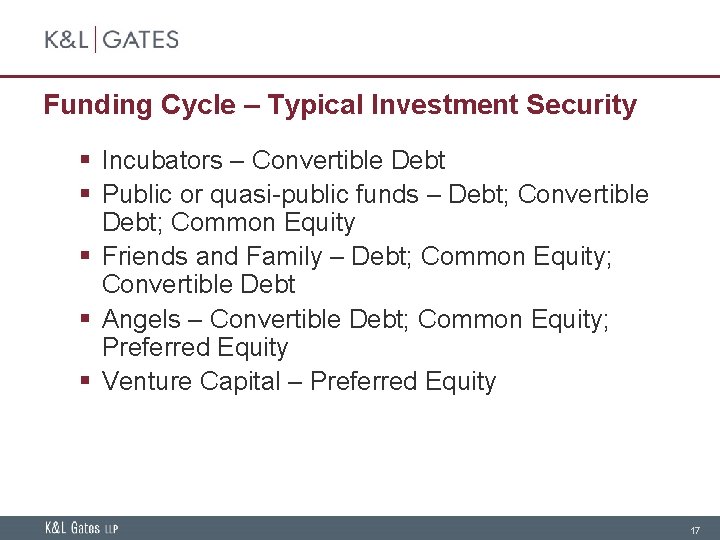
Funding Cycle – Typical Investment Security § Incubators – Convertible Debt § Public or quasi-public funds – Debt; Convertible Debt; Common Equity § Friends and Family – Debt; Common Equity; Convertible Debt § Angels – Convertible Debt; Common Equity; Preferred Equity § Venture Capital – Preferred Equity 17
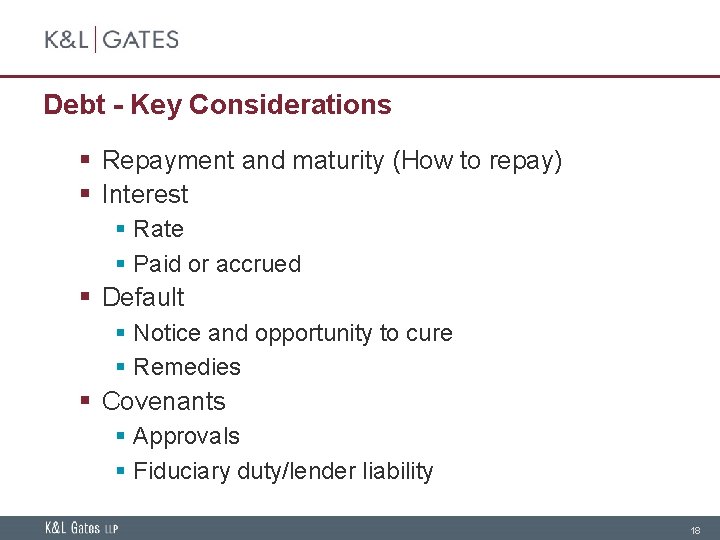
Debt - Key Considerations § Repayment and maturity (How to repay) § Interest § Rate § Paid or accrued § Default § Notice and opportunity to cure § Remedies § Covenants § Approvals § Fiduciary duty/lender liability 18
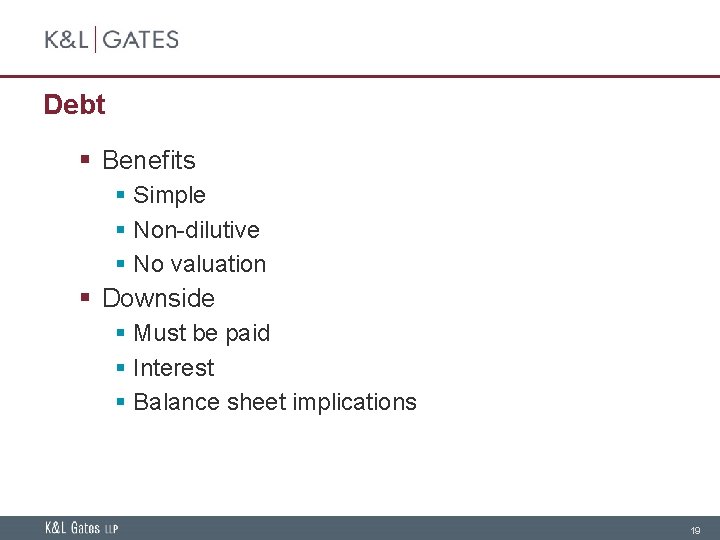
Debt § Benefits § Simple § Non-dilutive § No valuation § Downside § Must be paid § Interest § Balance sheet implications 19
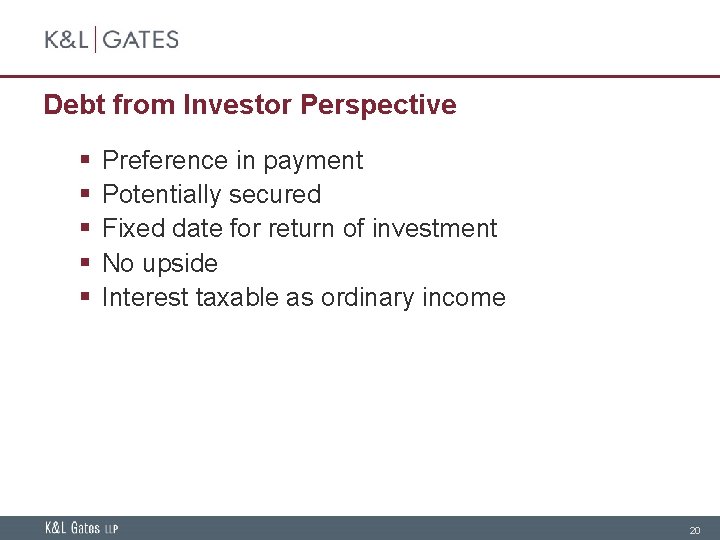
Debt from Investor Perspective § § § Preference in payment Potentially secured Fixed date for return of investment No upside Interest taxable as ordinary income 20
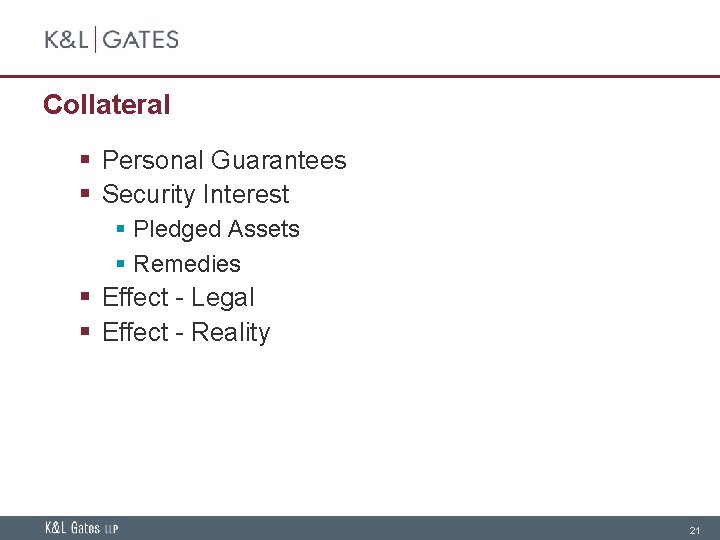
Collateral § Personal Guarantees § Security Interest § Pledged Assets § Remedies § Effect - Legal § Effect - Reality 21
Subordination § Lien Position § Payment § On-going § Default 22
Warrants § Regret Mitigation § Right to purchase stock (similar to options) § Major considerations § How many warrants § Exercise price (Valuation) § Time of exercise (date, sale, financing) § Assignment § Effect on cap chart 23
Common Equity § Benefits § Simple § Less expensive § Aligns interests § Downside § Requires valuation § Likely lower price 24
Common Equity – Investor Perspective § § § Simple – Aligns interest Investor gets “Upside” No preference Highest risk capital No typical preferred protections § Price protection § Dividends § Approvals 25
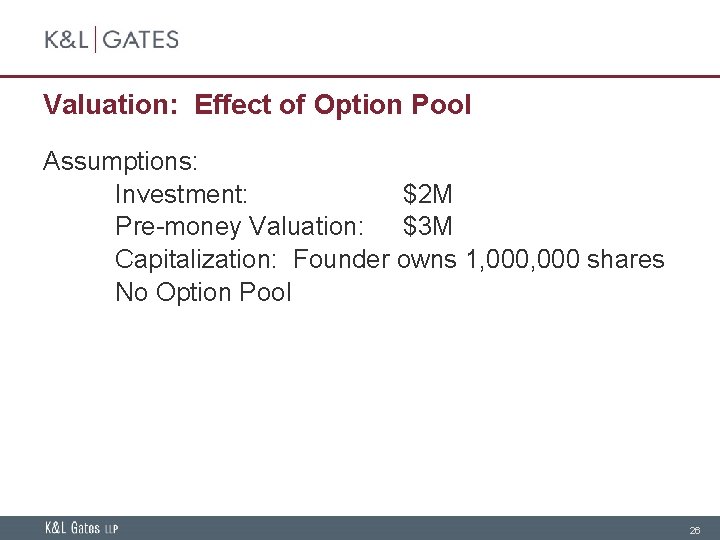
Valuation: Effect of Option Pool Assumptions: Investment: $2 M Pre-money Valuation: $3 M Capitalization: Founder owns 1, 000 shares No Option Pool 26
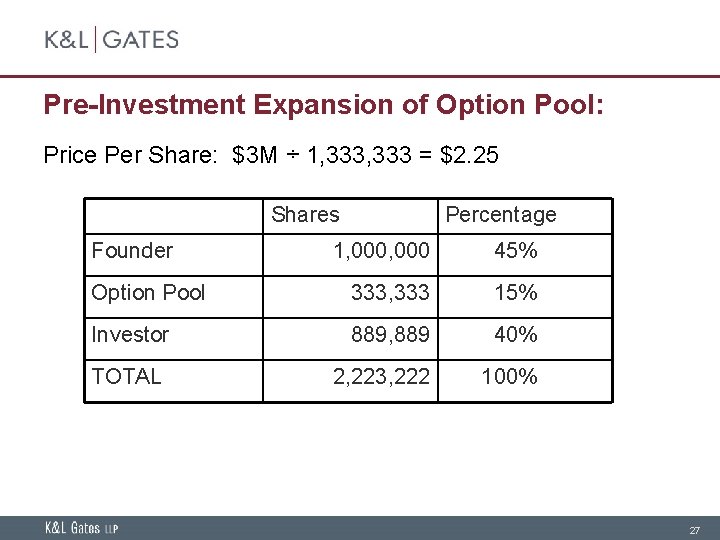
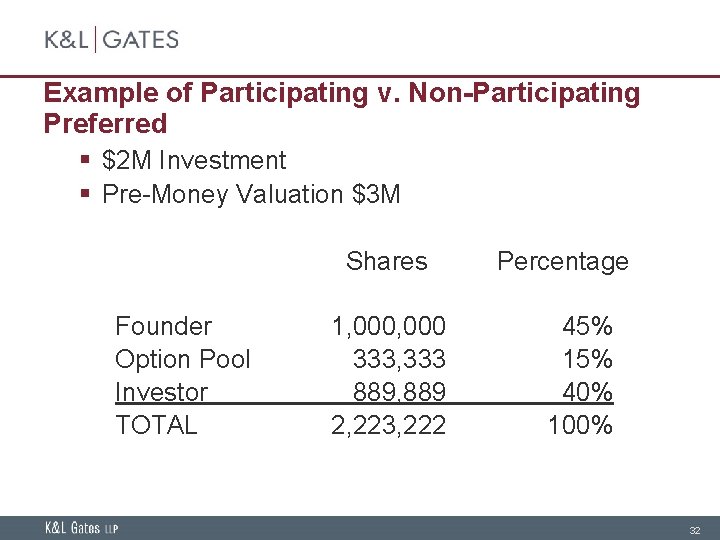
Pre-Investment Expansion of Option Pool: Price Per Share: $3 M ÷ 1, 333 = $2. 25 Shares Founder Percentage 1, 000 45% Option Pool 333, 333 15% Investor 889, 889 40% 2, 223, 222 100% TOTAL 27
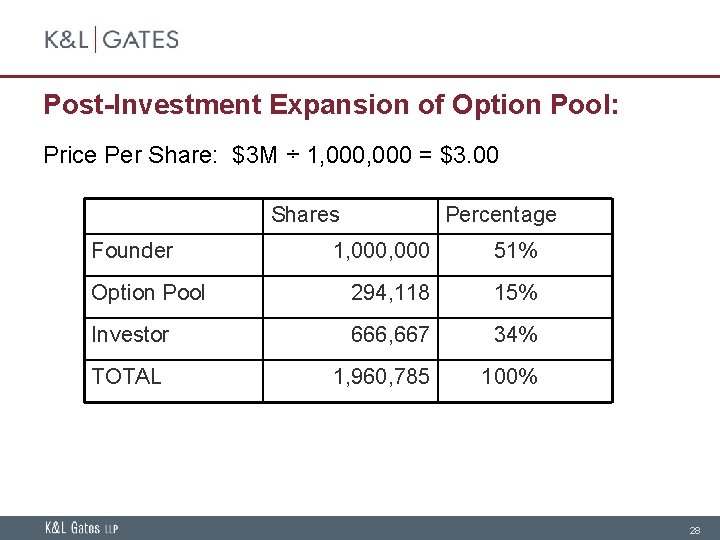
Post-Investment Expansion of Option Pool: Price Per Share: $3 M ÷ 1, 000 = $3. 00 Shares Founder Percentage 1, 000 51% Option Pool 294, 118 15% Investor 666, 667 34% 1, 960, 785 100% TOTAL 28
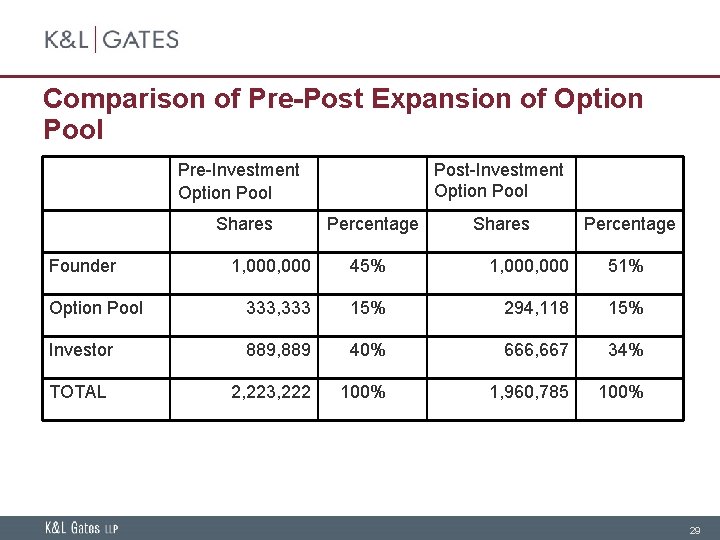
Comparison of Pre-Post Expansion of Option Pool Pre-Investment Option Pool Shares Founder Post-Investment Option Pool Percentage Shares Percentage 1, 000 45% 1, 000 51% Option Pool 333, 333 15% 294, 118 15% Investor 889, 889 40% 666, 667 34% 2, 223, 222 100% 1, 960, 785 100% TOTAL 29
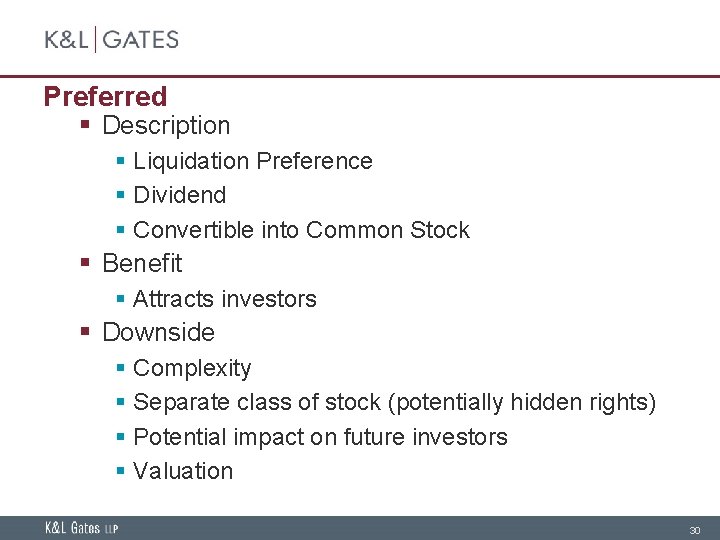
Preferred § Description § Liquidation Preference § Dividend § Convertible into Common Stock § Benefit § Attracts investors § Downside § Complexity § Separate class of stock (potentially hidden rights) § Potential impact on future investors § Valuation 30
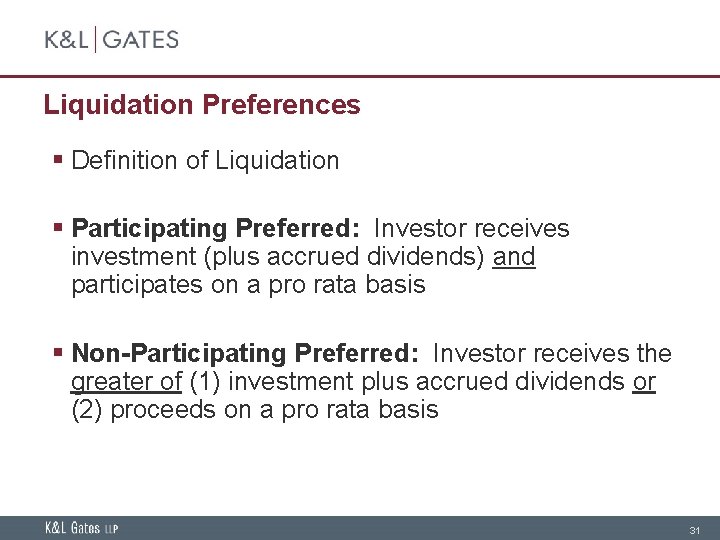
Liquidation Preferences § Definition of Liquidation § Participating Preferred: Investor receives investment (plus accrued dividends) and participates on a pro rata basis § Non-Participating Preferred: Investor receives the greater of (1) investment plus accrued dividends or (2) proceeds on a pro rata basis 31
Example of Participating v. Non-Participating Preferred § $2 M Investment § Pre-Money Valuation $3 M Shares Founder Option Pool Investor TOTAL 1, 000 333, 333 889, 889 2, 223, 222 Percentage 45% 15% 40% 100% 32
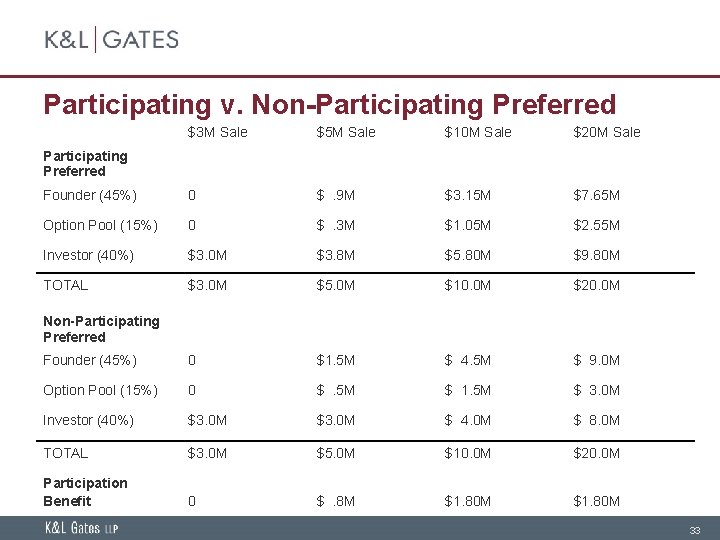
Participating v. Non-Participating Preferred $3 M Sale $5 M Sale $10 M Sale $20 M Sale Founder (45%) 0 $. 9 M $3. 15 M $7. 65 M Option Pool (15%) 0 $. 3 M $1. 05 M $2. 55 M Investor (40%) $3. 0 M $3. 8 M $5. 80 M $9. 80 M TOTAL $3. 0 M $5. 0 M $10. 0 M $20. 0 M Founder (45%) 0 $1. 5 M $ 4. 5 M $ 9. 0 M Option Pool (15%) 0 $. 5 M $ 1. 5 M $ 3. 0 M Investor (40%) $3. 0 M $ 4. 0 M $ 8. 0 M TOTAL $3. 0 M $5. 0 M $10. 0 M $20. 0 M Participation Benefit 0 $. 8 M $1. 80 M Participating Preferred Non-Participating Preferred 33
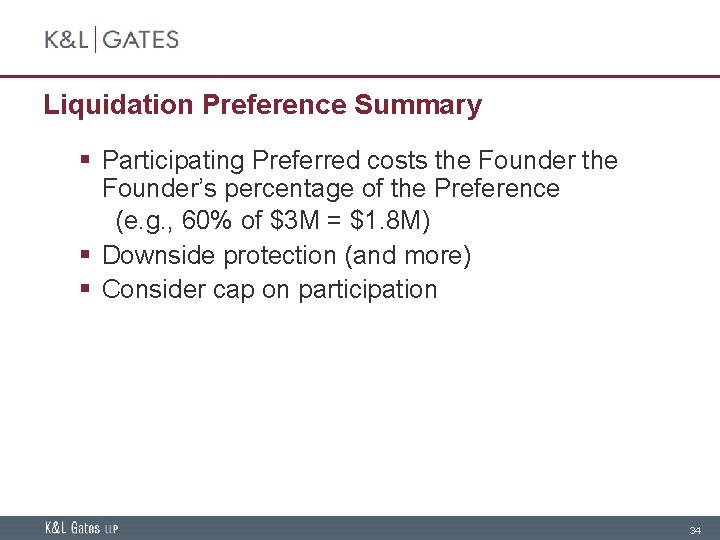
Liquidation Preference Summary § Participating Preferred costs the Founder’s percentage of the Preference (e. g. , 60% of $3 M = $1. 8 M) § Downside protection (and more) § Consider cap on participation 34
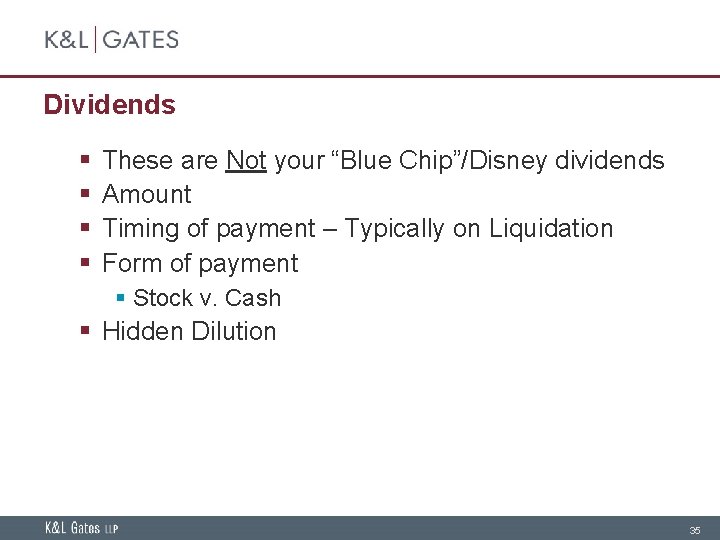
Dividends § § These are Not your “Blue Chip”/Disney dividends Amount Timing of payment – Typically on Liquidation Form of payment § Stock v. Cash § Hidden Dilution 35
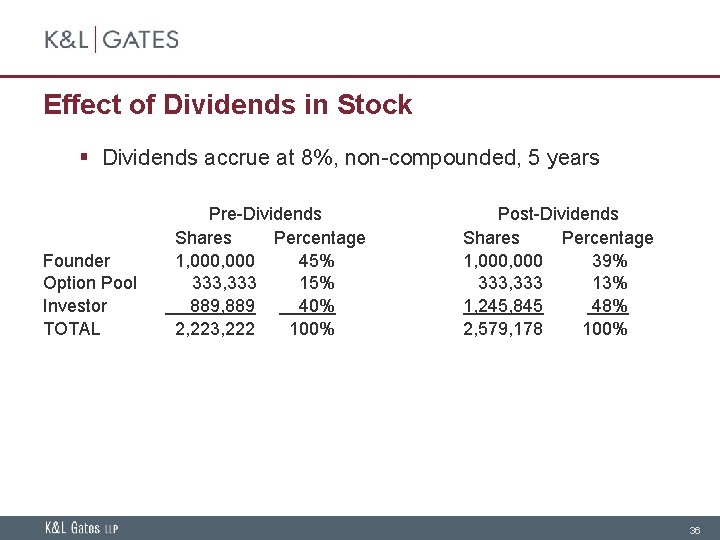
Effect of Dividends in Stock § Dividends accrue at 8%, non-compounded, 5 years Founder Option Pool Investor TOTAL Pre-Dividends Shares Percentage 1, 000 45% 333, 333 15% 889, 889 40% 2, 223, 222 100% Post-Dividends Shares Percentage 1, 000 39% 333, 333 13% 1, 245, 845 48% 2, 579, 178 100% 36
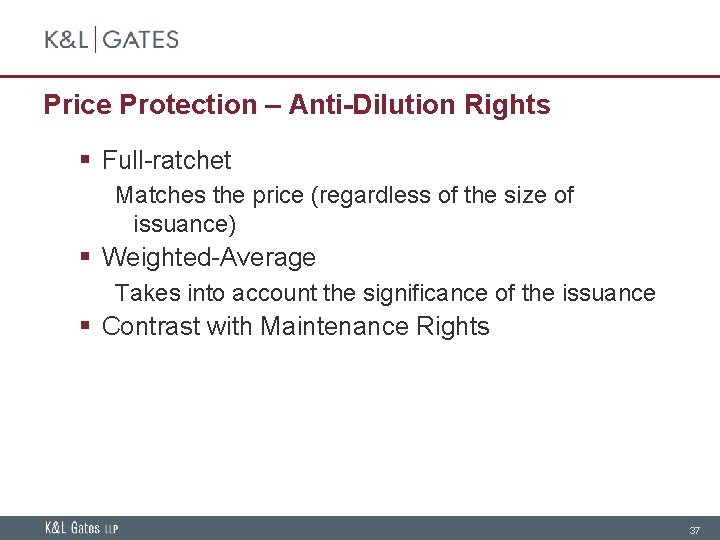
Price Protection – Anti-Dilution Rights § Full-ratchet Matches the price (regardless of the size of issuance) § Weighted-Average Takes into account the significance of the issuance § Contrast with Maintenance Rights 37
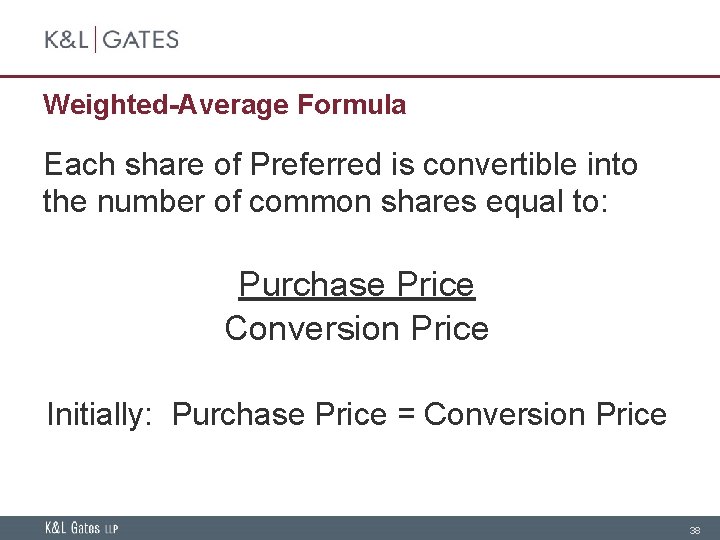
Weighted-Average Formula Each share of Preferred is convertible into the number of common shares equal to: Purchase Price Conversion Price Initially: Purchase Price = Conversion Price 38
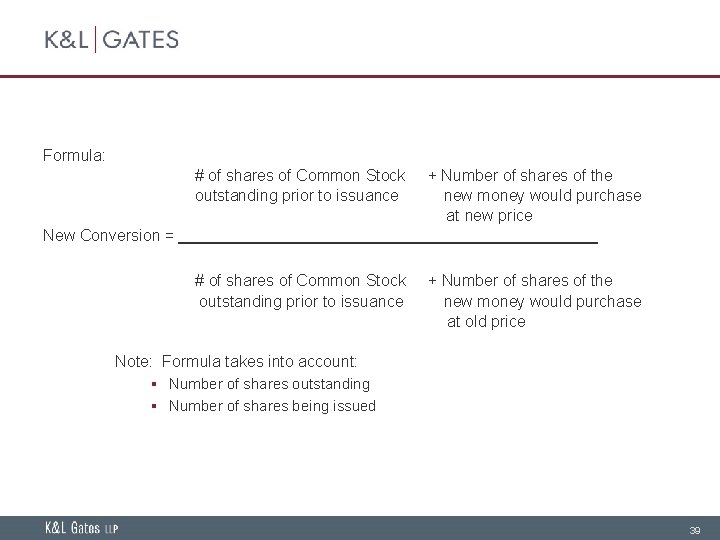
Formula: # of shares of Common Stock outstanding prior to issuance + Number of shares of the new money would purchase at new price New Conversion = ________________________ # of shares of Common Stock outstanding prior to issuance + Number of shares of the new money would purchase at old price Note: Formula takes into account: § Number of shares outstanding § Number of shares being issued 39
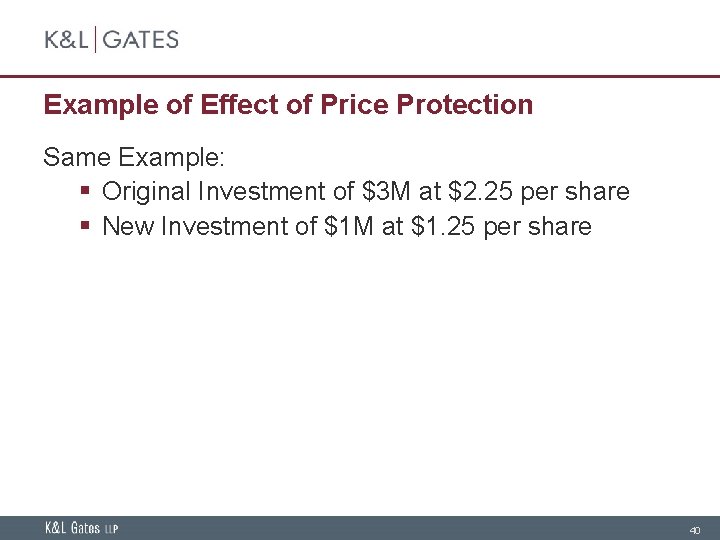
Example of Effect of Price Protection Same Example: § Original Investment of $3 M at $2. 25 per share § New Investment of $1 M at $1. 25 per share 40
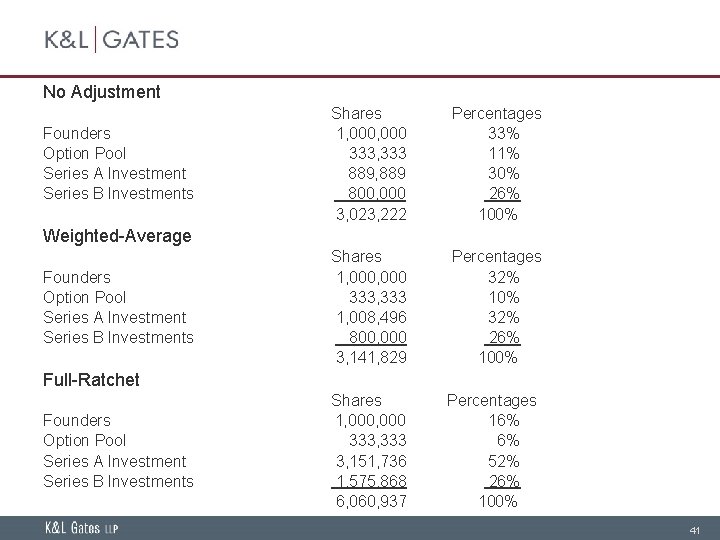
No Adjustment Founders Option Pool Series A Investment Series B Investments Shares 1, 000 333, 333 889, 889 800, 000 3, 023, 222 Percentages 33% 11% 30% 26% 100% Shares 1, 000 333, 333 1, 008, 496 800, 000 3, 141, 829 Percentages 32% 10% 32% 26% 100% Shares 1, 000 333, 333 3, 151, 736 1, 575, 868 6, 060, 937 Percentages 16% 6% 52% 26% 100% Weighted-Average Founders Option Pool Series A Investment Series B Investments Full-Ratchet Founders Option Pool Series A Investment Series B Investments 41
Price Protection Lessons § Full-Ratchet Price Protection can be DEVASTATING to Founders § Weighted-Average Price Protection is costly, but manageable to Founders 42
Liquidation Rights § Redemption Rights § Timing § Price § Effect on Company § Force Sale § Right to force going public 43
Convertible Debt § Description § Convertible to equity upon trigger events § Sometimes convertible into new security § Sometimes convertible into common stock § Mandatory/Voluntary conversion § Discount to investment price (e. g. , 20%) § Fancy conversion terms (e. g. multiple of revenues) § Base price in case of no additional investment 44
Convertible Debt (cont. ) § Benefits § Avoids the “valuation issue” (sort of…) § Downside § Conversion price unknown § Usually accrues interest (additional dilution) § Debt holders can have interests that are not aligned with common 45
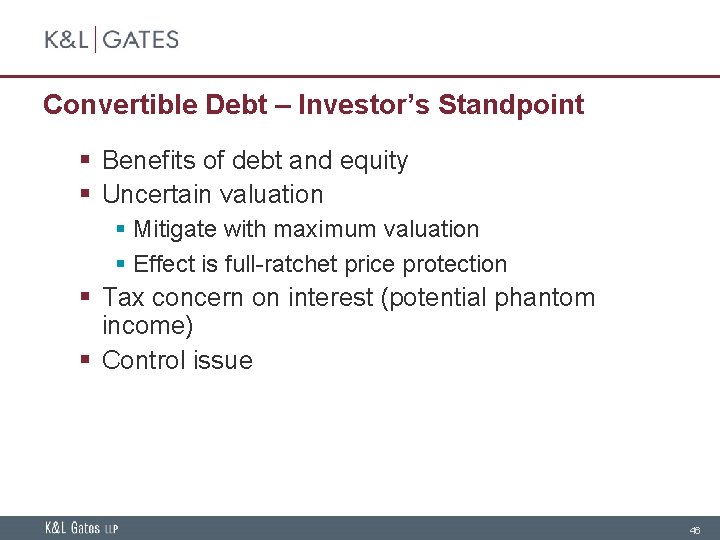
Convertible Debt – Investor’s Standpoint § Benefits of debt and equity § Uncertain valuation § Mitigate with maximum valuation § Effect is full-ratchet price protection § Tax concern on interest (potential phantom income) § Control issue 46
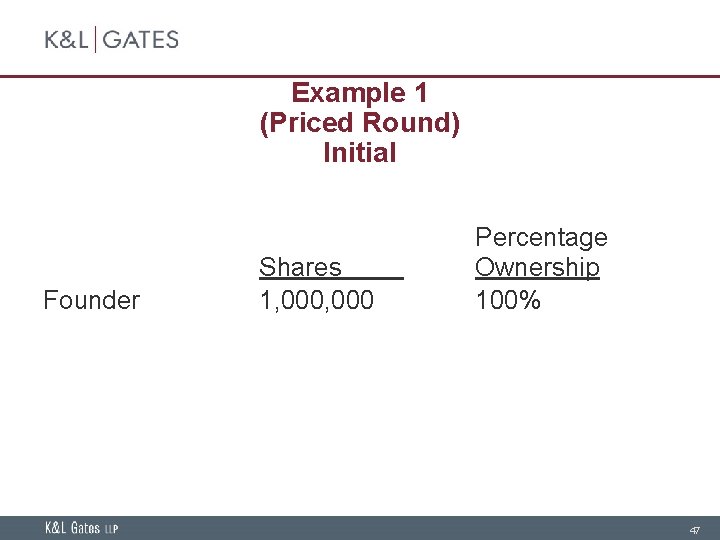
Example 1 (Priced Round) Initial Founder Shares 1, 000 Percentage Ownership 100% 47
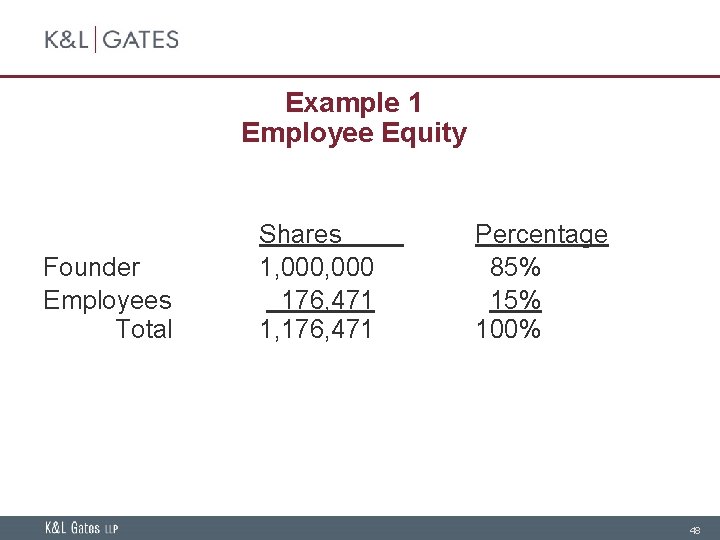
Example 1 Employee Equity Founder Employees Total Shares 1, 000 176, 471 1, 176, 471 Percentage 85% 100% 48
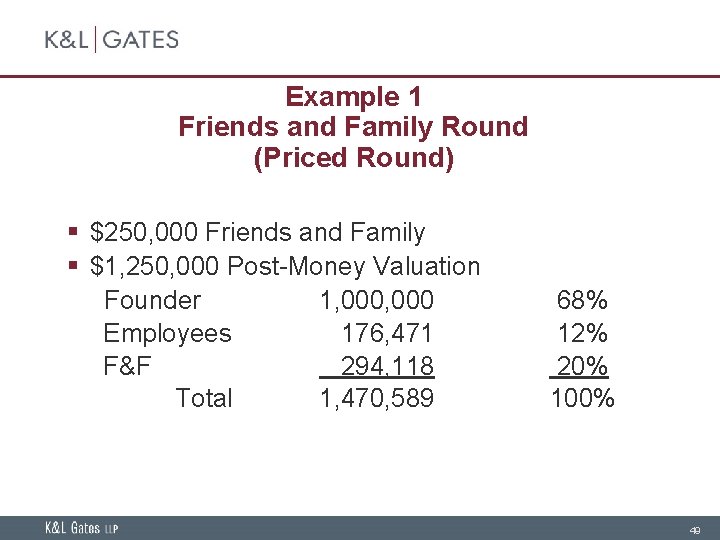
Example 1 Friends and Family Round (Priced Round) § $250, 000 Friends and Family § $1, 250, 000 Post-Money Valuation Founder 1, 000 Employees 176, 471 F&F 294, 118 Total 1, 470, 589 68% 12% 20% 100% 49
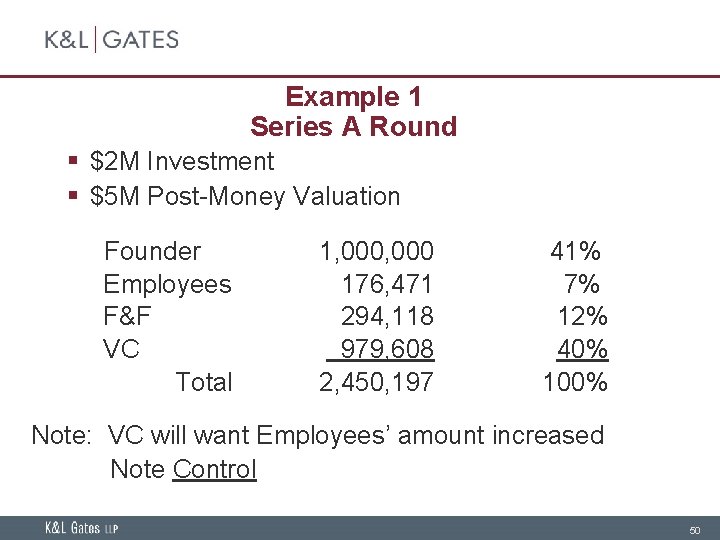
Example 1 Series A Round § $2 M Investment § $5 M Post-Money Valuation Founder Employees F&F VC Total 1, 000 176, 471 294, 118 979, 608 2, 450, 197 41% 7% 12% 40% 100% Note: VC will want Employees’ amount increased Note Control 50
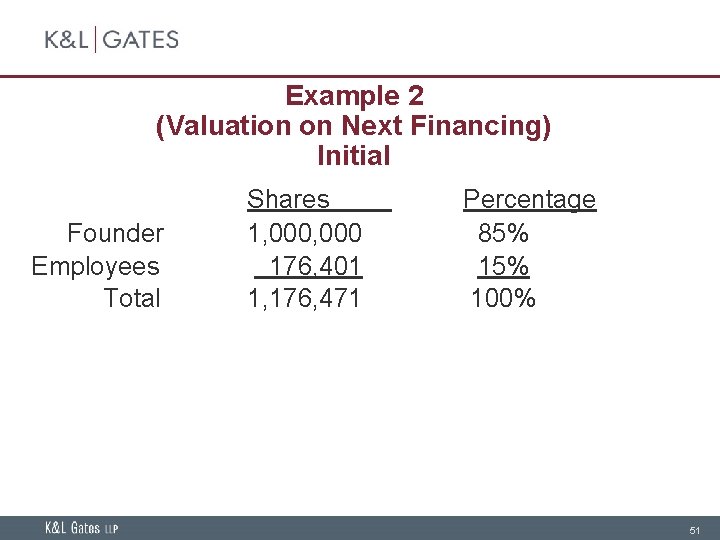
Example 2 (Valuation on Next Financing) Initial Founder Employees Total Shares 1, 000 176, 401 1, 176, 471 Percentage 85% 100% 51
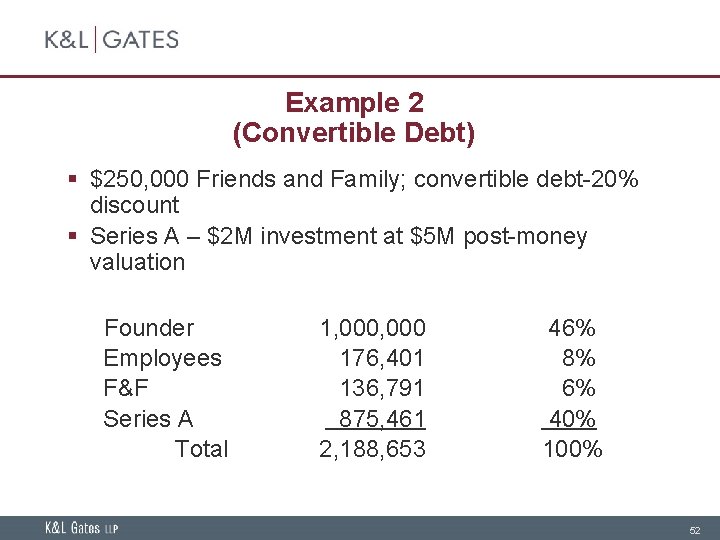
Example 2 (Convertible Debt) § $250, 000 Friends and Family; convertible debt-20% discount § Series A – $2 M investment at $5 M post-money valuation Founder Employees F&F Series A Total 1, 000 176, 401 136, 791 875, 461 2, 188, 653 46% 8% 6% 40% 100% 52
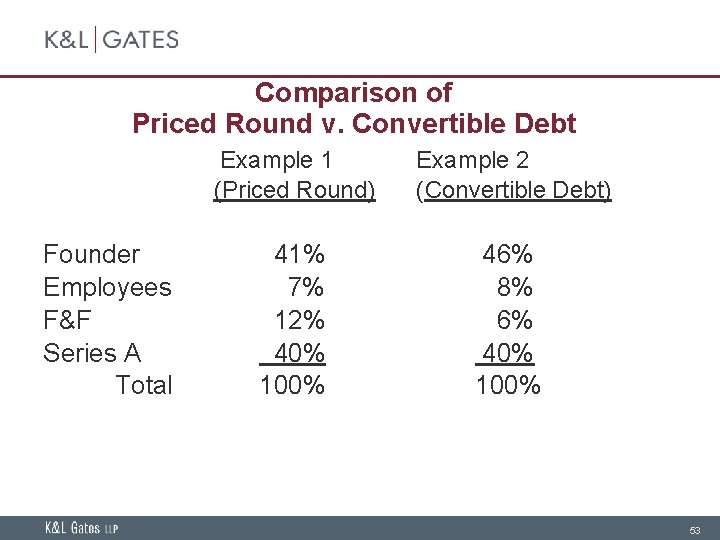
Comparison of Priced Round v. Convertible Debt Founder Employees F&F Series A Total Example 1 (Priced Round) Example 2 (Convertible Debt) 41% 7% 12% 40% 100% 46% 8% 6% 40% 100% 53
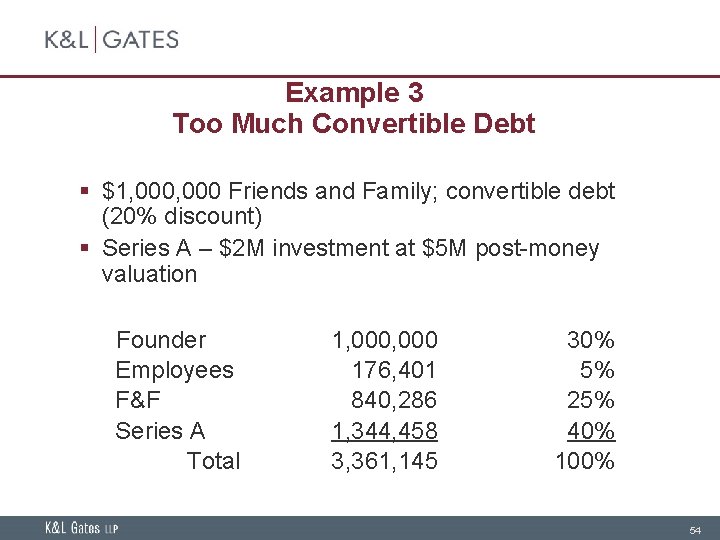
Example 3 Too Much Convertible Debt § $1, 000 Friends and Family; convertible debt (20% discount) § Series A – $2 M investment at $5 M post-money valuation Founder Employees F&F Series A Total 1, 000 176, 401 840, 286 1, 344, 458 3, 361, 145 30% 5% 25% 40% 100% 54
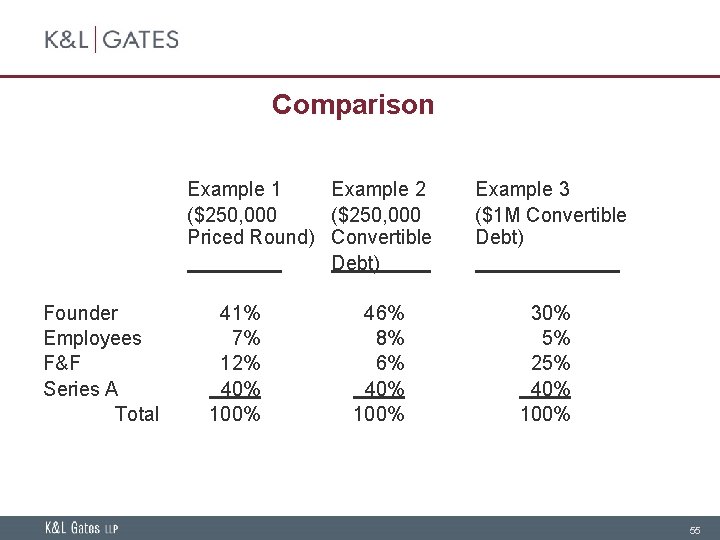
Comparison Example 1 Example 2 ($250, 000 Priced Round) Convertible Debt) Founder Employees F&F Series A Total 41% 7% 12% 40% 100% 46% 8% 6% 40% 100% Example 3 ($1 M Convertible Debt) 30% 5% 25% 40% 100% 55
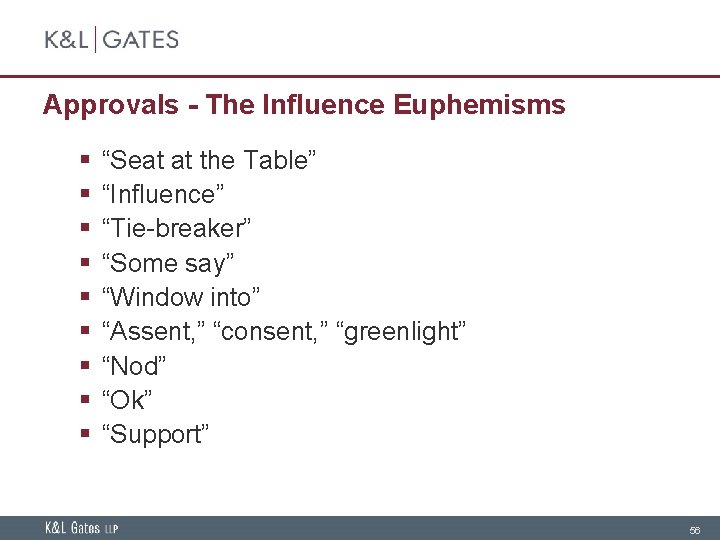
Approvals - The Influence Euphemisms § § § § § “Seat at the Table” “Influence” “Tie-breaker” “Some say” “Window into” “Assent, ” “consent, ” “greenlight” “Nod” “Ok” “Support” 56
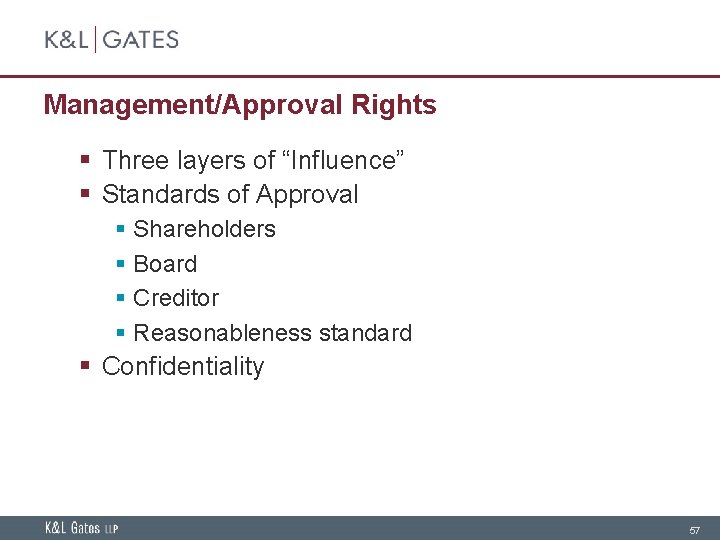
Management/Approval Rights § Three layers of “Influence” § Standards of Approval § Shareholders § Board § Creditor § Reasonableness standard § Confidentiality 57
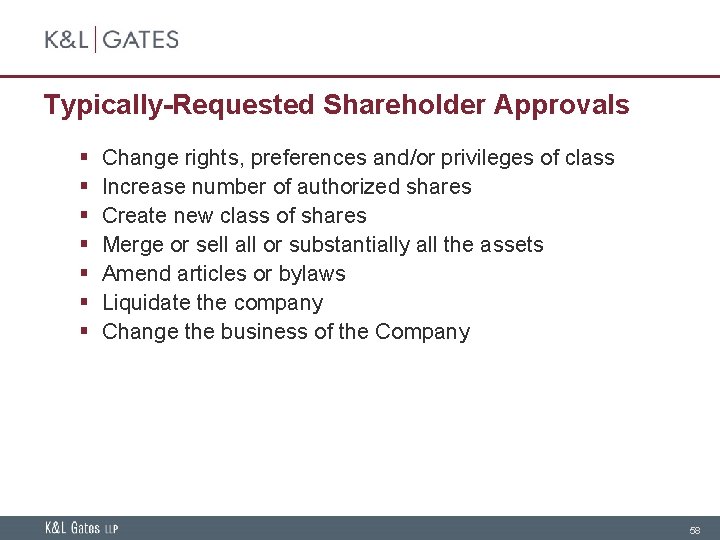
Typically-Requested Shareholder Approvals § § § § Change rights, preferences and/or privileges of class Increase number of authorized shares Create new class of shares Merge or sell all or substantially all the assets Amend articles or bylaws Liquidate the company Change the business of the Company 58
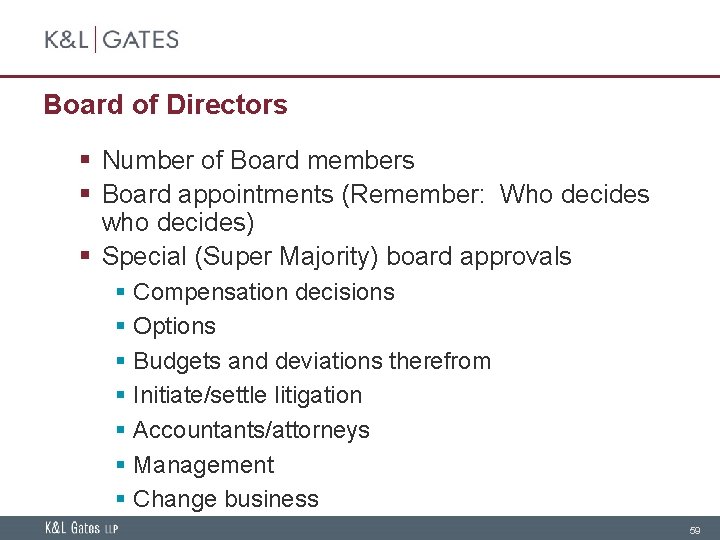
Board of Directors § Number of Board members § Board appointments (Remember: Who decides who decides) § Special (Super Majority) board approvals § Compensation decisions § Options § Budgets and deviations therefrom § Initiate/settle litigation § Accountants/attorneys § Management § Change business 59
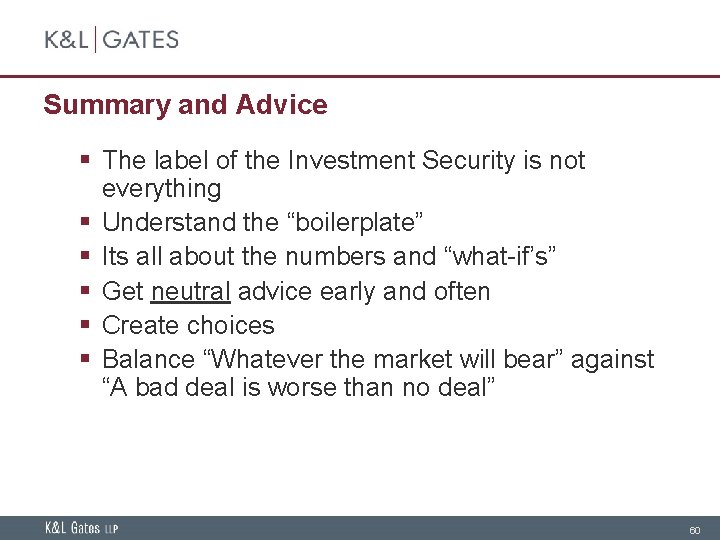
Summary and Advice § The label of the Investment Security is not everything § Understand the “boilerplate” § Its all about the numbers and “what-if’s” § Get neutral advice early and often § Create choices § Balance “Whatever the market will bear” against “A bad deal is worse than no deal” 60
Questions and Answers 61