
Stars What is a star The objects that
Stars
What is a star? • The objects that heat and light the planets in a system • A star is a ball of plasma held together by its own gravity – Nuclear reactions occur in stars (H He) – Energy from the nuclear reactions is released as electromagnetic radiation
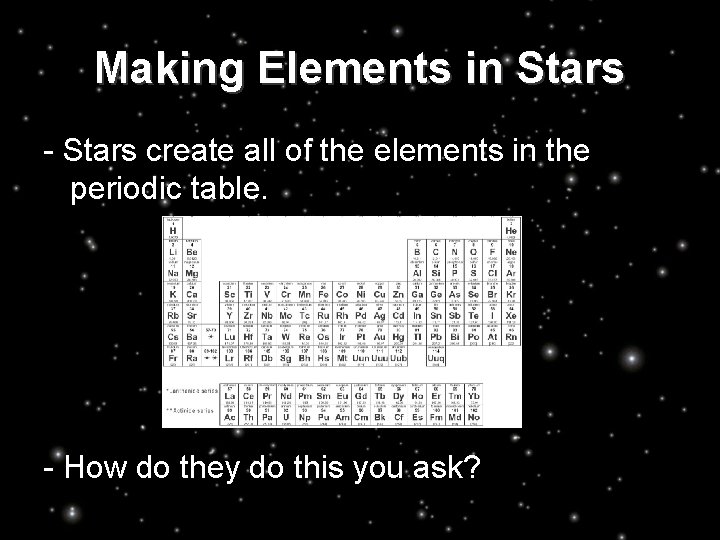
Making Elements in Stars - Stars create all of the elements in the periodic table. - How do they do this you ask?
Making Elements in Stars - All stars live by fusing hydrogen to make helium. - At higher temperatures and pressures, heavier elements can form. -Examples: * Helium fuses with Carbon to make Oxygen * Carbon and Oxygen fuse to make silicon * Two silicon atoms fuse to make iron
Making Elements in Stars - The formation of elements in stars occurs in massive stars near the end of their life cycle. -Eventually the star forms layers, like an onion, forming different elements in different layers. - Some elements are only able to form during supernova explosions, which are rare.

Making Elements in Stars
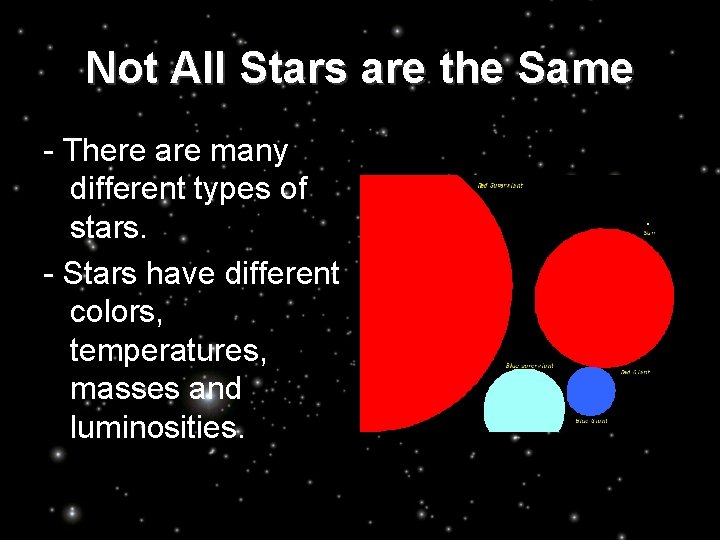
Not All Stars are the Same - There are many different types of stars. - Stars have different colors, temperatures, masses and luminosities.
Characteristics of Stars • Magnitude (brightness) – Apparent magnitude • How bright a star appears to be from Earth – Absolute magnitude (luminosity) • How bright a star actually is
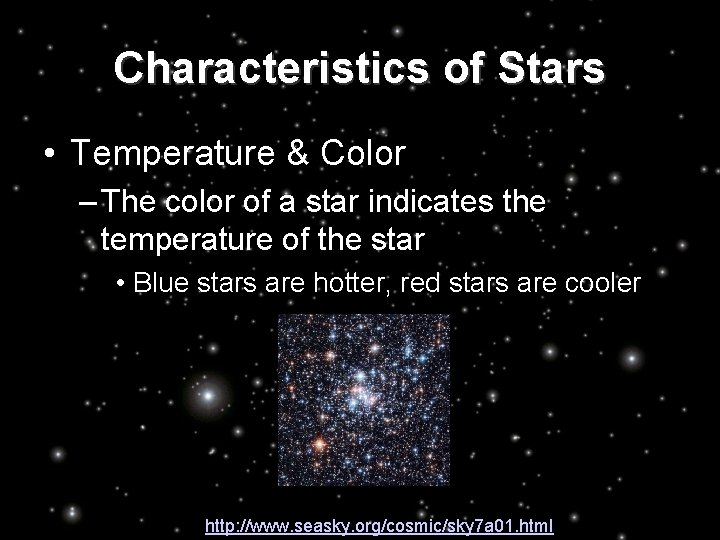
Characteristics of Stars • Temperature & Color – The color of a star indicates the temperature of the star • Blue stars are hotter, red stars are cooler http: //www. seasky. org/cosmic/sky 7 a 01. html
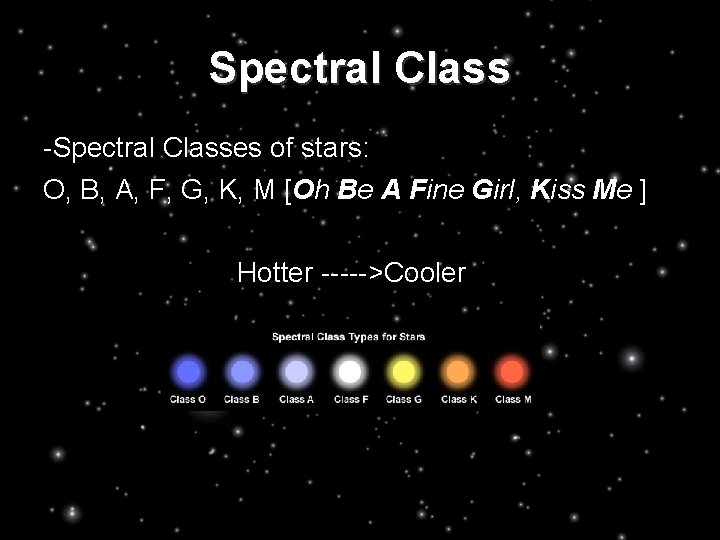
Spectral Class -Spectral Classes of stars: O, B, A, F, G, K, M [Oh Be A Fine Girl, Kiss Me ] Hotter ----->Cooler
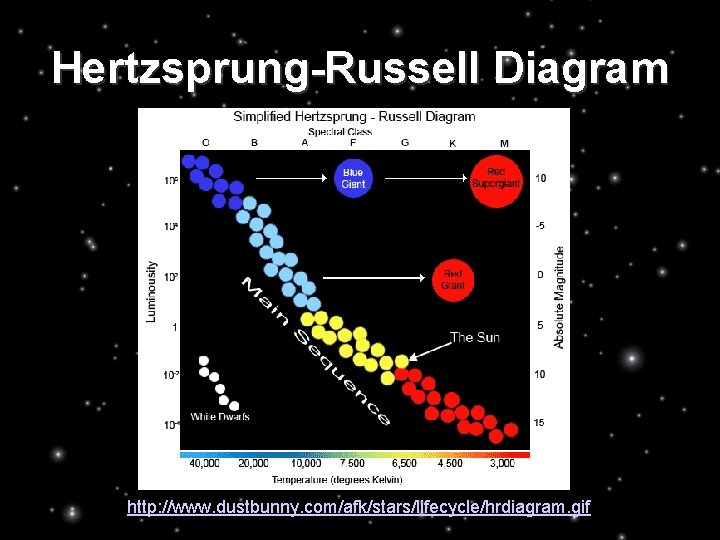
Hertzsprung-Russell Diagram http: //www. dustbunny. com/afk/stars/lifecycle/hrdiagram. gif
Main Sequence Stars • A major grouping of stars that forms a narrow band from the upper left to the lower right when plotted according to luminosity and surface temperature on the Hertzsprung-Russell diagram
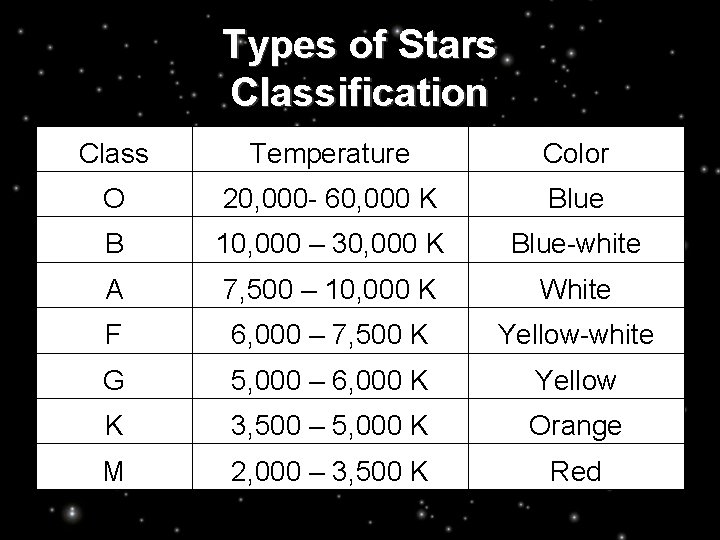
Types of Stars Classification Class Temperature Color O 20, 000 - 60, 000 K Blue B 10, 000 – 30, 000 K Blue-white A 7, 500 – 10, 000 K White F 6, 000 – 7, 500 K Yellow-white G 5, 000 – 6, 000 K Yellow K 3, 500 – 5, 000 K Orange M 2, 000 – 3, 500 K Red
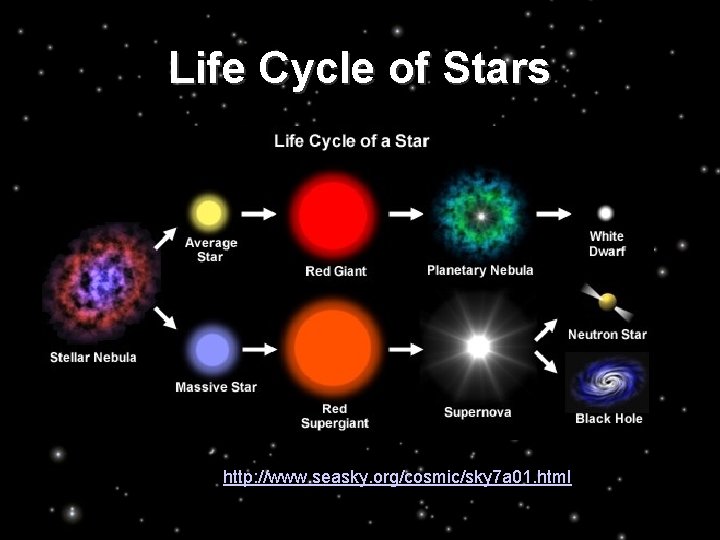
Life Cycle of Stars http: //www. seasky. org/cosmic/sky 7 a 01. html
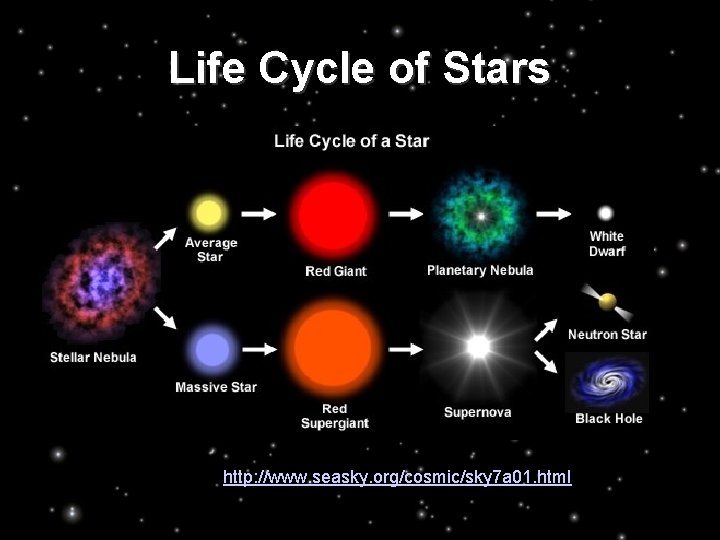
Life Cycle of Stars • Begin their lives as clouds of dust and gas called nebulae • Gravity may cause the nebula to contract • Matter in the gas cloud will begin to condense into a dense region called a protostar • The protostar continues to condense, it heats up. Eventually, it reaches a critical mass and nuclear fusion begins. • Begins the main sequence phase of the star • Most of its life is n this phase
Life Cycle of Stars Life span of a star depends on its size. – Very large, massive stars burn their fuel much faster than smaller stars – Their main sequence may last only a few hundred thousand years – Smaller stars will live on for billions of years because they burn their fuel much more slowly • Eventually, the star's fuel will begin to run out.
Life Cycle of Stars • It will expand into what is known as a red giant • Massive stars will become red supergiants • This phase will last until the star exhausts its remaining fuel • At this point the star will collapse
Life Cycle of Stars • Most average stars will blow away their outer atmospheres to form a planetary nebula • Their cores will remain behind and burn as a white dwarf until they cool down • What will be left is a dark ball of matter known as a black dwarf
Life Cycle of Stars • If the star is massive enough, the collapse will trigger a violent explosion known as a supernova • If the remaining mass of the star is about 1. 4 times that of our Sun, the core is unable to support itself and it will collapse further to become a neutron star
Life Cycle of Stars • The matter inside the star will be compressed so tightly that its atoms are compacted into a dense shell of neutrons. If the remaining mass of the star is more than about three times that of the Sun, it will collapse so completely that it will literally disappear from the universe. What is left behind is an intense region of gravity called a black hole
Life Cycle of Stars http: //www. seasky. org/cosmic/sky 7 a 01. html
- Slides: 21