
Stars Solar System Folktale How the Stars Came
- Slides: 19
Stars & Solar System
Folktale: How the Stars Came to Be In the beginning, before people, when only animals were on earth, all the animals worked, except for coyote. He was lazy. He merely watched while the other animals put the rivers where they are now, so that there would be water to drink. They made mountains for beauty. They made forests and trees for shade. The animals made grass grow. They created the deserts by putting down sand all kinds of other rocks. To make the desert attractive they painted rocks pink and yellow and many other colors. They made cactus grow, and then put lakes in different places.
The animals looked at what they had done and said, "It is not enough. " So they made mesas and canyons. They did one more thing. They made hundreds and hundreds of tiny, shiny objects with which they planned to complete their work. But they didn't know what to do with them. Some said, "Put them in the mountains. " Some said, "Hang them in the trees. " Others said, "Sprinkle them in the dessert. " They couldn't all agree. So they left them on the ground and went to bed.
While they slept, Coyote came to see what they had been up to all day. He sniffed the objects. He picked one up and examined it closely. "What is this good for? " he said. Seeing no use for it, he threw it into the air. "What is this good for? " he said. Then he tossed it over his shoulder. Again he picked up one of the objects. "What is this supposed to be? " He threw it away in disgust. He examined each shiny thing, and finding them not good to eat and not useful in any way, he threw them away into the air, until at last there were not any left.
Then he looked up into the sky and saw them where he had thrown them, tiny spots of light in the darkness. This is how the stars came to be where they are now. Coyote, the busybody, is responsible.
How are stars formed? All stars are born in huge clouds of gas and dust, called nebulae. The gases and dust swirl around to form into clumps which grow larger and then contract, becoming very hot and dense. Eventually, nuclear reactions begin inside and the clumps start to shine.
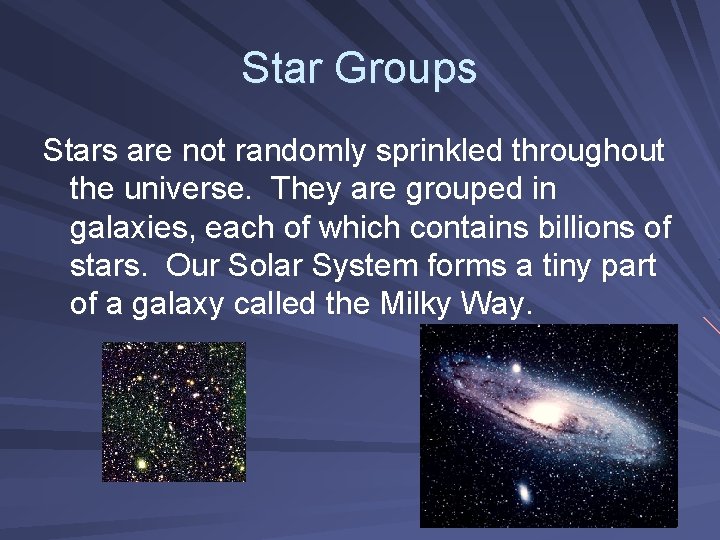
Star Groups Stars are not randomly sprinkled throughout the universe. They are grouped in galaxies, each of which contains billions of stars. Our Solar System forms a tiny part of a galaxy called the Milky Way.
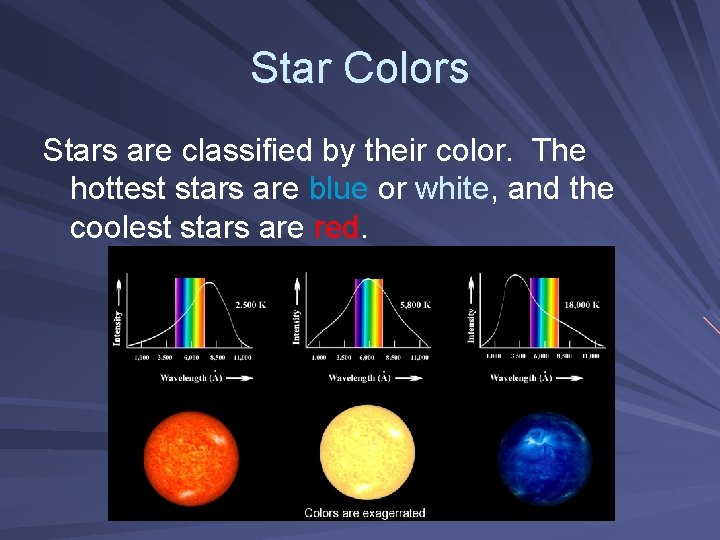
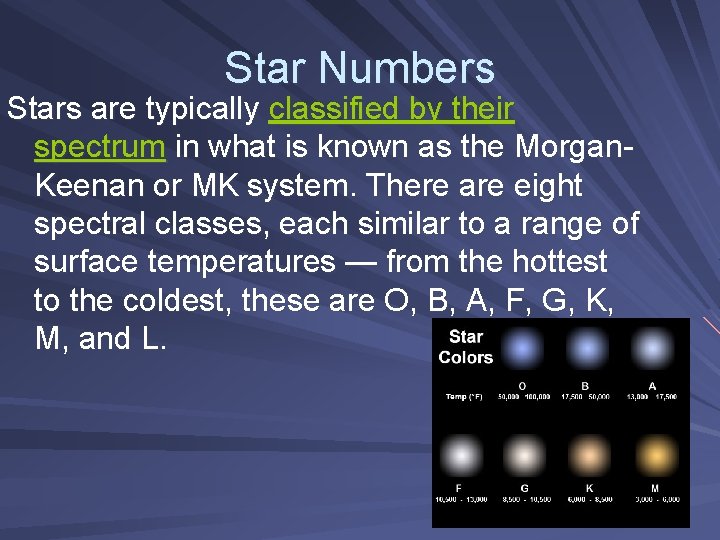
Star Colors Stars are classified by their color. The hottest stars are blue or white, and the coolest stars are red.
Star Numbers Stars are typically classified by their spectrum in what is known as the Morgan. Keenan or MK system. There are eight spectral classes, each similar to a range of surface temperatures — from the hottest to the coldest, these are O, B, A, F, G, K, M, and L.
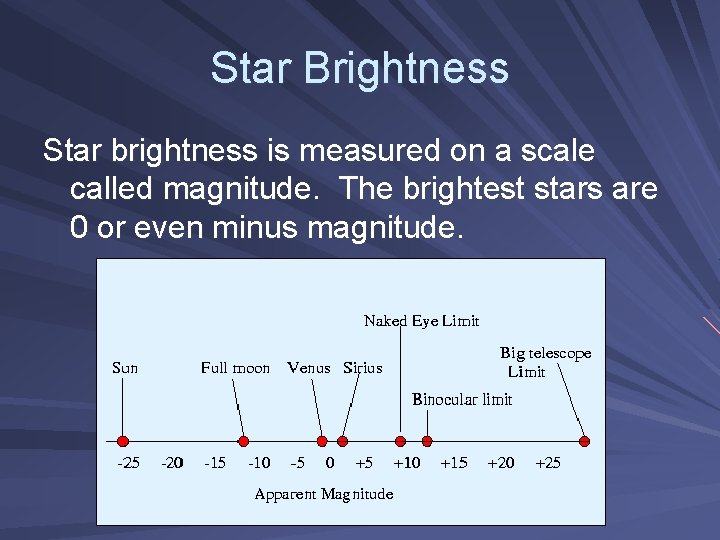
Star Brightness Star brightness is measured on a scale called magnitude. The brightest stars are 0 or even minus magnitude.
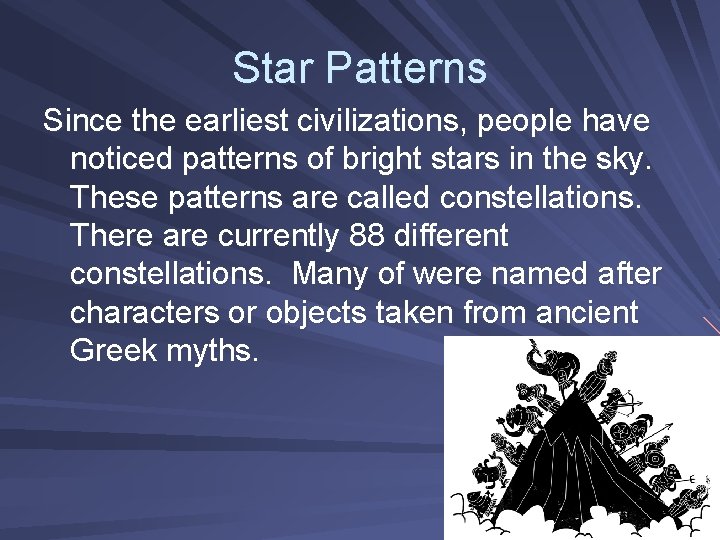
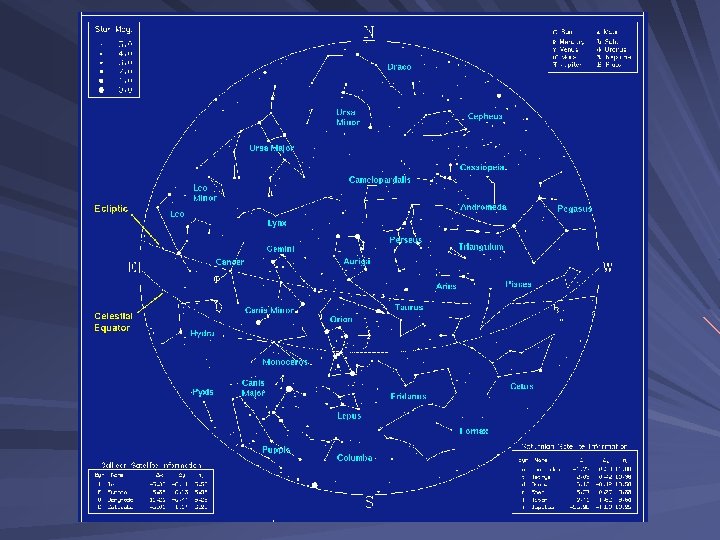
Star Patterns Since the earliest civilizations, people have noticed patterns of bright stars in the sky. These patterns are called constellations. There are currently 88 different constellations. Many of were named after characters or objects taken from ancient Greek myths.
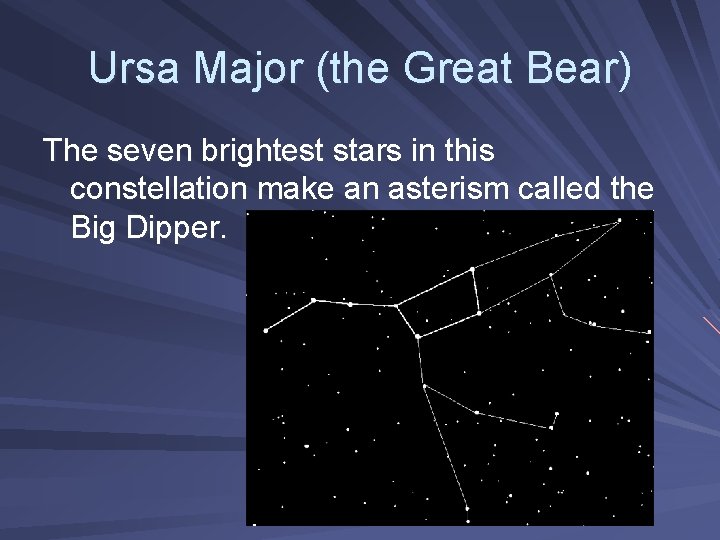
Ursa Major (the Great Bear) The seven brightest stars in this constellation make an asterism called the Big Dipper.
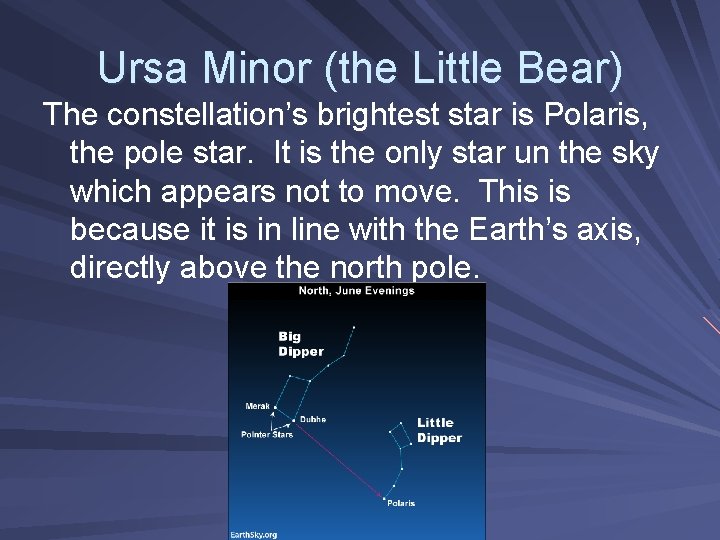
Ursa Minor (the Little Bear) The constellation’s brightest star is Polaris, the pole star. It is the only star un the sky which appears not to move. This is because it is in line with the Earth’s axis, directly above the north pole.
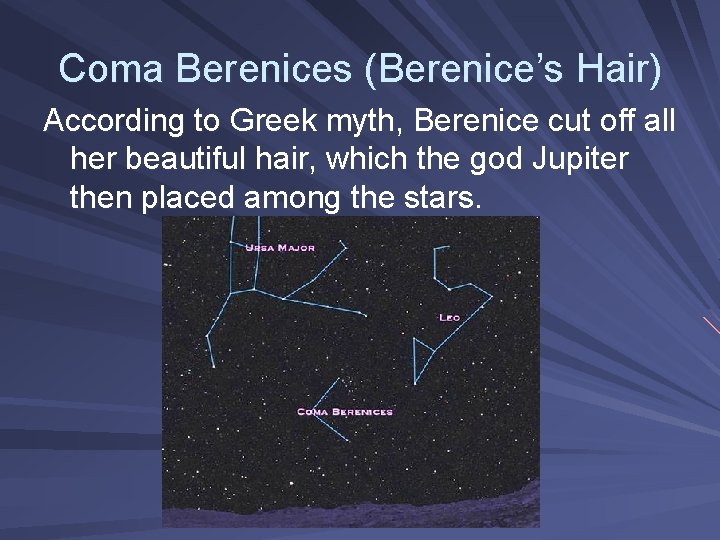
Coma Berenices (Berenice’s Hair) According to Greek myth, Berenice cut off all her beautiful hair, which the god Jupiter then placed among the stars.
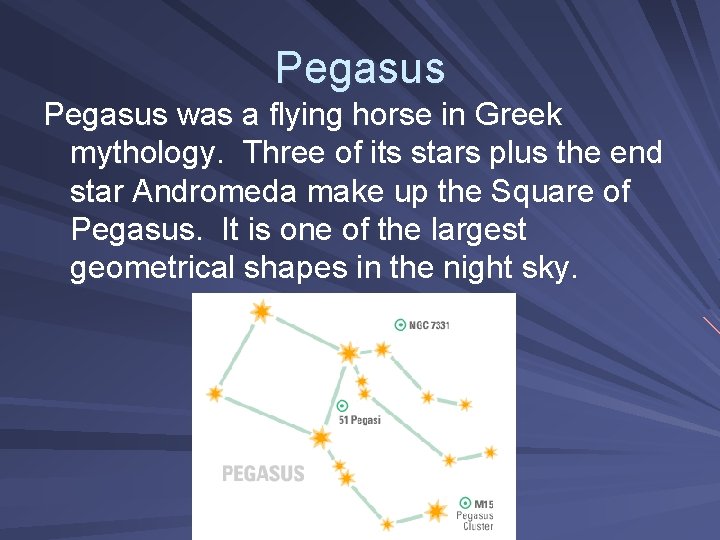
Pegasus was a flying horse in Greek mythology. Three of its stars plus the end star Andromeda make up the Square of Pegasus. It is one of the largest geometrical shapes in the night sky.
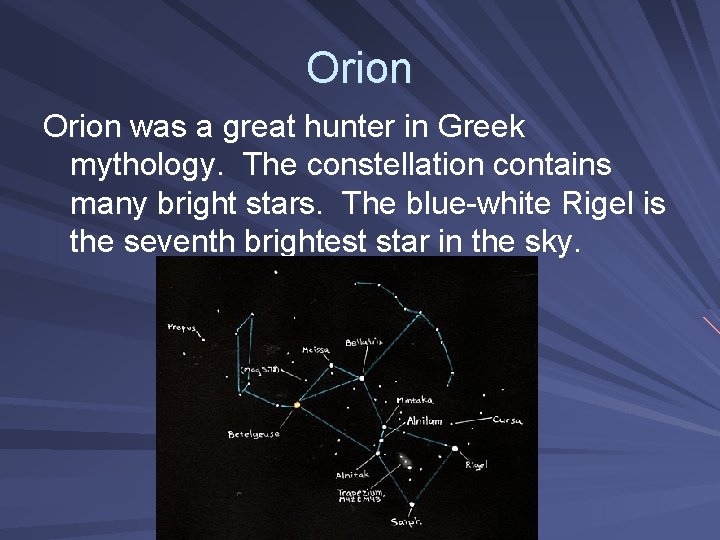
Orion was a great hunter in Greek mythology. The constellation contains many bright stars. The blue-white Rigel is the seventh brightest star in the sky.
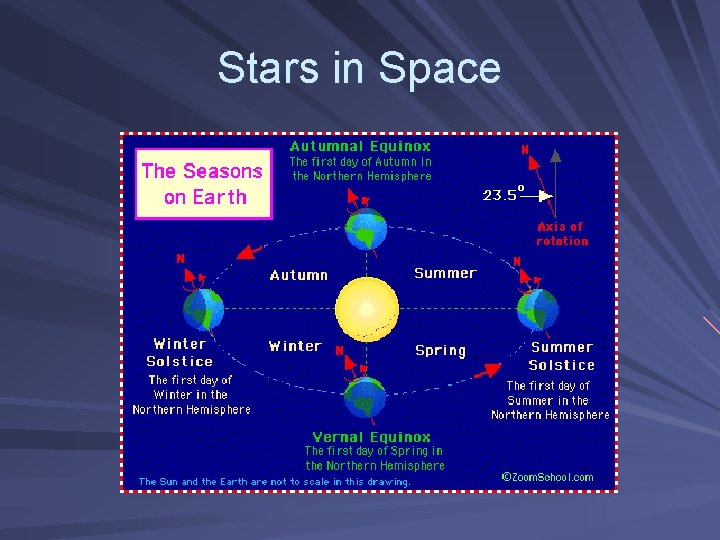
Stars in Space As well as appearing to move across the sky during the night, the stars also change so that you see some different ones each month. This happens because the Earth orbits the Sun, taking a year to make its long journey through space. During its orbit, the dark night side of Earth faces out towards different parts of space.
Stars in Space