
Stars Part One Brightness and Distance Concept 1
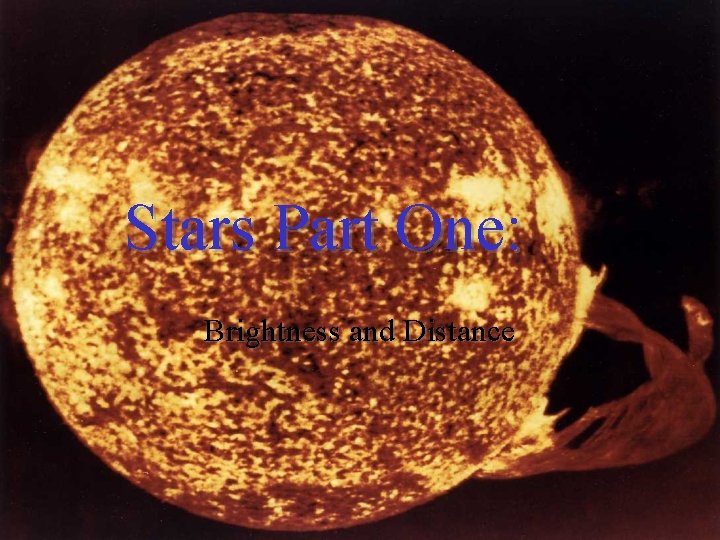
Stars Part One: Brightness and Distance
Concept -1 – Temperature λmax (metres) = 2. 90 x 10 -3 m k T (Kelvin) λmax = Peak black body wavelength T = The star’s surface temperature in Kelvins
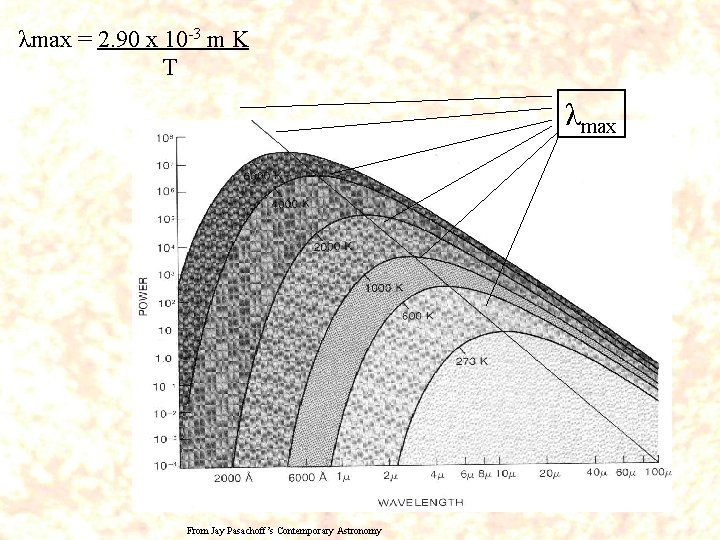
λmax = 2. 90 x 10 -3 m K T λmax From Jay Pasachoff’s Contemporary Astronomy
Put this in your notes: A star has a surface temperature of 5787 K, what is its λmax? λmax = (2. 90 x 10 -3 m K)/T = (2. 90 x 10 -3 m K)/5787 = 501 nm
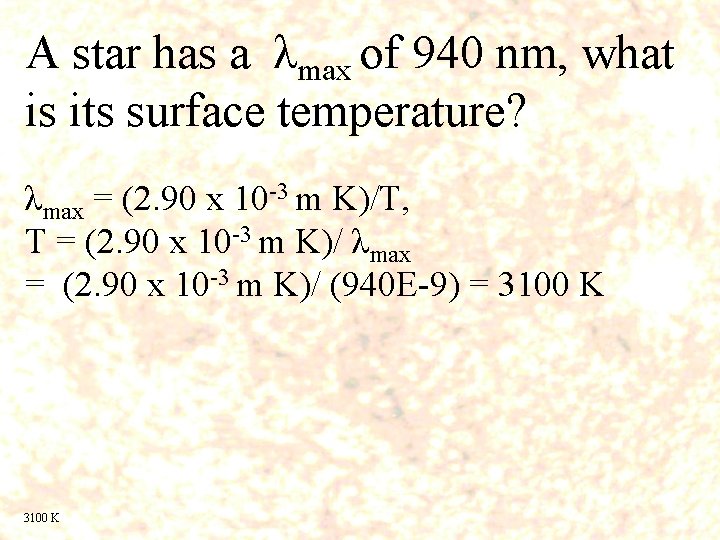
A star has a λmax of 940 nm, what is its surface temperature? λmax = (2. 90 x 10 -3 m K)/T, T = (2. 90 x 10 -3 m K)/ λmax = (2. 90 x 10 -3 m K)/ (940 E-9) = 3100 K
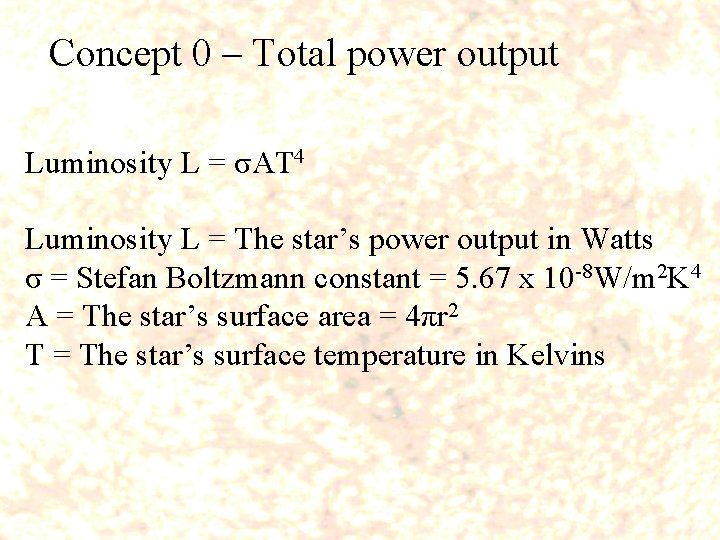
Concept 0 – Total power output Luminosity L = σAT 4 Luminosity L = The star’s power output in Watts σ = Stefan Boltzmann constant = 5. 67 x 10 -8 W/m 2 K 4 A = The star’s surface area = 4πr 2 T = The star’s surface temperature in Kelvins
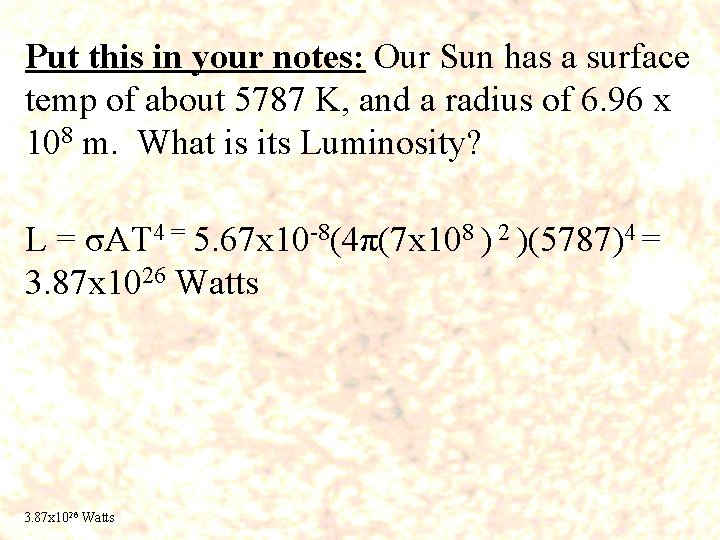
Put this in your notes: Our Sun has a surface temp of about 5787 K, and a radius of 6. 96 x 108 m. What is its Luminosity? L = σAT 4 = 5. 67 x 10 -8(4π(7 x 10⁸ ) 2 )(5787)4 = 3. 87 x 1026 Watts
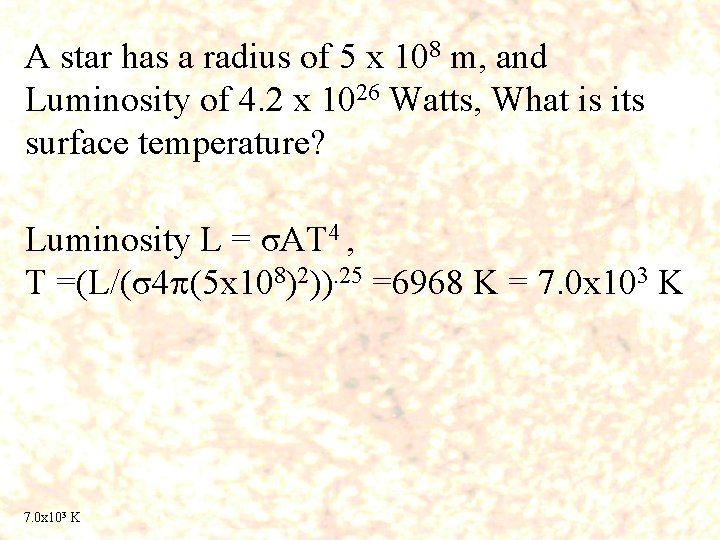
A star has a radius of 5 x 10⁸ m, and Luminosity of 4. 2 x 1026 Watts, What is its surface temperature? Luminosity L = σAT 4 , T =(L/(σ4 (5 x 10⁸)2)). 25 =6968 K = 7. 0 x 103 K
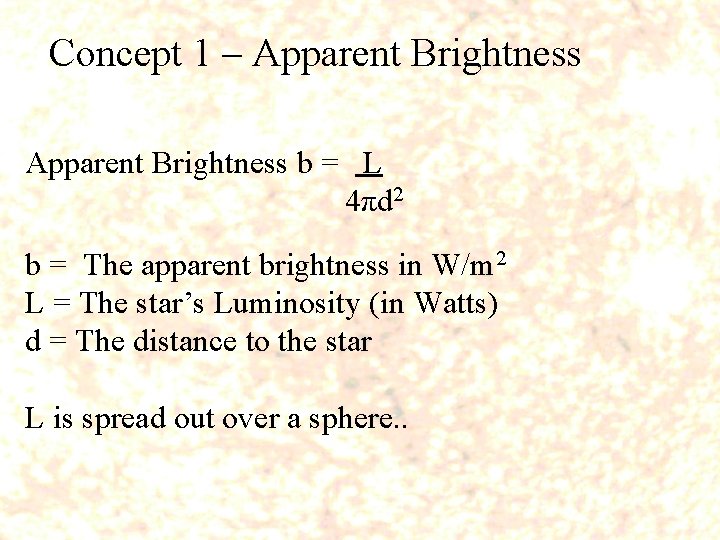
Concept 1 – Apparent Brightness b = L 4πd 2 b = The apparent brightness in W/m 2 L = The star’s Luminosity (in Watts) d = The distance to the star L is spread out over a sphere. .
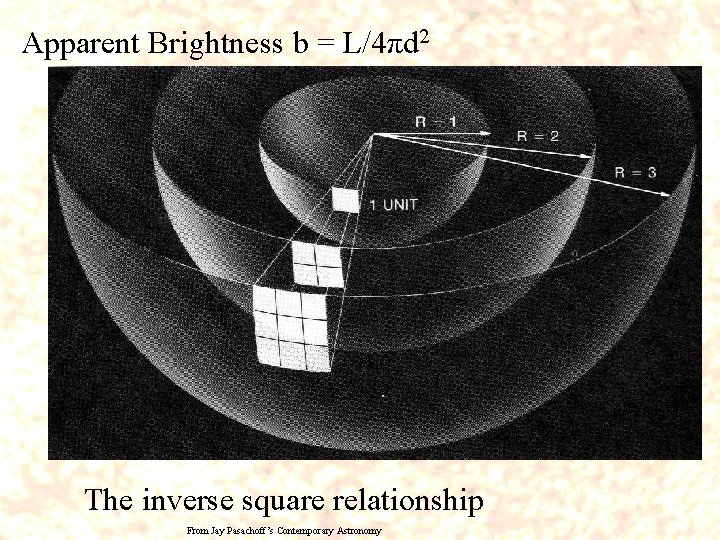
Apparent Brightness b = L/4πd 2 The inverse square relationship From Jay Pasachoff’s Contemporary Astronomy
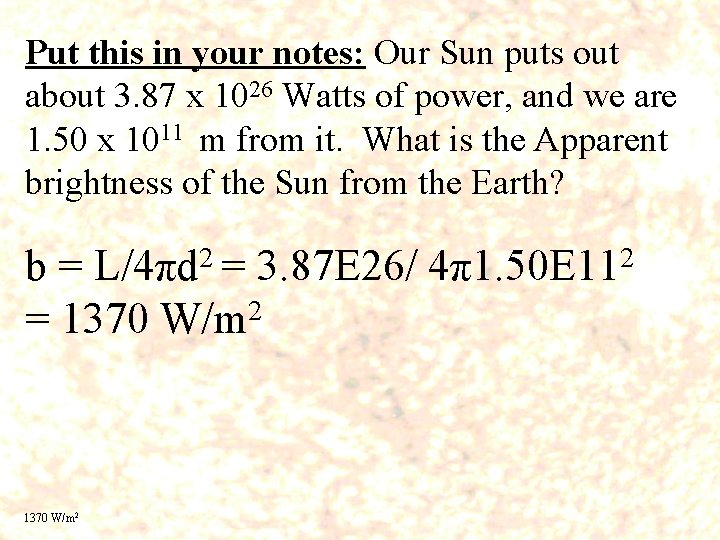
Put this in your notes: Our Sun puts out about 3. 87 x 1026 Watts of power, and we are 1. 50 x 1011 m from it. What is the Apparent brightness of the Sun from the Earth? 2 L/4πd = b= 3. 87 E 26/ 2 = 1370 W/m 2 2 4π1. 50 E 11
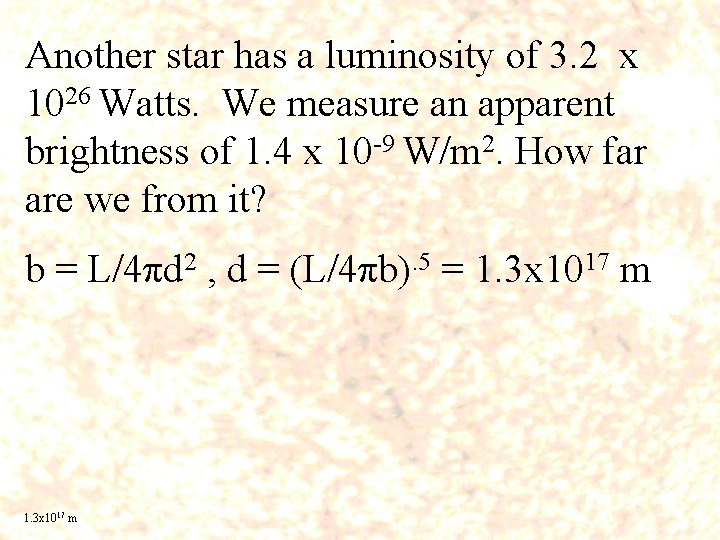
Another star has a luminosity of 3. 2 x 1026 Watts. We measure an apparent brightness of 1. 4 x 10 -9 W/m 2. How far are we from it? b = L/4πd 2 , d = (L/4πb). 5 = 1. 3 x 10¹⁷ m
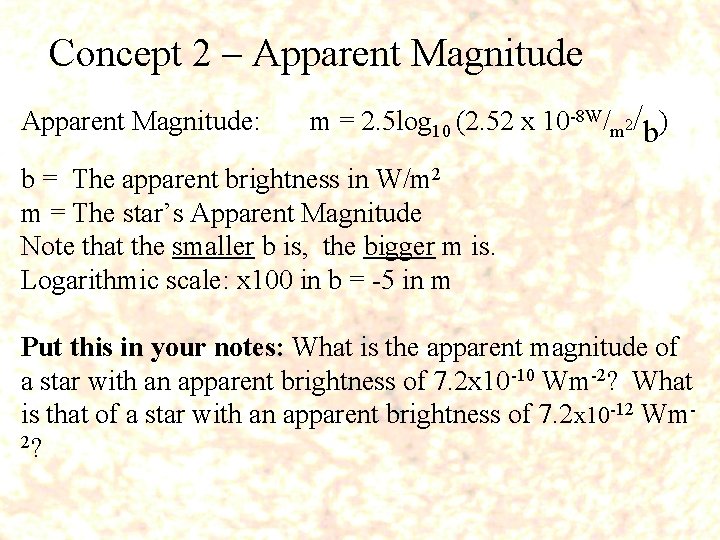
Concept 2 – Apparent Magnitude: m = 2. 5 log 10 (2. 52 x 10 -8 W/m 2/b) b = The apparent brightness in W/m 2 m = The star’s Apparent Magnitude Note that the smaller b is, the bigger m is. Logarithmic scale: x 100 in b = -5 in m Put this in your notes: What is the apparent magnitude of a star with an apparent brightness of 7. 2 x 10 -10 Wm-2? What is that of a star with an apparent brightness of 7. 2 x 10 -12 Wm 2?
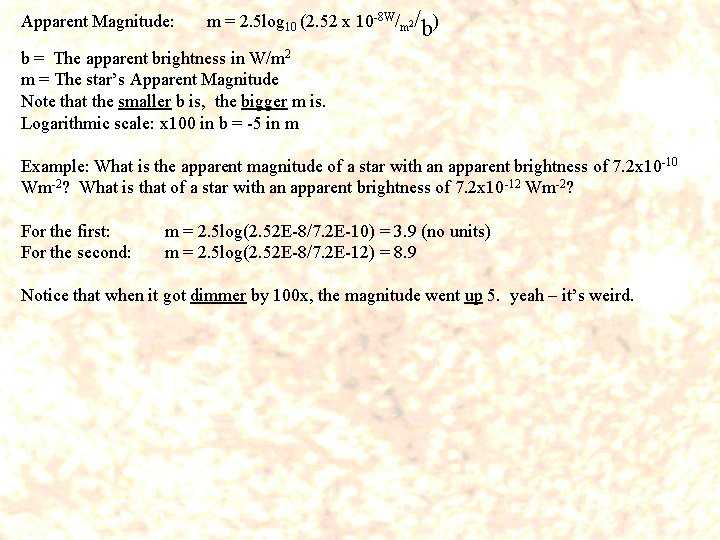
Apparent Magnitude: m = 2. 5 log 10 (2. 52 x 10 -8 W/m 2/ ) b b = The apparent brightness in W/m 2 m = The star’s Apparent Magnitude Note that the smaller b is, the bigger m is. Logarithmic scale: x 100 in b = -5 in m Example: What is the apparent magnitude of a star with an apparent brightness of 7. 2 x 10 -10 Wm-2? What is that of a star with an apparent brightness of 7. 2 x 10 -12 Wm-2? For the first: For the second: m = 2. 5 log(2. 52 E-8/7. 2 E-10) = 3. 9 (no units) m = 2. 5 log(2. 52 E-8/7. 2 E-12) = 8. 9 Notice that when it got dimmer by 100 x, the magnitude went up 5. yeah – it’s weird.
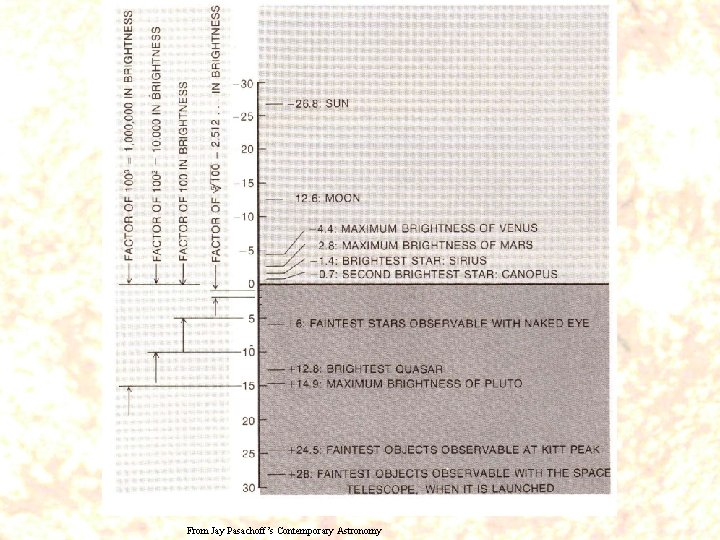
From Jay Pasachoff’s Contemporary Astronomy
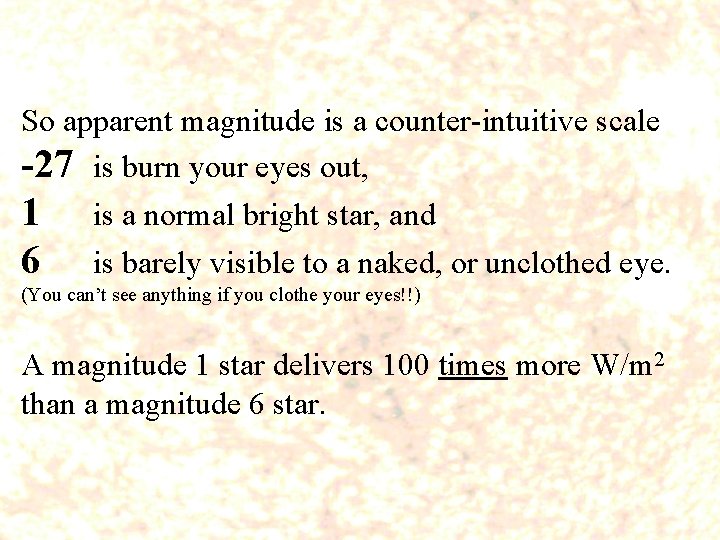
So apparent magnitude is a counter-intuitive scale -27 is burn your eyes out, 1 is a normal bright star, and 6 is barely visible to a naked, or unclothed eye. (You can’t see anything if you clothe your eyes!!) A magnitude 1 star delivers 100 times more W/m 2 than a magnitude 6 star.
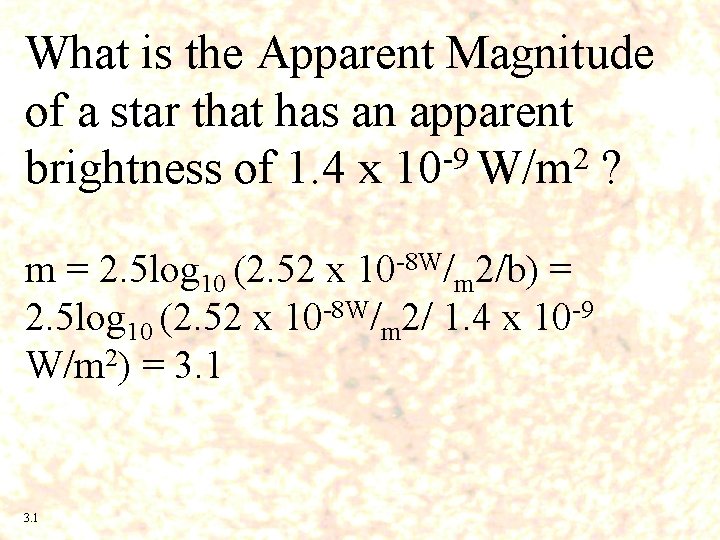
What is the Apparent Magnitude of a star that has an apparent brightness of 1. 4 x 10 -9 W/m 2 ? m = 2. 5 log 10 (2. 52 x 10 -8 W/m 2/b) = 2. 5 log 10 (2. 52 x 10 -8 W/m 2/ 1. 4 x 10 -9 W/m 2) = 3. 1
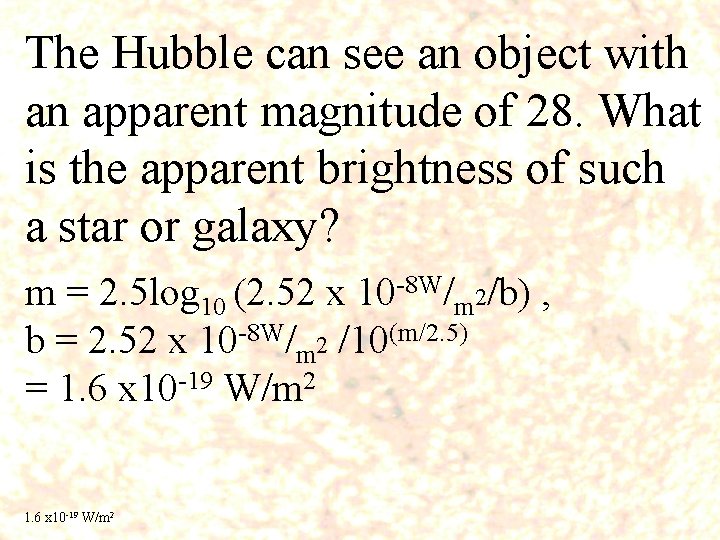
The Hubble can see an object with an apparent magnitude of 28. What is the apparent brightness of such a star or galaxy? m = 2. 5 log 10 (2. 52 x 10 -8 W/m 2/b) , b = 2. 52 x 10 -8 W/m 2 /10(m/2. 5) = 1. 6 x 10 -19 W/m 2
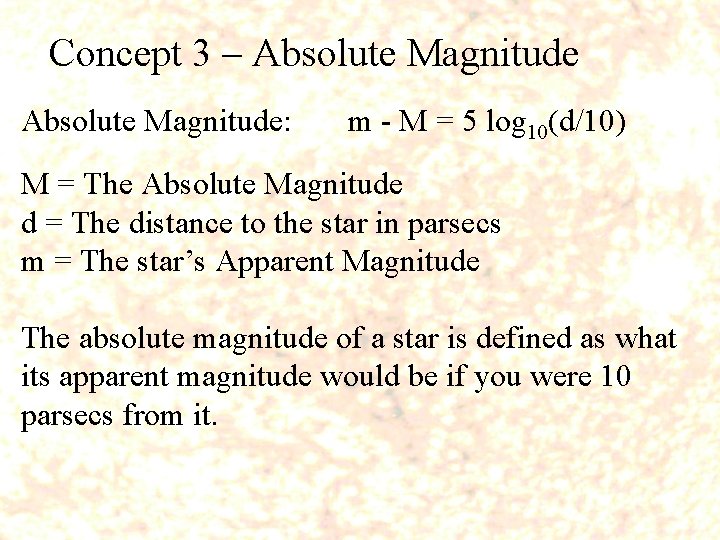
Concept 3 – Absolute Magnitude: m - M = 5 log 10(d/10) M = The Absolute Magnitude d = The distance to the star in parsecs m = The star’s Apparent Magnitude The absolute magnitude of a star is defined as what its apparent magnitude would be if you were 10 parsecs from it.
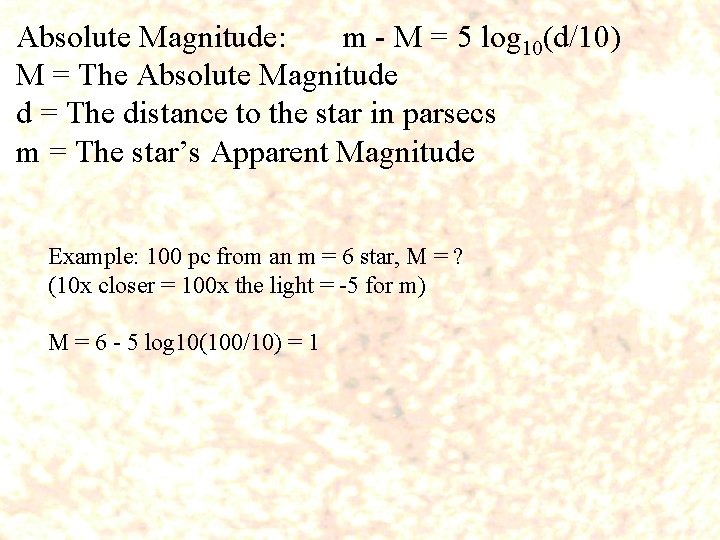
Absolute Magnitude: m - M = 5 log 10(d/10) M = The Absolute Magnitude d = The distance to the star in parsecs m = The star’s Apparent Magnitude Example: 100 pc from an m = 6 star, M = ? (10 x closer = 100 x the light = -5 for m) M = 6 - 5 log 10(100/10) = 1
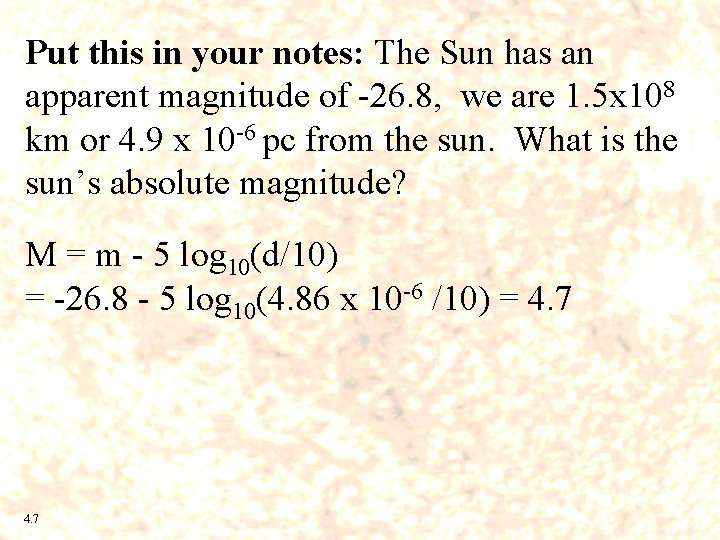
Put this in your notes: The Sun has an apparent magnitude of -26. 8, we are 1. 5 x 10⁸ km or 4. 9 x 10 -6 pc from the sun. What is the sun’s absolute magnitude? M = m - 5 log 10(d/10) = -26. 8 - 5 log 10(4. 86 x 10 -6 /10) = 4. 7
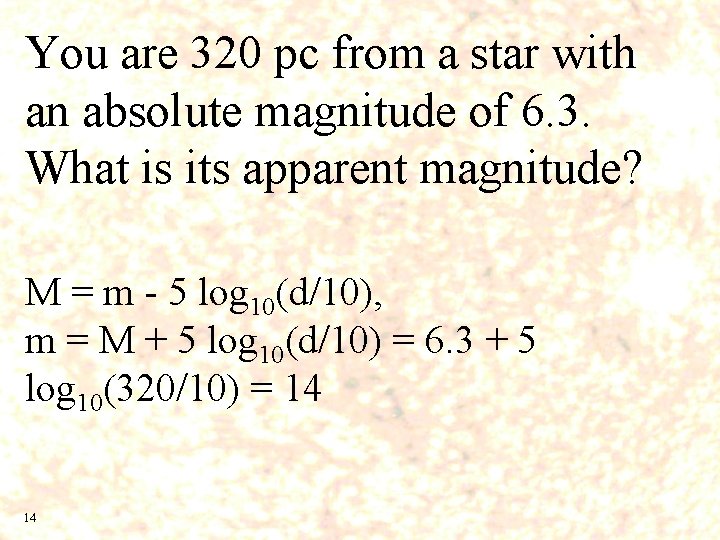
You are 320 pc from a star with an absolute magnitude of 6. 3. What is its apparent magnitude? M = m - 5 log 10(d/10), m = M + 5 log 10(d/10) = 6. 3 + 5 log 10(320/10) = 14 14
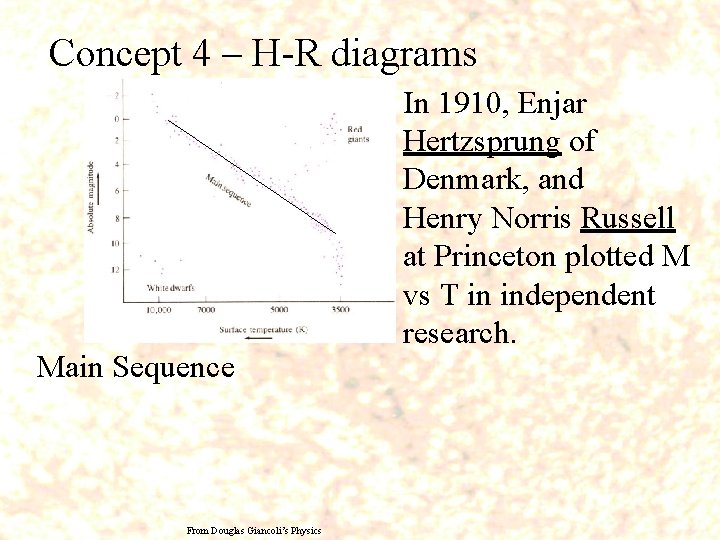
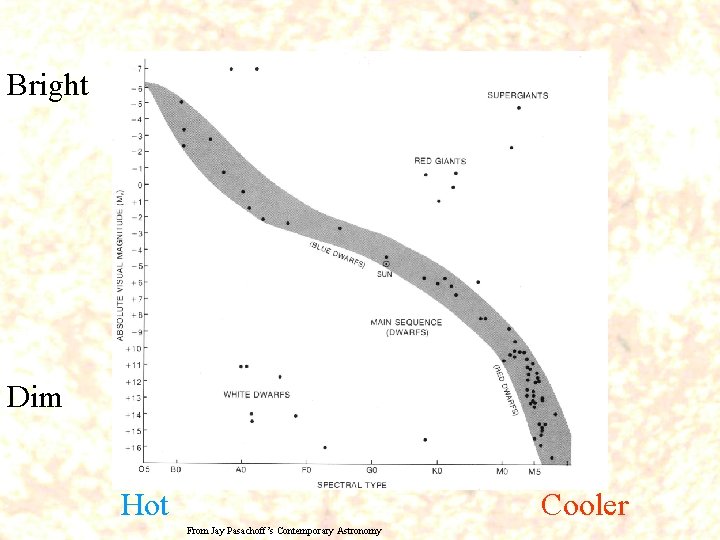
Concept 4 – H-R diagrams Main Sequence From Douglas Giancoli’s Physics In 1910, Enjar Hertzsprung of Denmark, and Henry Norris Russell at Princeton plotted M vs T in independent research.
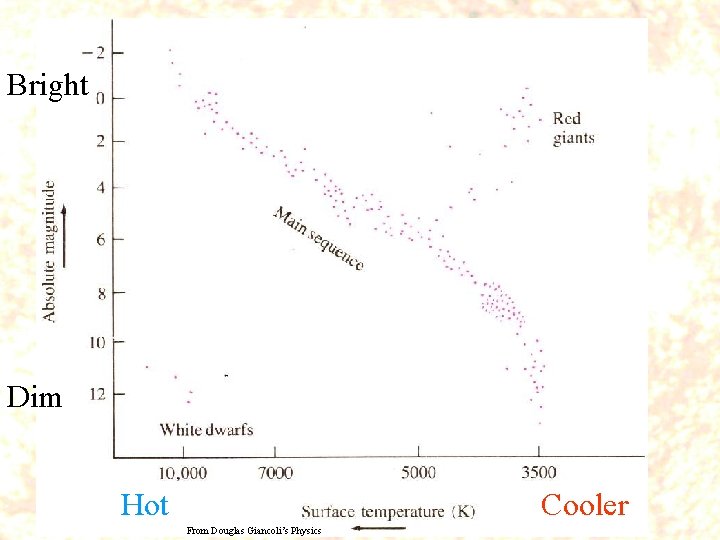
Bright Dim Hot Cooler From Douglas Giancoli’s Physics
Bright Dim Hot Cooler From Jay Pasachoff’s Contemporary Astronomy
O B A F G K M Oh (Hot) be a fine girl, kiss me! (Cooler)
The atmosphere The Star Light from star is filtered by atmosphere
From Jay Pasachoff’s Contemporary Astronomy
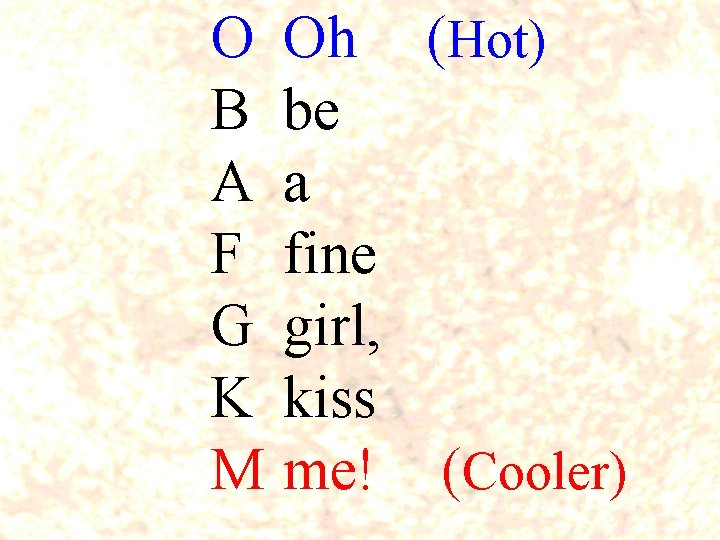
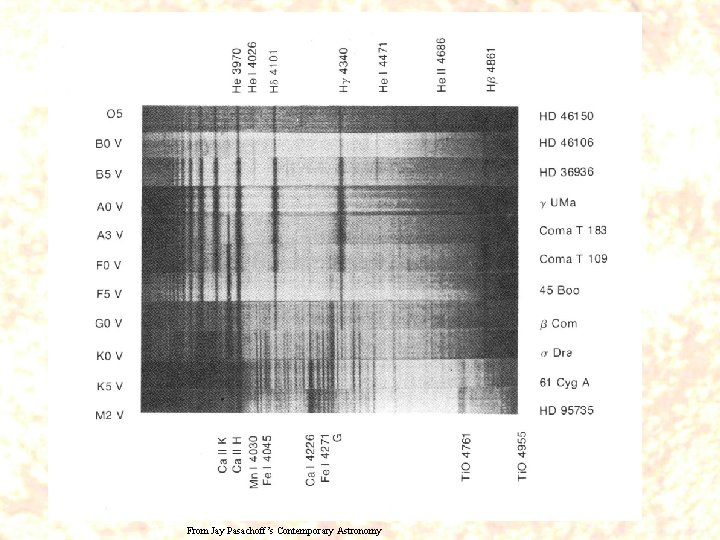
Spectral types: O - 30, 000 - 60, 000 K, ionized H, weak H lines, spectral lines are spread out. O types are rare and gigantic. BAFGKM-
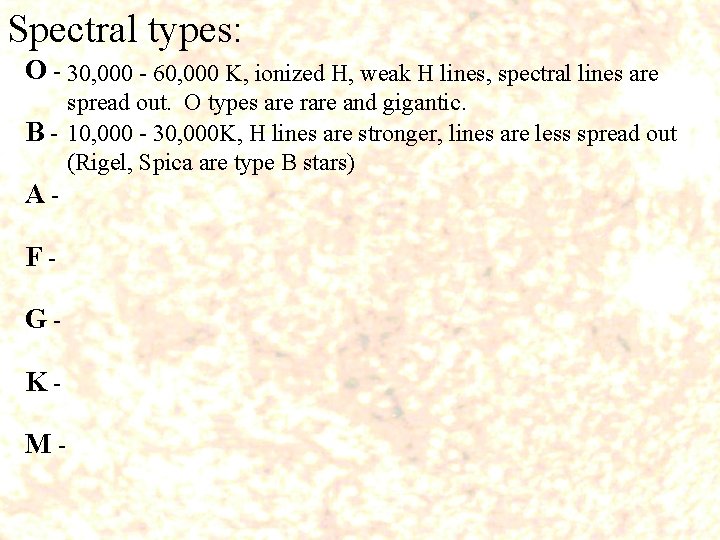
Spectral types: O - 30, 000 - 60, 000 K, ionized H, weak H lines, spectral lines are spread out. O types are rare and gigantic. B - 10, 000 - 30, 000 K, H lines are stronger, lines are less spread out (Rigel, Spica are type B stars) A- FGKM-
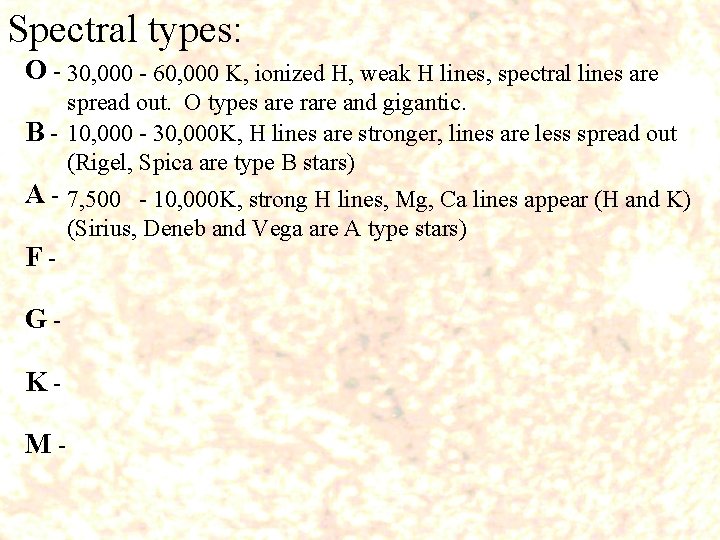
Spectral types: O - 30, 000 - 60, 000 K, ionized H, weak H lines, spectral lines are spread out. O types are rare and gigantic. B - 10, 000 - 30, 000 K, H lines are stronger, lines are less spread out (Rigel, Spica are type B stars) A - 7, 500 - 10, 000 K, strong H lines, Mg, Ca lines appear (H and K) (Sirius, Deneb and Vega are A type stars) F- GKM-
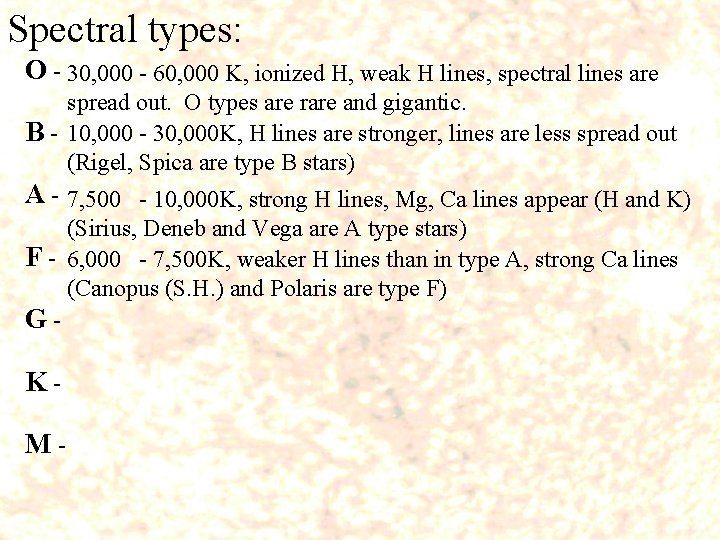
Spectral types: O - 30, 000 - 60, 000 K, ionized H, weak H lines, spectral lines are spread out. O types are rare and gigantic. B - 10, 000 - 30, 000 K, H lines are stronger, lines are less spread out (Rigel, Spica are type B stars) A - 7, 500 - 10, 000 K, strong H lines, Mg, Ca lines appear (H and K) (Sirius, Deneb and Vega are A type stars) F - 6, 000 - 7, 500 K, weaker H lines than in type A, strong Ca lines (Canopus (S. H. ) and Polaris are type F) G- KM-
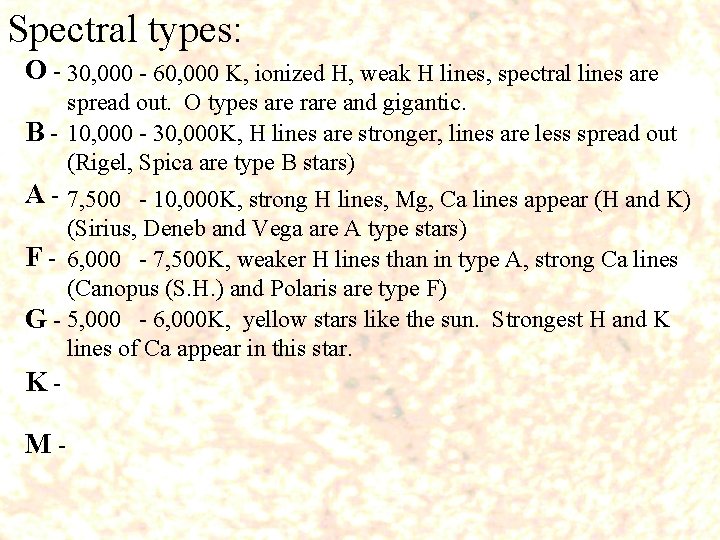
Spectral types: O - 30, 000 - 60, 000 K, ionized H, weak H lines, spectral lines are spread out. O types are rare and gigantic. B - 10, 000 - 30, 000 K, H lines are stronger, lines are less spread out (Rigel, Spica are type B stars) A - 7, 500 - 10, 000 K, strong H lines, Mg, Ca lines appear (H and K) (Sirius, Deneb and Vega are A type stars) F - 6, 000 - 7, 500 K, weaker H lines than in type A, strong Ca lines (Canopus (S. H. ) and Polaris are type F) G - 5, 000 - 6, 000 K, yellow stars like the sun. Strongest H and K lines of Ca appear in this star. K- M-
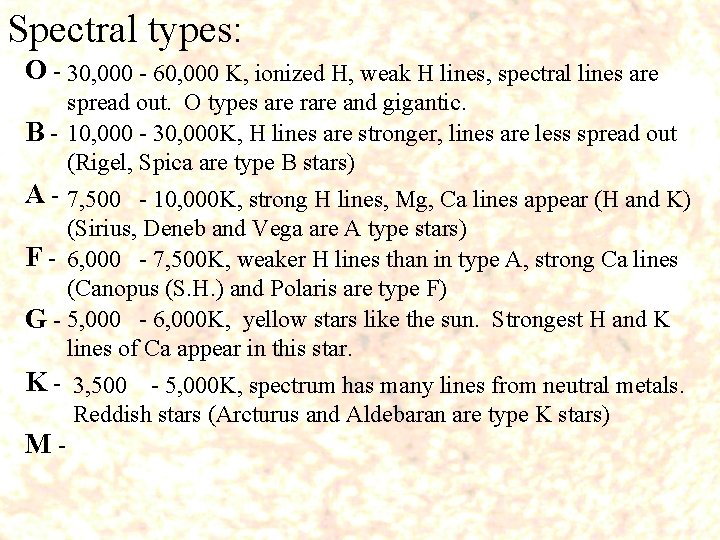
Spectral types: O - 30, 000 - 60, 000 K, ionized H, weak H lines, spectral lines are spread out. O types are rare and gigantic. B - 10, 000 - 30, 000 K, H lines are stronger, lines are less spread out (Rigel, Spica are type B stars) A - 7, 500 - 10, 000 K, strong H lines, Mg, Ca lines appear (H and K) (Sirius, Deneb and Vega are A type stars) F - 6, 000 - 7, 500 K, weaker H lines than in type A, strong Ca lines (Canopus (S. H. ) and Polaris are type F) G - 5, 000 - 6, 000 K, yellow stars like the sun. Strongest H and K lines of Ca appear in this star. K - 3, 500 - 5, 000 K, spectrum has many lines from neutral metals. Reddish stars (Arcturus and Aldebaran are type K stars) M-
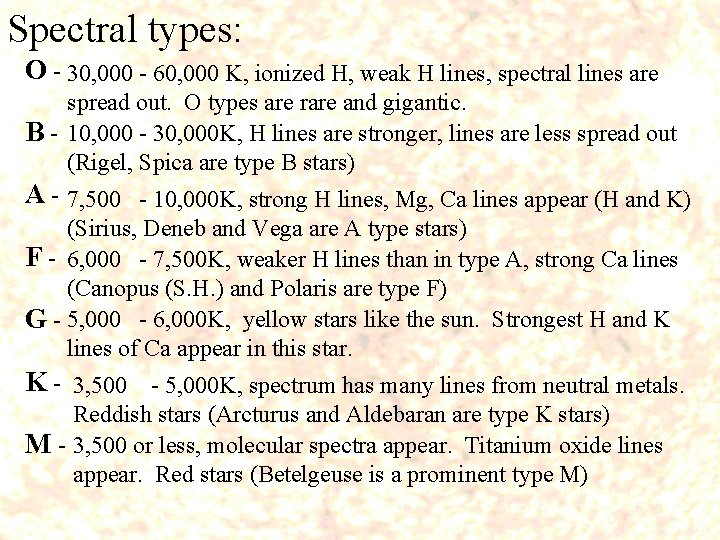
Spectral types: O - 30, 000 - 60, 000 K, ionized H, weak H lines, spectral lines are spread out. O types are rare and gigantic. B - 10, 000 - 30, 000 K, H lines are stronger, lines are less spread out (Rigel, Spica are type B stars) A - 7, 500 - 10, 000 K, strong H lines, Mg, Ca lines appear (H and K) (Sirius, Deneb and Vega are A type stars) F - 6, 000 - 7, 500 K, weaker H lines than in type A, strong Ca lines (Canopus (S. H. ) and Polaris are type F) G - 5, 000 - 6, 000 K, yellow stars like the sun. Strongest H and K lines of Ca appear in this star. K - 3, 500 - 5, 000 K, spectrum has many lines from neutral metals. Reddish stars (Arcturus and Aldebaran are type K stars) M - 3, 500 or less, molecular spectra appear. Titanium oxide lines appear. Red stars (Betelgeuse is a prominent type M)
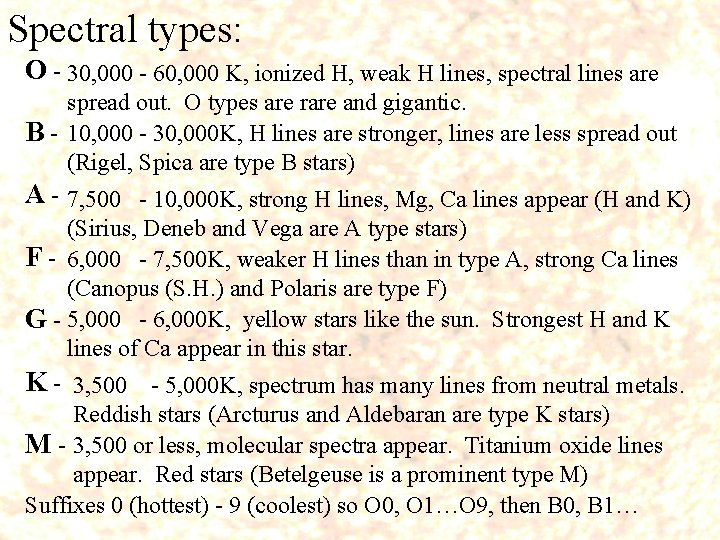
Spectral types: O - 30, 000 - 60, 000 K, ionized H, weak H lines, spectral lines are spread out. O types are rare and gigantic. B - 10, 000 - 30, 000 K, H lines are stronger, lines are less spread out (Rigel, Spica are type B stars) A - 7, 500 - 10, 000 K, strong H lines, Mg, Ca lines appear (H and K) (Sirius, Deneb and Vega are A type stars) F - 6, 000 - 7, 500 K, weaker H lines than in type A, strong Ca lines (Canopus (S. H. ) and Polaris are type F) G - 5, 000 - 6, 000 K, yellow stars like the sun. Strongest H and K lines of Ca appear in this star. K - 3, 500 - 5, 000 K, spectrum has many lines from neutral metals. Reddish stars (Arcturus and Aldebaran are type K stars) M - 3, 500 or less, molecular spectra appear. Titanium oxide lines appear. Red stars (Betelgeuse is a prominent type M) Suffixes 0 (hottest) - 9 (coolest) so O 0, O 1…O 9, then B 0, B 1…
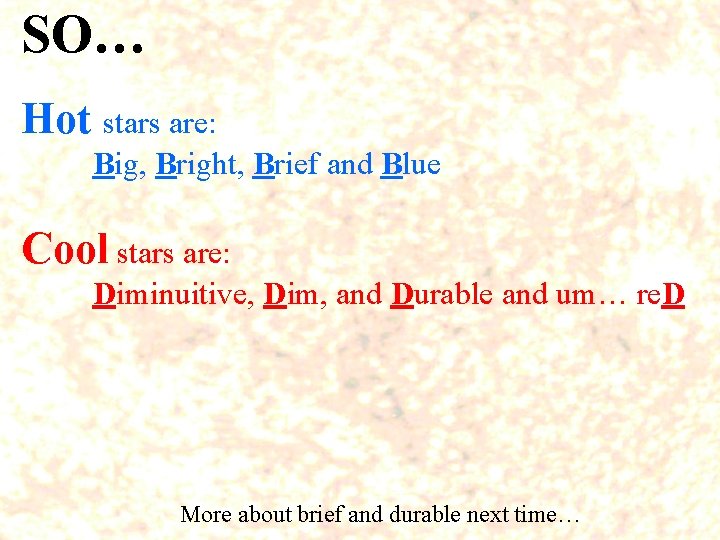
SO… Hot stars are: Big, Bright, Brief and Blue Cool stars are: Diminuitive, Dim, and Durable and um… re. D More about brief and durable next time…
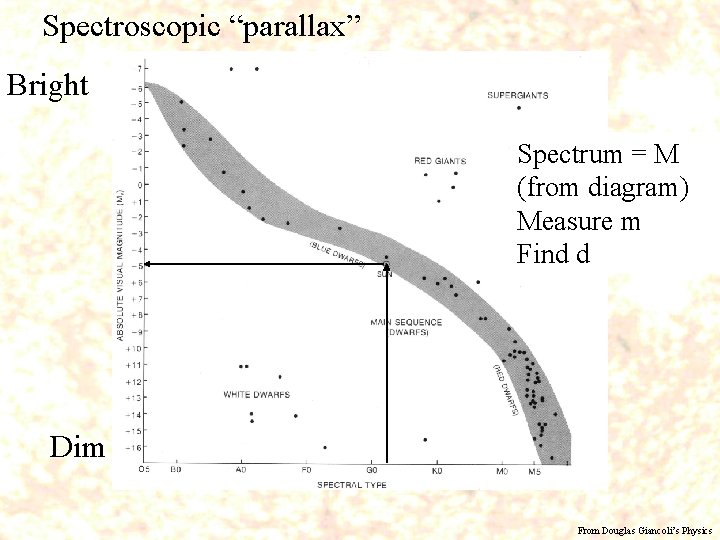
Spectroscopic “parallax” Bright Spectrum = M (from diagram) Measure m Find d Dim From Douglas Giancoli’s Physics
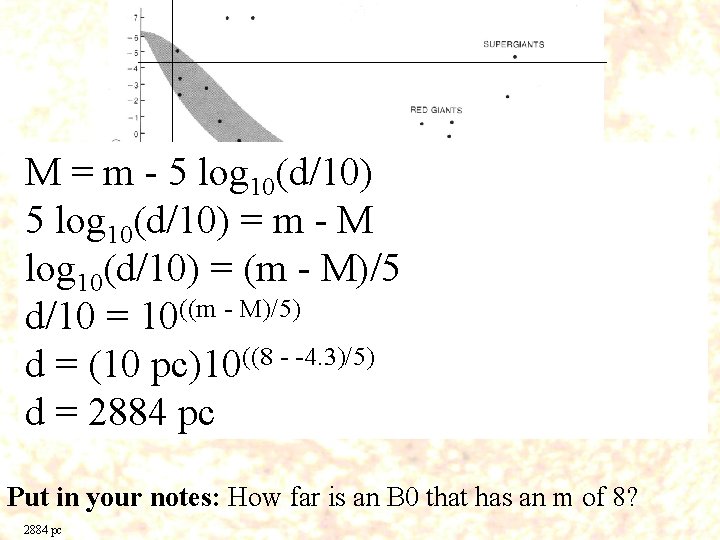
M = m - 5 log 10(d/10) = m - M log 10(d/10) = (m - M)/5 d/10 = 10((m - M)/5) d = (10 pc)10((8 - -4. 3)/5) d = 2884 pc Put in your notes: How far is an B 0 that has an m of 8? 2884 pc
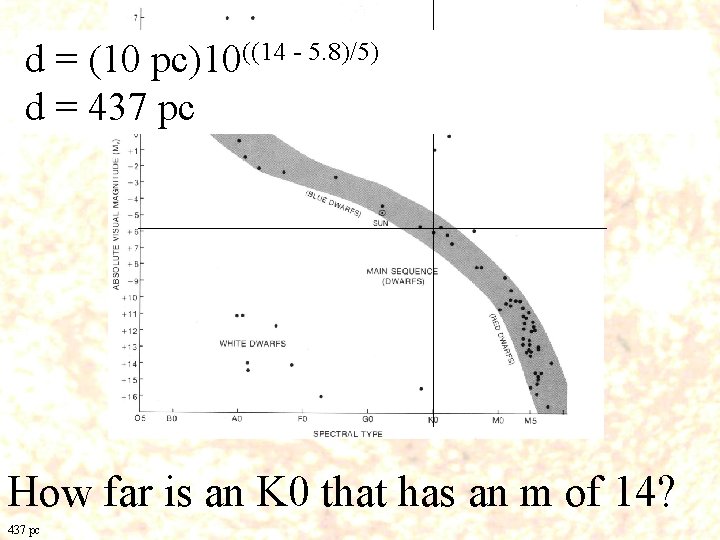
d = (10 pc)10((14 - 5. 8)/5) d = 437 pc How far is an K 0 that has an m of 14? 437 pc
Ok, now… Drool.
- Slides: 41