
Starbucks Crystal Hill Stephen Lechtenberg Anand Mc Gee
Starbucks Crystal Hill Stephen Lechtenberg Anand Mc. Gee Allison Purtell Jason Torres
Industry Overview � Highest imported product in world, second to oil � U. S. Coffee Industry � 20, 000 stores, $11 Billion profit � Top 50 companies, 70% of profit � Secure prime locations, drive store traffic, deliver high quality products
Business and Economic Factors � Business Characteristics � Expansion, � franchising and licensing, store traffic Economic Characteristics � Coffee beans, futures contracts
Forces for Driving Change � Environmental concerns � Sustainable coffee � Organic coffee, fair trade, and shade grown coffee � Customer’s desire for information � “Green” coffee
Competitive Forces � Threat of New Entrants � Low � startup costs, strong first mover advantage Rivalry Among Existing Firms � Highly � Threat of Substitute Products � Low � concentrated, highly competitive customer switching costs, differentiation Bargaining Power of Customers � Millions � of coffee consumers worldwide, little power Bargaining Power of Suppliers � Firms hold power, suppliers compete against eachother
Competitive Positions � Starbucks � First mover advantage (Blue Ocean) � Differentiation � Mc. Donalds � Mc. Cafe � division Dunkin Donuts � Starbucks � Nestle biggest competitor
Competitive Moves � Innovation � Contribute � more capital to R&D Expansion � Starbucks, 700 new stores in 2009 � Mc. Donalds, 1, 000 new stores in 2009 � Dunkin Donuts, 100 stores in Taiwan by 2017 � Product Differentiation
Key Success Factors � Starbucks: � Continue disciplined expansion Product differentiation � Mc. Donald’s: � Most � products for your dollar Nestle: � Unmatched � product and brand portfolio Dunkin’ Donuts: � Innovation
Attractiveness of Coffee Industry � � Coffee beans are 2 nd largest export Large companies make up 70% of industry � Must secure prime locations, manage and increase store traffic, and sell high quality products � � Companies must expand in order to succeed Competition on price Relationships with coffee producers is key Overall attractive industry � Starbucks saw $1, 000 profit per store in 2008 � Typical coffee shop saw $500, 000 profit per store
Marketing Efforts � � � Recognition in Hollywood Loyal customers Rewards programs � My � � Starbucks Rewards card Facebook Competition
Financial outcomes � Consolidated Company revenue � $2. 5 Billion in 2008 � $2. 4 Billion in 2009 Due to strengthening U. S. dollar And fewer stores being opened in ’ 09 High costs in closing 800 stores � Current stock price of $21. 59 � Forecasted to increase in December
Pricing � First price reduction in August 2009 � Due to 6% decrease in sales On standard drinks by 5 -15 cents �To attract non-loyal customers Specialty drinks increased �Was last raised in 2007 by 5 cents �Loyal customers won’t leave � Trying stores to cut down costs by being more efficient in
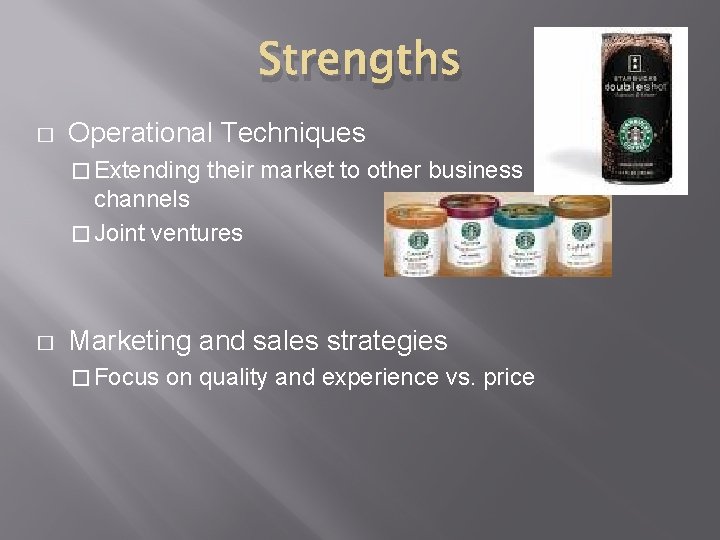
Strengths � Operational Techniques � Extending their market to other business channels � Joint ventures � Marketing and sales strategies � Focus on quality and experience vs. price
Strengths � Customer service � “Develop enthusiastically satisfied customers all of the time. ” � Wireless internet � Comment cards � Management techniques � Empowerment of employees � Every employee a “partner”
Core Competencies � Vertically Integrated � Placement � “…to become the most recognized and respected brand in the world”
Weaknesses � Lack of current new product development Slow to diversify into new markets � Pricing strategies � Current marketing strategies not meeting marketing objectives � Younger, less educated customers with lower economic status
Weaknesses � Market saturation has gotten in the way of products and services not meeting marketing characteristics � Low customer satisfaction � Speed of service � Inconsistency
Opportunities � Co-branding � International expansion � India � and Pacific “Going green” practices
Threats � Rising costs of coffee or dairy products � Copycat brands/Competition � Mc. Donalds � and Dunkin Donuts Declining coffee market � New beverage or pastime could evolve
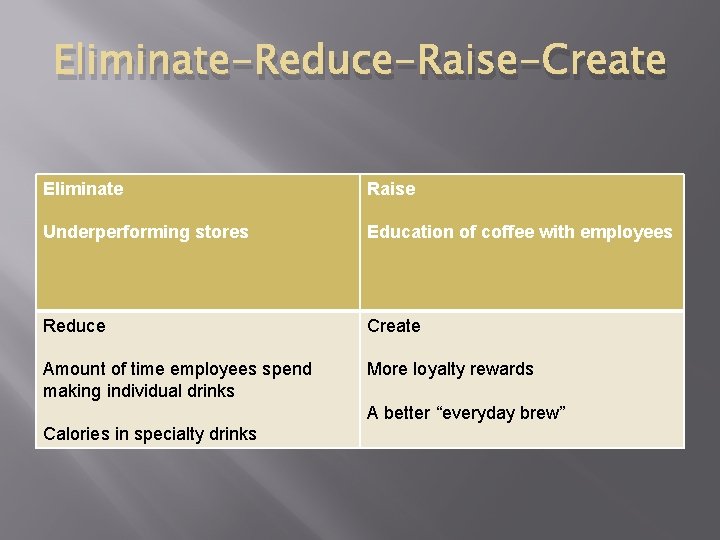
Eliminate-Reduce-Raise-Create Eliminate Raise Underperforming stores Education of coffee with employees Reduce Create Amount of time employees spend making individual drinks More loyalty rewards A better “everyday brew” Calories in specialty drinks
Competitive Strength � � � By keeping Focus on quality coffee and excellent customer service Easier to acquire quality suppliers Harder for competition to keep up
Valuable Assets and Resources � � Quality coffee Diversified menu, reaching across 3 tiers of customers Technology Employees
Starbucks’ Issues/Solutions Problem: Overexpansion Solutions: Transformation Agenda 1) Improving U. S. state 2) Re-igniting emotional attachment 3) Build for the long term 4) Expand around globe outside U. S.

- Slides: 24