
STAR Scheduler Gabriele Carcassi STAR Collaboration What is

STAR Scheduler Gabriele Carcassi STAR Collaboration
What is the STAR scheduler? • Resource Broker – receives job requests from the user and decides how to assign them to the resources available • Wrapper on evolving technologies – by and by that GRID middleware fit for STAR needs is available is integrated in the scheduler flexible architecture
Scheduler benefits • Enables the Distributed Disk framework – Data files are distributed on the local disk of each node of the farm – The job requiring a given files is dispatched where the file can be found • Interfacing with STAR file catalog – User specify job input through a metadata/catalog query (ex. Gold-Gold at 200 Ge. V, Fullfield, minbias, . . . ) – File catalog implementation is modular
Scheduler benefits • User interface: description and specification – Well defined user interface and job model – Abstract description allows us to embed in the scheduler the logic on how to use resources – Allows us to experiment and migrate to other tools with minimal impact for the user (for job submission) – Makes it clearer for other groups collaborating with us to understand our needs • Extensible architecture
Technologies used • Scheduler is written in Java • Job description language is an XML file • Current implementation uses – LSF for job submission – STAR catalog as the file catalog • Experimenting with Condor-g for GRID submission
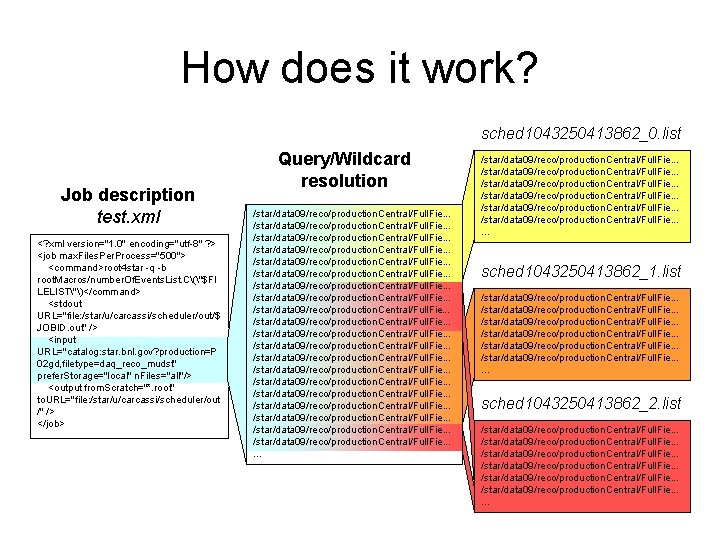
How does it work? sched 1043250413862_0. list Job description test. xml <? xml version="1. 0" encoding="utf-8" ? > <job max. Files. Per. Process="500"> <command>root 4 star -q -b root. Macros/number. Of. Events. List. C("$FI LELIST")</command> <stdout URL="file: /star/u/carcassi/scheduler/out/$ JOBID. out" /> <input URL="catalog: star. bnl. gov? production=P 02 gd, filetype=daq_reco_mudst" prefer. Storage="local" n. Files="all"/> <output from. Scratch="*. root" to. URL="file: /star/u/carcassi/scheduler/out /" /> </job> Query/Wildcard resolution /star/data 09/reco/production. Central/Full. Fie. . . /star/data 09/reco/production. Central/Full. Fie. . . /star/data 09/reco/production. Central/Full. Fie. . . sched 1043250413862_1. list /star/data 09/reco/production. Central/Full. Fie. . . sched 1043250413862_2. list /star/data 09/reco/production. Central/Full. Fie. . .
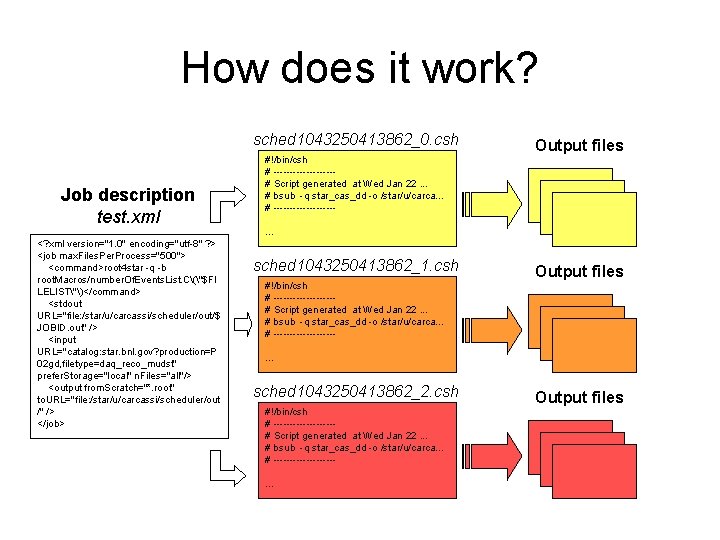
How does it work? sched 1043250413862_0. csh Job description test. xml <? xml version="1. 0" encoding="utf-8" ? > <job max. Files. Per. Process="500"> <command>root 4 star -q -b root. Macros/number. Of. Events. List. C("$FI LELIST")</command> <stdout URL="file: /star/u/carcassi/scheduler/out/$ JOBID. out" /> <input URL="catalog: star. bnl. gov? production=P 02 gd, filetype=daq_reco_mudst" prefer. Storage="local" n. Files="all"/> <output from. Scratch="*. root" to. URL="file: /star/u/carcassi/scheduler/out /" /> </job> #!/bin/csh # ---------# Script generated at Wed Jan 22. . . # bsub -q star_cas_dd -o /star/u/carca. . . # ---------- Output files . . . sched 1043250413862_1. csh #!/bin/csh # ---------# Script generated at Wed Jan 22. . . # bsub -q star_cas_dd -o /star/u/carca. . . # ---------- Output files . . . sched 1043250413862_2. csh #!/bin/csh # ---------# Script generated at Wed Jan 22. . . # bsub -q star_cas_dd -o /star/u/carca. . . # ---------. . . Output files
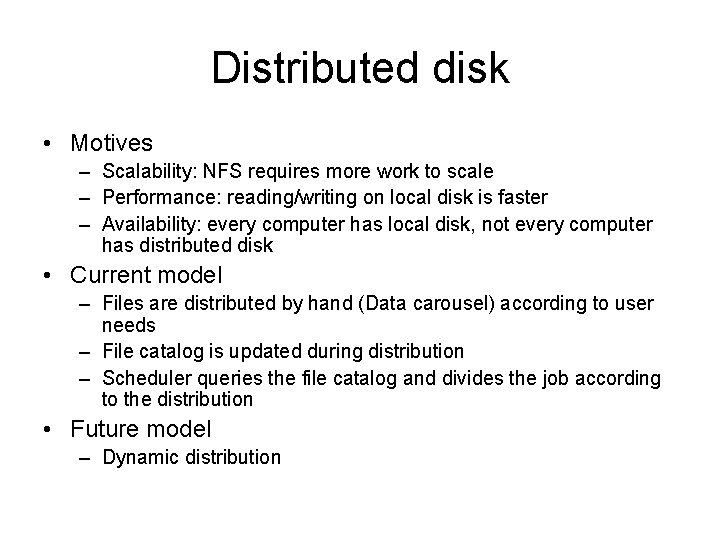
Distributed disk • Motives – Scalability: NFS requires more work to scale – Performance: reading/writing on local disk is faster – Availability: every computer has local disk, not every computer has distributed disk • Current model – Files are distributed by hand (Data carousel) according to user needs – File catalog is updated during distribution – Scheduler queries the file catalog and divides the job according to the distribution • Future model – Dynamic distribution
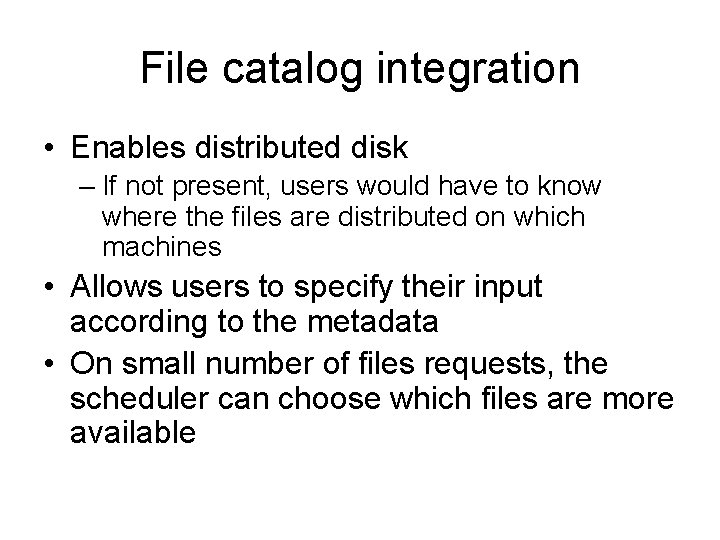
File catalog integration • Enables distributed disk – If not present, users would have to know where the files are distributed on which machines • Allows users to specify their input according to the metadata • On small number of files requests, the scheduler can choose which files are more available
File catalog integration • Implemented through an interface (pure abstract class – The query itself is an opaque string passed directly to the file catalog – Other tags tell the scheduler how to extract the desired group • single copy or all copies of the same files • prefer files on NFS or local disk • number of files requires
User Interface • Job description – an XML and it’s tag used to describe to the scheduler which command is to be dispatched and on which input files • Job specification – a set of simple rules that define how the user job is supposed to behave
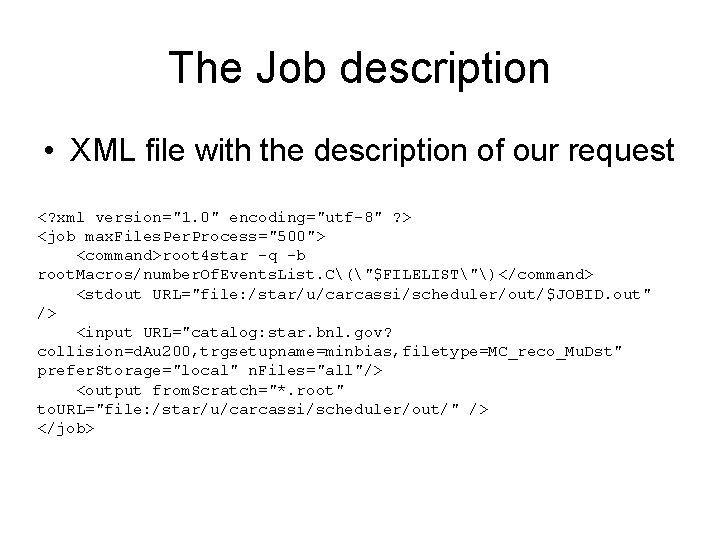
The Job description • XML file with the description of our request <? xml version="1. 0" encoding="utf-8" ? > <job max. Files. Per. Process="500"> <command>root 4 star -q -b root. Macros/number. Of. Events. List. C("$FILELIST")</command> <stdout URL="file: /star/u/carcassi/scheduler/out/$JOBID. out" /> <input URL="catalog: star. bnl. gov? collision=d. Au 200, trgsetupname=minbias, filetype=MC_reco_Mu. Dst" prefer. Storage="local" n. Files="all"/> <output from. Scratch="*. root" to. URL="file: /star/u/carcassi/scheduler/out/" /> </job>
Job specification • The scheduler prepares some environment variables to communicate the job its decision about job splitting – $FILELIST, $INPUTFILECOUNT and $INPUTFILExx contain information about the input files assigned to the job – $SCRATCH is a local directory available to the job to put it’s output for later retrieval
Job specification • The other main requirement is that the output of the different processes won’t clash one another – One can use $JOBID to create filenames that are unique for each process
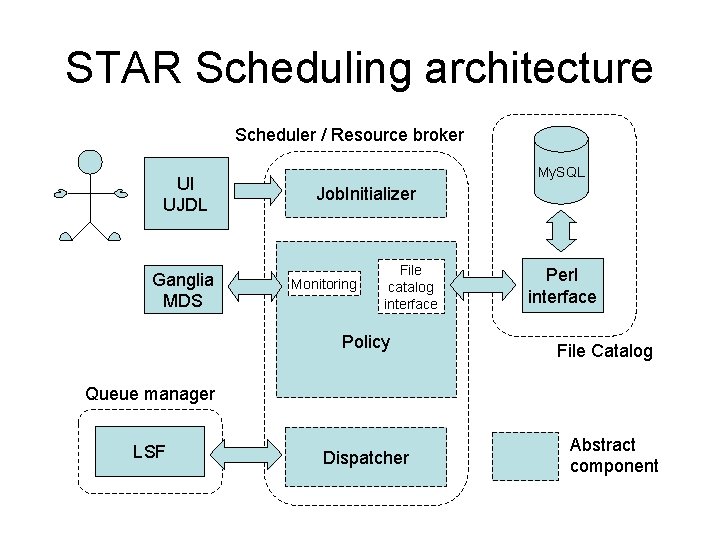
STAR Scheduling architecture Scheduler / Resource broker UI UJDL Ganglia MDS My. SQL Job. Initializer Monitoring File catalog interface Policy Perl interface File Catalog Queue manager LSF Dispatcher Abstract component
Job Initializer • Parses the xml job request • Checks the request to see if it is valid – Checks for elements outside specification (typically errors) – Checks for consistency (existence of input files on disk, . . . ) – Checks for requirements (require the output file, . . . ) • Creates the Java objects representing the request (Job. Request)
Job Initializer • Current implementation – Strict parser: any keyword outside the specification stops the process – Checks for the existence of the stdin file and the stdout directory – Forces the stdout to prevent side effects (such as LSF would accidentally send the output by mail)
Policy • The core of resource brokering: – From one request, creates a series of processes to fulfill that request – Processes are created according to farm administrator’s decisions – The policy may query the file catalog, the queues or other middleware to make an optimal decision (ex. MDS, Ganglia, . . . )
Policy • We anticipate a lot of the work in finding an optimal policy • Policy is easily changeable, to allow the administrator to change the behavior of the system
Policy • Current policy – Resolves the queries and the wildcards to form a single file list – Divide the list into several sub-lists, according to where the input files are located and the maximum number of files set per process – Creates one process for every file list.
Dispatcher • From the abstract process description, creates everything that is needed to dispatch the jobs – Talks to the underlying queue system – Takes care of creating the script that will be executed: csh based (widely supported) – Creates environment variables and the file list
Dispatcher • Current implementation: – creates file list and script in the directory where the job was submitted from – creates environment variables containing the job id, the list of files and all the files in the list, assigns a scratch directory. – creates a command line for LSF – submits job to LSF
Conclusion • The tool is available and working – In production since September 2002 and slowly acquiring acceptance (difficult to get people to try, but once they try it they like it) • Allows the use of local disks • Architecture is open to allow changes – Different policies – Catalog implementation (MAGDA, RLS, GDMP, . . . ? ) – Dispatcher implementation (Condor, Condor-g – Globus, . . . ) • We are preparing an implementation that uses Condor-g and allows us to dispatch jobs to the GRID
- Slides: 23