
STAR Light PDR 3 October 2001 STARLight SYSTEM
STAR Light PDR – 3 October 2001 STARLight SYSTEM REQUIREMENTS Roger De Roo 734 -647 -8779, deroo@umich. edu STARLight PDR 3 Oct ‘ 01 R De Roo System - Page D. 1
Outline STARLight Outline: • Science requirements & instrument concept • STAR and DSDR technologies, instrument configuration • Platform requirements (power/weight/balance) • Flowdown requirements • Noise Budget, sampling, interference rejection • Calibration STARLight PDR 3 Oct ‘ 01 R De Roo System - Page D. 2
STARLight Science Requirements STAR-Light Design Goals Measurement Objectives Soil Moisture Monitoring (L-band radiometer w/ 4 K accuracy) Land Surface Process Model Development (long term operation, plot scale ) Polar Operations (airborne access only) STARLight PDR 3 Oct ‘ 01 R De Roo System - Page D. 3
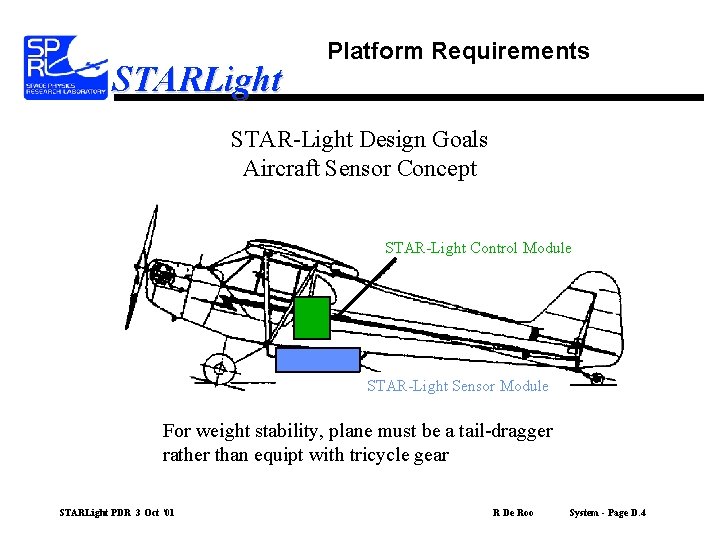
STARLight Platform Requirements STAR-Light Design Goals Aircraft Sensor Concept STAR-Light Control Module STAR-Light Sensor Module For weight stability, plane must be a tail-dragger rather than equipt with tricycle gear STARLight PDR 3 Oct ‘ 01 R De Roo System - Page D. 4
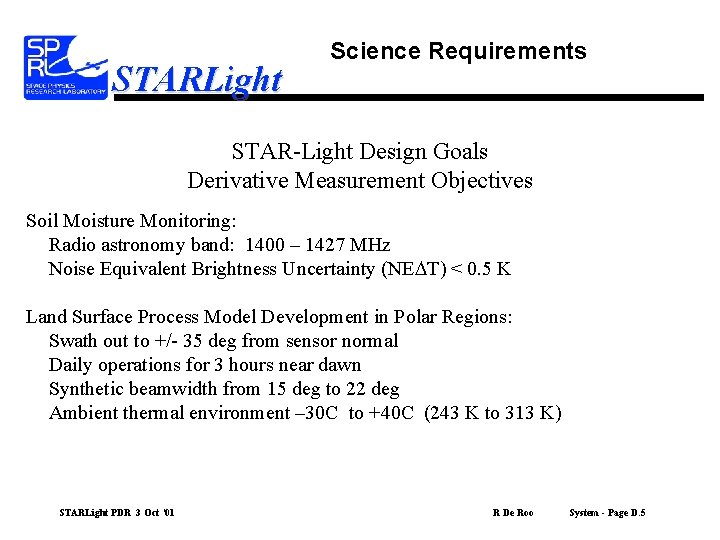
STARLight Science Requirements STAR-Light Design Goals Derivative Measurement Objectives Soil Moisture Monitoring: Radio astronomy band: 1400 – 1427 MHz Noise Equivalent Brightness Uncertainty (NEDT) < 0. 5 K Land Surface Process Model Development in Polar Regions: Swath out to +/- 35 deg from sensor normal Daily operations for 3 hours near dawn Synthetic beamwidth from 15 deg to 22 deg Ambient thermal environment – 30 C to +40 C (243 K to 313 K) STARLight PDR 3 Oct ‘ 01 R De Roo System - Page D. 5
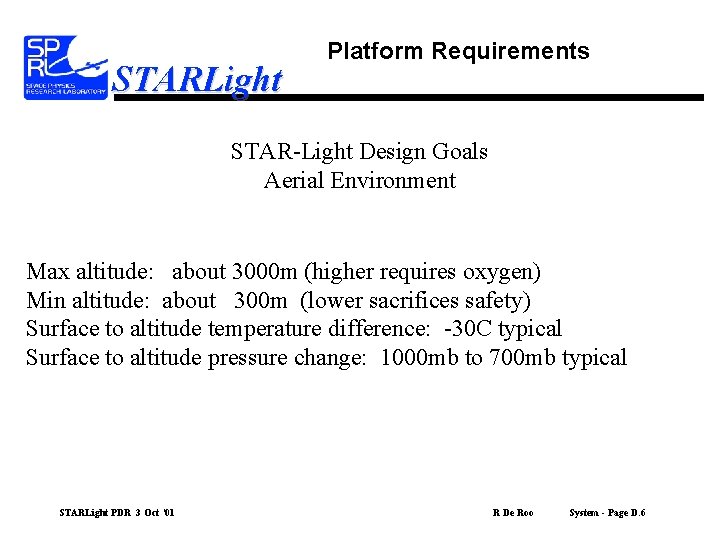
STARLight Platform Requirements STAR-Light Design Goals Aerial Environment Max altitude: about 3000 m (higher requires oxygen) Min altitude: about 300 m (lower sacrifices safety) Surface to altitude temperature difference: -30 C typical Surface to altitude pressure change: 1000 mb to 700 mb typical STARLight PDR 3 Oct ‘ 01 R De Roo System - Page D. 6

Sensor Concept: Configuration STARLight Mechanical arrangement on aircraft belly Cold Plate Analog Digital Antenna Receiver Radome Cross section Receiver assembly is a field-replaceable unit STARLight PDR 3 Oct ‘ 01 R De Roo System - Page D. 7
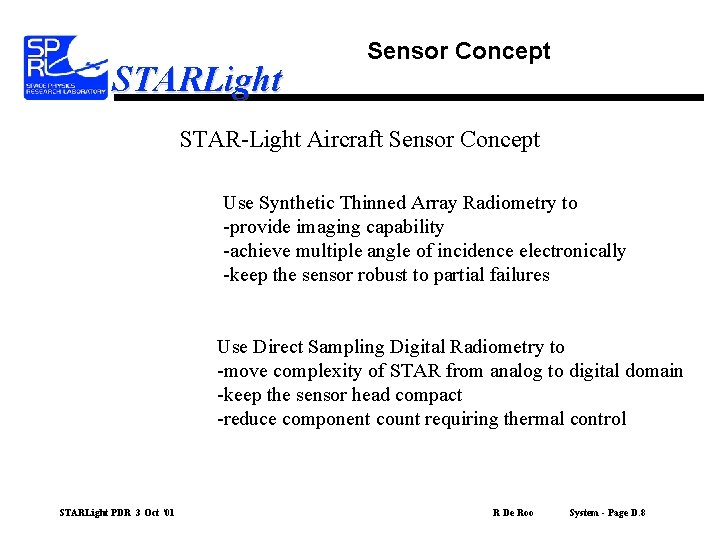
STARLight Sensor Concept STAR-Light Aircraft Sensor Concept Use Synthetic Thinned Array Radiometry to -provide imaging capability -achieve multiple angle of incidence electronically -keep the sensor robust to partial failures Use Direct Sampling Digital Radiometry to -move complexity of STAR from analog to digital domain -keep the sensor head compact -reduce component count requiring thermal control STARLight PDR 3 Oct ‘ 01 R De Roo System - Page D. 8
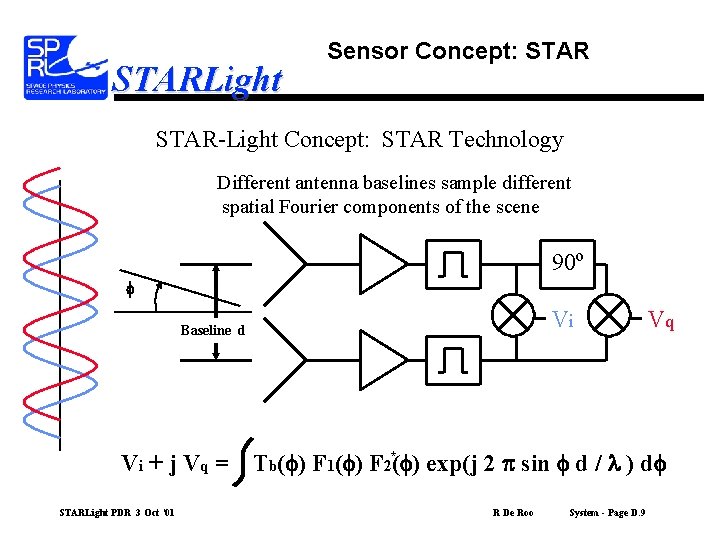
STARLight Sensor Concept: STAR-Light Concept: STAR Technology Different antenna baselines sample different spatial Fourier components of the scene 90 o f Vi Baseline d Vi + j Vq = STARLight PDR 3 Oct ‘ 01 Vq Tb(f) F 1(f) F 2*(f) exp(j 2 p sin f d / l ) df R De Roo System - Page D. 9

STARLight Sensor Concept: DSDR Direct Sampling Digital Receiver Technology A/D DSP Vi Vq A/D Transfer • Noise bandwidth definition • I/Q detection (Hilbert transform) • Complex correlation from analog to digital domain STARLight PDR 3 Oct ‘ 01 R De Roo System - Page D. 10

Sensor Concept STARLight STAR concept Use a standard antenna array with missing elements: 7 l/2 2 l/2 3 l/2 To simulate an array of larger dimensions, by using each Element in turn as the phase center of the array: + = 14 l/2 STARLight PDR 3 Oct ‘ 01 R De Roo System - Page D. 11
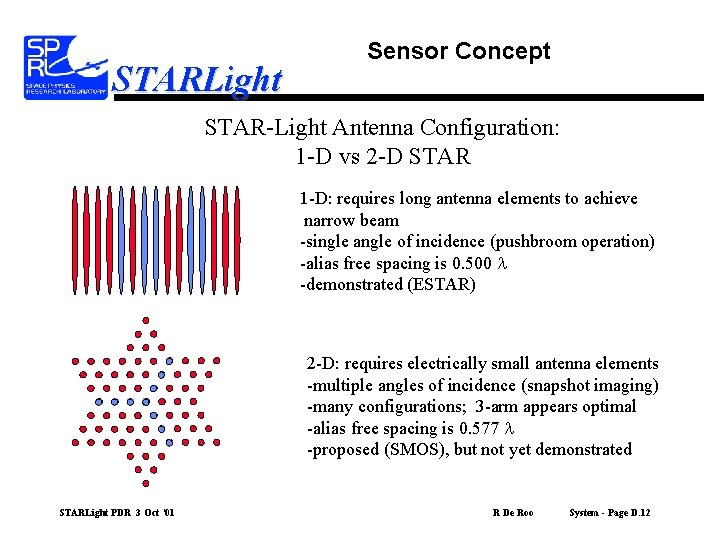
STARLight Sensor Concept STAR-Light Antenna Configuration: 1 -D vs 2 -D STAR 1 -D: requires long antenna elements to achieve narrow beam -single angle of incidence (pushbroom operation) -alias free spacing is 0. 500 l -demonstrated (ESTAR) 2 -D: requires electrically small antenna elements -multiple angles of incidence (snapshot imaging) -many configurations; 3 -arm appears optimal -alias free spacing is 0. 577 l -proposed (SMOS), but not yet demonstrated STARLight PDR 3 Oct ‘ 01 R De Roo System - Page D. 12
Sensor Concept STARLight STAR Issues Huge sidelobes: STAR requires an aperture taper which increases synthesized beamwidth by a factor of 2 (canceling the aperture doubling) ………but the advantages of thinning remain Optimal taper is Blackmann [Camps etal ’ 98] Increased noise: Noise in STAR image Noise in real aperture pixel = Real Aperture Area. Actual Aperture in STAR ………but longer dwell time for STAR to reduce noise equals time required to scan the real array or real aperture [Le. Vine ’ 90, Ruf ’ 88] STARLight PDR 3 Oct ‘ 01 R De Roo System - Page D. 13
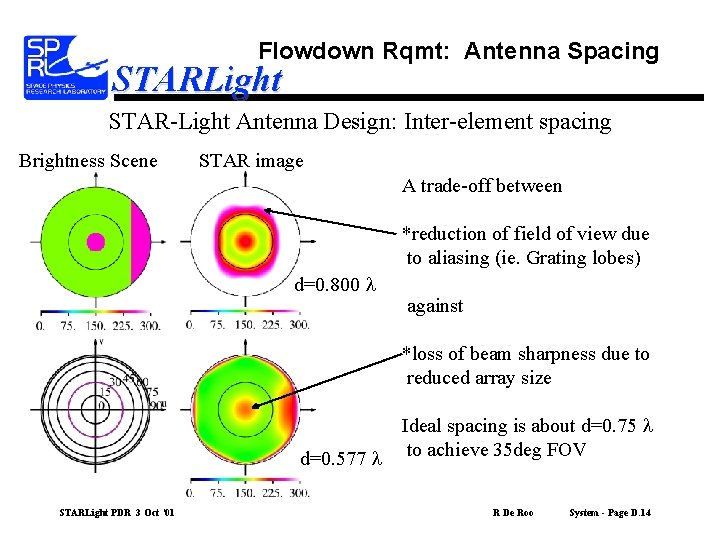
Flowdown Rqmt: Antenna Spacing STARLight STAR-Light Antenna Design: Inter-element spacing Brightness Scene STAR image A trade-off between *reduction of field of view due to aliasing (ie. Grating lobes) d=0. 800 l against *loss of beam sharpness due to reduced array size Ideal spacing is about d=0. 75 l d=0. 577 l to achieve 35 deg FOV STARLight PDR 3 Oct ‘ 01 R De Roo System - Page D. 14
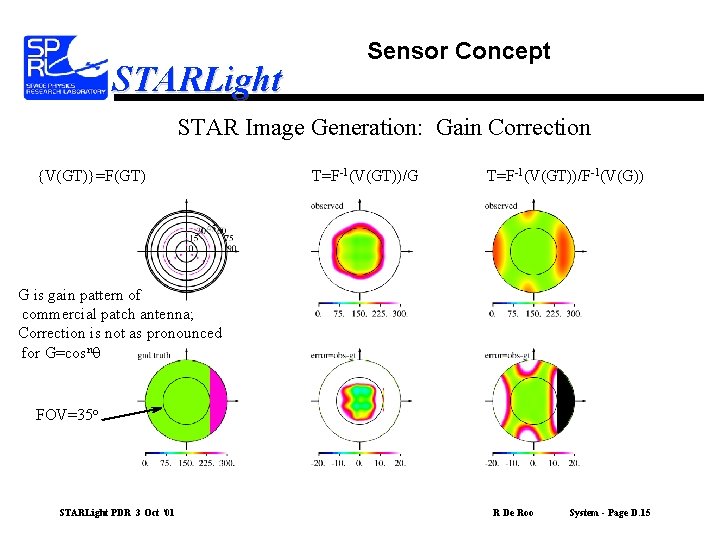
STARLight Sensor Concept STAR Image Generation: Gain Correction {V(GT)}=F(GT) T=F-1(V(GT))/G T=F-1(V(GT))/F-1(V(G)) G is gain pattern of commercial patch antenna; Correction is not as pronounced for G=cosnq FOV=35 o STARLight PDR 3 Oct ‘ 01 R De Roo System - Page D. 15
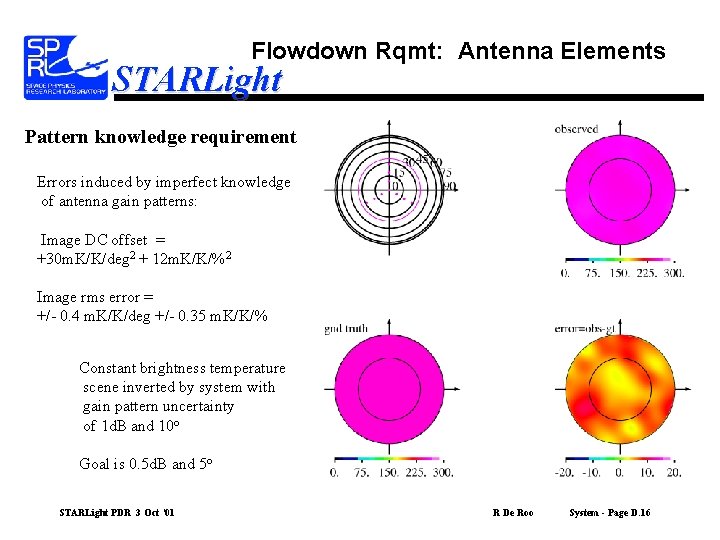
Flowdown Rqmt: Antenna Elements STARLight Pattern knowledge requirement Errors induced by imperfect knowledge of antenna gain patterns: Image DC offset = +30 m. K/K/deg 2 + 12 m. K/K/%2 Image rms error = +/- 0. 4 m. K/K/deg +/- 0. 35 m. K/K/% Constant brightness temperature scene inverted by system with gain pattern uncertainty of 1 d. B and 10 o Goal is 0. 5 d. B and 5 o STARLight PDR 3 Oct ‘ 01 R De Roo System - Page D. 16
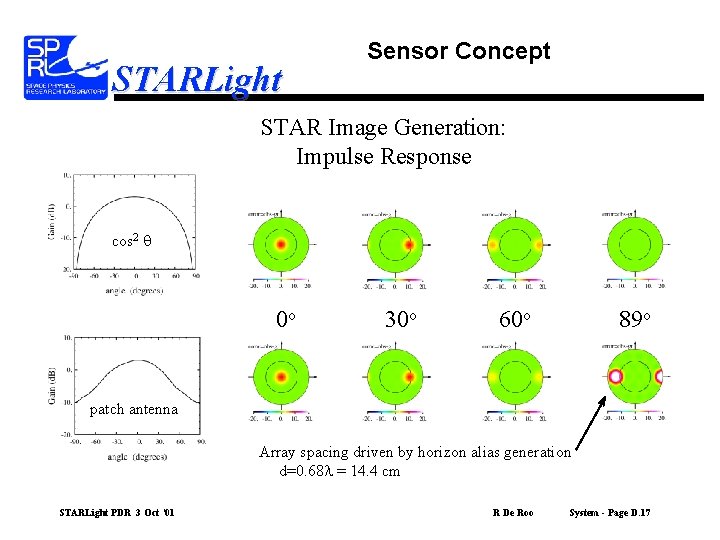
STARLight Sensor Concept STAR Image Generation: Impulse Response cos 2 q 0 o 30 o 60 o 89 o patch antenna Array spacing driven by horizon alias generation d=0. 68 l = 14. 4 cm STARLight PDR 3 Oct ‘ 01 R De Roo System - Page D. 17
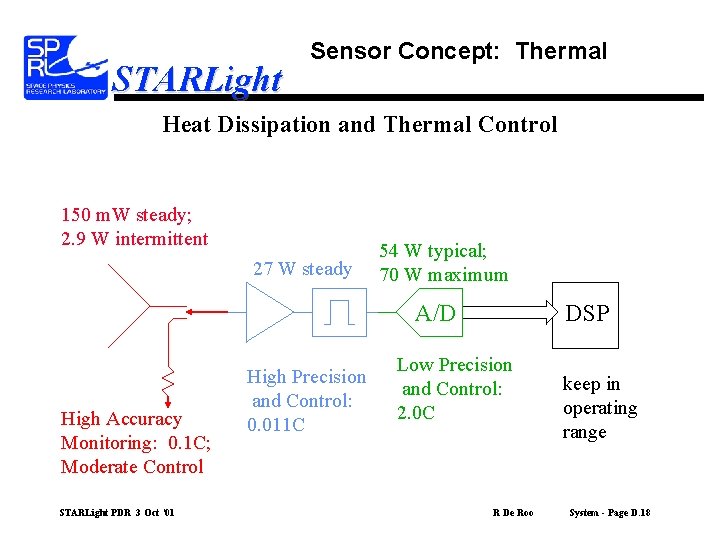
STARLight Sensor Concept: Thermal Heat Dissipation and Thermal Control 150 m. W steady; 2. 9 W intermittent 27 W steady 54 W typical; 70 W maximum A/D High Accuracy Monitoring: 0. 1 C; Moderate Control STARLight PDR 3 Oct ‘ 01 High Precision and Control: 0. 011 C DSP Low Precision and Control: 2. 0 C R De Roo keep in operating range System - Page D. 18
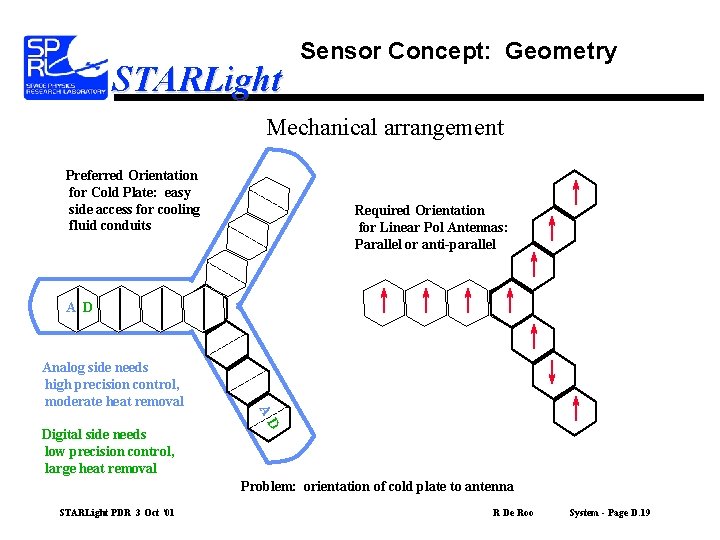
STARLight Sensor Concept: Geometry Mechanical arrangement Preferred Orientation for Cold Plate: easy side access for cooling fluid conduits Required Orientation for Linear Pol Antennas: Parallel or anti-parallel A D D Digital side needs low precision control, large heat removal A Analog side needs high precision control, moderate heat removal Problem: orientation of cold plate to antenna STARLight PDR 3 Oct ‘ 01 R De Roo System - Page D. 19
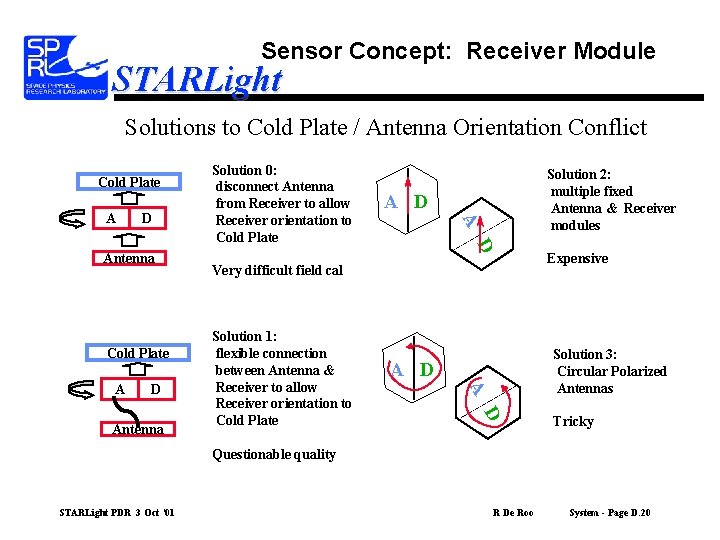
Sensor Concept: Receiver Module STARLight Solutions to Cold Plate / Antenna Orientation Conflict Cold Plate D Solution 1: flexible connection between Antenna & Receiver to allow Receiver orientation to Cold Plate Expensive Solution 3: Circular Polarized Antennas A D D Antenna Very difficult field cal A A A D D Antenna Solution 2: multiple fixed Antenna & Receiver modules A A Solution 0: disconnect Antenna from Receiver to allow Receiver orientation to Cold Plate Tricky Questionable quality STARLight PDR 3 Oct ‘ 01 R De Roo System - Page D. 20
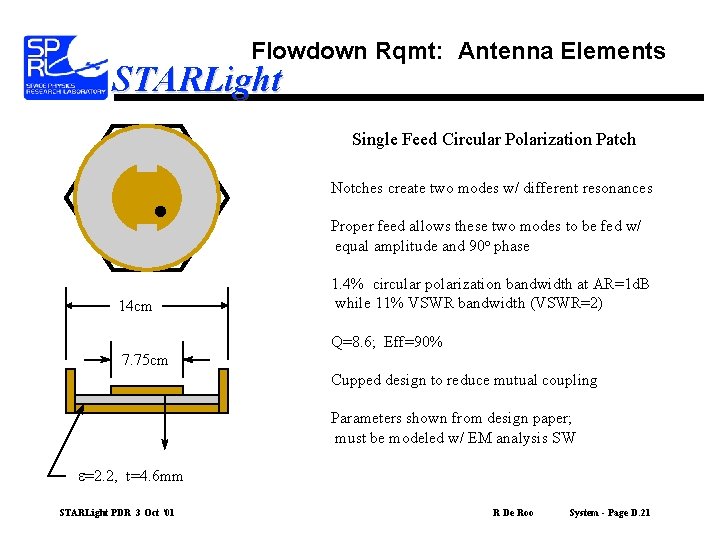
Flowdown Rqmt: Antenna Elements STARLight Single Feed Circular Polarization Patch Notches create two modes w/ different resonances Proper feed allows these two modes to be fed w/ equal amplitude and 90 o phase 14 cm 1. 4% circular polarization bandwidth at AR=1 d. B while 11% VSWR bandwidth (VSWR=2) Q=8. 6; Eff=90% 7. 75 cm Cupped design to reduce mutual coupling Parameters shown from design paper; must be modeled w/ EM analysis SW e=2. 2, t=4. 6 mm STARLight PDR 3 Oct ‘ 01 R De Roo System - Page D. 21
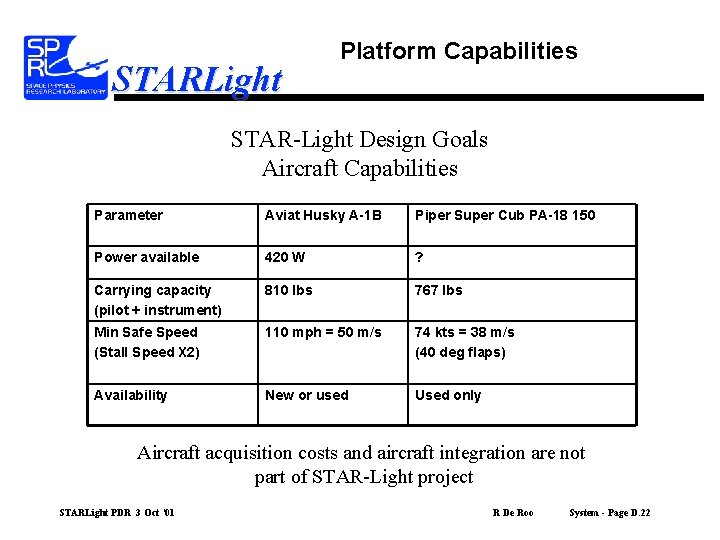
STARLight Platform Capabilities STAR-Light Design Goals Aircraft Capabilities Parameter Aviat Husky A-1 B Piper Super Cub PA-18 150 Power available 420 W ? Carrying capacity (pilot + instrument) 810 lbs 767 lbs Min Safe Speed (Stall Speed X 2) 110 mph = 50 m/s 74 kts = 38 m/s (40 deg flaps) Availability New or used Used only Aircraft acquisition costs and aircraft integration are not part of STAR-Light project STARLight PDR 3 Oct ‘ 01 R De Roo System - Page D. 22
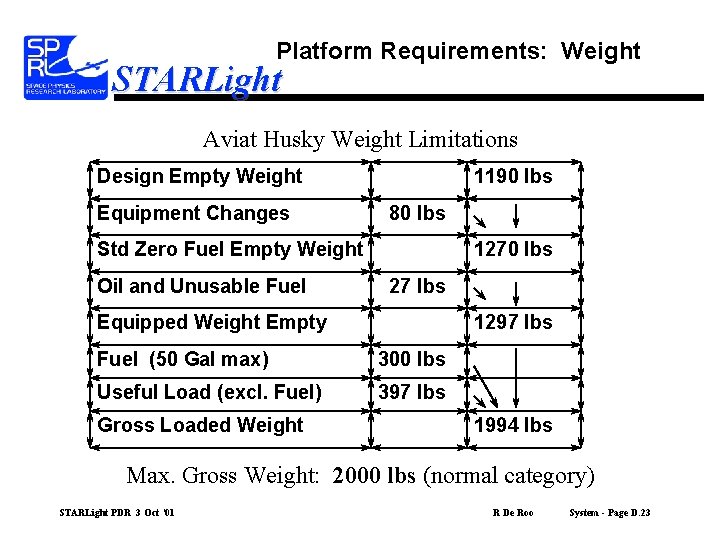
Platform Requirements: Weight STARLight Aviat Husky Weight Limitations Design Empty Weight Equipment Changes 1190 lbs 80 lbs Std Zero Fuel Empty Weight Oil and Unusable Fuel 1270 lbs 27 lbs Equipped Weight Empty 1297 lbs Fuel (50 Gal max) 300 lbs Useful Load (excl. Fuel) 397 lbs Gross Loaded Weight 1994 lbs Max. Gross Weight: 2000 lbs (normal category) STARLight PDR 3 Oct ‘ 01 R De Roo System - Page D. 23
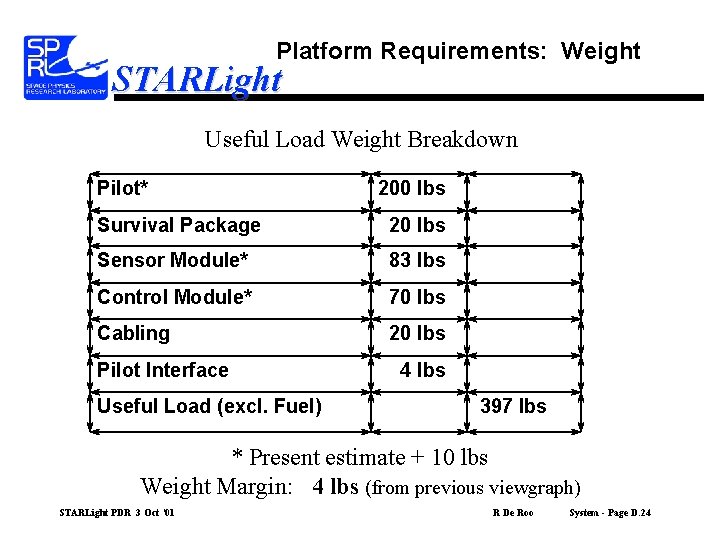
Platform Requirements: Weight STARLight Useful Load Weight Breakdown Pilot* 200 lbs Survival Package 20 lbs Sensor Module* 83 lbs Control Module* 70 lbs Cabling 20 lbs Pilot Interface Useful Load (excl. Fuel) 4 lbs 397 lbs * Present estimate + 10 lbs Weight Margin: 4 lbs (from previous viewgraph) STARLight PDR 3 Oct ‘ 01 R De Roo System - Page D. 24
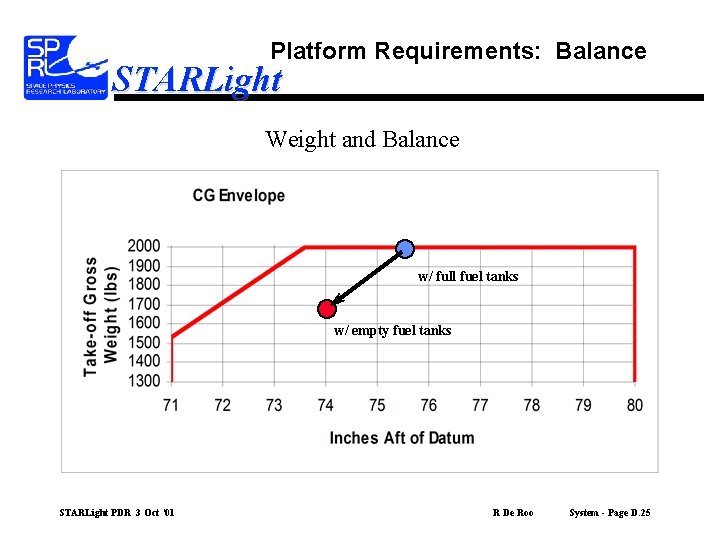
Platform Requirements: Balance STARLight Weight and Balance w/ full fuel tanks w/ empty fuel tanks STARLight PDR 3 Oct ‘ 01 R De Roo System - Page D. 25
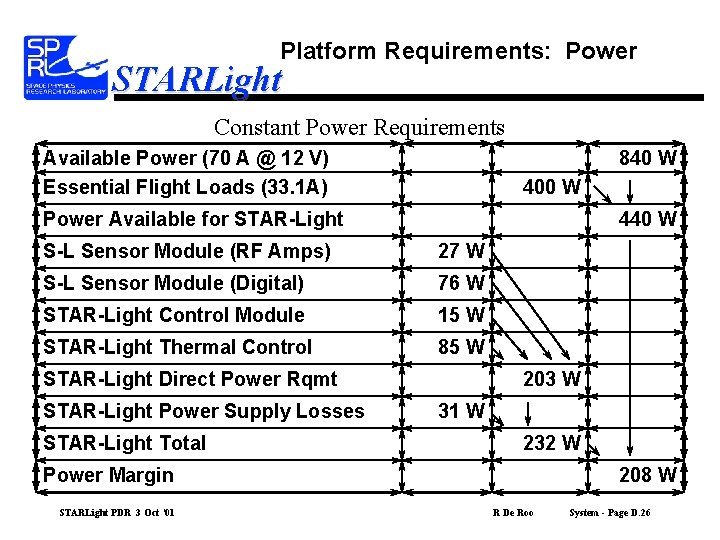
Platform Requirements: Power STARLight Constant Power Requirements Available Power (70 A @ 12 V) Essential Flight Loads (33. 1 A) 840 W 400 W Power Available for STAR-Light 440 W S-L Sensor Module (RF Amps) 27 W S-L Sensor Module (Digital) 76 W STAR-Light Control Module 15 W STAR-Light Thermal Control 85 W STAR-Light Direct Power Rqmt STAR-Light Power Supply Losses STAR-Light Total 203 W 31 W 232 W Power Margin STARLight PDR 3 Oct ‘ 01 208 W R De Roo System - Page D. 26
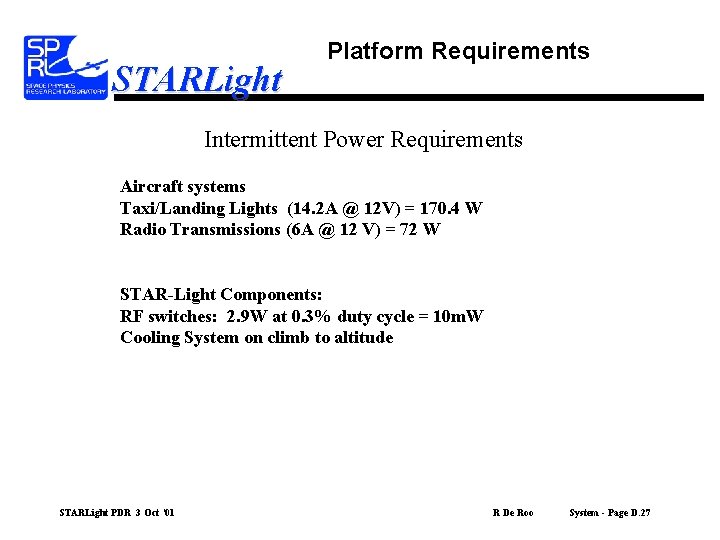
STARLight Platform Requirements Intermittent Power Requirements Aircraft systems Taxi/Landing Lights (14. 2 A @ 12 V) = 170. 4 W Radio Transmissions (6 A @ 12 V) = 72 W STAR-Light Components: RF switches: 2. 9 W at 0. 3% duty cycle = 10 m. W Cooling System on climb to altitude STARLight PDR 3 Oct ‘ 01 R De Roo System - Page D. 27
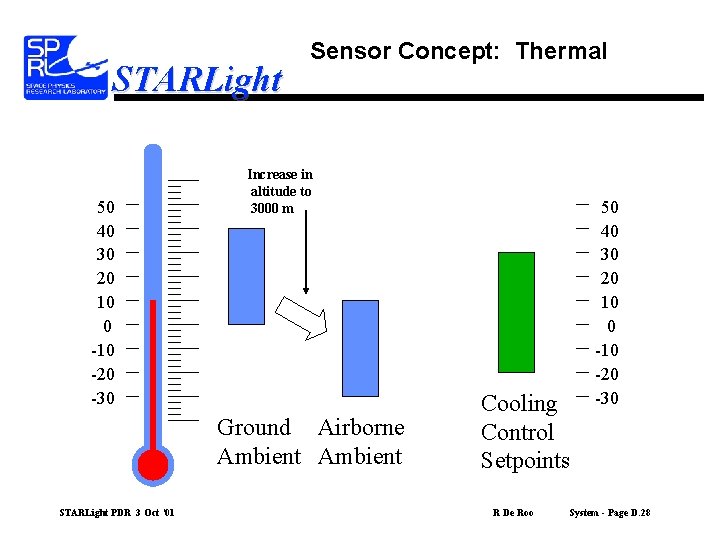
STARLight 50 40 30 20 10 0 -10 -20 -30 Sensor Concept: Thermal Increase in altitude to 3000 m Ground Airborne Ambient STARLight PDR 3 Oct ‘ 01 Cooling Control Setpoints R De Roo 50 40 30 20 10 0 -10 -20 -30 System - Page D. 28
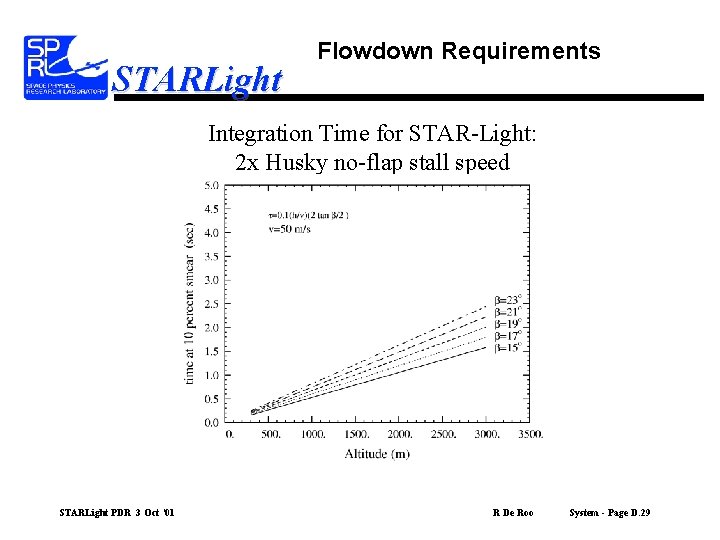
STARLight Flowdown Requirements Integration Time for STAR-Light: 2 x Husky no-flap stall speed STARLight PDR 3 Oct ‘ 01 R De Roo System - Page D. 29
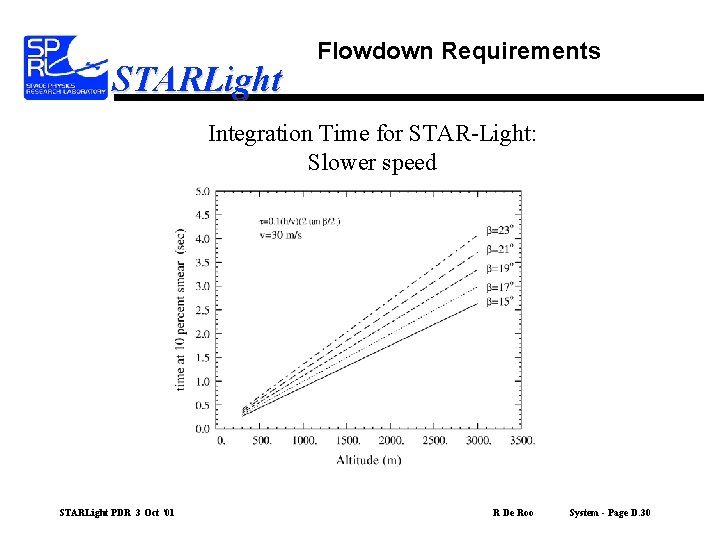
STARLight Flowdown Requirements Integration Time for STAR-Light: Slower speed STARLight PDR 3 Oct ‘ 01 R De Roo System - Page D. 30
![Flowdown Rqmt: Noise Figure STARLight For any taper [Camps, ’ 98]: DT d. W=constant](http://slidetodoc.com/presentation_image_h2/e1423bbdd4329d6524775a9615d0e8f1/image-31.jpg "Flowdown Rqmt: Noise Figure STARLight For any taper [Camps, ’ 98]: DT d. W=constant")
Flowdown Rqmt: Noise Figure STARLight For any taper [Camps, ’ 98]: DT d. W=constant NEDT(uniform) = d. W(Blackman)/d. W(uniform) * NEDT(Blackman) = (15 deg)^2 / (10 deg)^2 * 0. 5 K = 1. 12 K For uniform taper [Le. Vine, ’ 90], NEDT = Tsys Asyn = Trec + 300 K 73 sqrt( B t ) n Ael sqrt( 20 e 6. 1. 5 ) 10 For NEDT < 1 K, STARLight PDR 3 Oct ‘ 01 Tsys< 750 K or Trec<450 K (NF < 4. 1 d. B) R De Roo System - Page D. 31
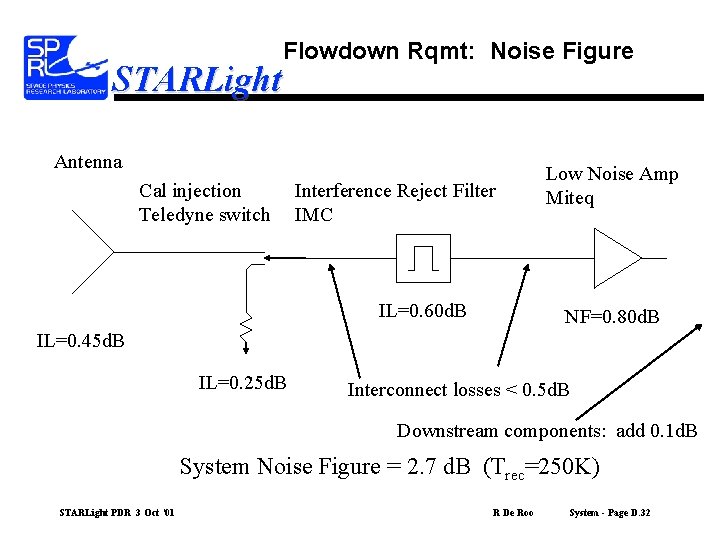
Flowdown Rqmt: Noise Figure STARLight Antenna Cal injection Teledyne switch Interference Reject Filter IMC IL=0. 60 d. B Low Noise Amp Miteq NF=0. 80 d. B IL=0. 45 d. B IL=0. 25 d. B Interconnect losses < 0. 5 d. B Downstream components: add 0. 1 d. B System Noise Figure = 2. 7 d. B (Trec=250 K) STARLight PDR 3 Oct ‘ 01 R De Roo System - Page D. 32
STARLight Flowdown Rqmt: Gain Signal amplitude at ADC must be > 4 levels (2 bits) for bias levels to not matter [Fischman, ’ 01] At Tsys=250 K, k Tsys B = -101. 6 d. Bm; LSB=15. 63 m. V for typical ADC (SPT 7610) => Padc=-26. 6 d. Bm Overall gain must be > 75 d. B For amplifier w/ G=26 d. B, 3 amplification stages minimum (to allow for losses in receiver, use 4 stages) STARLight PDR 3 Oct ‘ 01 R De Roo System - Page D. 33
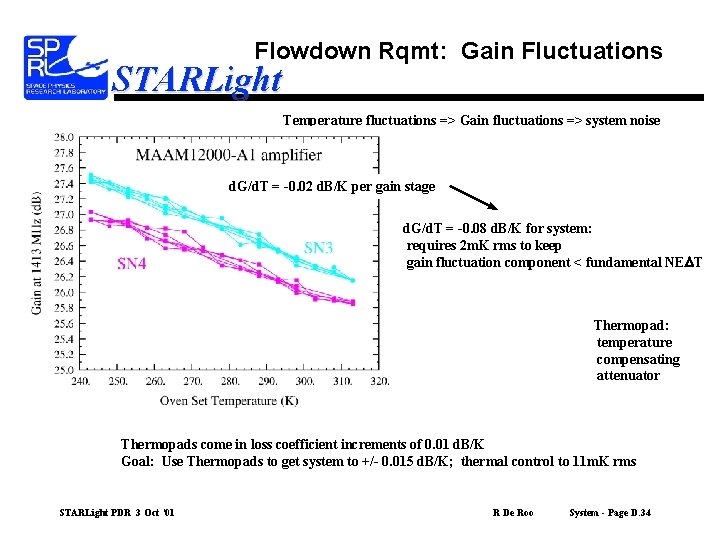
Flowdown Rqmt: Gain Fluctuations STARLight Temperature fluctuations => Gain fluctuations => system noise d. G/d. T = -0. 02 d. B/K per gain stage d. G/d. T = -0. 08 d. B/K for system: requires 2 m. K rms to keep gain fluctuation component < fundamental NEDT Thermopad: temperature compensating attenuator Thermopads come in loss coefficient increments of 0. 01 d. B/K Goal: Use Thermopads to get system to +/- 0. 015 d. B/K; thermal control to 11 m. K rms STARLight PDR 3 Oct ‘ 01 R De Roo System - Page D. 34
STARLight Flowdown Rqmt: ADC levels Need a minimum of 4 levels for darkest target [Fischman ’ 01] Is a 3 -bit Analog to Digital Converter (ADC) enough? Tsys(max) / Tsys(min) < (8 levels)^2 / (4 levels)^2 = 4 where Tsys=Tb+Trec If we wish to look at the sky, Tb(min)=~0 K; On Earth, Tb(max)=~300 K Then, Trec>100 K or we need more bits Therefore, 3 bit ADC is enough STARLight PDR 3 Oct ‘ 01 R De Roo System - Page D. 35
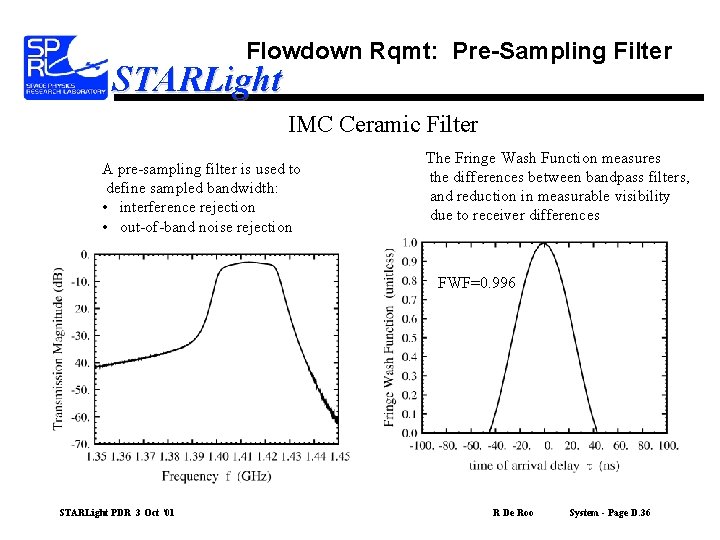
Flowdown Rqmt: Pre-Sampling Filter STARLight IMC Ceramic Filter A pre-sampling filter is used to define sampled bandwidth: • interference rejection • out-of-band noise rejection The Fringe Wash Function measures the differences between bandpass filters, and reduction in measurable visibility due to receiver differences FWF=0. 996 STARLight PDR 3 Oct ‘ 01 R De Roo System - Page D. 36
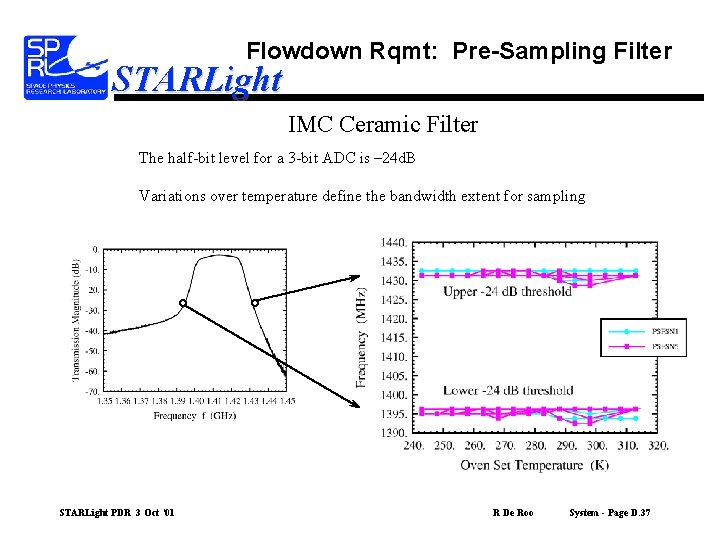
Flowdown Rqmt: Pre-Sampling Filter STARLight IMC Ceramic Filter The half-bit level for a 3 -bit ADC is – 24 d. B Variations over temperature define the bandwidth extent for sampling STARLight PDR 3 Oct ‘ 01 R De Roo System - Page D. 37
![Flowdown Rqmt: ADC sampling STARLight Sampling Rate considerations [Feixure etal ’ 98] For a](http://slidetodoc.com/presentation_image_h2/e1423bbdd4329d6524775a9615d0e8f1/image-38.jpg "Flowdown Rqmt: ADC sampling STARLight Sampling Rate considerations [Feixure etal ’ 98] For a")
Flowdown Rqmt: ADC sampling STARLight Sampling Rate considerations [Feixure etal ’ 98] For a noise bandwidth (approx -3 d. B BW) of 1403 – 1423 MHz, the sampled bandwidth (approx – 24 d. B BW) is 1390 – 1435 MHz For I/Q demodulation, 2 f. H/m < fs < 2 f. L/(m-1), where m=1, 2, …mmax and mmax=floor[f. H/(f. H-f. L)] 92. 58 MHz < fs < 92. 66 MHz or 95. 67 MHz < fs < 95. 86 MHz or 98. 97 MHz < fs < 99. 29 MHz or 102. 5 MHz < fs < 102. 96 MHz… STARLight PDR 3 Oct ‘ 01 fs=102. 8 MHz R De Roo System - Page D. 38
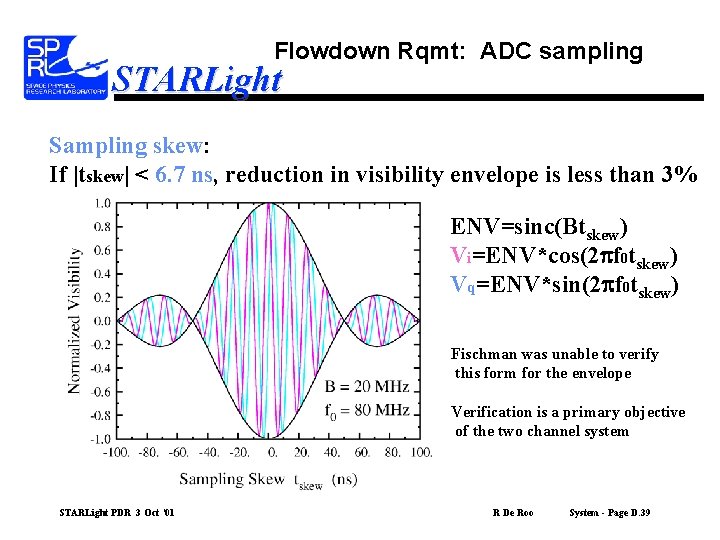
Flowdown Rqmt: ADC sampling STARLight Sampling skew: If |tskew| < 6. 7 ns, reduction in visibility envelope is less than 3% ENV=sinc(Btskew) Vi=ENV*cos(2 pf 0 tskew) Vq=ENV*sin(2 pf 0 tskew) Fischman was unable to verify this form for the envelope Verification is a primary objective of the two channel system STARLight PDR 3 Oct ‘ 01 R De Roo System - Page D. 39
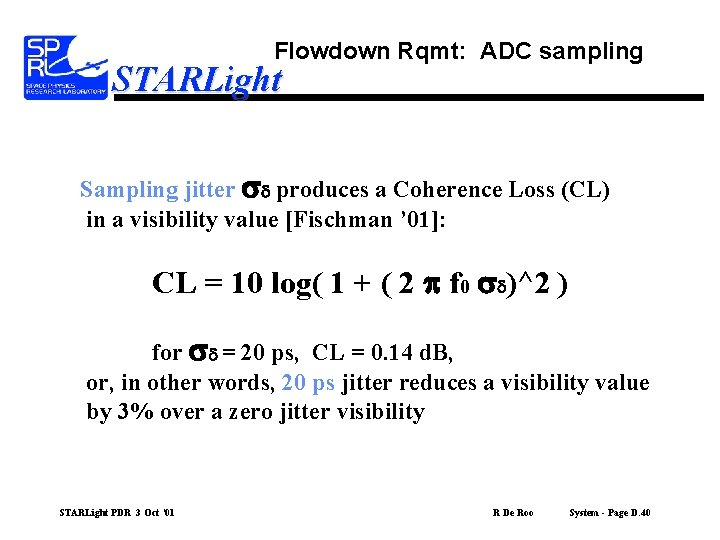
Flowdown Rqmt: ADC sampling STARLight Sampling jitter sd produces a Coherence Loss (CL) in a visibility value [Fischman ’ 01]: CL = 10 log( 1 + ( 2 p f 0 sd)^2 ) for sd = 20 ps, CL = 0. 14 d. B, or, in other words, 20 ps jitter reduces a visibility value by 3% over a zero jitter visibility STARLight PDR 3 Oct ‘ 01 R De Roo System - Page D. 40
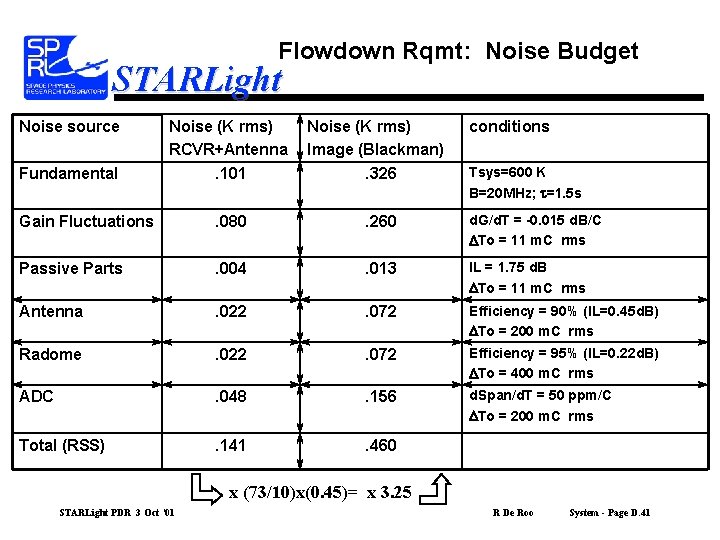
Flowdown Rqmt: Noise Budget STARLight Noise source Noise (K rms) RCVR+Antenna Noise (K rms) Image (Blackman) conditions Fundamental . 101 . 326 Tsys=600 K B=20 MHz; t=1. 5 s Gain Fluctuations . 080 . 260 d. G/d. T = -0. 015 d. B/C DTo = 11 m. C rms Passive Parts . 004 . 013 IL = 1. 75 d. B DTo = 11 m. C rms Antenna . 022 . 072 Efficiency = 90% (IL=0. 45 d. B) DTo = 200 m. C rms Radome . 022 . 072 Efficiency = 95% (IL=0. 22 d. B) DTo = 400 m. C rms ADC . 048 . 156 d. Span/d. T = 50 ppm/C DTo = 200 m. C rms Total (RSS) . 141 . 460 x (73/10)x(0. 45)= x 3. 25 STARLight PDR 3 Oct ‘ 01 R De Roo System - Page D. 41
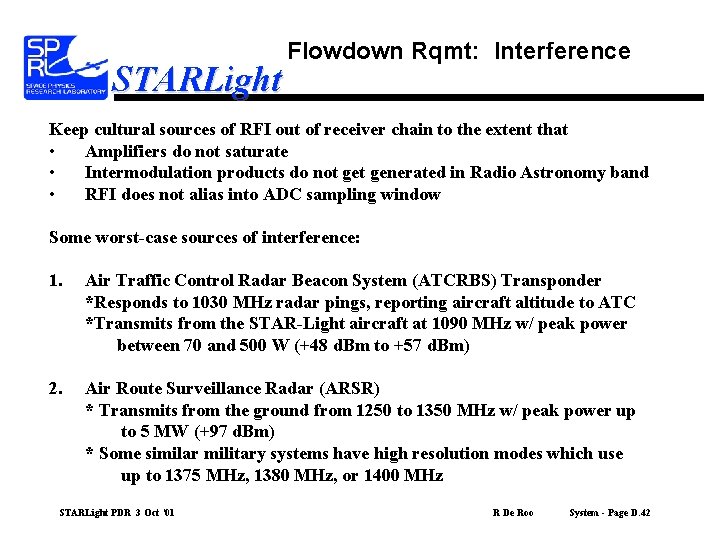
STARLight Flowdown Rqmt: Interference Keep cultural sources of RFI out of receiver chain to the extent that • Amplifiers do not saturate • Intermodulation products do not generated in Radio Astronomy band • RFI does not alias into ADC sampling window Some worst-case sources of interference: 1. Air Traffic Control Radar Beacon System (ATCRBS) Transponder *Responds to 1030 MHz radar pings, reporting aircraft altitude to ATC *Transmits from the STAR-Light aircraft at 1090 MHz w/ peak power between 70 and 500 W (+48 d. Bm to +57 d. Bm) 2. Air Route Surveillance Radar (ARSR) * Transmits from the ground from 1250 to 1350 MHz w/ peak power up to 5 MW (+97 d. Bm) * Some similar military systems have high resolution modes which use up to 1375 MHz, 1380 MHz, or 1400 MHz STARLight PDR 3 Oct ‘ 01 R De Roo System - Page D. 42
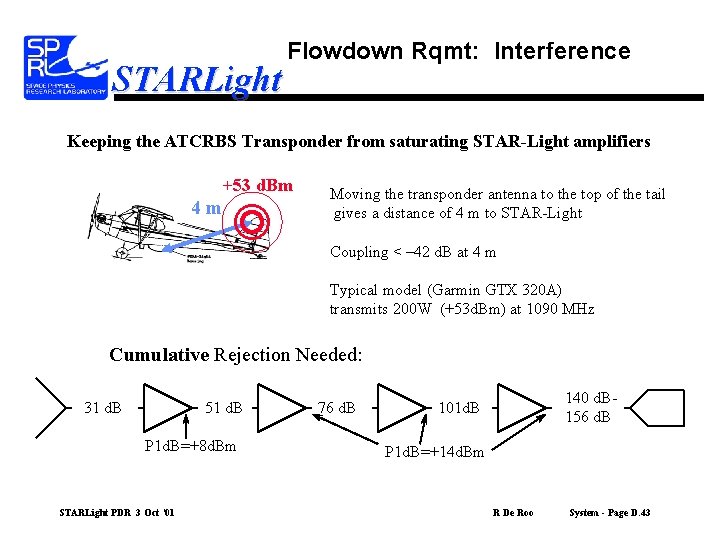
STARLight Flowdown Rqmt: Interference Keeping the ATCRBS Transponder from saturating STAR-Light amplifiers +53 d. Bm 4 m Moving the transponder antenna to the top of the tail gives a distance of 4 m to STAR-Light Coupling < – 42 d. B at 4 m Typical model (Garmin GTX 320 A) transmits 200 W (+53 d. Bm) at 1090 MHz Cumulative Rejection Needed: 31 d. B 51 d. B P 1 d. B=+8 d. Bm STARLight PDR 3 Oct ‘ 01 76 d. B 140 d. B 156 d. B 101 d. B P 1 d. B=+14 d. Bm R De Roo System - Page D. 43
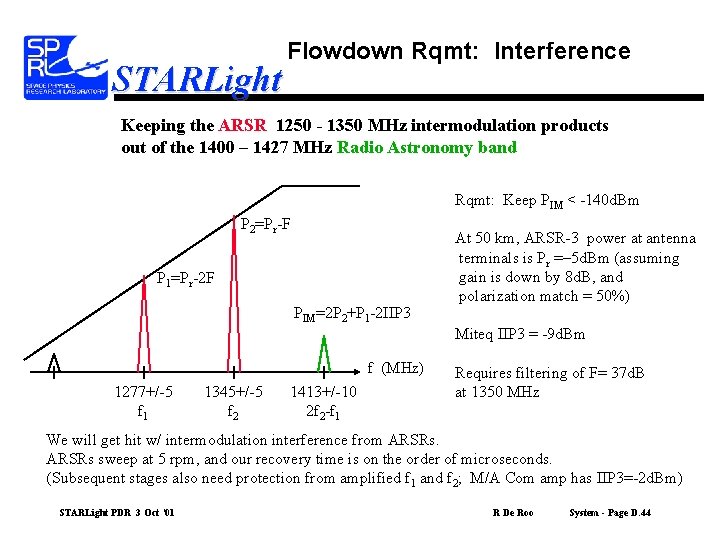
STARLight Flowdown Rqmt: Interference Keeping the ARSR 1250 - 1350 MHz intermodulation products out of the 1400 – 1427 MHz Radio Astronomy band Rqmt: Keep PIM < -140 d. Bm P 2=Pr-F P 1=Pr-2 F PIM=2 P 2+P 1 -2 IIP 3 At 50 km, ARSR-3 power at antenna terminals is Pr =– 5 d. Bm (assuming gain is down by 8 d. B, and polarization match = 50%) Miteq IIP 3 = -9 d. Bm f (MHz) 1277+/-5 f 1 1345+/-5 f 2 1413+/-10 2 f 2 -f 1 Requires filtering of F= 37 d. B at 1350 MHz We will get hit w/ intermodulation interference from ARSRs sweep at 5 rpm, and our recovery time is on the order of microseconds. (Subsequent stages also need protection from amplified f 1 and f 2; M/A Com amp has IIP 3=-2 d. Bm) STARLight PDR 3 Oct ‘ 01 R De Roo System - Page D. 44
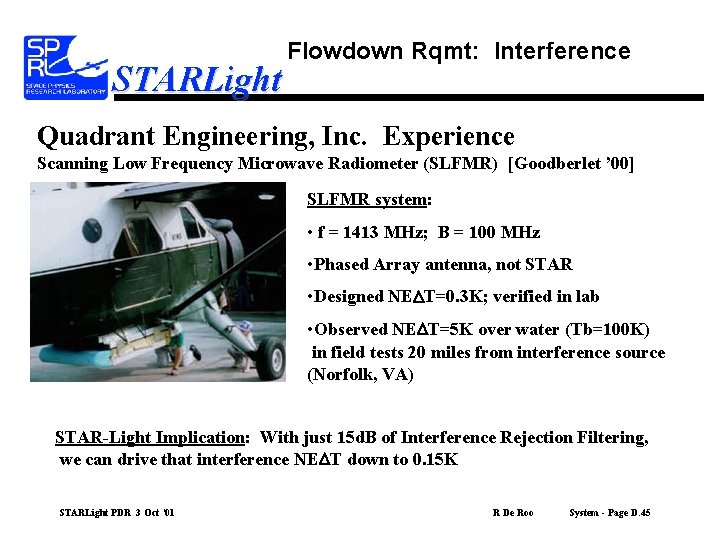
STARLight Flowdown Rqmt: Interference Quadrant Engineering, Inc. Experience Scanning Low Frequency Microwave Radiometer (SLFMR) [Goodberlet ’ 00] SLFMR system: • f = 1413 MHz; B = 100 MHz • Phased Array antenna, not STAR • Designed NEDT=0. 3 K; verified in lab • Observed NEDT=5 K over water (Tb=100 K) in field tests 20 miles from interference source (Norfolk, VA) STAR-Light Implication: With just 15 d. B of Interference Rejection Filtering, we can drive that interference NEDT down to 0. 15 K STARLight PDR 3 Oct ‘ 01 R De Roo System - Page D. 45
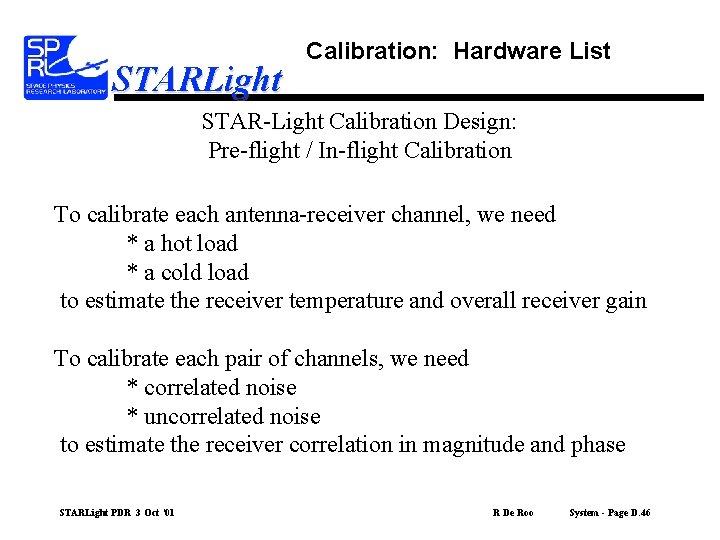
STARLight Calibration: Hardware List STAR-Light Calibration Design: Pre-flight / In-flight Calibration To calibrate each antenna-receiver channel, we need * a hot load * a cold load to estimate the receiver temperature and overall receiver gain To calibrate each pair of channels, we need * correlated noise * uncorrelated noise to estimate the receiver correlation in magnitude and phase STARLight PDR 3 Oct ‘ 01 R De Roo System - Page D. 46
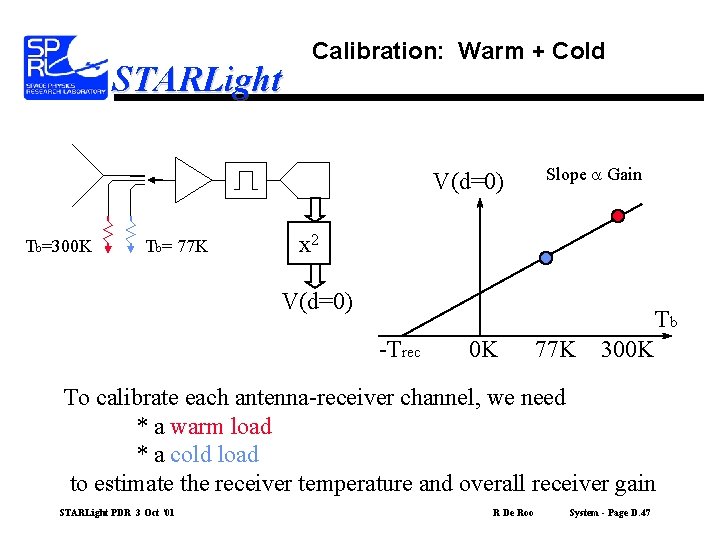
STARLight Calibration: Warm + Cold V(d=0) Tb=300 K Tb= 77 K Slope a Gain x 2 V(d=0) Tb -Trec 0 K 77 K 300 K To calibrate each antenna-receiver channel, we need * a warm load * a cold load to estimate the receiver temperature and overall receiver gain STARLight PDR 3 Oct ‘ 01 R De Roo System - Page D. 47
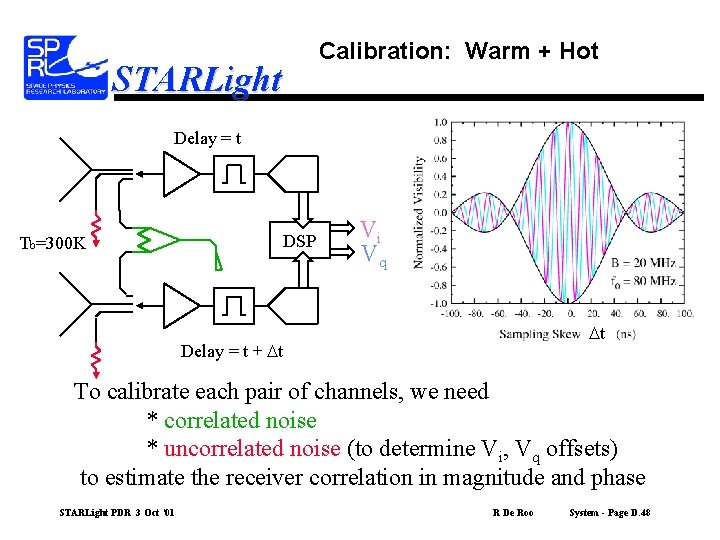
Calibration: Warm + Hot STARLight Delay = t DSP Tb=300 K Vi Vq Dt Delay = t + Dt To calibrate each pair of channels, we need * correlated noise * uncorrelated noise (to determine Vi, Vq offsets) to estimate the receiver correlation in magnitude and phase STARLight PDR 3 Oct ‘ 01 R De Roo System - Page D. 48
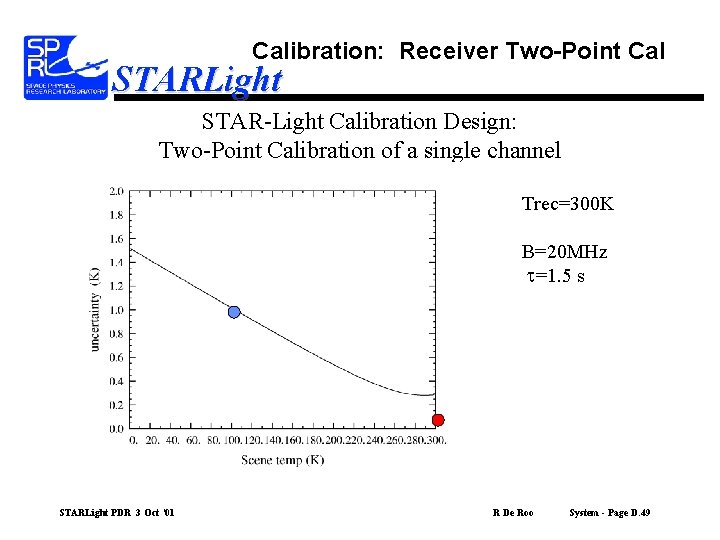
Calibration: Receiver Two-Point Cal STARLight STAR-Light Calibration Design: Two-Point Calibration of a single channel Trec=300 K B=20 MHz t=1. 5 s STARLight PDR 3 Oct ‘ 01 R De Roo System - Page D. 49
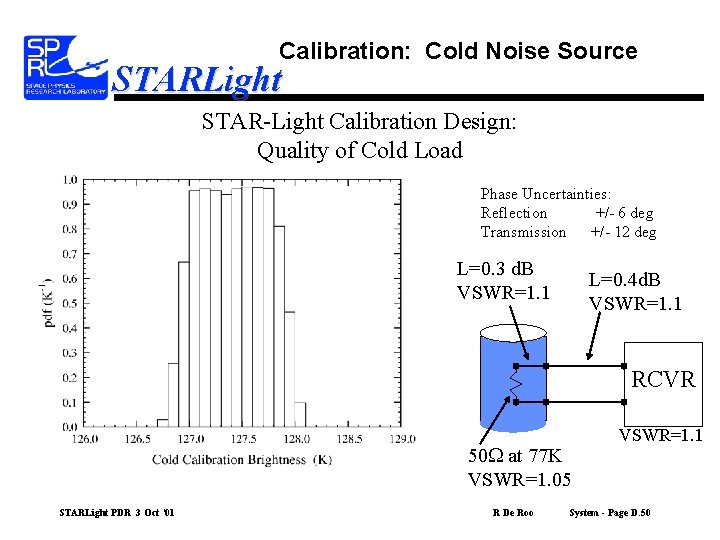
Calibration: Cold Noise Source STARLight STAR-Light Calibration Design: Quality of Cold Load Phase Uncertainties: Reflection +/- 6 deg Transmission +/- 12 deg L=0. 3 d. B VSWR=1. 1 L=0. 4 d. B VSWR=1. 1 RCVR 50 W at 77 K VSWR=1. 05 STARLight PDR 3 Oct ‘ 01 R De Roo VSWR=1. 1 System - Page D. 50
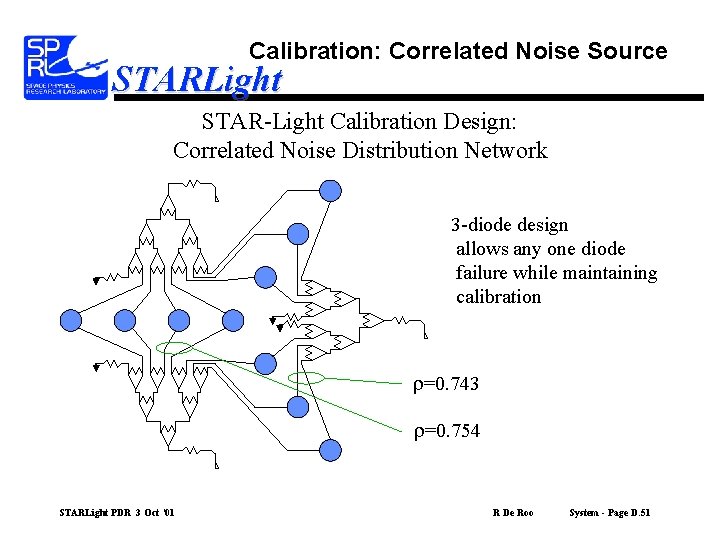
Calibration: Correlated Noise Source STARLight STAR-Light Calibration Design: Correlated Noise Distribution Network 3 -diode design allows any one diode failure while maintaining calibration r=0. 743 r=0. 754 STARLight PDR 3 Oct ‘ 01 R De Roo System - Page D. 51
STARLight Two Channel Prototype Two Channel prototype tests: • NEDT verification (Dec ’ 01) • End-to-end fringe wash function measurement (Jan ’ 02) • Receiver calibration validation (Feb ’ 02) • Antenna radiation efficiency measurement (Spring ’ 02) Tasks to be done prior to CDR: • Antenna specification and design (Oct ’ 01) • Antenna manufacture and integration (Nov ’ 01– Mar ’ 02) • STAR model evolution (continuous) • Cold load final design (Oct-Dec ’ 01) Post CDR: • Antenna characterization • System validation STARLight PDR 3 Oct ‘ 01 R De Roo System - Page D. 52
- Slides: 52