
Star Formation and Protostars at High Angular Resolution
- Slides: 17
Star Formation and Protostars at High Angular Resolution with the SMA Jes Jørgensen (Cf. A) Tyler Bourke, Philip Myers, David Wilner (Cf. A), Fredrik Schöier (Stockholm), Ewine van Dishoeck (Leiden), . . . and the PROSAC team. ACP Submillimeter Astronomy in the era of the SMA, Cambridge, June 14, 2005
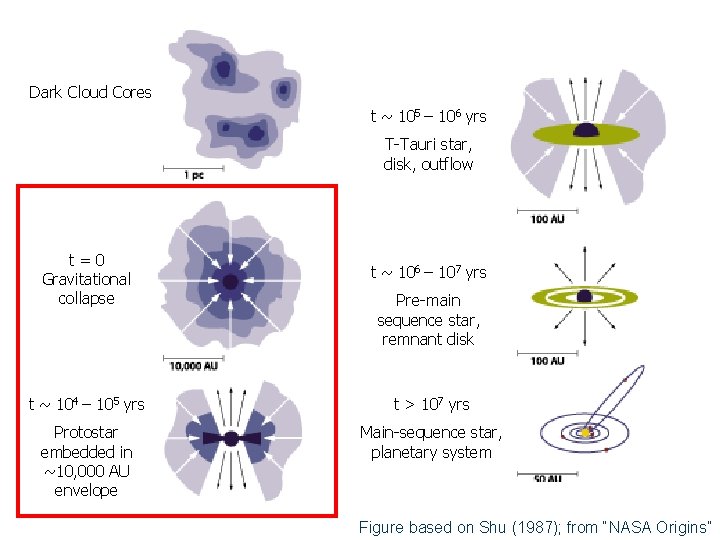
Dark Cloud Cores t ~ 105 – 106 yrs T-Tauri star, disk, outflow t=0 Gravitational collapse t ~ 106 – 107 yrs t ~ 104 – 105 yrs t > 107 yrs Protostar embedded in ~10, 000 AU envelope Main-sequence star, planetary system Pre-main sequence star, remnant disk Figure based on Shu (1987); from “NASA Origins”
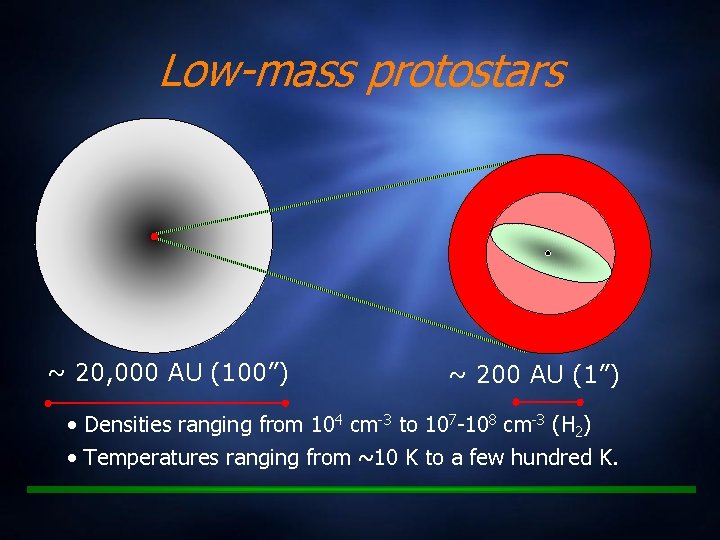
Low-mass protostars ~ 20, 000 AU (100”) ~ 200 AU (1”) • Densities ranging from 104 cm-3 to 107 -108 cm-3 (H 2) • Temperatures ranging from ~10 K to a few hundred K.
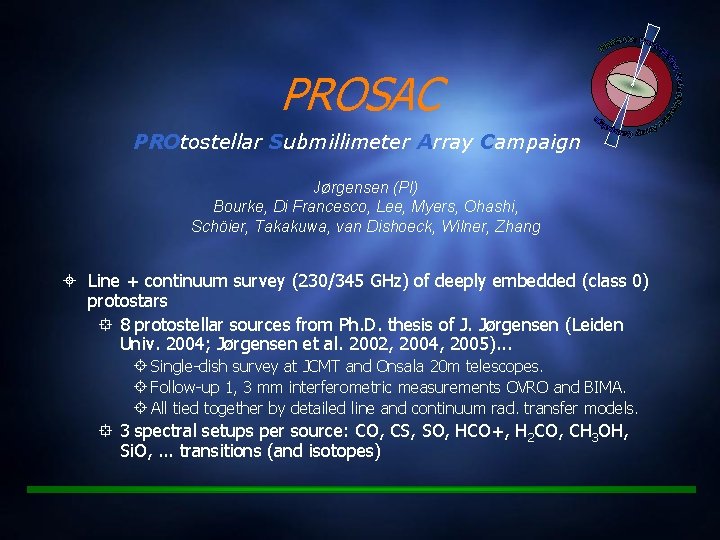
PROSAC PROtostellar Submillimeter Array Campaign Jørgensen (PI) Bourke, Di Francesco, Lee, Myers, Ohashi, Schöier, Takakuwa, van Dishoeck, Wilner, Zhang Line + continuum survey (230/345 GHz) of deeply embedded (class 0) protostars 8 protostellar sources from Ph. D. thesis of J. Jørgensen (Leiden Univ. 2004; Jørgensen et al. 2002, 2004, 2005). . . Single-dish survey at JCMT and Onsala 20 m telescopes. Follow-up 1, 3 mm interferometric measurements OVRO and BIMA. All tied together by detailed line and continuum rad. transfer models. 3 spectral setups per source: CO, CS, SO, HCO+, H 2 CO, CH 3 OH, Si. O, . . . transitions (and isotopes)
In this talk. . . What is the structure of protostellar envelopes on a few 100 AU scales? What is the physical structure of circumstellar disks - and their molecular content? Do low-mass protostars have hot cores, i. e. , inner regions with temperatures higher than 100 K and where complex organic molecules might be present?
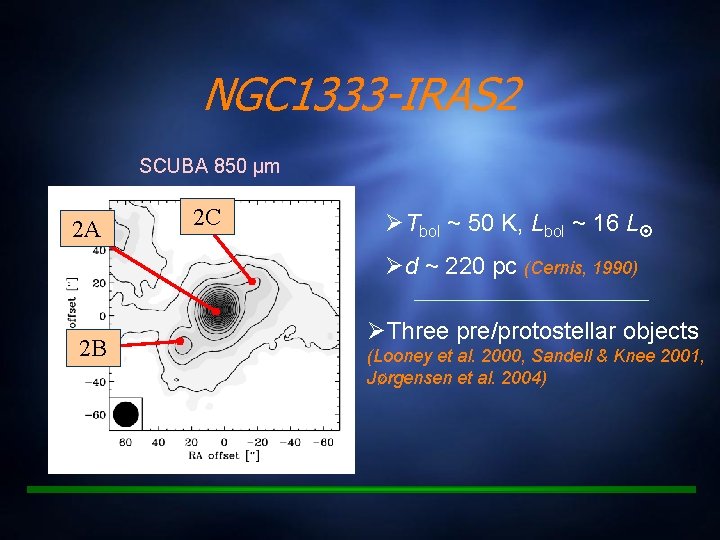
NGC 1333 -IRAS 2 SCUBA 850 µm 2 A 2 C ØTbol ~ 50 K, Lbol ~ 16 L Ød ~ 220 pc (Cernis, 1990) 2 B ØThree pre/protostellar objects (Looney et al. 2000, Sandell & Knee 2001, Jørgensen et al. 2004)
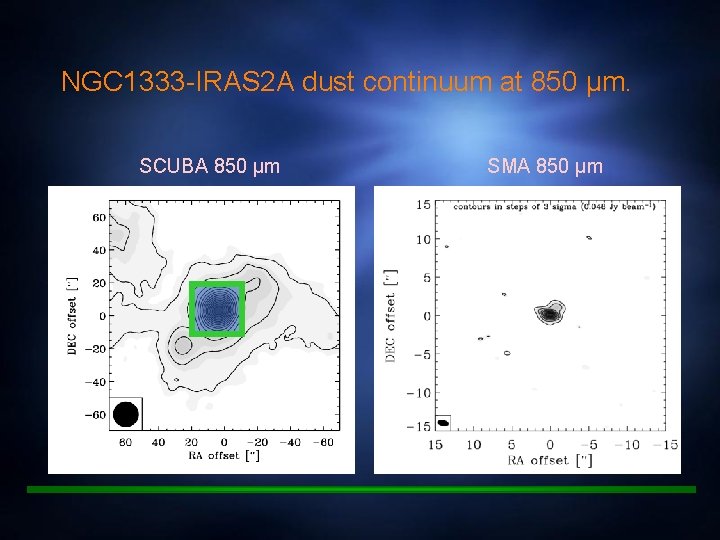
NGC 1333 -IRAS 2 A dust continuum at 850 µm. SCUBA 850 µm SMA 850 µm
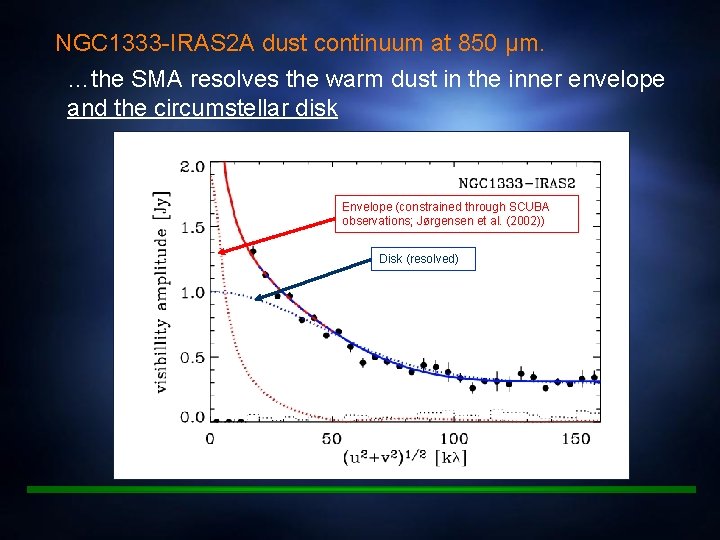
NGC 1333 -IRAS 2 A dust continuum at 850 µm. …the SMA resolves the warm dust in the inner envelope and the circumstellar disk SMA 850 µm Envelope (constrained through SCUBA observations; Jørgensen et al. (2002)) Disk (resolved)
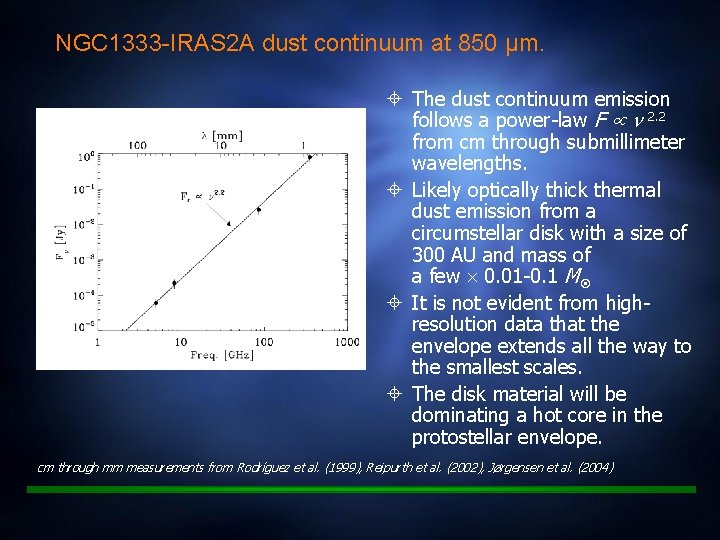
NGC 1333 -IRAS 2 A dust continuum at 850 µm. The dust continuum emission follows a power-law F 2. 2 from cm through submillimeter wavelengths. Likely optically thick thermal dust emission from a circumstellar disk with a size of 300 AU and mass of a few 0. 01 -0. 1 M It is not evident from highresolution data that the envelope extends all the way to the smallest scales. The disk material will be dominating a hot core in the protostellar envelope. cm through mm measurements from Rodríguez et al. (1999), Reipurth et al. (2002), Jørgensen et al. (2004)
Envelope and disk chemistry Low-mass hot cores: Presence of complex organic species on small scales (i. p. , IRAS 16293: Cazaux et al. (2003), Kuan et al. (2004), Bottinelli et al. (2004)).
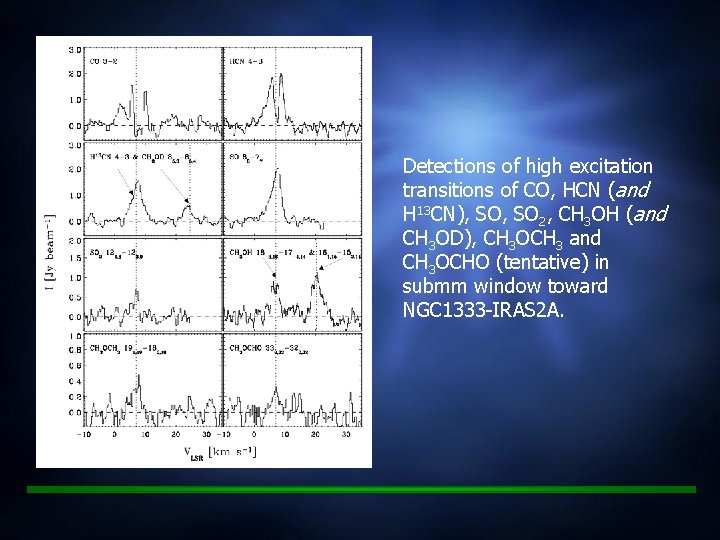
Detections of high excitation transitions of CO, HCN (and H 13 CN), SO 2, CH 3 OH (and CH 3 OD), CH 3 OCH 3 and CH 3 OCHO (tentative) in submm window toward NGC 1333 -IRAS 2 A.
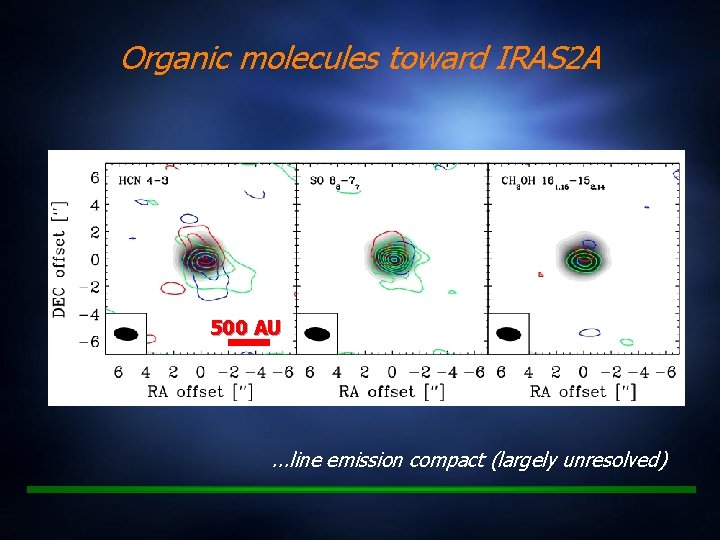
Organic molecules toward IRAS 2 A 500 AU . . . line emission compact (largely unresolved)
Envelope and disk chemistry Low-mass hot cores: Presence of complex organic species on small scales (i. p. , IRAS 16293: Cazaux et al. (2003), Kuan et al. (2004), Bottinelli et al. (2004)). Complex organic species detected on small scales in IRAS 2 A. . . . but in the 2” SMA beam: the disk column density is dominating compared to the hot core. Sulfur species are expected to be enhanced in typical hot cores (Charnley 1997, Wakelam et al. 2004)
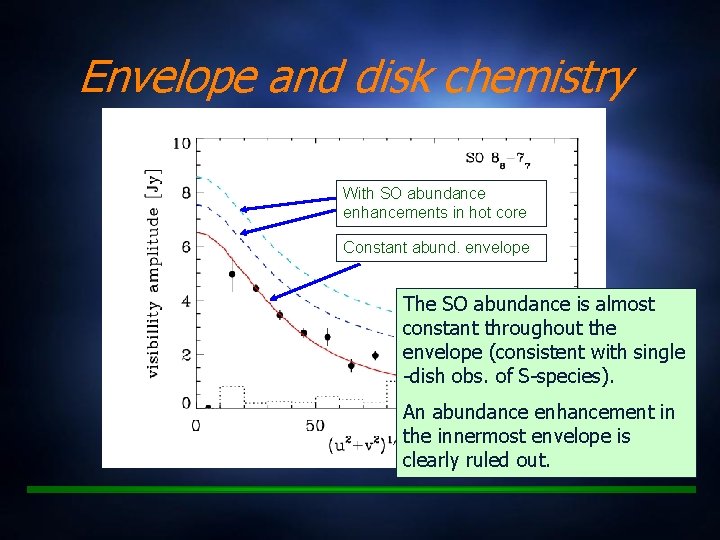
Envelope and disk chemistry With SO abundance enhancements in hot core Constant abund. envelope The SO abundance is almost constant throughout the envelope (consistent with single -dish obs. of S-species). An abundance enhancement in the innermost envelope is clearly ruled out.
Envelope and disk chemistry Low-mass hot cores: Presence of complex organic species on small scales (i. p. , IRAS 16293: Cazaux et al. (2003), Kuan et al. (2004), Bottinelli et al. (2004)). Complex organic species detected on small scales in IRAS 2 A. . . . but in the 2” SMA beam: the disk column density is dominating compared to the hot core. Sulfur species are expected to be enhanced in typical hot cores (Charnley 1997, Wakelam et al. 2004) The presence of the high excitation lines of in particular CH 3 OH suggests that the temperature is high ~ 150 K. Heated layer of circumstellar disk (e. g. , Elias 29; Ceccarelli et al. 2002)? Jørgensen et al. , Ap. J, submitted
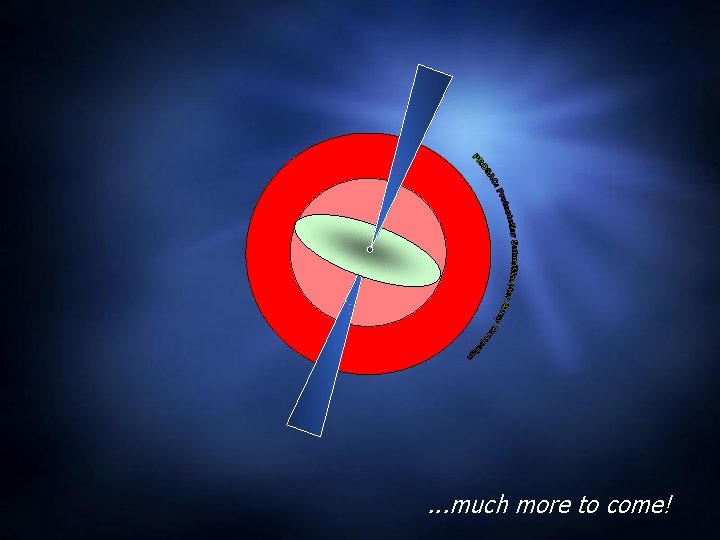
. . . much more to come!
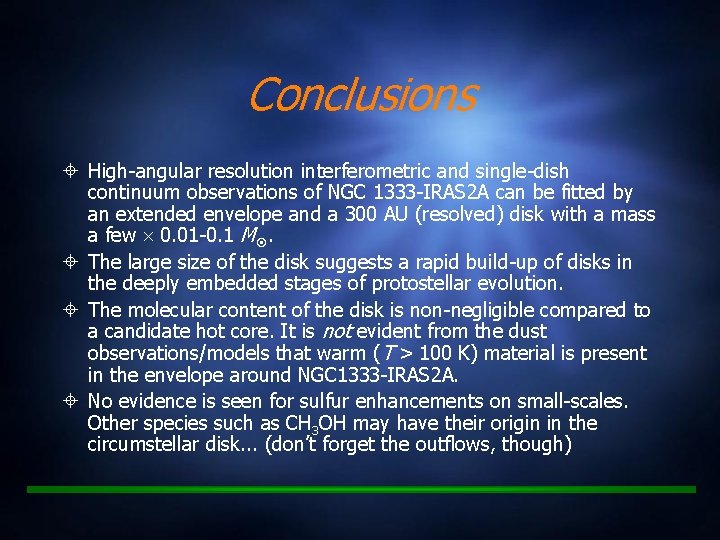
Conclusions High-angular resolution interferometric and single-dish continuum observations of NGC 1333 -IRAS 2 A can be fitted by an extended envelope and a 300 AU (resolved) disk with a mass a few 0. 01 -0. 1 M. The large size of the disk suggests a rapid build-up of disks in the deeply embedded stages of protostellar evolution. The molecular content of the disk is non-negligible compared to a candidate hot core. It is not evident from the dust observations/models that warm (T > 100 K) material is present in the envelope around NGC 1333 -IRAS 2 A. No evidence is seen for sulfur enhancements on small-scales. Other species such as CH 3 OH may have their origin in the circumstellar disk. . . (don’t forget the outflows, though)