
Star formation and big bang Nucleosynthesis Brief History
Star formation and big bang Nucleosynthesis § Brief History of the Universe. § Nucleosynthesis primordial. § Hertzsprung-Russell diagram. “The physics of stars “ A. C. Phillips, Wiley, 2004 “ La matiere nuclèaire: Des etoiles aux noyaux”, Eric Suraud, Hermann, 1998
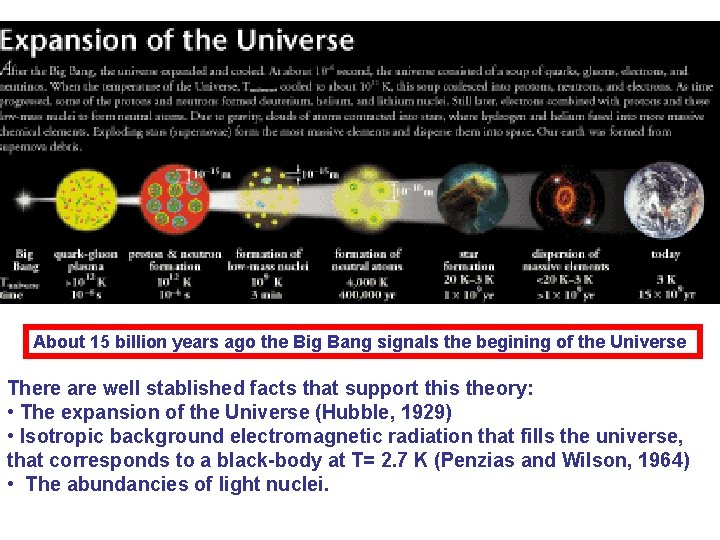
About 15 billion years ago the Big Bang signals the begining of the Universe There are well stablished facts that support this theory: • The expansion of the Universe (Hubble, 1929) • Isotropic background electromagnetic radiation that fills the universe, that corresponds to a black-body at T= 2. 7 K (Penzias and Wilson, 1964) • The abundancies of light nuclei.
Expansion of the Universe Edwin Hubble (1929) made the observation that the Universe is continuosly expanding. • The relative speed of separation between the galaxies is proportional to its relative distance. Vrel H drel with H 2. 3 10 -18 s-1. • Galaxies that are twice as far from us move away twice as fast. • The universe is expanding in every direction. • In principle every galaxy has taken the same amount of time to move from a common starting point to its current position. • These arguments give acces to calculate the age of the universe!. It turns out to be compatible with 15 billion years. • This phenomenon of galaxies moving farther away from each other give rise to the red shift. The wavelength of light coming from distant galaxies is being stretched.
To avoid conceptual and philosophycal problems, we will not talk about the instant zero!! We prefere to say that at t 10 -9 s ( 1 nanosecond) the fundamental constituents of matter are differentiated. The universe is filled with quarks, antiquarks, gluons, electroweak bosons, leptons, including neutrinos and antineutrinos, and photons. The universe is very dense, ρ 10 20 g cm-3 , and hot, T 1014 K. The universe expands and as a consequence it cools. When the temperature fell below 1014 K, then quarks can joint together in small agregates: the hadrons. We have the baryons: three quarks , as neutrons and protons, and the mesons: quark- antiquark as the pions. The gluons remain inside the hadrons. They are the responsible for the binding of quarks inside the hadrons. At the end of few microseconds! The universe consist of a mixture of hadrons (mainly neutrons and protons) , leptons and photons. The temperature has decreased considerably : T 10 13 K and the density also: ρ 10 15 g cm -3.
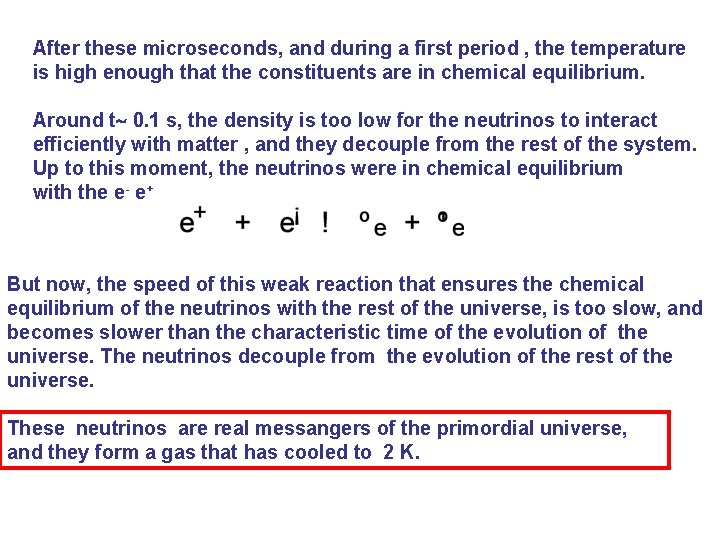
After these microseconds, and during a first period , the temperature is high enough that the constituents are in chemical equilibrium. Around t 0. 1 s, the density is too low for the neutrinos to interact efficiently with matter , and they decouple from the rest of the system. Up to this moment, the neutrinos were in chemical equilibrium with the e- e+ But now, the speed of this weak reaction that ensures the chemical equilibrium of the neutrinos with the rest of the universe, is too slow, and becomes slower than the characteristic time of the evolution of the universe. The neutrinos decouple from the evolution of the rest of the universe. These neutrinos are real messangers of the primordial universe, and they form a gas that has cooled to 2 K.

Nucleosynthesis primordial or Big Bang nucleosynthesis At T above 1010 K any deuteron formed from np collisions was quickly broken by collisions because thermal energies involved often exceeded the 2. 2 Me. V binding energy of the deuteron. High temperatures thermal neutron-proton equilibrium At normal circunstances, the neutron desintegrates with a mean life of 900 s (15 min). However, at high temperatures and densities, neutrons and protons transform in each other using thermal neutrinos and antineutrinos, electrons and positrons, and reach a thermal chemical equilibrium!
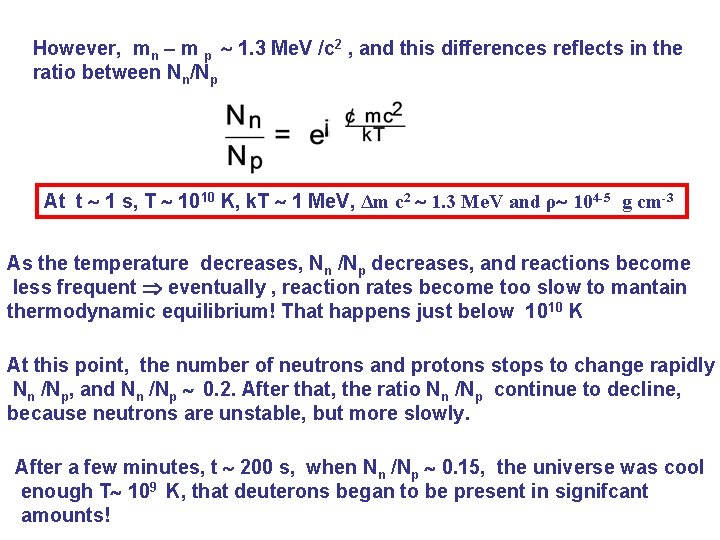
However, mn – m p 1. 3 Me. V /c 2 , and this differences reflects in the ratio between Nn/Np At t 1 s, T 1010 K, k. T 1 Me. V, Δm c 2 1. 3 Me. V and ρ 104 -5 g cm-3 As the temperature decreases, Nn /Np decreases, and reactions become less frequent eventually , reaction rates become too slow to mantain thermodynamic equilibrium! That happens just below 1010 K At this point, the number of neutrons and protons stops to change rapidly Nn /Np, and Nn /Np 0. 2. After that, the ratio Nn /Np continue to decline, because neutrons are unstable, but more slowly. After a few minutes, t 200 s, when Nn /Np 0. 15, the universe was cool enough T 109 K, that deuterons began to be present in signifcant amounts!
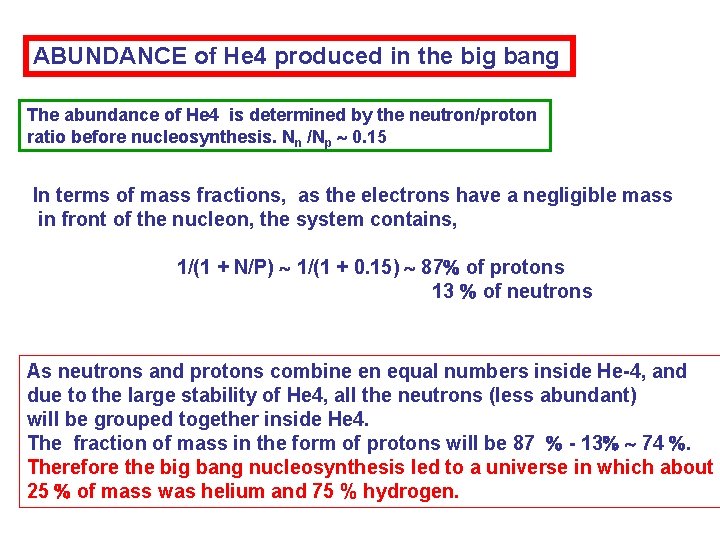
ABUNDANCE of He 4 produced in the big bang The abundance of He 4 is determined by the neutron/proton ratio before nucleosynthesis. Nn /Np 0. 15 In terms of mass fractions, as the electrons have a negligible mass in front of the nucleon, the system contains, 1/(1 + N/P) 1/(1 + 0. 15) 87 of protons 13 of neutrons As neutrons and protons combine en equal numbers inside He-4, and due to the large stability of He 4, all the neutrons (less abundant) will be grouped together inside He 4. The fraction of mass in the form of protons will be 87 - 13 74 . Therefore the big bang nucleosynthesis led to a universe in which about 25 of mass was helium and 75 % hydrogen.
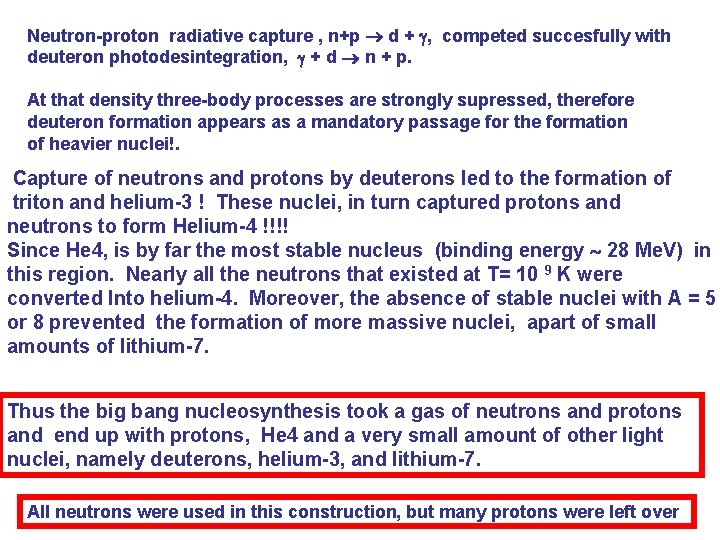
Neutron-proton radiative capture , n+p d + , competed succesfully with deuteron photodesintegration, + d n + p. At that density three-body processes are strongly supressed, therefore deuteron formation appears as a mandatory passage for the formation of heavier nuclei!. Capture of neutrons and protons by deuterons led to the formation of triton and helium-3 ! These nuclei, in turn captured protons and neutrons to form Helium-4 !!!! Since He 4, is by far the most stable nucleus (binding energy 28 Me. V) in this region. Nearly all the neutrons that existed at T= 10 9 K were converted Into helium-4. Moreover, the absence of stable nuclei with A = 5 or 8 prevented the formation of more massive nuclei, apart of small amounts of lithium-7. Thus the big bang nucleosynthesis took a gas of neutrons and protons and end up with protons, He 4 and a very small amount of other light nuclei, namely deuterons, helium-3, and lithium-7. All neutrons were used in this construction, but many protons were left over
Besides, the expanding universe continues to cool and the temperature becomes to low to overcome the Coulomb barriers! That happens at T 3 108 K (k T 0. 04 Me. V) around 1000 s after the big bang : the primordial nucleosynthesis ends! The mass composition of the universe is 75 of protons, 25 of He-4 and some traces of deuterium, 3 -He ( 10 -4 ) and 7 -Li and 7 -Be ( 10 -10 ). There will NOT be more nucleosynthesis until it will take place inside the stars much later! ( 1 million years after the big bang). Star interiors will be the only place in the Universe such that temperatures and densities will be high enough to allow fusion nuclear reactions. Before reaching that stadium, the universe composed of nuclei, protons, Electrons, neutrinos and photons continues to expand to cool. At t 3 105 years, T 4000 K (k. T 0. 3 e. V) , the electrons are captured by the nuclei to form ATOMS. In general the binding energies of the atoms are of the order of the e. V. The ionization energy of the simplest atom ( H) is 13. 6 e. V.
Decoupling of the photons The atomization of matter has also another consequence: the decoupling of the photons! The charge neutral matter becomes almost transparent to photons. From that moment, the photons will evolve independently of the rest , as first happen with neutrinos! These decoupled photons are the ones that can be observed as the background thermal radiation of about 2. 7 K. Role of gravitation Up to now, gravitation has played almost no role ( except at the first instants that we have not considered). From now on, Gravity will be the driving force behind stellar evolution. It leads to the compression of matter and to the formation of stars and also leads to the conditions (inside the stars) were nuclear forces will play a constructive role in thermonuclear fusion. Allowing for the transformation of helium in heavier elements such as carbon, oxigen and iron : star dust out of which we are made
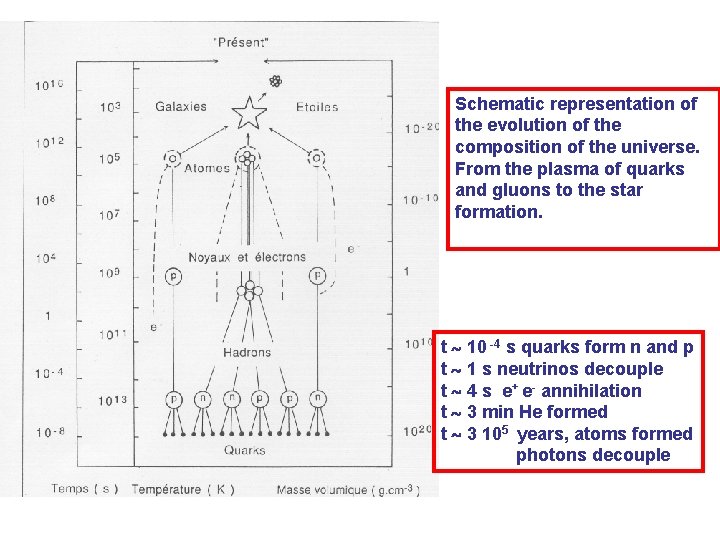
Schematic representation of the evolution of the composition of the universe. From the plasma of quarks and gluons to the star formation. t 10 -4 s quarks form n and p t 1 s neutrinos decouple t 4 s e+ e- annihilation t 3 min He formed t 3 105 years, atoms formed photons decouple
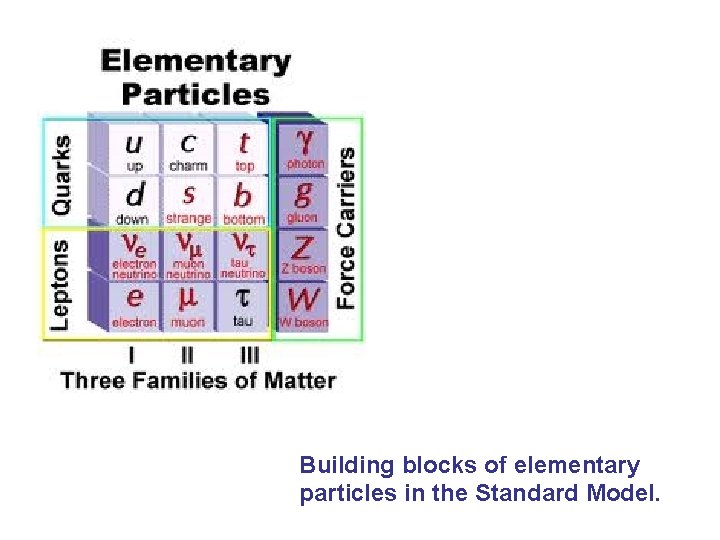
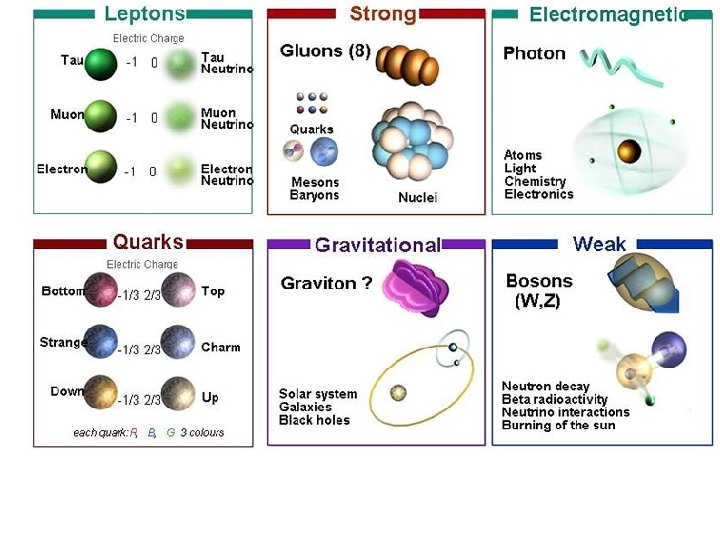
Building blocks of elementary particles in the Standard Model.
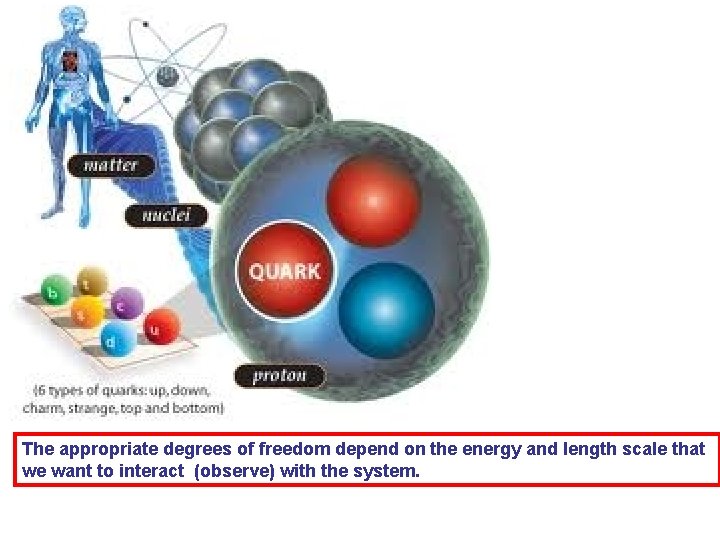
The appropriate degrees of freedom depend on the energy and length scale that we want to interact (observe) with the system.
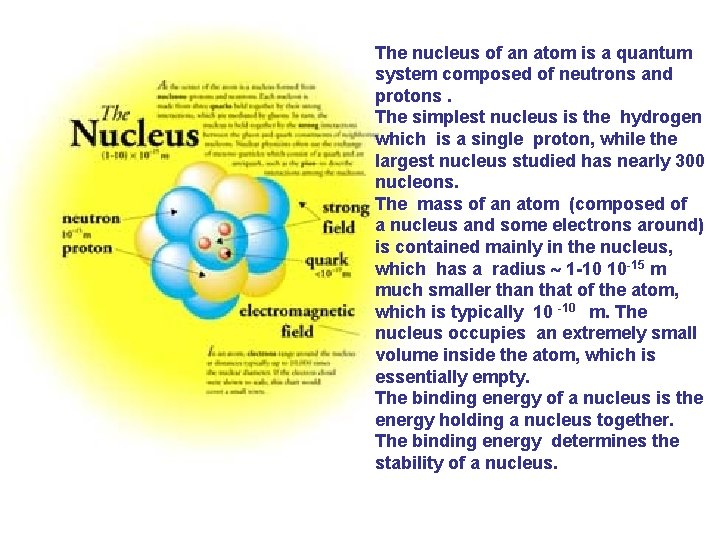
The nucleus of an atom is a quantum system composed of neutrons and protons. The simplest nucleus is the hydrogen which is a single proton, while the largest nucleus studied has nearly 300 nucleons. The mass of an atom (composed of a nucleus and some electrons around) is contained mainly in the nucleus, which has a radius 1 -10 10 -15 m much smaller than that of the atom, which is typically 10 -10 m. The nucleus occupies an extremely small volume inside the atom, which is essentially empty. The binding energy of a nucleus is the energy holding a nucleus together. The binding energy determines the stability of a nucleus.
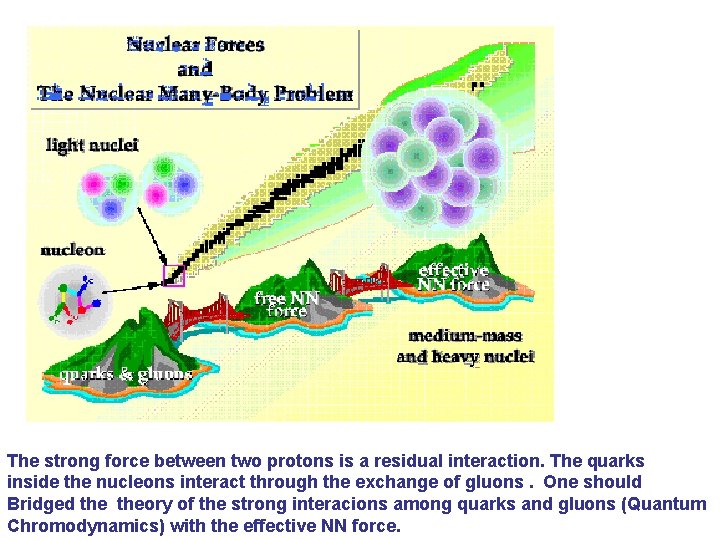
The strong force between two protons is a residual interaction. The quarks inside the nucleons interact through the exchange of gluons. One should Bridged theory of the strong interacions among quarks and gluons (Quantum Chromodynamics) with the effective NN force.
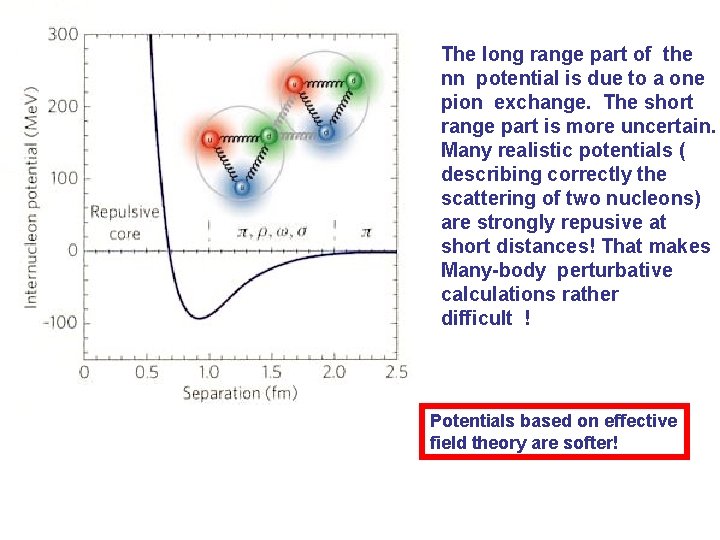
The long range part of the nn potential is due to a one pion exchange. The short range part is more uncertain. Many realistic potentials ( describing correctly the scattering of two nucleons) are strongly repusive at short distances! That makes Many-body perturbative calculations rather difficult ! Potentials based on effective field theory are softer!
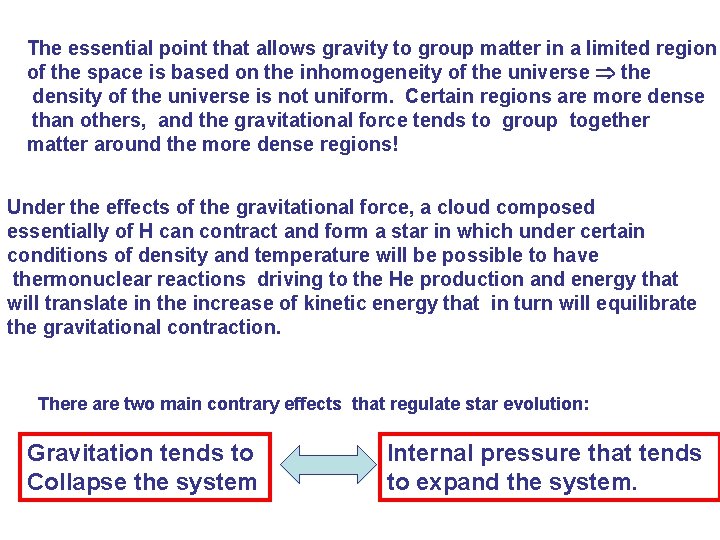
The essential point that allows gravity to group matter in a limited region of the space is based on the inhomogeneity of the universe the density of the universe is not uniform. Certain regions are more dense than others, and the gravitational force tends to group together matter around the more dense regions! Under the effects of the gravitational force, a cloud composed essentially of H can contract and form a star in which under certain conditions of density and temperature will be possible to have thermonuclear reactions driving to the He production and energy that will translate in the increase of kinetic energy that in turn will equilibrate the gravitational contraction. There are two main contrary effects that regulate star evolution: Gravitation tends to Collapse the system Internal pressure that tends to expand the system.
What is the origin of this internal pressure? Stars are electrically neutral, initially they are formed with neutral atoms! Electric forces are screened. The pressure has mainly two origins: Thermal: Is the most frequent. The thermal movement provides the pressure. The graviational collapse produces an increment of density and temperature, such that thermonuclear reactions can take place They produce enough energy to equilibrate the star during the combustion. Quantic: Is the consequence of the Pauli operator. Are cold stars! White dwarfs Another example of cold stars, are the neutron stars. In this case the pressure is provided by the neutron-neutron interactions. In all cases we need the EQUATION of STATE of the system that relates pressure with the density and temperature.
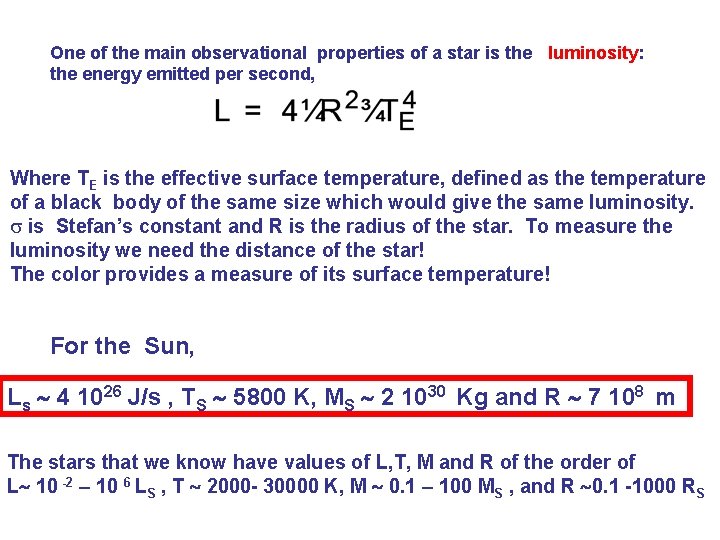
One of the main observational properties of a star is the luminosity: the energy emitted per second, Where TE is the effective surface temperature, defined as the temperature of a black body of the same size which would give the same luminosity. s is Stefan’s constant and R is the radius of the star. To measure the luminosity we need the distance of the star! The color provides a measure of its surface temperature! For the Sun, Ls 4 1026 J/s , TS 5800 K, MS 2 1030 Kg and R 7 108 m The stars that we know have values of L, T, M and R of the order of L 10 -2 – 10 6 LS , T 2000 - 30000 K, M 0. 1 – 100 MS , and R 0. 1 -1000 RS
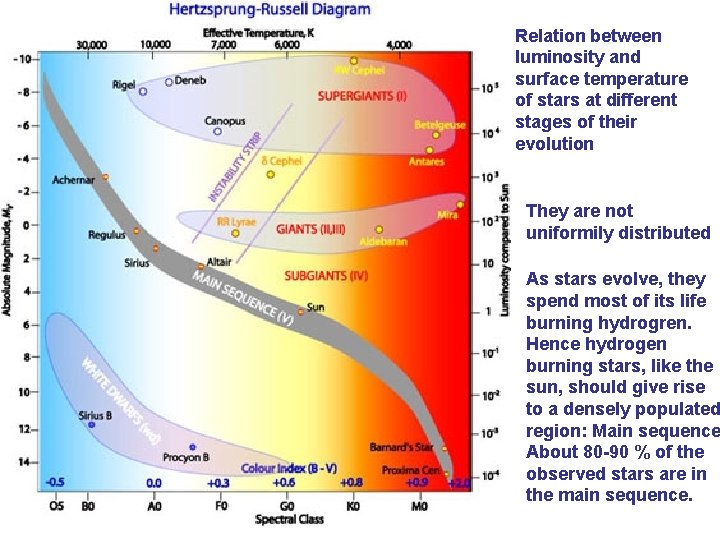
Relation between luminosity and surface temperature of stars at different stages of their evolution They are not uniformily distributed As stars evolve, they spend most of its life burning hydrogren. Hence hydrogen burning stars, like the sun, should give rise to a densely populated region: Main sequence About 80 -90 % of the observed stars are in the main sequence.
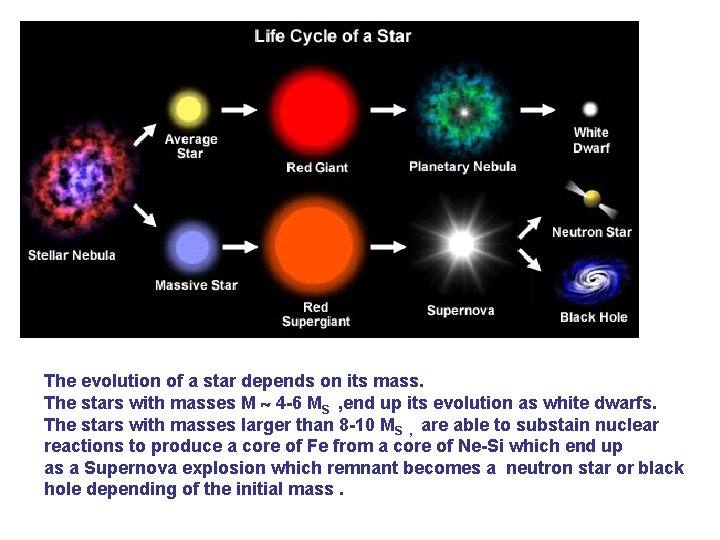
The evolution of a star depends on its mass. The stars with masses M 4 -6 MS , end up its evolution as white dwarfs. The stars with masses larger than 8 -10 MS , are able to substain nuclear reactions to produce a core of Fe from a core of Ne-Si which end up as a Supernova explosion which remnant becomes a neutron star or black hole depending of the initial mass.
Star structure We take a star in the main sequence, burning hydrogen. As the sun. Many aspects that determine the structure of the star will be valid for other types of stars. The description of a “ stable” star is based on the idea that is composed of a gas of atoms in hydrostatic equilibrium in which the gravitatory attraction that wouldbring to the collapse of the star is compensated by the internal presure. One should also consider, thermal and radiative equlibrium and convective equilibrium. To simplify , we can assume that the star has spherical symmetry and ignore vibrations, rotations , etc. .
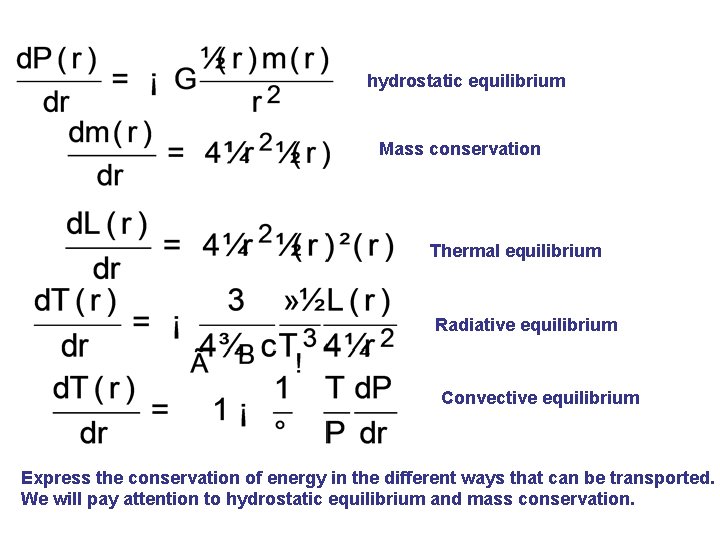
hydrostatic equilibrium Mass conservation Thermal equilibrium Radiative equilibrium Convective equilibrium Express the conservation of energy in the different ways that can be transported. We will pay attention to hydrostatic equilibrium and mass conservation.
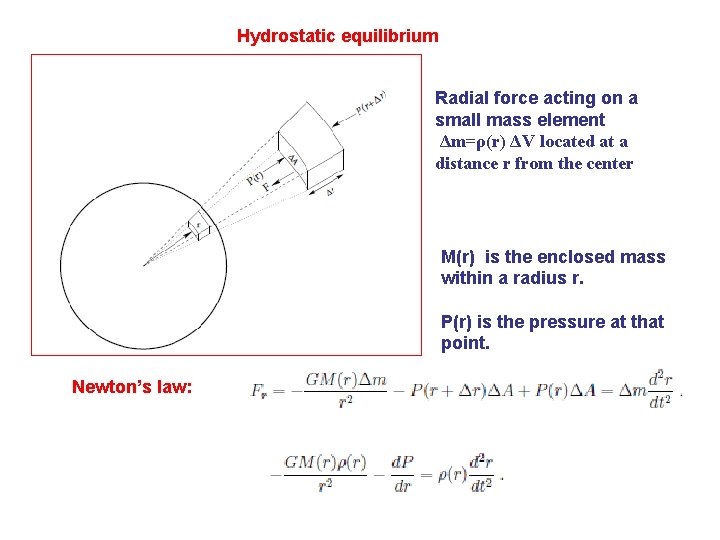
Hydrostatic equilibrium Radial force acting on a small mass element Δm=ρ(r) ΔV located at a distance r from the center M(r) is the enclosed mass within a radius r. P(r) is the pressure at that point. Newton’s law:
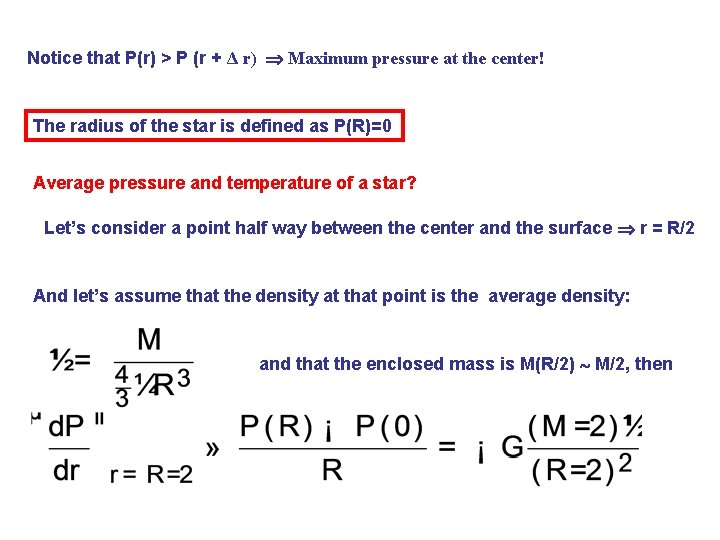
Notice that P(r) > P (r + Δ r) Maximum pressure at the center! The radius of the star is defined as P(R)=0 Average pressure and temperature of a star? Let’s consider a point half way between the center and the surface r = R/2 And let’s assume that the density at that point is the average density: and that the enclosed mass is M(R/2) M/2, then
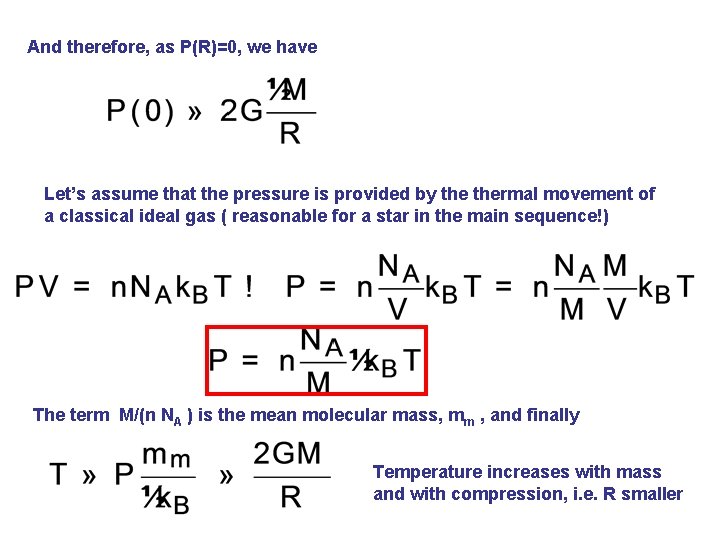
And therefore, as P(R)=0, we have Let’s assume that the pressure is provided by thermal movement of a classical ideal gas ( reasonable for a star in the main sequence!) The term M/(n NA ) is the mean molecular mass, mm , and finally Temperature increases with mass and with compression, i. e. R smaller
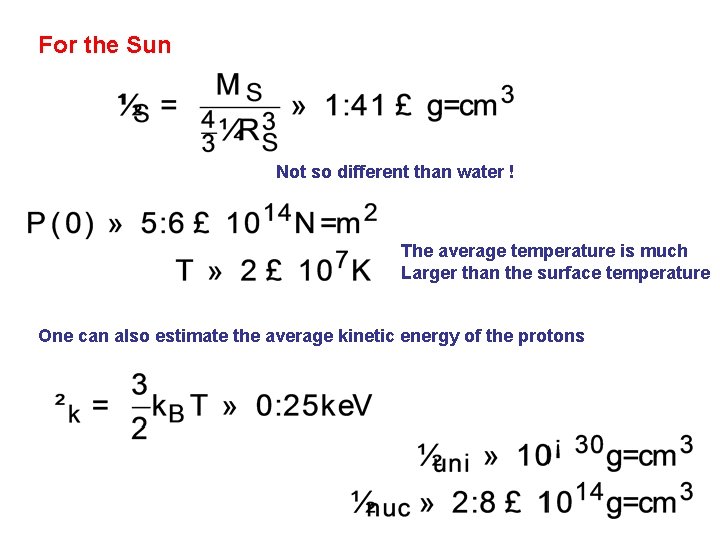
For the Sun Not so different than water ! The average temperature is much Larger than the surface temperature One can also estimate the average kinetic energy of the protons
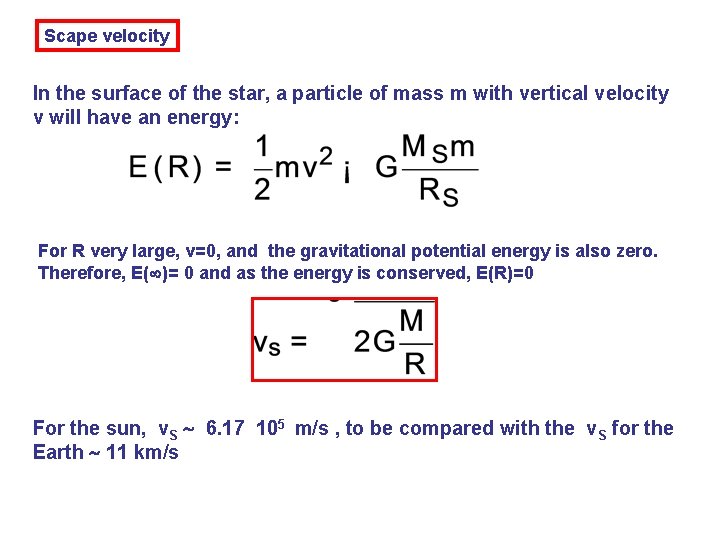
Scape velocity In the surface of the star, a particle of mass m with vertical velocity v will have an energy: For R very large, v=0, and the gravitational potential energy is also zero. Therefore, E( )= 0 and as the energy is conserved, E(R)=0 For the sun, v. S 6. 17 105 m/s , to be compared with the v. S for the Earth 11 km/s
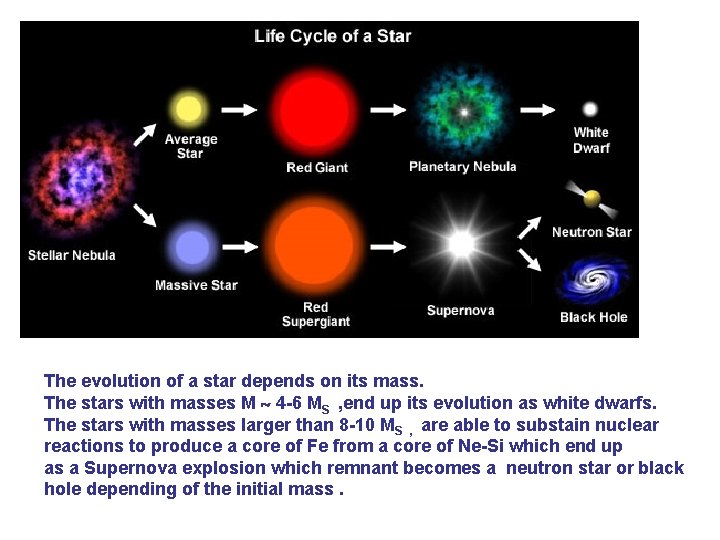
The evolution of a star depends on its mass. The stars with masses M 4 -6 MS , end up its evolution as white dwarfs. The stars with masses larger than 8 -10 MS , are able to substain nuclear reactions to produce a core of Fe from a core of Ne-Si which end up as a Supernova explosion which remnant becomes a neutron star or black hole depending of the initial mass.
- Slides: 32