
STAR as a Fixed Target Experiment Sam Brovko
STAR as a Fixed Target Experiment? Sam Brovko, Brooke Haag, Daniel Cebra Abstract for APS meeting: Analysis of fixed target collisions between gold ions in the beam and aluminum nuclei in the beam pipe using the STAR detector at RHIC will be presented. These fixed target collisions allow us to study a region of collision energy below the lowest energy scheduled for the RHIC beam energy scan. This might extend the region baryon chemical potential available for discovery of the critical point in the hadronic gas to quark-gluon plasma boundary in the nuclear matter phase diagram. In this talk, we will show preliminary results of pion, proton and light nuclei spectra as well as d. N/dy distributions for pions and protons. Comparisons will be made to results from the AGS heavy ion program and to Ur. QMD simulations. Brovko, Haag, Cebra January 06, 2011 LF Spectra Phone Conference Slide 1 of 40
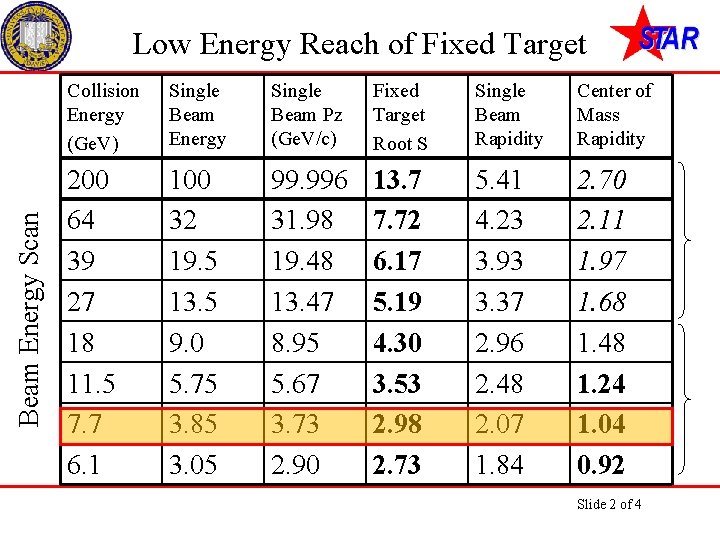
Beam Energy Scan Low Energy Reach of Fixed Target Collision Energy (Ge. V) Single Beam Energy Single Beam Pz (Ge. V/c) Fixed Target Root S Single Beam Rapidity Center of Mass Rapidity 200 64 39 27 18 11. 5 7. 7 6. 1 100 32 19. 5 13. 5 9. 0 5. 75 3. 85 3. 05 99. 996 31. 98 19. 48 13. 47 8. 95 5. 67 3. 73 2. 90 13. 7 7. 72 6. 17 5. 19 4. 30 3. 53 2. 98 2. 73 5. 41 4. 23 3. 93 3. 37 2. 96 2. 48 2. 07 1. 84 2. 70 2. 11 1. 97 1. 68 1. 48 1. 24 1. 04 0. 92 Slide 2 of 40
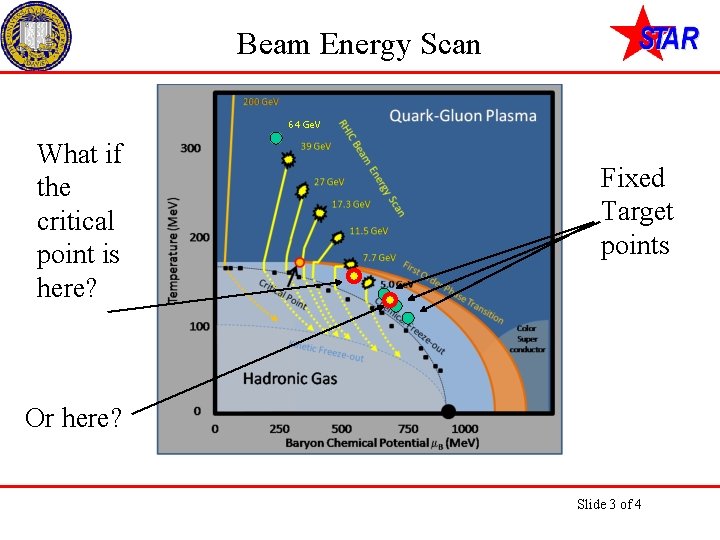
Beam Energy Scan 64 Ge. V What if the critical point is here? Fixed Target points Or here? Slide 3 of 40
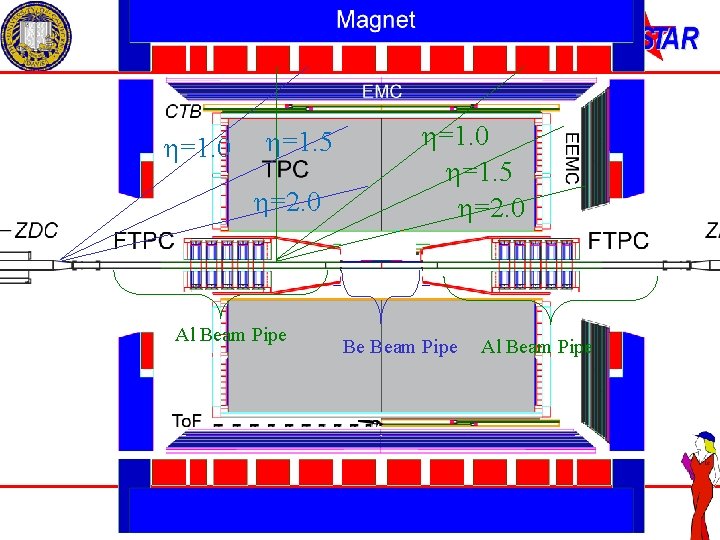
h=1. 0 h=1. 5 h=2. 0 Al Beam Pipe h=1. 0 h=1. 5 h=2. 0 Be Beam Pipe Al Beam Pipe Slide 4 of 40
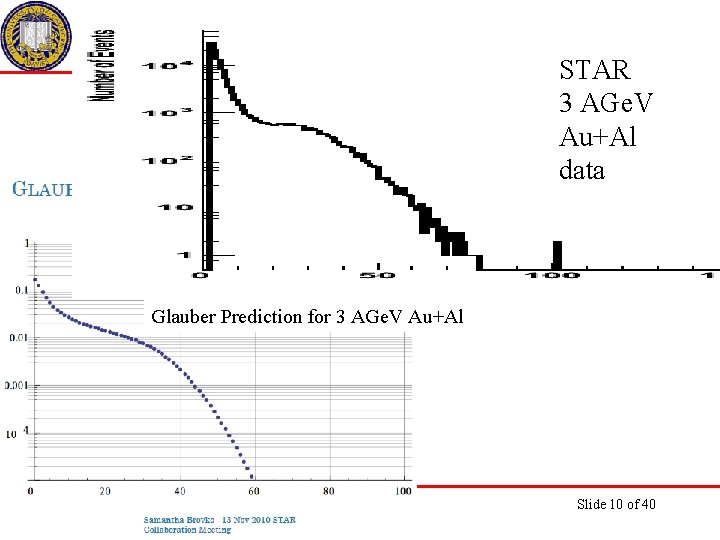
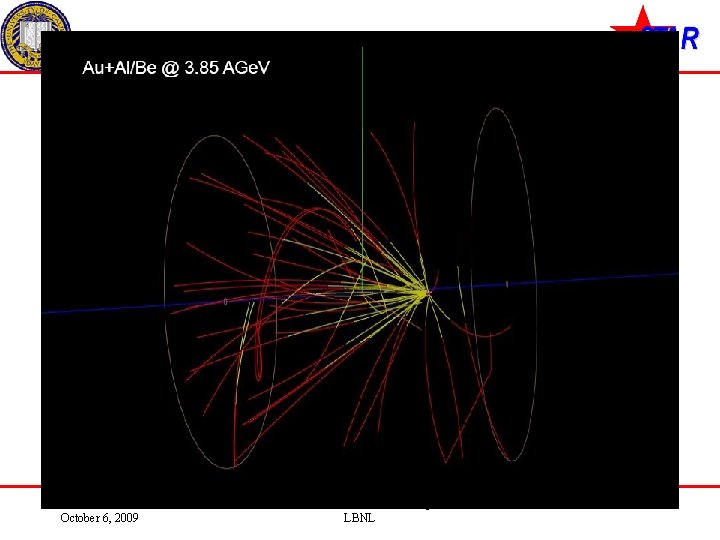
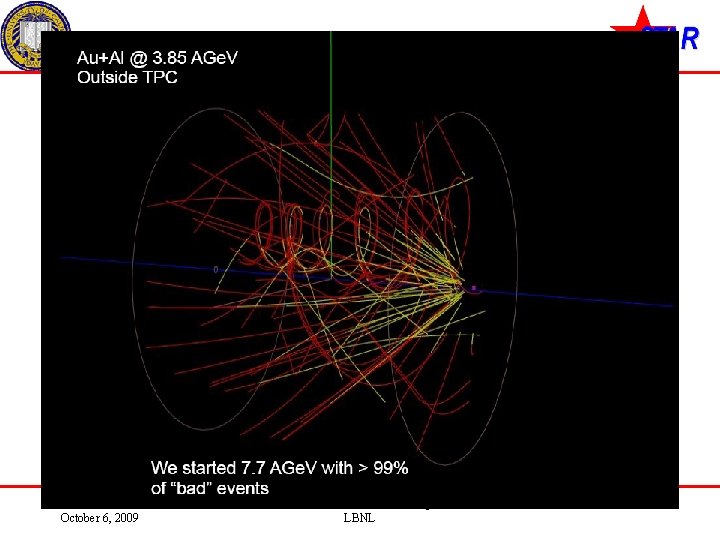
3 AGe. V 197 Au + 27 Al Required Steps: 1) Demonstrate that we can select Al target events 2) Demonstrate that we can demonstrate that we have am Au projectile 3) Demonstrate that we know that collision energy Slide 5 of 40
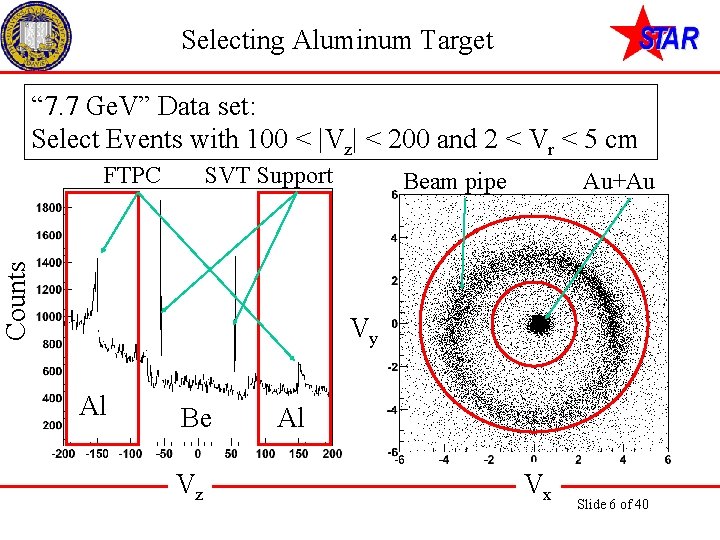
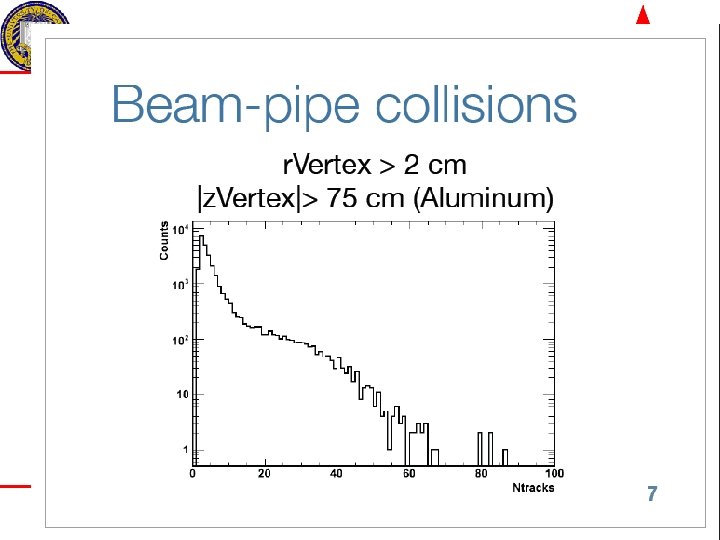
Selecting Aluminum Target “ 7. 7 Ge. V” Data set: Select Events with 100 < |Vz| < 200 and 2 < Vr < 5 cm SVT Support Counts FTPC Beam pipe Au+Au Vy Al Be Vz Al Vx Slide 6 of 40

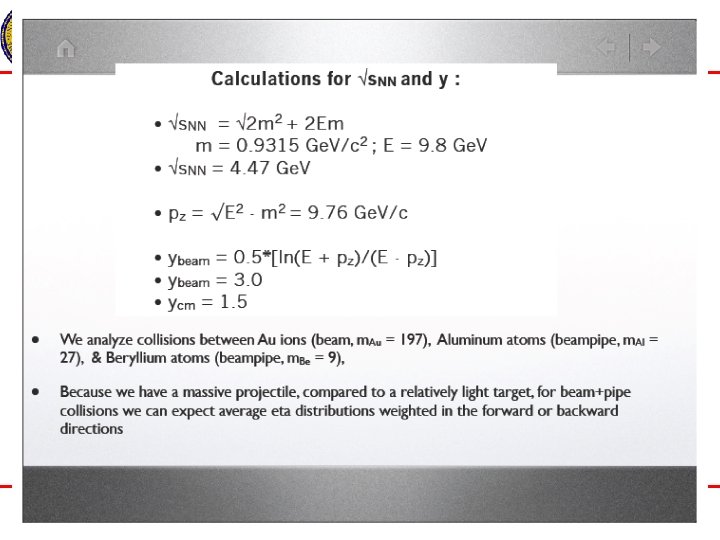
Determining the Collision Energy Challenge – We have “oriented” the target parallel to the beam axis The target is infinitely “thick”. The initial projectile energy is 2. 94 AGe. V. How much energy is lost prior to the Au+Al nuclear collision? Range of 3 AGe. V Au in Al is 64. 8 cm due to d. E/dx The Au+Al nuclear interaction length is 3. 63 cm. The Au ion travels only 5% of its range before experiencing a nuclear collision, therefore it will lose only 5% of its energy. Collision Energy is 2. 8 +/- 0. 2 AGe. V Slide 7 of 40
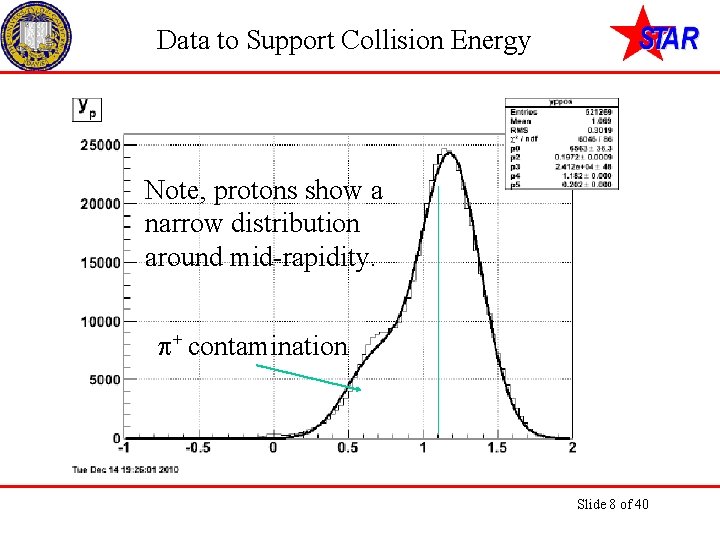
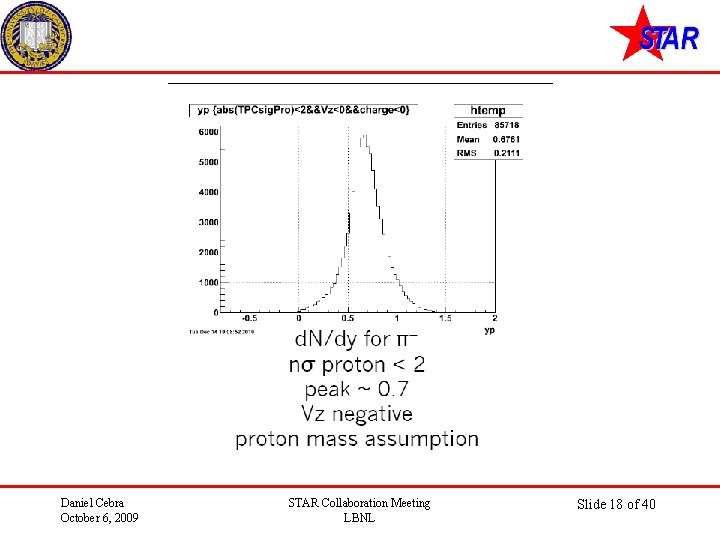
Data to Support Collision Energy Note, protons show a narrow distribution around mid-rapidity. p+ contamination Slide 8 of 40
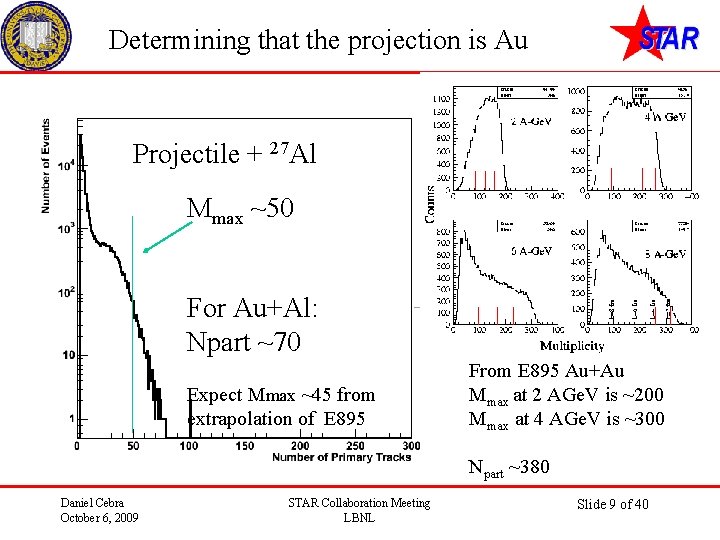
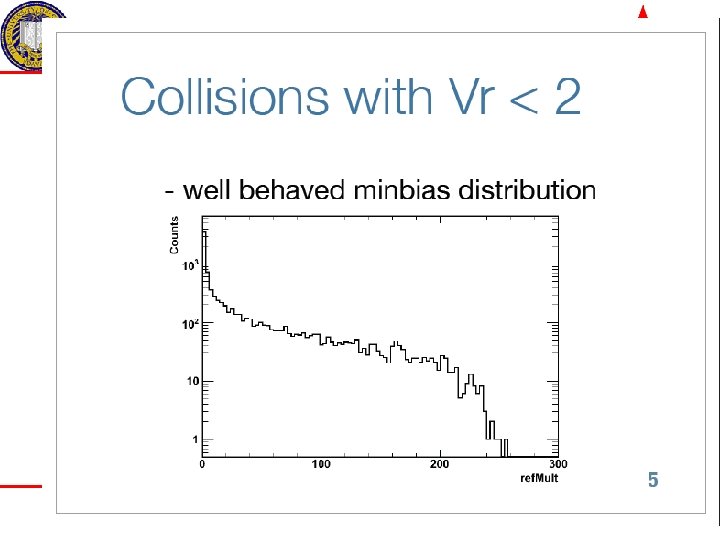
Determining that the projection is Au Projectile + 27 Al 7. 7 Ge. V Au+Au Mmax ~50 For Au+Al: Npart ~70 Expect Mmax ~45 from extrapolation of E 895 From E 895 Au+Au Mmax at 2 AGe. V is ~200 Mmax at 4 AGe. V is ~300 Npart ~380 Daniel Cebra October 6, 2009 STAR Collaboration Meeting LBNL Slide 9 of 40
Determining that the projection is Au STAR 3 AGe. V Au+Al data Glauber Prediction for 3 AGe. V Au+Al Slide 10 of 40
Daniel Cebra October 6, 2009 STAR Collaboration Meeting LBNL Slide 11 of 40
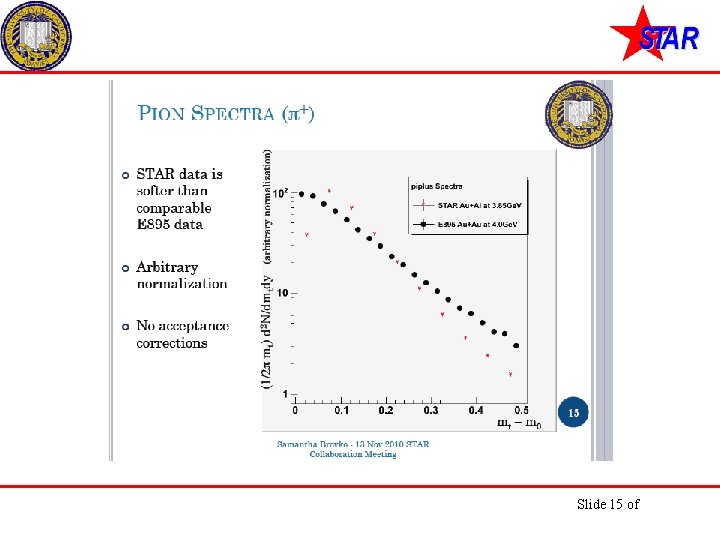
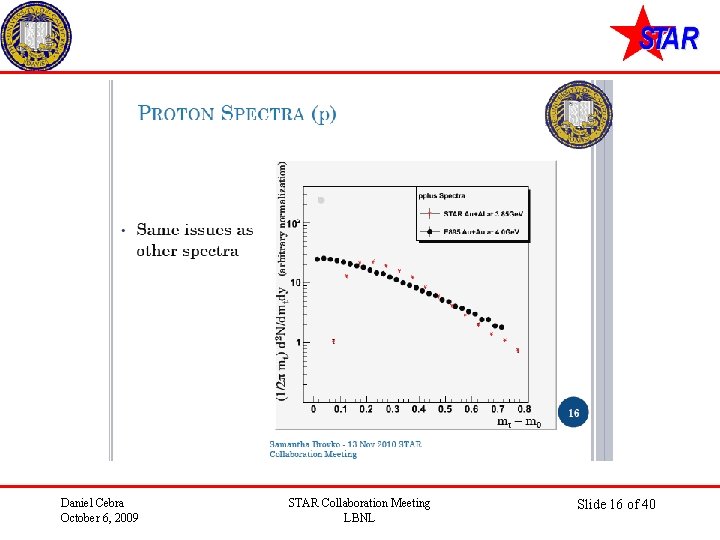
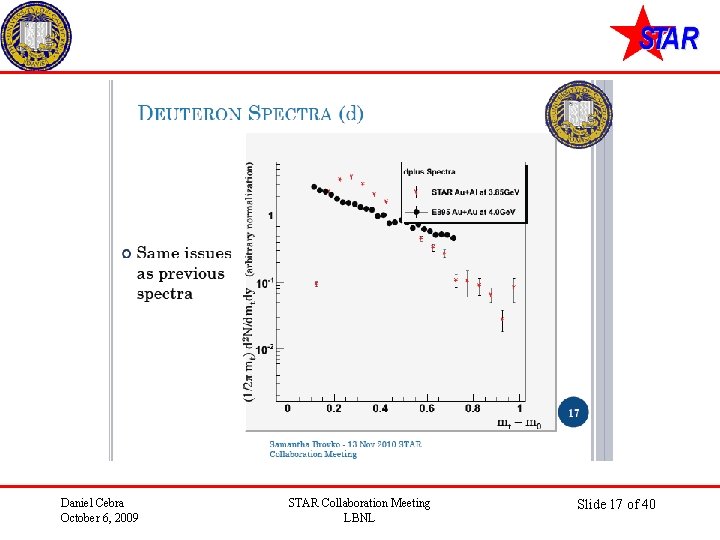
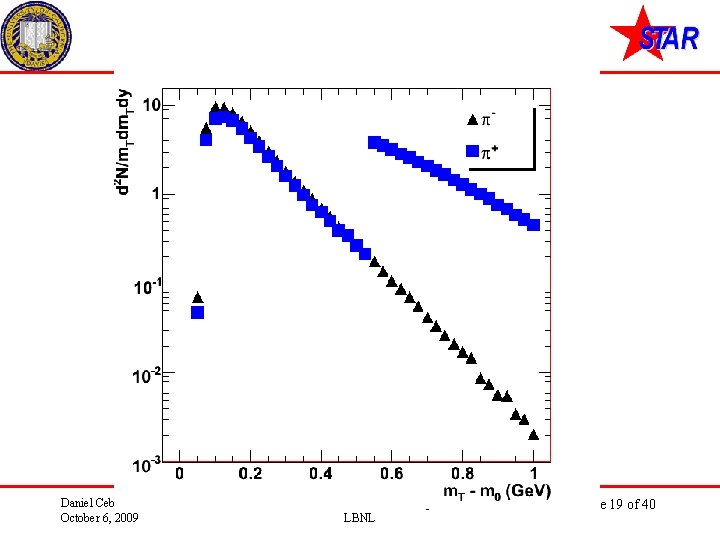
Pion Spectra from 3. 85 AGe. V Au+Al Slide 12 of 40
Acceptance for Fixed Target h = 1. 8 Slide 13 of 40

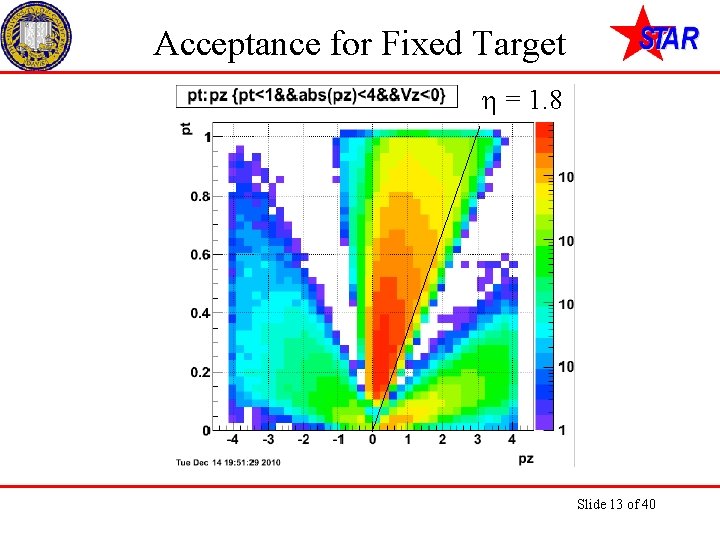
Conclusions • We can select fixed target Au+Al events • The collision energy is fairly well defined • Fixed target geometry is adequate to RHIC subinjection energy beams. • We will focus on charged particle spectra. Slide 14 of 40
Backup Slides Slide 15 of 40
Daniel Cebra October 6, 2009 STAR Collaboration Meeting LBNL Slide 16 of 40
Daniel Cebra October 6, 2009 STAR Collaboration Meeting LBNL Slide 17 of 40
Daniel Cebra October 6, 2009 STAR Collaboration Meeting LBNL Slide 18 of 40
Daniel Cebra October 6, 2009 STAR Collaboration Meeting LBNL Slide 19 of 40
Daniel Cebra October 6, 2009 STAR Collaboration Meeting LBNL Slide 20 of 40
Daniel Cebra October 6, 2009 STAR Collaboration Meeting LBNL Slide 21 of 40
Daniel Cebra October 6, 2009 STAR Collaboration Meeting LBNL Slide 22 of 40
Daniel Cebra October 6, 2009 STAR Collaboration Meeting LBNL Slide 23 of 40
Daniel Cebra October 6, 2009 STAR Collaboration Meeting LBNL Slide 24 of 40
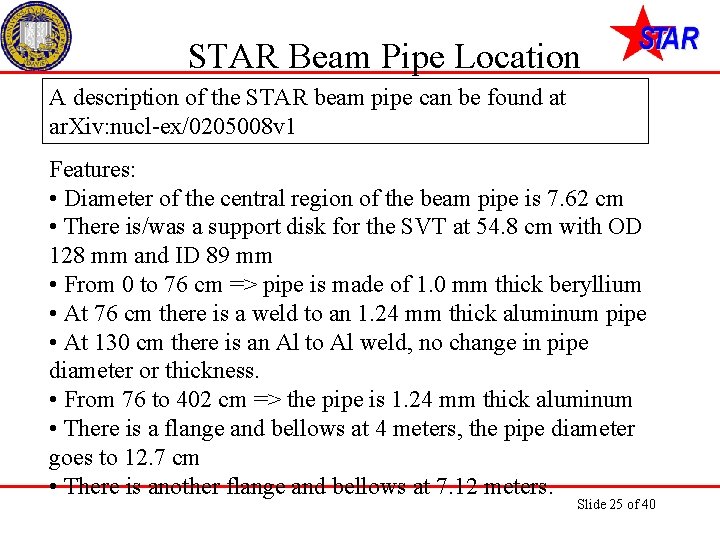
STAR Beam Pipe Location A description of the STAR beam pipe can be found at ar. Xiv: nucl-ex/0205008 v 1 Features: • Diameter of the central region of the beam pipe is 7. 62 cm • There is/was a support disk for the SVT at 54. 8 cm with OD 128 mm and ID 89 mm • From 0 to 76 cm => pipe is made of 1. 0 mm thick beryllium • At 76 cm there is a weld to an 1. 24 mm thick aluminum pipe • At 130 cm there is an Al to Al weld, no change in pipe diameter or thickness. • From 76 to 402 cm => the pipe is 1. 24 mm thick aluminum • There is a flange and bellows at 4 meters, the pipe diameter goes to 12. 7 cm • There is another flange and bellows at 7. 12 meters. Slide 25 of 40
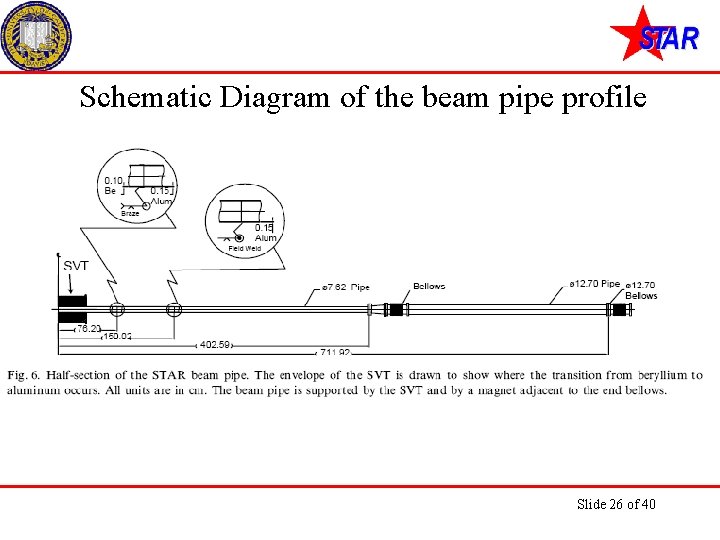
Schematic Diagram of the beam pipe profile Slide 26 of 40
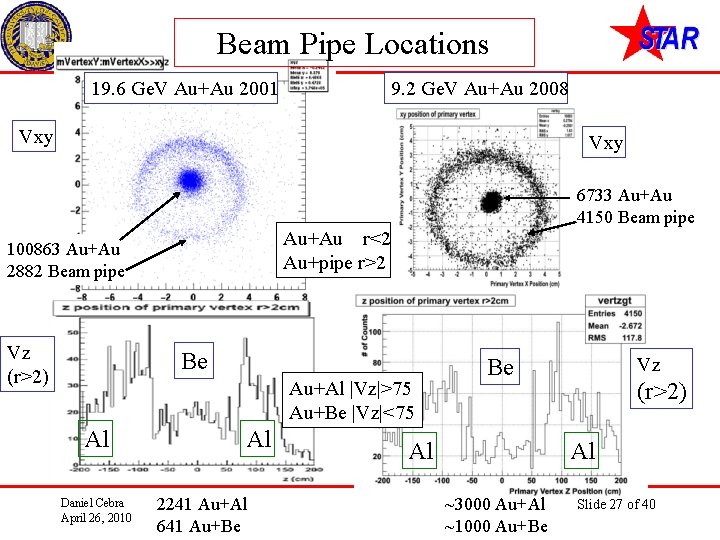
Beam Pipe Locations 19. 6 Ge. V Au+Au 2001 9. 2 Ge. V Au+Au 2008 Vxy 6733 Au+Au 4150 Beam pipe Au+Au r<2 Au+pipe r>2 100863 Au+Au 2882 Beam pipe Vz (r>2) Be Au+Al |Vz|>75 Au+Be |Vz|<75 Al Daniel Cebra April 26, 2010 Al 2241 Au+Al 641 Au+Be Vz Be Al (r>2) Al ~3000 Au+Al ~1000 Au+Be Slide 27 of 40
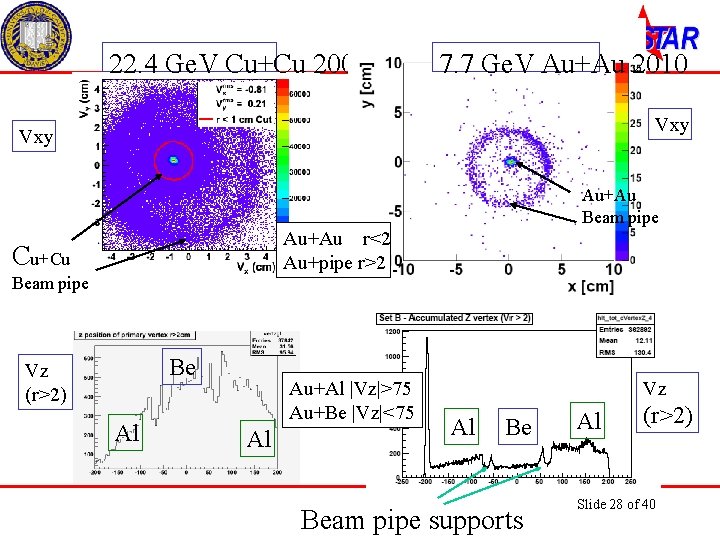
22. 4 Ge. V Cu+Cu 2005 7. 7 Ge. V Au+Au 2010 Vxy Au+Au Beam pipe Au+Au r<2 Au+pipe r>2 Cu+Cu Beam pipe Be Vz (r>2) Al Au+Al |Vz|>75 Au+Be |Vz|<75 Al Vz Al Be Beam pipe supports Al (r>2) Slide 28 of 40
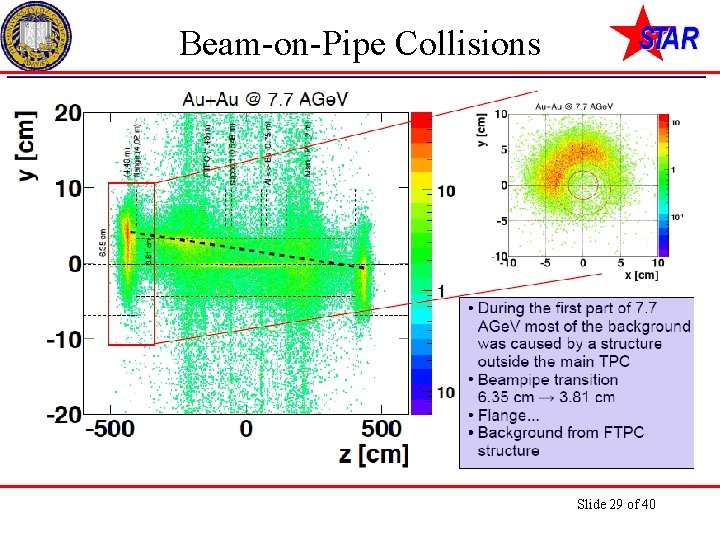
Beam-on-Pipe Collisions Slide 29 of 40
- Slides: 29