
Standing Waves Beats and Group Velocity Superposition again
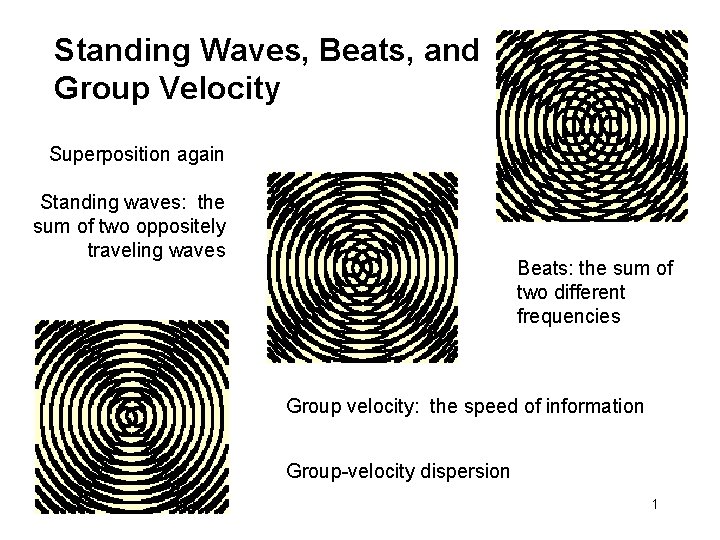
Standing Waves, Beats, and Group Velocity Superposition again Standing waves: the sum of two oppositely traveling waves Beats: the sum of two different frequencies Group velocity: the speed of information Group-velocity dispersion 1
Leerdoelen In dit college leer je: • Dat lichtgolven kunnen interfereren (superpositie) • Hoe lichtgolven bij verschillende golflengtes samen een puls vormen • Interferentiepatronen berekenen • Wat de groepssnelheid is van een lichtpuls en hoe je die berekent • Analyseren wat de invloed van dispersie is op lichtpulsen • Een golf f = f ( x, t ). Bedenk steeds of in een plot x constant wordt gehouden (“film”) of dat t constant is (“foto”). • Hecht: 7. 2 2
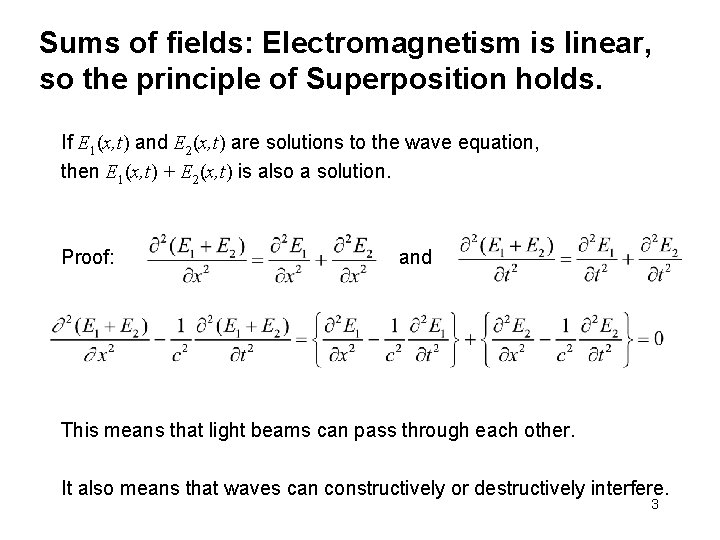
Sums of fields: Electromagnetism is linear, so the principle of Superposition holds. If E 1(x, t) and E 2(x, t) are solutions to the wave equation, then E 1(x, t) + E 2(x, t) is also a solution. Proof: and This means that light beams can pass through each other. It also means that waves can constructively or destructively interfere. 3
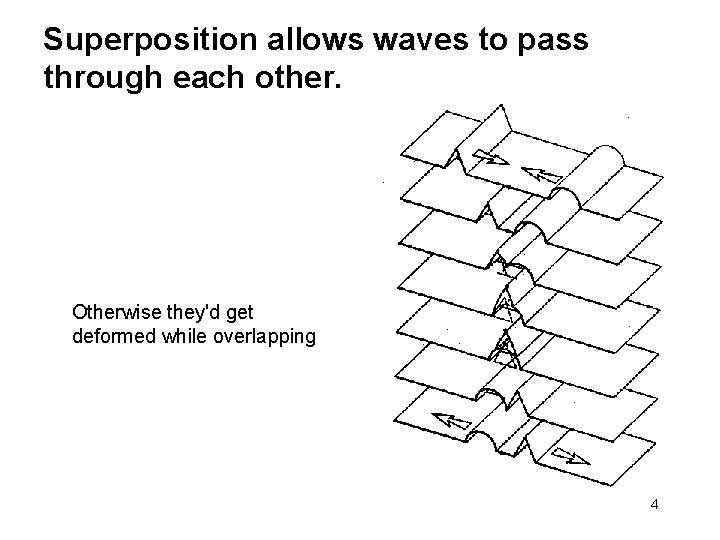
Superposition allows waves to pass through each other. Otherwise they'd get deformed while overlapping 4
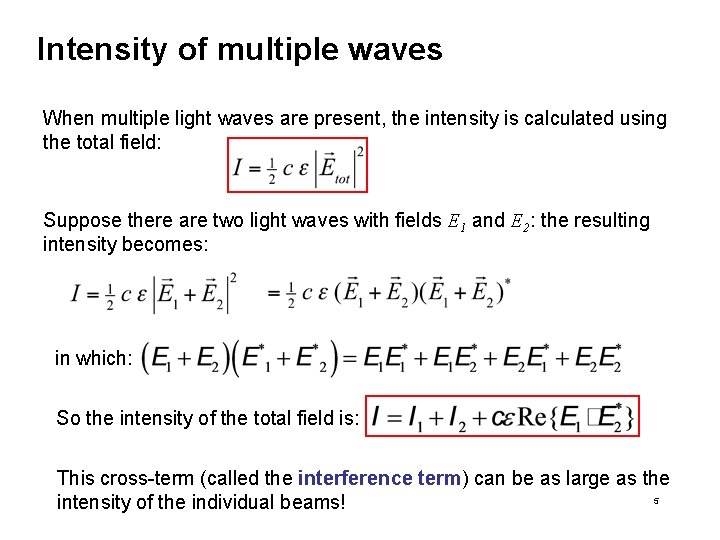
Intensity of multiple waves When multiple light waves are present, the intensity is calculated using the total field: Suppose there are two light waves with fields E 1 and E 2: the resulting intensity becomes: in which: So the intensity of the total field is: This cross-term (called the interference term) can be as large as the 5 intensity of the individual beams!
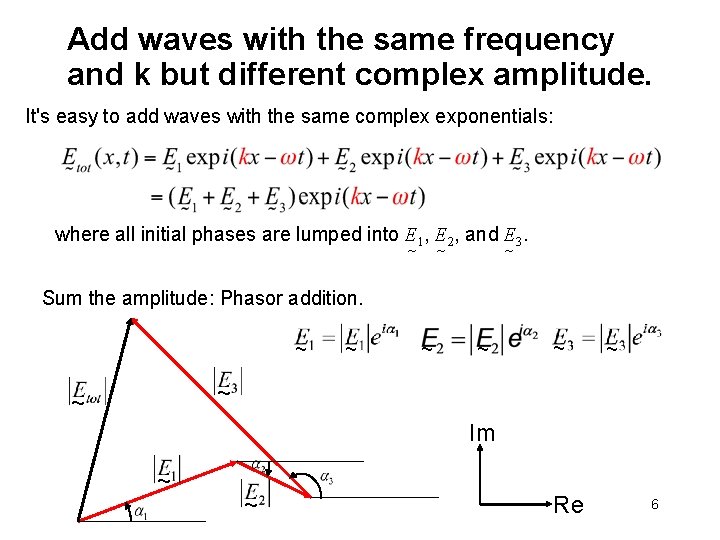
Add waves with the same frequency and k but different complex amplitude. It's easy to add waves with the same complex exponentials: where all initial phases are lumped into E 1, E 2, and E 3. ~ ~ ~ Sum the amplitude: Phasor addition. ~ ~ ~ ~ Im ~ ~ Re 6

But sometimes the complex exponentials will be different! Now we’ll add waves with different complex exponentials. Note the plus sign! 7
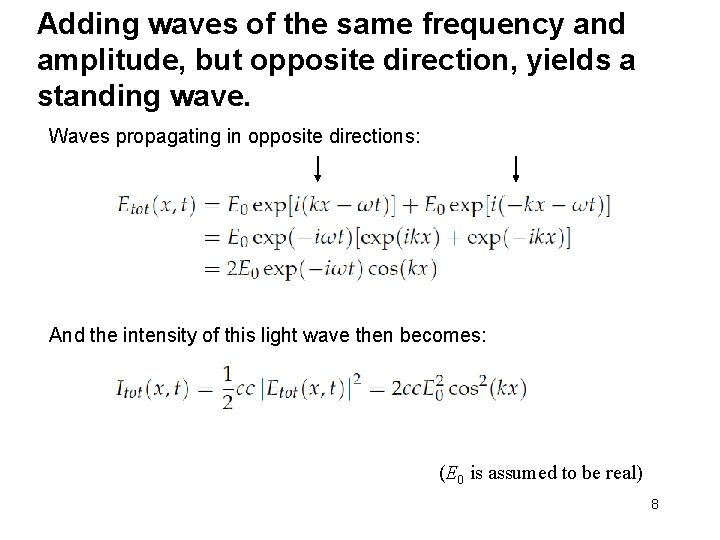
Adding waves of the same frequency and amplitude, but opposite direction, yields a standing wave. Waves propagating in opposite directions: And the intensity of this light wave then becomes: (E 0 is assumed to be real) 8
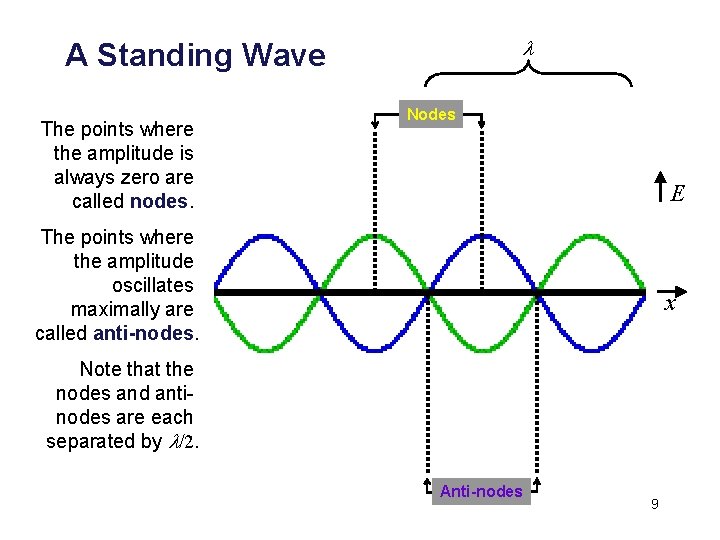
l A Standing Wave The points where the amplitude is always zero are called nodes. Nodes E The points where the amplitude oscillates maximally are called anti-nodes. x Note that the nodes and antinodes are each separated by l/2. Anti-nodes 9
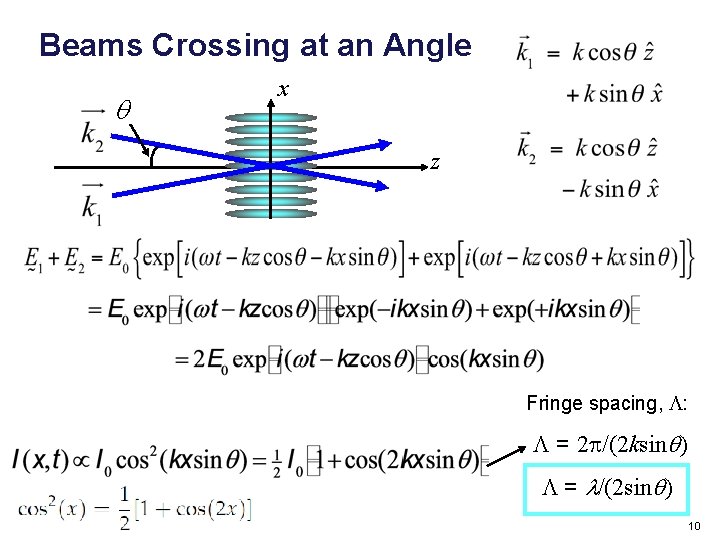
Beams Crossing at an Angle q x z Fringe spacing, L: L = 2 p/(2 ksinq) L = l/(2 sinq) 10
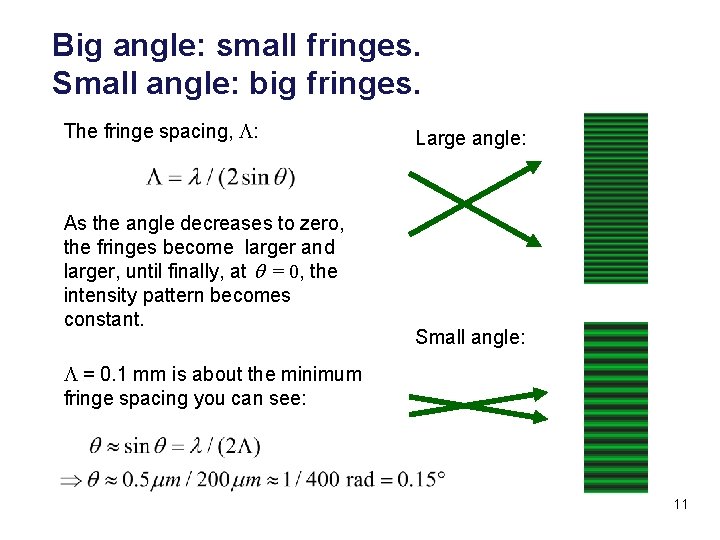
Big angle: small fringes. Small angle: big fringes. The fringe spacing, L: As the angle decreases to zero, the fringes become larger and larger, until finally, at q = 0, the intensity pattern becomes constant. Large angle: Small angle: L = 0. 1 mm is about the minimum fringe spacing you can see: 11
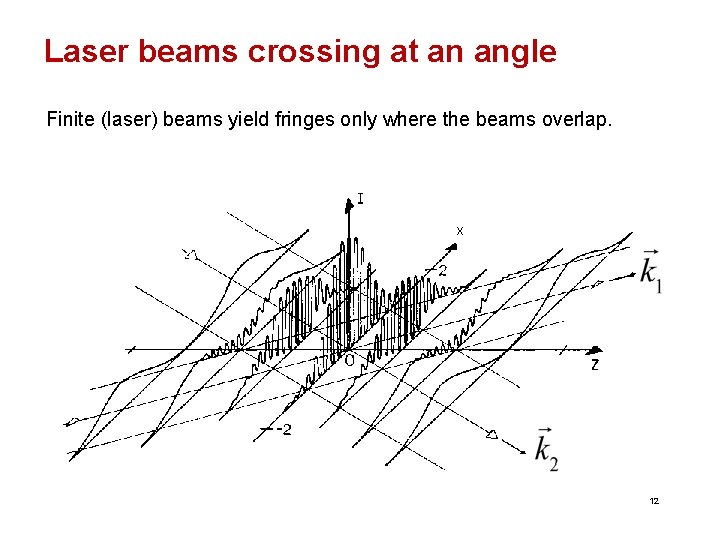
Laser beams crossing at an angle Finite (laser) beams yield fringes only where the beams overlap. x 12

Two point sources Interfering spherical waves also yield standing waves and fringes (in 2 D and 3 D) Examples with different separations. Note the different node patterns. 13
![Superposition of waves with different frequencies [at one point x] Take E 0 to](http://slidetodoc.com/presentation_image_h2/acfba7e42fced65fd4bac5fe61c24ed5/image-14.jpg "Superposition of waves with different frequencies [at one point x] Take E 0 to")
Superposition of waves with different frequencies [at one point x] Take E 0 to be real. We typically have that w 1 and w 2 are similar, this means wave >> Dw 14
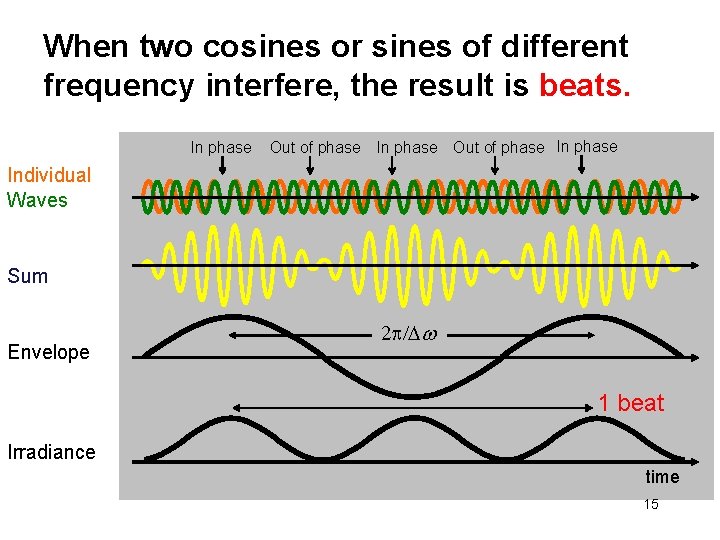
When two cosines or sines of different frequency interfere, the result is beats. In phase Out of phase Individual Waves Sum Envelope 1 2 p/Dw 1 beat Irradiance time 15
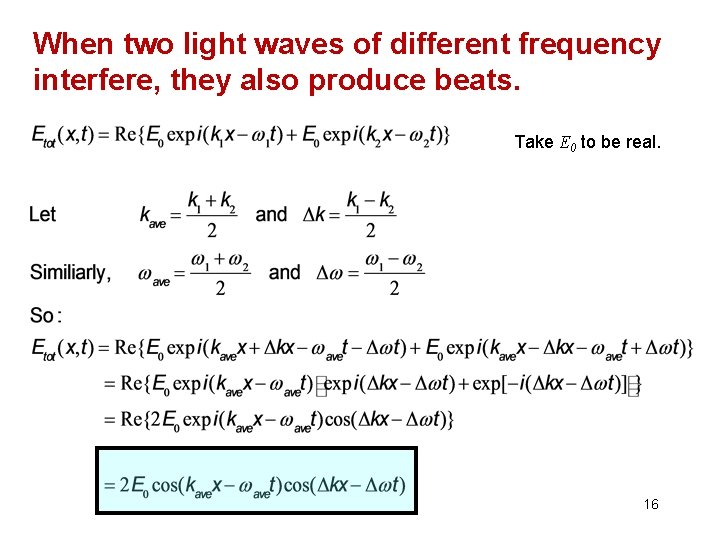
When two light waves of different frequency interfere, they also produce beats. Take E 0 to be real. 16

Traveling-Wave Beats In phase Out of phase Individual waves Sum Envelope Intensity z 17
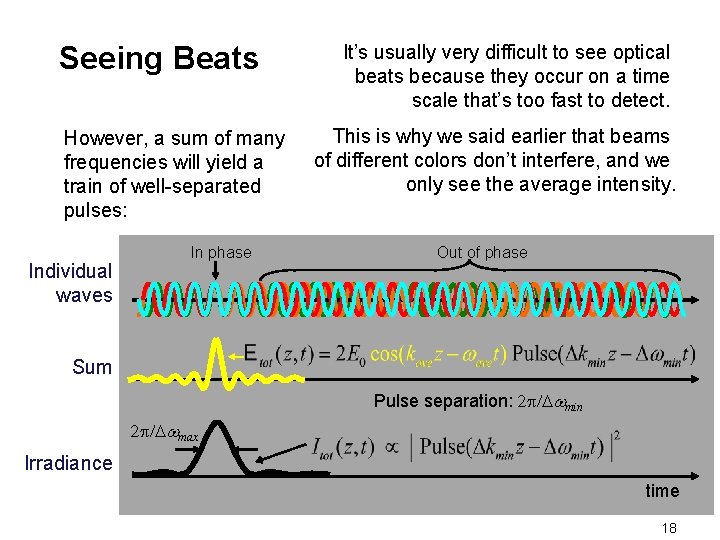
Seeing Beats However, a sum of many frequencies will yield a train of well-separated pulses: Individual waves In phase It’s usually very difficult to see optical beats because they occur on a time scale that’s too fast to detect. This is why we said earlier that beams of different colors don’t interfere, and we only see the average intensity. Out of phase Sum Pulse separation: 2 p/Dwmin 2 p/Dwmax Irradiance time 18
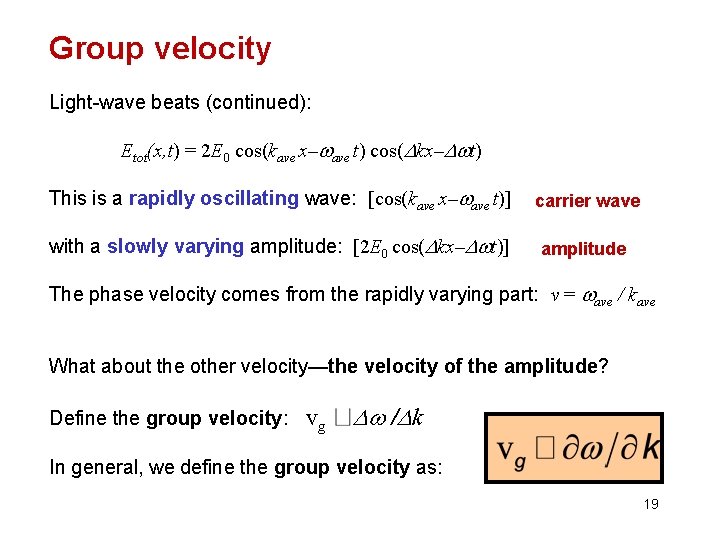
Group velocity Light-wave beats (continued): Etot(x, t) = 2 E 0 cos(kave x–wave t) cos(Dkx–Dwt) This is a rapidly oscillating wave: [cos(kave x–wave t)] carrier wave with a slowly varying amplitude: [2 E 0 cos(Dkx–Dwt)] amplitude The phase velocity comes from the rapidly varying part: v = wave / kave What about the other velocity—the velocity of the amplitude? Define the group velocity: vg Dw /Dk In general, we define the group velocity as: 19
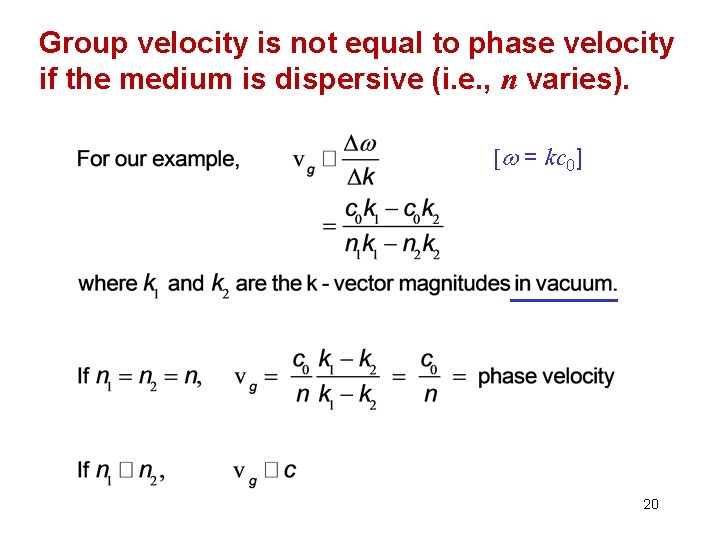
Group velocity is not equal to phase velocity if the medium is dispersive (i. e. , n varies). [w = kc 0] 20
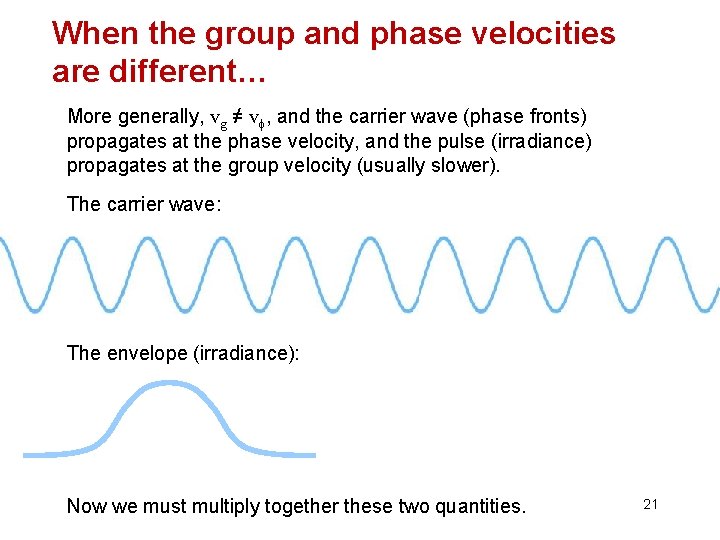
When the group and phase velocities are different… More generally, vg ≠ vf, and the carrier wave (phase fronts) propagates at the phase velocity, and the pulse (irradiance) propagates at the group velocity (usually slower). The carrier wave: The envelope (irradiance): Now we must multiply together these two quantities. 21
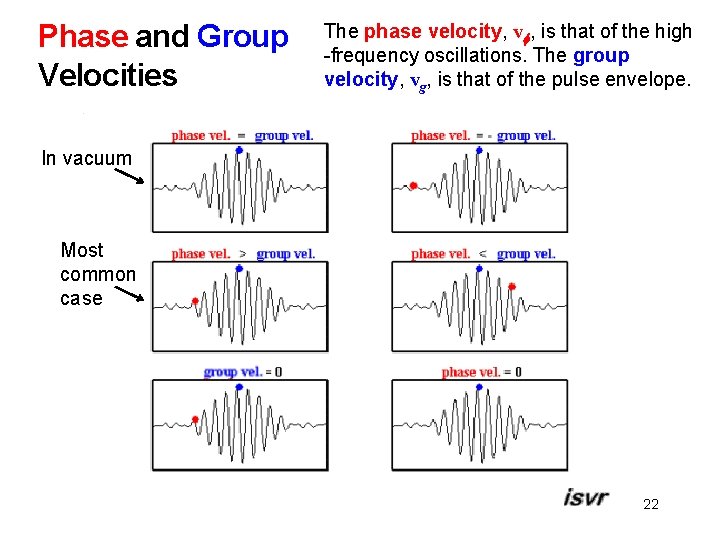
Phase and Group Velocities The phase velocity, vf, is that of the high -frequency oscillations. The group velocity, vg, is that of the pulse envelope. In vacuum Most common case 22
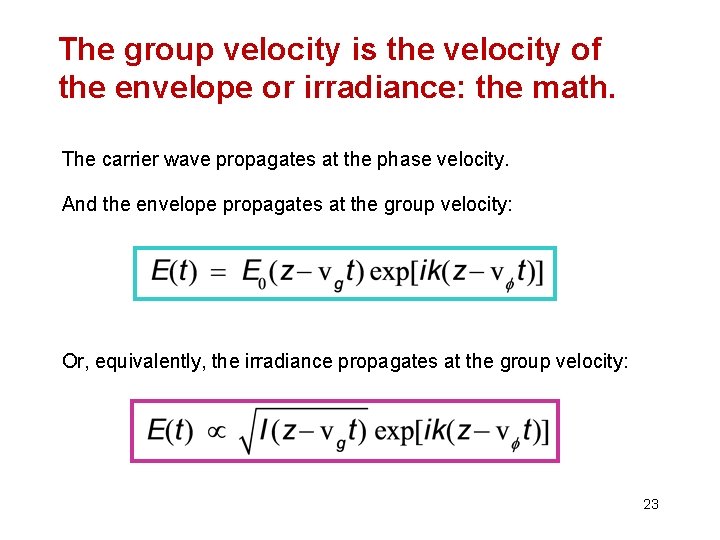
The group velocity is the velocity of the envelope or irradiance: the math. The carrier wave propagates at the phase velocity. And the envelope propagates at the group velocity: Or, equivalently, the irradiance propagates at the group velocity: 23
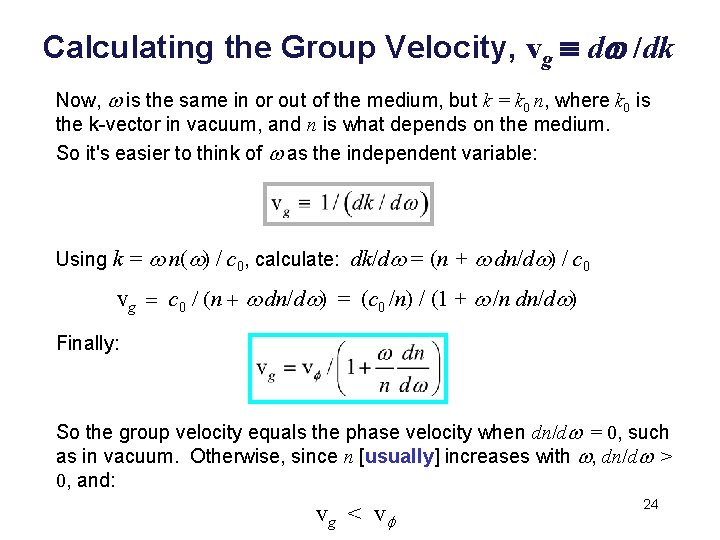
Calculating the Group Velocity, vg º dw /dk Now, w is the same in or out of the medium, but k = k 0 n, where k 0 is the k-vector in vacuum, and n is what depends on the medium. So it's easier to think of w as the independent variable: Using k = w n(w) / c 0, calculate: dk/dw = (n + w dn/dw) / c 0 vg = c 0 / (n + w dn/dw) = (c 0 /n) / (1 + w /n dn/dw) Finally: So the group velocity equals the phase velocity when dn/dw = 0, such as in vacuum. Otherwise, since n [usually] increases with w, dn/dw > 0, and: vg < vf 24
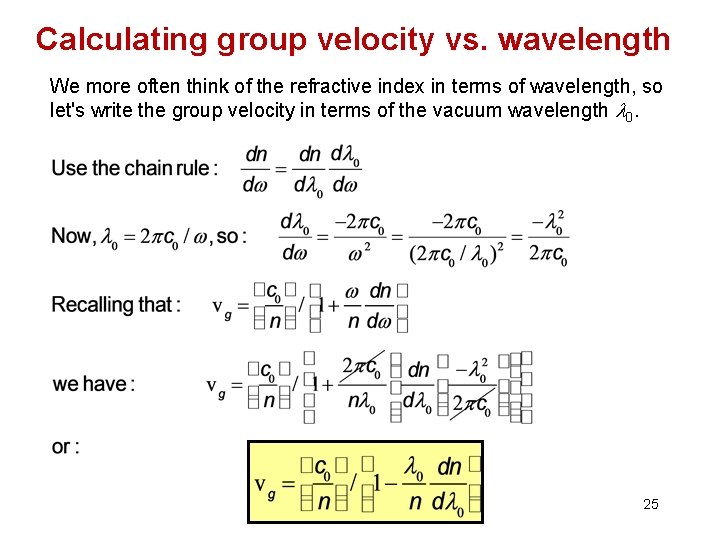
Calculating group velocity vs. wavelength We more often think of the refractive index in terms of wavelength, so let's write the group velocity in terms of the vacuum wavelength l 0. 25
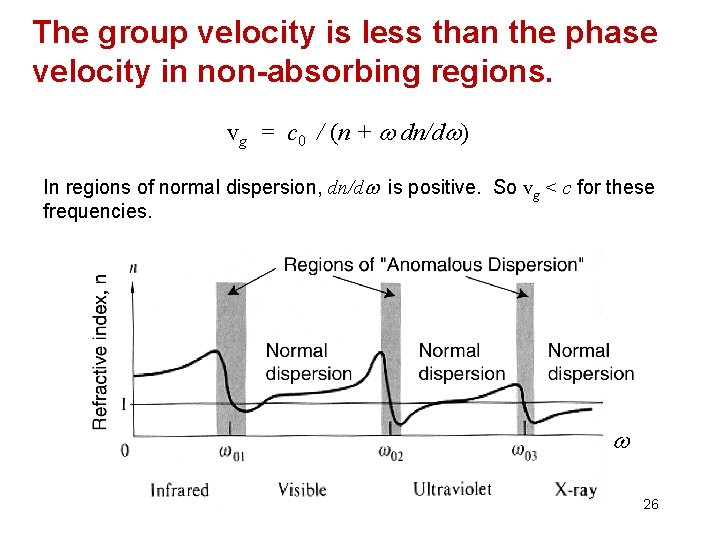
The group velocity is less than the phase velocity in non-absorbing regions. vg = c 0 / (n + w dn/dw) In regions of normal dispersion, dn/dw is positive. So vg < c for these frequencies. w 26
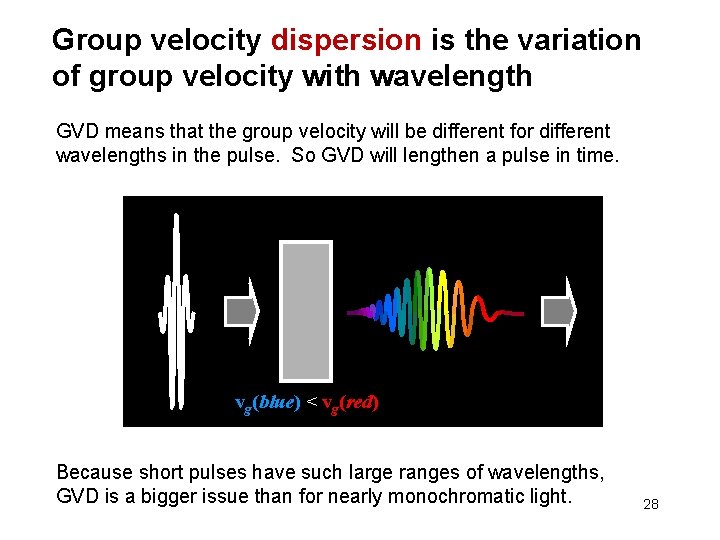
Group velocity dispersion is the variation of group velocity with wavelength GVD means that the group velocity will be different for different wavelengths in the pulse. So GVD will lengthen a pulse in time. vg(blue) < vg(red) Because short pulses have such large ranges of wavelengths, GVD is a bigger issue than for nearly monochromatic light. 28
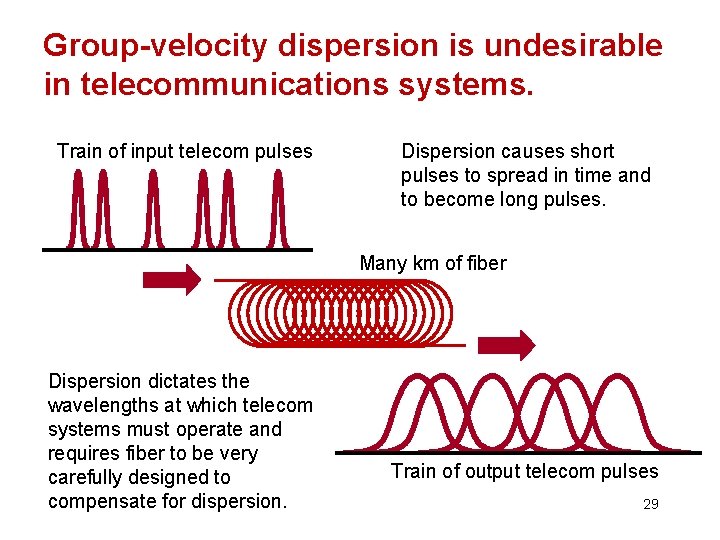
Group-velocity dispersion is undesirable in telecommunications systems. Train of input telecom pulses Dispersion causes short pulses to spread in time and to become long pulses. Many km of fiber Dispersion dictates the wavelengths at which telecom systems must operate and requires fiber to be very carefully designed to compensate for dispersion. Train of output telecom pulses 29
Tot slot Wat hebben we vandaag gezien: • Superpositie en interferentie van licht • Lichtpulsen zijn een superpositie van lichtgolven met verschillende golflengtes • Fase- en groepssnelheid van lichtpulsen • De invloed van dispersie op lichtpulsen 30
- Slides: 29