
STANDING WAVES AND WAVE BEHAVIOR What is a
STANDING WAVES AND WAVE BEHAVIOR
What is a standing wave and how does it form? ■ A vibration of a system in which some particular points remain fixed while others between them vibrate with the maximum amplitude. ■ In a bounded medium, meaning where the medium is finite, standing waves are produced by any two identical waves traveling in opposite direction that have the right wavelength. – Correct wavelength meets its reflection. – The interference creates the wave that does not appear to move.
Standing Waves (cont. ) ■ Require energy to be fed into the system at an appropriate frequency. – Driving frequency equals its natural frequency – THIS is RESONANCE! ■ Resonance can be identified by a dramatic increase in amplitude.
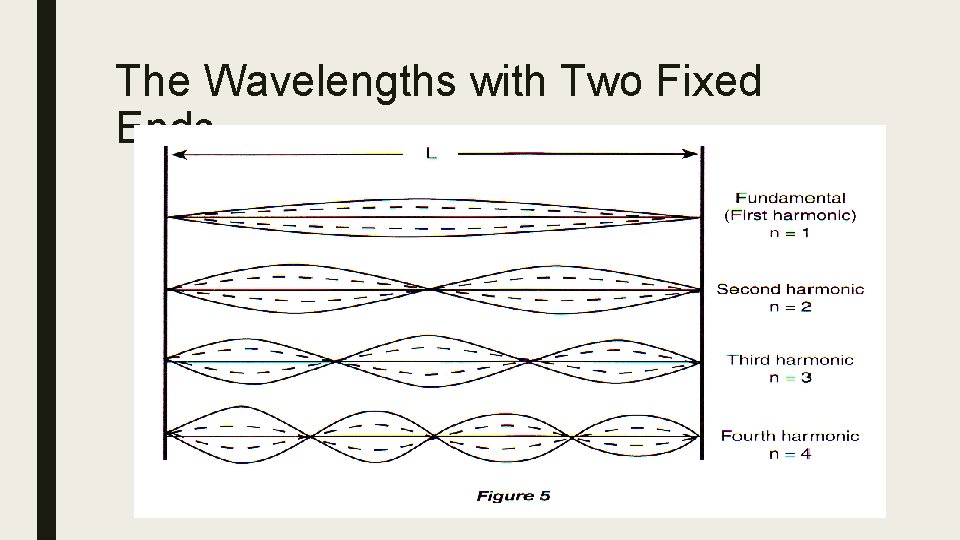
The Wavelengths with Two Fixed Ends
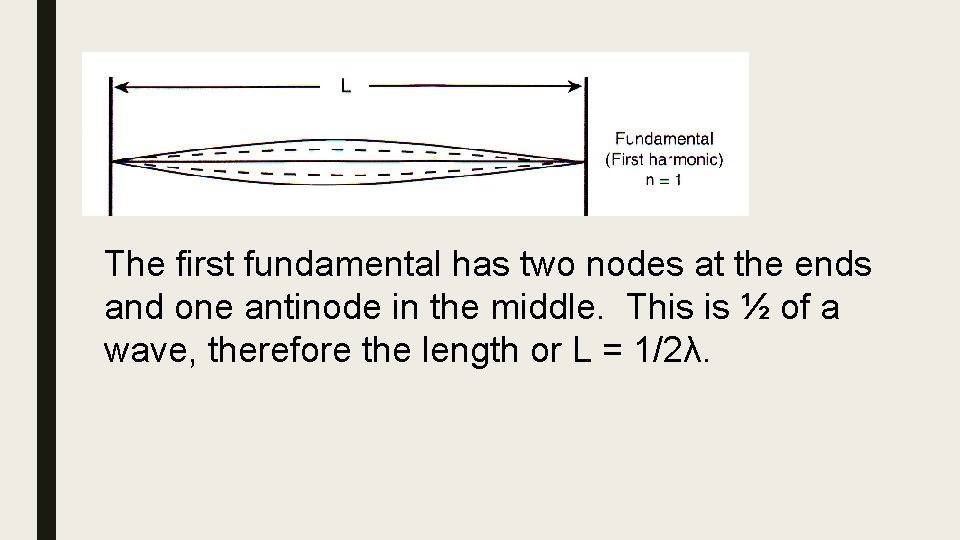
The first fundamental has two nodes at the ends and one antinode in the middle. This is ½ of a wave, therefore the length or L = 1/2λ.
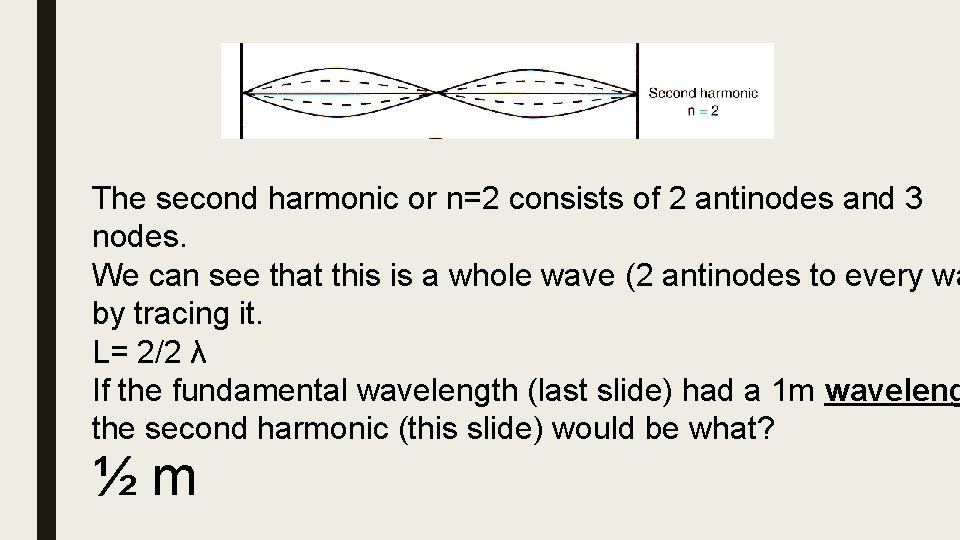
The second harmonic or n=2 consists of 2 antinodes and 3 nodes. We can see that this is a whole wave (2 antinodes to every wa by tracing it. L= 2/2 λ If the fundamental wavelength (last slide) had a 1 m waveleng the second harmonic (this slide) would be what? ½m
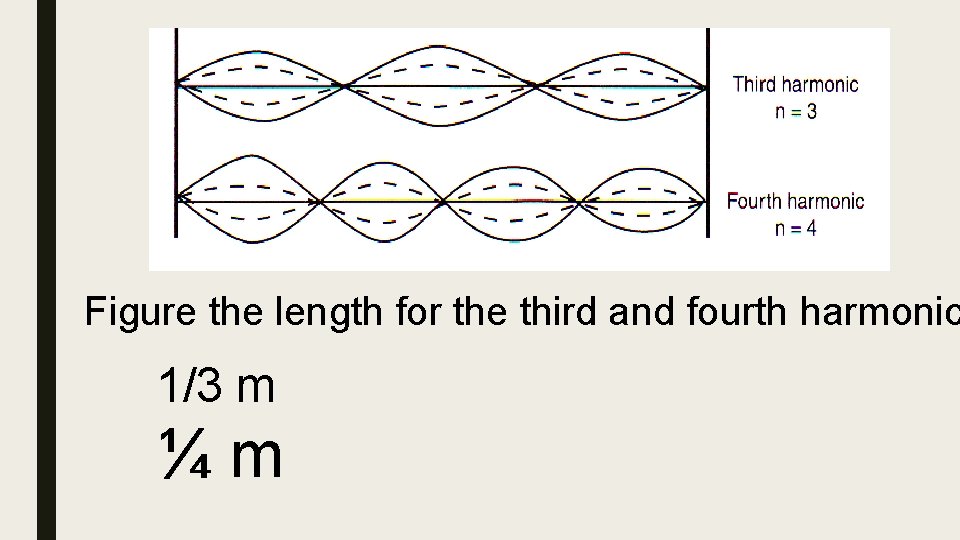
Figure the length for the third and fourth harmonic 1/3 m ¼m
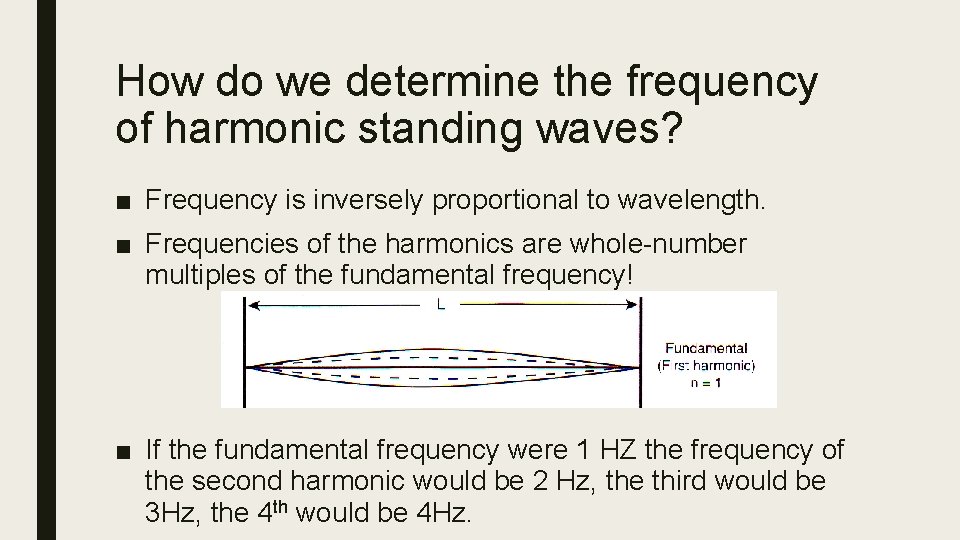
How do we determine the frequency of harmonic standing waves? ■ Frequency is inversely proportional to wavelength. ■ Frequencies of the harmonics are whole-number multiples of the fundamental frequency! ■ If the fundamental frequency were 1 HZ the frequency of the second harmonic would be 2 Hz, the third would be 3 Hz, the 4 th would be 4 Hz.
- Slides: 8