
StandardsReferenced Grading SIP Team Margie Rachel Julia Kristi


- Slides: 32
Standards-Referenced Grading • SIP Team: • Margie, Rachel, Julia, Kristi, Jim, Chris H. , Ashley, Garth A Repair Kit for Grading (15 Fixes for Broken Grades), Ken O’Connor Original presentation created by: Brent Morrison & Jeanine Butler, AWSP/WASA Summer Conference, June 28, 2010 Power Standards, Larry Ainsworth Formative Assessment & Standards-Based Grading, Robert Marzano Fair Isn’t Always Equal, Rick Wormeli Assessment Balance and Quality, Steve Chappuis, Carol Commadore, and Rick Stiggins Transformative Assessment, James Popham 1
Learning Targets for this Morning: • Audience members will gain informational level of understanding of the what and why of standards-referenced grading • Based on information shared, audience members begin to formulate questions regarding implications of standardsreferenced grading 2
Carol Dweck, “Mindset, ” 2006 Fixed mindset vs. growth mindset; What does the research tell us? 3
4
Carol Dweck, “Mindset”, 2006 • Mindset determines intellectual risk-taking • Mindset determines self-image • Mindset can be changed with effective guidance & environment 5
Why Standards-Referenced Grades? • Focus is on a growth mindset • Focus is on outcomes of what kids should learn (standards and targets) • Focus is on growth of performance over time • Focus on students acting as partners in the learning • Focus on a classroom environment comprised of positive academic risk-taking 6
7
8
Based on responses from over 300 teachers and 150 administrators… Source: “Transforming Classroom Grading” by Robert Marzano Most teachers and administrators believe that providing feedback is the most important reason for giving grades 9
If grades are about feedback… Should grades be accurate regarding student performance/achievement? 10
If you can’t confidently and resoundingly say “YES” that: • At EHS our grades are supportive of learning • At EHS our grades are consistent • At EHS our grades are accurate • At EHS our grades are meaningful Then what… 11
We need to implement some fixes! 12
Ken O’Conner • A Repair Kit for Grading - 15 Fixes for Broken Grades 13
Fix #1: Behavior & Achievement are different 14
15
Fix #2 One teacher does not accept late assignments and another reduces grades by 10% for each day the assignment is late. • Does this make for consistent grades between teachers? • Does marking down for timeliness represent students’ achievement on standards? 16
Grades are seen by some teachers as extrinsic motivators – Are grades motivators for students who don’t do well? – If one of the goals of a school is to develop “independent, self-directed, life -long learners” don’t students need to be intrinsically motivated? (students as assessment partners) 17
Consider… • No studies support the use of low grades as punishments. Instead of prompting greater effort, low grades more often cause students to withdraw from learning” -Guskey and Bailey, 2001 18
Fix #3 • Johnny brings in hand sanitizer and receives bonus points • Does his grade now accurately reflect his academic achievement? 19
Fix #4 Johnny is caught cheating on his math test. He is suspended from school and a score of zero is recorded for that test. If grades are to reflect student achievement toward the standards, is the appropriate consequence for this scenario? 20
Fix #5 Consider Johnny… • Johnny is absent often • Johnny demonstrates mastery of the course’s Power Standards & Targets by scoring very high on all summative assessments If grades should be accurate, what should Johnny’s grade be for the class? 21
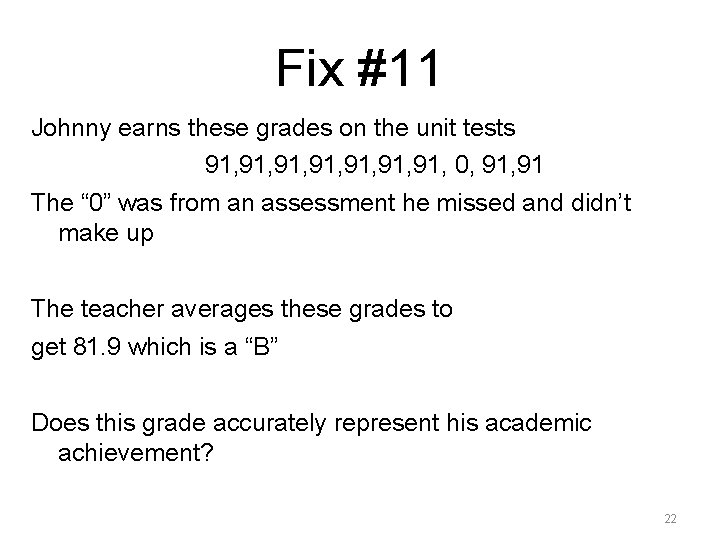
Fix #11 Johnny earns these grades on the unit tests 91, 91, 0, 91 The “ 0” was from an assessment he missed and didn’t make up The teacher averages these grades to get 81. 9 which is a “B” Does this grade accurately represent his academic achievement? 22
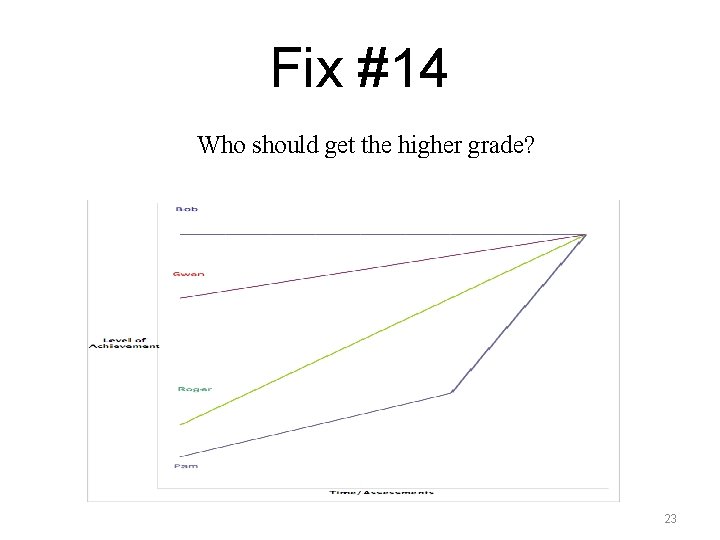
Fix #14 Who should get the higher grade? 23
What would a standardsbased grading system look like at EHS? 24
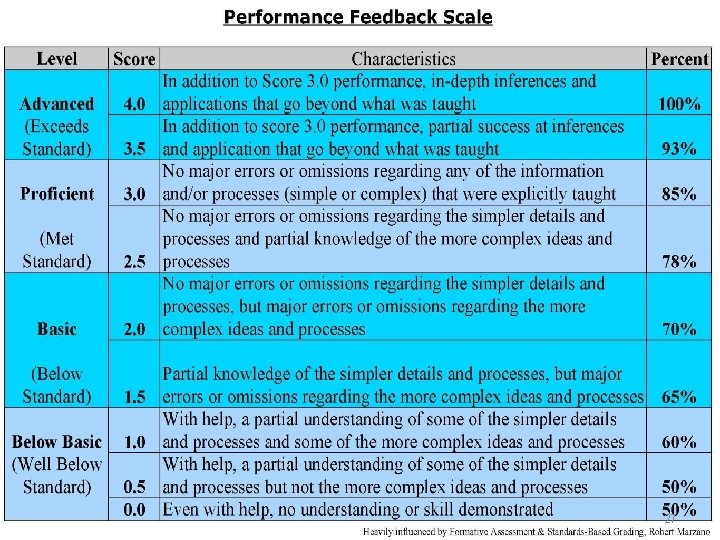
Concepts for a standards-referenced grading system Pervasive school belief in growth mindset (all students can learn more) Grading categories in grade book are the Power Standards or Targets (not quizzes, homework, participation, etc. ) Address “behaviors”(attendance, participation, effort, etc), but score and report those separately Focus on level of learning reached at the end of the grading period for grades (most recent evidence) 25
Concepts for a standardsreferenced grading system Use Assessment For Learning strategies Teachers develop systems that involve students tracking their own progress toward meeting standards (same for “behaviors”) and self-reflection Develop rubrics with examples of each level and work with students to insure that they fully understand how to reach level Transition to a four-tiered (nine sub-tiers) grading system 26
27
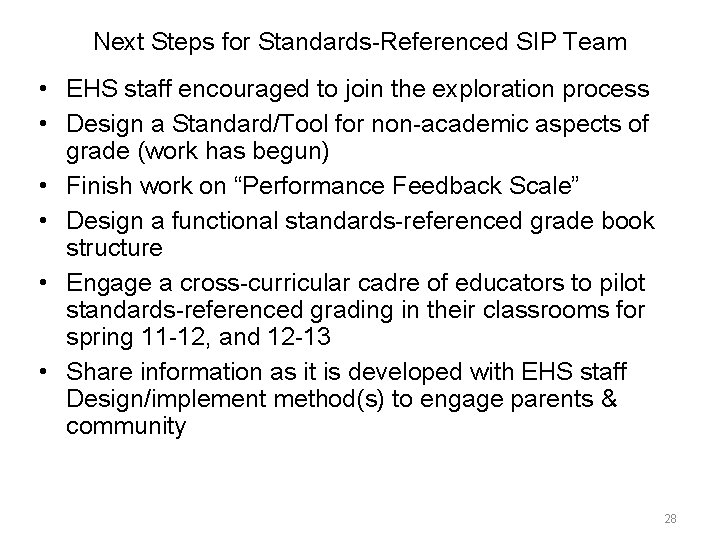
Next Steps for Standards-Referenced SIP Team • EHS staff encouraged to join the exploration process • Design a Standard/Tool for non-academic aspects of grade (work has begun) • Finish work on “Performance Feedback Scale” • Design a functional standards-referenced grade book structure • Engage a cross-curricular cadre of educators to pilot standards-referenced grading in their classrooms for spring 11 -12, and 12 -13 • Share information as it is developed with EHS staff Design/implement method(s) to engage parents & community 28
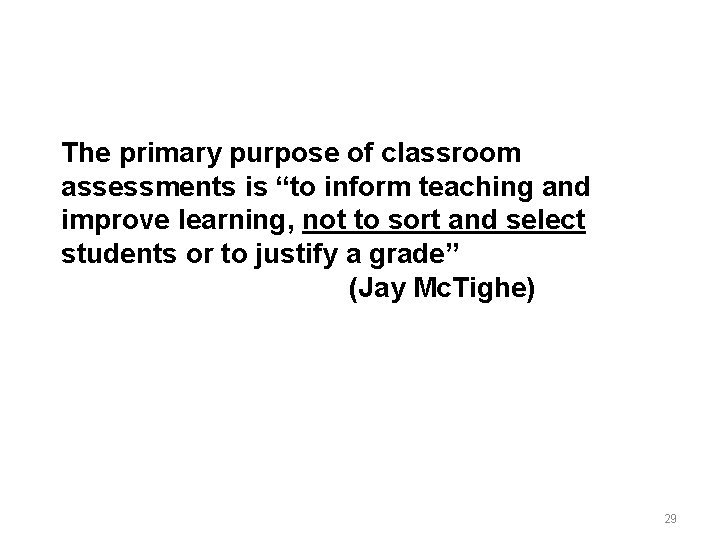
The primary purpose of classroom assessments is “to inform teaching and improve learning, not to sort and select students or to justify a grade” (Jay Mc. Tighe) 29
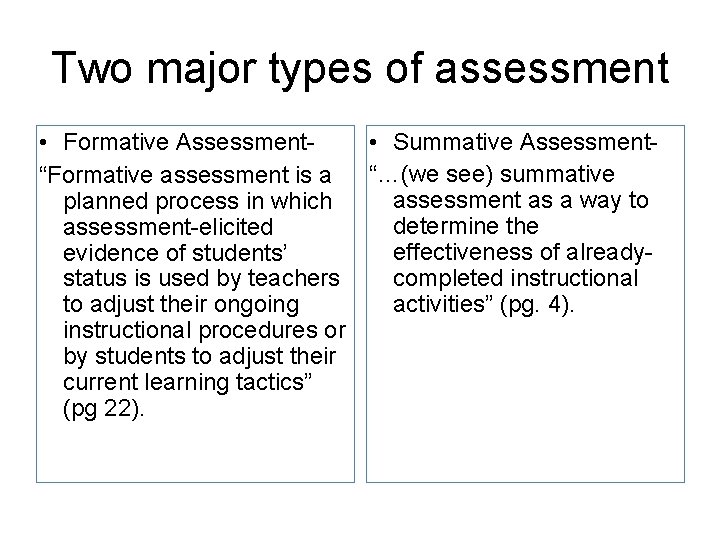
Two major types of assessment • Formative Assessment • Summative Assessment“…(we see) summative “Formative assessment is a assessment as a way to planned process in which determine the assessment-elicited effectiveness of alreadyevidence of students’ completed instructional status is used by teachers activities” (pg. 4). to adjust their ongoing instructional procedures or by students to adjust their current learning tactics” (pg 22).
Next Steps for Assessment Team • Continue our work on common formative and summative assessments- BAT SIP Team in their departments (monitor data monthly using protocol) • Staff Training 4/11/12 • Departments create a school-wide assessment plan for use in fall 2012
Any questions? Who would like to get involved? 32