
Standards Showcase PREMIS Preservation metadata Rebecca Guenther Library
Standards Showcase: PREMIS (Preservation metadata) Rebecca Guenther, Library of Congress ALA Annual 2006 LC booth presentation June 24 -25, 2006
Overview § What is preservation metadata? § Background § PREMIS work • Survey • Data dictionary § Features of the data dictionary § Implementing PREMIS § Future

Digital preservation: advances & remaining challenges § Groups around the world and conferences continue to make significant progress in raising awareness about digital preservation imperative § Gradual shift in focus from articulating problem to solving it … • Not so much “Why is digital preservation important” anymore; rather, “What must be done to achieve preservation objectives? ” § Many practical challenges in implementing reliable, sustainable digital preservation programs § One key implementation challenge: preservation metadata
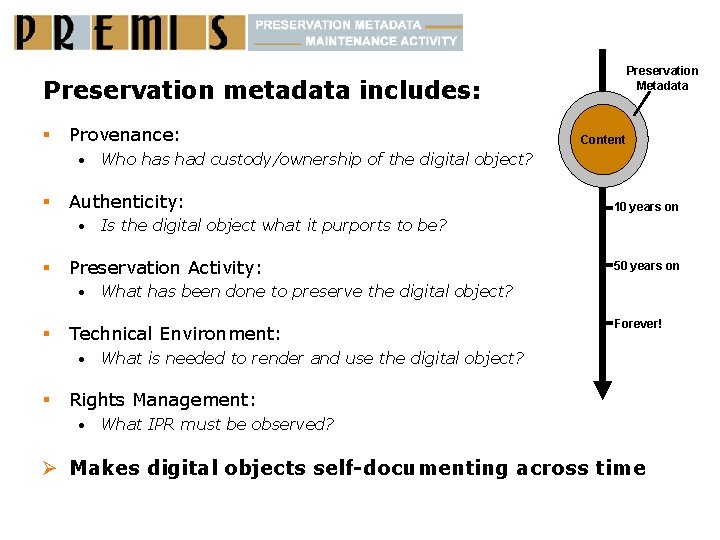
Preservation Metadata Preservation metadata includes: § Provenance: • § § § 50 years on What has been done to preserve the digital object? Technical Environment: • 10 years on Is the digital object what it purports to be? Preservation Activity: • § Who has had custody/ownership of the digital object? Authenticity: • Content Forever! What is needed to render and use the digital object? Rights Management: • What IPR must be observed? Ø Makes digital objects self-documenting across time

PREMIS background … § Pre-2002: various preservation metadata element sets released Different scopes, purposes, underlying models/assumptions • No international standard; little consolidation of expertise/best practice • § June 2002: Preservation Metadata Framework • • • § International working group (jointly sponsored by OCLC, RLG) Comprehensive, high-level description of types of information constituting preservation metadata Used OAIS reference model as starting point Set of “prototype” preservation metadata elements Consensus-based foundation for developing formal preservation metadata specifications … but not an “off-the-shelf, ready to implement” solution Post-2002: Needed implementable preservation metadata, with guidelines for application and use, relevant to a wide range of digital preservation systems and contexts • Motivated formation of PREMIS Working Group
PREMIS Working Group § Preservation metadata: key component of sustainable digital preservation § June 2003: OCLC, RLG sponsored international working group: • PREMIS: Preservation Metadata: Implementation Strategies § Objective: • Define implementable, core preservation metadata, with guidelines/recommendations for management and use § Membership: > 30 experts from 5 countries, libraries, museums, archives, government agencies, private sector • Co-Chairs: Priscilla Caplan (FCLA), Rebecca Guenther (LC) •
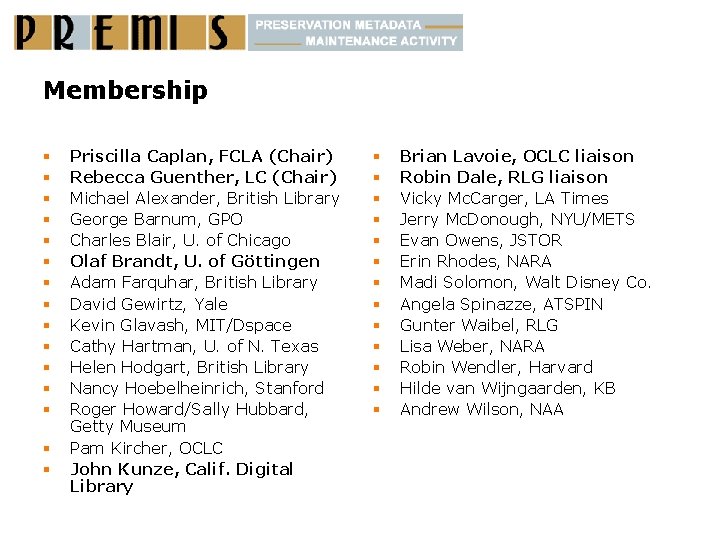
Membership § § § § Priscilla Caplan, FCLA (Chair) Rebecca Guenther, LC (Chair) Michael Alexander, British Library George Barnum, GPO Charles Blair, U. of Chicago Olaf Brandt, U. of Göttingen Adam Farquhar, British Library David Gewirtz, Yale Kevin Glavash, MIT/Dspace Cathy Hartman, U. of N. Texas Helen Hodgart, British Library Nancy Hoebelheinrich, Stanford Roger Howard/Sally Hubbard, Getty Museum Pam Kircher, OCLC John Kunze, Calif. Digital Library § § § § Brian Lavoie, OCLC liaison Robin Dale, RLG liaison Vicky Mc. Carger, LA Times Jerry Mc. Donough, NYU/METS Evan Owens, JSTOR Erin Rhodes, NARA Madi Solomon, Walt Disney Co. Angela Spinazze, ATSPIN Gunter Waibel, RLG Lisa Weber, NARA Robin Wendler, Harvard Hilde van Wijngaarden, KB Andrew Wilson, NAA
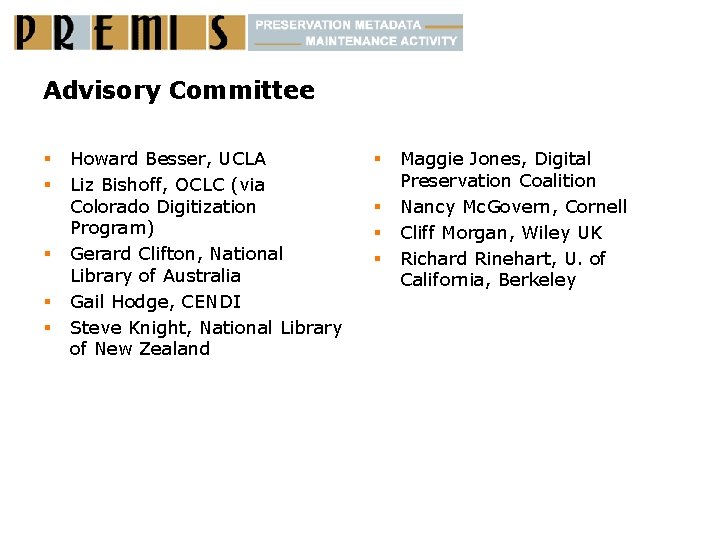
Advisory Committee § § § Howard Besser, UCLA Liz Bishoff, OCLC (via Colorado Digitization Program) Gerard Clifton, National Library of Australia Gail Hodge, CENDI Steve Knight, National Library of New Zealand § § Maggie Jones, Digital Preservation Coalition Nancy Mc. Govern, Cornell Cliff Morgan, Wiley UK Richard Rinehart, U. of California, Berkeley
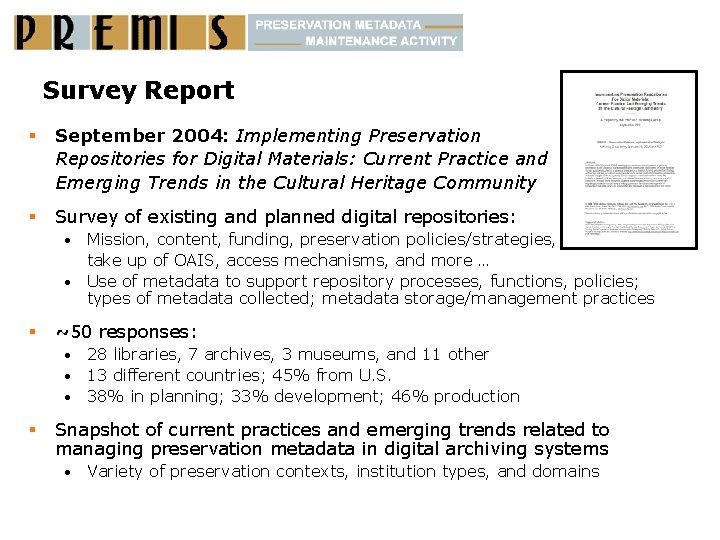
Survey Report § September 2004: Implementing Preservation Repositories for Digital Materials: Current Practice and Emerging Trends in the Cultural Heritage Community § Survey of existing and planned digital repositories: Mission, content, funding, preservation policies/strategies, take up of OAIS, access mechanisms, and more … • Use of metadata to support repository processes, functions, policies; types of metadata collected; metadata storage/management practices • § ~50 responses: 28 libraries, 7 archives, 3 museums, and 11 other • 13 different countries; 45% from U. S. • 38% in planning; 33% development; 46% production • § Snapshot of current practices and emerging trends related to managing preservation metadata in digital archiving systems • Variety of preservation contexts, institution types, and domains
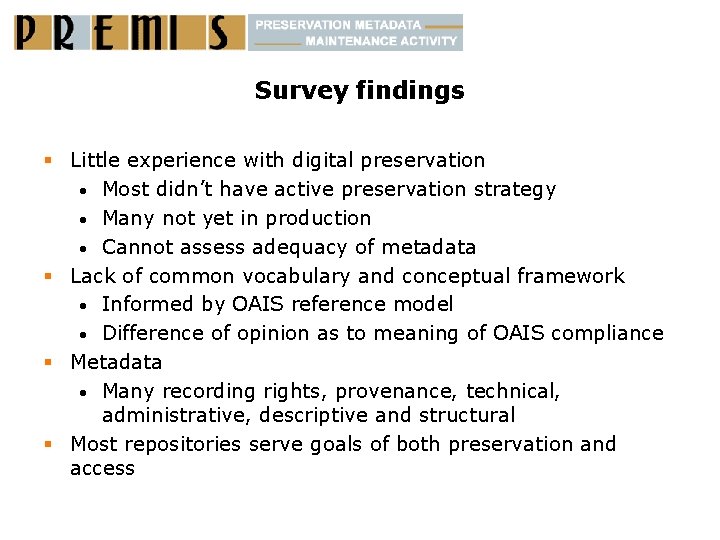
Survey findings § Little experience with digital preservation • Most didn’t have active preservation strategy • Many not yet in production • Cannot assess adequacy of metadata § Lack of common vocabulary and conceptual framework • Informed by OAIS reference model • Difference of opinion as to meaning of OAIS compliance § Metadata • Many recording rights, provenance, technical, administrative, descriptive and structural § Most repositories serve goals of both preservation and access
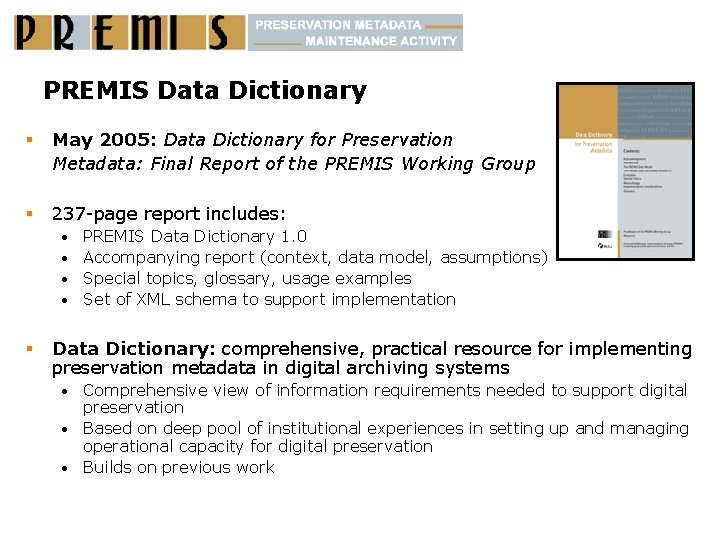
PREMIS Data Dictionary § May 2005: Data Dictionary for Preservation Metadata: Final Report of the PREMIS Working Group § 237 -page report includes: PREMIS Data Dictionary 1. 0 • Accompanying report (context, data model, assumptions) • Special topics, glossary, usage examples • Set of XML schema to support implementation • § Data Dictionary: comprehensive, practical resource for implementing preservation metadata in digital archiving systems Comprehensive view of information requirements needed to support digital preservation • Based on deep pool of institutional experiences in setting up and managing operational capacity for digital preservation • Builds on previous work •
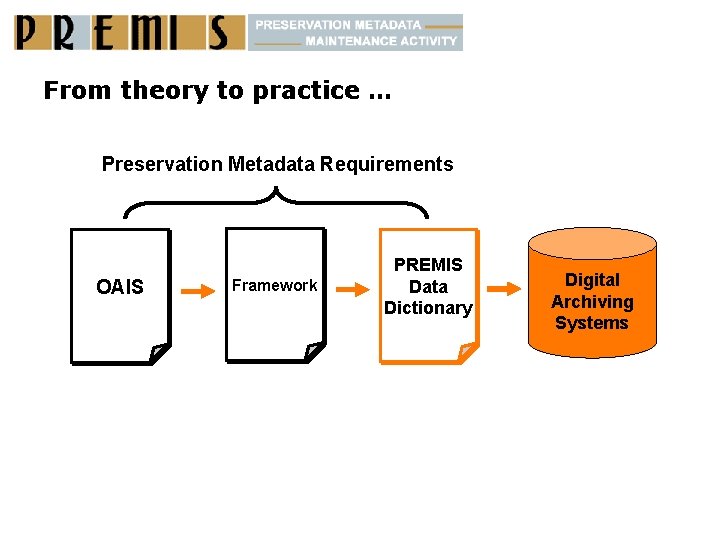
From theory to practice … Preservation Metadata Requirements OAIS Framework PREMIS Data Dictionary Digital Archiving Systems
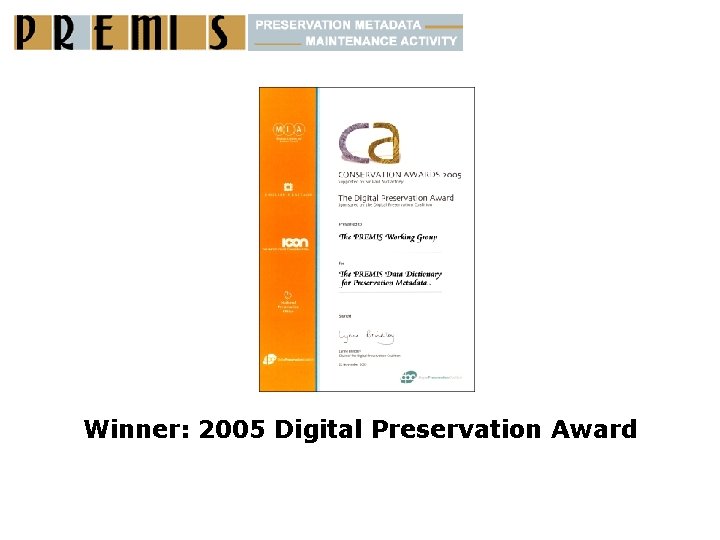
Winner: 2005 Digital Preservation Award
Some guiding principles and assumptions … § “Implementable, core, preservation metadata”: “Preservation metadata”: maintain viability, renderability, understandability, authenticity, identity in a preservation context • “Core”: What most preservation repositories need to know to preserve digital materials over the long-term • “Implementable”: rigorously defined; supported by usage guidelines/recommendations; emphasis on automated workflows • § Implementation neutral: No assumptions on specific implementation • Promote flexibility/interoperability • Focus on semantic units: what you need to know (implementation-neutral) vs. metadata elements: how you record it (implementation-specific) • Information that needs to be “recoverable” from the digital archiving system, independent of local implementation •
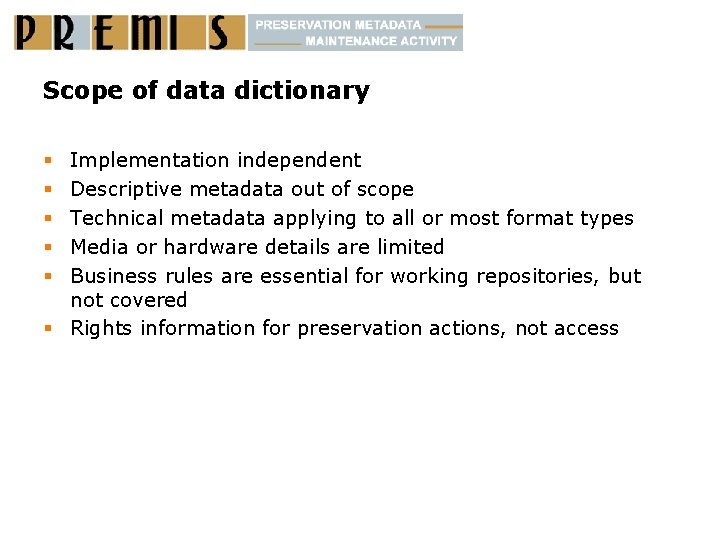
Scope of data dictionary Implementation independent Descriptive metadata out of scope Technical metadata applying to all or most format types Media or hardware details are limited Business rules are essential for working repositories, but not covered § Rights information for preservation actions, not access § § §
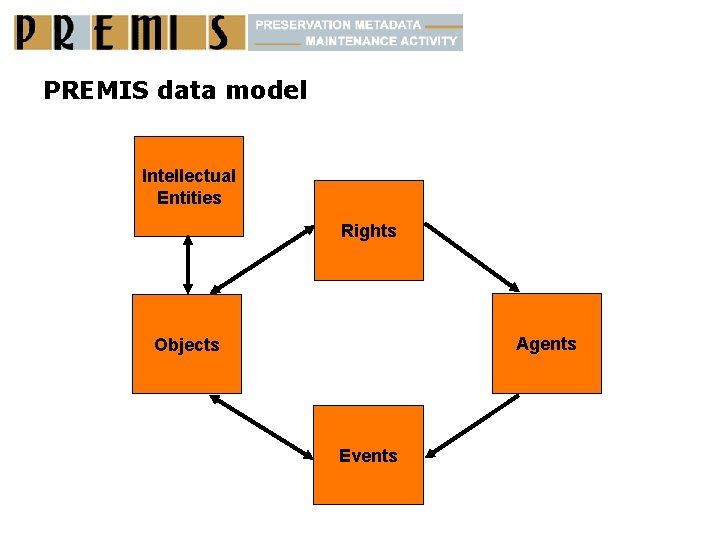
PREMIS data model Intellectual Entities Rights Agents Objects Events
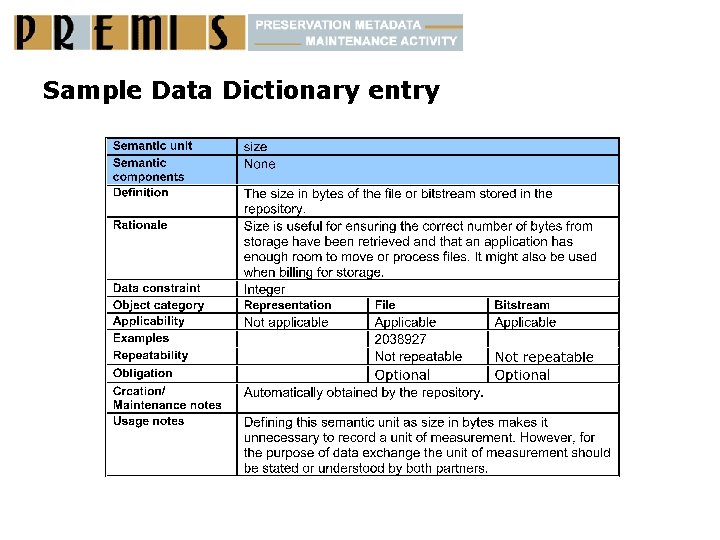
Sample Data Dictionary entry
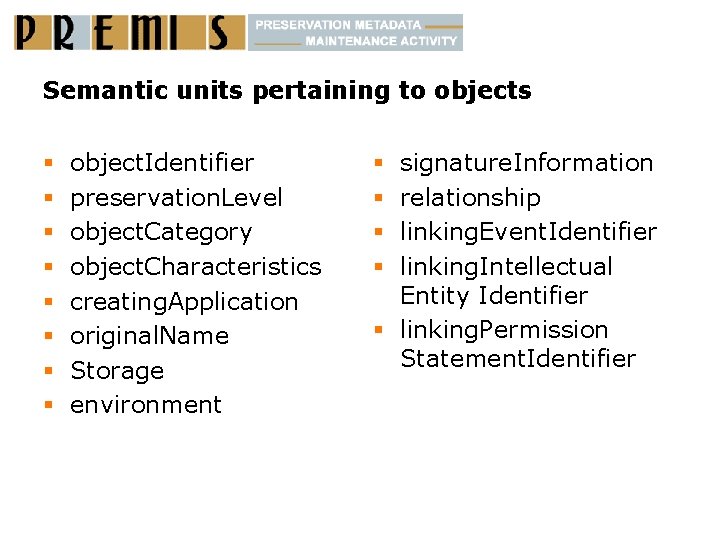
Semantic units pertaining to objects § § § § object. Identifier preservation. Level object. Category object. Characteristics creating. Application original. Name Storage environment signature. Information relationship linking. Event. Identifier linking. Intellectual Entity Identifier § linking. Permission Statement. Identifier § §
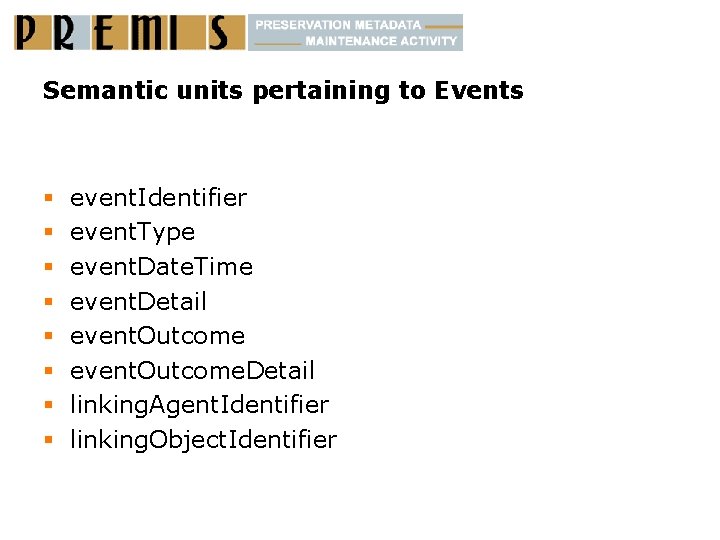
Semantic units pertaining to Events § § § § event. Identifier event. Type event. Date. Time event. Detail event. Outcome. Detail linking. Agent. Identifier linking. Object. Identifier
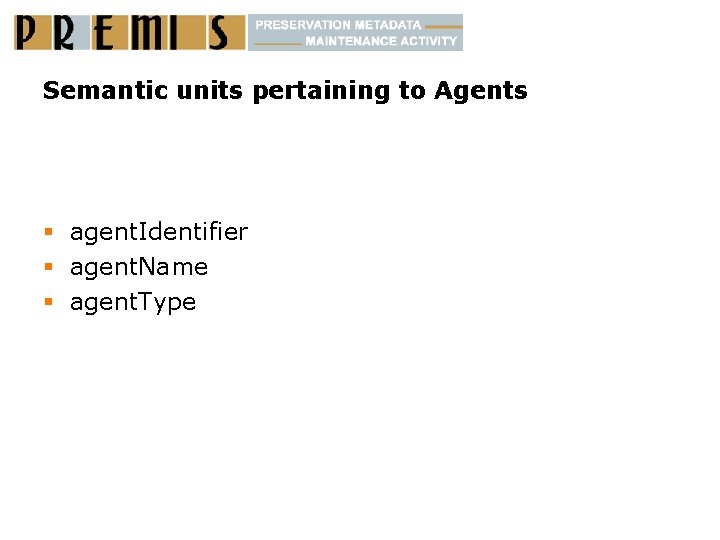
Semantic units pertaining to Agents § agent. Identifier § agent. Name § agent. Type
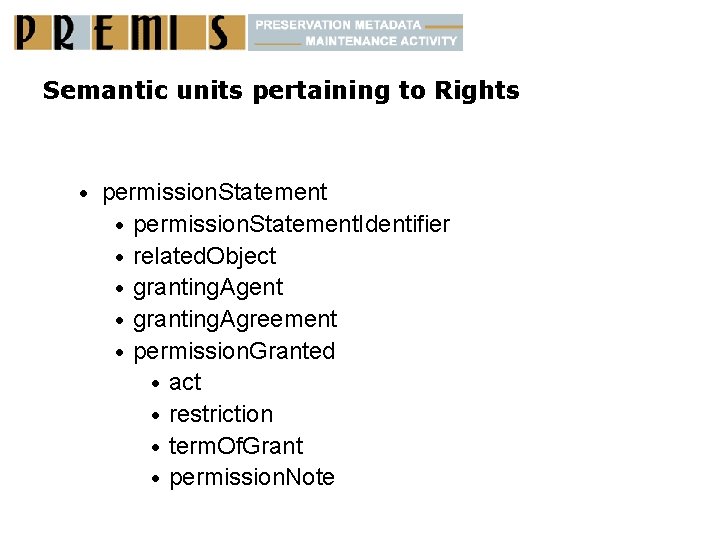
Semantic units pertaining to Rights · permission. Statement. Identifier · related. Object · granting. Agent · granting. Agreement · permission. Granted · act · restriction · term. Of. Grant · permission. Note
Community interest § As of March 2006: ~25, 000 “hits” on Data Dictionary • More than 100 subscribers to the PREMIS Implementers’ Group discussion list • § PREMIS Data Dictionary product of collaboration and consensus PREMIS membership reflects variety of institutions, domains, countries • Multiplicity of perspectives promotes applicability in multiplicity of contexts • Digital preservation is a shared problem; this invites shared solutions • § Data Dictionary useful to any institution or organization committed to the long-term preservation of digital materials
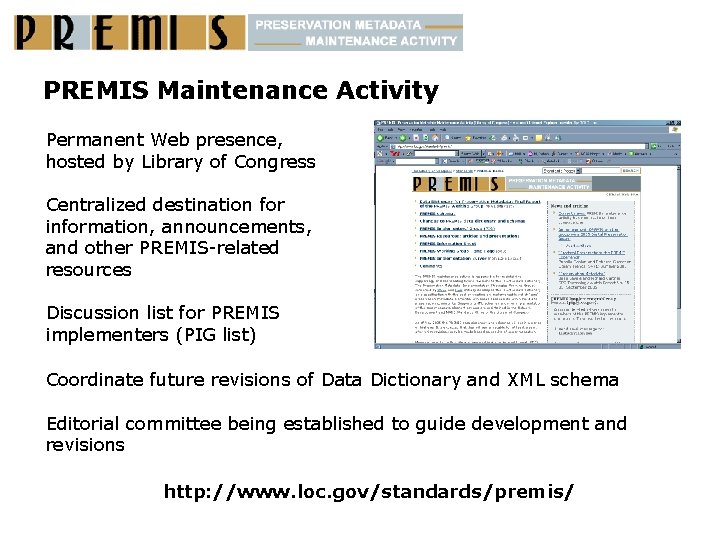
PREMIS Maintenance Activity Permanent Web presence, hosted by Library of Congress Centralized destination for information, announcements, and other PREMIS-related resources Discussion list for PREMIS implementers (PIG list) Coordinate future revisions of Data Dictionary and XML schema Editorial committee being established to guide development and revisions http: //www. loc. gov/standards/premis/
Current activities § Documenting errata and proposed revisions to Data Dictionary (feedback through PIG list) • http: //www. loc. gov/standards/premis/changes. html § PREMIS Implementers’ Registry • http: //www. loc. gov/standards/premis-registry. html § Consultancies, etc. : Rights issues for digital preservation (Karen Coyle) • PREMIS implementation guidelines and recommendations (Deborah Woodyard-Robinson) • PREMIS-to-OAIS mapping (Brian Lavoie) • § PREMIS on the road: Digital Curation Center PREMIS workshop (July 17 -18 Glasgow) • Repository workshop at National Library of Australia (Aug. 31) • Investigating workshops in US •
Going forward … § Establish Editorial committee § First revision of Data Dictionary § Work with other initiatives (e. g. , METS, Z 39. 87) to integrate PREMIS with existing standards, technologies, best practices (e. g. METS) § Contribute preservation metadata resources to digital preservation community that are: Openly available • Oriented toward practical implementation • Supported by a long-term commitment • Tools •
Some implementers … § Math. Arc (Germany): A joint project funded by NSF (Cornell) and SUB Göttingen (DFG) to build a distributed archive for mathematical journals distributed between two archives to keep information redundant. § DAITTSS (Florida): a preservation repository for the use of the libraries of the public universities of Florida. Uses a locallydeveloped software application (DAITSS), which implements most of the PREMIS data elements. § Ex Libris (Digi. Tool): an enterprise solution for the management of digital assets in libraries and academic environments consisting of a number of modules, each designed to address different needs, functions, and workflows pertaining to the life cycle of a digital object § For more information see: • http: //www. loc. gov/premis-registry. html
Conclusion § PREMIS Data Dictionary provides critical piece of reliable digital preservation infrastructure comprised of technology, standards, and best practice § PREMIS Data Dictionary is a building block with which effective, sustainable digital preservation strategies can be implemented § PREMIS Data Dictionary tightly focused on implementation: • Practical implementation was guiding principle in all discussions • Developed tools to support implementation; released with Data Dictionary • Further work with encouragement for international participation and tools development is ongoing Ø Unglamorous but necessary infrastructure!
URLs, etc. § PREMIS Maintenance Activity: http: //www. loc. gov/standards/premis/ § PREMIS Working Group: http: //www. oclc. org/research/projects/pmwg/ § Data Dictionary for Preservation Metadata: Final Report of the PREMIS Working Group: http: //www. oclc. org/research/projects/pmwg/premis-final. pdf § Please send project information to Implementers’ Registry and join the PIG list!
- Slides: 28