
STANDARDS OF TRAINING FOR GROUP WORKERS BRANDON WAGGONER

STANDARDS OF TRAINING FOR GROUP WORKERS BRANDON WAGGONER AND RACHEL PARRISH-MARTIN LIBERTY UNIVERSITY
“GROUP LEADERS ARE NOT BORN. THEY ARE TRAINED” (Barlow, 2004). Four ways of learning: Experiential, Supervision, Observation, and Academic Barlow, S. H. (2004). A strategic three-year plan to teach beginning, intermediate, and advanced group skills. The Journal for Specialists in Group Work, 29(1), 113 -126.
DISCUSSION • What skills and knowledge should a therapist have before beginning and leading a group? • What should training for group therapists look like?
GOVERNING BODIES • American Counseling Association • Association for Specialist in Group Work • Council for the Accreditation of Counseling and Educational Related Programs • American Group Psychotherapy Association (Professional)
AMERICAN COUNSELING ASSOCIATION • Code of ethics (2014) • A. 9. a. Screening Counselors • Screen prospective group counseling/therapy participants. To the extent possible, counselors select members whose needs and goals are compatible with the goals of the group, who will not impede the group process, and whose well-being will not be jeopardized by the group experience. • A. 9. b. Protecting Clients • In a group setting, counselors take reasonable precautions to protect clients from physical, emotional, or psychological trauma. American Counseling Association. (2014). ACA code of ethics. Retrieved from http: //www. counseling. org/docs/ethics/2014 -aca-code-ofethics. pdf
ACA CODE OF ETHICS • B. 4. a. Group Work • In group work, counselors clearly explain the importance and parameters of confidentiality for the specific group. American Counseling Association. (2014). ACA code of ethics. Retrieved from http: //www. counseling. org/docs/ethics/2014 -aca-code-ofethics. pdf
CODE OF ETHICS CASE STUDY • You are leading a therapy group at a local Christian counseling agency. The stated goal of the group is to help individuals who have lost a loved one to suicide. During one session, a group member states that all those who commit suicide will “go to hell. ” This begins to spark debate among the group members. Feeling singled out, the initial member states that they will discuss what transpired in group with their pastor in order to gain more information.
ASSOCIATION FOR SPECIALIST IN GROUP WORK (ASGW) • A division of the ACA • Published professional training standards for group counselors (1983), revised in 1990, and 2000 • Published best practice guidelines 2007
ASGW PROFESSIONAL STANDARDS OF GROUP WORKERS • Purpose: guidance to counselor training programs • Defines two types of training • Core training • Specialist training Wilson, F. R. , Rapin, L. S. , & Haley-Banez, L. (2000). Association for Specialists in Group Work: Professional standards for the training of group workers. Journal for Specialists in Group Work, 25(4), 327 -342.
CORE TRAINING • Core competencies • Consistent with CACREP standards • Does not qualify for independent practice • Master’s degrees prepare counselors with these standards • Prerequisite for advanced group work Wilson, F. R. , Rapin, L. S. , & Haley-Banez, L. (2000). Association for Specialists in Group Work: Professional standards for the training of group workers. Journal for Specialists in Group Work, 25(4), 327 -342.
CORE TRAINING CURRICULUM • At least one course in group work that addresses: • Scope of practice • Types of group work • Group development • Group process and dynamics • Group leadership • Standards of training and practice • A minimum of 10 hours (20 recommended) of observation and participation Wilson, F. R. , Rapin, L. S. , & Haley-Banez, L. (2000). Association for Specialists in Group Work: Professional standards for the training of group workers. Journal for Specialists in Group Work, 25(4), 327 -342.
SPECIALIZATION TRAINING • Knowledge, skills, and experiences necessary for independent practice • Four areas of advanced practice • • Task/Work Group Facilitation Group Psychoeducation Group Counseling Group Psychotherapy • Built upon ACA’s model definition of working stages • Presumes mastery of core training Wilson, F. R. , Rapin, L. S. , & Haley-Banez, L. (2000). Association for Specialists in Group Work: Professional standards for the training of group workers. Journal for Specialists in Group Work, 25(4), 327 -342.
SPECIALIZATION TRAINING: TASK/WORK GROUP FACILITATION • Organizational development, management, and consultation • Theory and practice of task/work group facilitation • Coursework includes: • Organization development • Consultation, management • Sociology Wilson, F. R. , Rapin, L. S. , & Haley-Banez, L. (2000). Association for Specialists in Group Work: Professional standards for the training of group workers. Journal for Specialists in Group Work, 25(4), 327 -342.
SPECIALIZATION TRAINING: GROUP PSYCHOEDUCATION • Organizational development, school and community counseling/psychology • Health promotion • Marketing, program development and evaluation • Organizational consultation, theory and practice of group psychoeducation • Coursework includes: • Community psychology • Consultation • Health promotion • Marketing • Curriculum design Wilson, F. R. , Rapin, L. S. , & Haley-Banez, L. (2000). Association for Specialists in Group Work: Professional standards for the training of group workers. Journal for Specialists in Group Work, 25(4), 327 -342.
SPECIALIZATION TRAINING: GROUP COUNSELING • Normal human development • Health promotion • Theory and practice of group counseling • Coursework includes: • Normal human development • Family development • Family counseling, assessment and problem identification Wilson, F. R. , Rapin, L. S. , & Haley-Banez, L. (2000). Association for Specialists in Group Work: Professional standards for the training of group workers. Journal for Specialists in Group Work, 25(4), 327 -342.
SPECIALIZATION TRAINING: GROUP PSYCHOTHERAPY • Normal and abnormal human development • Assessment and diagnosis of mental and emotional disorders • Treatment of psychopathology • Theory and practice of group psychotherapy • Coursework includes: • Abnormal human development • Family pathology and family therapy • Assessment and diagnosis of mental and emotional disorders Wilson, F. R. , Rapin, L. S. , & Haley-Banez, L. (2000). Association for Specialists in Group Work: Professional standards for the training of group workers. Journal for Specialists in Group Work, 25(4), 327 -342.
SPECIALIZATION TRAINING CURRICULUM • Training in one or more of the four specialization areas • Program states the philosophy of training • Specifies clear training objectives • Experience requirements include facilitating a specialty area group in each area: • • Task/Work Group Facilitation: 30 hours (45 recommended) Group Psychoeducation: 30 hours (45 recommended) Group Counseling: 45 hours (60 recommended) Group Psychotherapy: 45 hours (60 recommended) • Expectation that students will limit their practice to their specialization areas Wilson, F. R. , Rapin, L. S. , & Haley-Banez, L. (2000). Association for Specialists in Group Work: Professional standards for the training of group workers. Journal for Specialists in Group Work, 25(4), 327 -342.
EXPERIENTIAL TRAINING • Required across most training courses • Anderson, Sylvan, & Sheets (2014) found results of experiential training: • Positive • Challenging • Mixed Anderson, M. L. , Sylvan, A. L. , & Sheets, R. L. (2014). Experiential group training: An exploration of student perceptions. Ideas and Research You Can Use: VISTAS Online, 2014, 1 -22.
ASGW BEST PRACTICE GUIDELINES • Purpose: To clarify the application of the ACA code of ethics • Three sections: • Planning • Performing • Group Processing Thomas, R. V. , & Pender, D. A. (2008). Association for specialists in group work: Best practice guidelines 2007 revisions. The Journal for Specialists in Group Work, 33(2), 111 -117.
PLANNING • Professional context and regulatory requirements • Scope of practice and conceptual framework • Assessment • Professional disclosure • Group member preparation • Professional development • Trends and technological changes • Program development and evaluation • Resources Thomas, R. V. , & Pender, D. A. (2008). Association for specialists in group work: Best practice guidelines 2007 revisions. The Journal for Specialists in Group Work, 33(2), 111 -117.
PERFORMING • Self knowledge • Collaboration • Group competencies • Evaluation • Group plan adaptation • Diversity • Therapeutic conditions and dynamics • Ethical surveillance • Meaning Thomas, R. V. , & Pender, D. A. (2008). Association for specialists in group work: Best practice guidelines 2007 revisions. The Journal for Specialists in Group Work, 33(2), 111 -117.
GROUP PROCESSING • Processing schedule • Reflective practice • Evaluation and follow-up • Consultation and training Thomas, R. V. , & Pender, D. A. (2008). Association for specialists in group work: Best practice guidelines 2007 revisions. The Journal for Specialists in Group Work, 33(2), 111 -117.
SPECIAL EMPHASIS: MULTICULTURAL AND SOCIAL JUSTICE • Multicultural and Social Justice Competence Principles for Group Workers revision in 2012. • Facilitating the empowerment of individuals within a society • Defines: Multicultural, social justice, social privilege, oppression, and action taking. • Develop group workers competency in these areas. Singh, A. A. , Merchant, N. , Skudrzyk, B. , & Ingene, D. (2012). Multicultural and social justice competence principles for group workers. Association for Specialists in Group Work.
SPECIAL EMPHASIS: MULTICULTURAL AND SOCIAL JUSTICE • Competency in this area falls within 3 domains: • Awareness of self and group members • Strategies and skills • Social justice advocacy Singh, A. A. , Merchant, N. , Skudrzyk, B. , & Ingene, D. (2012). Multicultural and social justice competence principles for group workers. Association for Specialists in Group Work.
SPECIAL EMPHASIS: MULTICULTURAL AND SOCIAL JUSTICE • When privilege and oppression is found: • Embrace one’s role as a social change agent • Develop the skills to move towards making specific changes • Develop ability to take action and make changes • Identify issues of privilege and oppression Singh, A. A. , Merchant, N. , Skudrzyk, B. , & Ingene, D. (2012). Multicultural and social justice competence principles for group workers. Association for Specialists in Group Work.
ASGW GUIDELINES CASE STUDY • Jorlan is a group leader who comes from a multiracial family and working class background. Her mother is an immigrant from Haiti and her father is an African American, raised in a conservative family that has lived for generations in a rural area of a southern state. Being part of a community, having strong work ethic, as well as partaking in family and religious life, has been very important to Jorlan and her family. • Jorlan was asked to prepare a plan and facilitate a counseling group for individuals dealing with losses. During one of the group sessions, a group member Mary, disclosed sadness and grief as her partner died. Mary was in love and in a relationship with a woman. She did not have family support and her place of worship did not approve of her sexual orientation. Mary is an immigrant from a South American country and her partner was a woman from New England area with Protestant relatives who with pride traced their roots back to England. Mary felt discouraged, experienced shame, and at times started to question her worthiness. She was angry and hurt as she had no legal protection. She was unable to make funeral arrangements for her partner as legally she was not viewed as a partner. Her partner’s family chose to have a private funeral from which she was excluded.
COUNCIL FOR THE ACCREDITATION OF COUNSELING AND EDUCATIONAL RELATED PROGRAMS (CACREP) • Committed to the development of standards • Recognizes a dynamic, diverse, and complex society • Promotes continuing optimal human development and improvement • Encourages growth, change, and collaboration • Respects diversity of instructional approaches and strategies • Strengthens standards, program improvement, and best practices Council for the Accreditation of Counseling and Related Educational Programs. (2019). About CACREP. Retrieved from https: //www. cacrep. org/about-cacrep/
INTENT OF CACREP (2016) STANDARDS • Promote unity within the profession of counseling • Ensure solidified identity as professional counselors • Provide specialization opportunities • Produce graduates that demonstrate knowledge, skills, and professional dispositions Council for the Accreditation of Counseling and Educational Related Programs. (2015). 2016 CACREP standards. Retrieved from https: //www. cacrep. org/wp-content/uploads/2018/05/2016 -Standards-with-Glossary-5. 3. 2018. pdf
ORGANIZATION OF 2016 CACREP STANDARDS Six Sections 1. The Learning Environment 2. Professional Counseling Identity 3. Professional Practice 4. Evaluation in the Program 5. Entry-Level Specialty Areas 6. Doctoral Standards for Counselor Education and Supervision Council for the Accreditation of Counseling and Educational Related Programs. (2015). 2016 CACREP standards. Retrieved from https: //www. cacrep. org/wp-content/uploads/2018/05/2016 -Standards-with-Glossary-5. 3. 2018. pdf
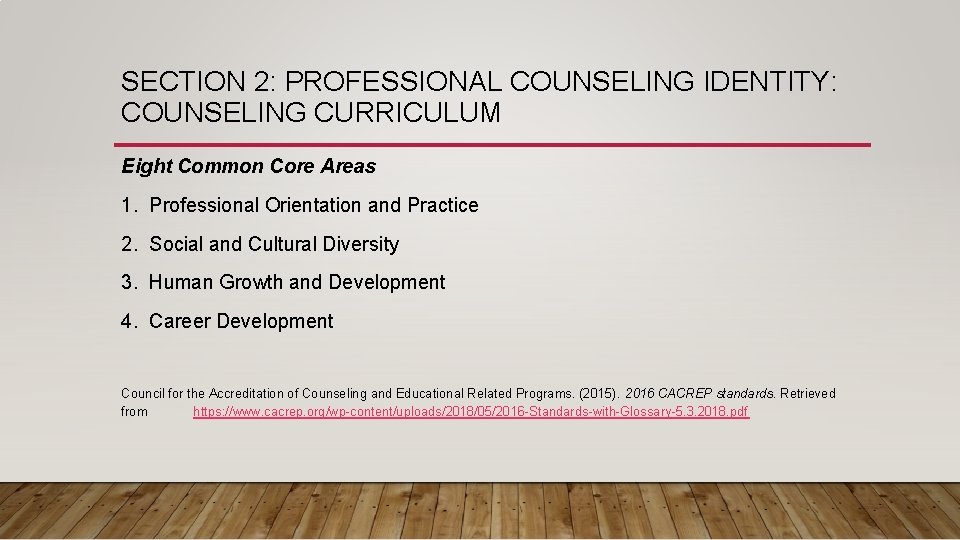
SECTION 2: PROFESSIONAL COUNSELING IDENTITY: COUNSELING CURRICULUM Eight Common Core Areas 1. Professional Orientation and Practice 2. Social and Cultural Diversity 3. Human Growth and Development 4. Career Development Council for the Accreditation of Counseling and Educational Related Programs. (2015). 2016 CACREP standards. Retrieved from https: //www. cacrep. org/wp-content/uploads/2018/05/2016 -Standards-with-Glossary-5. 3. 2018. pdf
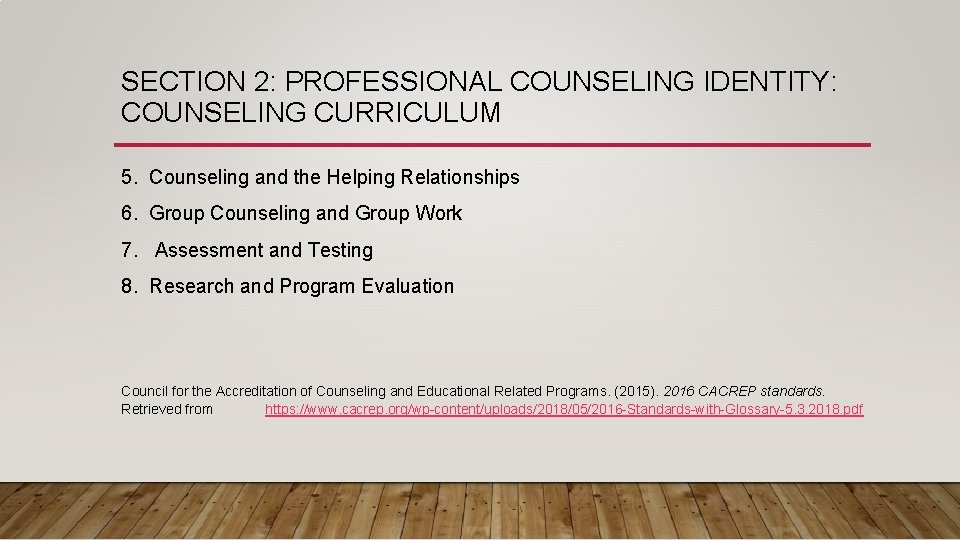
SECTION 2: PROFESSIONAL COUNSELING IDENTITY: COUNSELING CURRICULUM 5. Counseling and the Helping Relationships 6. Group Counseling and Group Work 7. Assessment and Testing 8. Research and Program Evaluation Council for the Accreditation of Counseling and Educational Related Programs. (2015). 2016 CACREP standards. Retrieved from https: //www. cacrep. org/wp-content/uploads/2018/05/2016 -Standards-with-Glossary-5. 3. 2018. pdf
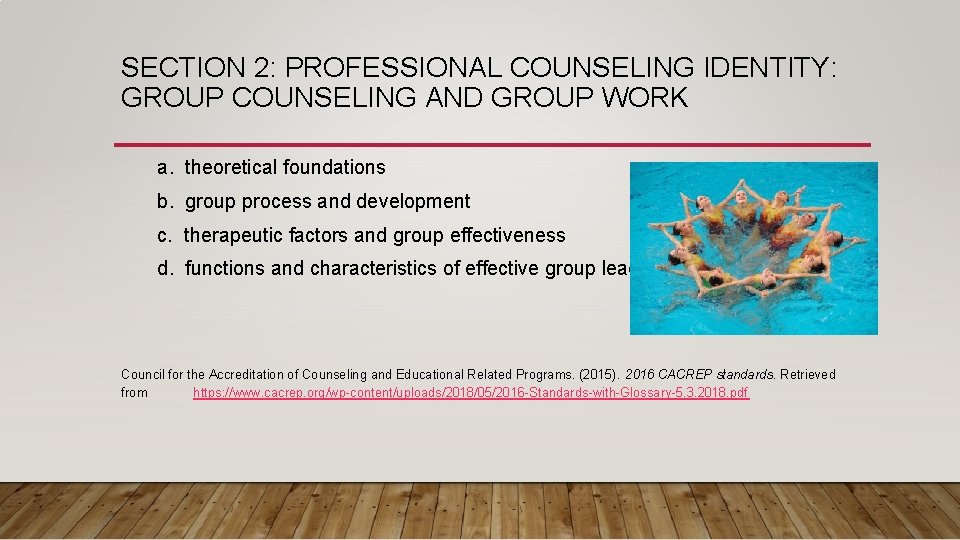
SECTION 2: PROFESSIONAL COUNSELING IDENTITY: GROUP COUNSELING AND GROUP WORK a. theoretical foundations b. group process and development c. therapeutic factors and group effectiveness d. functions and characteristics of effective group leaders Council for the Accreditation of Counseling and Educational Related Programs. (2015). 2016 CACREP standards. Retrieved from https: //www. cacrep. org/wp-content/uploads/2018/05/2016 -Standards-with-Glossary-5. 3. 2018. pdf
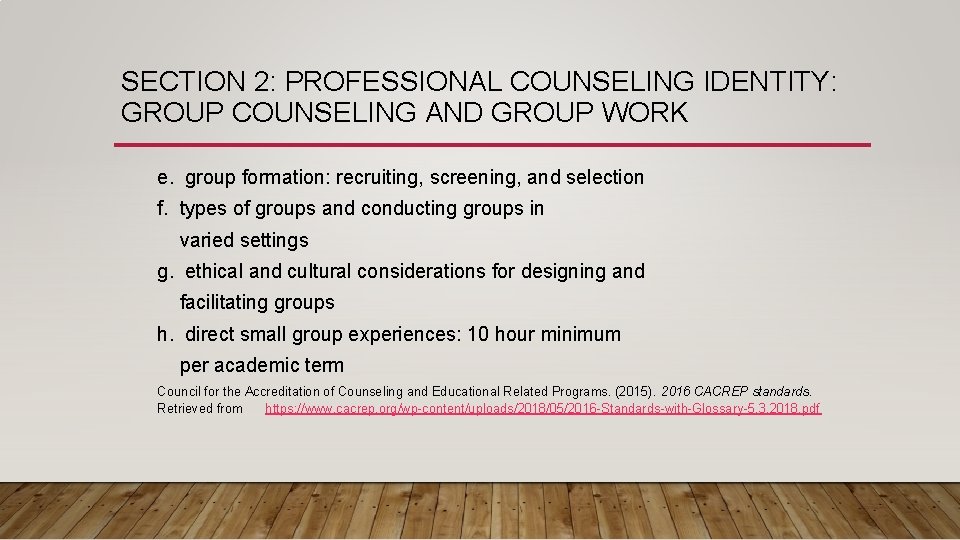
SECTION 2: PROFESSIONAL COUNSELING IDENTITY: GROUP COUNSELING AND GROUP WORK e. group formation: recruiting, screening, and selection f. types of groups and conducting groups in varied settings g. ethical and cultural considerations for designing and facilitating groups h. direct small group experiences: 10 hour minimum per academic term Council for the Accreditation of Counseling and Educational Related Programs. (2015). 2016 CACREP standards. Retrieved from https: //www. cacrep. org/wp-content/uploads/2018/05/2016 -Standards-with-Glossary-5. 3. 2018. pdf
CURRENT DISCUSSION: CACREP STANDARDS THAT IMPACT GROUP COUNSELING Spirituality and Religion 1. Removal of a definition of spirituality in the 2016 CACREP Standards, and 2. Relocation of undefined concepts of spirituality and religion to the Social and Cultural Diversity core curriculum area of Professional Identity in the 2016 CACREP Standards. Bohecker, L. , Schellenberg, R. , & Silvey, J. (2017). Spirituality and religion : The ninth CACREP core curriculum area. Counseling and Values, 62(2), 128143. http: //dx. doi. org. ezproxy. liberty. edu/10. 1002/cvj. 12055
CURRENT DISCUSSION: SPIRITUALITY AND RELIGION • Inconsistency between the value of promoting holistic wellness within the counseling profession and de-emphasizing the dimension of spirituality and religion in Professional Identity and training Bohecker, L. , Schellenberg, R. , & Silvey, J. (2017). Spirituality and religion : The ninth CACREP core curriculum area. Counseling and Values, 62(2), 128 -143. http: //dx. doi. org. ezproxy. liberty. edu/10. 1002/cvj. 12055
CURRENT DISCUSSION: SPIRITUALITY AND RELIGION • The ACA has endorsed the Association for Spiritual, Ethical, and Religious Values in Counseling (ASERVIC) Competencies to assist counselors in appropriately meeting clients’ spiritual and religious needs. • However, researchers discovered that a significant number of counselors are not aware of ASERVIC and the Competencies. Bohecker, L. , Schellenberg, R. , & Silvey, J. (2017). Spirituality and religion : The ninth CACREP core curriculum area. Counseling and Values, 62(2), 128143. http: //dx. doi. org. ezproxy. liberty. edu/10. 1002/cvj. 12055 Reiner, S. M. , & Dobmeier, R. A. (2014). Counselor preparation and the Association for Spiritual, Ethical, and Religious Values in Counseling Competencies: An exploratory study. Counseling and Values, 59, 192– 207. doi: 10. 1002/j. 2161 -007 X. 2014. 00051. x
ASSOCIATION FOR SPIRITUAL, ETHICAL, AND RELIGIOUS VALUES IN COUNSELING (ASERVIC): COMPETENCIES Purpose • To complement ACA (2016) ethical standards • To honor diversity and embrace multiculturalism • To support worth, dignity, potential, and uniqueness • To recognize social and cultural contexts • To be used with evidence-based best practices Association for Spiritual, Ethical, and Religious Values in Counseling. (2019). Competencies for addressing spiritual and religious issues in counseling. Retrieved from http: //www. aservic. org/wp-content/uploads/2017/02/ASERVIC-Spiritual-Competencies_FINAL. pdf
ASERVIC COMPETENCIES Cultural Worldview • Describe similarities/differences between spirituality and religion • Identify basic beliefs of various spiritual systems, major world religions, agnosticism, and atheism • Recognize the impact of client’s beliefs/non-beliefs on worldview and psychosocial functioning Association for Spiritual, Ethical, and Religious Values in Counseling. (2019). Competencies for addressing spiritual and religious issues in counseling. Retrieved from http: //www. aservic. org/wp-content/uploads/2017/02/ASERVIC-Spiritual-Competencies_FINAL. pdf
ASERVIC COMPETENCIES Counselor Self-Awareness • Exploration of attitudes, beliefs, and values about spirituality/religion • Evaluation of spiritual/religious beliefs and values on the client and the counseling process • Identification of limits of understanding of the client’s spiritual and/or religious perspective Association for Spiritual, Ethical, and Religious Values in Counseling. (2019). Competencies for addressing spiritual and religious issues in counseling. Retrieved from http: //www. aservic. org/wp-content/uploads/2017/02/ASERVIC-Spiritual. Competencies_FINAL. pdf
ASERVIC COMPETENCIES • Acquainted with religious/spiritual resources and leaders for consultation and referral Human and Spiritual Development • Describe and apply various models of spiritual and/or religious development and their relationship to human development Association for Spiritual, Ethical, and Religious Values in Counseling. (2019). Competencies for addressing spiritual and religious issues in counseling. Retrieved from http: //www. aservic. org/wp-content/uploads/2017/02/ASERVIC-Spiritual-Competencies_FINAL. pdf
ASERVIC COMPETENCIES Communication • Responds to client communications about spirituality/religion with acceptance and sensitivity • Uses concepts that are consistent and acceptable with the client’s spiritual/religious perspectives • Recognizes spiritual/religious themes in client communication and is able to appropriately address these Association for Spiritual, Ethical, and Religious Values in Counseling. (2019). Competencies for addressing spiritual and religious issues in counseling. Retrieved from http: //www. aservic. org/wp-content/uploads/2017/02/ASERVIC-Spiritual-Competencies_FINAL. pdf
ASERVIC COMPETENCIES Assessment • Strives to understand a client’s spiritual/religious perspective during the intake and assessment processes. Diagnosis and Treatment • Recognizes that the client’s spiritual/religious perspectives can a) enhance well-being; b) contribute to client problems; and/or c) exacerbate symptoms Association for Spiritual, Ethical, and Religious Values in Counseling. (2019). Competencies for addressing spiritual and religious issues in counseling. Retrieved from http: //www. aservic. org/wp-content/uploads/2017/02/ASERVIC-Spiritual. Competencies_FINAL. pdf
ASERVIC COMPETENCIES • Sets goals with the client that are consistent with the client’s spiritual/religious perspectives • Able to a) modify therapeutic techniques to include a client’s spiritual/religious perspectives, and b) utilize spiritual/religious practices as techniques when appropriate and acceptable to a client’s viewpoint • Apply theory and current research supporting inclusion Association for Spiritual, Ethical, and Religious Values in Counseling. (2019). Competencies for addressing spiritual and religious issues in counseling. Retrieved from http: //www. aservic. org/wp-content/uploads/2017/02/ASERVIC-Spiritual. Competencies_FINAL. pdf
ASERVIC COMPETENCIES of a client’s spiritual/religious perspectives and practices • ASERVIC endorses the counseling competencies established by the Association for Multicultural Counseling and Development (AMCD) and the Association for Lesbian, Gay, Bisexual, and Transgender Issues in Counseling (ALGBTIC) Association for Spiritual, Ethical, and Religious Values in Counseling. (2019). Competencies for addressing spiritual and religious issues in counseling. Retrieved from http: //www. aservic. org/wp-content/uploads/2017/02/ASERVIC-Spiritual-Competencies_FINAL. pdf
CURRENT DISCUSSION: SPIRITUALITY AND RELIGION AS NINTH CORE CURRICULUM AREA OF CACREP Rationale • Spiritual values can be the most significantly held cultural values of clients • To provide consistent training standards in meeting the spiritual and religious needs of clients • To globally advocate holistic wellness for all individuals • To prevent client neglect and unethical treatment Bohecker, L. , Schellenberg, R. , & Silvey, J. (2017). Spirituality and religion : The ninth CACREP core curriculum area. Counseling and Values, 62(2), 128143. http: //dx. doi. org. ezproxy. liberty. edu/10. 1002/cvj. 12055 Burke, M. T. (1998– 1999, Winter). From the chair. The CACREP Connection, p. 2.
PROPOSED NINTH CACREP CORE CURRICULUM AREA OF SPIRITUALITY AND RELIGION a. spiritual and religious history and development of counseling b. spirituality, spiritual identities, faith-based cultures, and world religions c. models of faith, spiritual, and religious development d. spiritual and religious supervision, collaboration, and consultation e. spiritual and faith-based wellness, functioning, and identity Bohecker, L. , Schellenberg, R. , & Silvey, J. (2017). Spirituality and religion : The ninth CACREP core curriculum area. Counseling and Values, 62(2), 128143. http: //dx. doi. org. ezproxy. liberty. edu/10. 1002/cvj. 12055
CORE CURRICULUM AREA OF SPIRITUALITY AND RELIGION f. spiritual/religious perspectives of clinical assessment, case conceptualization, and diagnosis and treatment planning g. competencies for addressing spiritual and religious issues h. working with diverse spiritual and religious systems i. interviewing and assessing individuals, couples, and families from diverse spiritual/religious backgrounds j. identification of spiritual/religious values and appropriate Bohecker, L. , Schellenberg, R. , & Silvey, J. (2017). Spirituality and religion : The ninth CACREP core curriculum area. Counseling and Values, 62(2), 128143. http: //dx. doi. org. ezproxy. liberty. edu/10. 1002/cvj. 12055
CORE CURRICULUM AREA OF SPIRITUALITY AND RELIGION treatment, planning, and intervention strategies k. impact of spiritual/religious beliefs on: grief/loss process, rituals, behaviors, aging, intergenerational influences, crisis/trauma, addictions, human sexuality, couple/family functioning, infidelity, violence, abuse, and health issues Bohecker, L. , Schellenberg, R. , & Silvey, J. (2017). Spirituality and religion : The ninth CACREP core curriculum area. Counseling and Values, 62(2), 128143. http: //dx. doi. org. ezproxy. liberty. edu/10. 1002/cvj. 12055
CORE CURRICULUM AREA OF SPIRITUALITY AND RELIGION l. ethical/culturally relevant strategies for referrals and consultation with spiritual leaders Note. The curriculum standards were reviewed by an expert panel of 11 counselor educators. Bohecker, L. , Schellenberg, R. , & Silvey, J. (2017). Spirituality and religion : The ninth CACREP core curriculum area. Counseling and Values, 62(2), 128143. http: //dx. doi. org. ezproxy. liberty. edu/10. 1002/cvj. 12055
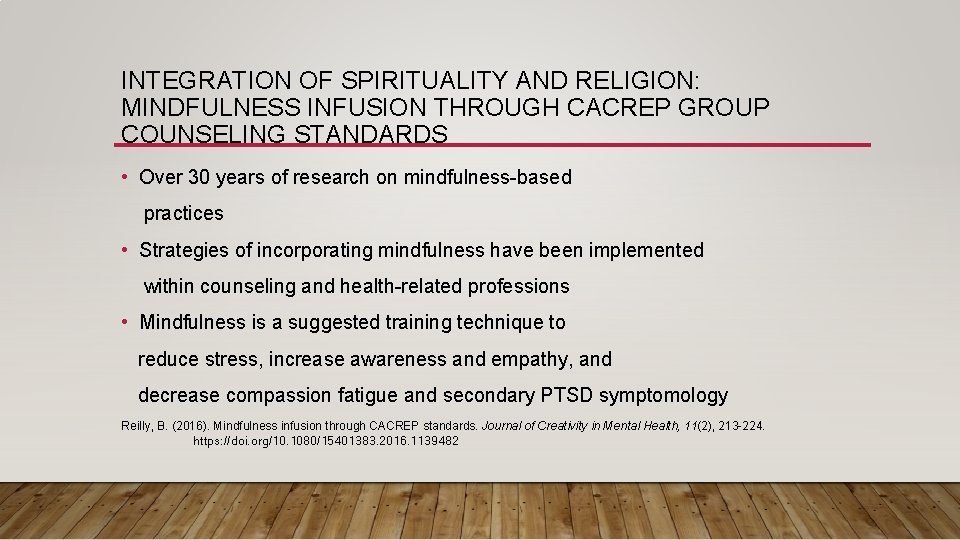
INTEGRATION OF SPIRITUALITY AND RELIGION: MINDFULNESS INFUSION THROUGH CACREP GROUP COUNSELING STANDARDS • Over 30 years of research on mindfulness-based practices • Strategies of incorporating mindfulness have been implemented within counseling and health-related professions • Mindfulness is a suggested training technique to reduce stress, increase awareness and empathy, and decrease compassion fatigue and secondary PTSD symptomology Reilly, B. (2016). Mindfulness infusion through CACREP standards. Journal of Creativity in Mental Health, 11(2), 213 -224. https: //doi. org/10. 1080/15401383. 2016. 1139482
INTEGRATION OF SPIRITUALITY AND RELIGION: MINDFULNESS INFUSION THROUGH CACREP GROUP COUNSELING STANDARDS Mindfulness practices • help increase awareness by nonjudgmentally attending to thoughts, emotions, and physical sensations • continually bring attention back to the present moment as experienced in the body Reilly, B. (2016). Mindfulness infusion through CACREP standards. Journal of Creativity in Mental Health, 11(2), 213 -224. https: //doi. org/10. 1080/15401383. 2016. 1139482
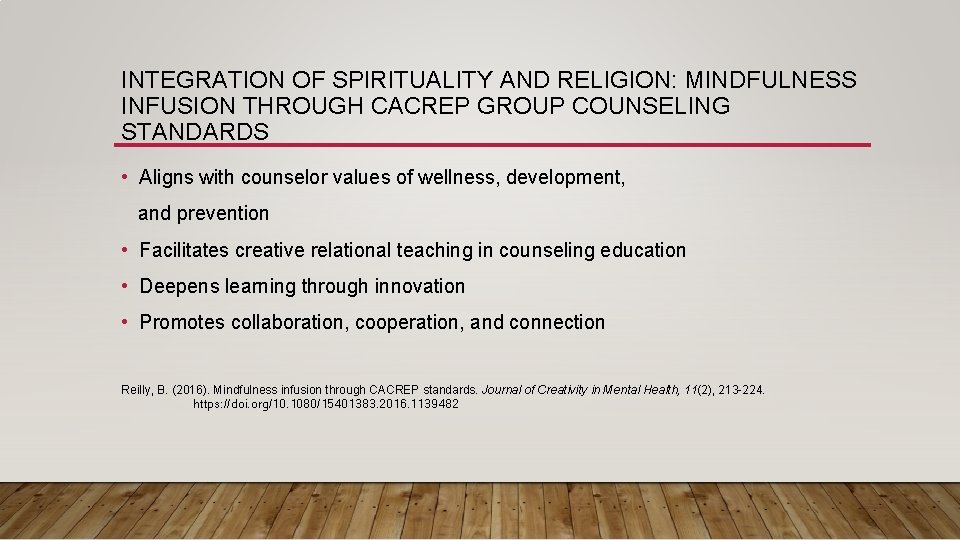
INTEGRATION OF SPIRITUALITY AND RELIGION: MINDFULNESS INFUSION THROUGH CACREP GROUP COUNSELING STANDARDS • Aligns with counselor values of wellness, development, and prevention • Facilitates creative relational teaching in counseling education • Deepens learning through innovation • Promotes collaboration, cooperation, and connection Reilly, B. (2016). Mindfulness infusion through CACREP standards. Journal of Creativity in Mental Health, 11(2), 213 -224. https: //doi. org/10. 1080/15401383. 2016. 1139482
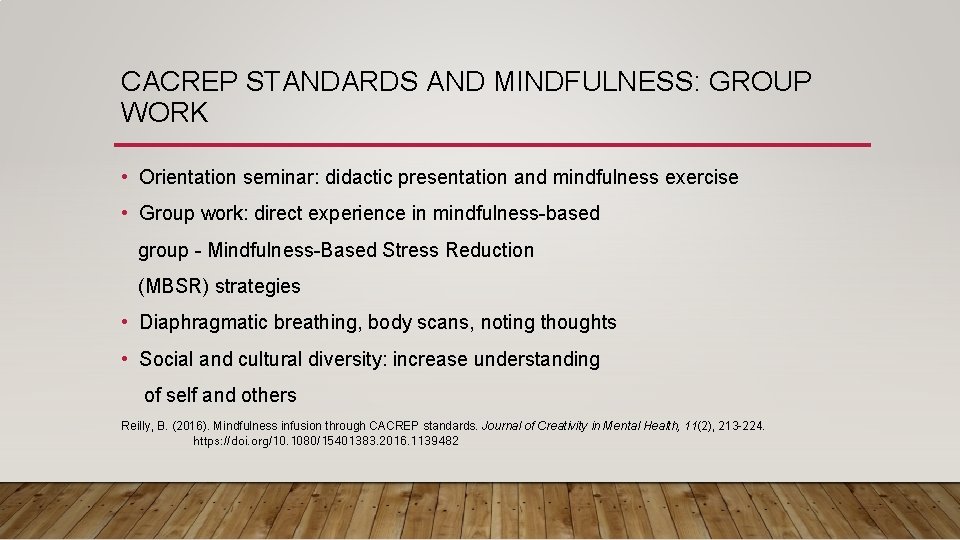
CACREP STANDARDS AND MINDFULNESS: GROUP WORK • Orientation seminar: didactic presentation and mindfulness exercise • Group work: direct experience in mindfulness-based group - Mindfulness-Based Stress Reduction (MBSR) strategies • Diaphragmatic breathing, body scans, noting thoughts • Social and cultural diversity: increase understanding of self and others Reilly, B. (2016). Mindfulness infusion through CACREP standards. Journal of Creativity in Mental Health, 11(2), 213 -224. https: //doi. org/10. 1080/15401383. 2016. 1139482
INTEGRATION OF SPIRITUALITY AND RELIGION: CENTERING PRAYER AND CACREP GROUP COUNSELING STANDARDS • Some programs may prefer a Christian-oriented mindfulness practice • Centering prayer as an alternative to secular or Eastern mindfulness-based practices • Developed from Christian contemplative tradition in the 1970 s • Primary contributors: Thomas Keating, William Meninger, M. Basil Pennington, Thomas Merton Knabb, J. J. (2012). Centering prayer as an alternative to mindfulness-based cognitive therapy for depression relapse prevention. Journal of Religion and Health, 51(3), 908 -24. doi: http: //dx. doi. org. ezproxy. liberty. edu/10. 1007/s 10943 -010 -940
CENTERING PRAYER: GROUP WORK Process of centering prayer • Quieting of thoughts and focusing on the inner-dwelling faith in God • Choosing a single (sacred) word that reflects the faithful love of God • Sitting in silence for about 20 minutes • Refocusing on God’s presence via the sacred word when one’s awareness is drawn away Knabb, J. J. (2012). Centering prayer as an alternative to mindfulness-based cognitive therapy for depression relapse prevention. Journal of Religion and Health, 51(3), 908 -24. doi: http: //dx. doi. org. ezproxy. liberty. edu/10. 1007/s 10943 -010 -940
CENTERING PRAYER: GROUP WORK • Closing in prayer, such as “Our Father”, after taking a few minutes to come out of meditation Knabb, J. J. (2012). Centering prayer as an alternative to mindfulness-based cognitive therapy for depression relapse prevention. Journal of Religion and Health, 51(3), 908 -24. doi: http: //dx. doi. org. ezproxy. liberty. edu/10. 1007/s 10943 -010 -940
DISCUSSION QUESTIONS Doctoral Professional Identity How do you see the integration of spirituality and religion into CACREP Professional Identity Group Counseling standards impacting: 1. 2. 3. 4. 5. the conceptualization of clients from multiple theoretical perspectives? ethical and culturally relevant counseling in multiple settings? ethical and culturally relevant strategies used in counselor preparation? the role of counselors and counselor educators advocating on behalf of the profession and professional identity? ethical and culturally relevant leadership and advocacy practices? Council for the Accreditation of Counseling and Educational Related Programs. (2015). 2016 CACREP standards. Retrieved from https: //www. cacrep. org/wp-content/uploads/2018/05/2016 -Standards-with-Glossary-5. 3. 2018. pdf
REFERENCES American Counseling Association. (2014). ACA code of ethics. Retrieved from http: //www. counseling. org/docs/ethics/2014 -aca-codeof-ethics. pdf Anderson, M. L. , Sylvan, A. L. , & Sheets, R. L. (2014). Experiential group training: An exploration of student perceptions. Ideas and Research You Can Use: VISTAS Online, 2014, 1 -22 Association for Spiritual, Ethical, and Religious Values in Counseling. (2019). Competencies for addressing spiritual and religious issues in counseling. Retrieved from http: //www. aservic. org/wp-content/uploads/2017/02/ASERVICSpiritual- Competencies_FINAL. pdf Barlow, S. H. (2004). A strategic three-year plan to teach beginning, intermediate, and advanced group skills. The Journal for Specialists in Group Work, 29(1), 113 -126. Bohecker, L. , Schellenberg, R. , & Silvey, J. (2017). Spirituality and religion : The ninth CACREP core curriculum area. Counseling and Values, 62(2), 128 -143. http: //dx. doi. org. ezproxy. liberty. edu/10. 1002/cvj. 12055 Burke, M. T. (1998– 1999, Winter). From the chair. The CACREP Connection, p. 2.
REFERENCES Council for the Accreditation of Counseling and Educational Related Programs. (2015). 2016 CACREP standards. Retrieved from https: //www. cacrep. org/wp-content/uploads/2018/05/2016 -Standards-with-Glossary-5. 3. 2018. pdf Council for the Accreditation of Counseling and Related Educational Programs. (2019). About CACREP. Retrieved from https: //www. cacrep. org/about-cacrep/ Davenport, D. S. (2004). Ethical issues in the teaching of group counseling. The Journal for Specialists in Group Work, 29(1), 43 -49. Gladding, S. T. (1994). Effective Group Counseling. ERIC/CASS, School of Education, University of North Carolina at Greensboro, 101 Park Bldg. , Greensboro, NC 27412 -5001. Knabb, J. J. (2012). Centering prayer as an alternative to mindfulness-based cognitive therapy for depression relapse prevention. Journal of Religion and Health, 51(3), 908 -24. doi: http: //dx. doi. org. ezproxy. liberty. edu/10. 1007/s 10943 -010940 Reilly, B. (2016). Mindfulness infusion through CACREP standards. Journal of Creativity in Mental Health, 11(2), 213224. https: //doi. org/10. 1080/15401383. 2016. 1139482
REFERENCES Reiner, S. M. , & Dobmeier, R. A. (2014). Counselor preparation and the Association for Spiritual, Ethical, and Religious Values in Counseling Competencies: An exploratory study. Counseling and Values, 59, 192– 207. doi: 10. 1002/j. 2161007 X. 2014. 00051. x Thomas, R. V. , & Pender, D. A. (2008). Association for specialists in group work: Best practice guidelines 2007 revisions. The Journal for Specialists in Group Work, 33(2), 111 -117. Singh, A. A. , Merchant, N. , Skudrzyk, B. , & Ingene, D. (2012). Multicultural and social justice competence principles for group workers. Association for Specialists in Group Work. Wilson, F. R. , Rapin, L. S. , & Haley-Banez, L. (2000). Association for Specialists in Group Work: Professional standards for the training of group workers. Journal for Specialists in Group Work, 25(4), 327 -342.
- Slides: 60