
Standards of Measurement 2010 2011 Units and Standards
- Slides: 17
Standards of Measurement 2010 -2011
Units and Standards 1. Standards – exact quantity that people agree to use for comparison 2. SI – standard system of measurement 1. All scientists use this system 2. Metric vs English System 1. Americans use the English System 1. Example: Feet and Inches 2. 1970’s we tried to convert to the metric system 1. We failed miserably
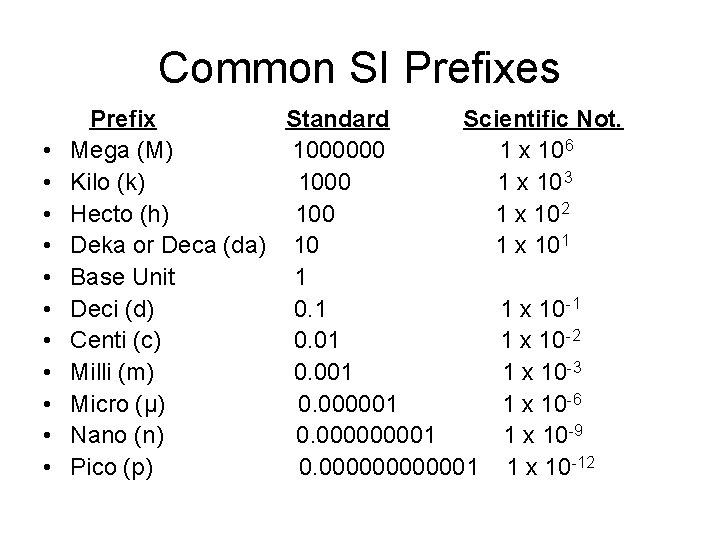
Common SI Prefixes • • • Prefix Standard Scientific Not. Mega (M) 1000000 1 x 10 6 Kilo (k) 1000 1 x 10 3 Hecto (h) 100 1 x 10 2 Deka or Deca (da) 10 1 x 101 Base Unit 1 Deci (d) 0. 1 1 x 10 -1 Centi (c) 0. 01 1 x 10 -2 Milli (m) 0. 001 1 x 10 -3 Micro (µ) 0. 000001 1 x 10 -6 Nano (n) 0. 00001 1 x 10 -9 Pico (p) 0. 0000001 1 x 10 -12
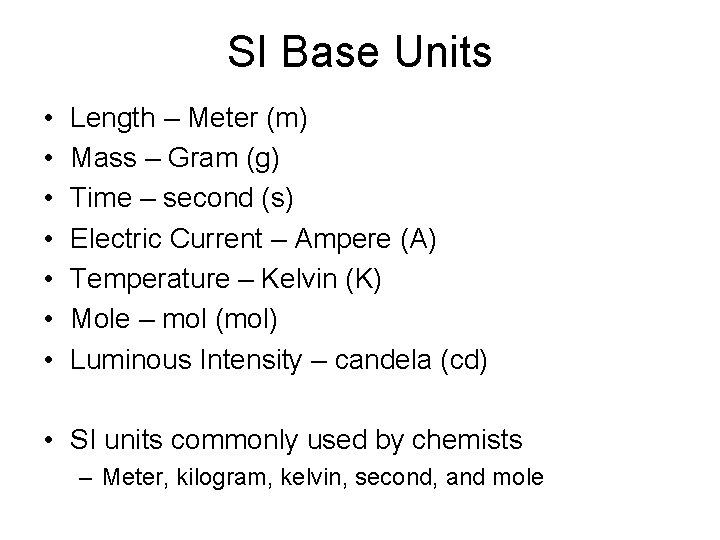
SI Base Units • • Length – Meter (m) Mass – Gram (g) Time – second (s) Electric Current – Ampere (A) Temperature – Kelvin (K) Mole – mol (mol) Luminous Intensity – candela (cd) • SI units commonly used by chemists – Meter, kilogram, kelvin, second, and mole
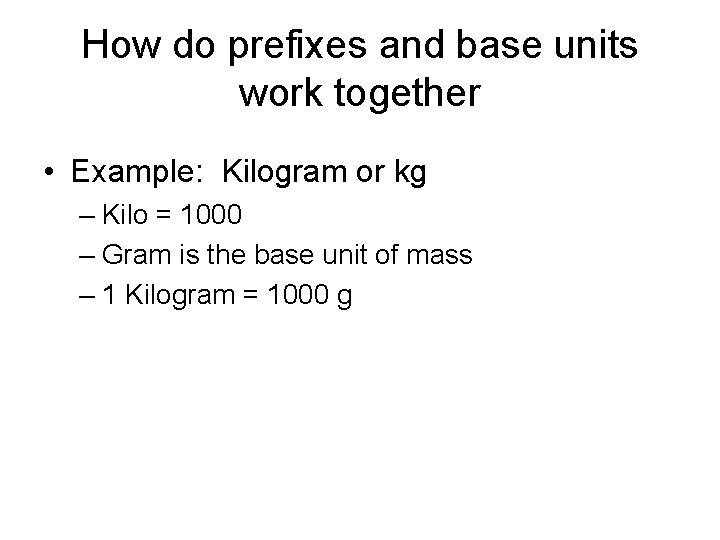
How do prefixes and base units work together • Example: Kilogram or kg – Kilo = 1000 – Gram is the base unit of mass – 1 Kilogram = 1000 g
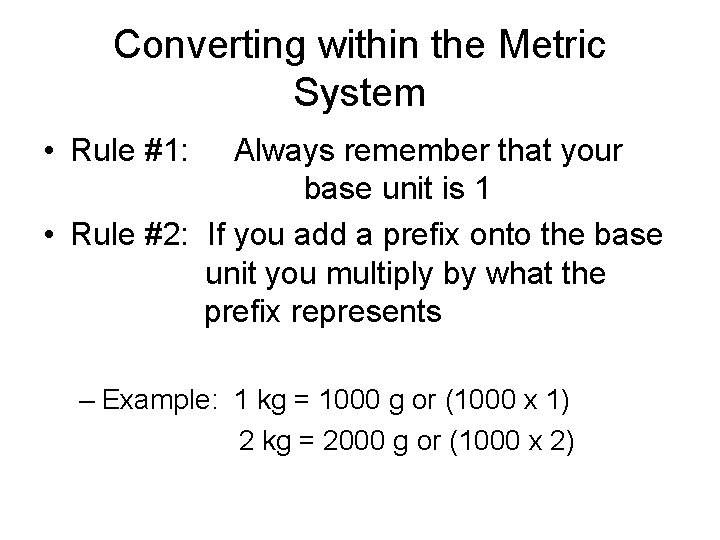
Converting within the Metric System • Rule #1: Always remember that your base unit is 1 • Rule #2: If you add a prefix onto the base unit you multiply by what the prefix represents – Example: 1 kg = 1000 g or (1000 x 1) 2 kg = 2000 g or (1000 x 2)
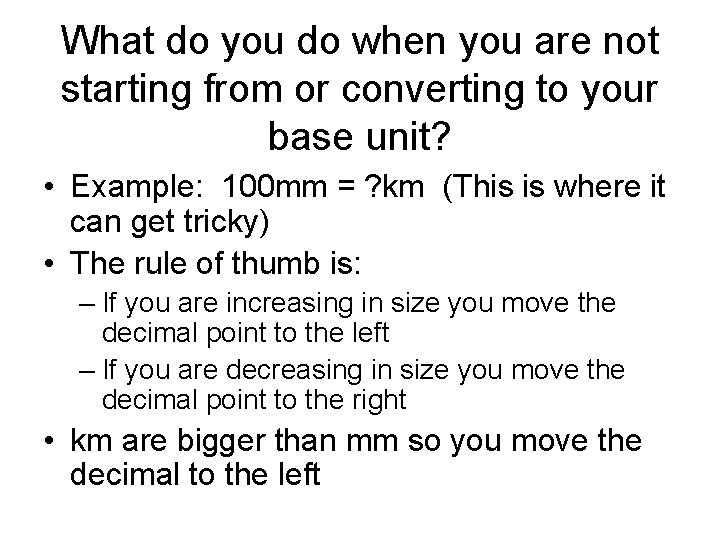
What do you do when you are not starting from or converting to your base unit? • Example: 100 mm = ? km (This is where it can get tricky) • The rule of thumb is: – If you are increasing in size you move the decimal point to the left – If you are decreasing in size you move the decimal point to the right • km are bigger than mm so you move the decimal to the left
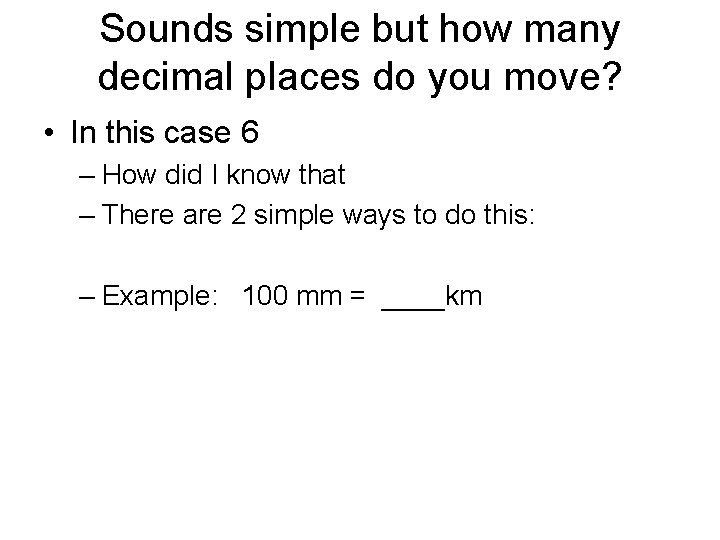
Sounds simple but how many decimal places do you move? • In this case 6 – How did I know that – There are 2 simple ways to do this: – Example: 100 mm = ____km
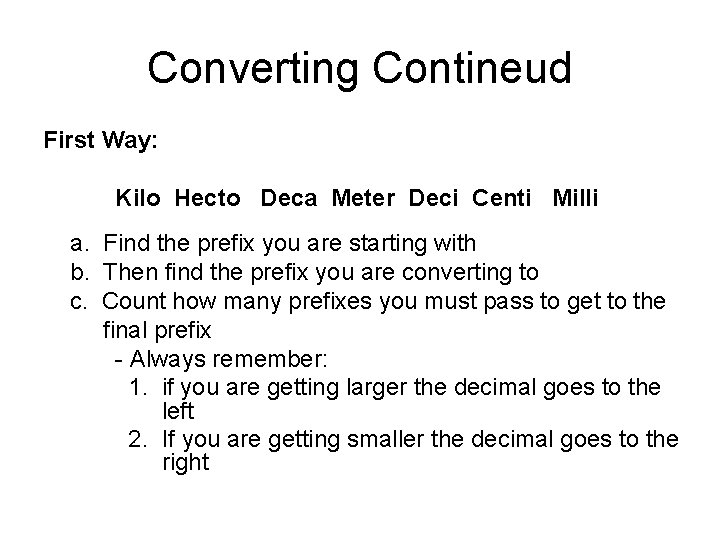
Converting Contineud First Way: Kilo Hecto Deca Meter Deci Centi Milli a. Find the prefix you are starting with b. Then find the prefix you are converting to c. Count how many prefixes you must pass to get to the final prefix - Always remember: 1. if you are getting larger the decimal goes to the left 2. If you are getting smaller the decimal goes to the right
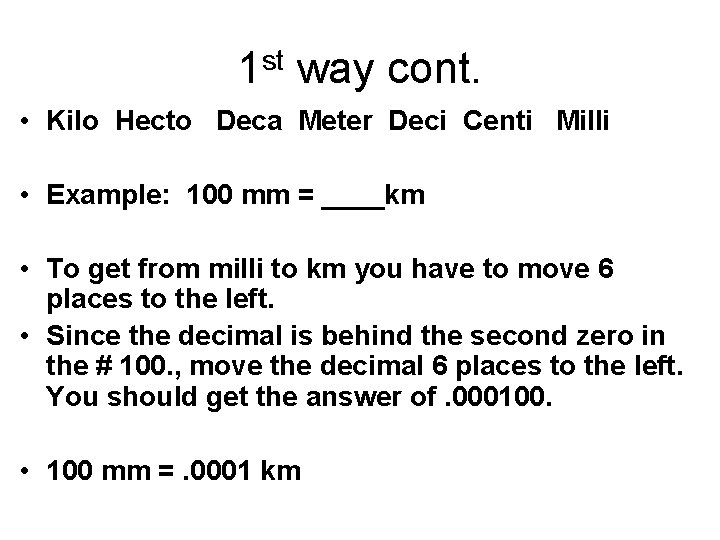
1 st way cont. • Kilo Hecto Deca Meter Deci Centi Milli • Example: 100 mm = ____km • To get from milli to km you have to move 6 places to the left. • Since the decimal is behind the second zero in the # 100. , move the decimal 6 places to the left. You should get the answer of. 000100. • 100 mm =. 0001 km
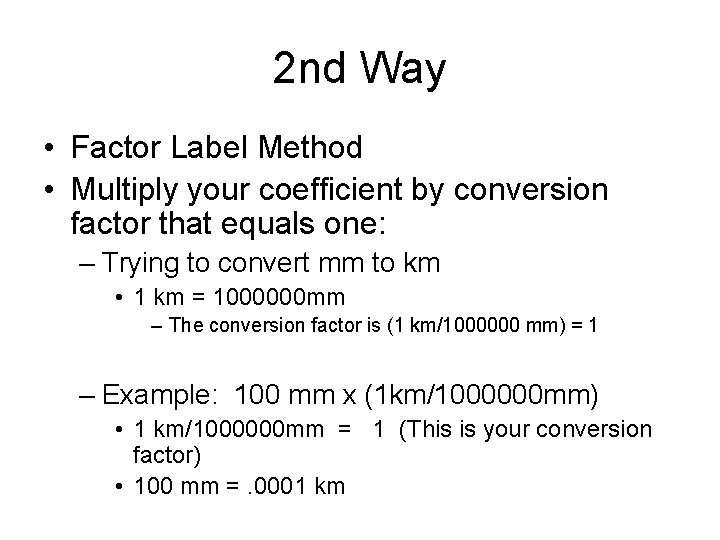
2 nd Way • Factor Label Method • Multiply your coefficient by conversion factor that equals one: – Trying to convert mm to km • 1 km = 1000000 mm – The conversion factor is (1 km/1000000 mm) = 1 – Example: 100 mm x (1 km/1000000 mm) • 1 km/1000000 mm = 1 (This is your conversion factor) • 100 mm =. 0001 km
Volume • Defined as the amount of space occupied by an object • It does not just measure liquid
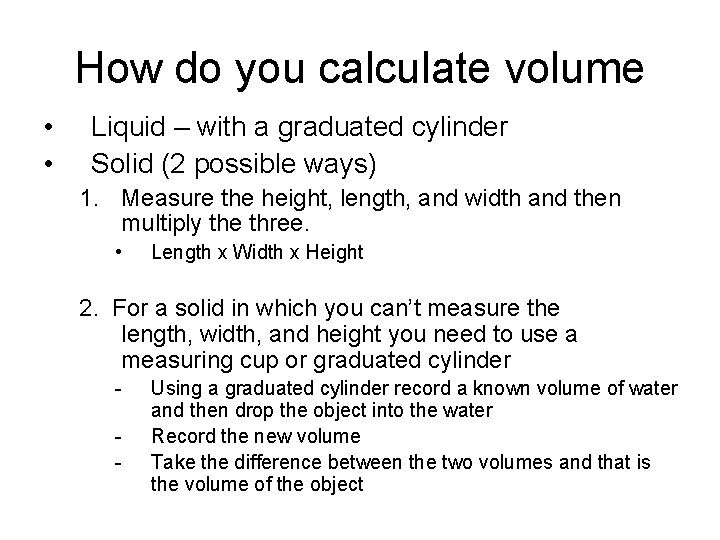
How do you calculate volume • • Liquid – with a graduated cylinder Solid (2 possible ways) 1. Measure the height, length, and width and then multiply the three. • Length x Width x Height 2. For a solid in which you can’t measure the length, width, and height you need to use a measuring cup or graduated cylinder - Using a graduated cylinder record a known volume of water and then drop the object into the water Record the new volume Take the difference between the two volumes and that is the volume of the object
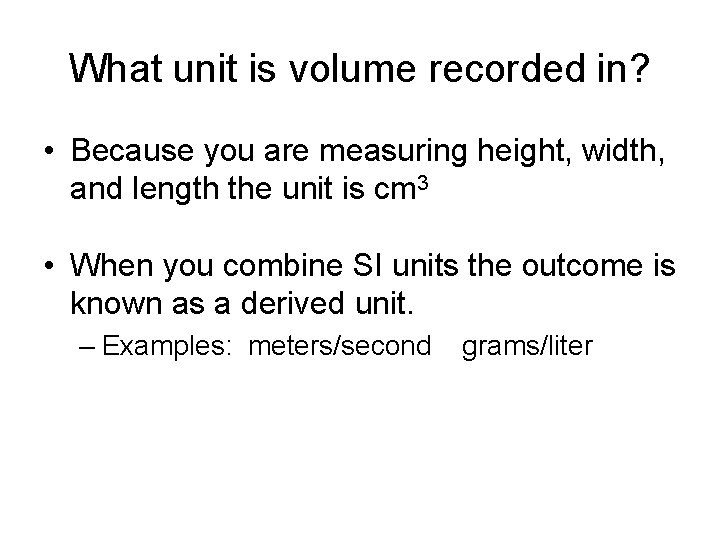
What unit is volume recorded in? • Because you are measuring height, width, and length the unit is cm 3 • When you combine SI units the outcome is known as a derived unit. – Examples: meters/second grams/liter
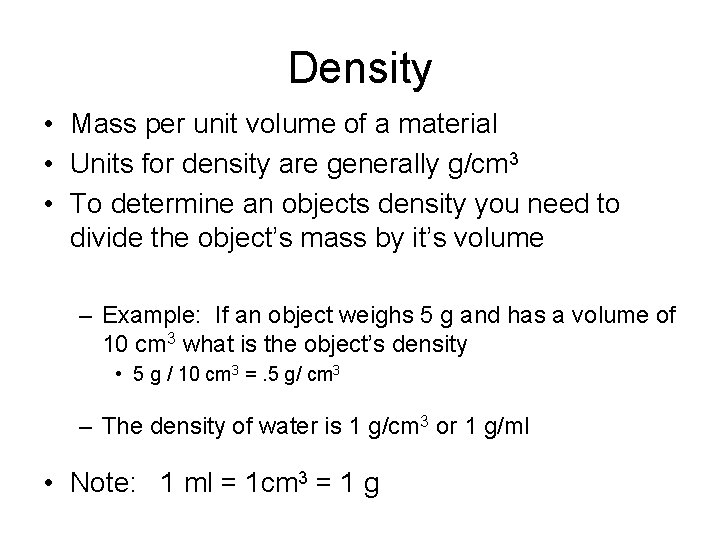
Density • Mass per unit volume of a material • Units for density are generally g/cm 3 • To determine an objects density you need to divide the object’s mass by it’s volume – Example: If an object weighs 5 g and has a volume of 10 cm 3 what is the object’s density • 5 g / 10 cm 3 =. 5 g/ cm 3 – The density of water is 1 g/cm 3 or 1 g/ml • Note: 1 ml = 1 cm 3 = 1 g
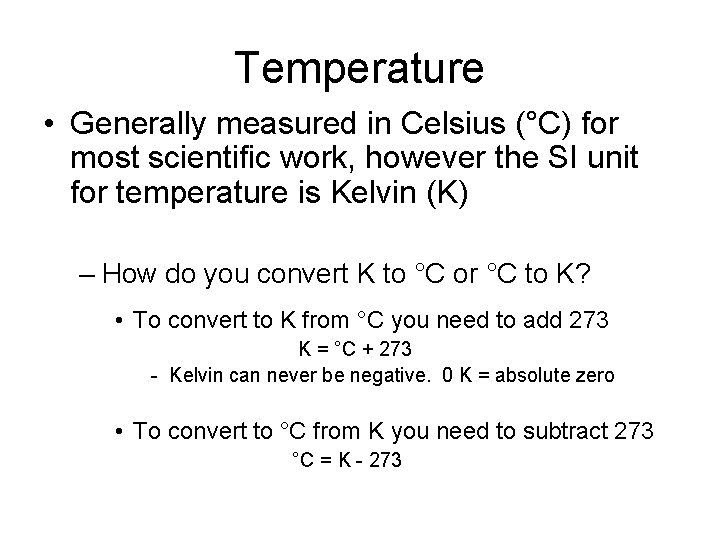
Temperature • Generally measured in Celsius (°C) for most scientific work, however the SI unit for temperature is Kelvin (K) – How do you convert K to °C or °C to K? • To convert to K from °C you need to add 273 K = °C + 273 - Kelvin can never be negative. 0 K = absolute zero • To convert to °C from K you need to subtract 273 °C = K - 273
Temperature Contineud • • • Generally we don’t use °F or Fahrenheit To convert °F to °C use this formula: °C = (°F - 32) x 5/9 To convert °C to °F ° F = (° C x 9/5) + 32 If you want to convert °F to K first convert to °C then add 273 • If you want to convert K to °F first convert K to °C then convert °C to K by subtracting 273