
Standards of diabetes care Mohsen Eledrisi MD FACP

Standards of diabetes care Mohsen Eledrisi, MD, FACP, FACE Department of Medicine Hamad Medical Corporation Doha, Qatar www. eledrisi. com
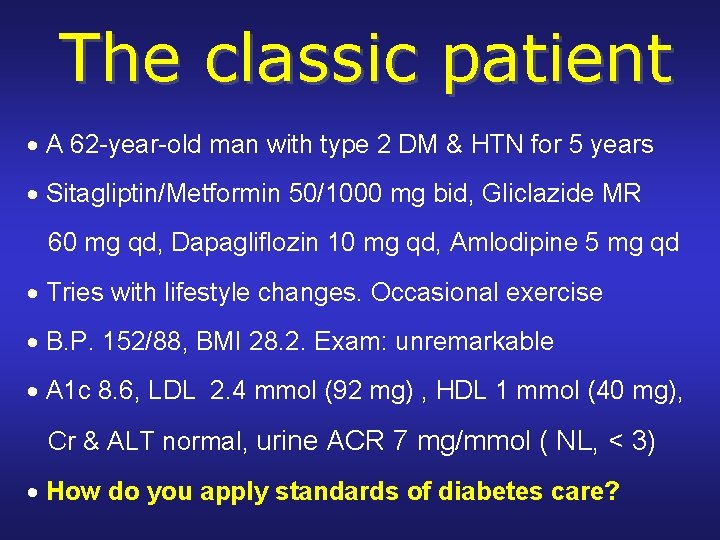
The classic patient A 62 -year-old man with type 2 DM & HTN for 5 years Sitagliptin/Metformin 50/1000 mg bid, Gliclazide MR 60 mg qd, Dapagliflozin 10 mg qd, Amlodipine 5 mg qd Tries with lifestyle changes. Occasional exercise B. P. 152/88, BMI 28. 2. Exam: unremarkable A 1 c 8. 6, LDL 2. 4 mmol (92 mg) , HDL 1 mmol (40 mg), Cr & ALT normal, urine ACR 7 mg/mmol ( NL, < 3) How do you apply standards of diabetes care?
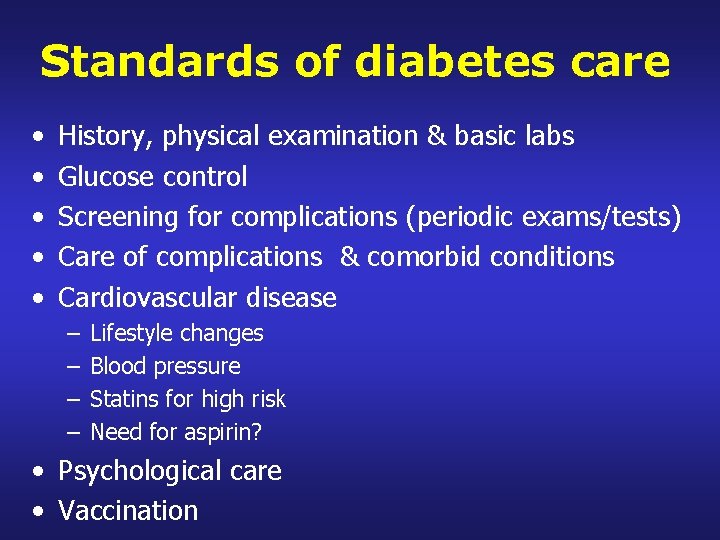
Standards of diabetes care • • • History, physical examination & basic labs Glucose control Screening for complications (periodic exams/tests) Care of complications & comorbid conditions Cardiovascular disease – – Lifestyle changes Blood pressure Statins for high risk Need for aspirin? • Psychological care • Vaccination
Standards of diabetes care • • • History, physical examination & basic labs Glucose control Screening for complications (periodic exams/tests) Care of complications & comorbid conditions Cardiovascular disease – – Lifestyle changes Blood pressure Statins for high risk Need for aspirin? • Psychological care • Vaccination
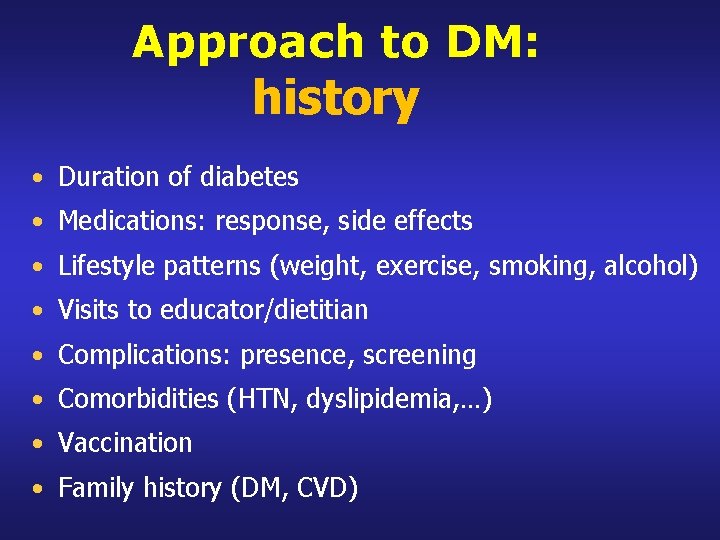
Approach to DM: history • Duration of diabetes • Medications: response, side effects • Lifestyle patterns (weight, exercise, smoking, alcohol) • Visits to educator/dietitian • Complications: presence, screening • Comorbidities (HTN, dyslipidemia, …) • Vaccination • Family history (DM, CVD)
Approach to DM: physical exam • Blood pressure • Weight, height, BMI • Thyroid • Skin • Foot • Focused systematic examination
Approach to DM: baseline lab. tests • A 1 c • Lipids • Serum creatinine, e. GFR • Serum K+ (if on ACEI, ARB, or diuretic) • ALT, AST • Urine albumin: creatinine ratio (UACR) • TSH for type 1 DM American Diabetes Association. Diabetes Care 2021; 44 (suppl 1): S 40
Diabetes: why care? • Risk of cardiovascular disease (CAD, stroke, PAD) • # 1 cause of chronic kidney disease and dialysis • # 1 cause of non-traumatic limb amputations • # 1 cause of blindness in adults • Major cause of disability and work absenteeism • It confers an equivalent risk to ageing 15 years • A huge economic impact (complications, meds, labs, . ) Peters S, et al. Lancet 2014; 383: 197 Center for disease control & prevention www. cdc. gov
Standards of diabetes care • • • History, physical examination, basic labs Glucose control Screening for complications (periodic exams/tests) Care of complications & comorbid conditions Cardiovascular disease – – Lifestyle changes Blood pressure Statins for high risk Need for aspirin? • Psychological care • Vaccination
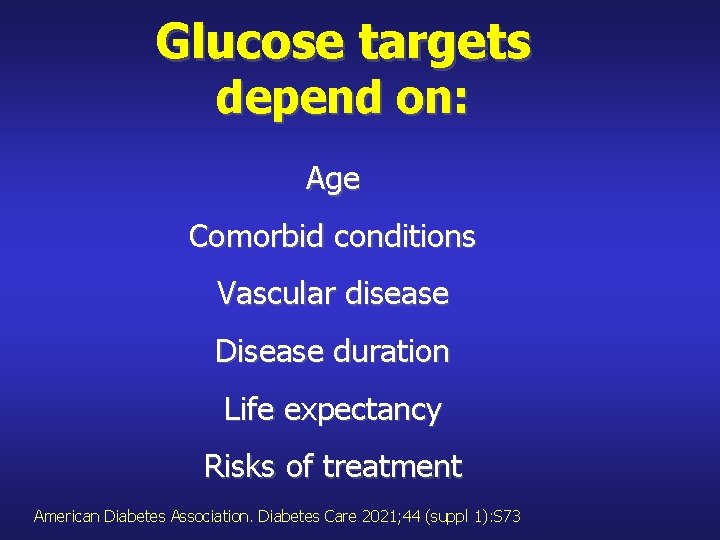
Glucose targets depend on: Age Comorbid conditions Vascular disease Disease duration Life expectancy Risks of treatment American Diabetes Association. Diabetes Care 2021; 44 (suppl 1): S 73
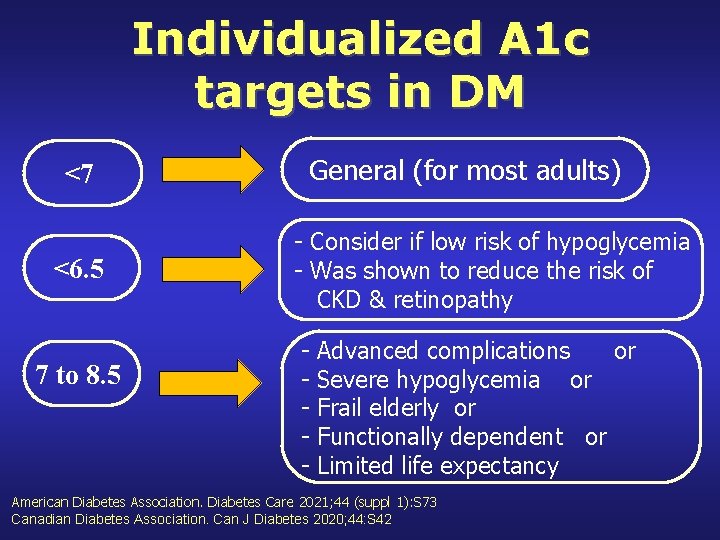
Individualized A 1 c targets in DM <7 <6. 5 7 to 8. 5 General (for most adults) - Consider if low risk of hypoglycemia - Was shown to reduce the risk of CKD & retinopathy - Advanced complications or Severe hypoglycemia or Frail elderly or Functionally dependent or Limited life expectancy American Diabetes Association. Diabetes Care 2021; 44 (suppl 1): S 73 Canadian Diabetes Association. Can J Diabetes 2020; 44: S 42
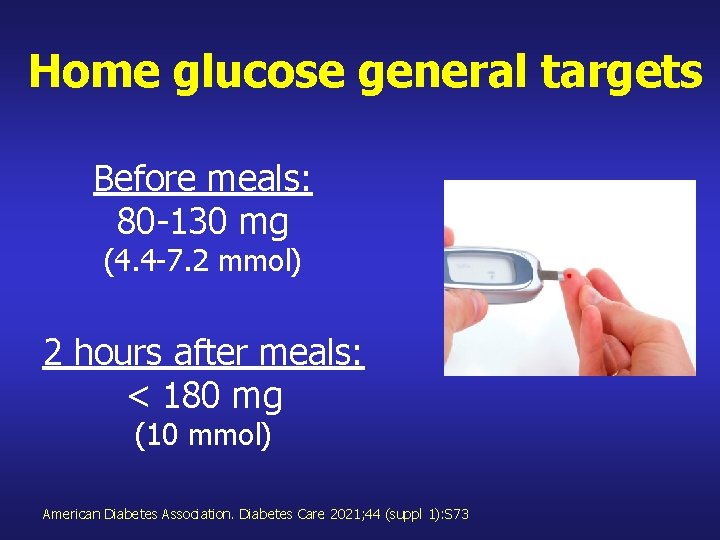
Home glucose general targets Before meals: 80 -130 mg (4. 4 -7. 2 mmol) 2 hours after meals: < 180 mg (10 mmol) American Diabetes Association. Diabetes Care 2021; 44 (suppl 1): S 73
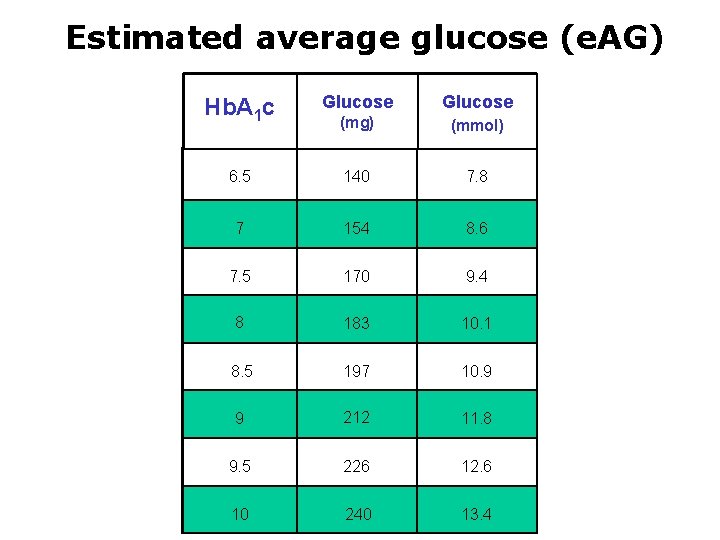
Estimated average glucose (e. AG) Hb. A 1 c Glucose (mg) (mmol) 6. 5 140 7. 8 7 154 8. 6 7. 5 170 9. 4 8 183 10. 1 8. 5 197 10. 9 9 212 11. 8 9. 5 226 12. 6 10 240 13. 4
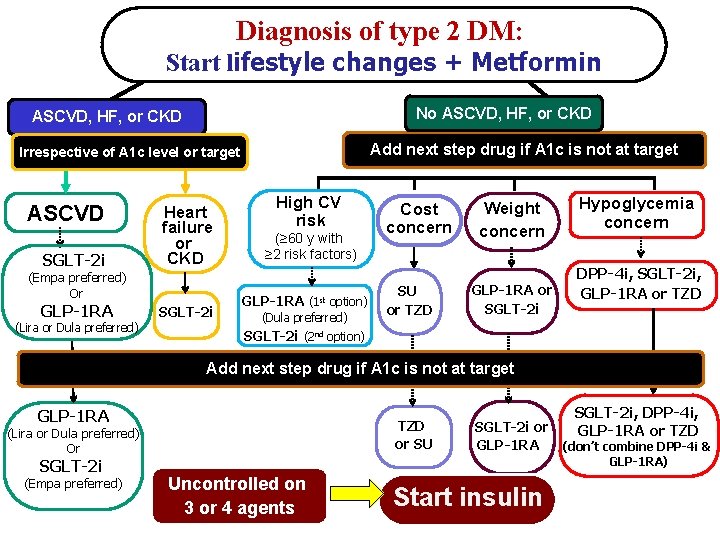
Diagnosis of type 2 DM: Start lifestyle changes + Metformin No ASCVD, HF, or CKD Add next step drug if A 1 c is not at target Irrespective of A 1 c level or target ASCVD SGLT-2 i Heart failure or CKD (Empa preferred) Or GLP-1 RA (Lira or Dula preferred) SGLT-2 i High CV risk (≥ 60 y with ≥ 2 risk factors) GLP-1 RA (1 st option) (Dula preferred) Cost concern SU or TZD Weight concern GLP-1 RA or SGLT-2 i Hypoglycemia concern DPP-4 i, SGLT-2 i, GLP-1 RA or TZD SGLT-2 i (2 nd option) Add next step drug if A 1 c is not at target GLP-1 RA TZD or SU (Lira or Dula preferred) Or SGLT-2 i (Empa preferred) SGLT-2 i, DPP-4 i, SGLT-2 i or GLP-1 RA or TZD GLP-1 RA (don’t combine DPP-4 i & GLP-1 RA) Uncontrolled on 3 or 4 agents Start insulin
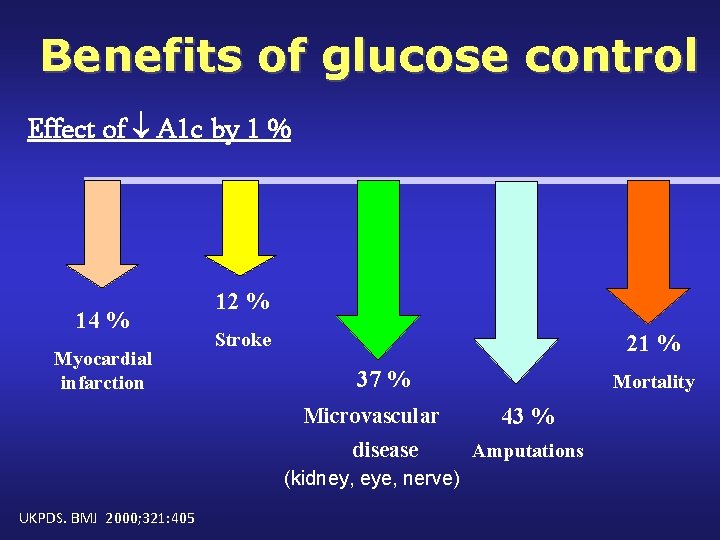
Benefits of glucose control Effect of A 1 c by 1 % 14 % Myocardial infarction 12 % Stroke 21 % 37 % Microvascular disease (kidney, eye, nerve) UKPDS. BMJ 2000; 321: 405 Mortality 43 % Amputations
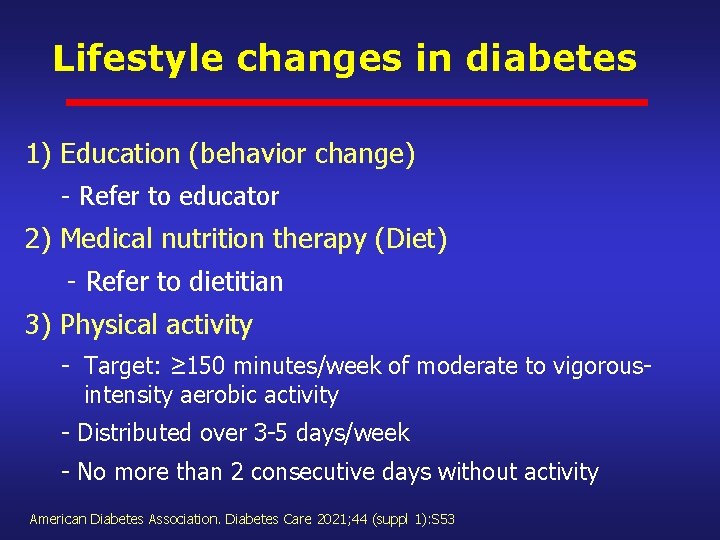
Lifestyle changes in diabetes 1) Education (behavior change) - Refer to educator 2) Medical nutrition therapy (Diet) - Refer to dietitian 3) Physical activity - Target: ≥ 150 minutes/week of moderate to vigorousintensity aerobic activity - Distributed over 3 -5 days/week - No more than 2 consecutive days without activity American Diabetes Association. Diabetes Care 2021; 44 (suppl 1): S 53
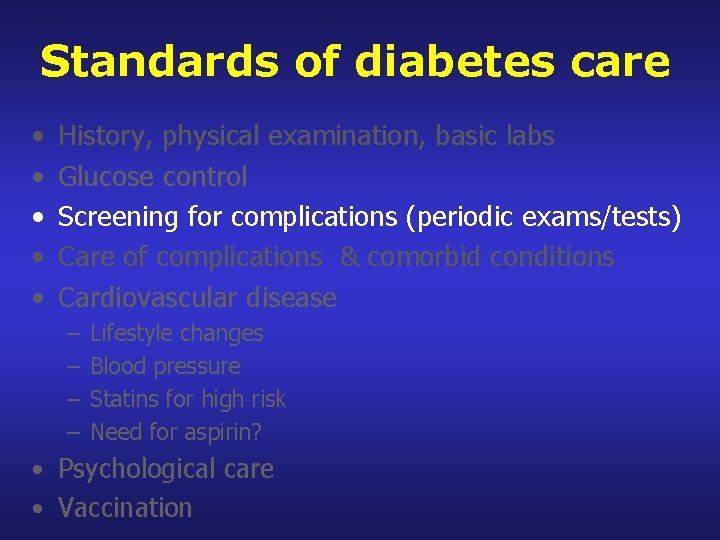
Standards of diabetes care • • • History, physical examination, basic labs Glucose control Screening for complications (periodic exams/tests) Care of complications & comorbid conditions Cardiovascular disease – – Lifestyle changes Blood pressure Statins for high risk Need for aspirin? • Psychological care • Vaccination
Periodic exams & referrals • Refer to educator (yearly & as indicated) • Refer to dietitian (yearly & as indicated) • Dilated eye exam (yearly) • Comprehensive foot exam (yearly) • Dentist • Family planning for women of reproductive age American Diabetes Association. Diabetes Care 2021; 44 (suppl 1): S 40
Screening for diabetic retinopathy Dilated eye examination • Type 2 DM: - At the time of diagnosis then yearly • Type 1 DM: - Start 5 years after diagnosis then yearly American Diabetes Association. Diabetes Care 2021; 44 (suppl 1): S 151
Foot care: Screening for diabetic neuropathy - History & comprehensive foot exam: • Type 2 DM : At the time of diagnosis then every year • Type 1 DM : Start 5 years after diagnosis then every year - Inspect feet each visit for high risk American Diabetes Association. Diabetes Care 2021; 44 (suppl 1): S 151
Foot examination - Inspect the feet: Integrity of the skin Deformities Callus Wounds/ulcers Infections (tinea)
Foot care • Comprehensive exam yearly • Visual inspection (every visit for high risk patients) • Vibration, temperature, or pinprick sensation • 10 -gram monofilament test • Assess pedal pulses (refer for Ankle-brachial index if ↓) American Diabetes Association. Diabetes Care 2021; 44 (suppl 1): S 40
Periodic lab. tests 1) A 1 c – Every 6 months if controlled – Every 3 months if not controlled 2) Urine albumin creatinine, s. creatinine, e. GFR: – Yearly – More frequent if CKD or changing medications/doses 3) Serum Potassium (if on ACEI, ARB or diuretic) – Yearly – More frequent if CKD or changing medications/doses American Diabetes Association. Diabetes Care 2021; 44 (suppl 1): S 40
Periodic lab. tests 3) Lipids - Yearly - More frequent if not at target or changing doses/therapy 4) ALT, AST - Yearly 5) Serum vitamin B 12: (If on long term Metformin) - Some experts recommend monitoring if on metformin >4 years - Every year in such cases American Diabetes Association. Diabetes Care 2021; 44 (suppl 1): S 40 KDIGO guidelines. Kidney Int 2020; 98: 4 S
Back to our patient A 62 -year-old man with type 2 DM & HTN for 5 years Sitagliptin/Metformin 50/1000 mg bid, Dapagliflozin 10 mg qd, Amlodipine 5 mg qd Tries with lifestyle changes. Occasional exercise B. P. 152/88, BMI 28. 2. Exam: unremarkable A 1 c 8. 2, LDL 2. 4 mmol (92 mg) , HDL 1 mmol (40 mg), Cr & ALT normal, urine ACR 7 mg/mmol ( NL, < 3) How do you apply standards of diabetes care?
DM & the kidneys • Diabetes: the commonest cause of CKD & dialysis • Serum creatinine, e. GFR at least yearly • Check random urine albumin: creatinine ratio (UACR) – If normal, check every year
Screening for diabetic kidney disease Urine albumin: creatinine ratio • Type 2 DM: - At the time of diagnosis then yearly • Type 1 DM: - Start 5 years after diagnosis then yearly American Diabetes Association. Diabetes Care 2021; 44 (suppl 1): S 151
Diabetic kidney disease • Albuminuria and/or • Low e. GFR • Patients usually have: – Long duration of DM – Retinopathy (usually in type 1 DM) – Albuminuria • Some patients have low e. GFR with no albuminuria American Diabetes Association. Diabetes Care 2021; 44 (suppl 1): S 151
Urine albumin: creatinine ratio • Normal: <3 mg/mmol (30 mg/g) • If high: – Repeat • Causes of transient high UACR: – Exercise within 24 hours, infection, fever, heart failure, marked hyperglycemia, uncontrolled B. P. • Albuminuria: 2 out of 3 abnormal within 3 -6 months American Diabetes Association. Diabetes Care 2021; 44 (suppl 1): S 151
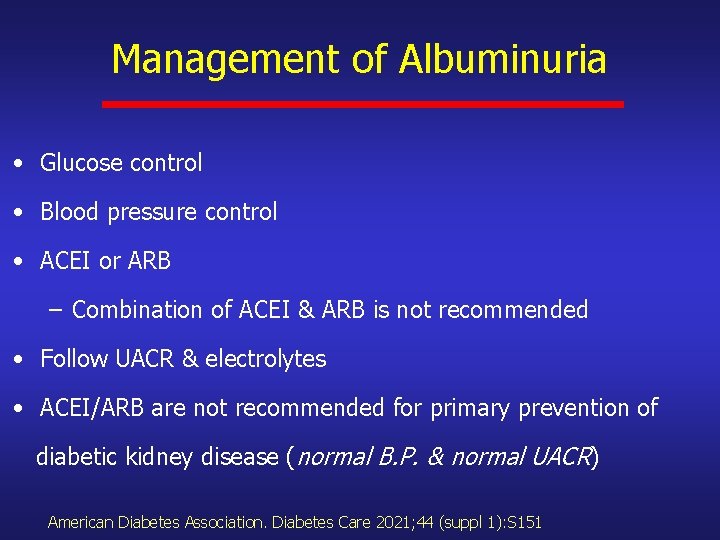
Management of Albuminuria • Glucose control • Blood pressure control • ACEI or ARB – Combination of ACEI & ARB is not recommended • Follow UACR & electrolytes • ACEI/ARB are not recommended for primary prevention of diabetic kidney disease (normal B. P. & normal UACR) American Diabetes Association. Diabetes Care 2021; 44 (suppl 1): S 151
Standards of diabetes care • • • History, physical examination & basic labs Glucose control Screening for complications (periodic exams/tests) Care of complications & comorbid conditions Cardiovascular disease – – Lifestyle changes Blood pressure Statins for high risk Need for aspirin? • Psychological care • Vaccination
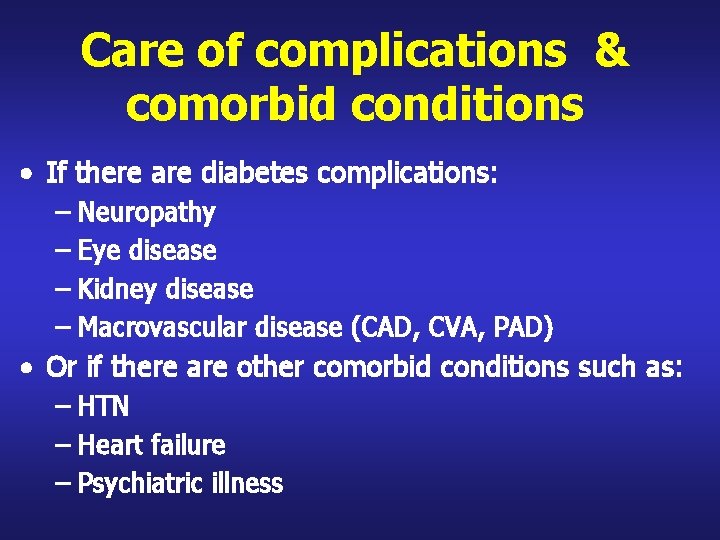
Care of complications & comorbid conditions • If there are diabetes complications: – Neuropathy – Eye disease – Kidney disease – Macrovascular disease (CAD, CVA, PAD) • Or if there are other comorbid conditions such as: – HTN – Heart failure – Psychiatric illness
Standards of diabetes care • • • History, physical examination & basic labs Glucose control Screening for complications (periodic exams/tests) Care of complications & comorbid conditions Cardiovascular disease – – Lifestyle changes Blood pressure Statins for high risk Need for aspirin? • Psychological care • Vaccination
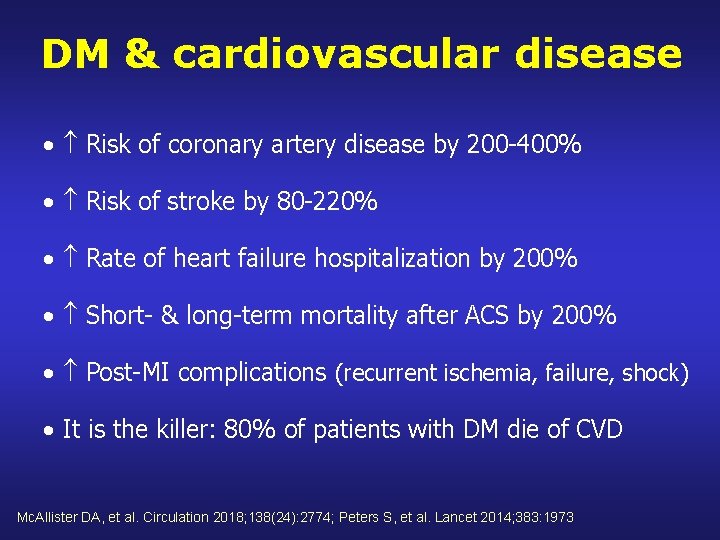
DM & cardiovascular disease • Risk of coronary artery disease by 200 -400% Risk of stroke by 80 -220% Rate of heart failure hospitalization by 200% • Short- & long-term mortality after ACS by 200% • Post-MI complications (recurrent ischemia, failure, shock) • It is the killer: 80% of patients with DM die of CVD Mc. Allister DA, et al. Circulation 2018; 138(24): 2774; Peters S, et al. Lancet 2014; 383: 1973
Primary prevention of CVD in DM • Lifestyle changes (diet, exercise, healthy weight) • Smoking cessation • Blood pressure control • Statins for high-risk patients • Need for aspirin? • Glucose control American Diabetes Association. Diabetes Care 2021; 44 (suppl 1): S 125
Assess patient’s risk of CVD Using ACC/AHA 10 -year ASCVD risk calculator American Diabetes Association. Diabetes Care 2021; 44 (suppl 1): S 125
Lifestyle changes & CVD 1) Diet: 2) Healthy weight 3) Physical activity - Target of at least 150 minutes/week - Over 3 -5 days/week 4) Smoking history - Ask all patients - Counselling if smoking and referral for assistance
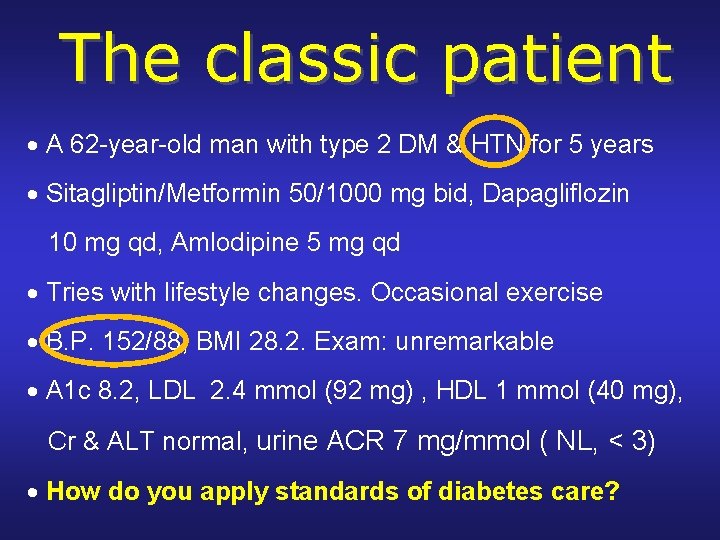
The classic patient A 62 -year-old man with type 2 DM & HTN for 5 years Sitagliptin/Metformin 50/1000 mg bid, Dapagliflozin 10 mg qd, Amlodipine 5 mg qd Tries with lifestyle changes. Occasional exercise B. P. 152/88, BMI 28. 2. Exam: unremarkable A 1 c 8. 2, LDL 2. 4 mmol (92 mg) , HDL 1 mmol (40 mg), Cr & ALT normal, urine ACR 7 mg/mmol ( NL, < 3) How do you apply standards of diabetes care?
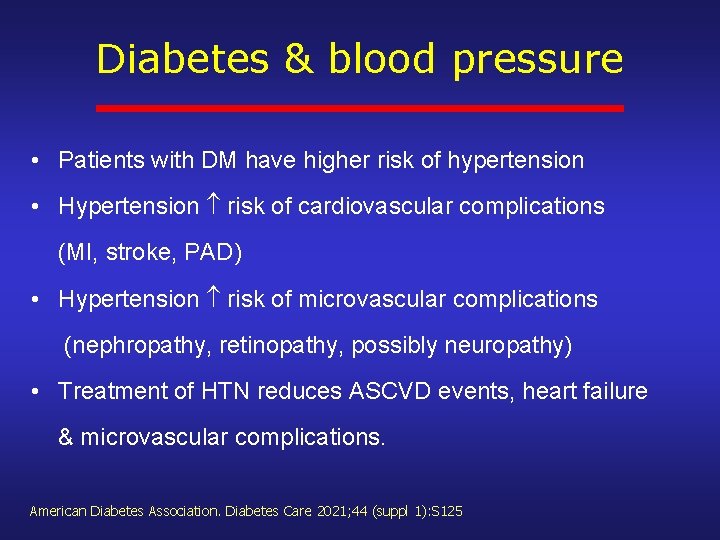
Diabetes & blood pressure • Patients with DM have higher risk of hypertension • Hypertension risk of cardiovascular complications (MI, stroke, PAD) • Hypertension risk of microvascular complications (nephropathy, retinopathy, possibly neuropathy) • Treatment of HTN reduces ASCVD events, heart failure & microvascular complications. American Diabetes Association. Diabetes Care 2021; 44 (suppl 1): S 125
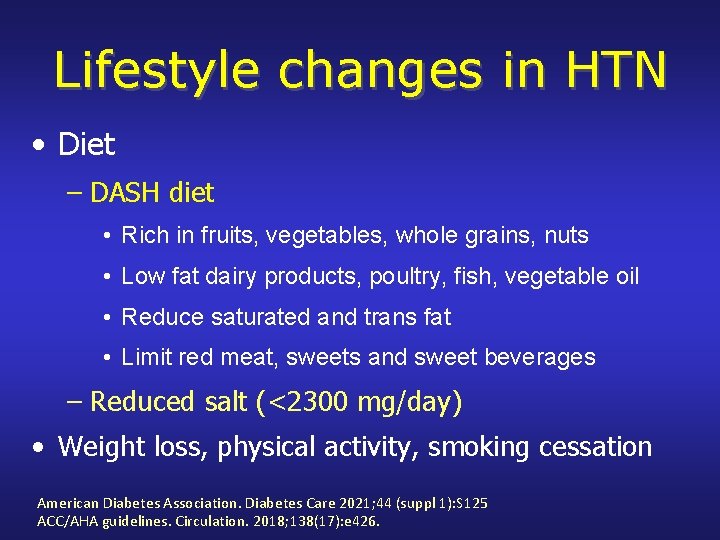
Lifestyle changes in HTN • Diet – DASH diet • Rich in fruits, vegetables, whole grains, nuts • Low fat dairy products, poultry, fish, vegetable oil • Reduce saturated and trans fat • Limit red meat, sweets and sweet beverages – Reduced salt (<2300 mg/day) • Weight loss, physical activity, smoking cessation American Diabetes Association. Diabetes Care 2021; 44 (suppl 1): S 125 ACC/AHA guidelines. Circulation. 2018; 138(17): e 426.
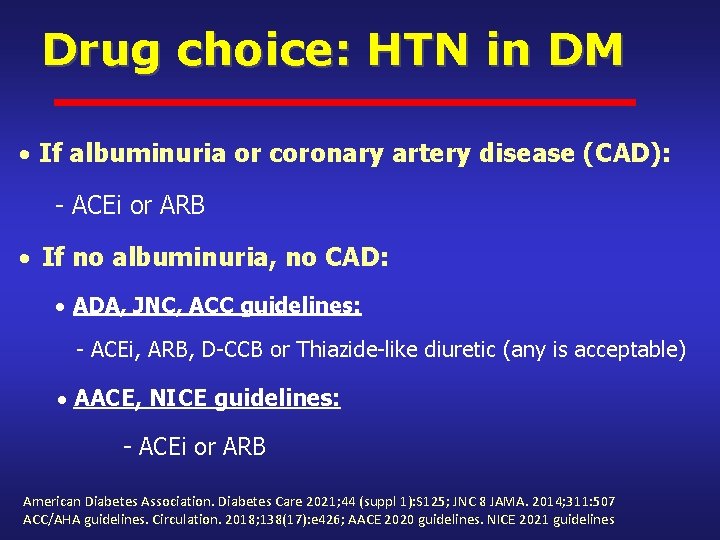
Drug choice: HTN in DM If albuminuria or coronary artery disease (CAD): - ACEi or ARB If no albuminuria, no CAD: ADA, JNC, ACC guidelines: - ACEi, ARB, D-CCB or Thiazide-like diuretic (any is acceptable) AACE, NICE guidelines: - ACEi or ARB American Diabetes Association. Diabetes Care 2021; 44 (suppl 1): S 125; JNC 8 JAMA. 2014; 311: 507 ACC/AHA guidelines. Circulation. 2018; 138(17): e 426; AACE 2020 guidelines. NICE 2021 guidelines
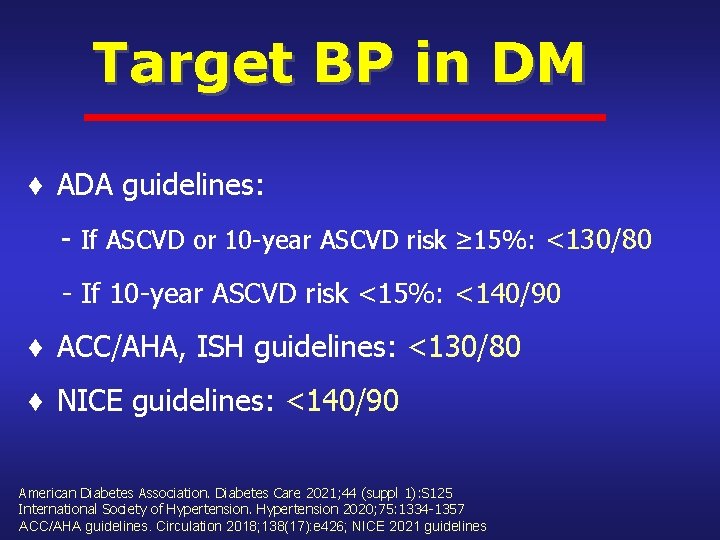
Target BP in DM ADA guidelines: - If ASCVD or 10 -year ASCVD risk ≥ 15%: <130/80 - If 10 -year ASCVD risk <15%: <140/90 ACC/AHA, ISH guidelines: <130/80 NICE guidelines: <140/90 American Diabetes Association. Diabetes Care 2021; 44 (suppl 1): S 125 International Society of Hypertension 2020; 75: 1334 -1357 ACC/AHA guidelines. Circulation 2018; 138(17): e 426; NICE 2021 guidelines
Use home BP monitoring to follow BP American Diabetes Association. Diabetes Care 2021; 44 (suppl 1): S 125 ACC/AHA guidelines. Circulation. 2018; 138(17): e 426.
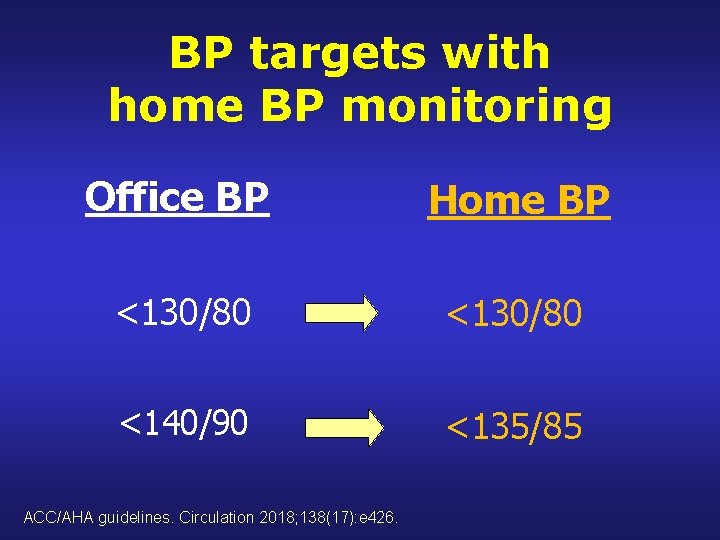
BP targets with home BP monitoring Office BP Home BP <130/80 <140/90 <135/85 ACC/AHA guidelines. Circulation 2018; 138(17): e 426.
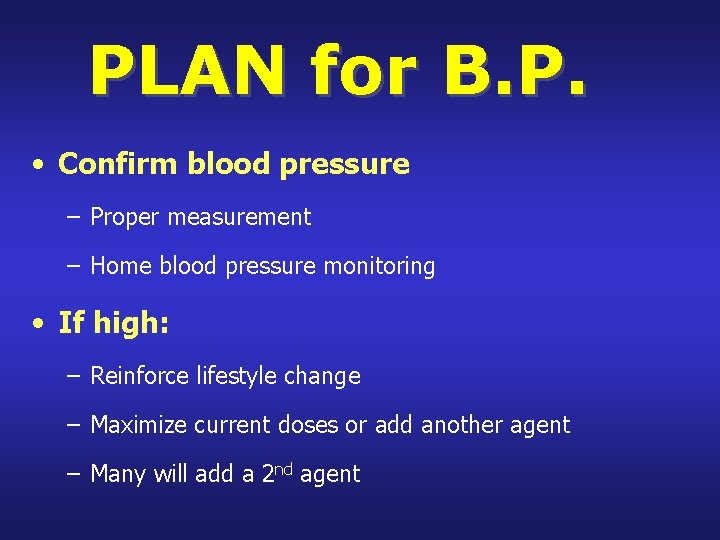
PLAN for B. P. • Confirm blood pressure – Proper measurement – Home blood pressure monitoring • If high: – Reinforce lifestyle change – Maximize current doses or add another agent – Many will add a 2 nd agent
Statins in DM When & which one?
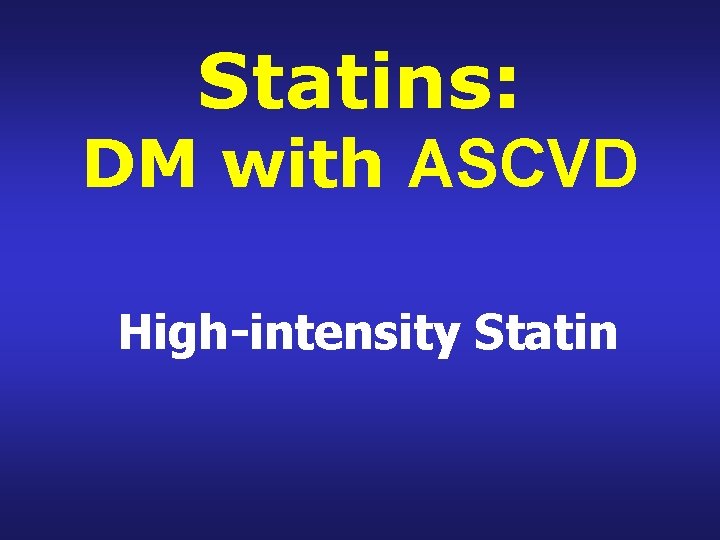
Statins: DM with ASCVD High-intensity Statin
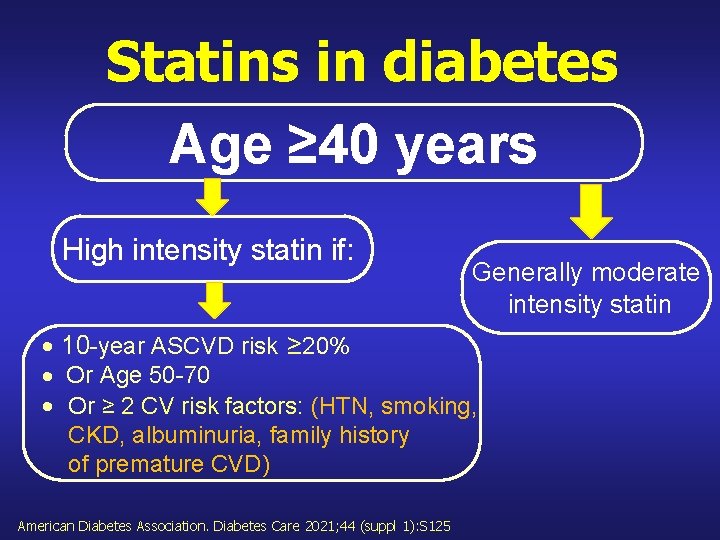
Statins in diabetes Age ≥ 40 years High intensity statin if: 10 -year ASCVD risk ≥ 20% Generally moderate intensity statin Or Age 50 -70 Or ≥ 2 CV risk factors: (HTN, smoking, CKD, albuminuria, family history of premature CVD) American Diabetes Association. Diabetes Care 2021; 44 (suppl 1): S 125
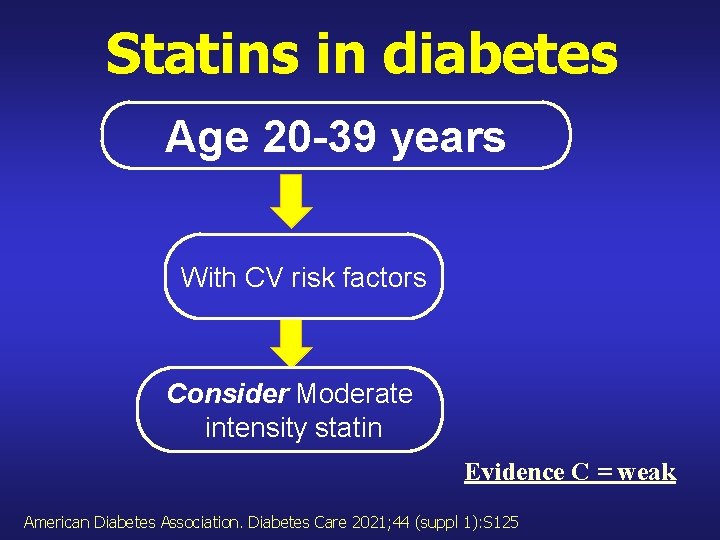
Statins in diabetes Age 20 -39 years With CV risk factors Consider Moderate intensity statin Evidence C = weak American Diabetes Association. Diabetes Care 2021; 44 (suppl 1): S 125
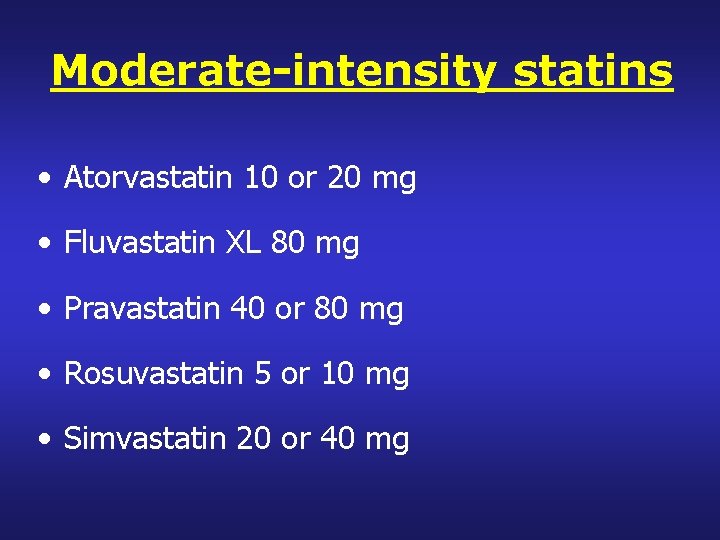
Moderate-intensity statins • Atorvastatin 10 or 20 mg • Fluvastatin XL 80 mg • Pravastatin 40 or 80 mg • Rosuvastatin 5 or 10 mg • Simvastatin 20 or 40 mg
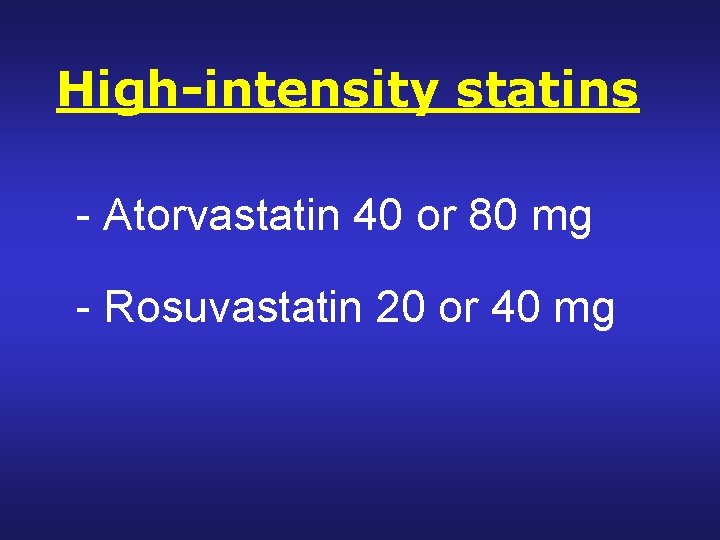
High-intensity statins - Atorvastatin 40 or 80 mg - Rosuvastatin 20 or 40 mg

ASPIRIN?
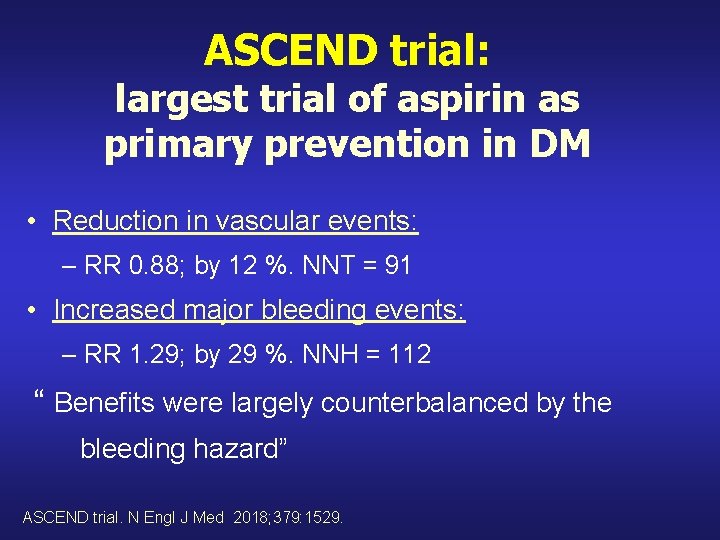
ASCEND trial: largest trial of aspirin as primary prevention in DM • Reduction in vascular events: – RR 0. 88; by 12 %. NNT = 91 • Increased major bleeding events: – RR 1. 29; by 29 %. NNH = 112 “ Benefits were largely counterbalanced by the bleeding hazard” ASCEND trial. N Engl J Med 2018; 379: 1529.
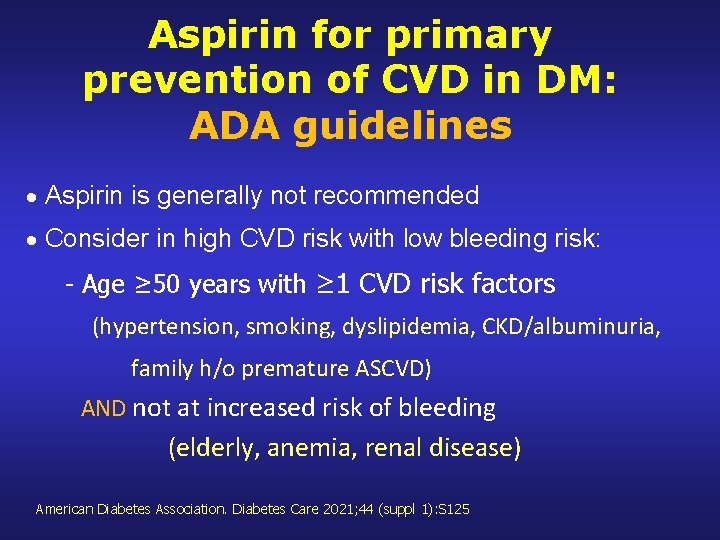
Aspirin for primary prevention of CVD in DM: ADA guidelines Aspirin is generally not recommended Consider in high CVD risk with low bleeding risk: - Age ≥ 50 years with ≥ 1 CVD risk factors (hypertension, smoking, dyslipidemia, CKD/albuminuria, family h/o premature ASCVD) AND not at increased risk of bleeding (elderly, anemia, renal disease) American Diabetes Association. Diabetes Care 2021; 44 (suppl 1): S 125
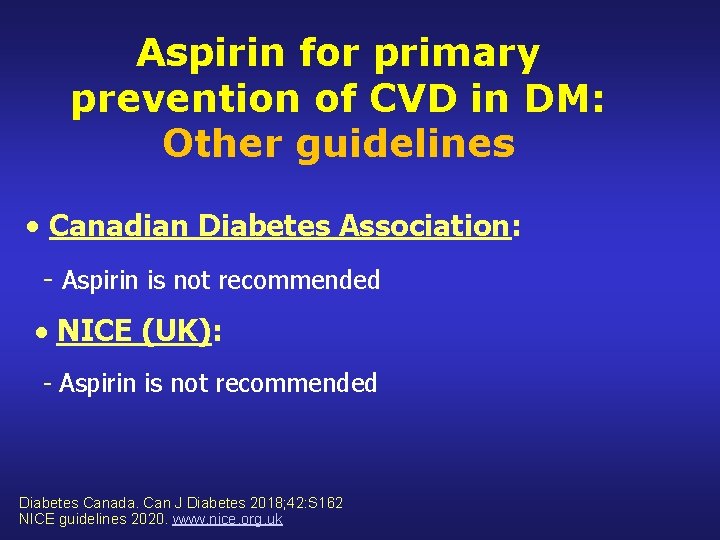
Aspirin for primary prevention of CVD in DM: Other guidelines Canadian Diabetes Association: - Aspirin is not recommended NICE (UK): - Aspirin is not recommended Diabetes Canada. Can J Diabetes 2018; 42: S 162 NICE guidelines 2020. www. nice. org. uk
Standards of diabetes care • • • History, physical examination & basic labs Glucose control Screening for complications (periodic exams/tests) Care of complications & comorbid conditions Cardiovascular disease – – Lifestyle changes Blood pressure Statins for high risk Need for aspirin? • Psychological care • Vaccination
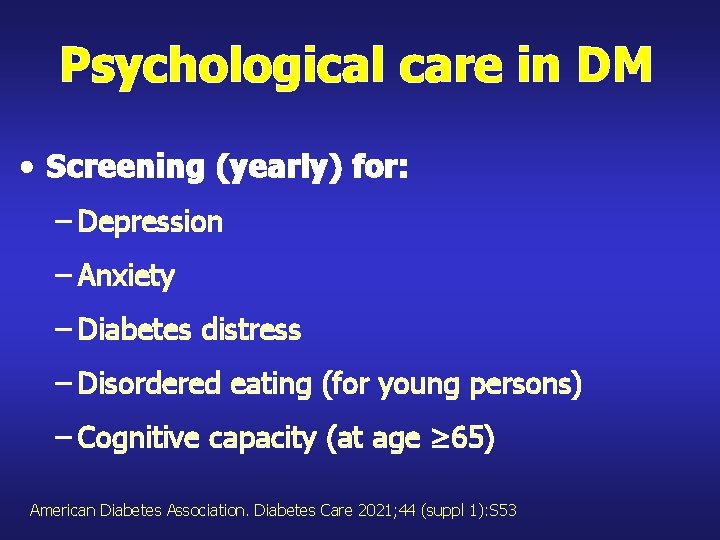
Psychological care in DM • Screening (yearly) for: – Depression – Anxiety – Diabetes distress – Disordered eating (for young persons) – Cognitive capacity (at age ≥ 65) American Diabetes Association. Diabetes Care 2021; 44 (suppl 1): S 53
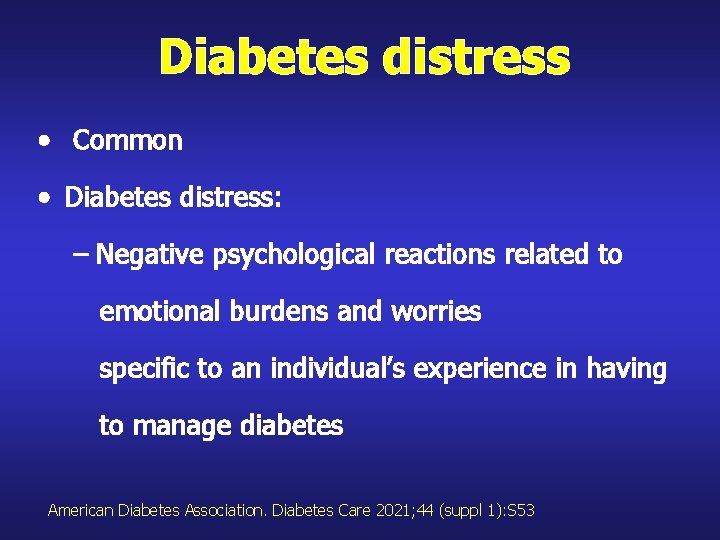
Diabetes distress • Common • Diabetes distress: – Negative psychological reactions related to emotional burdens and worries specific to an individual’s experience in having to manage diabetes American Diabetes Association. Diabetes Care 2021; 44 (suppl 1): S 53
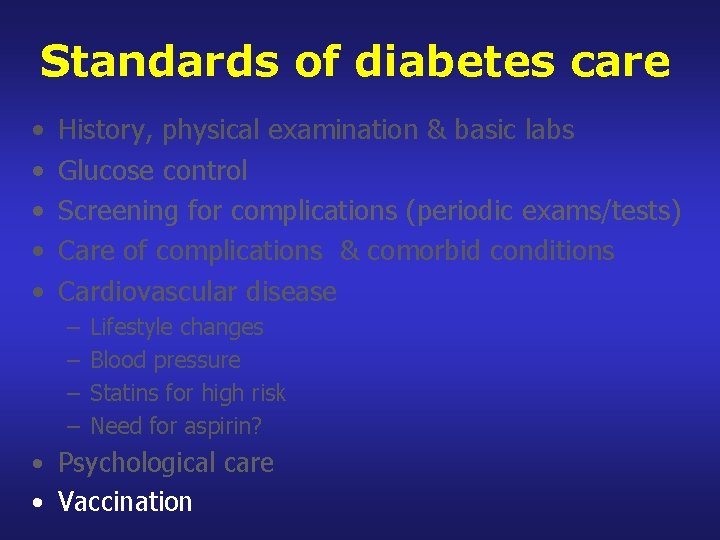
Standards of diabetes care • • • History, physical examination & basic labs Glucose control Screening for complications (periodic exams/tests) Care of complications & comorbid conditions Cardiovascular disease – – Lifestyle changes Blood pressure Statins for high risk Need for aspirin? • Psychological care • Vaccination
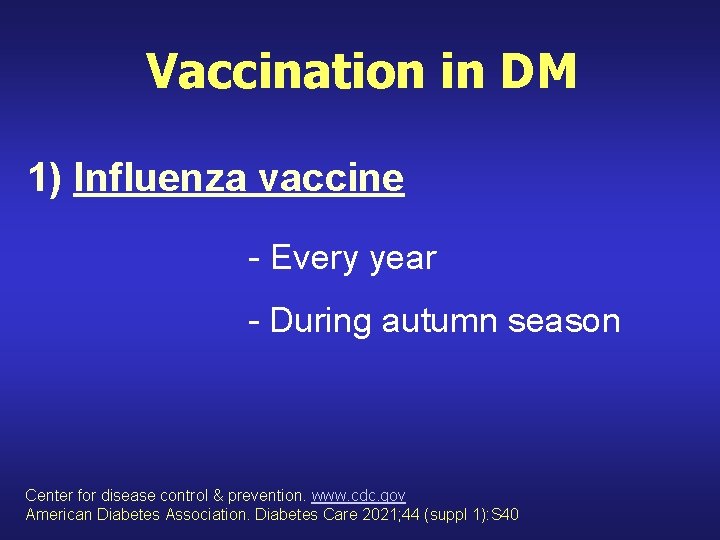
Vaccination in DM 1) Influenza vaccine - Every year - During autumn season Center for disease control & prevention. www. cdc. gov American Diabetes Association. Diabetes Care 2021; 44 (suppl 1): S 40
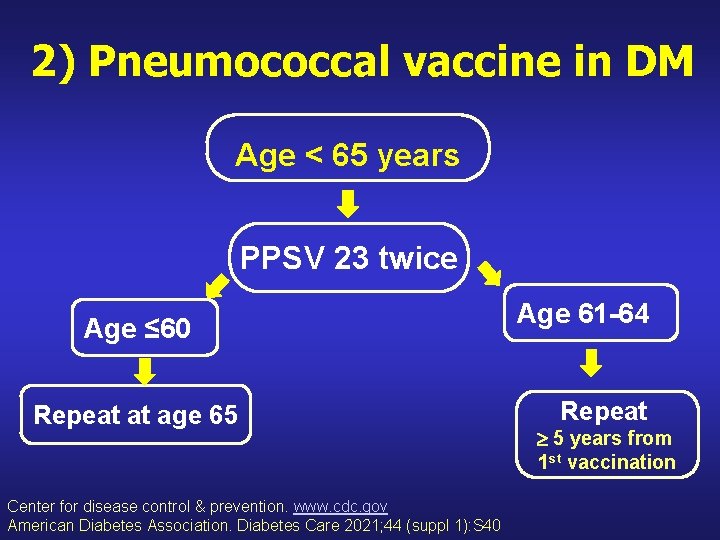
2) Pneumococcal vaccine in DM Age < 65 years PPSV 23 twice Age ≤ 60 Repeat at age 65 Center for disease control & prevention. www. cdc. gov American Diabetes Association. Diabetes Care 2021; 44 (suppl 1): S 40 Age 61 -64 Repeat 5 years from 1 st vaccination
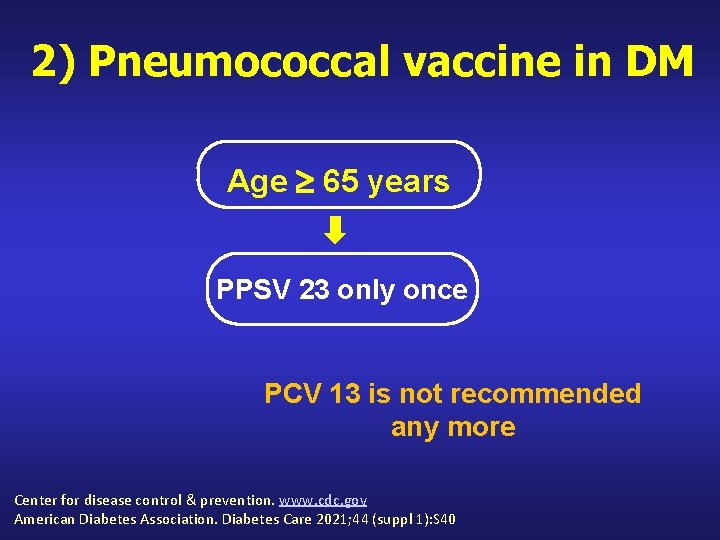
2) Pneumococcal vaccine in DM Age 65 years PPSV 23 only once PCV 13 is not recommended any more Center for disease control & prevention. www. cdc. gov American Diabetes Association. Diabetes Care 2021; 44 (suppl 1): S 40
Vaccination in DM 3) Hepatitis B vaccine - Administer for age 18 -59 - Consider for age 60 years Center for disease control & prevention. www. cdc. gov American Diabetes Association. Diabetes Care 2021; 44 (suppl 1): S 40
Do patients with DM need vitamins? • No evidence for vitamin or supplements • Routine supplements with vitamins/antioxidants is not recommended • Omega-3 supplements are not recommended for the prevention of treatment of CVD American Diabetes Association. Diabetes Care 2021; 44 (suppl. 1): S 53
Diabetes Care: SUMMARY 1 • Lifestyle: Lifestyle Refer to educator & dietitian/exercise • Glucose: Glucose Target A 1 c <7 (individualize) • Vascular: Statins for age 40 Aspirin is generally not recommended • Blood pressure: pressure Target: general <140/90 <130/80 if ASCVD or high risk ACEI or ARB if albuminuria or CAD • Kidneys: Kidneys Urine albumin/creatinine ratio yearly
Diabetes Care: SUMMARY 2 Eyes: Eyes Dilated eye exam yearly Foot: Foot Comprehensive exam yearly Psychological: Screen and refer if need Teeth: Teeth Dentist Vaccination: Influenza, Pneumococcal, Hepatitis B
- Slides: 66