
Standards Based Instruction Presented by Jan Stanley and
Standards Based Instruction Presented by: Jan Stanley and Erin Sullivan March 2009
Three Ways to Improve Student Learning • Raise the level of rigor in the content standards and objectives • Increase the skill and knowledge of teachers in teaching the content • Engage students in active learning designed around the standards for content, learning skills and technology tools.
What are the cultural shifts? 20 th century education Focus on teaching Teacher isolation to to to 21 st century education Focus on learning Teacher collaboration
What are our goals?
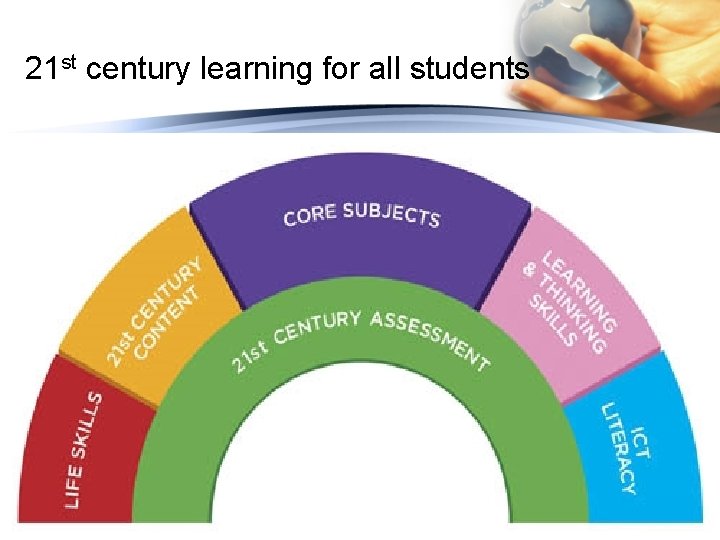
21 st century learning for all students
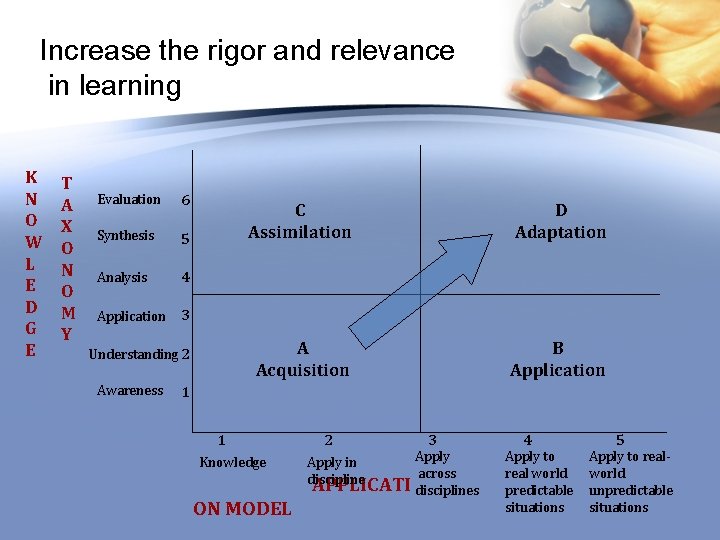
Increase the rigor and relevance in learning K N O W L E D G E T A X O N O M Y Evaluation 6 Synthesis 5 Analysis 4 Application 3 Understanding 2 Awareness C Assimilation D Adaptation A Acquisition B Application 1 1 Knowledge ON MODEL 2 3 Apply across APPLICATI disciplines Apply in discipline 4 Apply to real world predictable situations 5 Apply to realworld unpredictable situations
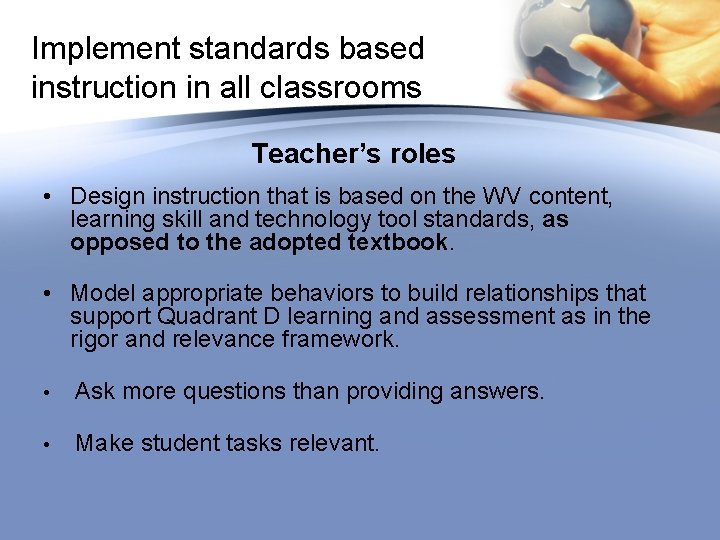
Implement standards based instruction in all classrooms Teacher’s roles • Design instruction that is based on the WV content, learning skill and technology tool standards, as opposed to the adopted textbook. • Model appropriate behaviors to build relationships that support Quadrant D learning and assessment as in the rigor and relevance framework. • Ask more questions than providing answers. • Make student tasks relevant.
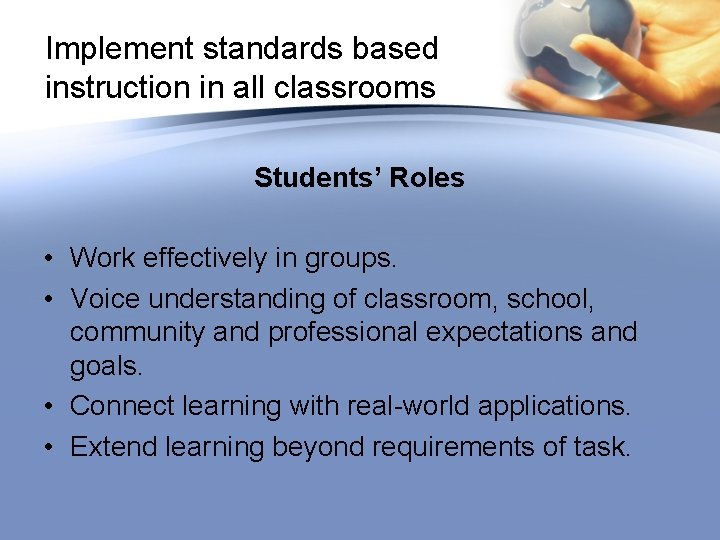
Implement standards based instruction in all classrooms Students’ Roles • Work effectively in groups. • Voice understanding of classroom, school, community and professional expectations and goals. • Connect learning with real-world applications. • Extend learning beyond requirements of task.
What steps has WVDE taken to prepare administrators and teachers?
District Leadership Conferences • 2003 -2004 -September/March/July/October – – – – Effective Schools - Transformations for Successful Schools Accept the Mission of “Learning for ALL” Accountability for Learning - Assessment Practices Urgency for Change - 10 Standards for System Change Building a Culture of Core Beliefs Assuring Access to a High Quality Curriculum Developing a Pre-K Standards Based Mathematics Curriculum – Formative Assessment and Benchmarking
District Leadership Conferences • 2005 – January/April/June – – – – – Creating Engaging Instruction for All Students Enhancing Teacher Efficacy Creating a Culture of High Expectations Standards Based Instruction in the Classroom Making Differentiation Work Making the Most of Understanding by Design Building Bridges/Creating Cultures Transforming the Entire System to Meet Student Needs Data Based Decisions: Developing and Implementing a Formative Assessment System – Leadership Spirit-Creating a Culture of Success – Characteristics of Quality Professional Development
District Leadership Conferences • 2005 -2006 – November/April – Developing the 21 st Century Learner Through Systems Thinking – Improving Schools From Within-Leadership for “Learning for All” – Structured Quality Campus Based Professional Development – Creating Successful Learning Communities – Developing the 21 st Century Learner: Implications for Instructional Practice – Implementing Formative Assessments to Improve Instruction – Creating Classroom Assessments For Learning
District Leadership Conferences • 2007 -April – Leading the Journey to Excellence in Assessment – Leading With Your Plan: From Planning to Action – Integrating the Elements of 21 st Century Learning With Your Strategic Plan – What Does 21 st Century Classroom Assessment Look Like? – 21 st Century Teacher Professional Development – Who Took My Chalk?
District Leadership Conferences • 2007 -2008 -December/March – Education and Learning in the 21 st Century: How, Why and What Do We Need to Do Differently? – What Does 21 st Century Learning Look Like Through the Eyes of the Learner? – The Competitive Edge: Equipping Students With 21 st Century Skills – Beyond the Bake Sale: Partnering With Parents to Promote Student Success – 21 st Century Skills: The Project Approach – Creating a Classroom of Thinkers
District Leadership Conferences • 2008 -October – Teaming to Promote 21 st Century Learning – Professional Learning Communities – Building Bee Hives: Creating Communities That Bring Sweet Rewards – PLCs: Managing and Monitoring the Implementation – Making Commitments That Matter – Creating and Sustaining High Performing Teams – Role of PLCs in New Teacher Induction and Mentoring – Inquiry Based Learning for Educators – Professional Learning Communities in Action – Project Based Learning Implementation
What resources have been developed?
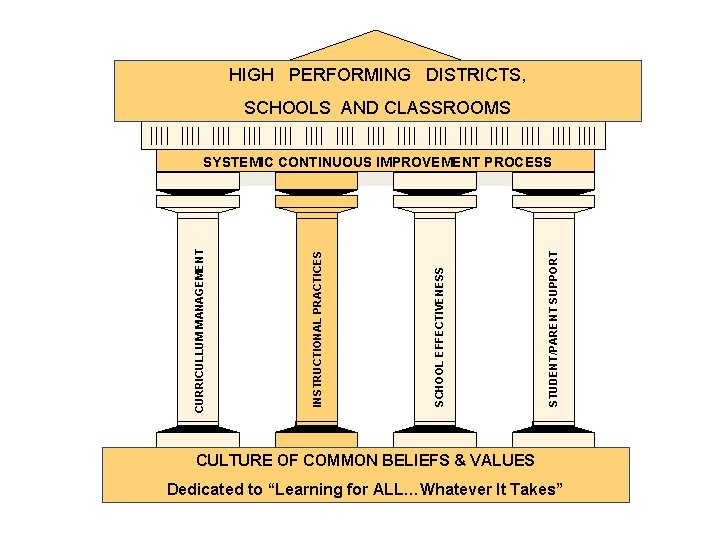
HIGH PERFORMING DISTRICTS, SCHOOLS AND CLASSROOMS STUDENT/PARENT SUPPORT SCHOOL EFFECTIVENESS INSTRUCTIONAL PRACTICES CURRICULLUM MANAGEMENT SYSTEMIC CONTINUOUS IMPROVEMENT PROCESS CULTURE OF COMMON BELIEFS & VALUES Dedicated to “Learning for ALL…Whatever It Takes”
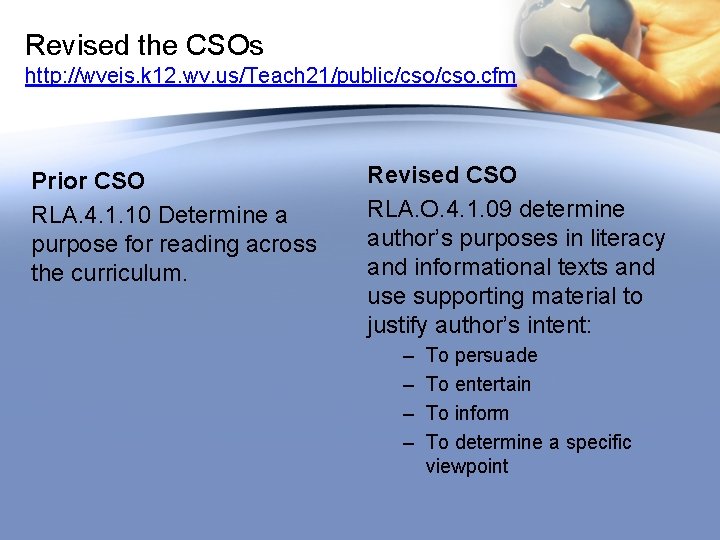
Revised the CSOs http: //wveis. k 12. wv. us/Teach 21/public/cso. cfm Prior CSO RLA. 4. 1. 10 Determine a purpose for reading across the curriculum. Revised CSO RLA. O. 4. 1. 09 determine author’s purposes in literacy and informational texts and use supporting material to justify author’s intent: – – To persuade To entertain To inform To determine a specific viewpoint
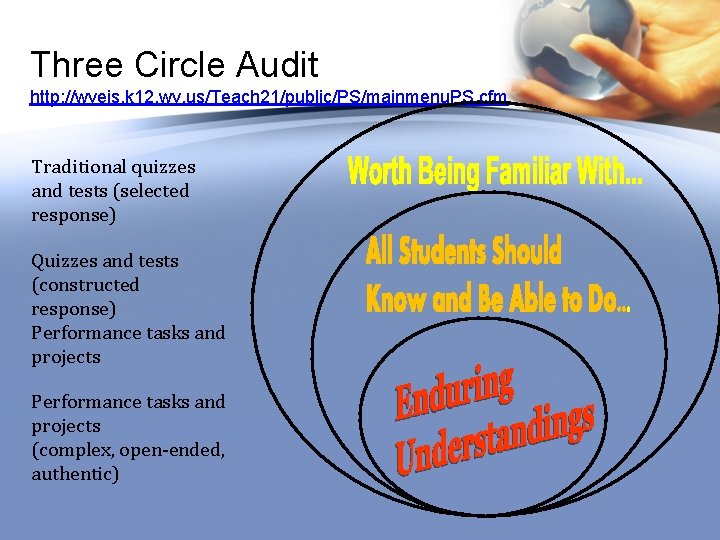
Three Circle Audit http: //wveis. k 12. wv. us/Teach 21/public/PS/mainmenu. PS. cfm Traditional quizzes and tests (selected response) Quizzes and tests (constructed response) Performance tasks and projects (complex, open-ended, authentic)
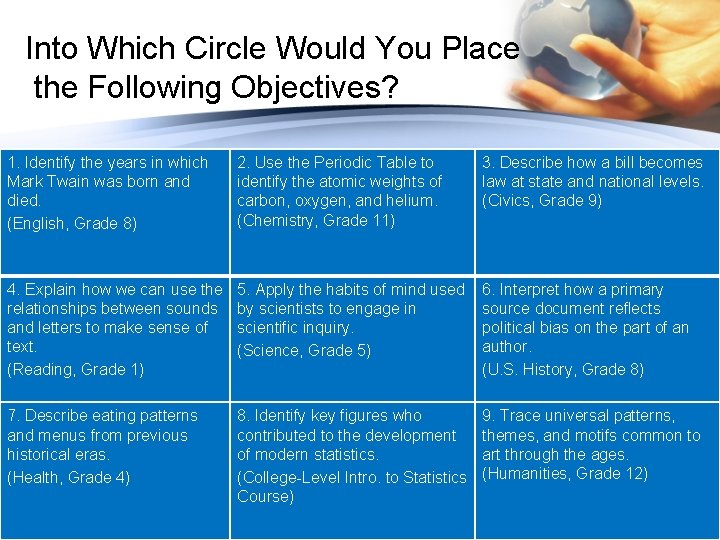
Into Which Circle Would You Place the Following Objectives? 1. Identify the years in which Mark Twain was born and died. (English, Grade 8) 2. Use the Periodic Table to identify the atomic weights of carbon, oxygen, and helium. (Chemistry, Grade 11) 3. Describe how a bill becomes law at state and national levels. (Civics, Grade 9) 4. Explain how we can use the relationships between sounds and letters to make sense of text. (Reading, Grade 1) 5. Apply the habits of mind used by scientists to engage in scientific inquiry. (Science, Grade 5) 6. Interpret how a primary source document reflects political bias on the part of an author. (U. S. History, Grade 8) 7. Describe eating patterns and menus from previous historical eras. (Health, Grade 4) 8. Identify key figures who contributed to the development of modern statistics. (College-Level Intro. to Statistics Course) 9. Trace universal patterns, themes, and motifs common to art through the ages. (Humanities, Grade 12)
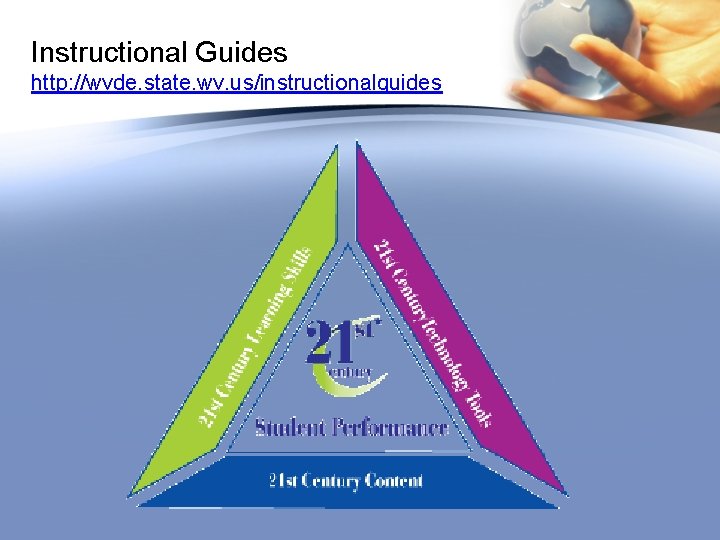
Instructional Guides http: //wvde. state. wv. us/instructionalguides
Balanced Assessment System http: //wvde. state. wv. us/teach 21/documents/21 Century. Assessment. pdf • • Summative Assessments Benchmark Assessments Formative Assessments OF Learning Formative Assessments/Classroom Assessments FOR Learning
What are the current steps in the process?
Work collaboratively • Establish professional learning communities to create cultural shifts – – – Fundamental purpose Use of assessments Response when students do not learn Work of teachers Focus –from external assistance to internal acceptance and ownership to improve the school – School culture – Professional development • Provide time to collaborate
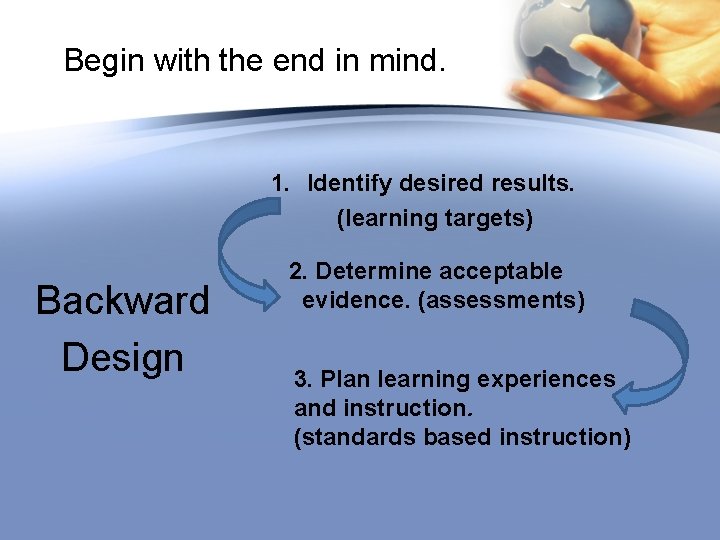
Begin with the end in mind. 1. Identify desired results. (learning targets) Backward Design 2. Determine acceptable evidence. (assessments) 3. Plan learning experiences and instruction. (standards based instruction)
Depth of Knowledge in the CSOs • Level 1 – Recall, recognition • Level 2 – Application of skills, concepts; conceptual understanding; procedural understanding • Level 3 –Solve problems, draw conclusions given data, arguments, situations and other information; construct mental models translating among different representations; justifying from evidence; summarizing a body of text • Level 4 – Extended thinking; requires integration of knowledge from multiple sources and ability to represent knowledge in a variety of ways; usually requires work over a period of time
Understanding Depth of Knowledge Ø DOK is about intended outcome, not difficulty. Ø DOK is a reference to the complexity of mental processing that must occur to answer a question, perform a task, or generate a product.
Activity: Determining DOK Level Ø DOK ? Describe a model that you might use to represent the relationships that exist within the rock cycle. Ø DOK ? Describe the difference between metamorphic and igneous rocks. Ø DOK ? Describe three characteristics of metamorphic rocks
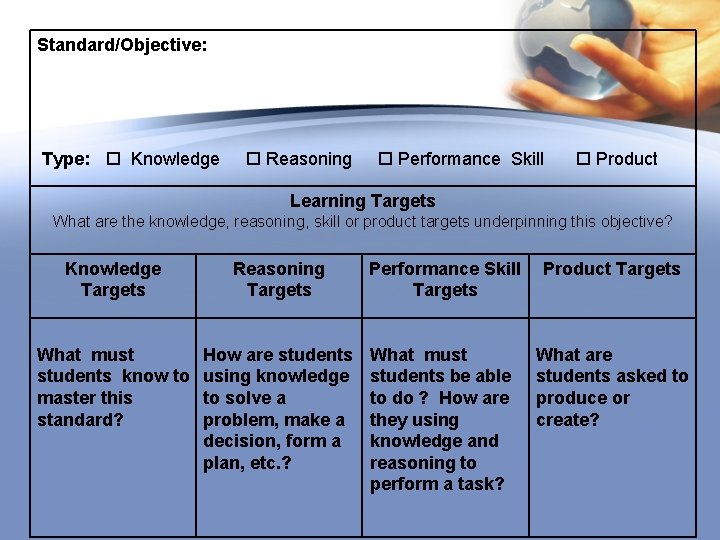
Standard/Objective: Type: Knowledge Reasoning Performance Skill Product Learning Targets What are the knowledge, reasoning, skill or product targets underpinning this objective? Knowledge Targets Reasoning Targets Performance Skill Targets Product Targets What must students know to master this standard? How are students using knowledge to solve a problem, make a decision, form a plan, etc. ? What must students be able to do ? How are they using knowledge and reasoning to perform a task? What are students asked to produce or create?
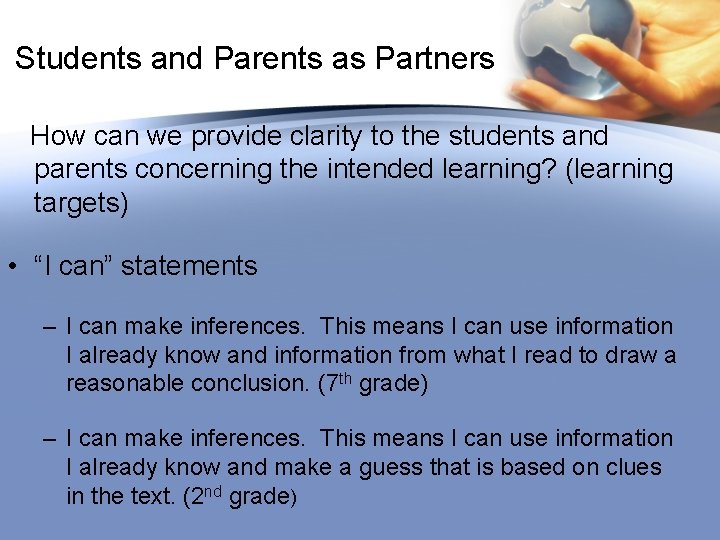
Students and Parents as Partners How can we provide clarity to the students and parents concerning the intended learning? (learning targets) • “I can” statements – I can make inferences. This means I can use information I already know and information from what I read to draw a reasonable conclusion. (7 th grade) – I can make inferences. This means I can use information I already know and make a guess that is based on clues in the text. (2 nd grade)
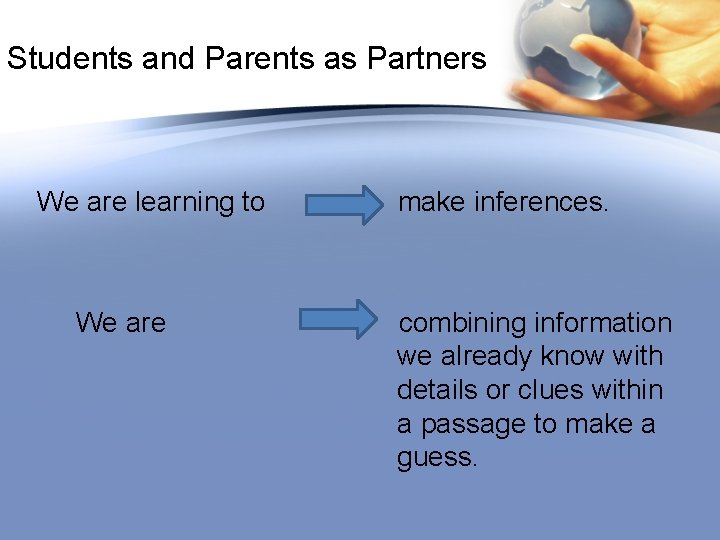
Students and Parents as Partners We are learning to We are make inferences. combining information we already know with details or clues within a passage to make a guess.
Matching Assessments to Learning Targets Accuracy in formative assessments requires matching the kinds of learning targets to the appropriate assessment method.
Assessment FOR Learning • Access what? -small explicit learning targets • Access how? -use a variety of assessment methods to provide evidence of students’ mastery of the learning targets – – – Selected response Constructed response Extended written response Performance/product Personal communication with students • Access when? -continuous/ongoing
In assessment FOR learning, both teacher and student use classroom assessment information to modify teaching and learning activities.
Questions students should ask teachers If I have not mastered an objective (summative/benchmark), how will I improve if I don’t know which specific learning targets are keeping me from mastery? – What knowledge do I need to demonstrate the intended learning? – What patterns of reasoning do I need to master? – What performance skills are required, if any? – What product development capabilities must I acquire?
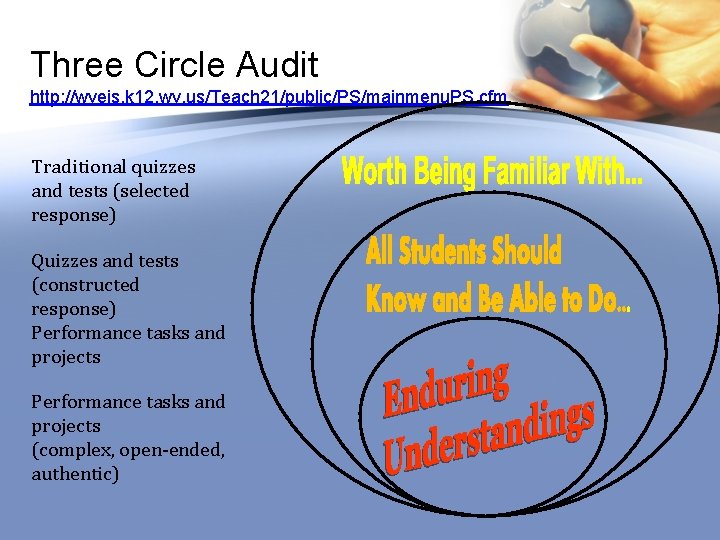
Three Circle Audit http: //wveis. k 12. wv. us/Teach 21/public/PS/mainmenu. PS. cfm Traditional quizzes and tests (selected response) Quizzes and tests (constructed response) Performance tasks and projects (complex, open-ended, authentic)
Planning Instruction • • • Authentic tasks Quality resources not limited to a textbook Connecting school with home, culture and community Problem-focused learning Cognitive and metacognition in the context of purposeful activities • Collaborative work on issues of deep concern to the students • Varied social configuration to complete activities • Engagement in substantive dialogue, discussion, debate about the substance of content
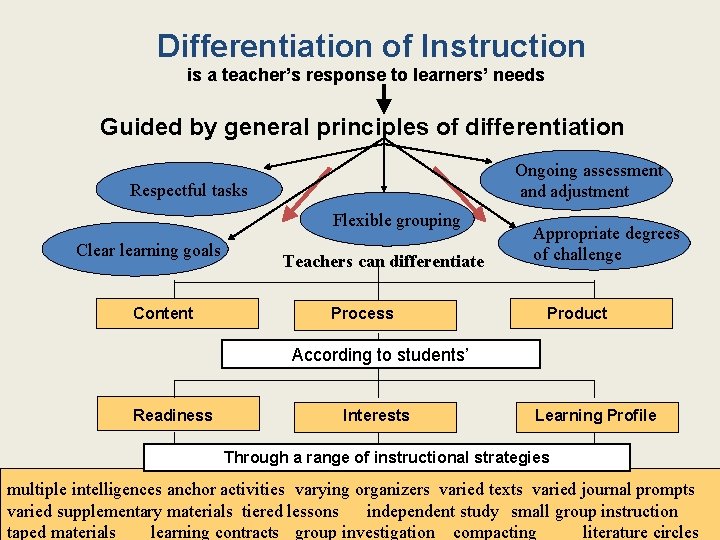
Differentiation of Instruction is a teacher’s response to learners’ needs Guided by general principles of differentiation Ongoing assessment and adjustment Respectful tasks Flexible grouping Clearning goals Content Teachers can differentiate Process Appropriate degrees of challenge Product According to students’ Readiness Interests Learning Profile Through a range of instructional strategies multiple intelligences anchor activities varying organizers varied texts varied journal prompts varied supplementary materials tiered lessons independent study small group instruction taped materials learning contracts group investigation compacting literature circles
The illiterate of the 21 st century will not be those who cannot read and write, but those who cannot learn, unlearn, and relearn. " --Alvin Toffler, American futurist
- Slides: 39