
Standards and Innovation Technology vs Installed Base Reiko
Standards and Innovation: Technology vs. Installed Base Reiko Aoki Hitotsubashi University & RIETI Yasuhiro Arai Kochi University 1
Introduction • Standards are beneficial when there are network effects • Standards necessary to appropriate returns from innovation when there are network effects • Standards are pro-innovation • However, strategic use of standards is possible ØInstalled base and inertia ØMaybe anti-competitive ( increase rival cost, switching cost, deter entry) • Can standards be anti-innovation? ØWhat is the relationship between standards and innovation? 2
Standards and Innovation • Relationship between standards and innovation Ø Patent pools and innovation Lampe and Moser (2012) Ø Standards and innovation (Cabral and Salant (2010), Flamm (2012)) • Competition issues Ø Collusion Ø Strategic use of standards and standard making process (Bekkers (2011)) Ø Foreclosure and predation (Mac. Kie-Mason et al (2007)) • Effect of Standards Ø Innovation Ø Use standards strategically 3
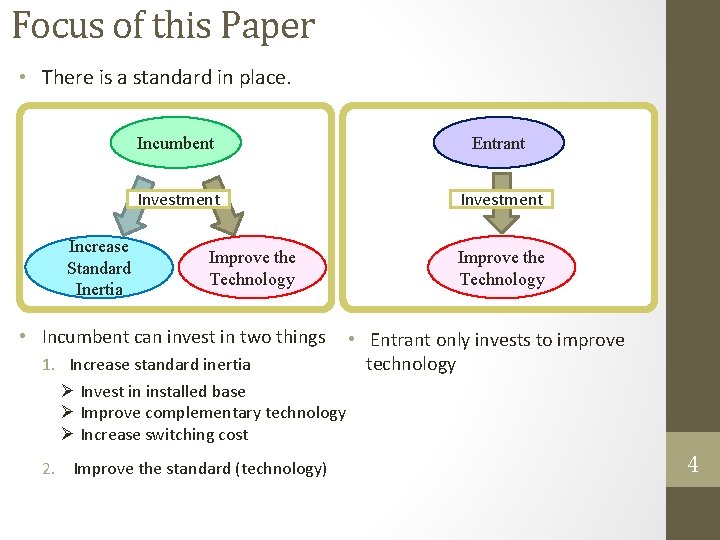
Focus of this Paper • There is a standard in place. Increase Standard Inertia Incumbent Entrant Investment Improve the Technology • Incumbent can invest in two things 1. Increase standard inertia Ø Invest in installed base Ø Improve complementary technology Ø Increase switching cost 2. Improve the standard (technology) Improve the Technology • Entrant only invests to improve technology 4
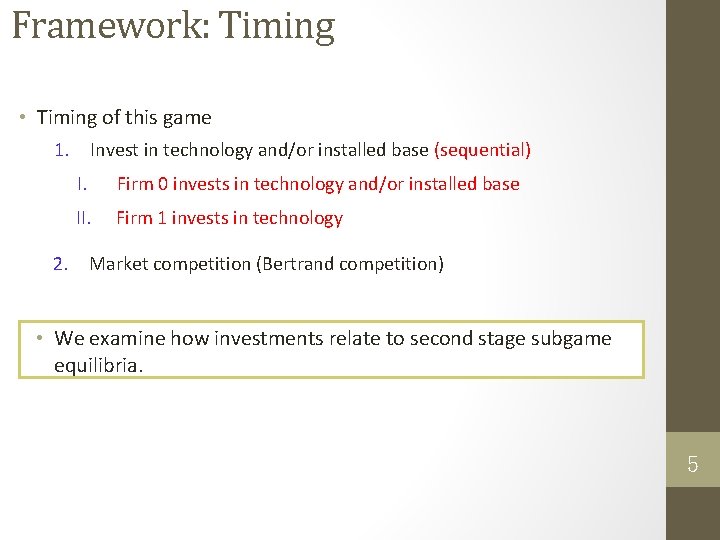
Framework: Timing • Timing of this game 1. Invest in technology and/or installed base (sequential) I. Firm 0 invests in technology and/or installed base II. Firm 1 invests in technology 2. Market competition (Bertrand competition) • We examine how investments relate to second stage subgame equilibria. 5
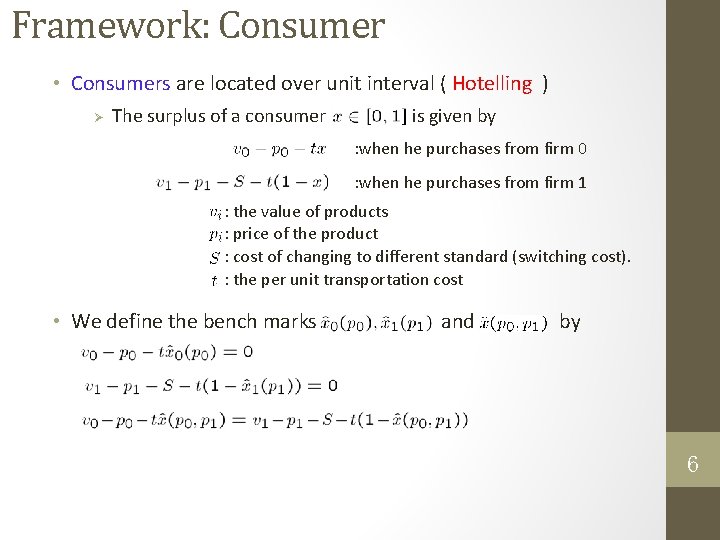
Framework: Consumer • Consumers are located over unit interval ( Hotelling ) Ø The surplus of a consumer is given by : when he purchases from firm 0 : when he purchases from firm 1 : the value of products : price of the product : cost of changing to different standard (switching cost). : the per unit transportation cost • We define the bench marks and by 6
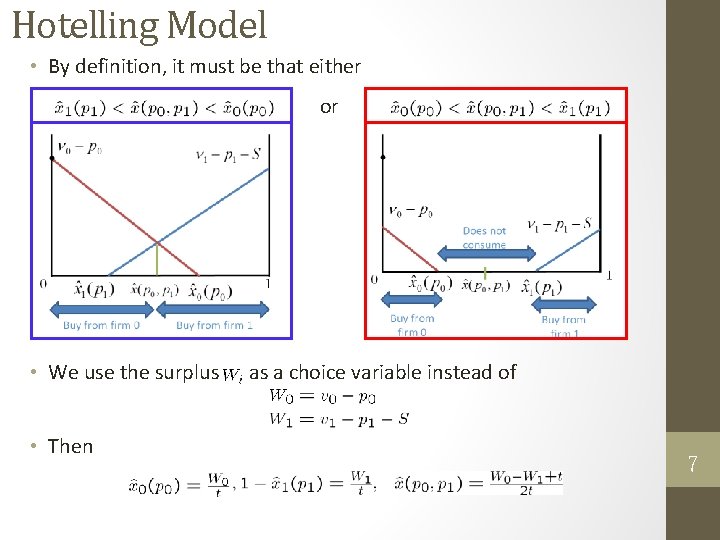
Hotelling Model • By definition, it must be that either or • We use the surplus • Then as a choice variable instead of 7
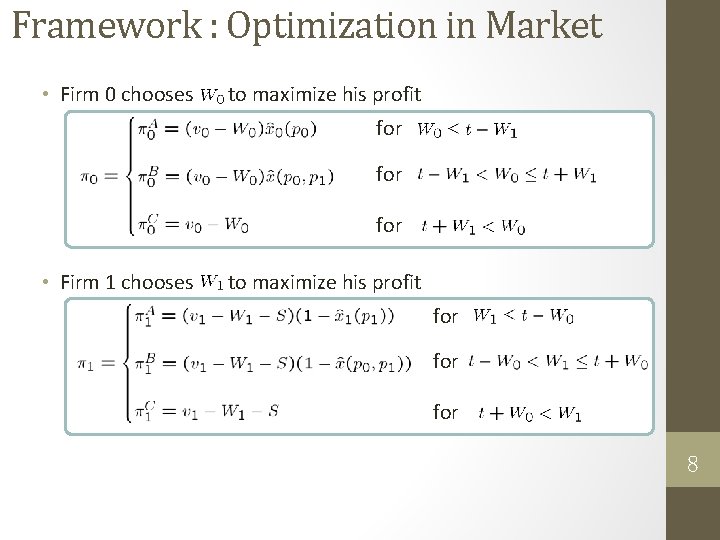
Framework : Optimization in Market • Firm 0 chooses to maximize his profit for for • Firm 1 chooses to maximize his profit for for 8
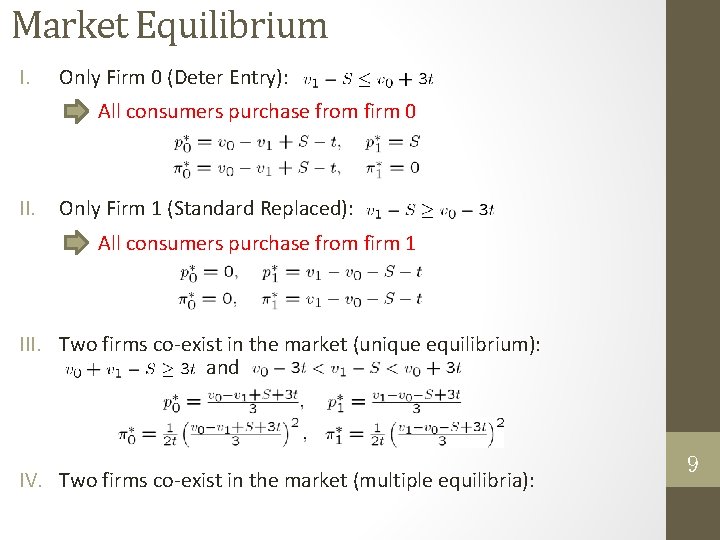
Market Equilibrium I. Only Firm 0 (Deter Entry): All consumers purchase from firm 0 II. Only Firm 1 (Standard Replaced): All consumers purchase from firm 1 III. Two firms co-exist in the market (unique equilibrium): and IV. Two firms co-exist in the market (multiple equilibria): 9
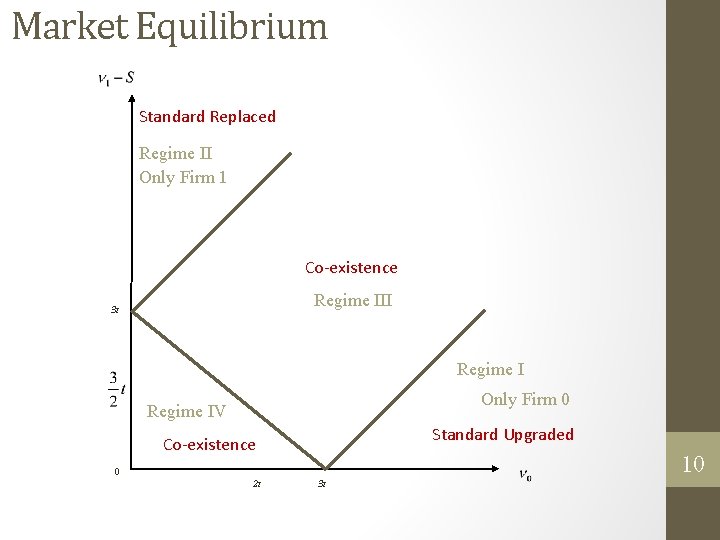
Market Equilibrium Standard Replaced Regime II Only Firm 1 Co-existence Regime III 3 t Regime I Only Firm 0 Regime IV Standard Upgraded Co-existence 10 0 2 t 3 t
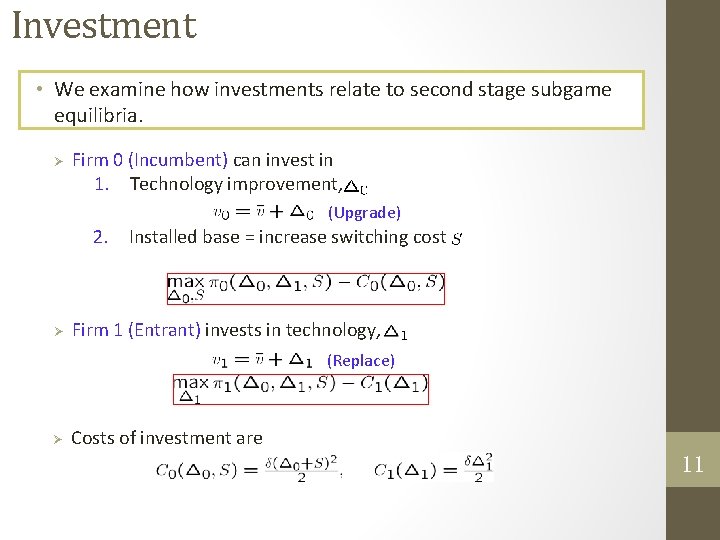
Investment • We examine how investments relate to second stage subgame equilibria. Ø Firm 0 (Incumbent) can invest in 1. Technology improvement, (Upgrade) 2. Installed base = increase switching cost Ø Firm 1 (Entrant) invests in technology, (Replace) Ø Costs of investment are 11
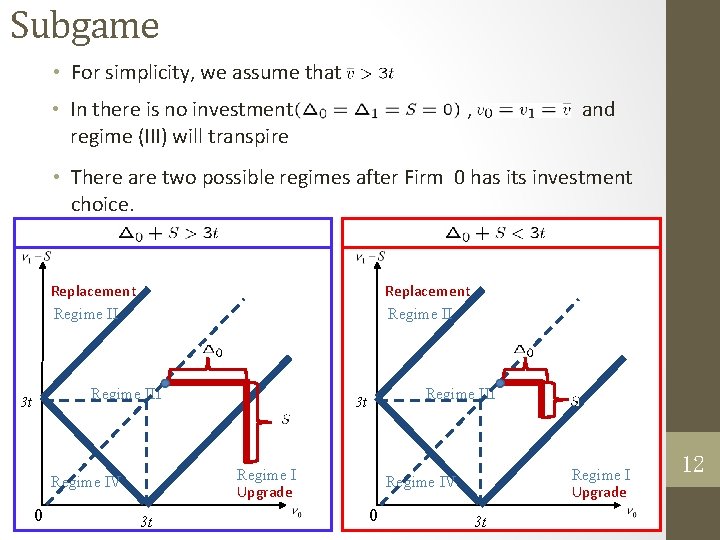
Subgame • For simplicity, we assume that • In there is no investment regime (III) will transpire , and • There are two possible regimes after Firm 0 has its investment choice. Replacement Regime III 3 t Regime I Upgrade Regime IV 0 Regime III 3 t 3 t Regime I Upgrade Regime IV 0 3 t 12
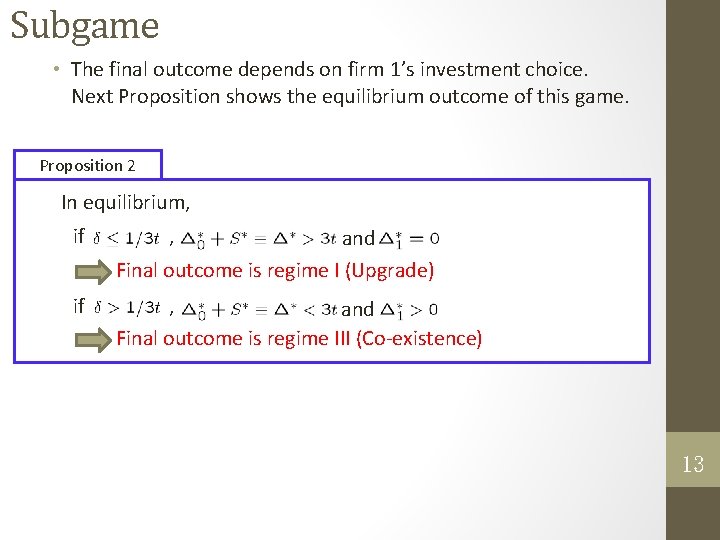
Subgame • The final outcome depends on firm 1’s investment choice. Next Proposition shows the equilibrium outcome of this game. Proposition 2 In equilibrium, if , and Final outcome is regime I (Upgrade) if , and Final outcome is regime III (Co-existence) 13
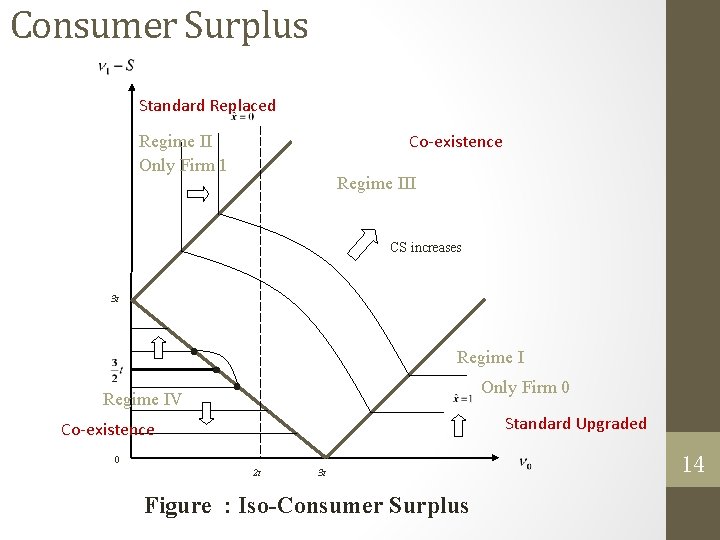
Consumer Surplus Standard Replaced Co-existence Regime II Only Firm 1 Regime III CS increases 3 t Regime I Only Firm 0 Regime IV Standard Upgraded Co-existence 0 2 t 3 t Figure : Iso-Consumer Surplus 14
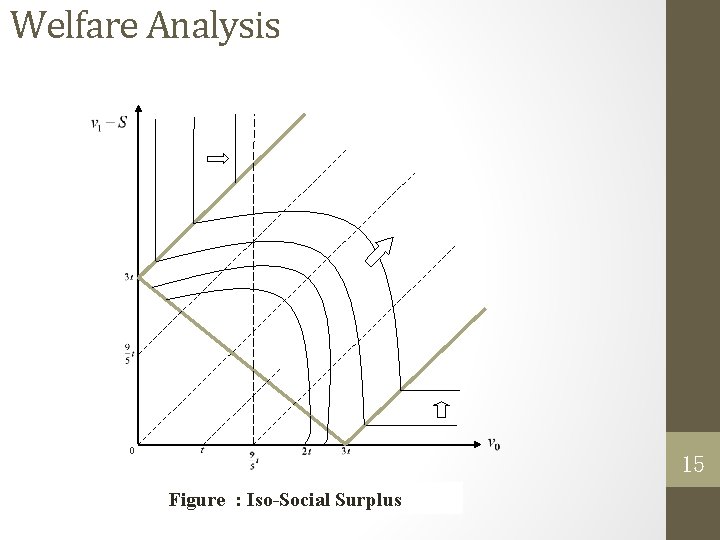
Welfare Analysis 0 15 Figure : Iso-Social Surplus
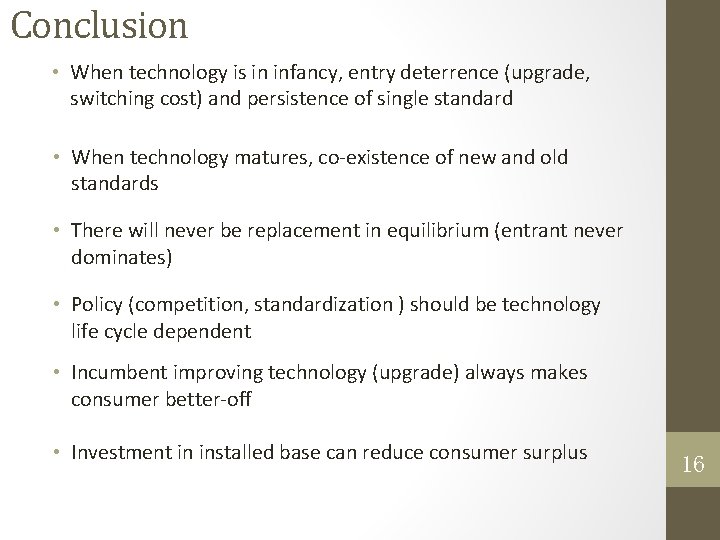
Conclusion • When technology is in infancy, entry deterrence (upgrade, switching cost) and persistence of single standard • When technology matures, co-existence of new and old standards • There will never be replacement in equilibrium (entrant never dominates) • Policy (competition, standardization ) should be technology life cycle dependent • Incumbent improving technology (upgrade) always makes consumer better-off • Investment in installed base can reduce consumer surplus 16
- Slides: 16