
Standardizing RPAL ASTs Programming Language Principles Lecture 10
- Slides: 30
Standardizing RPAL AST’s Programming Language Principles Lecture 10 Prepared by Manuel E. Bermúdez, Ph. D. Associate Professor University of Florida
The Semantics of RPAL We use the operational approach: To specify the semantics of a language, we give an OPERATIONAL PROCESS. In contrast, later we will discuss the DENOTATIONAL approach: PL constructs are “denoted” with functions whose behavior specify the meaning of the program.
The RPAL Operational Specification • In the case of RPAL, the process is 1. Scan and parse the program, transduce to a tree. 2. Standardize the tree.
The RPAL Operational Specification (cont’d) 3. Flatten the tree into either: a. A lambda expression. b. Control Structures for a machine (more later) • Important: • RPAL = lambda-calculus + syntactic sugar
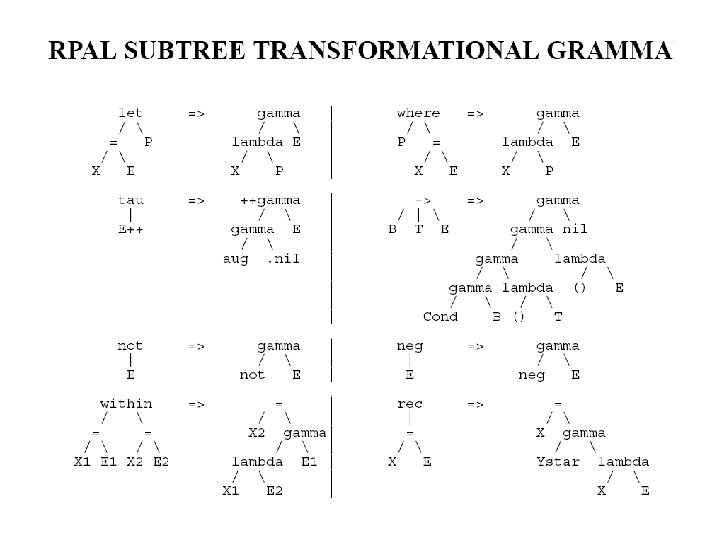
Standardizing an RPAL AST • "Desugar" the tree. • Transform into a binary tree, whose internal nodes are exclusively 'gamma' and 'lambda'. • Use the RPAL subtree transformational grammar (pictorial version)
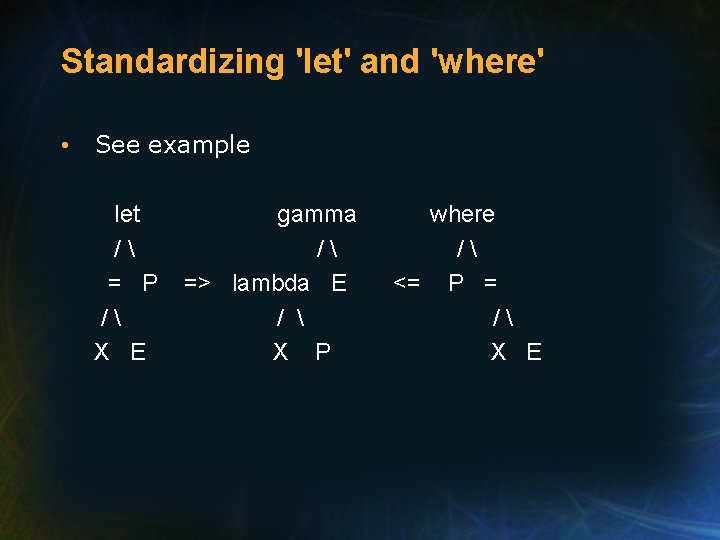
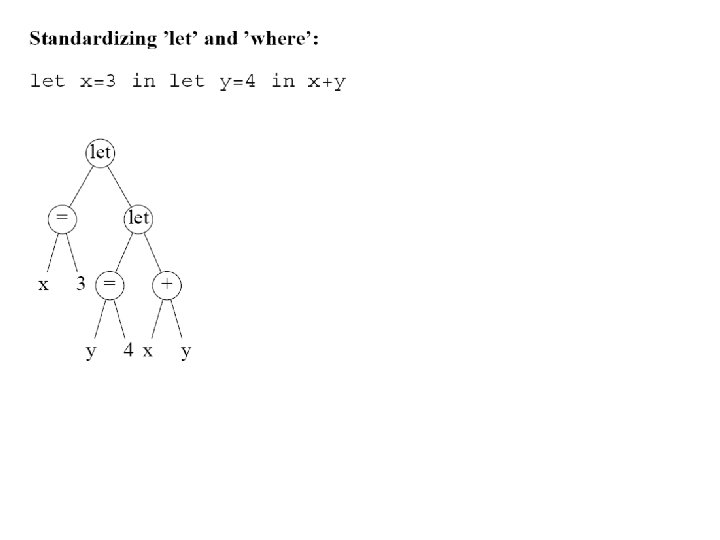
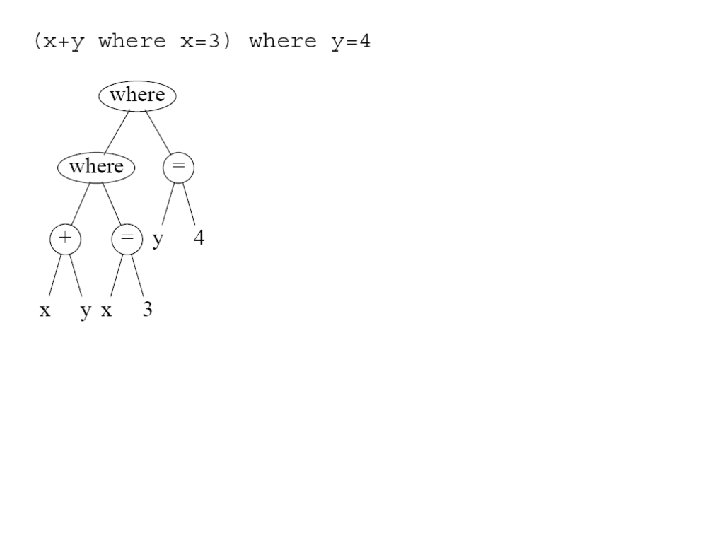
Standardizing 'let' and 'where' • See example let / = P / X E gamma / => lambda E / X P where / <= P = / X E
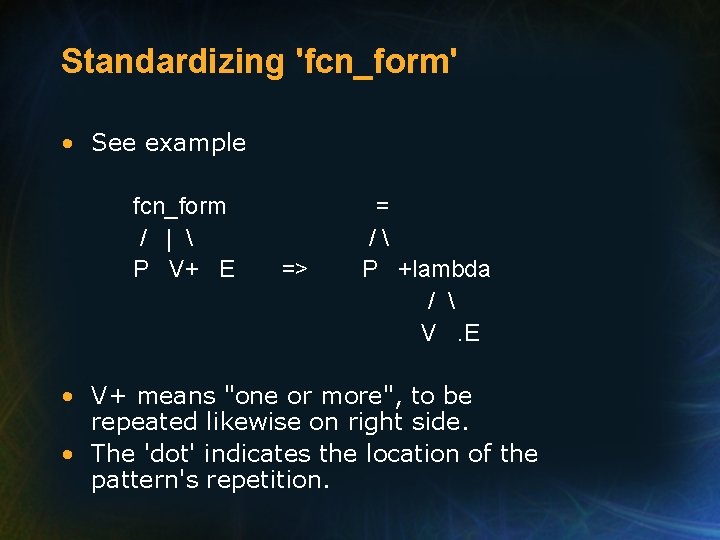
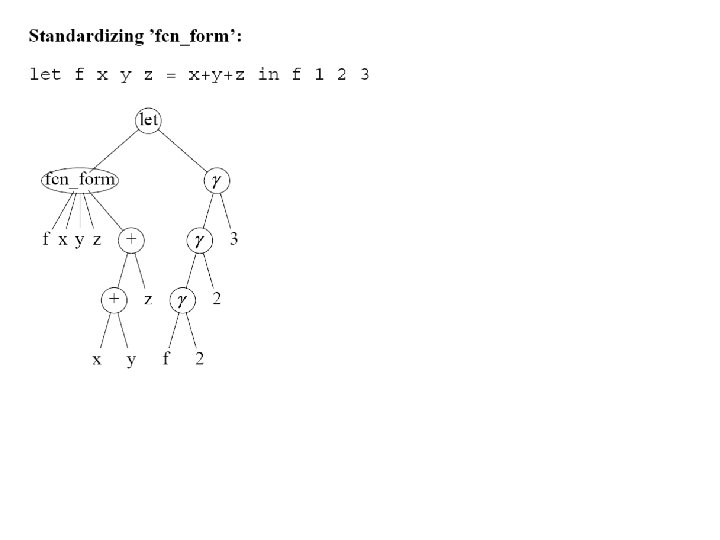
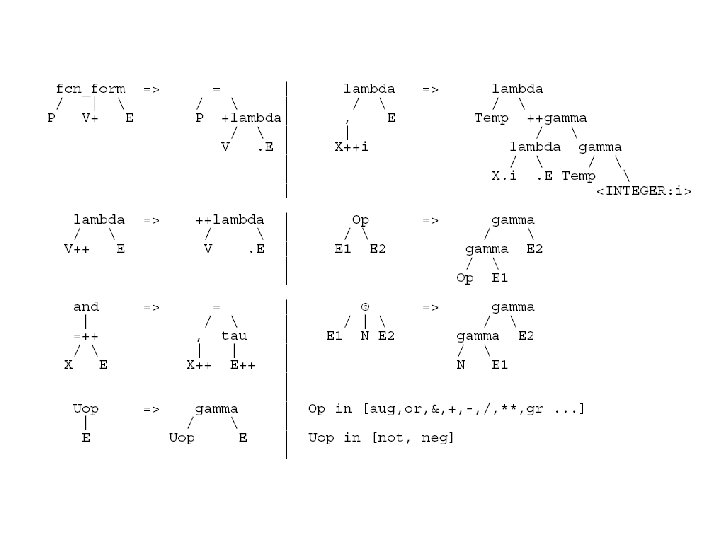
Standardizing 'fcn_form' • See example fcn_form / | P V+ E => = / P +lambda / V. E • V+ means "one or more", to be repeated likewise on right side. • The 'dot' indicates the location of the pattern's repetition.
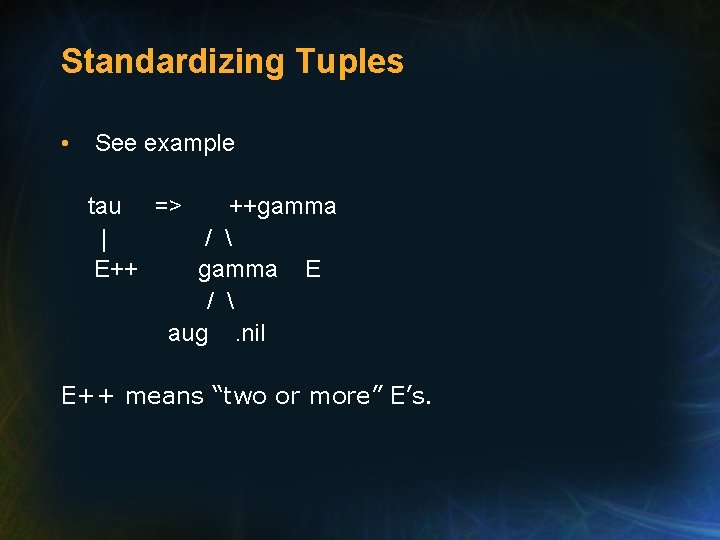
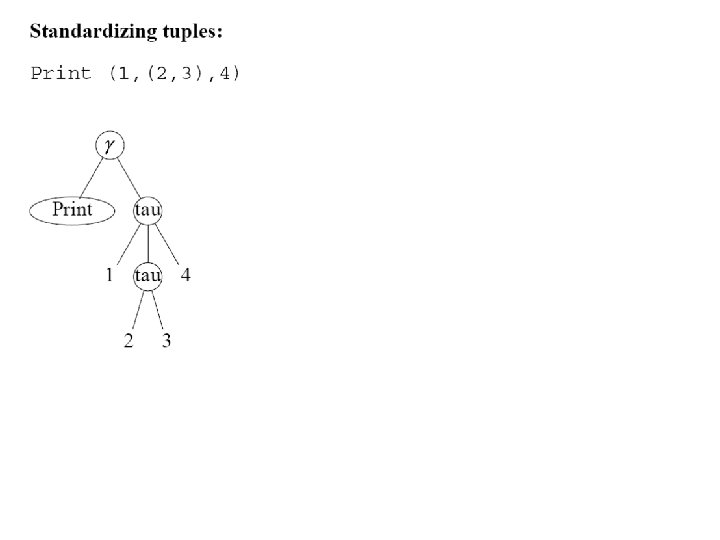
Standardizing Tuples • See example tau => ++gamma | / E++ gamma E / aug. nil E++ means “two or more” E’s.
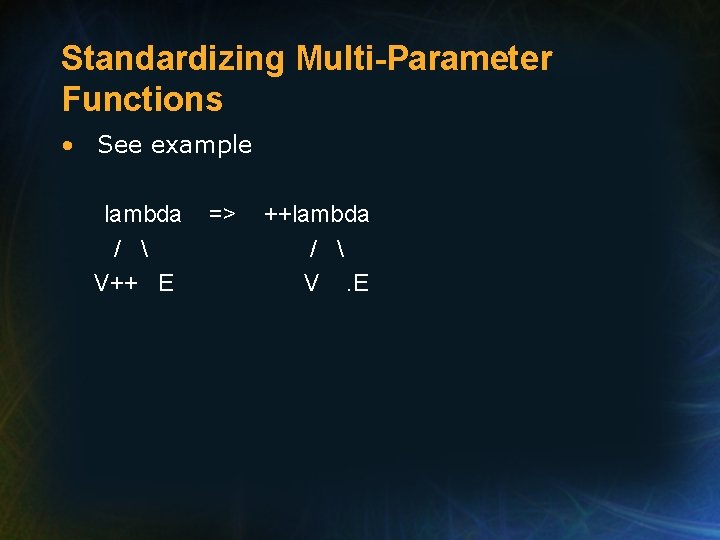
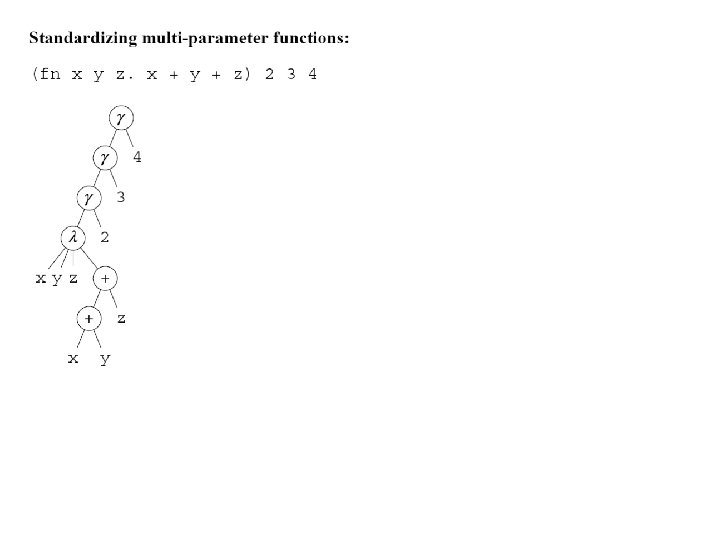
Standardizing Multi-Parameter Functions • See example lambda / V++ E => ++lambda / V. E
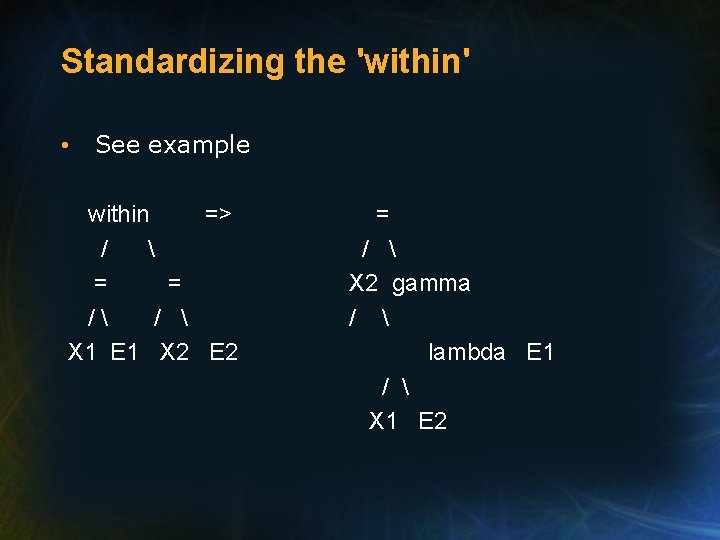
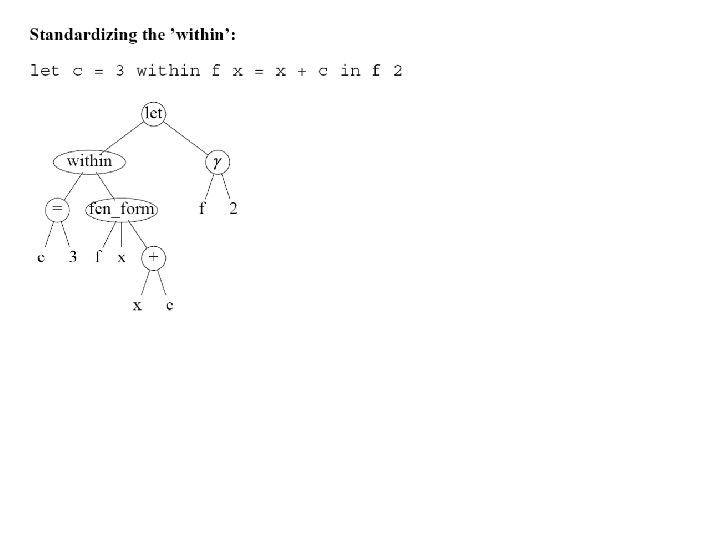
Standardizing the 'within' • See example within => / = = / / X 1 E 1 X 2 E 2 = / X 2 gamma / lambda E 1 / X 1 E 2
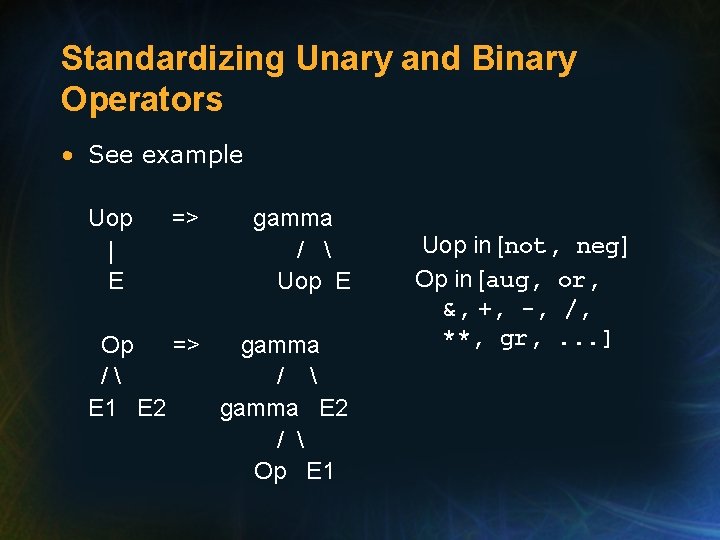
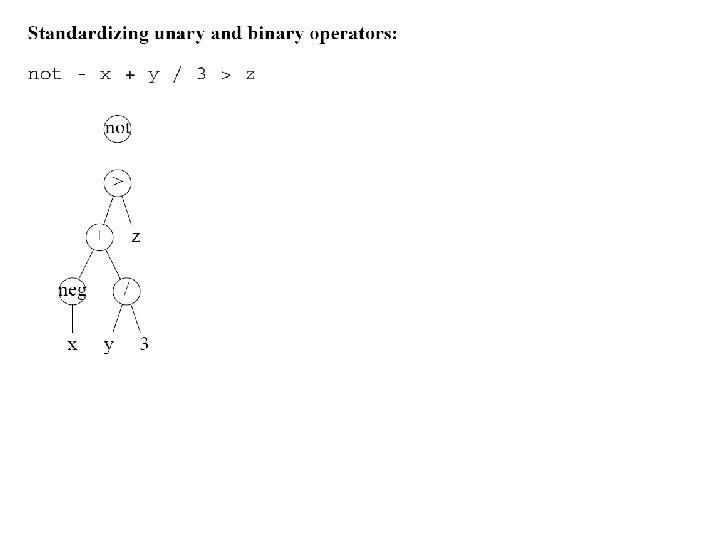
Standardizing Unary and Binary Operators • See example Uop | E => gamma / Uop E Op => gamma / / E 1 E 2 gamma E 2 / Op E 1 Uop in [not, neg] Op in [aug, or, &, +, -, /, **, gr, . . . ]
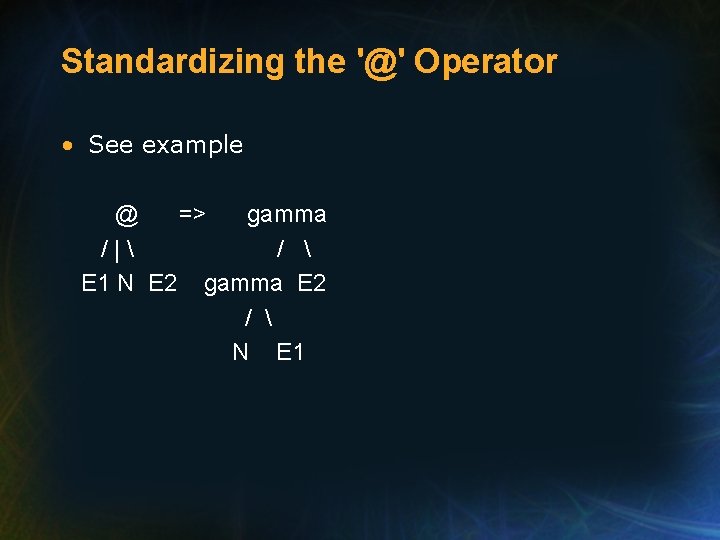
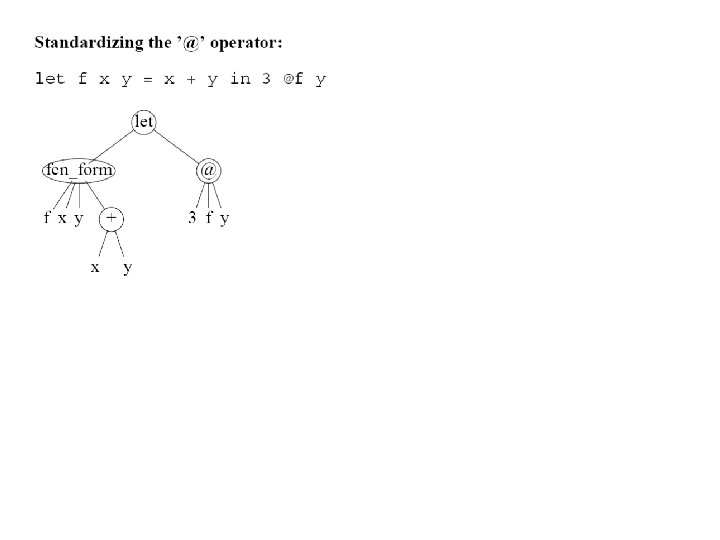
Standardizing the '@' Operator • See example @ => gamma /| / E 1 N E 2 gamma E 2 / N E 1
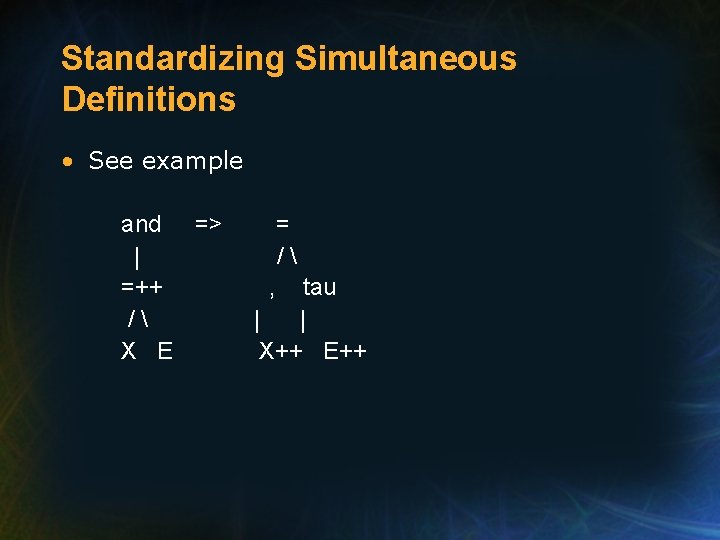
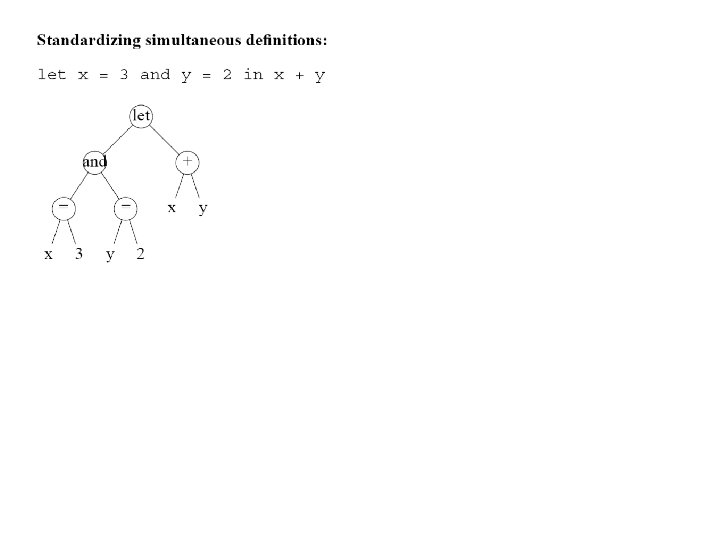
Standardizing Simultaneous Definitions • See example and => | =++ / X E = / , tau | | X++ E++
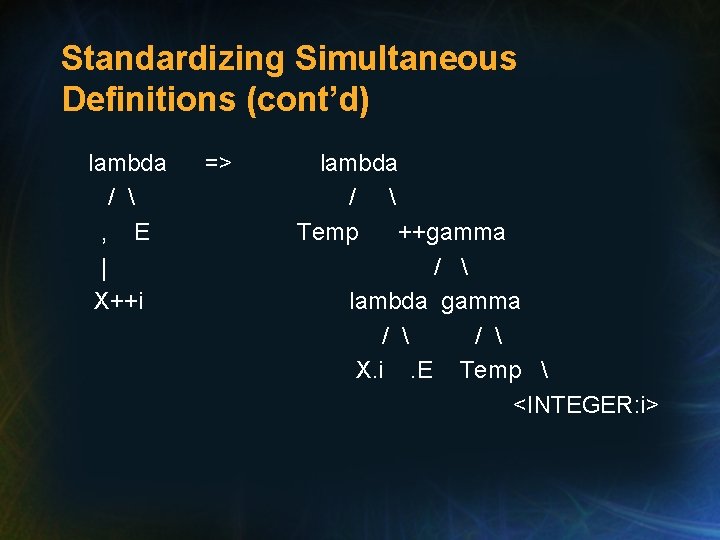
Standardizing Simultaneous Definitions (cont’d) lambda / , E | X++i => lambda / Temp ++gamma / lambda gamma / X. i. E Temp <INTEGER: i>
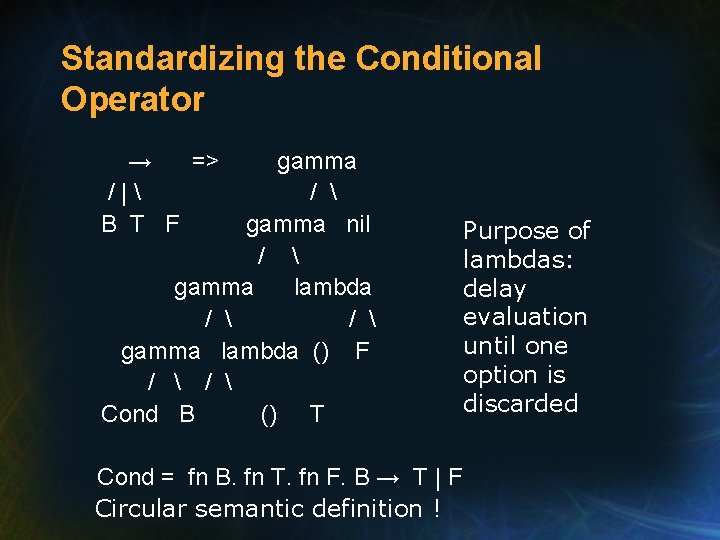
Standardizing the Conditional Operator → => /| B T F gamma / gamma nil / gamma lambda () F / Cond B () T Cond = fn B. fn T. fn F. B → T | F Circular semantic definition ! Purpose of lambdas: delay evaluation until one option is discarded
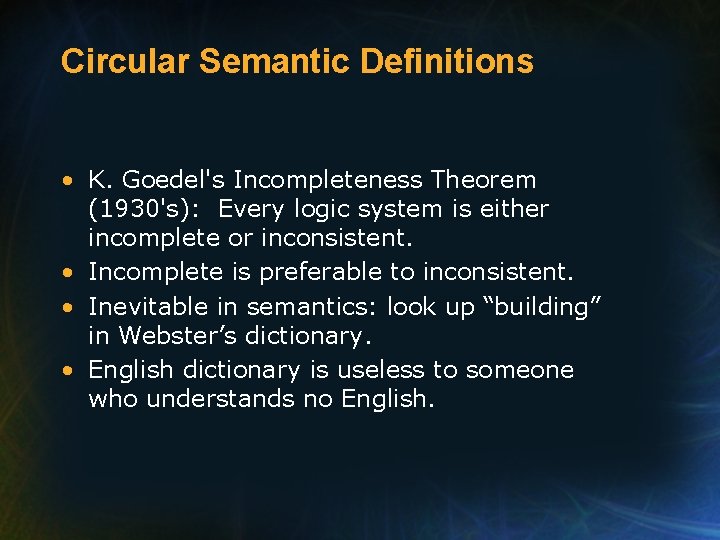
Circular Semantic Definitions • K. Goedel's Incompleteness Theorem (1930's): Every logic system is either incomplete or inconsistent. • Incomplete is preferable to inconsistent. • Inevitable in semantics: look up “building” in Webster’s dictionary. • English dictionary is useless to someone who understands no English.
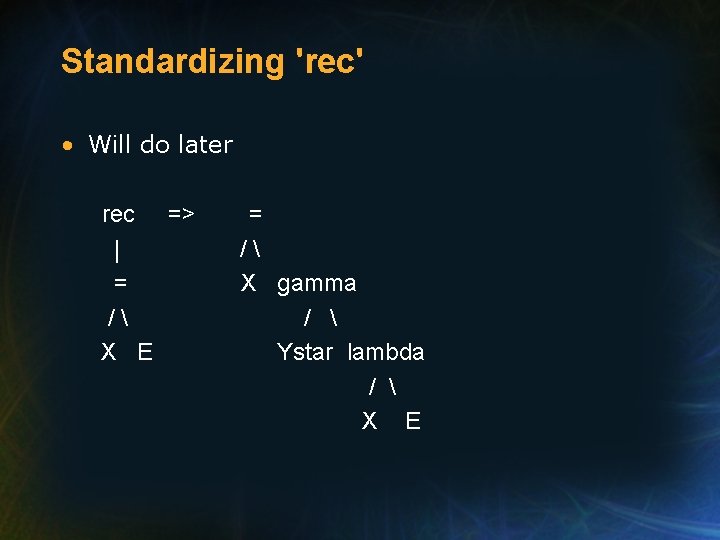
Standardizing 'rec' • Will do later rec => | = / X E = / X gamma / Ystar lambda / X E
Summary • Transform AST into a standardized tree (ST). • ST is binary. • All internal nodes in the ST are either gamma or lambda. • It’s called “desugaring” the program: reducing it to two constructs: function abstraction/definition (lambda), and function application (gamma).
Standardizing RPAL AST’s Programming Language Principles Lecture 10 Prepared by Manuel E. Bermúdez, Ph. D. Associate Professor University of Florida