
Standardizing a Network Infrastructure The technology was the



- Slides: 29
Standardizing a Network Infrastructure: The technology was the easy part! Johanna Madjedi, Director – Communications and Computing Services, ITS, Cal Poly San Luis Obispo Mark Crase, Sr. Dir. , Technology Infrastructure Initiatives, California State University Office of the Chancellor Copyright Mark Crase and Johanna Madjedi, 2002. This work is the intellectual property of the authors. Permission is granted for this material to be shared for non-commercial, educational purposes, provided that this copyright statement appears on the reproduced materials and notice is given that the copying is by permission of the authors. To disseminate otherwise or to republish requires written permission from the authors.
Order of Business • • • Integrated Technology Strategy Infrastructure Terminal Resources Proj. Implementation Challenges Creating the Process Outcomes Lessons Learned
The California State University • 23 Campuses • 1 R 2 Research • 21 4 -year Comprehensive • California Maritime Academy • 388, 000 Students • 80, 000 Faculty and Staff
How we got started… • Having long-recognized individually that technology was a key institutional success factor, in 1997 the CSU Presidents came together to ensure that each campus in the system would have the technology infrastructure required to support each institution’s academic and administrative programs
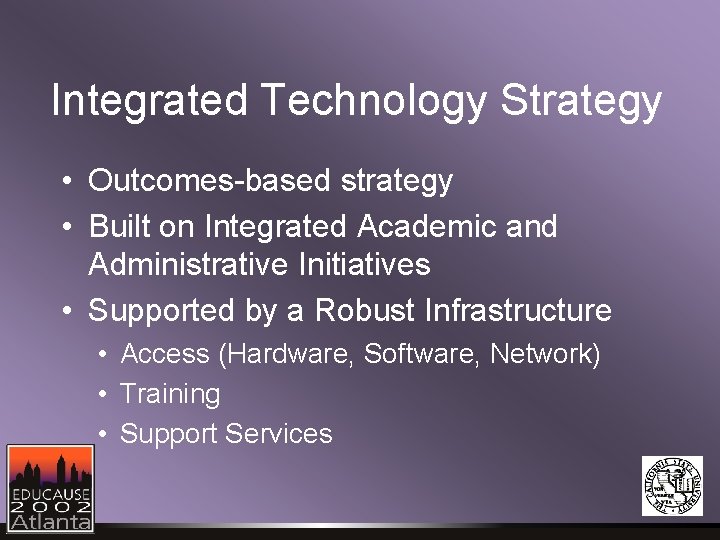
Integrated Technology Strategy • Outcomes-based strategy • Built on Integrated Academic and Administrative Initiatives • Supported by a Robust Infrastructure • Access (Hardware, Software, Network) • Training • Support Services
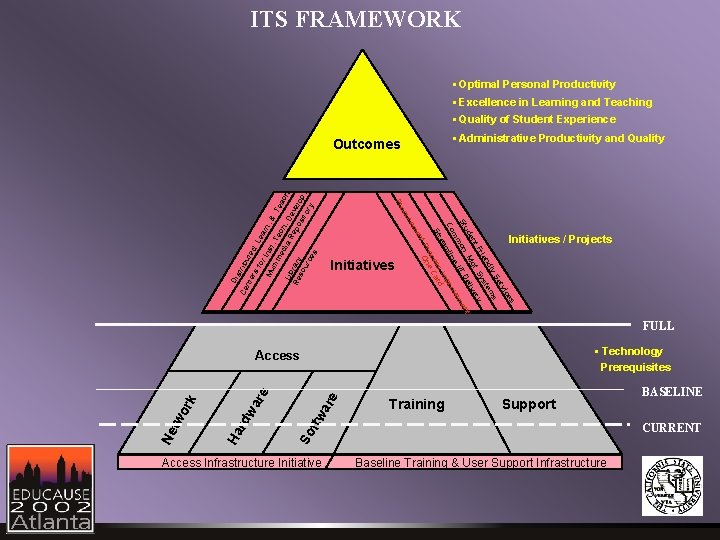
ITS FRAMEWORK • Optimal Personal Productivity • Excellence in Learning and Teaching • Quality of Student Experience • Administrative Productivity and Quality s ice rv Se s ly tem nd ys rie t F gt. S very i en l t e. M ud D en on St /T em e. I mm ov lin Co pr am Im re ss ard St ce C ro ne t. P O en em ur oc Pr Initiatives Ce Di str i nte bute d rs Le for arn I ns Mu. & ltim t. T Te e ch ac ed. D h. ia Lib R e r v e Re ary elo po so sit p. ur or ce y s Outcomes Initiatives / Projects FULL • Technology Prerequisites wa re Training Support Access Infrastructure Initiative BASELINE CURRENT So ft ar e dw Ha r Ne tw or k Access Baseline Training & User Support Infrastructure
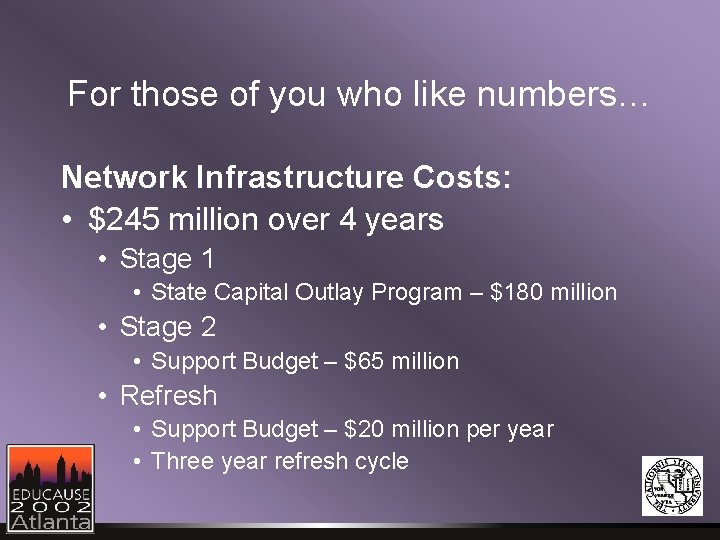
For those of you who like numbers… Network Infrastructure Costs: • $245 million over 4 years • Stage 1 • State Capital Outlay Program – $180 million • Stage 2 • Support Budget – $65 million • Refresh • Support Budget – $20 million per year • Three year refresh cycle
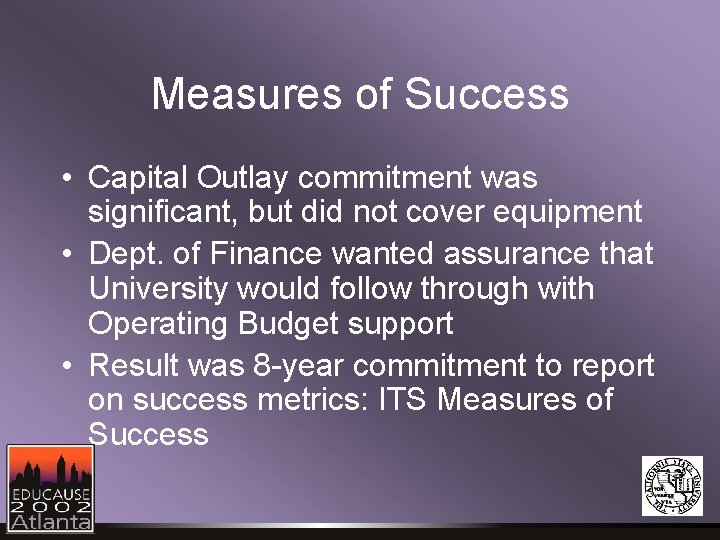
Measures of Success • Capital Outlay commitment was significant, but did not cover equipment • Dept. of Finance wanted assurance that University would follow through with Operating Budget support • Result was 8 -year commitment to report on success metrics: ITS Measures of Success
What’s Covered? • The “base” of the Pyramid includes: • Stage 1 • Spaces, Pathways and intra-building media • Stage 2 • Inter-building Media, Infrastructure Terminal Resources Project (ITRP)
Infrastructure Terminal Resources Project • Intended to ensure the value of the investment is maximized, the ITRP includes: • • • Systems Integration Network Equipment Network Management Operating Standards & Practices Support Staff Training and Professional Development
Implementation Challenges • The funding strategy magnified some conflicts inherent in any large institution • Stage 1 • Implementation is guided by long-established State and CSU policy • Managed at the campus level • Stage 2 • Dependent on Stage 1 scheduling • Managed by the Chancellor’s Office
Chancellor’s Office Concerns • Address requirements of Dept. of Finance • Ensure each campus gets required infrastructure • Make $$ go as far as possible • Raise the bar with respect to Operating Standards & Practices • Achieve enough standardization to ensure reliability in support of mission-critical apps.
Campus Concerns • Maintain operational flexibility to address unique local needs • Ensure participation in decision making • Complete project on time • Ensure funding sources are defined • Ensure funding is adequate • Ensure funding is guaranteed
How to Proceed? • Fall, 1999 – CO-led team of campus reps put out and RFP for Systems Integrator • Fall, 2000 – SBC selected as Integrator • December, 2000 – Establish Network Technology Alliance (NTA) • • • Campus Network Managers WAN Manager 2 campus CIO “mentors” Chancellor’s Office “fly wheels” Stage 2 consultant
Now that the easy part is done… • Forming • Storming • Norming • Performing
The “ormings” of the NTA • Forming • Established charge of the group • Define Baseline Campus Network Standards to guide Systems Integrator • Recommend network electronics “vendor of choice” • Draft Network Management System (NMS) Requirements • Established buy-in for participation • Members were appointed by campus CIO’s • Participation not mandatory, but strongly encouraged • Meetings approx. every two months
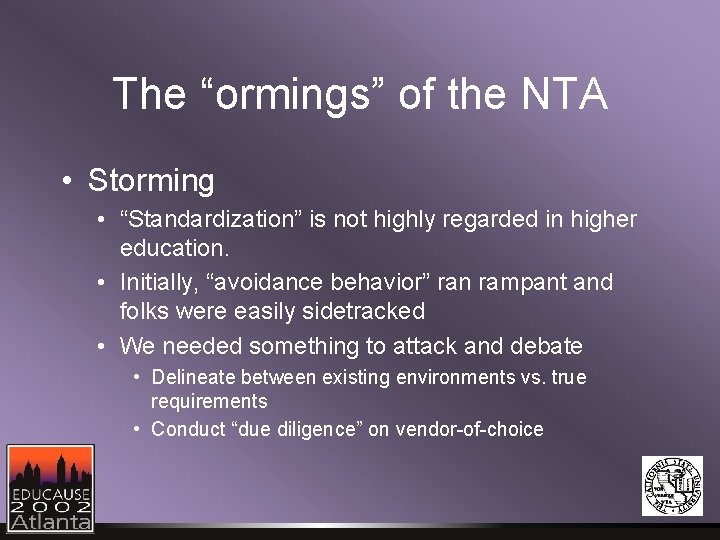
The “ormings” of the NTA • Storming • “Standardization” is not highly regarded in higher education. • Initially, “avoidance behavior” ran rampant and folks were easily sidetracked • We needed something to attack and debate • Delineate between existing environments vs. true requirements • Conduct “due diligence” on vendor-of-choice
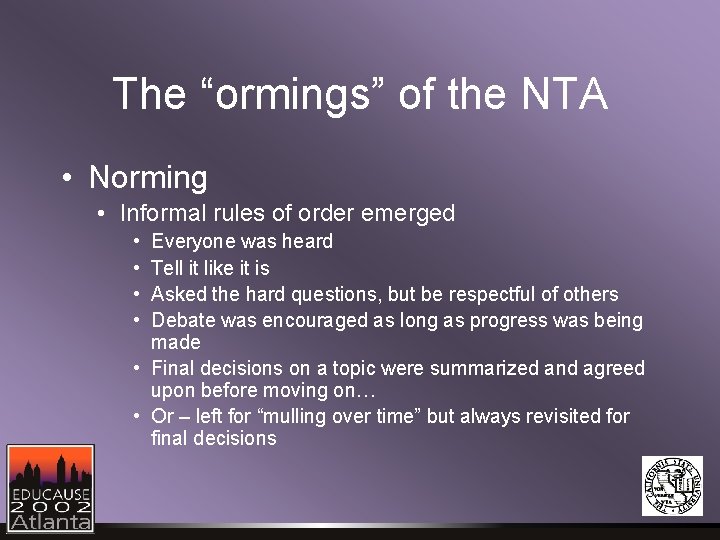
The “ormings” of the NTA • Norming • Informal rules of order emerged • • Everyone was heard Tell it like it is Asked the hard questions, but be respectful of others Debate was encouraged as long as progress was being made • Final decisions on a topic were summarized and agreed upon before moving on… • Or – left for “mulling over time” but always revisited for final decisions
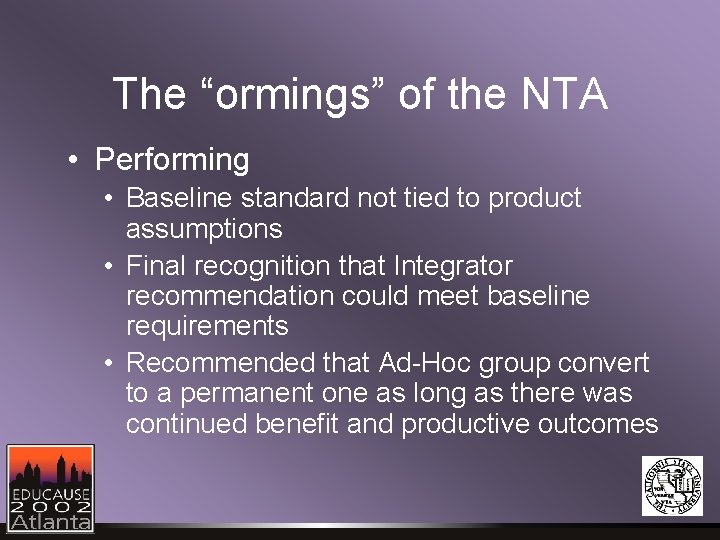
The “ormings” of the NTA • Performing • Baseline standard not tied to product assumptions • Final recognition that Integrator recommendation could meet baseline requirements • Recommended that Ad-Hoc group convert to a permanent one as long as there was continued benefit and productive outcomes
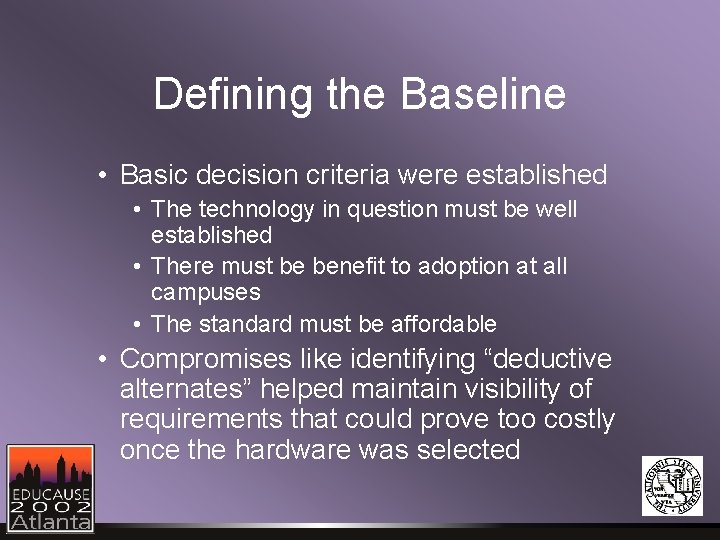
Defining the Baseline • Basic decision criteria were established • The technology in question must be well established • There must be benefit to adoption at all campuses • The standard must be affordable • Compromises like identifying “deductive alternates” helped maintain visibility of requirements that could prove too costly once the hardware was selected
Outcomes • Initial Goals Achieved • Baseline was established • Product was selected • Affinity between campuses was established • Unexpected outcomes • Shift toward more “System-wide” thinking • Campus leverage by using System standards • Participation and buy-in on a wide scale
For those who wanna know… Vendor of Choice: • Cisco for basic IP network infrastructure
Lessons Learned • Face-to-Face interaction is key • It’s hard to be mad at someone you just bought Girl Scout cookies from • Tight timelines maintain focus and force consensus • The attention span of the group is directly proportional to the amount of time allotted to complete the task. Said another way – left to their own devices, things will drift
Lessons Learned • Putting the facts on the table shifts the discussion from beliefs to truths • Starting with the standards and then identifying the technical solution was critical to preventing infinite debate • There must be some place to start from and a way to know you are done • Someone has to create “the draft” which is then revised and refined by the group as a whole • Basic principles helped bring debate to a conclusion • A clear charter up front let us know when we were done
Lessons Learned • Transparency prevents back room horse trading, increases faith in the process and creates a safe environment to bring new ideas to the table • Straw poles • Documented meeting notes • Clear reiteration and confirmation of decisions before continuing to the next issue
No good deed goes unpunished • • To “&” or not to “&”, that is the question! Network Security IP Telephony Other?
• Questions?