
Standardized Training Model for Procedural Skill Demonstration in
- Slides: 1
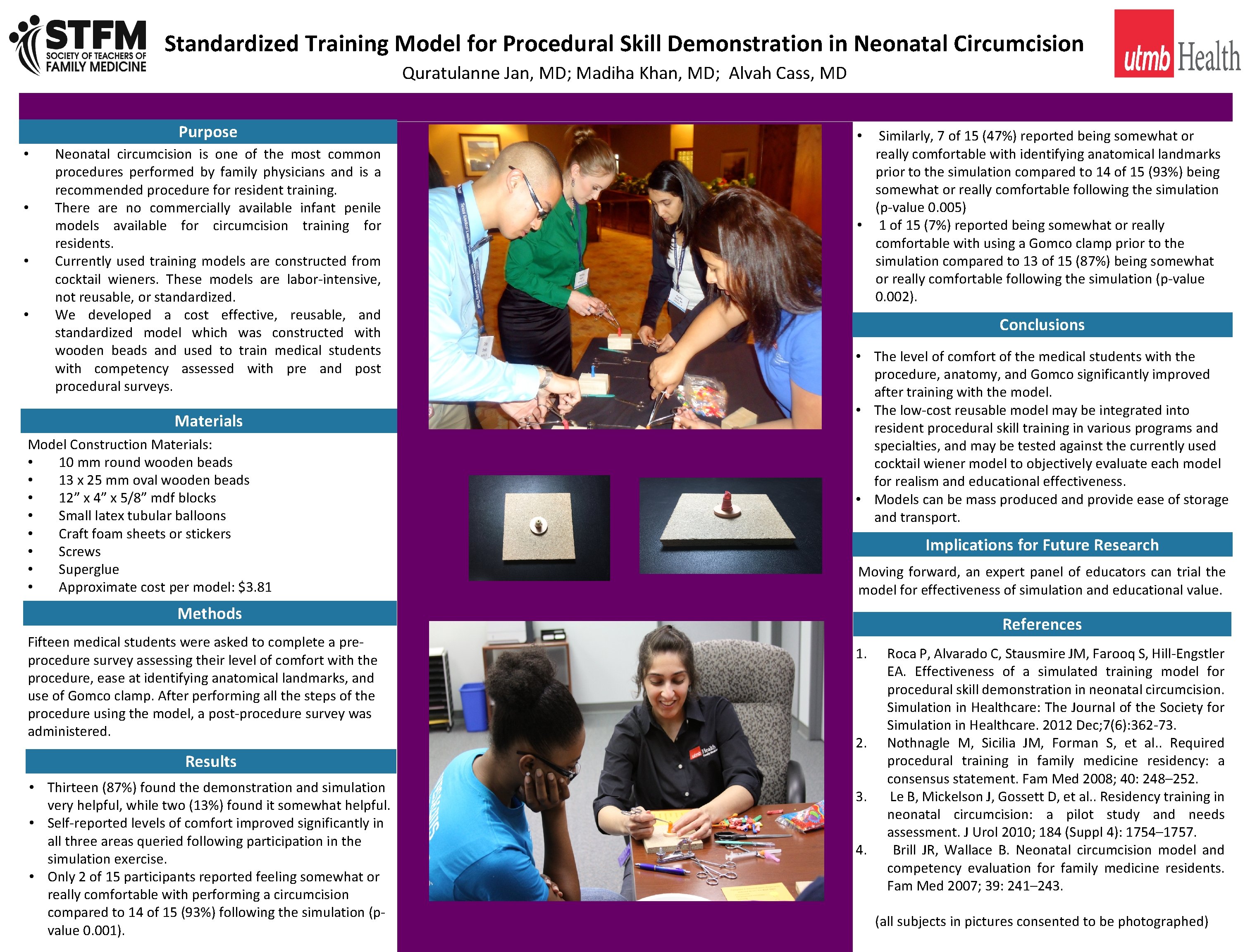
Standardized Training Model for Procedural Skill Demonstration in Neonatal Circumcision Quratulanne Jan, MD; Madiha Khan, MD; Alvah Cass, MD Purpose • • Neonatal circumcision is one of the most common procedures performed by family physicians and is a recommended procedure for resident training. There are no commercially available infant penile models available for circumcision training for residents. Currently used training models are constructed from cocktail wieners. These models are labor-intensive, not reusable, or standardized. We developed a cost effective, reusable, and standardized model which was constructed with wooden beads and used to train medical students with competency assessed with pre and post procedural surveys. Materials Model Construction Materials: • 10 mm round wooden beads • 13 x 25 mm oval wooden beads • 12” x 4” x 5/8” mdf blocks • Small latex tubular balloons • Craft foam sheets or stickers • Screws • Superglue • Approximate cost per model: $3. 81 Similarly, 7 of 15 (47%) reported being somewhat or really comfortable with identifying anatomical landmarks prior to the simulation compared to 14 of 15 (93%) being somewhat or really comfortable following the simulation (p-value 0. 005) • 1 of 15 (7%) reported being somewhat or really comfortable with using a Gomco clamp prior to the simulation compared to 13 of 15 (87%) being somewhat or really comfortable following the simulation (p-value 0. 002). • Conclusions • The level of comfort of the medical students with the procedure, anatomy, and Gomco significantly improved after training with the model. • The low-cost reusable model may be integrated into resident procedural skill training in various programs and specialties, and may be tested against the currently used cocktail wiener model to objectively evaluate each model for realism and educational effectiveness. • Models can be mass produced and provide ease of storage and transport. Implications for Future Research Moving forward, an expert panel of educators can trial the model for effectiveness of simulation and educational value. Methods Fifteen medical students were asked to complete a preprocedure survey assessing their level of comfort with the procedure, ease at identifying anatomical landmarks, and use of Gomco clamp. After performing all the steps of the procedure using the model, a post-procedure survey was administered. Results • Thirteen (87%) found the demonstration and simulation very helpful, while two (13%) found it somewhat helpful. • Self-reported levels of comfort improved significantly in all three areas queried following participation in the simulation exercise. • Only 2 of 15 participants reported feeling somewhat or really comfortable with performing a circumcision compared to 14 of 15 (93%) following the simulation (pvalue 0. 001). References 1. 2. 3. 4. Roca P, Alvarado C, Stausmire JM, Farooq S, Hill-Engstler EA. Effectiveness of a simulated training model for procedural skill demonstration in neonatal circumcision. Simulation in Healthcare: The Journal of the Society for Simulation in Healthcare. 2012 Dec; 7(6): 362 -73. Nothnagle M, Sicilia JM, Forman S, et al. . Required procedural training in family medicine residency: a consensus statement. Fam Med 2008; 40: 248– 252. Le B, Mickelson J, Gossett D, et al. . Residency training in neonatal circumcision: a pilot study and needs assessment. J Urol 2010; 184 (Suppl 4): 1754– 1757. Brill JR, Wallace B. Neonatal circumcision model and competency evaluation for family medicine residents. Fam Med 2007; 39: 241– 243. (all subjects in pictures consented to be photographed)