
Standardized Test Tips How to Take the Test
- Slides: 41
Standardized Test Tips How to Take the Test
Seven Basic Rules 1. Know the instructions for each subject test • Don’t waste precious test time re-reading the directions 2. Use your test booklet as scratch paper 3. Answer Easy Questions first • Mark the booklet to know which questions to come back to 4. Answer Hard Questions last • 1 minute is too long—skip it and come back later
Seven Basic Rules 5. Avoid Carelessness • • Mistakes happen when moving too quickly Don’t let frustration or lack of confidence affect the answers of the other questions 6. Be careful bubbling answers • • Bubble in groups of 5 or at the end of the page In your head, say the question # and the answer when filling in bubbles
Seven Basic Rules 7. Always guess when you don’t know the answer • You have a 100% chance of getting the answer wrong if it is left blank
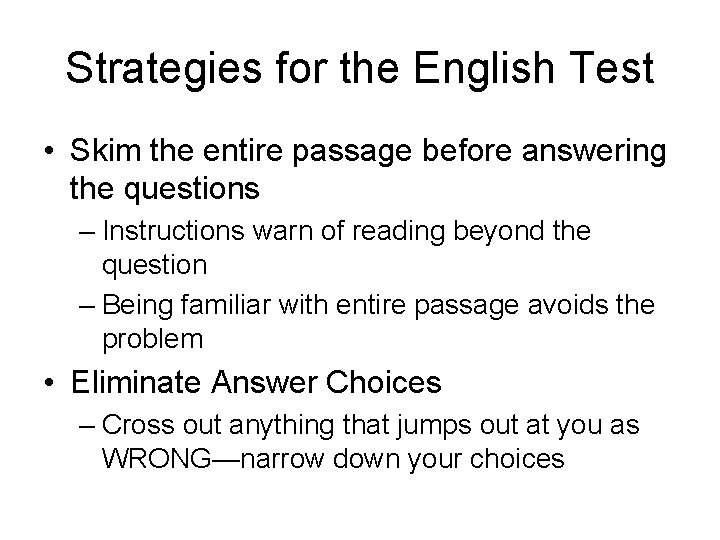
Strategies for the English Test • Skim the entire passage before answering the questions – Instructions warn of reading beyond the question – Being familiar with entire passage avoids the problem • Eliminate Answer Choices – Cross out anything that jumps out at you as WRONG—narrow down your choices
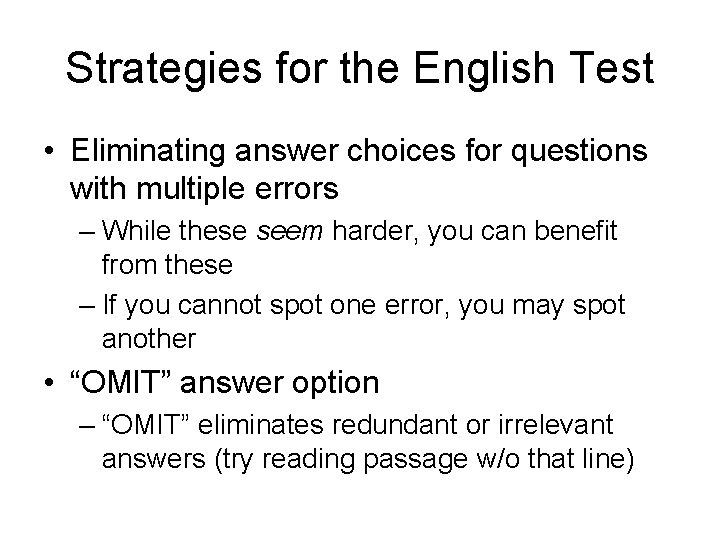
Strategies for the English Test • Eliminating answer choices for questions with multiple errors – While these seem harder, you can benefit from these – If you cannot spot one error, you may spot another • “OMIT” answer option – “OMIT” eliminates redundant or irrelevant answers (try reading passage w/o that line)
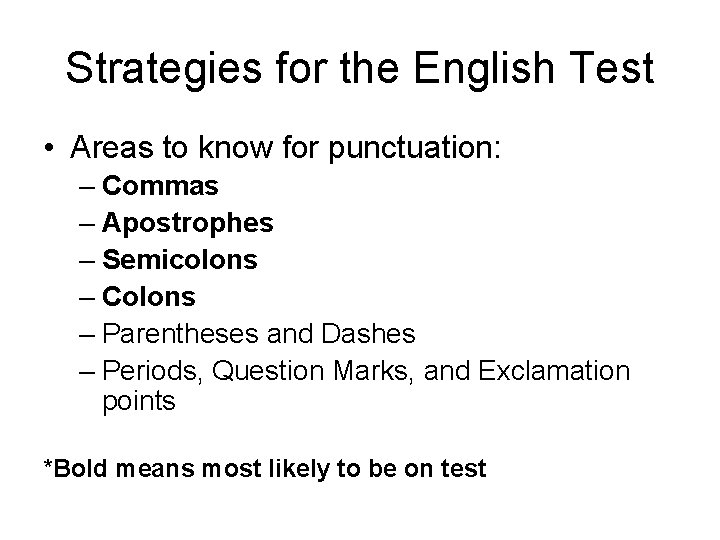
Strategies for the English Test • Areas to know for punctuation: – Commas – Apostrophes – Semicolons – Colons – Parentheses and Dashes – Periods, Question Marks, and Exclamation points *Bold means most likely to be on test
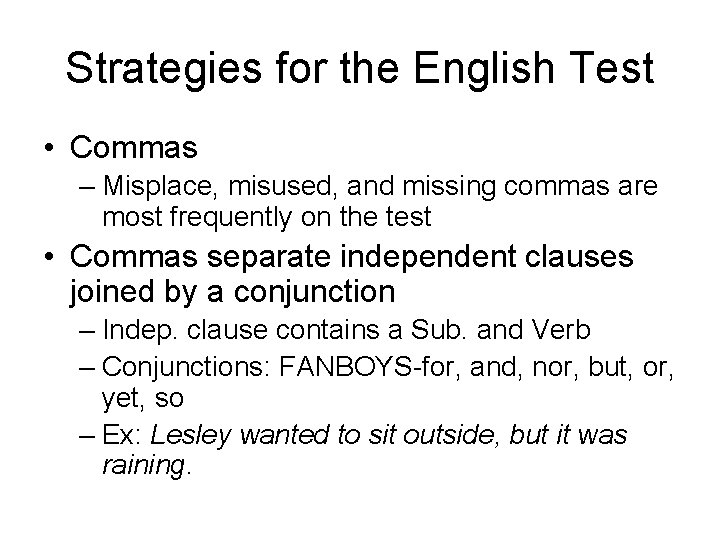
Strategies for the English Test • Commas – Misplace, misused, and missing commas are most frequently on the test • Commas separate independent clauses joined by a conjunction – Indep. clause contains a Sub. and Verb – Conjunctions: FANBOYS-for, and, nor, but, or, yet, so – Ex: Lesley wanted to sit outside, but it was raining.
Strategies for the English Test • Commas in a series – 3 or more items in a list separated by commas – Can either be noun or verb phrases – Ex: The hungry girl devoured a chicken sandwich, pizza, and ice cream. • Commas separate multiple nonessential adjectives modifying a noun – Ex: Rebecca’s new dog has long, silky hair.
Strategies for the English Test • Commas set off dependent phrases/clauses from the main clause of a sentence – Dependent clauses are not sentences on their own. They depend on independent clauses – Use a comma if the dependent phrase/clause is used at the beginning of the sentence. – Ex: After preparing an elaborate meal for herself, Anne was too tired to eat. – Ex: Anne was too tired to eat after preparing an elaborate meal for herself.
Strategies for the English Test • Commas to set off nonessential phrases and clauses – This part of the sentence could be taken out without affecting the meaning of the sentence – Ex: Everyone voted Carrie, who is the most popular girl in our school, prom queen. – Commas are NOT used when the phrase is important to the sentence – Ex: The girl who is sick missed three days of school.
Strategies for the English Test • Commas set off Appositives – Appositives rename/restate the modified noun – Ex: The dog, a Yorkshire Terrier, barked at all the neighbors.
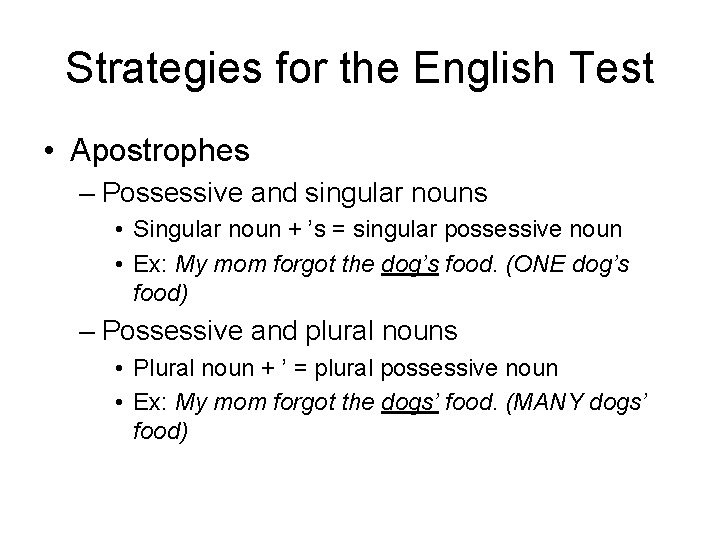
Strategies for the English Test • Apostrophes – Possessive and singular nouns • Singular noun + ’s = singular possessive noun • Ex: My mom forgot the dog’s food. (ONE dog’s food) – Possessive and plural nouns • Plural noun + ’ = plural possessive noun • Ex: My mom forgot the dogs’ food. (MANY dogs’ food)
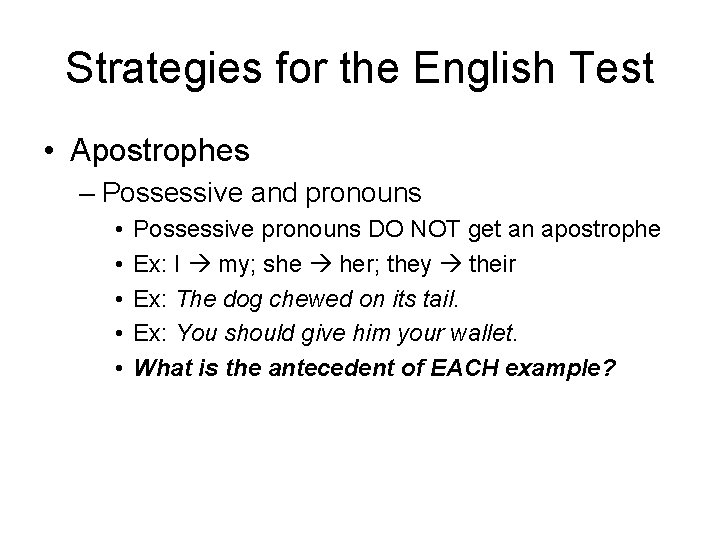
Strategies for the English Test • Apostrophes – Possessive and pronouns • • • Possessive pronouns DO NOT get an apostrophe Ex: I my; she her; they their Ex: The dog chewed on its tail. Ex: You should give him your wallet. What is the antecedent of EACH example?
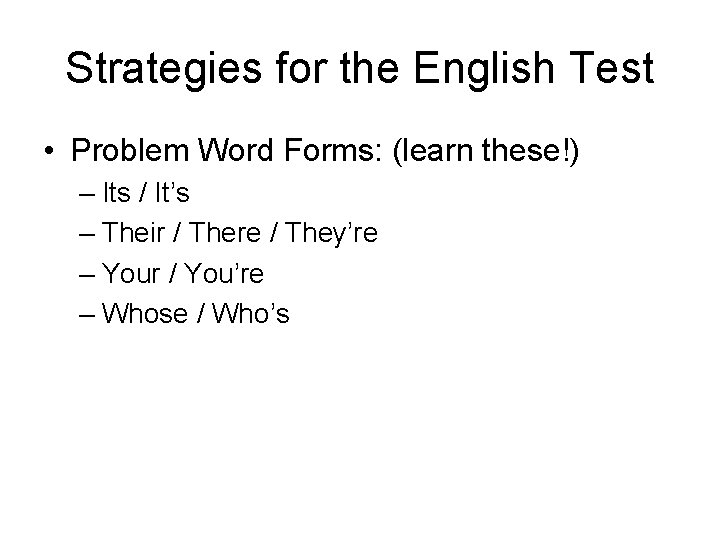
Strategies for the English Test • Problem Word Forms: (learn these!) – Its / It’s – Their / There / They’re – Your / You’re – Whose / Who’s
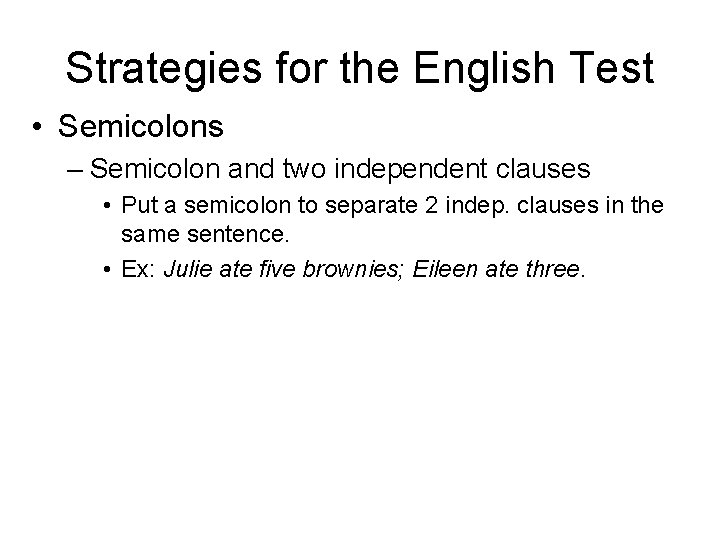
Strategies for the English Test • Semicolons – Semicolon and two independent clauses • Put a semicolon to separate 2 indep. clauses in the same sentence. • Ex: Julie ate five brownies; Eileen ate three.
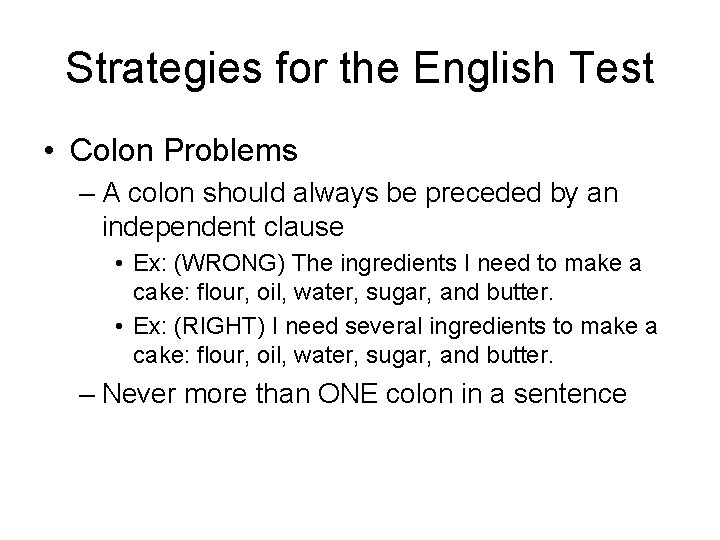
Strategies for the English Test • Colon Problems – A colon should always be preceded by an independent clause • Ex: (WRONG) The ingredients I need to make a cake: flour, oil, water, sugar, and butter. • Ex: (RIGHT) I need several ingredients to make a cake: flour, oil, water, sugar, and butter. – Never more than ONE colon in a sentence
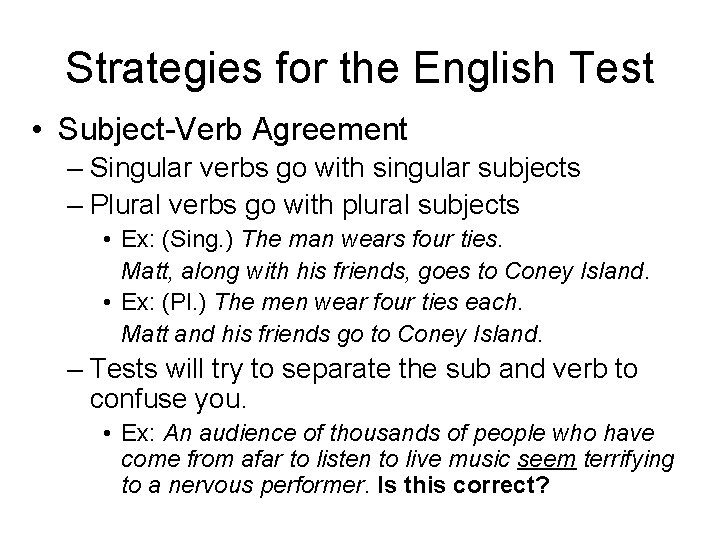
Strategies for the English Test • Subject-Verb Agreement – Singular verbs go with singular subjects – Plural verbs go with plural subjects • Ex: (Sing. ) The man wears four ties. Matt, along with his friends, goes to Coney Island. • Ex: (Pl. ) The men wear four ties each. Matt and his friends go to Coney Island. – Tests will try to separate the sub and verb to confuse you. • Ex: An audience of thousands of people who have come from afar to listen to live music seem terrifying to a nervous performer. Is this correct?
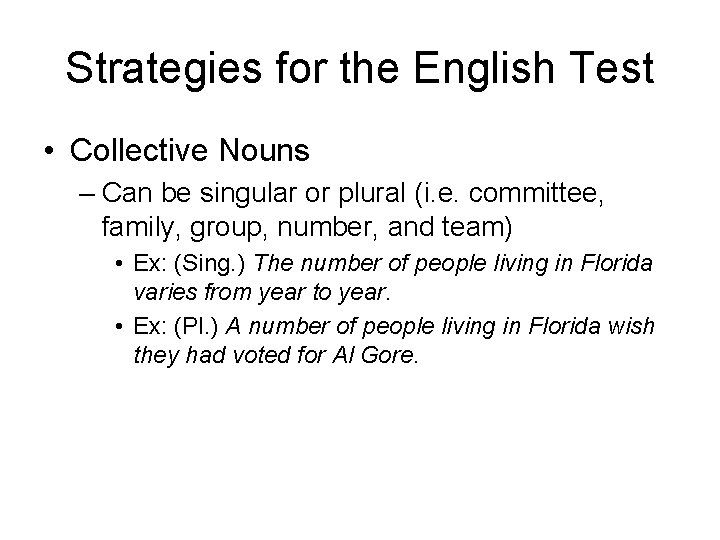
Strategies for the English Test • Collective Nouns – Can be singular or plural (i. e. committee, family, group, number, and team) • Ex: (Sing. ) The number of people living in Florida varies from year to year. • Ex: (Pl. ) A number of people living in Florida wish they had voted for Al Gore.
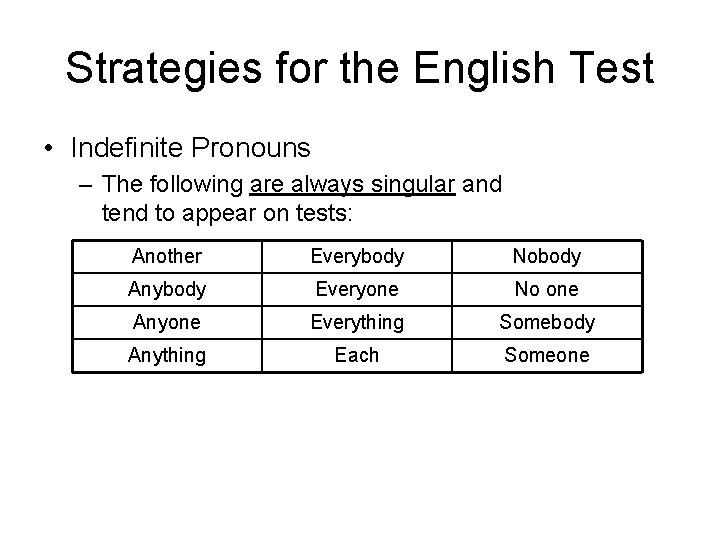
Strategies for the English Test • Indefinite Pronouns – The following are always singular and tend to appear on tests: Another Everybody Nobody Anybody Everyone No one Anyone Everything Somebody Anything Each Someone
Strategies for the English Test • Pronoun-Antecedent Agreement – Will find these errors frequently on tests – Antecedent is the word to which a later pronoun refers back to – Pronoun must agree in both gender and number with its antecedent Ex: (WRONG) Already late for the show, Mary couldn’t find their keys. Ex: (RIGHT) Already late for the show, Mary couldn’t find her keys.
Strategies for the English Test • Verb Tenses – Different Verb Tenses in One Sentence • Verb tenses must be logical if they happen at all • Ex: Next year, I was on an ocean voyage. Is this correct? – Tricky Verbs on Tests (know tenses) • Lie/Lay • Swim • Begin Break Choose Sang Drank Run Arise Blow Sit Get
Strategies for the English Test • Adverbs / Adjectives – To describe a noun = ADJECTIVE – To describe a verb, adjective, adverb = ADVERB – Ex: (WRONG) She shut him up quick (RIGHT) She shut him up quickly. Ex: (WRONG) My mom made dinner good. (RIGHT) My mom made dinner well.
Strategies for the English Test • Comparative / Superlative Modifiers – Comparative modifiers compare one thing to another – Require comparison WITH something else • Ex: My boyfriend is nicer than yours. – Superlative modifiers tell how one thing compares to everything else • Ex: My boyfriend is the nicest boy in the world.
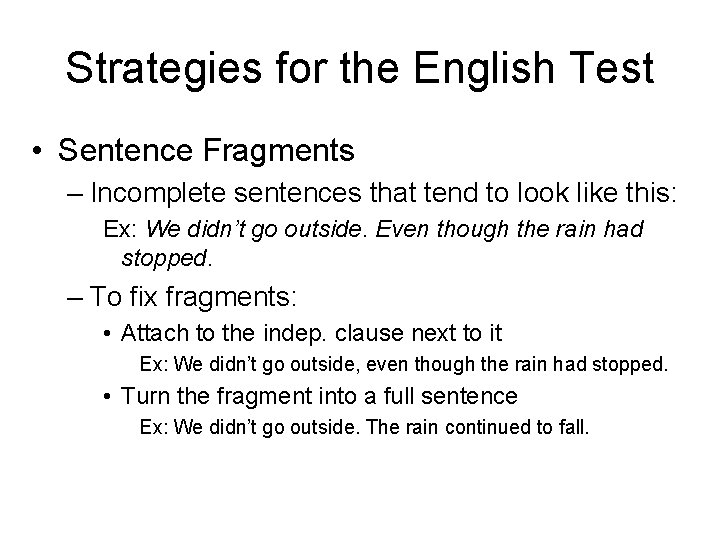
Strategies for the English Test • Sentence Fragments – Incomplete sentences that tend to look like this: Ex: We didn’t go outside. Even though the rain had stopped. – To fix fragments: • Attach to the indep. clause next to it Ex: We didn’t go outside, even though the rain had stopped. • Turn the fragment into a full sentence Ex: We didn’t go outside. The rain continued to fall.
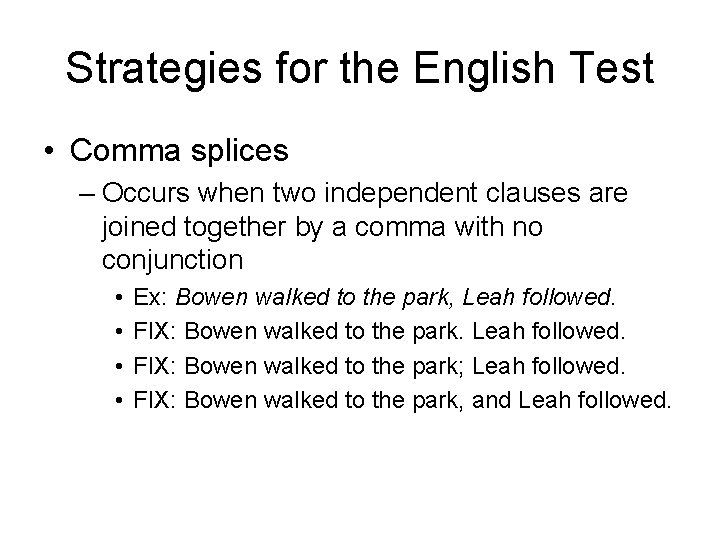
Strategies for the English Test • Comma splices – Occurs when two independent clauses are joined together by a comma with no conjunction • • Ex: Bowen walked to the park, Leah followed. FIX: Bowen walked to the park; Leah followed. FIX: Bowen walked to the park, and Leah followed.
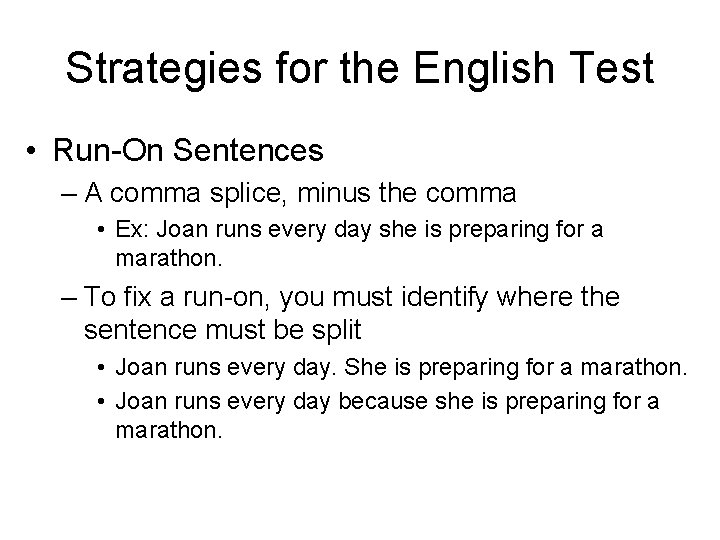
Strategies for the English Test • Run-On Sentences – A comma splice, minus the comma • Ex: Joan runs every day she is preparing for a marathon. – To fix a run-on, you must identify where the sentence must be split • Joan runs every day. She is preparing for a marathon. • Joan runs every day because she is preparing for a marathon.
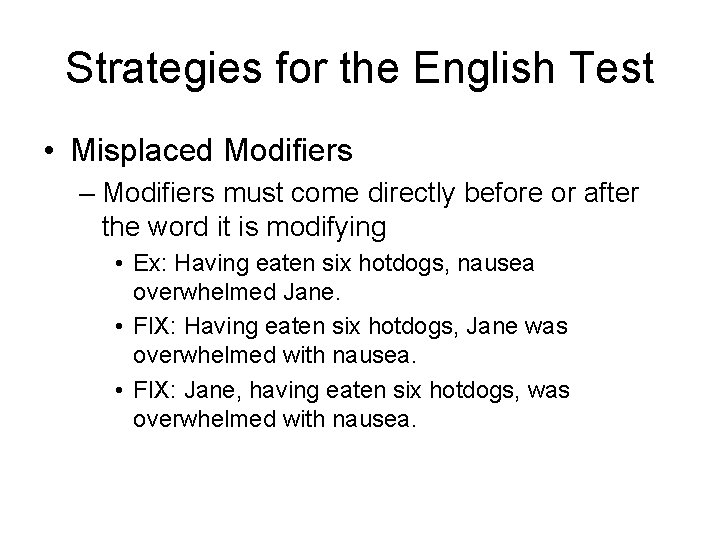
Strategies for the English Test • Misplaced Modifiers – Modifiers must come directly before or after the word it is modifying • Ex: Having eaten six hotdogs, nausea overwhelmed Jane. • FIX: Having eaten six hotdogs, Jane was overwhelmed with nausea. • FIX: Jane, having eaten six hotdogs, was overwhelmed with nausea.
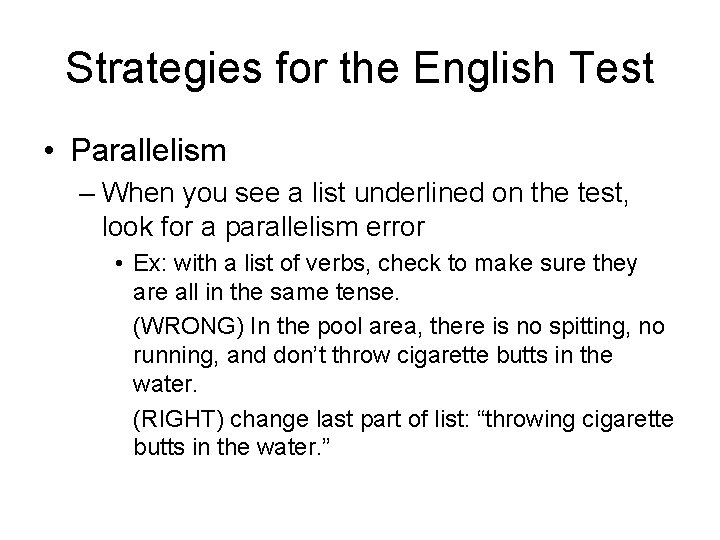
Strategies for the English Test • Parallelism – When you see a list underlined on the test, look for a parallelism error • Ex: with a list of verbs, check to make sure they are all in the same tense. (WRONG) In the pool area, there is no spitting, no running, and don’t throw cigarette butts in the water. (RIGHT) change last part of list: “throwing cigarette butts in the water. ”
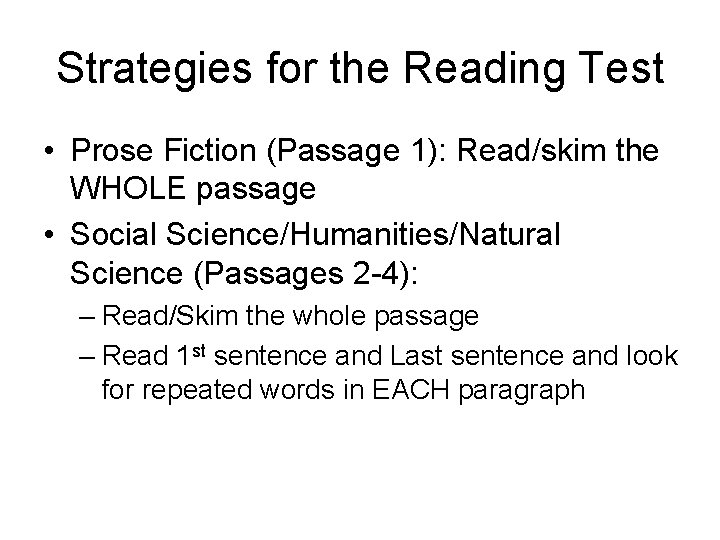
Strategies for the Reading Test • Prose Fiction (Passage 1): Read/skim the WHOLE passage • Social Science/Humanities/Natural Science (Passages 2 -4): – Read/Skim the whole passage – Read 1 st sentence and Last sentence and look for repeated words in EACH paragraph
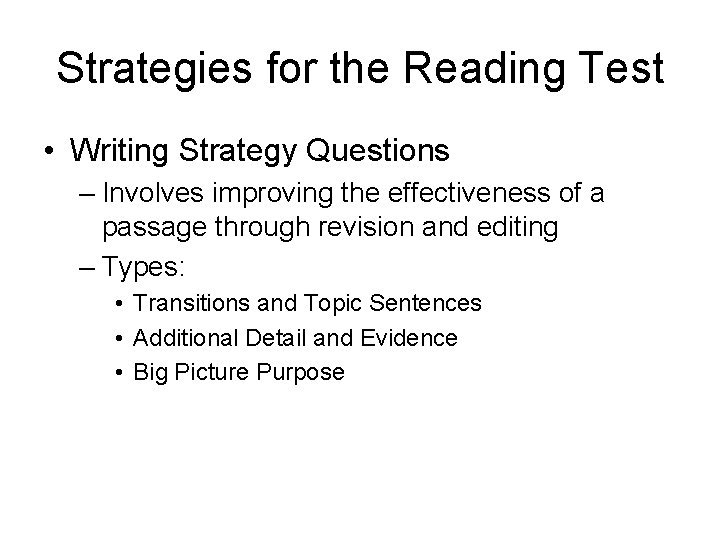
Strategies for the Reading Test • Writing Strategy Questions – Involves improving the effectiveness of a passage through revision and editing – Types: • Transitions and Topic Sentences • Additional Detail and Evidence • Big Picture Purpose
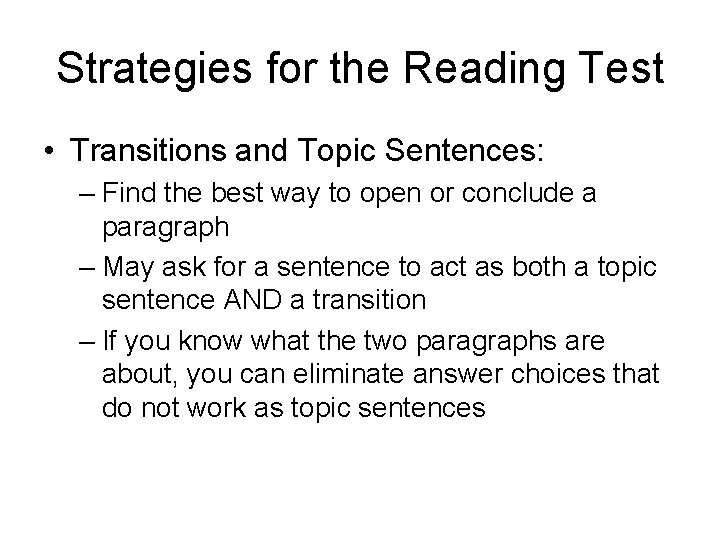
Strategies for the Reading Test • Transitions and Topic Sentences: – Find the best way to open or conclude a paragraph – May ask for a sentence to act as both a topic sentence AND a transition – If you know what the two paragraphs are about, you can eliminate answer choices that do not work as topic sentences
Strategies for the Reading Test • Additional Detail and Evidence – Choose the answer that provides the best additional detail or evidence – Usually to help support another part of the paragraph/passage – You must understand the point that is being made in the paragraph(s)/passage – Look for TRANSITIONS that work as flags: • “However” (means the information is contradictory) • “Moreover” (means the info. is in agreement)
Strategies for the Reading Test • Big Picture Purpose – These always come at the END of the passage – Ask you to identify the passage’s: • Main point • (author’s) Intended purpose • Intended audience – Test comprehension of the passage
Strategies for the Reading Test • Big Picture Purpose (con’t) – The answer choices come in two parts • Part 1: Yes/No • Part 2: Give an explanation for the answer
Strategies for the Reading Test • Organization – Deal with the logical structuring of the passage on the level of the sentence, paragraph, or passage as a whole – 3 Types of questions: • Sentence Reorganization • Paragraph Reorganization • Passage Reorganization
Strategies for the Reading Test • Sentence Reorganization – Often involve the placement of a modifier – Half of the organization questions on the English Test will ask you to reorder the sentences. –Study MODIFIERS!
Strategies for the Reading Test • Paragraph Reorganization – Reorder sentences WITHIN a paragraph – Best Approach: decide which sentence should come first and then eliminate possible answer choices – Always look for the topic sentence of the paragraph!
Strategies for the Reading Test • Passage Reorganization – Appear at the end of the passage – You will either have to: • Insert a sentence where it would best belong • Move a paragraph to a new location – These are strategy questions • If asks for a sentence to be placed at the start of the para. then it is supposed to be a TOPIC sent. • Placed at the end? Concluding/clincher sentence. – Remember the LOGICAL order of an essay
Strategies for the Reading Test • Redundancy – Ability to spot redundant (repeated) phrases – They say the same thing twice = NO GOOD! – These questions will almost always give the option to OMIT. Redundant = OMIT!
Strategies for the Reading Test • Appropriate Word Choice and Identifying Tone – Word choice: pick the right one (there/their/they’re) – Content gives clues to tone – History/Culture: formal style (omit slang, contractions, personal pronouns) – Personal Essay: less formal style