
Standardization Internationalization Programming Language Design and Implementation 4
- Slides: 13
Standardization, Internationalization Programming Language Design and Implementation (4 th Edition) by T. Pratt and M. Zelkowitz Prentice Hall, 2001 Section 1. 3. 3 -1. 3. 4
Who defines a language? § Is: I = 1 && 2 + 3 | 4; legal in C? What is assigned to I if it is? § § 3 ways typically to answer this: 1. Read language manual (Problem: Can you find one? ) 부정확 2. Read language standard (Problem: Have you ever seen it? ) BNF, Vienna definition language, 3. Write a program to see what happens. (Easy to do!) C의 표준은 CC (UNIX) § § § Most do 3, but current compilers may not give correct answer 2
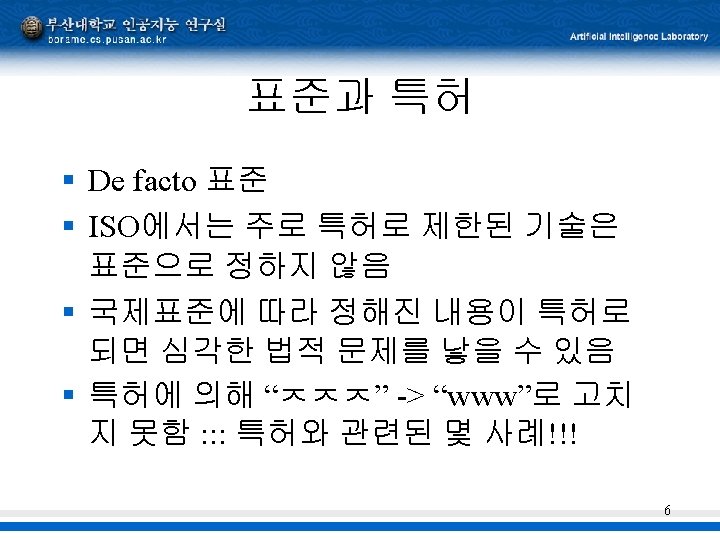
Creation of standards § § § Language standards defined by national standards bodies: ISO - International Standards organization IEEE - Institute of Electrical and Electronics Engineers ANSI - American National Standards Institute code, 언어, 통신규약, XML, 전자책, … WWW Consortium, EPC Global, … § SMTP(7 bits) MIME(8 bits) : Plain text, 음성, 영상, . . § § § All work in a similar way: 1. Working group of volunteers set up to define standard 2. Agree on features for new standard 3. Vote on standard 4. If approved by working group, submitted to parent organization for approval. 3
Creation of standards § Standards in the US are voluntary: § § There is no federal standards-making organization. NIST - National Institute for Standards and Technology develops standards that are only required on federal agencies, not for commercial organizations. § But: Consensus is the key to standards making: § § § Contentious features often omitted to gain consensus Only vendors have a vested interest in the results Users don't care until standard approved, and then it is too late! 한국 : : : 표준연구소, 산업자원부, 정보통신부, 과학기술처 § 4
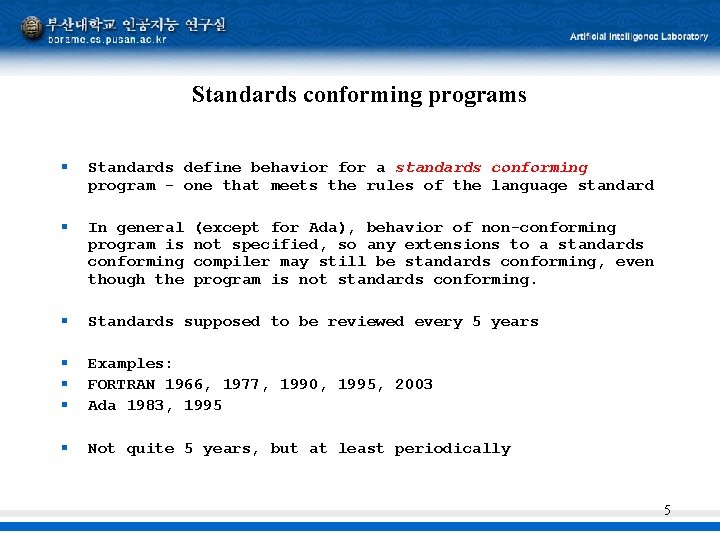
Standards conforming programs § Standards define behavior for a standards conforming program - one that meets the rules of the language standard § In general program is conforming though the § Standards supposed to be reviewed every 5 years § § § Examples: FORTRAN 1966, 1977, 1990, 1995, 2003 Ada 1983, 1995 § Not quite 5 years, but at least periodically (except for Ada), behavior of non-conforming not specified, so any extensions to a standards compiler may still be standards conforming, even program is not standards conforming. 5
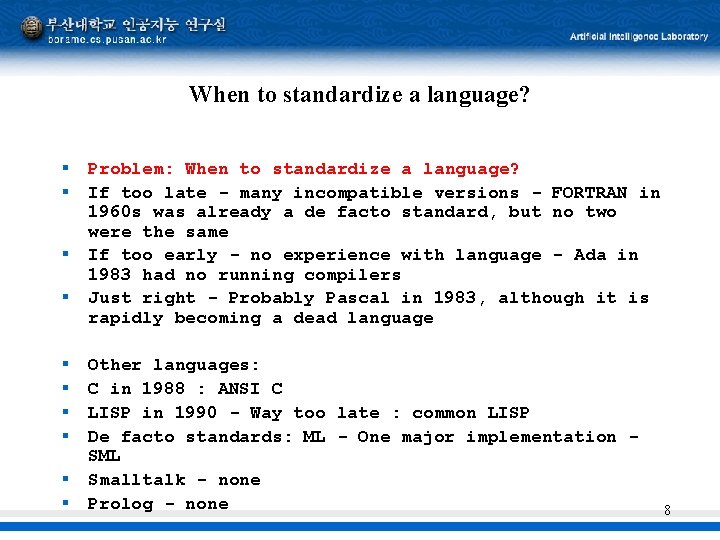
When to standardize a language? § § § § § Problem: When to standardize a language? If too late - many incompatible versions - FORTRAN in 1960 s was already a de facto standard, but no two were the same If too early - no experience with language - Ada in 1983 had no running compilers Just right - Probably Pascal in 1983, although it is rapidly becoming a dead language Other languages: C in 1988 : ANSI C LISP in 1990 - Way too late : common LISP De facto standards: ML - One major implementation SML Smalltalk - none Prolog - none 8
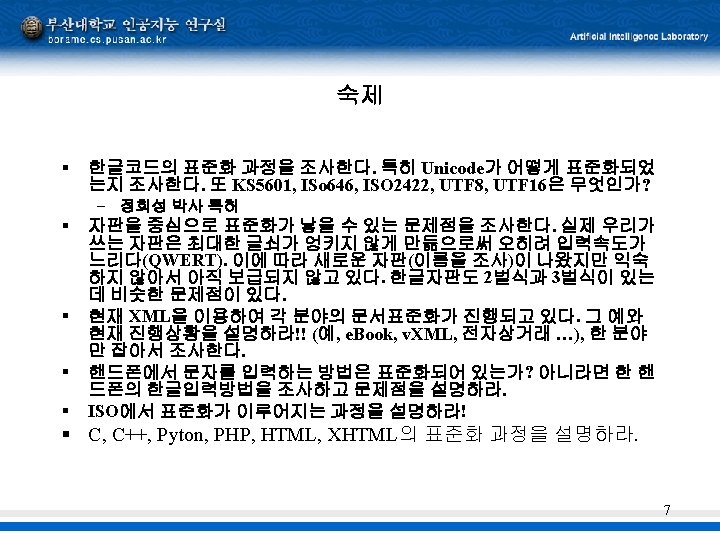
Internationalization § I 18 N issue - Internationalization - How to specify languages useful in a global economy? § § Characters used internationally: Single 8 -bit byte; usual format today - 256 character values. A lot in 1963, but insufficient today ASCII is a 7 bit 128 character code § § § What about other languages? Additional letters: German umlaut-ä, French accent-é, Scandanavian symbols-ö, Russian, other alphabets (Greek, Arabic, Hebrew), ideographs (Chinese), 한글 Unicode - 16 bit code allows for 65 K symbols. 8 -bit byte is insufficient 9
Internationalization (continued) § I 18 N name avoids deciding between internationalization and localization § § § Some of the internationalization issues: What character codes to use? Collating sequences? - How do you alphabetize various languages? Dates? - What date is 10/12/01? Is it a date in October or December? Time? - How do you handle time zones, summer time in Europe, daylight savings time in US, Southern hemisphere is 6 months out of phase with northern hemisphere, Date to change from summer to standard time is not consistent. Currency? - How to handle dollars, pounds, marks, francs, euros, 원, etc. XML에서는 dublin core를 사용 § § 10
Summary § Language design today must: § § § Allow program solution to match physical structure of problem Allow for world-wide use Be easy to prove solution correct § Rest of course will work on these goals 11
Programming Environment § § The environments in which programs are created and tested Separate compilation – Co-development of any large program – Function prototypes, external variables(COMMON, extern), naming convention(_…), Scope rule (Pascal, C, Ada), inheritance (Ada, C++), polymorphism, overloaded (Ada) – Stub : a subprogram call made to a subprogram that has not yet been compiled – To provide information for separate compilation • FOTRAN : COMMON <- redeclaration • Compile 순서 관리 <- Ada. • A library containing specifications – Consistency of the external data or subprograms • Linking? 12
Programming Environment (cont. ) § § Testing and debugging – Execution trace features (LISP, Prolog, … debugger) • Statements, variables – Breakpoints – Assertions • Assert(X>0) C % Exception handling 13