
Standardization in Ecology Enacting the Ecological Metadata Language
- Slides: 20
Standardization in Ecology: Enacting the Ecological Metadata Language Florence Millerand Post-doctoral Fellow Laboratory of Comparative Human Cognition / Scripps Institution of Oceanographyphy University of California, San Diego Presented at UCSD Science Studies Program Colloquium Series, January 30, 2006 San Diego, CA
Comparative Interoperability project NSF/Human and Social dynamics (2004 -2007) interoperability. ucsd. edu Geoffrey C. Bowker Center for Science, Technology & Society Santa Clara University Karen S. Baker Scripps Institution of Oceanography University of California, San Diego Florence Millerand LCHC/Scripps Institution of Oceanography University of California, San Diego David Ribes Sociology/Science Studies University of California, San Diego SSHRC CRSH
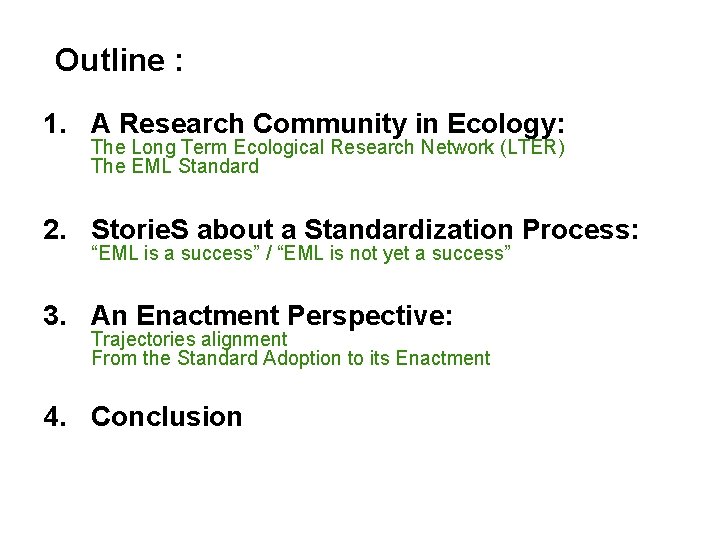
Outline : 1. A Research Community in Ecology: The Long Term Ecological Research Network (LTER) The EML Standard 2. Storie. S about a Standardization Process: “EML is a success” / “EML is not yet a success” 3. An Enactment Perspective: Trajectories alignment From the Standard Adoption to its Enactment 4. Conclusion
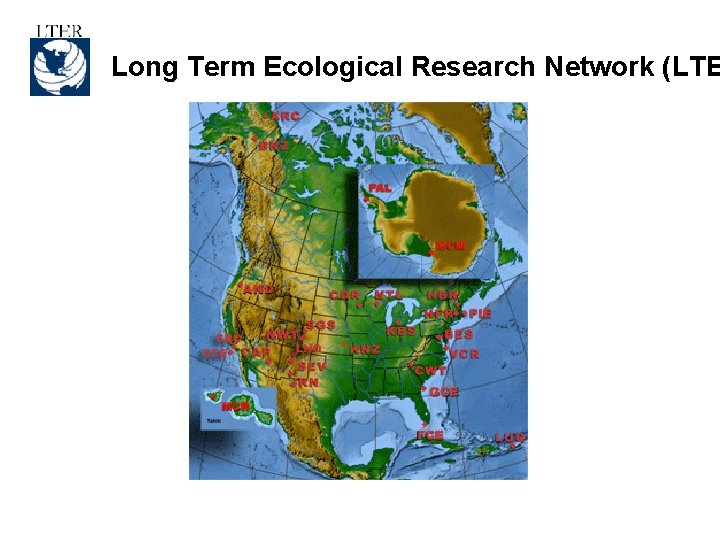
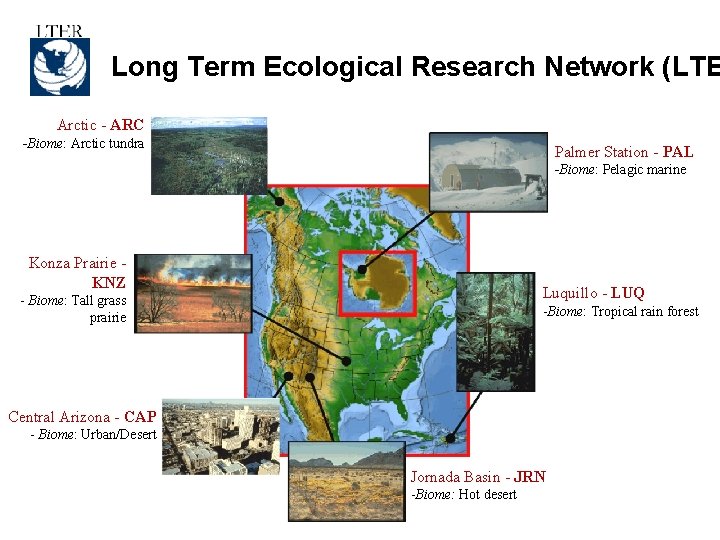
Long Term Ecological Research Network (LTE
Long Term Ecological Research Network (LTE Arctic - ARC -Biome: Arctic tundra Palmer Station - PAL -Biome: Pelagic marine Konza Prairie KNZ Luquillo - LUQ - Biome: Tall grass prairie -Biome: Tropical rain forest Central Arizona - CAP - Biome: Urban/Desert Jornada Basin - JRN -Biome: Hot desert
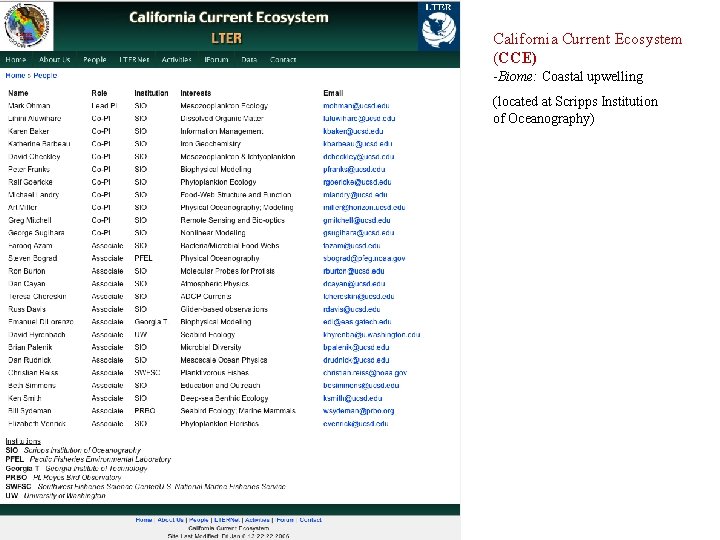
California Current Ecosystem (CCE) -Biome: Coastal upwelling (located at Scripps Institution of Oceanography)
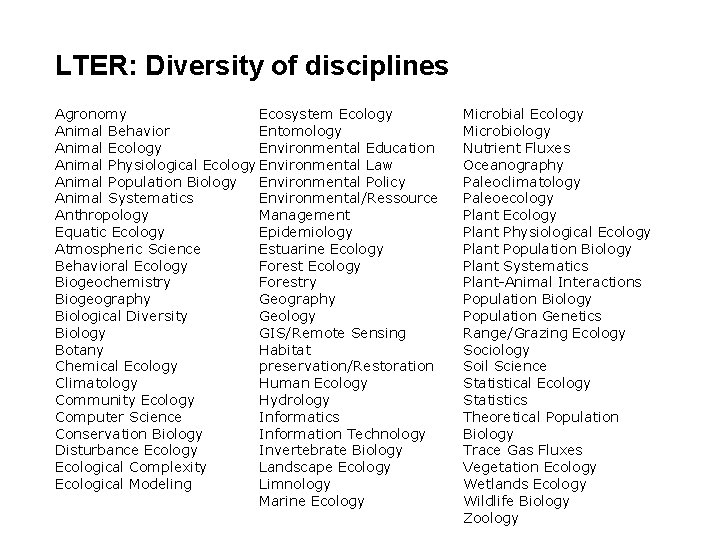
LTER: Diversity of disciplines Agronomy Ecosystem Ecology Animal Behavior Entomology Animal Ecology Environmental Education Animal Physiological Ecology Environmental Law Animal Population Biology Environmental Policy Animal Systematics Environmental/Ressource Anthropology Management Equatic Ecology Epidemiology Atmospheric Science Estuarine Ecology Behavioral Ecology Forest Ecology Biogeochemistry Forestry Biogeography Geography Biological Diversity Geology Biology GIS/Remote Sensing Botany Habitat Chemical Ecology preservation/Restoration Climatology Human Ecology Community Ecology Hydrology Computer Science Informatics Conservation Biology Information Technology Disturbance Ecology Invertebrate Biology Ecological Complexity Landscape Ecology Ecological Modeling Limnology Marine Ecology Microbial Ecology Microbiology Nutrient Fluxes Oceanography Paleoclimatology Paleoecology Plant Ecology Plant Physiological Ecology Plant Population Biology Plant Systematics Plant-Animal Interactions Population Biology Population Genetics Range/Grazing Ecology Sociology Soil Science Statistical Ecology Statistics Theoretical Population Biology Trace Gas Fluxes Vegetation Ecology Wetlands Ecology Wildlife Biology Zoology
Mission of the Long Term Ecological Research Network • Understanding general ecological phenomena that occur over long temporal and broad spatial scales • Conducting major synthesis and theoretical efforts • Providing information for the identification and solution of societal problems • Creating a legacy of well-designed and documented long-term experiments and observations for use by future generations
Mission of the Long Term Ecological Research Network • Understanding general ecological phenomena that occur over long temporal and broad spatial scales • Conducting major synthesis and theoretical efforts • Providing information for the identification and solution of societal problems • Creating a legacy of well-designed and documented long-term experiments and observations for use by future generations
LTER research covers time scales from months to centuries
Research over broad spatial scales – Comparisons between ecosystems across regional, continental, and global gradients CONTINENT LTER
Mission of the Long Term Ecological Research Network • Understanding general ecological phenomena that occur over long temporal and broad spatial scales • Conducting major synthesis and theoretical efforts • Providing information for the identification and solution of societal problems • Creating a legacy of well-designed and documented long-term experiments and observations for use by future generations
Mission of the Long Term Ecological Research Network • Understanding general ecological phenomena that occur over long temporal and broad spatial scales • Conducting major synthesis and theoretical efforts • Providing information for the identification and solution of societal problems • Creating a legacy of well-designed and documented long-term Data experiments and observations for use by future generations Managemen t
LTER Science Trajectory
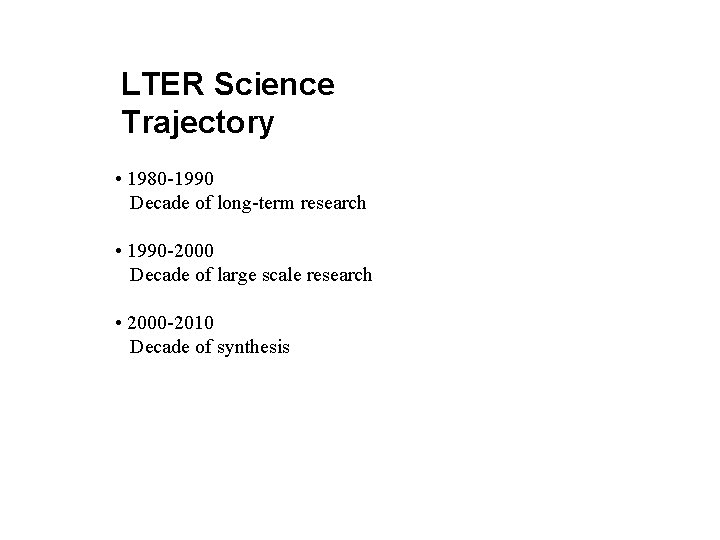
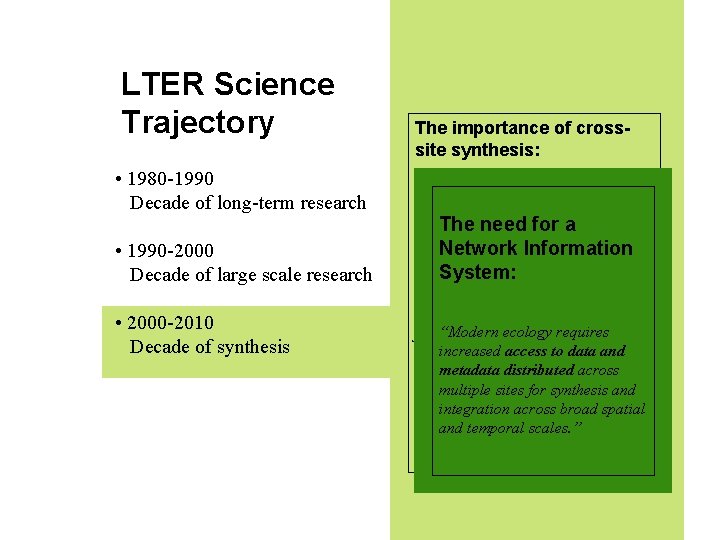
LTER Science Trajectory • 1980 -1990 Decade of long-term research • 1990 -2000 Decade of large scale research • 2000 -2010 Decade of synthesis
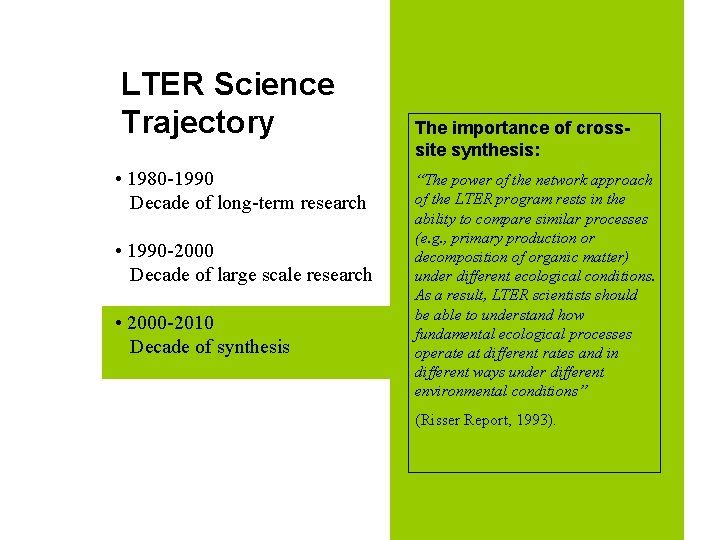
LTER Science Trajectory • 1980 -1990 Decade of long-term research • 1990 -2000 Decade of large scale research • 2000 -2010 Decade of synthesis The importance of crosssite synthesis: “The power of the network approach of the LTER program rests in the ability to compare similar processes (e. g. , primary production or decomposition of organic matter) under different ecological conditions. As a result, LTER scientists should be able to understand how fundamental ecological processes operate at different rates and in different ways under different environmental conditions” (Risser Report, 1993).
LTER Science Trajectory • 1980 -1990 Decade of long-term research • 1990 -2000 Decade of large scale research • 2000 -2010 Decade of synthesis The importance of crosssite synthesis: “The power of the network approach of the LTER program rests in the ability to compare similar The need for a processes (e. g. , primary production or Networkof. Information decomposition organic matter) System: under different ecological conditions. As a result, LTER scientists should be able to understand how “Modernecological ecology requires fundamental processes increased accessrates to data operate at different andand in metadata across different waysdistributed under different multiple sites for synthesis and environmental conditions” integration across broad spatial (Risser 1993). and Report, temporal scales. ”
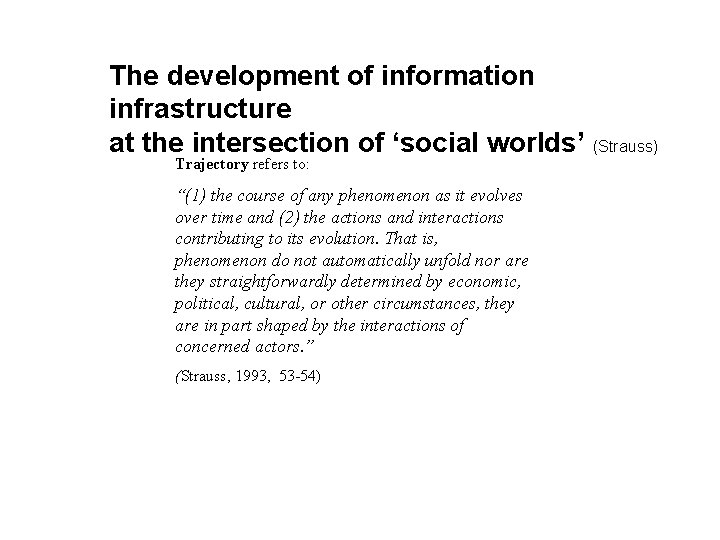
The development of information infrastructure at the intersection of ‘social worlds’ (Strauss) Trajectory refers to: “(1) the course of any phenomenon as it evolves over time and (2) the actions and interactions contributing to its evolution. That is, phenomenon do not automatically unfold nor are they straightforwardly determined by economic, political, cultural, or other circumstances, they are in part shaped by the interactions of concerned actors. ” (Strauss, 1993, 53 -54)
When implementing EML means more than doing ‘implementation’ work T N ME From EML adoption to its implementation T AC N E
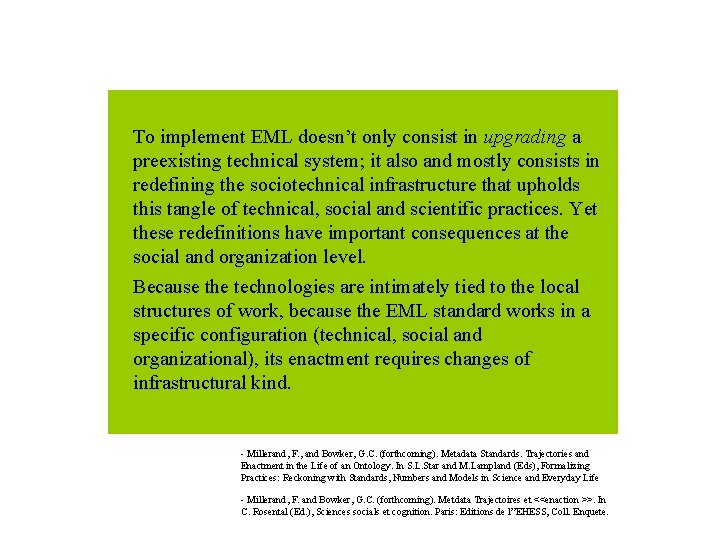
To implement EML doesn’t only consist in upgrading a preexisting technical system; it also and mostly consists in redefining the sociotechnical infrastructure that upholds this tangle of technical, social and scientific practices. Yet these redefinitions have important consequences at the social and organization level. Because the technologies are intimately tied to the local structures of work, because the EML standard works in a specific configuration (technical, social and organizational), its enactment requires changes of infrastructural kind. - Millerand, F. , and Bowker, G. C. (forthcoming). Metadata Standards. Trajectories and Enactment in the Life of an Ontology. In S. L. Star and M. Lampland (Eds), Formalizing Practices: Reckoning with Standards, Numbers and Models in Science and Everyday Life - Millerand, F. and Bowker, G. C. (forthcoming). Metdata Trajectoires et <<enaction >>. In C. Rosental (Ed. ), Sciences socials et cognition. Paris: Editions de l”EHESS, Coll. Enquete.