
Standardization and Interoperability in healthcare IT Export HIS
Standardization and Interoperability in healthcare IT Export HIS Shanghai & Guangzhou seminars Juha Mykkänen Health Information Systems R & D Unit University of Kuopio, Finland juha. mykkanen@uku. fi
In this presentation • Background • Application interoperability – what needs to be solved • Integration: how to create interoperability solutions in health information systems • View on health information systems standardization • International IS standardization Standardization and Interoperability in healthcare IT Mykkänen 2
Background of the presentation • Application integration – – Plug. IT project: see Dr. Korpela’s presentation Healthcare application integration 2001 2004 15 software companies, 6 hospital districts, 2 municipalities Experiences from 9 integration teams with 13 integration domains in Plug. IT – In this presentation: methods, using which the results were accomplished – Ser. API project: continues integration and standarization with Service architecture and Web service technologies • Health Information Systems standardization – national study in Finland: goals, target domains, organization and further actions to improve standardization Standardization and Interoperability in healthcare IT Mykkänen 3
Integration Challenges in Health Information Systems • • • e. g. Kuopio University Hospital has ~180 information systems point to point integration solutions, expensive tailoring, an obstacle for acquisition in health care organizations integration problems one of the top priorities for software companies (survey in 2001) simultaneous use of several applications by health professionals to provide care for a single patient (especially in hospitals) heterogeneity – legacy systems: even >10 years of use – applications implemented using several different technologies and platforms – standardized processes or workflows on few areas, local requirements • several different types of healthcare specific standards by various standardization bodies Standardization and Interoperability in healthcare IT Mykkänen 4

What is computer interoperability? • Although an intuitive answer is easy, a specific response is more complex • Institute of Electrical and Electronics Engineers (IEEE) dictionary: "The ability of two or more systems or components to exchange information and to use the information that has been exchanged. ” Semantic interoperability Functional interoperability [IEEE Standard Computer Dictionary: A Compilation of IEEE Standard Computer Glossaries, IEEE, 1990] [Niilo Saranummi, 9 Jan 2002] Standardization and Interoperability in healthcare IT Mykkänen 5
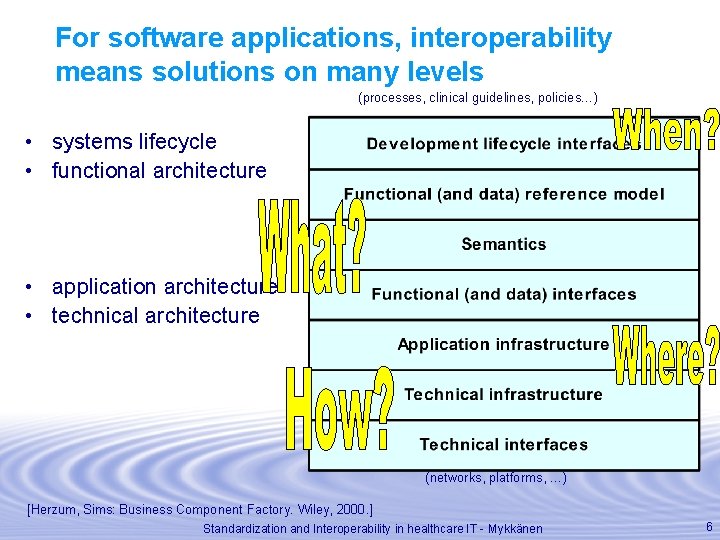
For software applications, interoperability means solutions on many levels (processes, clinical guidelines, policies…) • systems lifecycle • functional architecture • application architecture • technical architecture (networks, platforms, …) [Herzum, Sims: Business Component Factory. Wiley, 2000. ] Standardization and Interoperability in healthcare IT Mykkänen 6
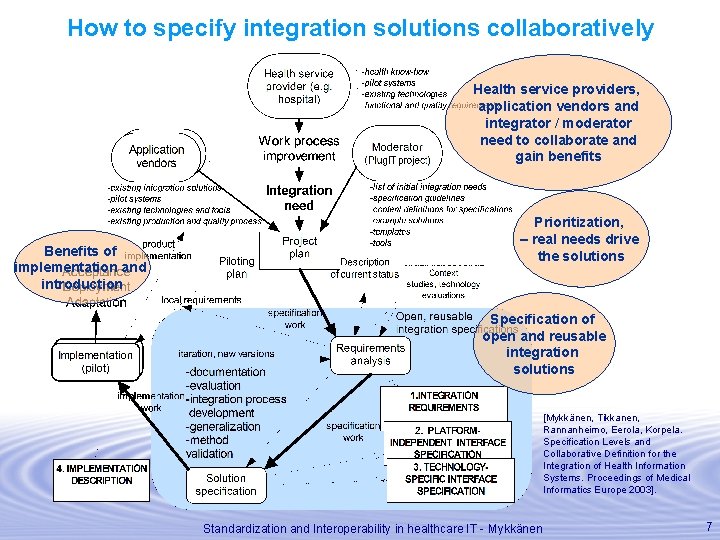
How to specify integration solutions collaboratively Health service providers, application vendors and integrator / moderator need to collaborate and gain benefits Benefits of implementation and introduction Prioritization, – real needs drive the solutions Specification of open and reusable integration solutions [Mykkänen, Tikkanen, Rannanheimo, Eerola, Korpela. Specification Levels and Collaborative Definition for the Integration of Health Information Systems. Proceedings of Medical Informatics Europe 2003]. Standardization and Interoperability in healthcare IT Mykkänen 7
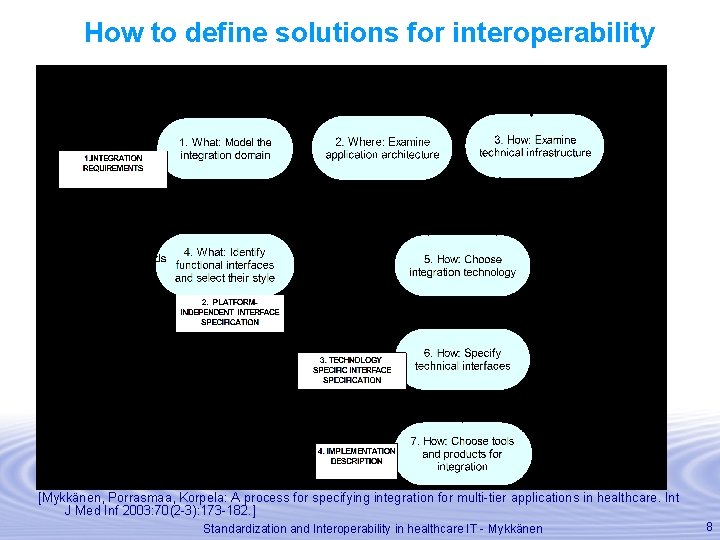
How to define solutions for interoperability [Mykkänen, Porrasmaa, Korpela: A process for specifying integration for multi tier applications in healthcare. Int J Med Inf 2003: 70(2 3): 173 182. ] Standardization and Interoperability in healthcare IT Mykkänen 8
Standardization of health information systems • Aims of standardization – uniformity, compatibility, objectivity, justice, hegemony • Target areas – healthcare information, processes and knowledge – healthcare IT solutions (messages, interfaces, security solutions, architecture, support for information and processes) • Standard families (e. g. ) – HL 7 Standards (messaging, version 3, clinical documents, clinical context integration, knowledge presentation) – CEN and national standards (national healthcare records, contents, guidelines, security, architecture) – move towards official ISO standards Standardization and Interoperability in healthcare IT Mykkänen 9
Current status and lessons from standardization in Finland • Current emphasis on electronic patient records with support for semantic interoperability – content, structure, codification • Other current standardization areas – usability (e. g. context management) – common services (service interfaces, service architecture) – security • Localization needed in content and coding • Each new messaging standard has been ”more strict” than the previous one Standardization and Interoperability in healthcare IT Mykkänen 10
To make standardization work • We need to carefully evaluate and select existing standards – and support their implementation in local practices • Make use of domain independent reference standards and common technology standards – e. g. XML based, security, framework and semantic standards • Specify ownership for standardization – and different standardization areas • Collaborate on inter professional and international levels – and assure quality and adequate participation of experts on different disciplines Standardization and Interoperability in healthcare IT Mykkänen 11
Thank you www. centek. fi/serapi www. plugit. fi www. uku. fi/tike/his/english Questions and further discussions welcome • • Tekes grant no. 40437/04 (Ser. API, 2004 2005): www. centek. fi/serapi National Technology Agency Tekes grants no. 40664/01, 40246/02 and 90/03 (Plug. IT, 2001 2004): www. plugit. fi Juha. Mykkanen@uku. fi Standardization and Interoperability in healthcare IT Mykkänen 12
- Slides: 12