
Standard Written Chinese From Classical Chinese to Modern
- Slides: 17
Standard Written Chinese: From Classical Chinese 文言 to Modern Chinese 白話 CHIN 342/442 Autumn 2019
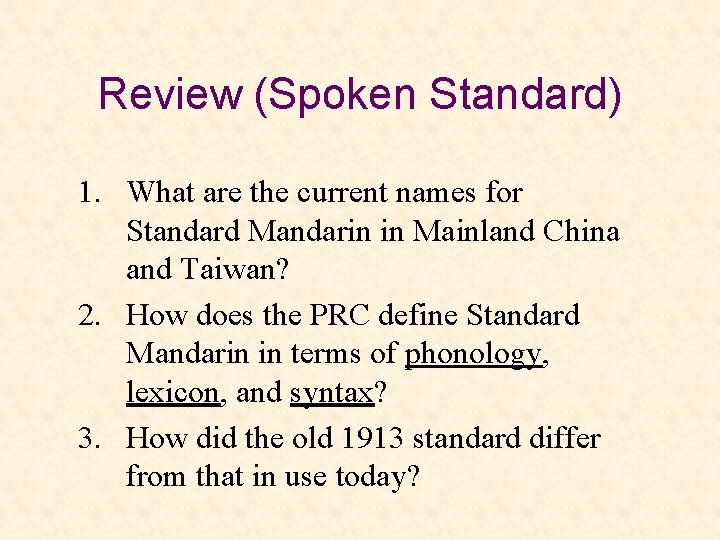
Review (Spoken Standard) 1. What are the current names for Standard Mandarin in Mainland China and Taiwan? 2. How does the PRC define Standard Mandarin in terms of phonology, lexicon, and syntax? 3. How did the old 1913 standard differ from that in use today?
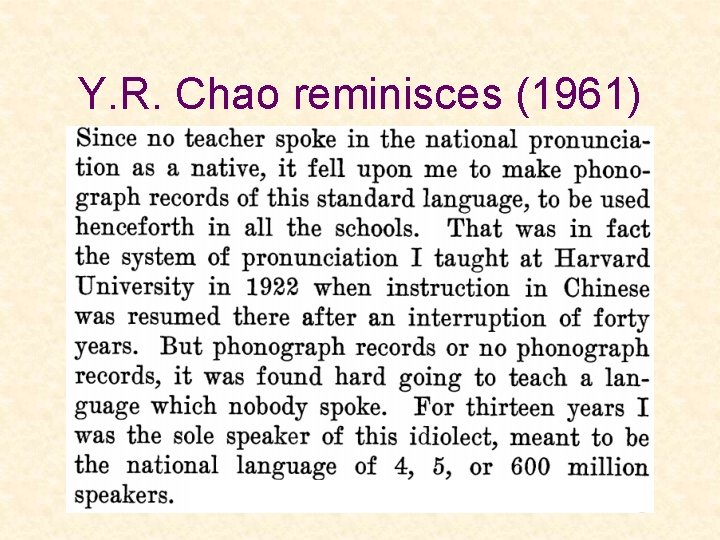
Y. R. Chao reminisces (1961)
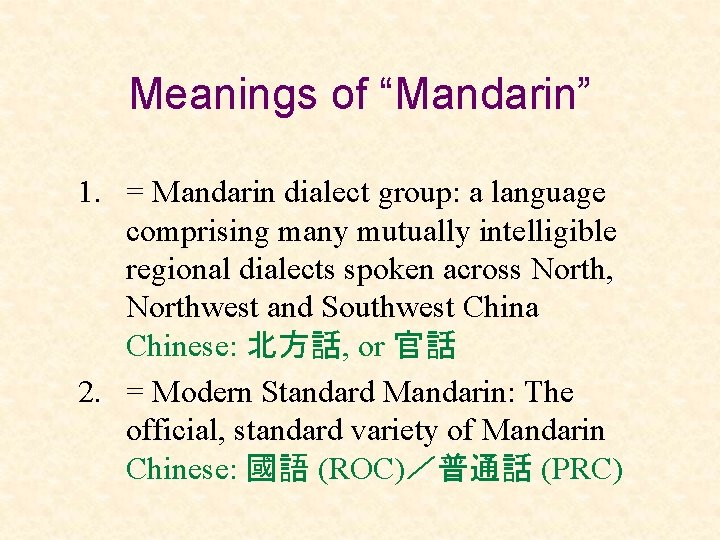
Meanings of “Mandarin” 1. = Mandarin dialect group: a language comprising many mutually intelligible regional dialects spoken across North, Northwest and Southwest China Chinese: 北方話, or 官話 2. = Modern Standard Mandarin: The official, standard variety of Mandarin Chinese: 國語 (ROC)/普通話 (PRC)
Meanings of “Mandarin” 3. = Míng-Qīng Guānhuà: The unofficial, heterogeneous common speech of elites in the late imperial period Chinese: 明清官話 4. [non-linguistic meanings: ] high government official in imperial China; any member of an elite body; a type of citrus fruit (júzi 橘子); etc.
Spoken vs. Written Language • Spoken language is primary; written language is secondary and dependent • Today’s Standard Written Chinese is based on Spoken Standard Mandarin • 她�在在哪儿 can represent only the Mandarin sentence tā xiànzài nǎr, not Cantonese kéuih yìhga hái bindouh a or Taiwanese i tsit-má tī tó-uī.
Classical Chinese (文言文) • A written language based on spoken norms of 3 rd century BCE Old Chinese, widely used until early 20 th century • Remained “frozen” while Old Chinese slowly changed into modern Chinese langs. • Grammar, vocabulary are as different from modern Chinese as Latin is from Spanish • No fixed pronunciation
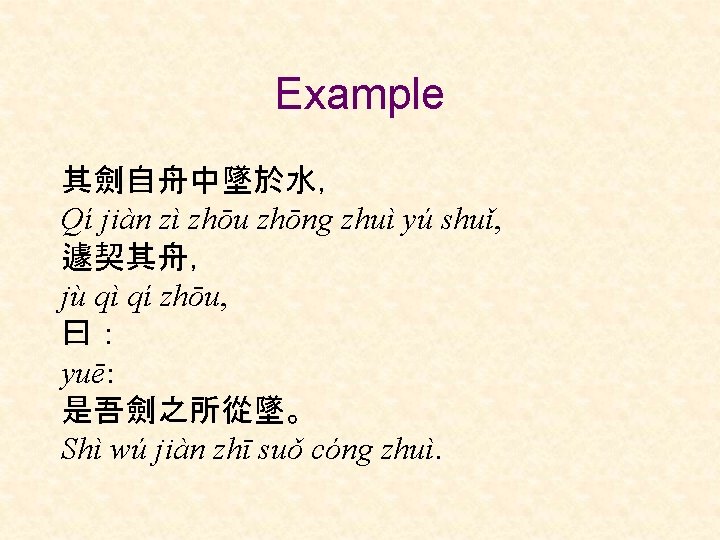
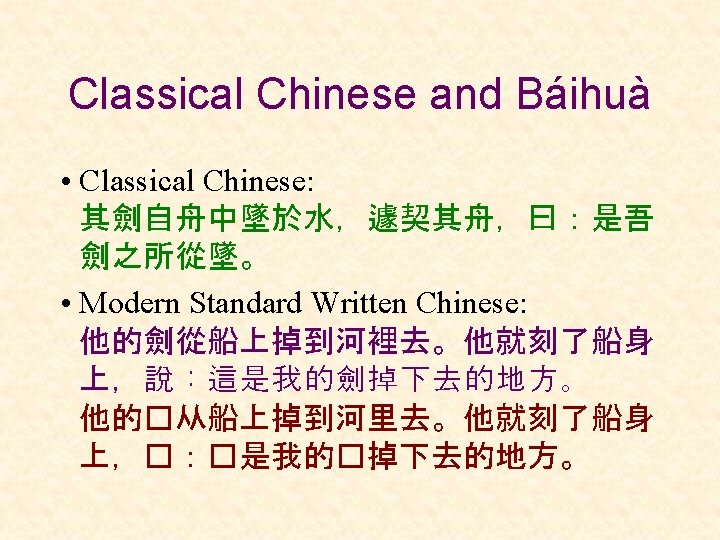
Example Passage • Lǚ Shì Chūnqiū 呂氏春秋 (239 BCE): [A man from the State of Chǔ was crossing a river]. His sword fell into the water from the boat. He quickly carved a notch in the boat, saying: “This is the place from which my sword fell. ” [When the boat stopped, he looked for his sword in the water at the notch he had made in the boat. ]
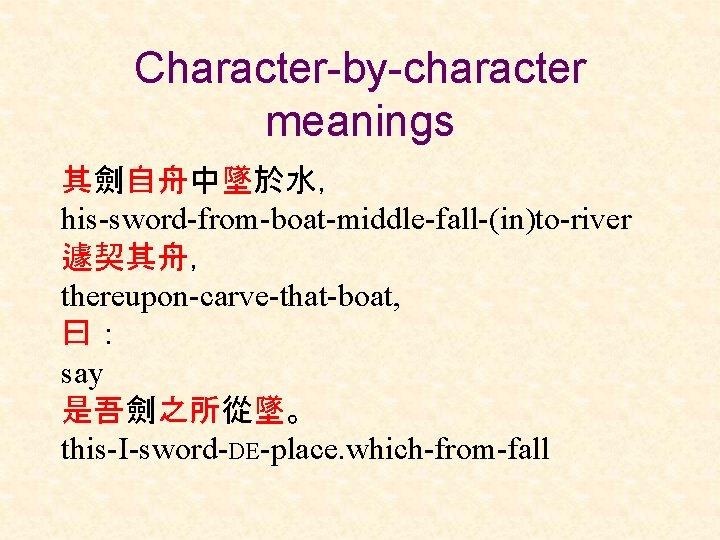
Character-by-character meanings 其劍自舟中墜於水, his-sword-from-boat-middle-fall-(in)to-river 遽契其舟, thereupon-carve-that-boat, 曰: say 是吾劍之所從墜。 this-I-sword-DE-place. which-from-fall
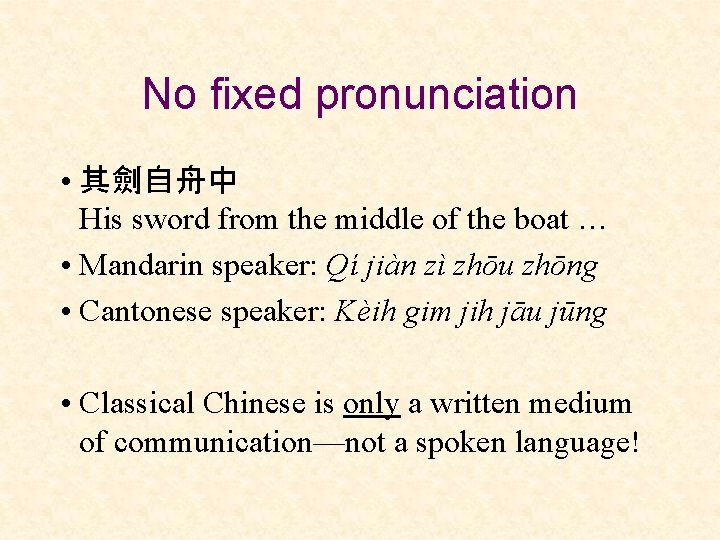
No fixed pronunciation • 其劍自舟中 His sword from the middle of the boat … • Mandarin speaker: Qí jiàn zì zhōu zhōng • Cantonese speaker: Kèih gim jih jāu jūng • Classical Chinese is only a written medium of communication—not a spoken language!
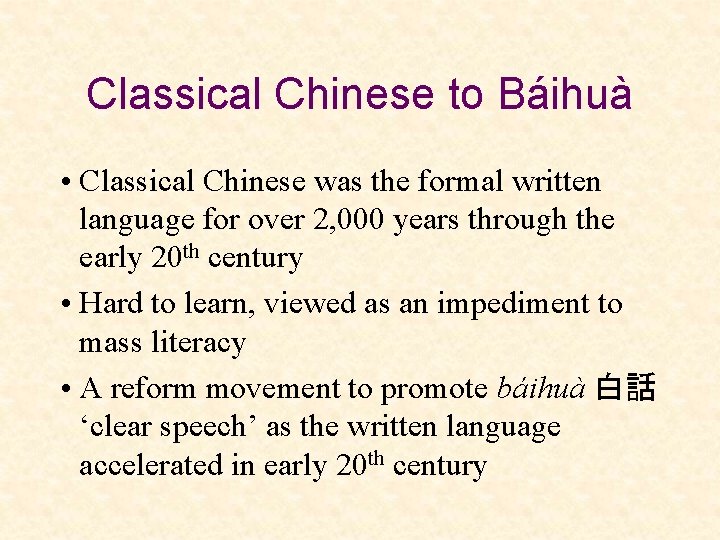
Classical Chinese to Báihuà • Classical Chinese was the formal written language for over 2, 000 years through the early 20 th century • Hard to learn, viewed as an impediment to mass literacy • A reform movement to promote báihuà 白話 ‘clear speech’ as the written language accelerated in early 20 th century
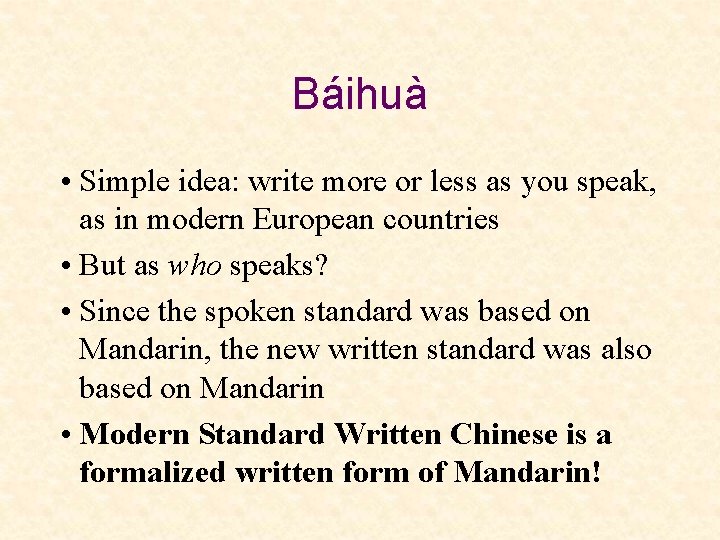
Báihuà • Simple idea: write more or less as you speak, as in modern European countries • But as who speaks? • Since the spoken standard was based on Mandarin, the new written standard was also based on Mandarin • Modern Standard Written Chinese is a formalized written form of Mandarin!
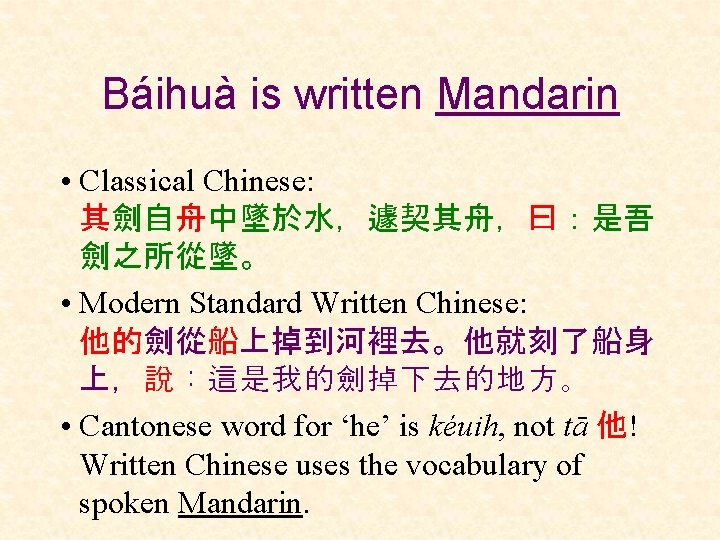
Báihuà is written Mandarin • Classical Chinese: 其劍自舟中墜於水,遽契其舟,曰:是吾 劍之所從墜。 • Modern Standard Written Chinese: 他的劍從船上掉到河裡去。他就刻了船身 上,說:這是我的劍掉下去的地方。 • Cantonese word for ‘he’ is kéuih, not tā 他! Written Chinese uses the vocabulary of spoken Mandarin.
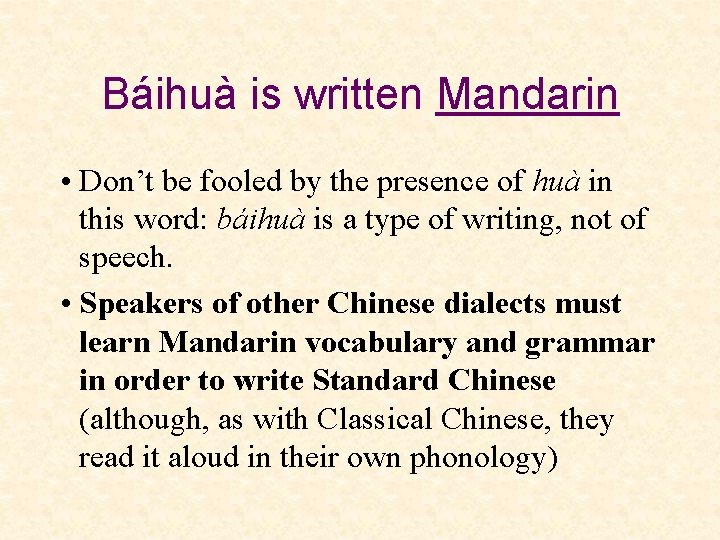
Báihuà is written Mandarin • Don’t be fooled by the presence of huà in this word: báihuà is a type of writing, not of speech. • Speakers of other Chinese dialects must learn Mandarin vocabulary and grammar in order to write Standard Chinese (although, as with Classical Chinese, they read it aloud in their own phonology)
End