
STANDARD SPECIFICATIONS FOR CONCRETE CEMENT SAND AGGREGATE ADMIXTURE



- Slides: 79
STANDARD SPECIFICATIONS FOR CONCRETE – CEMENT, SAND, AGGREGATE, ADMIXTURE & WATER 1
REFERENCES • Indian Railway Unified Standard Specifications & schedule of rates (USSOR) – (Works & Materials) – 2010 with CS no. 1 & 2 Total chapters – 26 • Chapter 3 - Plain Concrete ( cement, sand, aggregate, admixtures) • Chapter 26 - Mortars (water, cement, sand) 2
Specifications - Concrete Ingredients of concrete 1. 2. 3. 4. 5. Cement Fine Aggregate - Sand Coarse Aggregate Admixtures Water 3
CEMENT (26. 1. 2 ) • The cement used shall be any of the following and the type selected should be appropriate for the intended use. • Ordinary Portland Cement conforming to IS: 269: -2015 including 33, 43 and 53 grade cements Old specifications (a) 33 grade ordinary Portland cement conforming to IS: 269 (b) 43 grade ordinary Portland cement conforming to IS: 8112 (c) 53 grade ordinary Portland cement conforming to IS: 12269 4
CEMENT (26. 1. 2 ) (d) Rapid hardening Portland cement conforming to IS: 8041 (e) Portland Slag cement conforming to IS: 455 (f) Portland pozzolona cement (flyash based) conforming to IS: 1489 (part 1) (g) Portland Pozzolana cement (calcined clay based) conforming to IS: 1489 (part 2) (h) Hydrophobic cement conforming to IS: 8043. (i) Low heat Portland cement conforming to IS: 12600 (j) Sulphate resisting Portland cement conforming to IS: 12330. 5
CEMENT (26. 1. 2 ) • Different types of cement shall not be mixed together. • 33 Grade cement - gain in strength continues beyond 28 th day. • Higher Grade cement - heat of hydration is faster initially. - Release of heat is highest in Grade 53 cement. - hence be used only where there is the need for it on design considerations. 6
Field checks on cement 1. The stitching of bag should be intact and original. 2. Check the grade of cement. 3. Check the date of manufacture---w-week, mmonth, y- year. it should be fresh & not older than 3 month. Older than 6 month is not to be used. 4. No lumps should be present. 5. Put hand in bag of cement and feel it , should feel cool and rubbing between fingers should be silky. 7
Field checks on cement 6. When a handful cement dropped in water it should float before sinking. 7. Immerse a small cube made of cement paste in water and after 24 hours it should gain some strength and its edges should be intact. 8. Weigh 5 bags of cement and the average weight should be 50 kg. 9. Cement bags should be properly stored. 8
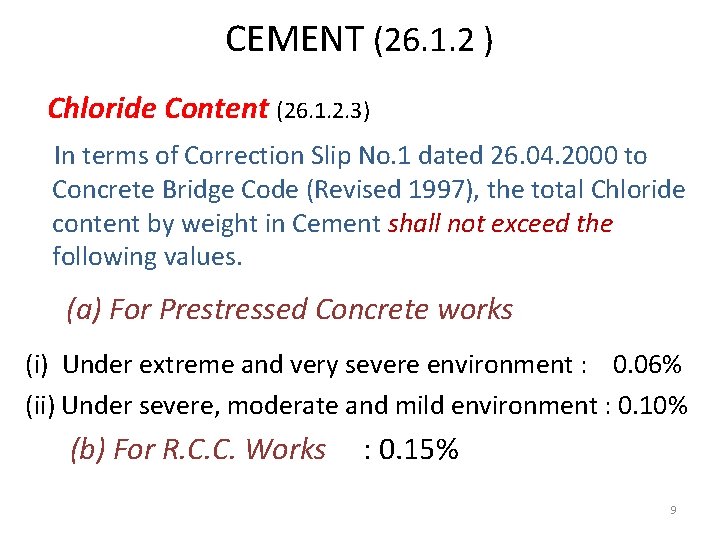
CEMENT (26. 1. 2 ) Chloride Content (26. 1. 2. 3) In terms of Correction Slip No. 1 dated 26. 04. 2000 to Concrete Bridge Code (Revised 1997), the total Chloride content by weight in Cement shall not exceed the following values. (a) For Prestressed Concrete works (i) Under extreme and very severe environment : 0. 06% (ii) Under severe, moderate and mild environment : 0. 10% (b) For R. C. C. Works : 0. 15% 9
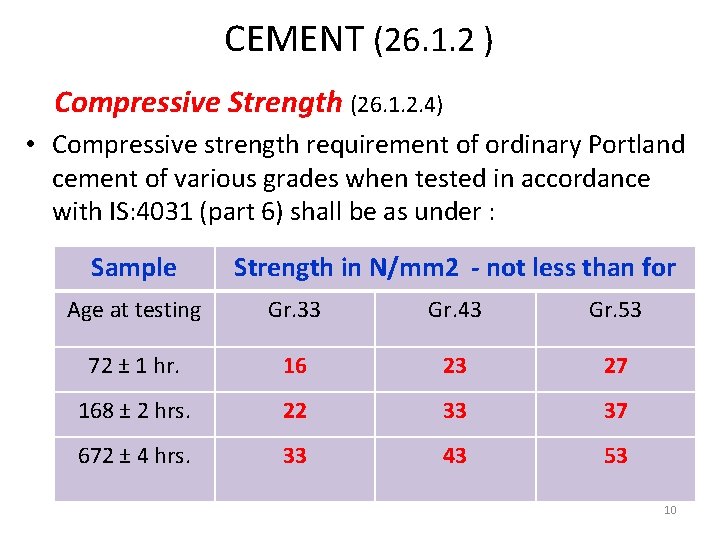
CEMENT (26. 1. 2 ) Compressive Strength (26. 1. 2. 4) • Compressive strength requirement of ordinary Portland cement of various grades when tested in accordance with IS: 4031 (part 6) shall be as under : Sample Strength in N/mm 2 - not less than for Age at testing Gr. 33 Gr. 43 Gr. 53 72 ± 1 hr. 16 23 27 168 ± 2 hrs. 22 33 37 672 ± 4 hrs. 33 43 53 10
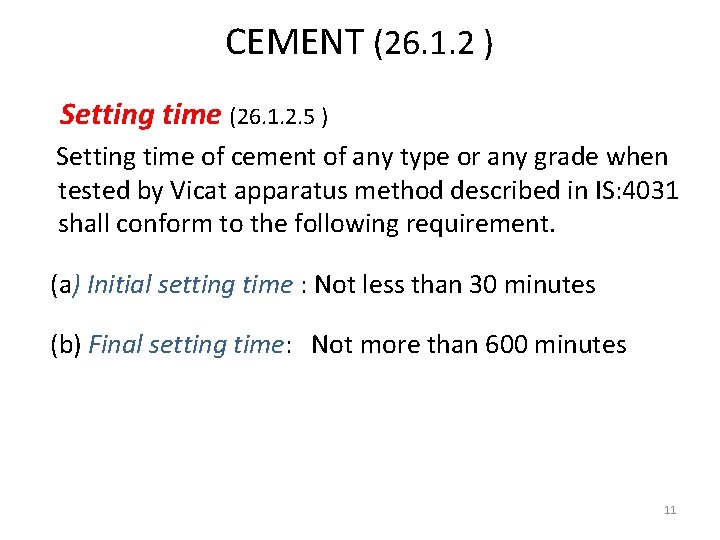
CEMENT (26. 1. 2 ) Setting time (26. 1. 2. 5 ) Setting time of cement of any type or any grade when tested by Vicat apparatus method described in IS: 4031 shall conform to the following requirement. (a) Initial setting time : Not less than 30 minutes (b) Final setting time: Not more than 600 minutes 11
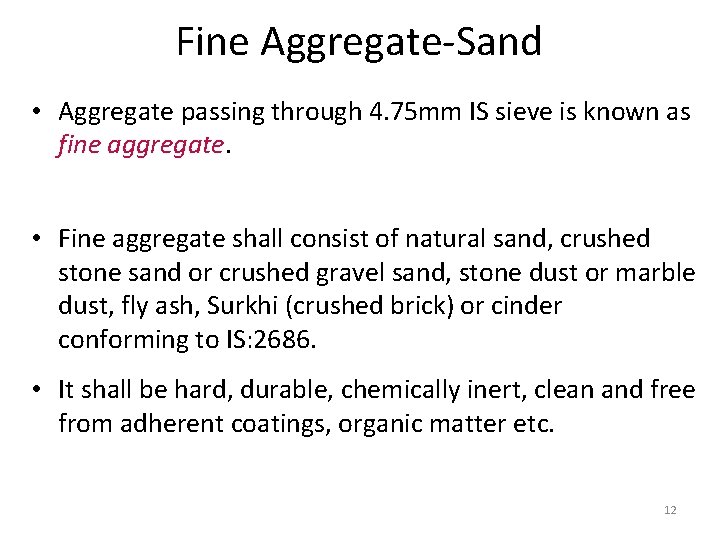
Fine Aggregate-Sand • Aggregate passing through 4. 75 mm IS sieve is known as fine aggregate. • Fine aggregate shall consist of natural sand, crushed stone sand or crushed gravel sand, stone dust or marble dust, fly ash, Surkhi (crushed brick) or cinder conforming to IS: 2686. • It shall be hard, durable, chemically inert, clean and free from adherent coatings, organic matter etc. 12
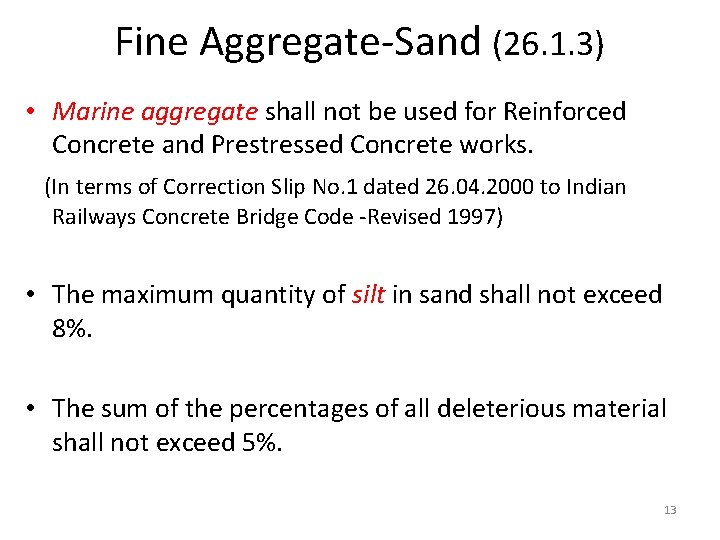
Fine Aggregate-Sand (26. 1. 3) • Marine aggregate shall not be used for Reinforced Concrete and Prestressed Concrete works. (In terms of Correction Slip No. 1 dated 26. 04. 2000 to Indian Railways Concrete Bridge Code -Revised 1997) • The maximum quantity of silt in sand shall not exceed 8%. • The sum of the percentages of all deleterious material shall not exceed 5%. 13
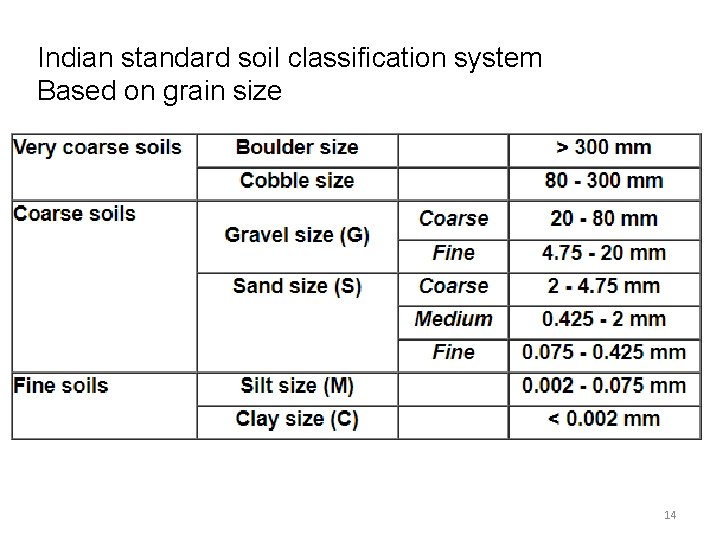
Indian standard soil classification system Based on grain size 14
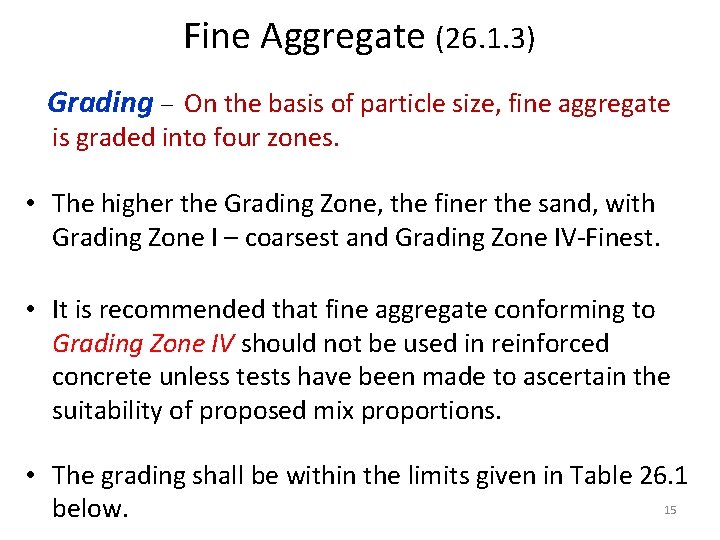
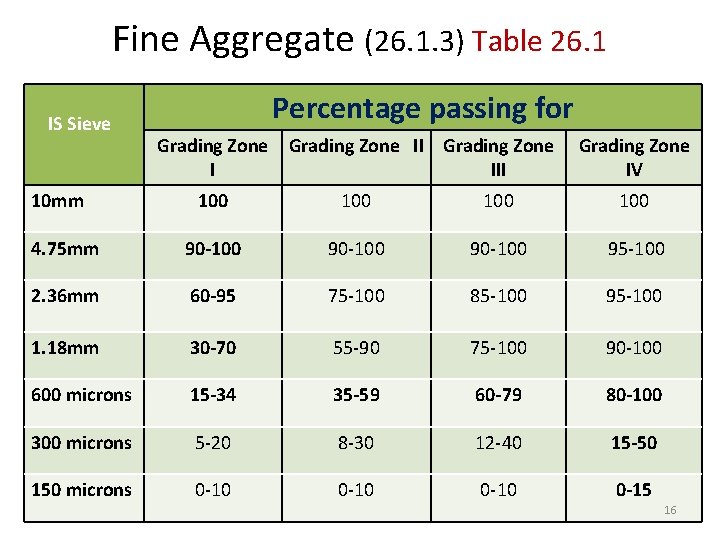
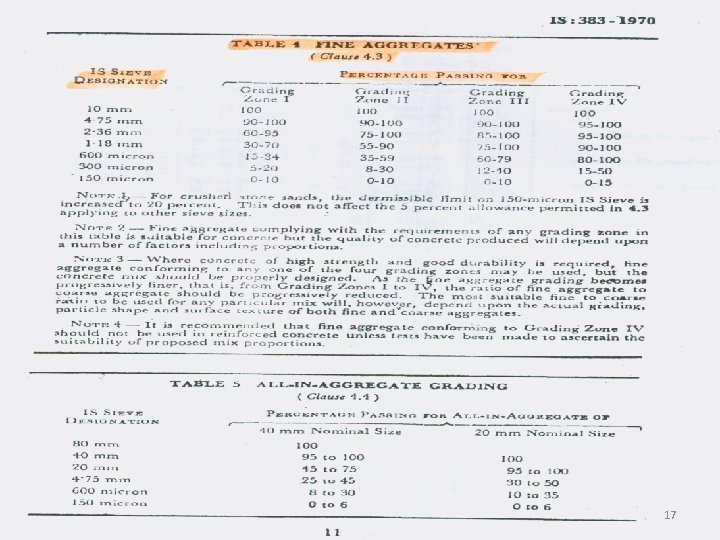
Fine Aggregate (26. 1. 3) Grading – On the basis of particle size, fine aggregate is graded into four zones. • The higher the Grading Zone, the finer the sand, with Grading Zone I – coarsest and Grading Zone IV-Finest. • It is recommended that fine aggregate conforming to Grading Zone IV should not be used in reinforced concrete unless tests have been made to ascertain the suitability of proposed mix proportions. • The grading shall be within the limits given in Table 26. 1 15 below.
Fine Aggregate (26. 1. 3) Table 26. 1 IS Sieve 10 mm Percentage passing for Grading Zone III Grading Zone IV 100 100 4. 75 mm 90 -100 95 -100 2. 36 mm 60 -95 75 -100 85 -100 95 -100 1. 18 mm 30 -70 55 -90 75 -100 90 -100 600 microns 15 -34 35 -59 60 -79 80 -100 300 microns 5 -20 8 -30 12 -40 15 -50 150 microns 0 -10 0 -15 16
17
Fine Aggregate (26. 1. 3) i) Coarse sand Its grading shall fall within the limits of grading Zone I, III of Table 26. 1. Coarse sand shall have Fineness Modulus not less than 2. 5. ii) Fine sand Its grading shall fall within the limits of Grading Zone IV of Table 26. 1. Fine sand shall have Fineness Modulus not less than 1. 0. Use of sea sand shall not be allowed, unless otherwise specified. 18
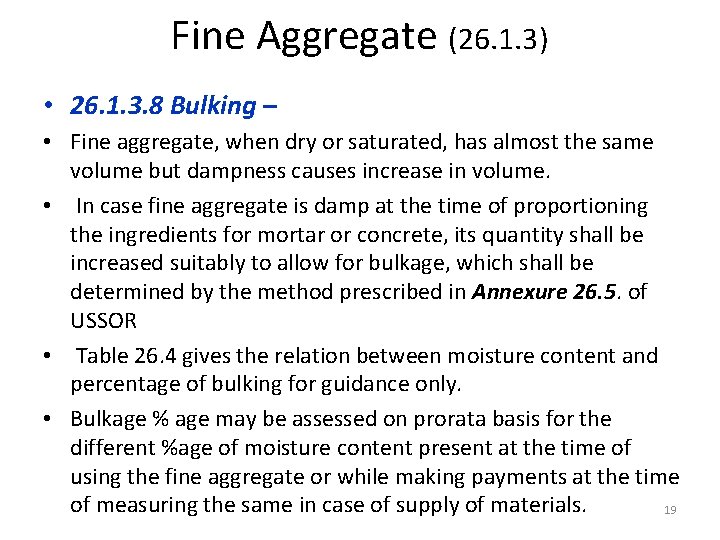
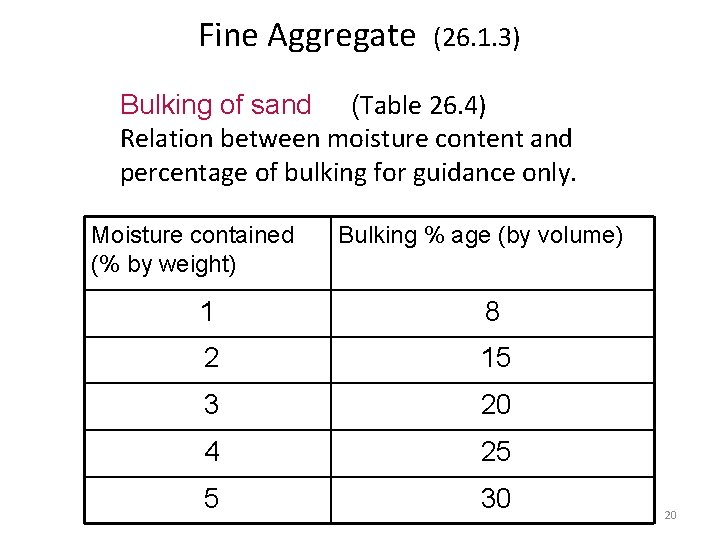
Fine Aggregate (26. 1. 3) • 26. 1. 3. 8 Bulking – • Fine aggregate, when dry or saturated, has almost the same volume but dampness causes increase in volume. • In case fine aggregate is damp at the time of proportioning the ingredients for mortar or concrete, its quantity shall be increased suitably to allow for bulkage, which shall be determined by the method prescribed in Annexure 26. 5. of USSOR • Table 26. 4 gives the relation between moisture content and percentage of bulking for guidance only. • Bulkage % age may be assessed on prorata basis for the different %age of moisture content present at the time of using the fine aggregate or while making payments at the time of measuring the same in case of supply of materials. 19
Fine Aggregate (26. 1. 3) Bulking of sand (Table 26. 4) Relation between moisture content and percentage of bulking for guidance only. Moisture contained (% by weight) Bulking % age (by volume) 1 8 2 15 3 20 4 25 5 30 20
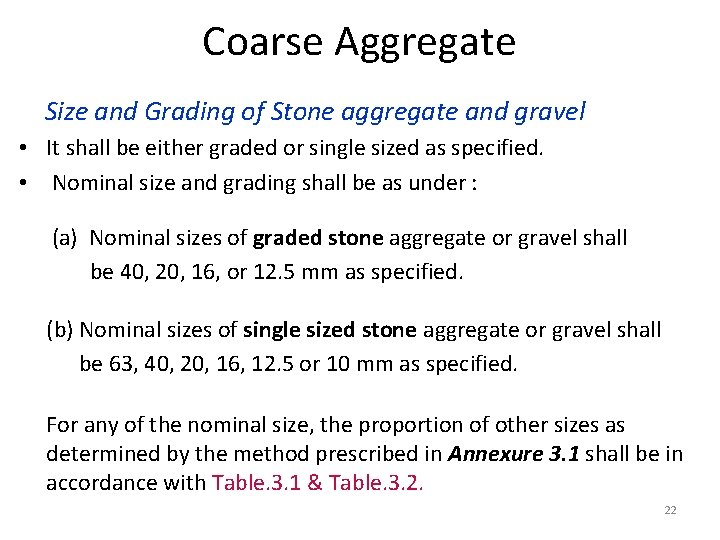
Coarse Aggregate • Aggregate, most of which is retained on 4. 75 mm IS Sieve and contains only as much fine material as is permitted in IS: 383 for various sizes and grading is known as Coarse aggregate. • It shall consist of naturally occurring (uncrushed, crushed or broken) stones or river bed shingle or pit gravel. • It shall be hard, strong, dense, durable and clean and roughly cubical in shape. • Marine aggregate shall not be used for reinforced concrete and prestressed concrete bridges. 21
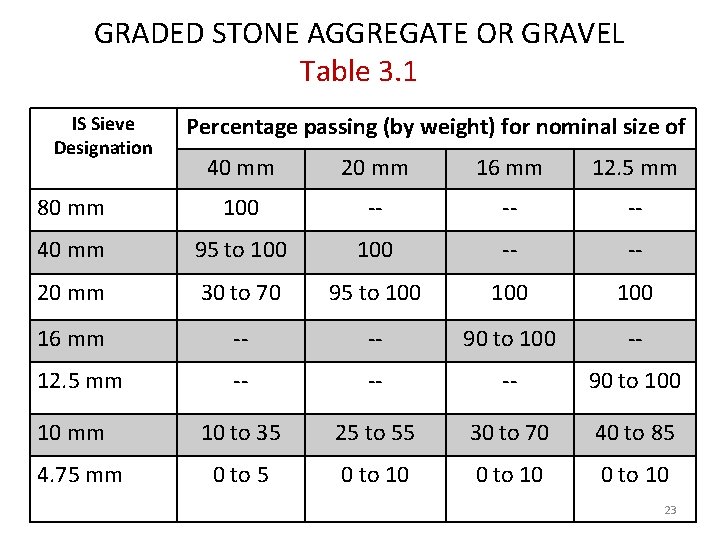
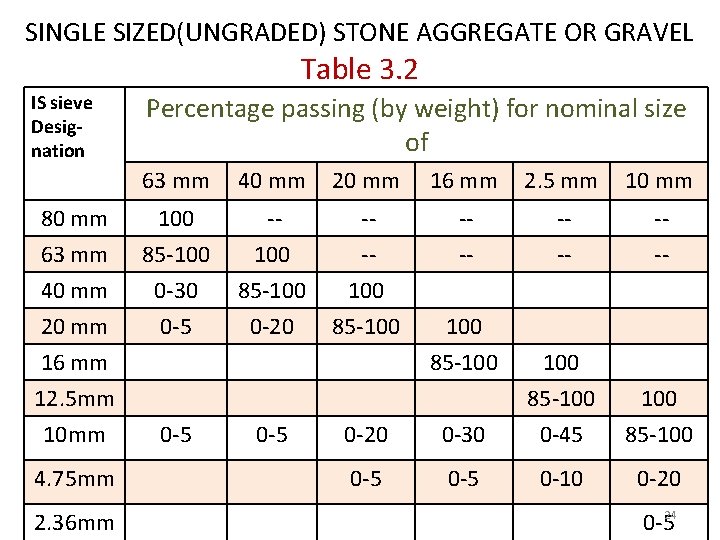
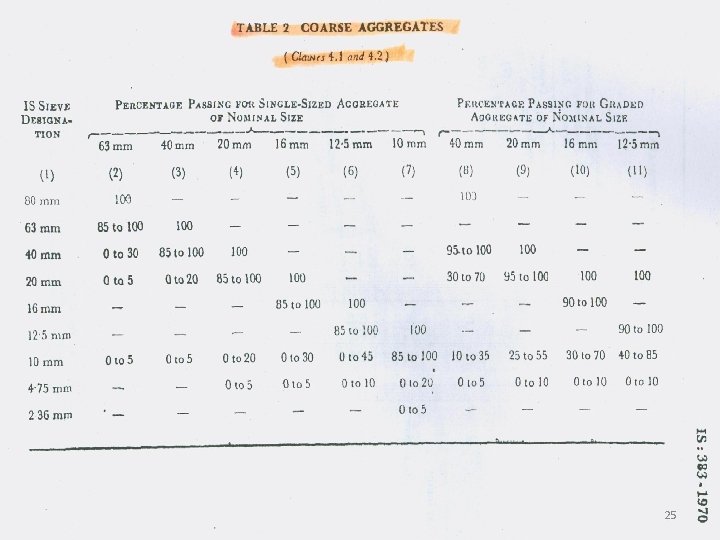
Coarse Aggregate Size and Grading of Stone aggregate and gravel • It shall be either graded or single sized as specified. • Nominal size and grading shall be as under : (a) Nominal sizes of graded stone aggregate or gravel shall be 40, 20, 16, or 12. 5 mm as specified. (b) Nominal sizes of single sized stone aggregate or gravel shall be 63, 40, 20, 16, 12. 5 or 10 mm as specified. For any of the nominal size, the proportion of other sizes as determined by the method prescribed in Annexure 3. 1 shall be in accordance with Table. 3. 1 & Table. 3. 2. 22
GRADED STONE AGGREGATE OR GRAVEL Table 3. 1 IS Sieve Designation Percentage passing (by weight) for nominal size of 40 mm 20 mm 16 mm 12. 5 mm 80 mm 100 -- -- -- 40 mm 95 to 100 -- -- 20 mm 30 to 70 95 to 100 100 16 mm -- -- 90 to 100 -- 12. 5 mm -- -- -- 90 to 100 10 to 35 25 to 55 30 to 70 40 to 85 0 to 10 10 mm 4. 75 mm 23
SINGLE SIZED(UNGRADED) STONE AGGREGATE OR GRAVEL Table 3. 2 IS sieve Designation Percentage passing (by weight) for nominal size of 63 mm 40 mm 20 mm 16 mm 2. 5 mm 10 mm 80 mm 63 mm 100 85 -100 --- --- 40 mm 20 mm 16 mm 12. 5 mm 10 mm 0 -30 0 -5 85 -100 0 -20 100 85 -100 0 -20 4. 75 mm 2. 36 mm 0 -5 100 85 -100 0 -20 0 -30 100 85 -100 0 -45 0 -5 0 -10 0 -524
25
Coarse Aggregate • Size of Coarse aggregate a) The nominal maximum size of coarse aggregate should be as large as possible within limits specified b) but in no case greater than one fourth of the minimum thickness of the members, provided that the concrete can be placed without difficulty to fill all corners of the form and to surround all reinforcement. For reinforced concrete work and prestressed concrete work, aggregates having a nominal size of 20 mm are generally considered satisfactory. 26
Coarse Aggregate (3. 1. 2) In special cases larger size may be specifically permitted by the Engineer but in no case the nominal maximum size in such RCC/ PSC structures shall be more than 40 mm. b)For heavily reinforced concrete members, as in the case of ribs of main beams, the nominal maximum size of aggregate should usually be restricted to 5 mm less than the minimum clear distance between the main bars or 5 mm less than the minimum cover to reinforcement whichever is smaller. - Where reinforcement is widely spaced as in solid slabs, limitations on the size of the aggregate may not be so important. 27
Coarse Aggregate (3. 1. 2) c) Coarse and fine aggregates shall preferably be batched separately, specially for design mix concrete. d) The largest possible size, properly graded, should be used in order to reduce the water demand. For high compressive strengths of concrete, this is usually economical. 28
Coarse Aggregate Testing of Coarse aggregate : Coarse aggregate shall be tested for the following (as per IS: 2386): a) Determination of particle size and shape The aggregate failing in the test should be got removed from the site. b) Estimation of organic impurities (As per IS: 2386 Part II): c) Surface moisture d) Determination of 10% fine value 29
Water • Water used for mixing and curing shall be clean and free from injurious quantities of alkalies, acids, oils, salts, sugar, organic materials, vegetable growth or other substances that may be deleterious to bricks, stone, concrete or steel. • Potable water is generally considered satisfactory for mixing. • The p. H value of water shall be not less than 6. 30
Water (26. 1. 1) • The following concentrations represent the maximum permissible values: (of deleterious materials in water). Reference may be made to Concrete Bridge Code. • (a) Limits of Acidity: To neutralize 200 ml sample of water, using phenolphthalein as an indicator, it should not require more than 2 ml of 0. 10 normal Na. OH. The details of test shall be as given in IS: 3025 (part 22). • (b) Limits of Alkalinity: To neutralize 200 ml sample of water, using mixed indicator, it should not require more than 10 ml of 0. 10 normal HCl. The details of tests shall be as given in IS: 3025 (part 23). 31
Water (26. 1. 1) • (c) Percentage of Solids: Maximum permissible limits of solids when tested in accordance with IS: 3025 shall be as under: Organic 200 mg/litre Inorganic 3000 mg/litre Sulphates (as SO 4) - 500 mg/litre Chlorides (as Cl) 500 mg/ litre for Prestressed Concrete Work, 1000 mg/ litre for Reinforced Concrete work and 2000 mg/ litre for Plain Concrete Work. Suspended matter - 2000 mg/litre 32
Water (26. 1. 1) • The physical and chemical properties of water used for mixing and curing should conform to the requirements of IS: 456 -2000. • The contractor has to arrange good quality water for construction indicating the source. • Sea water shall not be used for mixing or curing. • Frequency of Testing for Quality - Water from each source shall be tested before commencement of the work and thereafter once in every three months till completion of the work or when ordered. 33
Chemical Admixtures –General Requirements General: - When required, admixtures of approved quality shall be mixed with concrete, as specified. The admixtures shall conform to IS : 9103. Admixtures may be any one of the following classes for use in concrete: (a) Water reducing Admixtures (b) Retarding Admixtures (c) Accelerating Admixtures (d) Water reducing and retarding Admixtures (e) Water reducing and accelerating Admixtures (f) Permeability reducing (water proofing) Admixtures 34
Chemical Admixtures v Dosage of these admixtures may vary according to manufacturer’s specification. v No admixtures shall be accepted for use in concrete unless these are tested in accordance with IS: 9103 and the test results are approved by the Engineer. v Manufacturer’s recommendation shall be carefully followed so as to ensure complete solution of the product or to prepare a standard solution of uniform strength for easier use. 35
Special Precautions in use of Admixtures v Previous experience with and data on such materials should be considered in relation to the likely standards of supervision and workmanship to the work being specified. v Admixtures should not impair durability of concrete nor combine with the cement to form harmful compounds nor increase the risk of corrosion of reinforcement. v The workability, compressive strength and the slump loss of concrete with and without the use of admixtures shall be established during the trial mixes before use of admixtures. 36
3. 12 Special Precautions in use of Admixtures v The relative density of liquid admixtures shall be checked for each drum containing admixtures and compared with the specified value before acceptance. v The chloride content of admixtures shall be independently tested for each batch before acceptance. v If two or more admixtures are used simultaneously in the same concrete mix, data should be obtained to asses their interaction and to ensure their compatibility. 37
Chemical Admixtures As stipulated in Paras 4. 4. 2 and 4. 4. 3 of Indian Railways Concrete Bridge Code (Revised 1997), the following should be strictly adhered to i) Calcium chloride or admixtures containing calcium chloride shall not be used in structural concrete containing reinforcement, pre-stressing tendon or other embedded metal. ii) The admixture containing Cl & SO 3 ions shall not be used. Admixtures containing nitrates shall also not be used. Admixtures based on Thiocyanate may promote corrosion and therefore shall be prohibited. 38
Admixures / Plasticizers 39
Plasticisers • The Portland cement, being in fine state, will have a tendency to flocculate in wet concrete. This flocculation entraps certain amount of water used in the mix and thereby all the water is not freely available to fluidify the mix. • When plasticizers are added, they get absorbed on the cement particles. The absorption of charged polymer on the cement particles creates repulsive forces between particles, which overcome the attractive forces. This repulsive force is called Zeta Potential, which depends on the base, solid content, quantity of plasticizer used. The overall result is that the water particles trapped inside the floc gets released and becomes available to fluidify the mix. 40
Plasticisers • Plasticisers or dispersants are additives that increase the plasticity or decrease the viscosity of a material. These are the substances which are added in order to alter their physical properties. These are either liquids with low volatility or solids. They decrease the attraction between polymer chains to make them more flexible. Over the last 60 years more than 30, 000 different substances have been evaluated for their plasticizing properties. Of these, only a small number – approximately 50 – are today in commercial use. The dominant applications are for plastics, especially polyvinyl chloride (PVC). The properties of other materials may also be modified when blended with plasticizers including concrete, clays, and related products. According to 2014 data, the total global market for plasticizers was 8. 4 million metric tonnes including 1. 3 million metric tonnes in Europe. 41
Plasticisers for concrete • Plasticizers or water reducers, and superplasticizers or high range water reducers, are chemical admixtures that can be added to concrete mixtures to improve workability. Unless the mix is "starved" of water, the strength of concrete is inversely proportional to the amount of water added or water-cement (w/c) ratio. In order to produce stronger concrete, less water is added (without "starving" the mix), which makes the concrete mixture less workable and difficult to mix, necessitating the use of plasticizers, water reducers, superplasticizers, or dispersants. • Plasticizers are also often used when pozzolanic ash is added to concrete to improve strength. This method of mix proportioning is especially popular when producing high-strength concrete and fiber-reinforced concrete. 42
Plasticisers for concrete • Adding 1 -2% plasticizer per unit weight of cement is usually sufficient. Adding an excessive amount of plasticizer will result in excessive segregation of concrete and is not advisable. Depending on the particular chemical used, use of too much plasticizer may result in a retarding effect. • Plasticizers are commonly manufactured from lignosulfonates, a by-product from the paper industry. Superplasticizers have generally been manufactured from sulfonated naphthalene condensate or sulfonated melamine formaldehyde, although newer products based on polycarboxylic ethers are now available. Traditional lignosulfonate-based plasticisers, naphthalene and melamine sulfonate-based superplasticisers disperse the flocculated cement particles through a mechanism of electrostatic repulsion (see colloid). 43
Plasticisers for concrete • In normal plasticisers, the active substances are adsorbed on to the cement particles, giving them a negative charge, which leads to repulsion between particles. Lignin, naphthalene, and melamine sulfonate superplasticisers are organic polymers. The long molecules wrap themselves around the cement particles, giving them a highly negative charge so that they repel each other. • Polycarboxylate ether superplasticizer (PCE) or just polycarboxylate (PC), work differently from sulfonatebased superplasticizers, giving cement dispersion by steric stabilisation, instead of electrostatic repulsion. This form of dispersion is more powerful in its effect and gives improved workability retention to the cementitious mix. [12] 44
High Range Water Reducers or Superplasticizers • These admixtures are principally surface reactive agents (surfactants). They confer negative charge on individual cement particles (and also its hydrated particles) such that they are kept in a dispersed or suspended state due to inter-particle repulsion. Thus they confer high mobility to the particles. • A simple way of utilizing the super plasticizer is to proportion the ingredient of the mixture to produce the required hardened physical properties and then add sufficient plasticizer to achieve required consistency or workability. 45
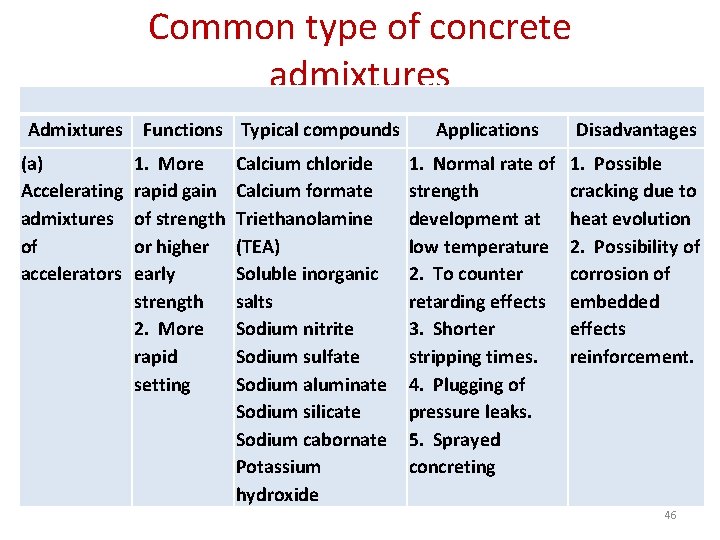
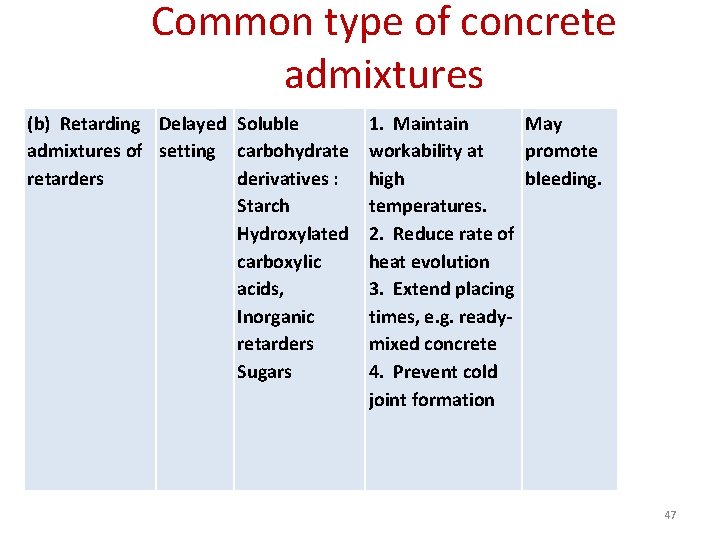
Common type of concrete admixtures Admixtures Functions Typical compounds (a) Accelerating admixtures of accelerators 1. More rapid gain of strength or higher early strength 2. More rapid setting Calcium chloride Calcium formate Triethanolamine (TEA) Soluble inorganic salts Sodium nitrite Sodium sulfate Sodium aluminate Sodium silicate Sodium cabornate Potassium hydroxide Applications Disadvantages 1. Normal rate of strength development at low temperature 2. To counter retarding effects 3. Shorter stripping times. 4. Plugging of pressure leaks. 5. Sprayed concreting 1. Possible cracking due to heat evolution 2. Possibility of corrosion of embedded effects reinforcement. 46
Common type of concrete admixtures (b) Retarding Delayed Soluble 1. Maintain May admixtures of setting carbohydrate workability at promote retarders derivatives : high bleeding. Starch temperatures. Hydroxylated 2. Reduce rate of carboxylic heat evolution acids, 3. Extend placing Inorganic times, e. g. readyretarders mixed concrete Sugars 4. Prevent cold joint formation 47
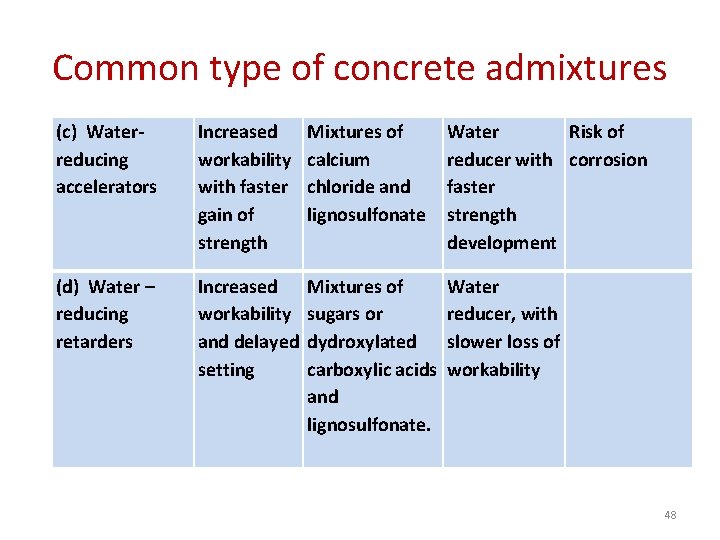
Common type of concrete admixtures (c) Waterreducing accelerators Increased workability with faster gain of strength Mixtures of calcium chloride and lignosulfonate Water Risk of reducer with corrosion faster strength development (d) Water – reducing retarders Increased workability and delayed setting Mixtures of sugars or dydroxylated carboxylic acids and lignosulfonate. Water reducer, with slower loss of workability 48
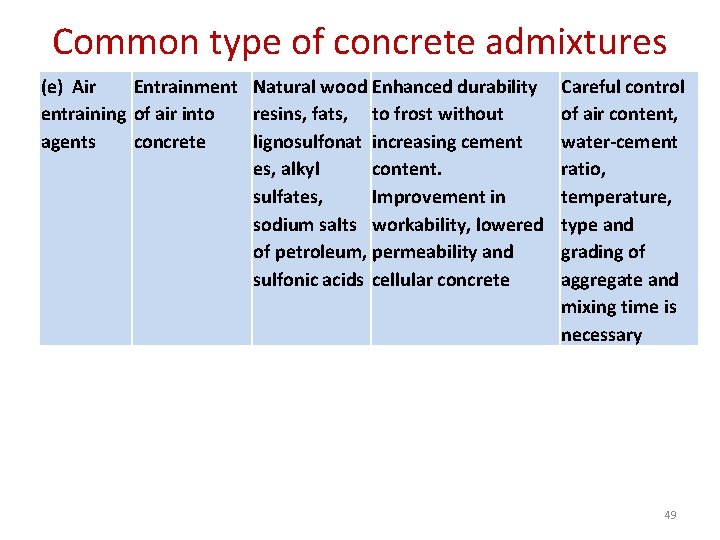
Common type of concrete admixtures (e) Air Entrainment Natural wood Enhanced durability entraining of air into resins, fats, to frost without agents concrete lignosulfonat increasing cement es, alkyl content. sulfates, Improvement in sodium salts workability, lowered of petroleum, permeability and sulfonic acids cellular concrete Careful control of air content, water-cement ratio, temperature, type and grading of aggregate and mixing time is necessary 49
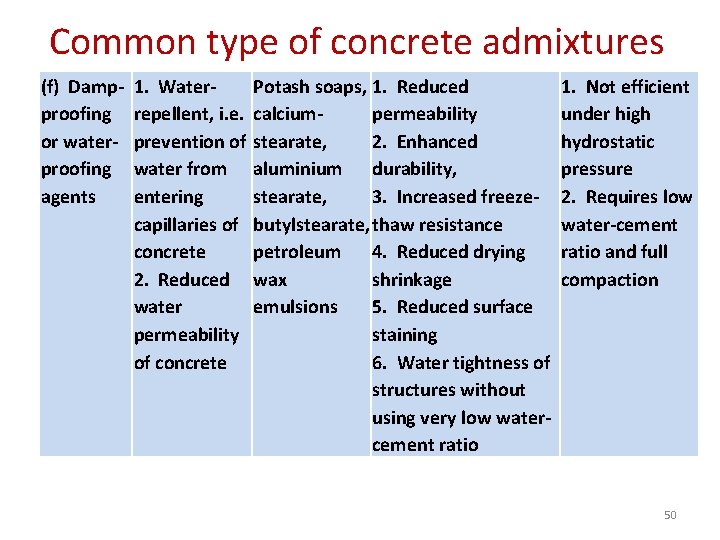
Common type of concrete admixtures (f) Dampproofing or waterproofing agents 1. Waterrepellent, i. e. prevention of water from entering capillaries of concrete 2. Reduced water permeability of concrete Potash soaps, 1. Reduced calciumpermeability stearate, 2. Enhanced aluminium durability, stearate, 3. Increased freezebutylstearate, thaw resistance petroleum 4. Reduced drying wax shrinkage emulsions 5. Reduced surface staining 6. Water tightness of structures without using very low watercement ratio 1. Not efficient under high hydrostatic pressure 2. Requires low water-cement ratio and full compaction 50
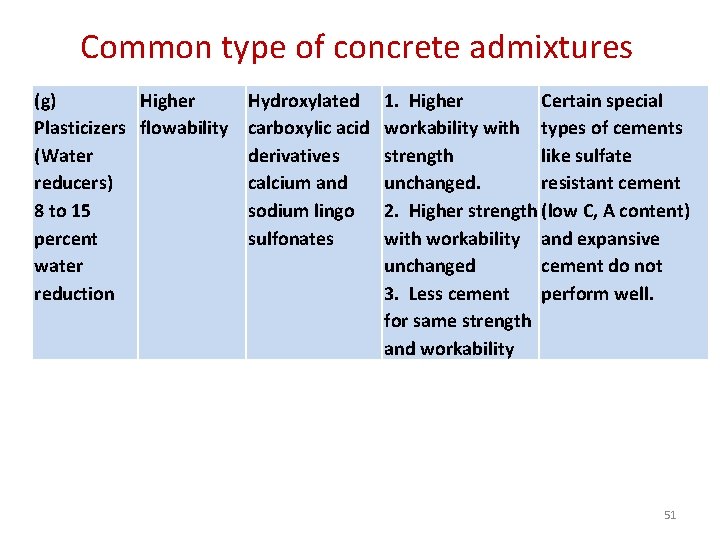
Common type of concrete admixtures (g) Higher Plasticizers flowability (Water reducers) 8 to 15 percent water reduction Hydroxylated carboxylic acid derivatives calcium and sodium lingo sulfonates 1. Higher Certain special workability with types of cements strength like sulfate unchanged. resistant cement 2. Higher strength (low C, A content) with workability and expansive unchanged cement do not 3. Less cement perform well. for same strength and workability 51
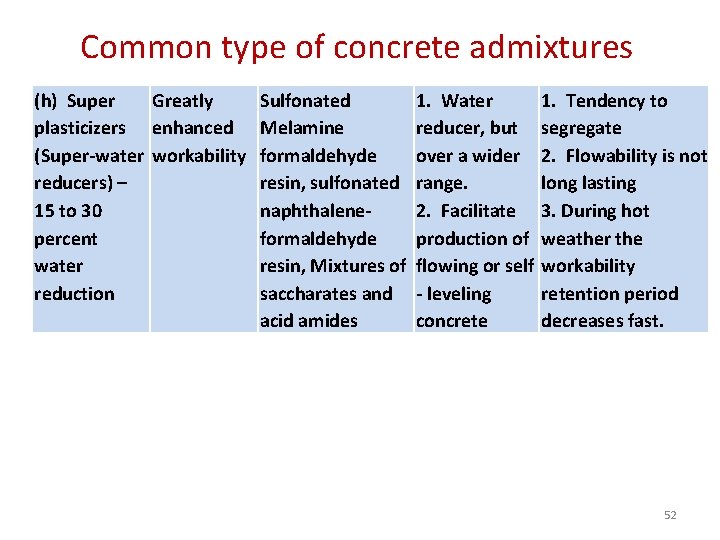
Common type of concrete admixtures (h) Super Greatly plasticizers enhanced (Super-water workability reducers) – 15 to 30 percent water reduction Sulfonated Melamine formaldehyde resin, sulfonated naphthaleneformaldehyde resin, Mixtures of saccharates and acid amides 1. Water reducer, but over a wider range. 2. Facilitate production of flowing or self - leveling concrete 1. Tendency to segregate 2. Flowability is not long lasting 3. During hot weather the workability retention period decreases fast. 52
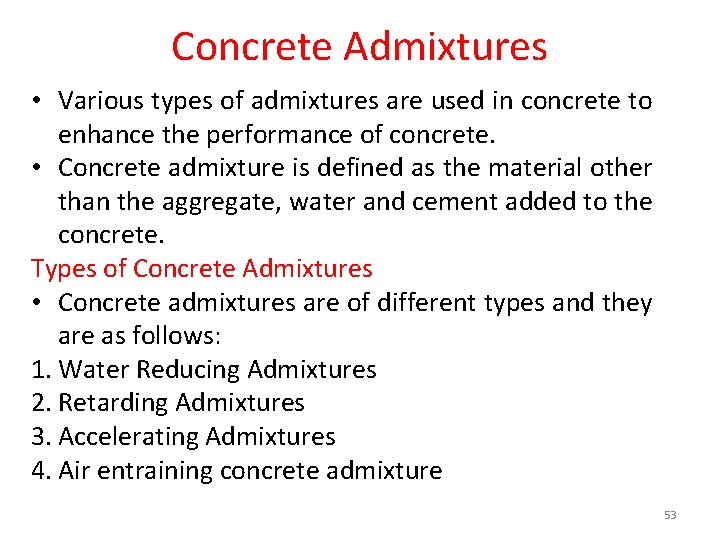
Concrete Admixtures • Various types of admixtures are used in concrete to enhance the performance of concrete. • Concrete admixture is defined as the material other than the aggregate, water and cement added to the concrete. Types of Concrete Admixtures • Concrete admixtures are of different types and they are as follows: 1. Water Reducing Admixtures 2. Retarding Admixtures 3. Accelerating Admixtures 4. Air entraining concrete admixture 53
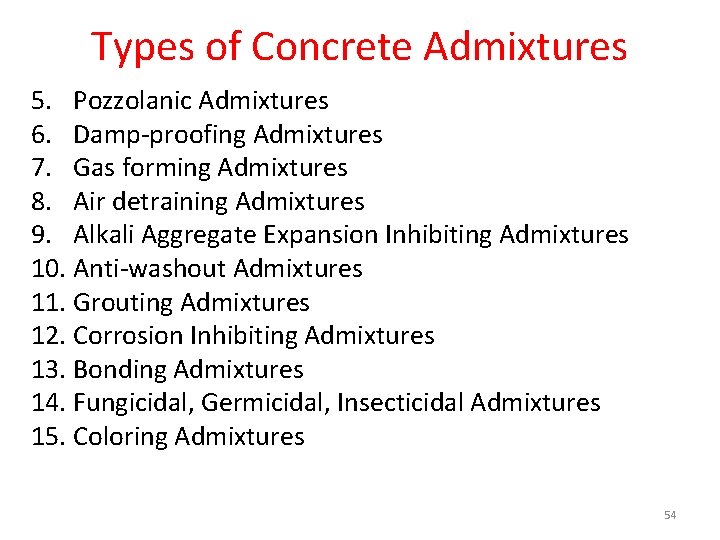
Types of Concrete Admixtures 5. Pozzolanic Admixtures 6. Damp-proofing Admixtures 7. Gas forming Admixtures 8. Air detraining Admixtures 9. Alkali Aggregate Expansion Inhibiting Admixtures 10. Anti-washout Admixtures 11. Grouting Admixtures 12. Corrosion Inhibiting Admixtures 13. Bonding Admixtures 14. Fungicidal, Germicidal, Insecticidal Admixtures 15. Coloring Admixtures 54
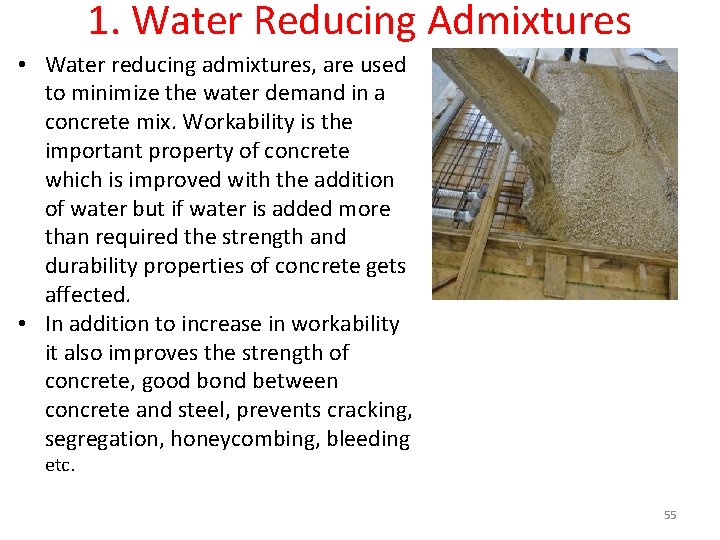
1. Water Reducing Admixtures • Water reducing admixtures, are used to minimize the water demand in a concrete mix. Workability is the important property of concrete which is improved with the addition of water but if water is added more than required the strength and durability properties of concrete gets affected. • In addition to increase in workability it also improves the strength of concrete, good bond between concrete and steel, prevents cracking, segregation, honeycombing, bleeding etc. 55
1. Water Reducing Admixtures • Water reducing admixtures, are also called as plasticizers. • These are classified into three types namely plasticizers, mid-range plasticizers and super plasticizers. • Normal plasticizer reduces the water demand up to 10%, • Mid-range plasticizers reduce the water demand up to 15% while • Super plasticizers reduce the water demand up to 30%. • Calcium, sodium and ammonium lignosulphonates are commonly used plasticizers. Some of the new generation super plasticizers are acrylic polymer based, poly carboxylate, multi-carboxylate ethers etc. 56
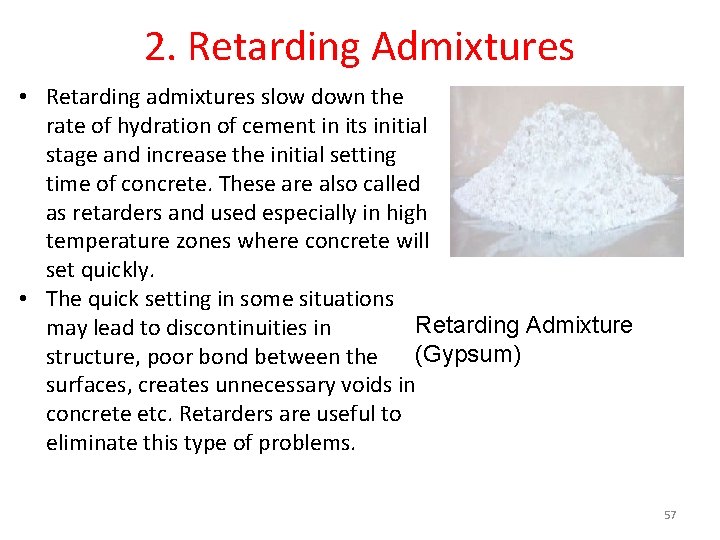
2. Retarding Admixtures • Retarding admixtures slow down the rate of hydration of cement in its initial stage and increase the initial setting time of concrete. These are also called as retarders and used especially in high temperature zones where concrete will set quickly. • The quick setting in some situations Retarding Admixture may lead to discontinuities in (Gypsum) structure, poor bond between the surfaces, creates unnecessary voids in concrete etc. Retarders are useful to eliminate this type of problems. 57
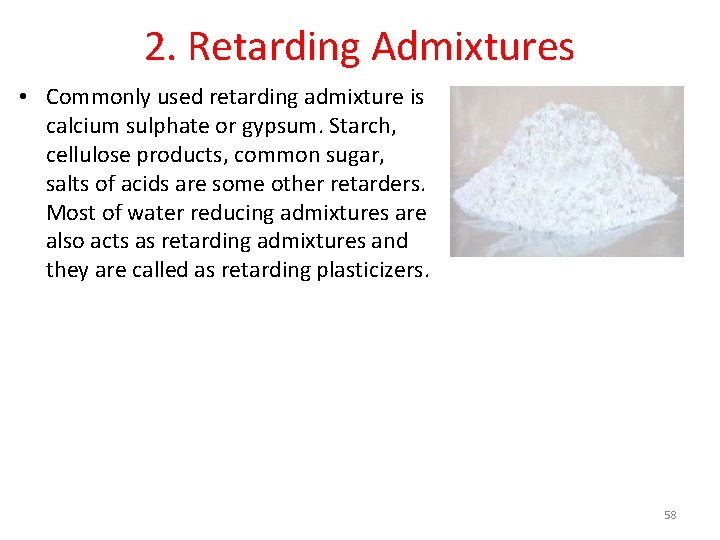
2. Retarding Admixtures • Commonly used retarding admixture is calcium sulphate or gypsum. Starch, cellulose products, common sugar, salts of acids are some other retarders. Most of water reducing admixtures are also acts as retarding admixtures and they are called as retarding plasticizers. 58
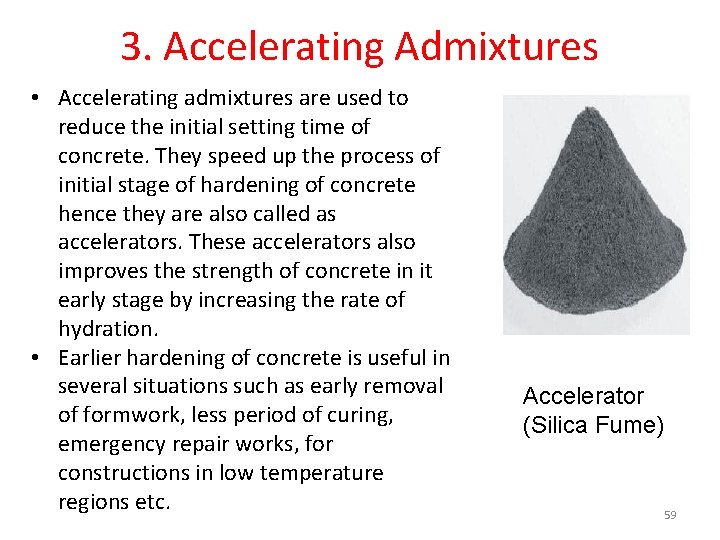
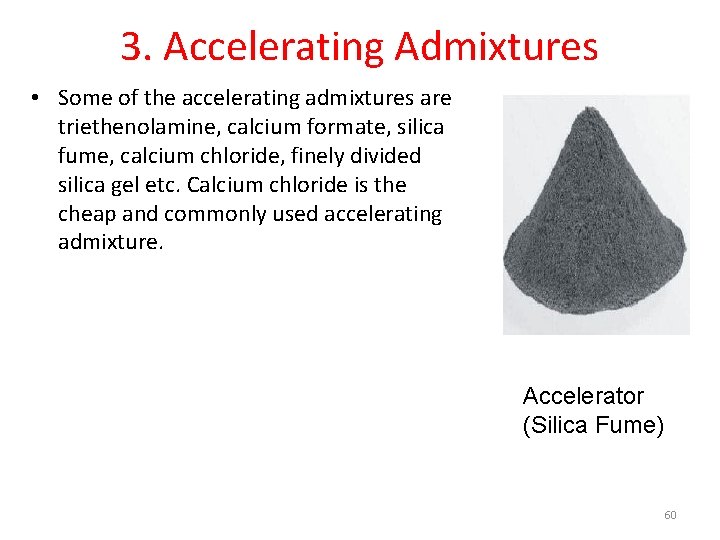
3. Accelerating Admixtures • Accelerating admixtures are used to reduce the initial setting time of concrete. They speed up the process of initial stage of hardening of concrete hence they are also called as accelerators. These accelerators also improves the strength of concrete in it early stage by increasing the rate of hydration. • Earlier hardening of concrete is useful in several situations such as early removal of formwork, less period of curing, emergency repair works, for constructions in low temperature regions etc. Accelerator (Silica Fume) 59
3. Accelerating Admixtures • Some of the accelerating admixtures are triethenolamine, calcium formate, silica fume, calcium chloride, finely divided silica gel etc. Calcium chloride is the cheap and commonly used accelerating admixture. Accelerator (Silica Fume) 60
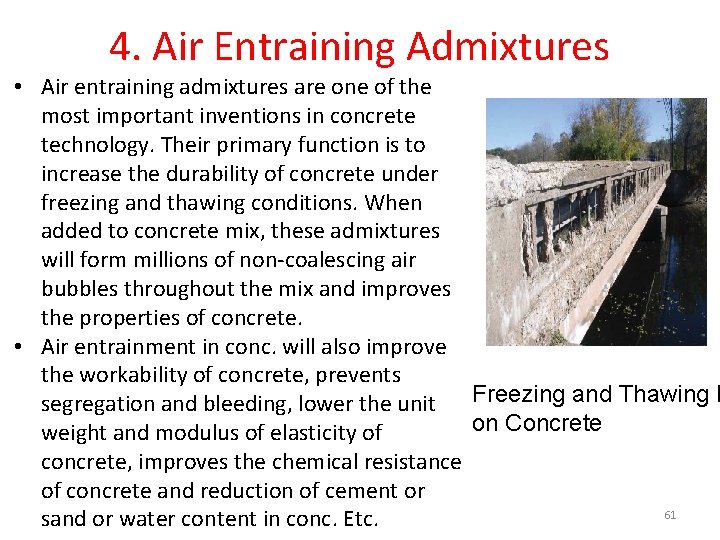
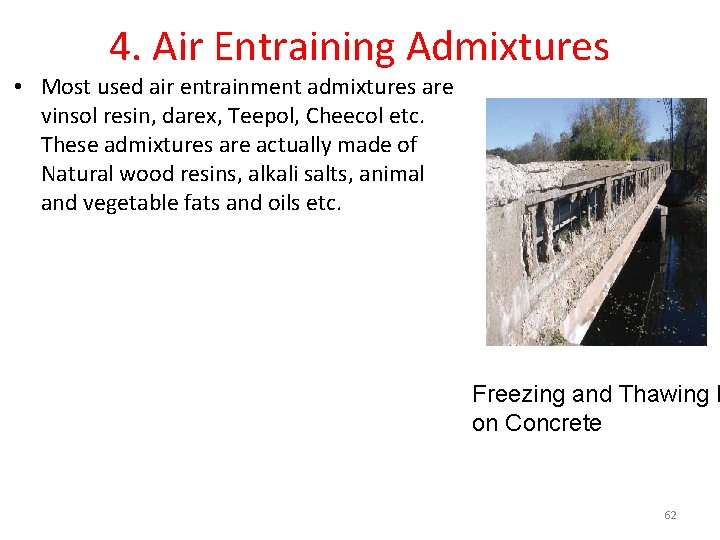
4. Air Entraining Admixtures • Air entraining admixtures are one of the most important inventions in concrete technology. Their primary function is to increase the durability of concrete under freezing and thawing conditions. When added to concrete mix, these admixtures will form millions of non-coalescing air bubbles throughout the mix and improves the properties of concrete. • Air entrainment in conc. will also improve the workability of concrete, prevents Freezing and Thawing E segregation and bleeding, lower the unit on Concrete weight and modulus of elasticity of concrete, improves the chemical resistance of concrete and reduction of cement or 61 sand or water content in conc. Etc.
4. Air Entraining Admixtures • Most used air entrainment admixtures are vinsol resin, darex, Teepol, Cheecol etc. These admixtures are actually made of Natural wood resins, alkali salts, animal and vegetable fats and oils etc. Freezing and Thawing E on Concrete 62
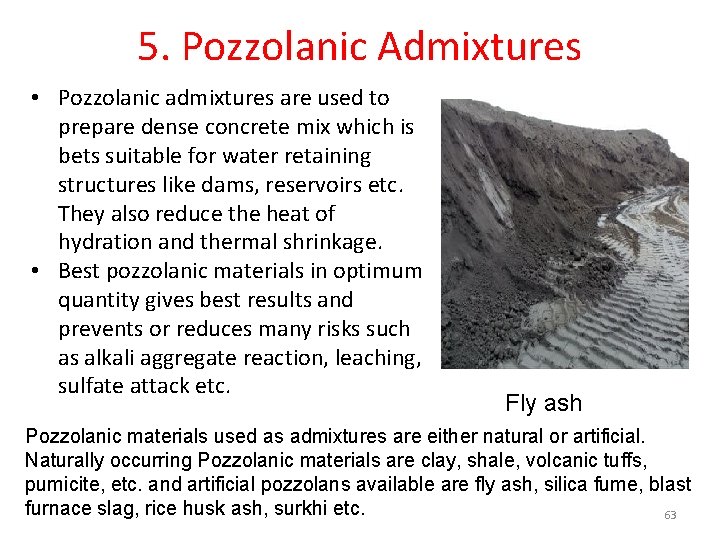
5. Pozzolanic Admixtures • Pozzolanic admixtures are used to prepare dense concrete mix which is bets suitable for water retaining structures like dams, reservoirs etc. They also reduce the heat of hydration and thermal shrinkage. • Best pozzolanic materials in optimum quantity gives best results and prevents or reduces many risks such as alkali aggregate reaction, leaching, sulfate attack etc. Fly ash Pozzolanic materials used as admixtures are either natural or artificial. Naturally occurring Pozzolanic materials are clay, shale, volcanic tuffs, pumicite, etc. and artificial pozzolans available are fly ash, silica fume, blast furnace slag, rice husk ash, surkhi etc. 63
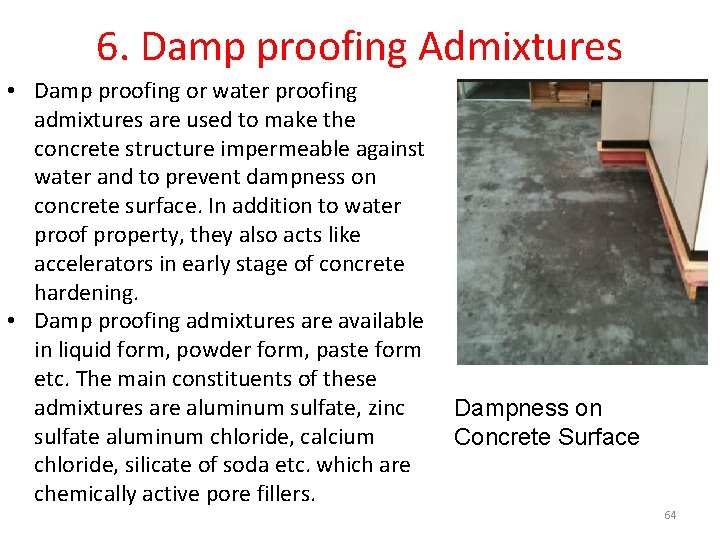
6. Damp proofing Admixtures • Damp proofing or water proofing admixtures are used to make the concrete structure impermeable against water and to prevent dampness on concrete surface. In addition to water proof property, they also acts like accelerators in early stage of concrete hardening. • Damp proofing admixtures are available in liquid form, powder form, paste form etc. The main constituents of these admixtures are aluminum sulfate, zinc sulfate aluminum chloride, calcium chloride, silicate of soda etc. which are chemically active pore fillers. Dampness on Concrete Surface 64
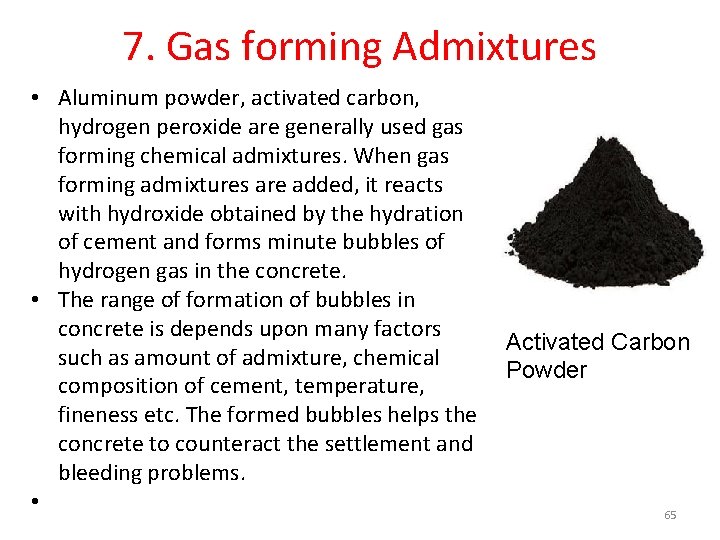
7. Gas forming Admixtures • Aluminum powder, activated carbon, hydrogen peroxide are generally used gas forming chemical admixtures. When gas forming admixtures are added, it reacts with hydroxide obtained by the hydration of cement and forms minute bubbles of hydrogen gas in the concrete. • The range of formation of bubbles in concrete is depends upon many factors such as amount of admixture, chemical composition of cement, temperature, fineness etc. The formed bubbles helps the concrete to counteract the settlement and bleeding problems. • Activated Carbon Powder 65
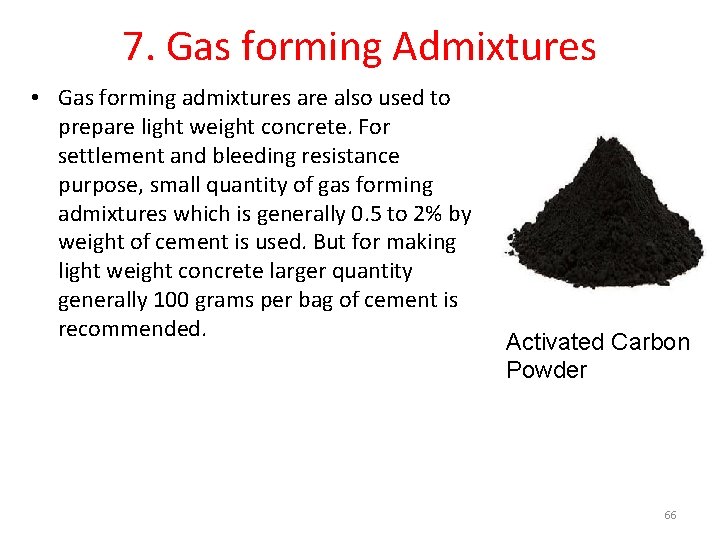
7. Gas forming Admixtures • Gas forming admixtures are also used to prepare light weight concrete. For settlement and bleeding resistance purpose, small quantity of gas forming admixtures which is generally 0. 5 to 2% by weight of cement is used. But for making light weight concrete larger quantity generally 100 grams per bag of cement is recommended. Activated Carbon Powder 66
8. Air detraining Admixtures • Air-detraining Admixtures are used to remove the excess air from the concrete voids. Sometimes, the aggregates may release the gas into concrete and air entrained is more than required then this type of admixtures are useful. • Some of the mostly used air-detraining admixtures are tributyl phosphate, silicones, water insoluble alcohols etc. 67
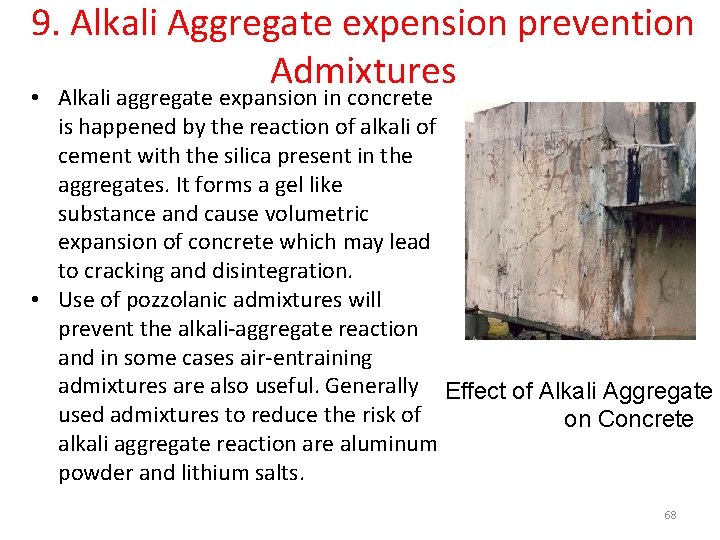
9. Alkali Aggregate expension prevention Admixtures • Alkali aggregate expansion in concrete is happened by the reaction of alkali of cement with the silica present in the aggregates. It forms a gel like substance and cause volumetric expansion of concrete which may lead to cracking and disintegration. • Use of pozzolanic admixtures will prevent the alkali-aggregate reaction and in some cases air-entraining admixtures are also useful. Generally Effect of Alkali Aggregate used admixtures to reduce the risk of on Concrete alkali aggregate reaction are aluminum powder and lithium salts. 68
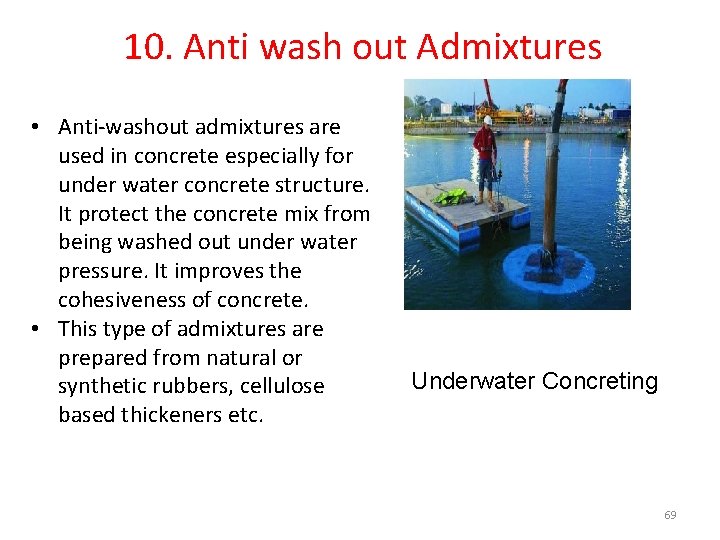
10. Anti wash out Admixtures • Anti-washout admixtures are used in concrete especially for under water concrete structure. It protect the concrete mix from being washed out under water pressure. It improves the cohesiveness of concrete. • This type of admixtures are prepared from natural or synthetic rubbers, cellulose based thickeners etc. Underwater Concreting 69
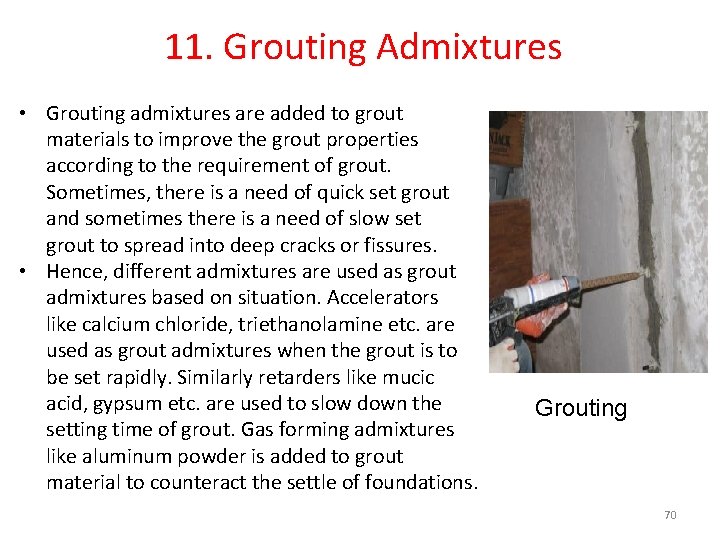
11. Grouting Admixtures • Grouting admixtures are added to grout materials to improve the grout properties according to the requirement of grout. Sometimes, there is a need of quick set grout and sometimes there is a need of slow set grout to spread into deep cracks or fissures. • Hence, different admixtures are used as grout admixtures based on situation. Accelerators like calcium chloride, triethanolamine etc. are used as grout admixtures when the grout is to be set rapidly. Similarly retarders like mucic acid, gypsum etc. are used to slow down the setting time of grout. Gas forming admixtures like aluminum powder is added to grout material to counteract the settle of foundations. Grouting 70
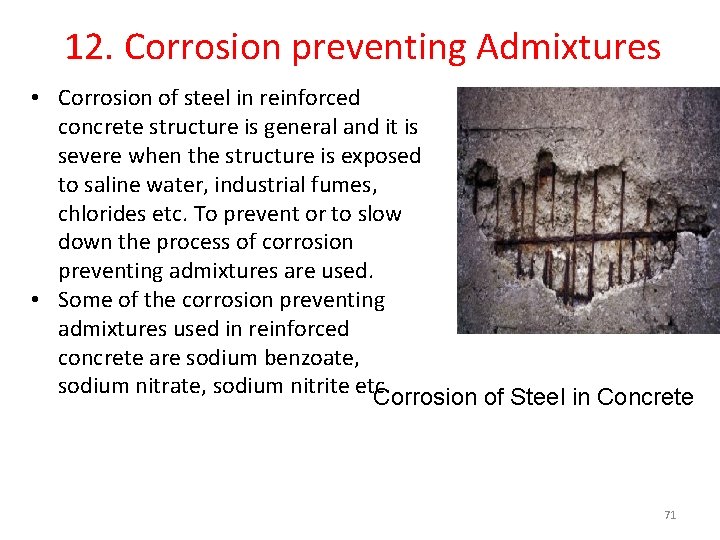
12. Corrosion preventing Admixtures • Corrosion of steel in reinforced concrete structure is general and it is severe when the structure is exposed to saline water, industrial fumes, chlorides etc. To prevent or to slow down the process of corrosion preventing admixtures are used. • Some of the corrosion preventing admixtures used in reinforced concrete are sodium benzoate, sodium nitrite etc. Corrosion of Steel in Concrete 71
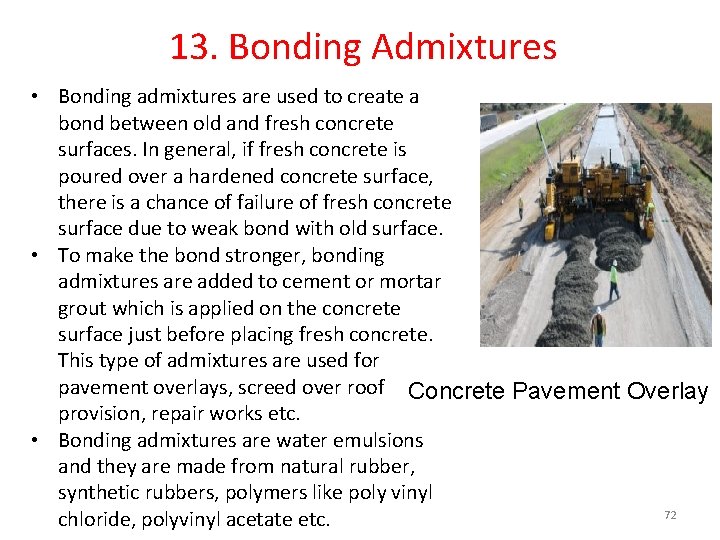
13. Bonding Admixtures • Bonding admixtures are used to create a bond between old and fresh concrete surfaces. In general, if fresh concrete is poured over a hardened concrete surface, there is a chance of failure of fresh concrete surface due to weak bond with old surface. • To make the bond stronger, bonding admixtures are added to cement or mortar grout which is applied on the concrete surface just before placing fresh concrete. This type of admixtures are used for pavement overlays, screed over roof Concrete Pavement Overlay provision, repair works etc. • Bonding admixtures are water emulsions and they are made from natural rubber, synthetic rubbers, polymers like poly vinyl 72 chloride, polyvinyl acetate etc.
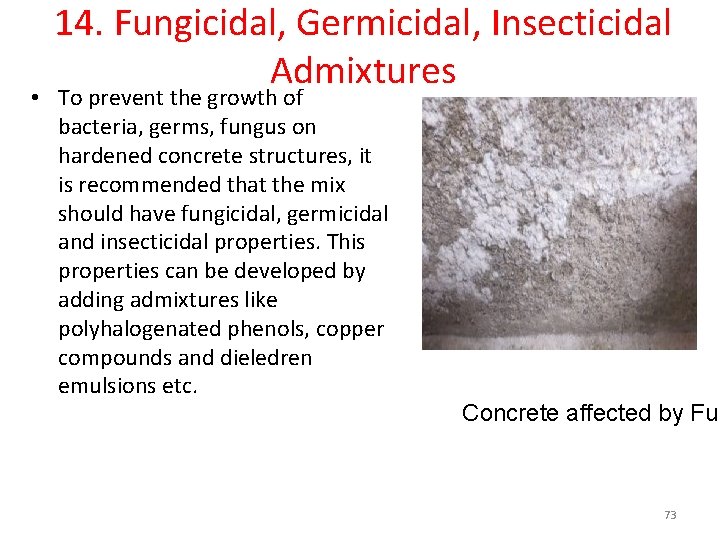
14. Fungicidal, Germicidal, Insecticidal Admixtures • To prevent the growth of bacteria, germs, fungus on hardened concrete structures, it is recommended that the mix should have fungicidal, germicidal and insecticidal properties. This properties can be developed by adding admixtures like polyhalogenated phenols, copper compounds and dieledren emulsions etc. Concrete affected by Fun 73
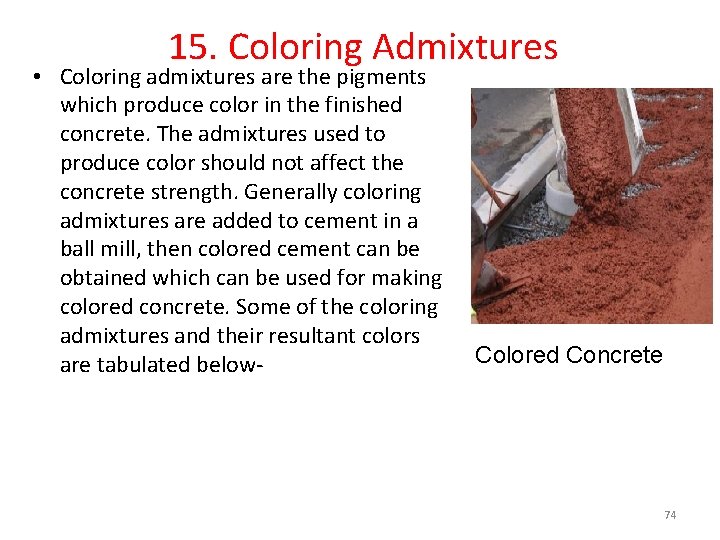
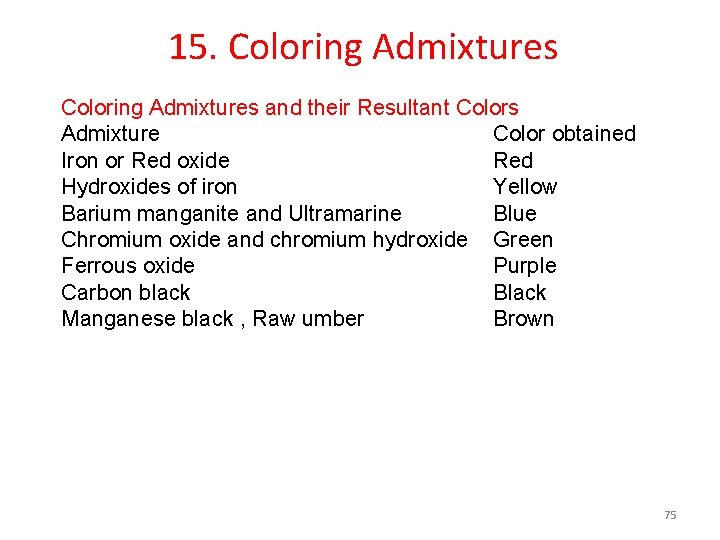
15. Coloring Admixtures • Coloring admixtures are the pigments which produce color in the finished concrete. The admixtures used to produce color should not affect the concrete strength. Generally coloring admixtures are added to cement in a ball mill, then colored cement can be obtained which can be used for making colored concrete. Some of the coloring admixtures and their resultant colors are tabulated below- Colored Concrete 74
15. Coloring Admixtures and their Resultant Colors Admixture Color obtained Iron or Red oxide Red Hydroxides of iron Yellow Barium manganite and Ultramarine Blue Chromium oxide and chromium hydroxide Green Ferrous oxide Purple Carbon black Black Manganese black , Raw umber Brown 75
Thanks 76
Provision of IS 456 10 PRODUCTION OF CONCRETE 10. 1 Quality Assurance Measures 10. 1. 1 In order that the properties of the completed structure be consistent with the requirements and the assumptions made during the planning and the design, adequate quality assurance measures shall be taken. The construction should result in satisfactory strength, serviceability and long term durability so as to lower the overall lifecycle cost. Quality assurance in construction activity relates to proper design, use of adequate materials and components to be supplied by the producers, proper workmanship in the execution of works by the contractor and ultimately proper care during the use of structure including timely maintenance and repair by the owner. 77
Provision of IS 456 10. 1. 2 Quality assurance measures are both technical and organizational. Some common cases should be specified in a general Quality Assurance Plan which shall identify the key elements necessary to provide fitness of the structure and the means by which they are to be provided and measured with the overall purpose to provide confidence that the realized project will work satisfactorily in service fulfilling intended needs. The job of quality control and quality assurance would involve quality audit of both the inputs as well as the outputs. Inputs are in the form of materials for concrete: workmanship in all stages of batching. mixing, transportation, placing, compaction and curing: and the related plant, machinery and equipments: resulting in the output in the form of concrete in place. To ensure proper performance, it is necessary that each step in concreting which wi 11 be covered by the next step is inspected as the work proceeds (see also 17). 78
10. 1. 3 Each party involved in the realization of a project should establish and implement a Quality Assurance Plan. for its participation in the project. Supplier's and subcontractor's activities shall be covered in the plan. The individual Quality Assurance Plans shall tit into the general Quality Assurance Plan. A Quality Assurance Plan shall define the tasks and responsibilities of all persons involved. Adequate control and checking procedures, and the organization and maintaining adequate documentation of the building process and its results. Such documentation should generally include: a) test reports and manufacturer's certificate for materials. concrete mix design details; b) pour cards for site organization and clearance for concrete placement; c) record of site inspectionof workmanship, field tests; d) non-conformance reports. change orders; e) quality control charts; and f) statistical analysis. NOTE-Quality control charts are recommended wherever the concrete is in continuous production over considerable period. 79