
Standard Position Coterminal and Reference Angles Measure of
- Slides: 16
Standard Position, Coterminal and Reference Angles
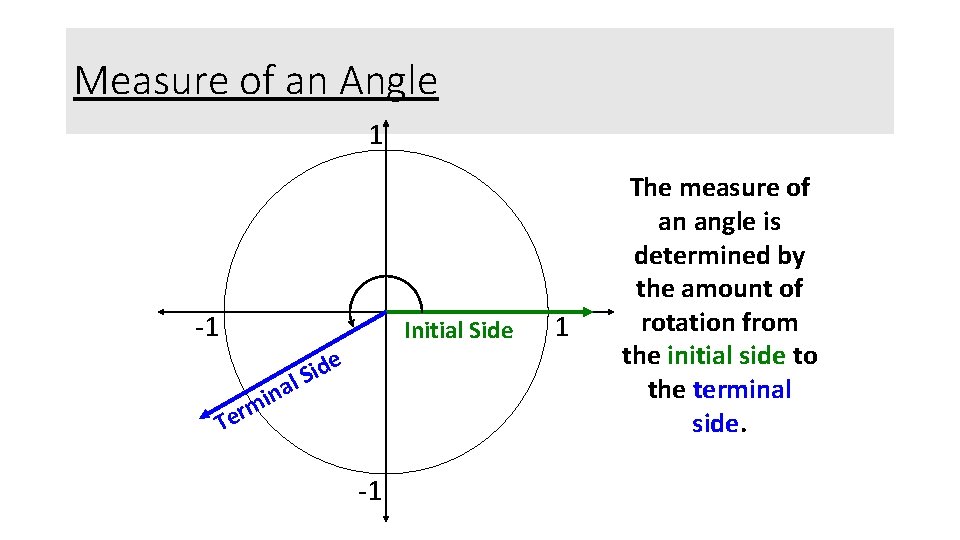
Measure of an Angle 1 -1 Initial Side n i m er T e d i al S -1 1 The measure of an angle is determined by the amount of rotation from the initial side to the terminal side.
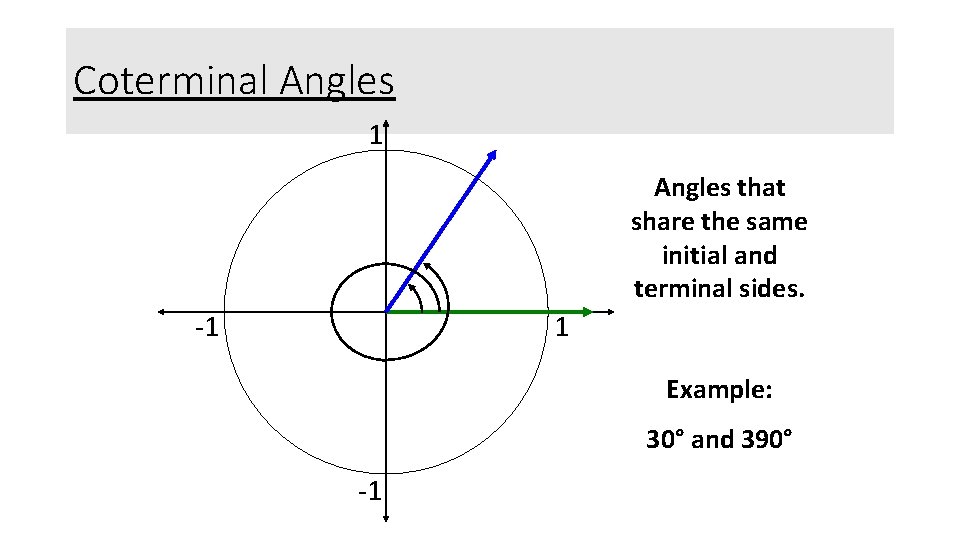
Coterminal Angles 1 Angles that share the same initial and terminal sides. -1 1 Example: 30° and 390° -1
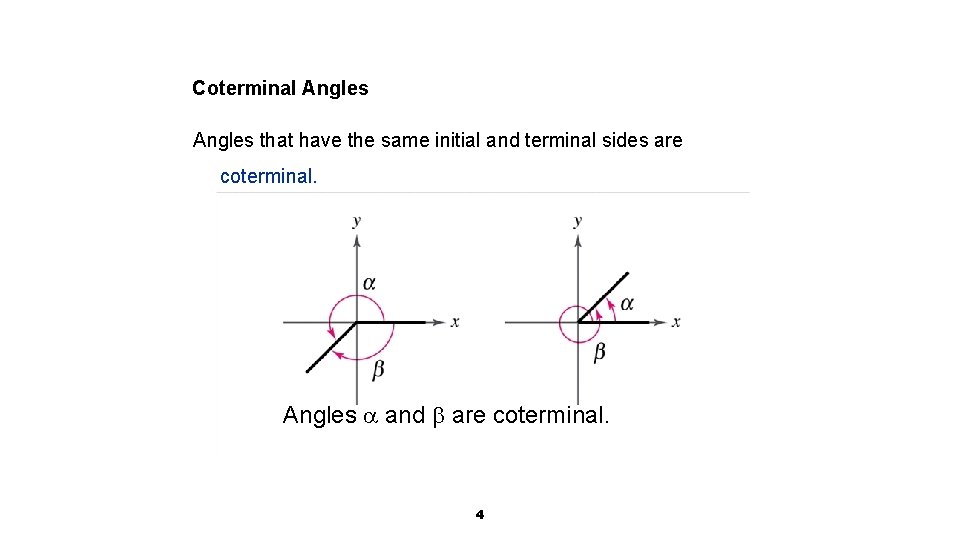
Coterminal Angles that have the same initial and terminal sides are coterminal. Angles and are coterminal. 4
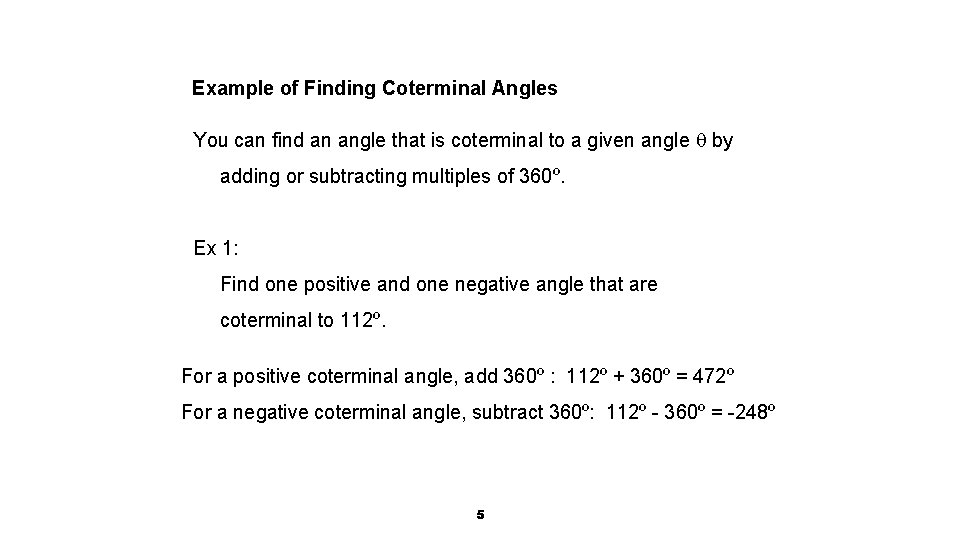
Example of Finding Coterminal Angles You can find an angle that is coterminal to a given angle by adding or subtracting multiples of 360º. Ex 1: Find one positive and one negative angle that are coterminal to 112º. For a positive coterminal angle, add 360º : 112º + 360º = 472º For a negative coterminal angle, subtract 360º: 112º - 360º = -248º 5
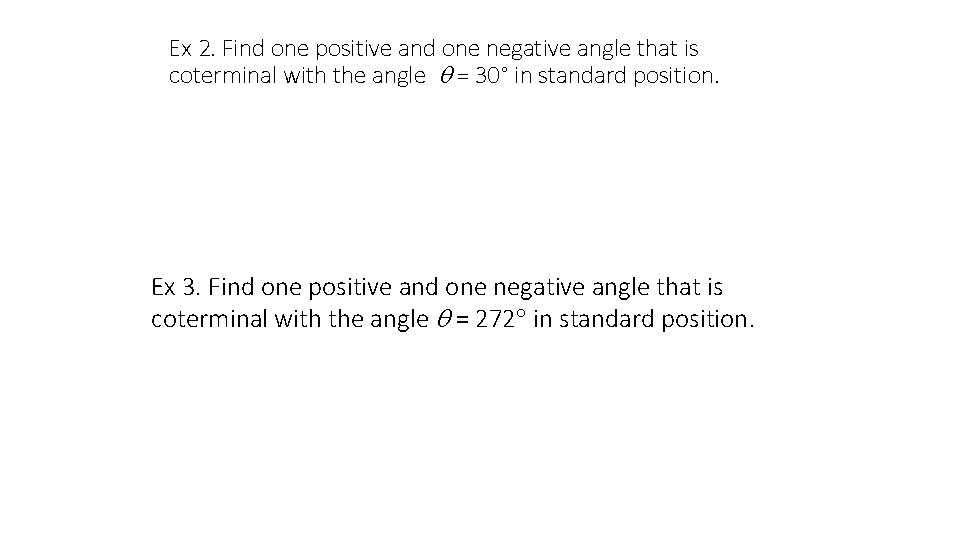
Ex 2. Find one positive and one negative angle that is coterminal with the angle = 30° in standard position. Ex 3. Find one positive and one negative angle that is coterminal with the angle = 272 in standard position.
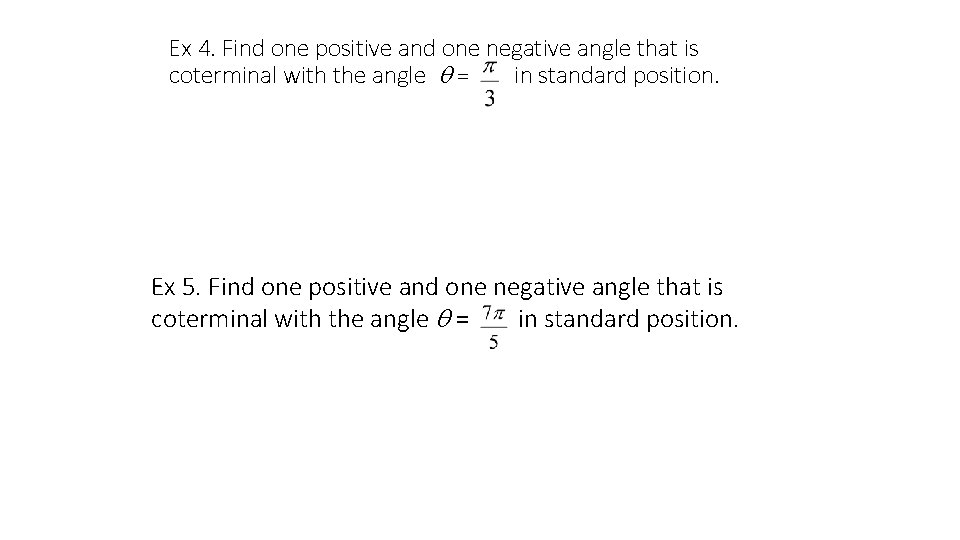
Ex 4. Find one positive and one negative angle that is coterminal with the angle = in standard position. Ex 5. Find one positive and one negative angle that is coterminal with the angle = in standard position.
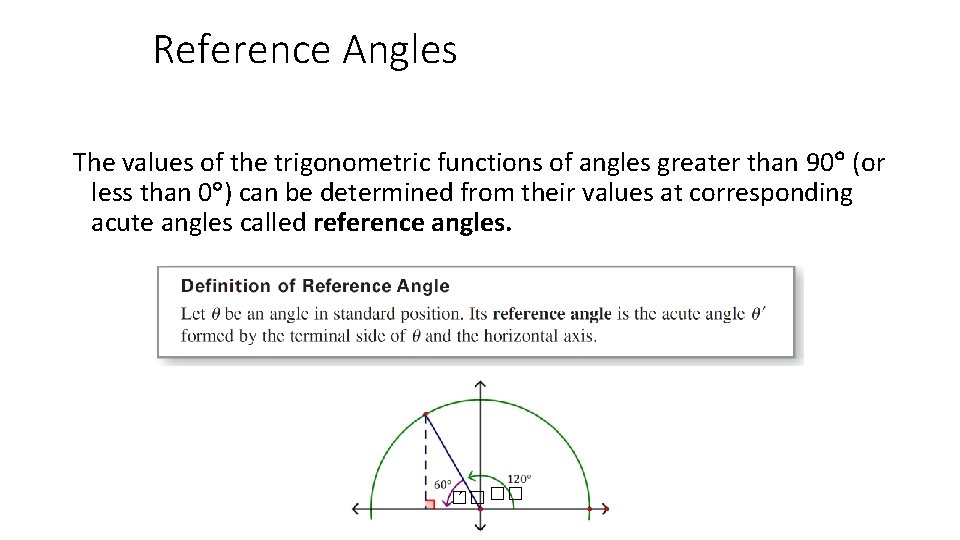
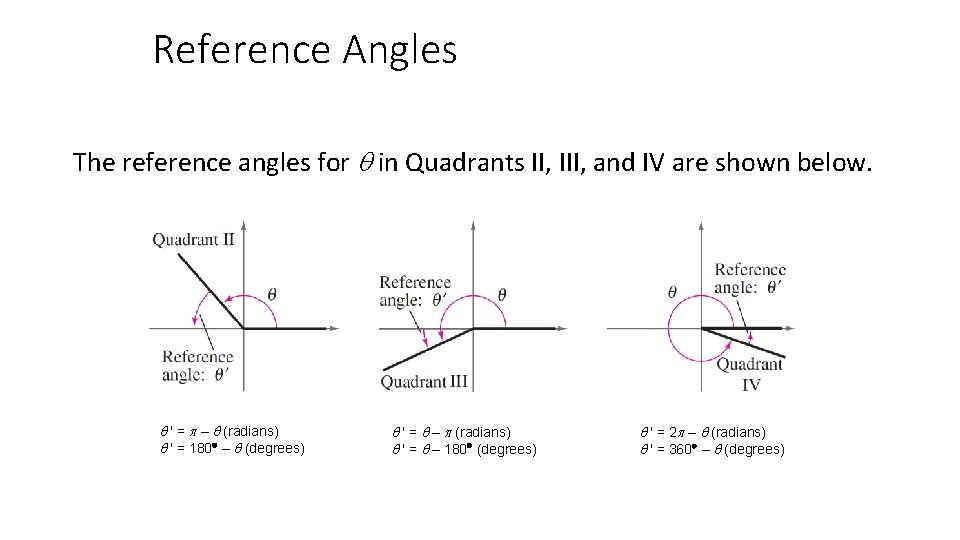
Reference Angles The values of the trigonometric functions of angles greater than 90 (or less than 0 ) can be determined from their values at corresponding acute angles called reference angles. �� ’ ��
Reference Angles The reference angles for in Quadrants II, III, and IV are shown below. ′ = – (radians) ′ = 180 – (degrees) ′ = – (radians) ′ = – 180 (degrees) ′ = 2 – (radians) ′ = 360 – (degrees)
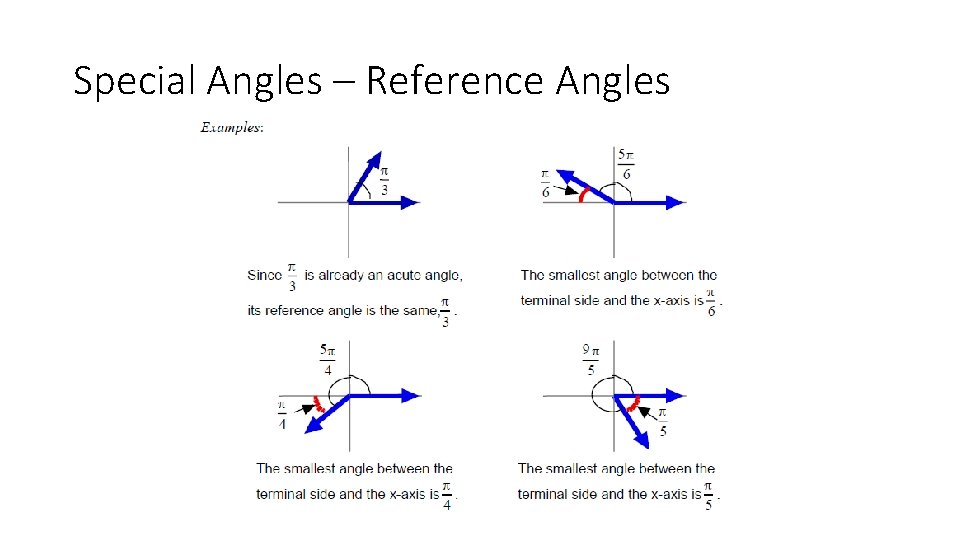
Special Angles – Reference Angles
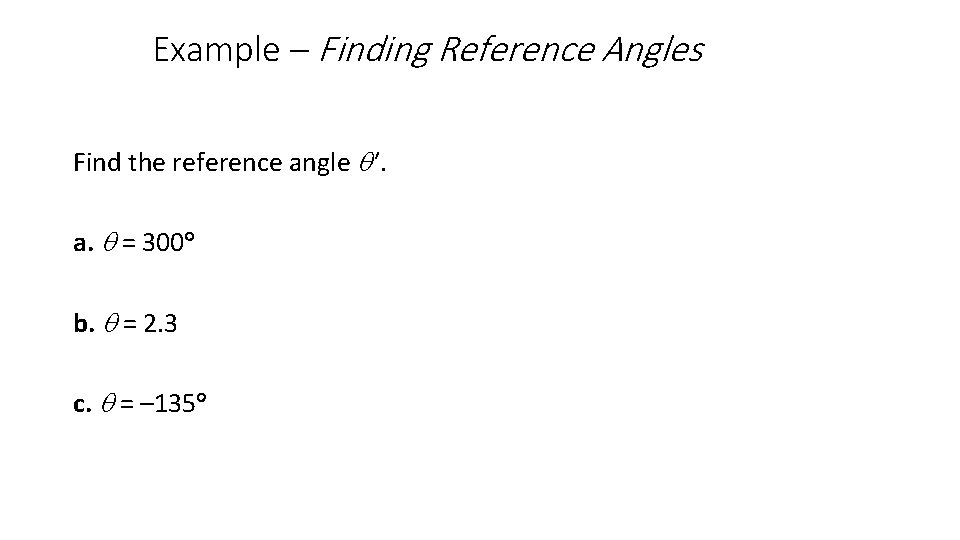
Example – Finding Reference Angles Find the reference angle ′. a. = 300 b. = 2. 3 c. = – 135
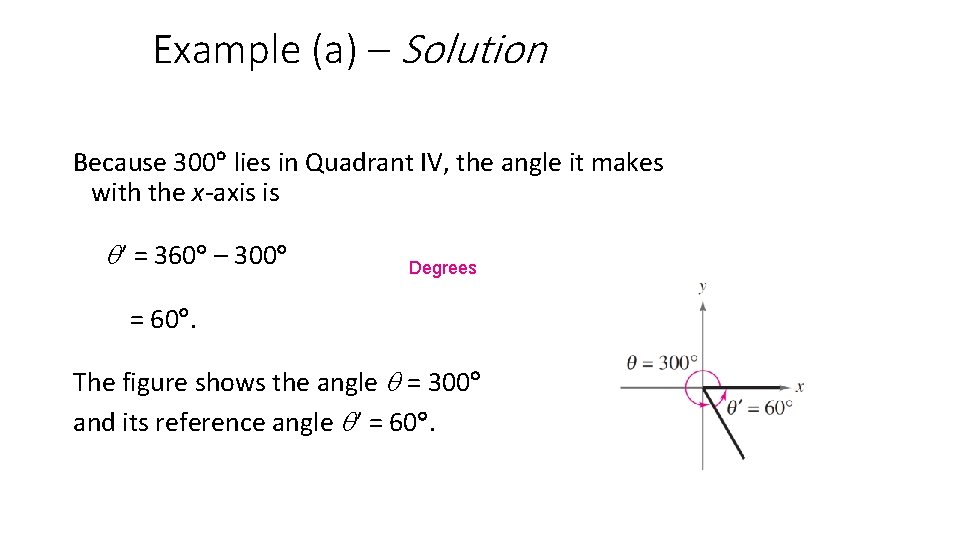
Example (a) – Solution Because 300 lies in Quadrant IV, the angle it makes with the x-axis is ′ = 360 – 300 Degrees = 60. The figure shows the angle = 300 and its reference angle ′ = 60.
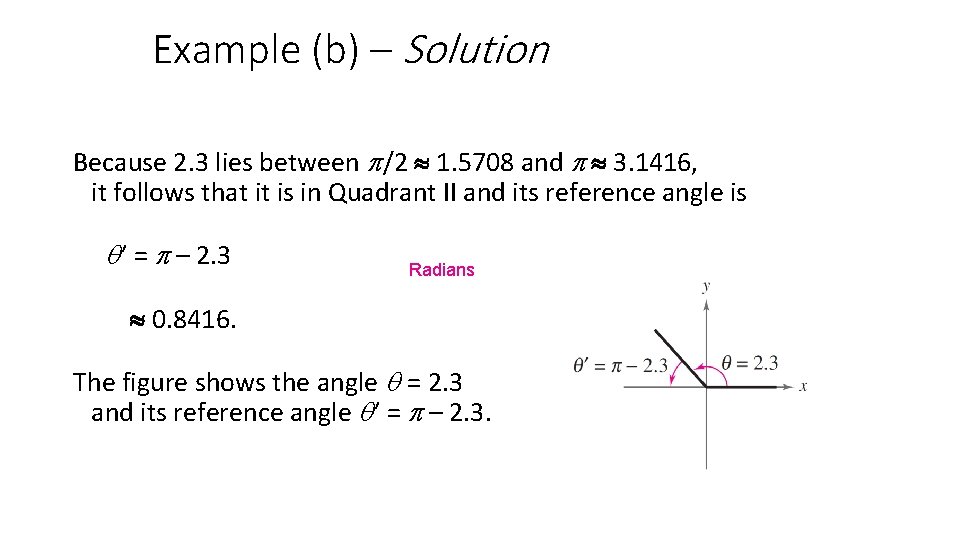
Example (b) – Solution Because 2. 3 lies between /2 1. 5708 and 3. 1416, it follows that it is in Quadrant II and its reference angle is ′ = – 2. 3 Radians 0. 8416. The figure shows the angle = 2. 3 and its reference angle ′ = – 2. 3. cont’d
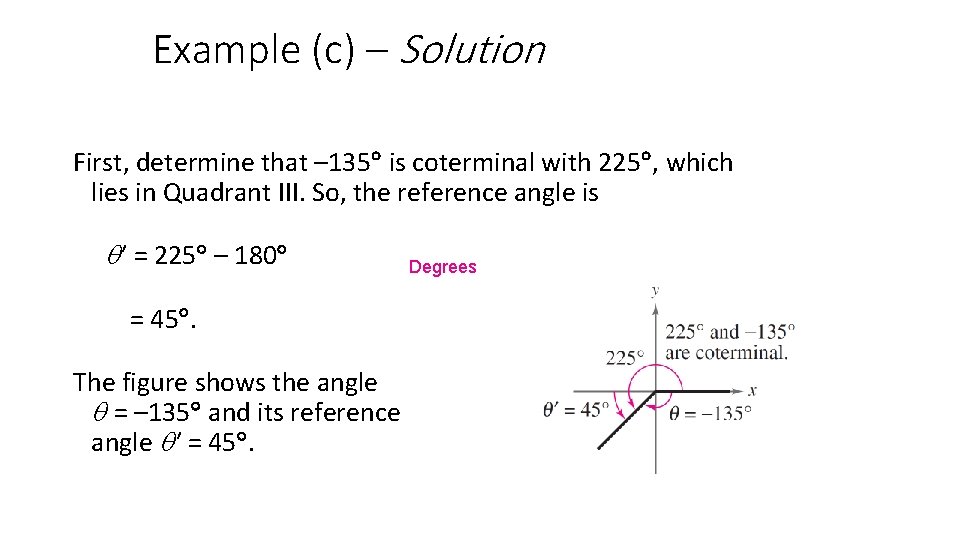
Example (c) – Solution First, determine that – 135 is coterminal with 225 , which lies in Quadrant III. So, the reference angle is ′ = 225 – 180 = 45. The figure shows the angle = – 135 and its reference angle ′ = 45. Degrees cont’d
Reference Angles When your angle is negative or is greater than one revolution, to find the reference angle, first find the positive coterminal angle between 0° and 360° or 0 and 2��.
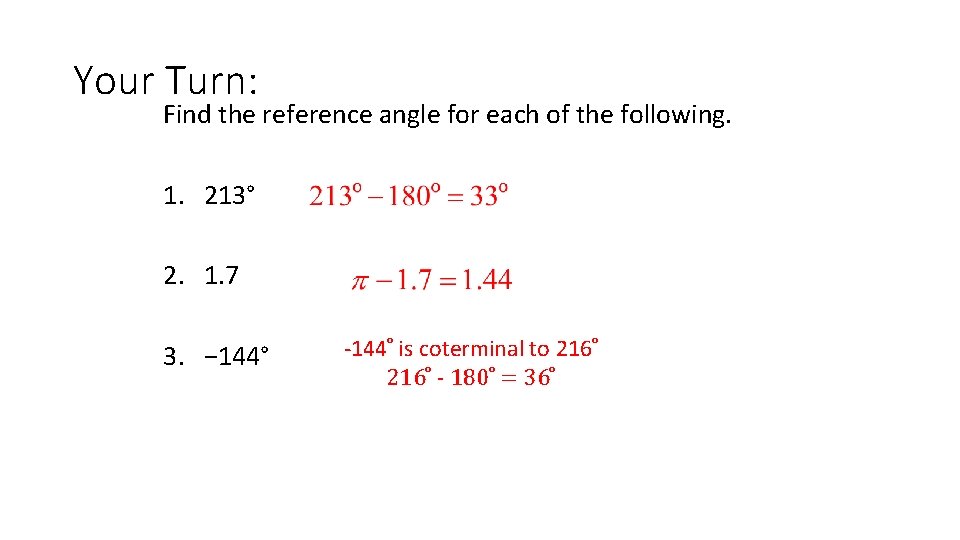
Your Turn: Find the reference angle for each of the following. 1. 213° 2. 1. 7 3. − 144° -144 is coterminal to 216 - 180 = 36