
Standard Operating Procedures Why do pilots not always
- Slides: 20
Standard Operating Procedures Why do pilots not (always) follow procedures?
Procedures and SOPs constitute the reference for crew standardization and provide the working environment required for enhanced and efficient crew communication and coordination. l To ensure effective compliance with published procedures and SOPs, it is important to understand why pilots intentionally or inadvertently deviate l In most cases of deviation, the procedure that was followed in place of the correct one seemed to be appropriate, considering the information available Non Adherence to Procedures Page 1. PQ_03_Vis_Issue 1
Purposes of Procedures and SOPs l Establish a common action project l Reduce ambiguities and error risks l Guarantee better task sharing l Reduce crew workload l Facilitate mastering actions and errors l Contribute to situational awareness l Reduce risks of conflicts • ICAO Air Nav Services on A/C Operations • FAA AC 120 -71 + JAR-OPS 1. 104 • IATA HFWG on “Adherence to SOP” Non Adherence to Procedures Page 1. PQ_03_Vis_Issue 1
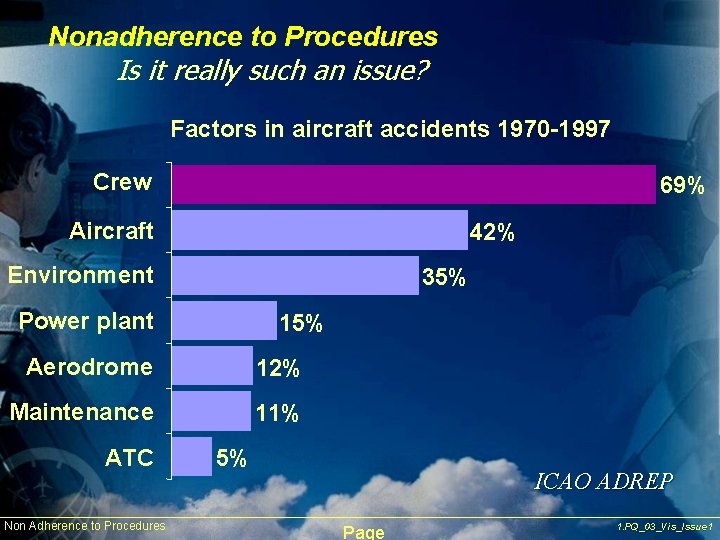
Outline and Objective of the Presentation l In earlier times: Incidents and accidents were linked with catastrophic structural, engine or system failures or with bad weather Technical evolutions led to a decline of catastrophic failures l At present: Primary and contributory causes are mostly crew-related (two out of three) l Non-adherence to procedures and SOPs as a threat: Sources on human error abound: ICAO ADREP, FSF ALAR Line operations safety audits (LOSA) and reporting confirm the rise of procedural errors Non Adherence to Procedures Page 1. PQ_03_Vis_Issue 1
Nonadherence to Procedures Is it really such an issue? Factors in aircraft accidents 1970 -1997 Crew 69% Aircraft 42% Environment 35% Power plant 15% Aerodrome 12% Maintenance 11% ATC Non Adherence to Procedures 5% ICAO ADREP Page 1. PQ_03_Vis_Issue 1
Line Operations Safety Audit (LOSA) Error Frequencies But what about consequences? Non Adherence to Procedures Page UTX 1. PQ_03_Vis_Issue 1
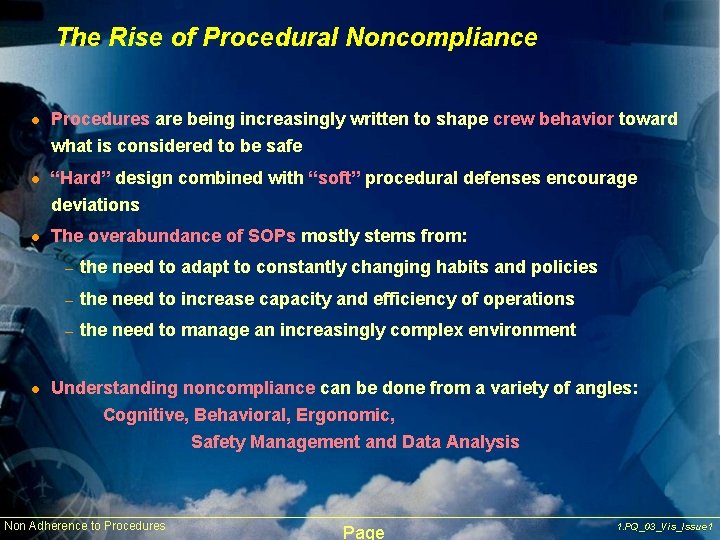
The Rise of Procedural Noncompliance l Procedures are being increasingly written to shape crew behavior toward what is considered to be safe l “Hard” design combined with “soft” procedural defenses encourage deviations l The overabundance of SOPs mostly stems from: l – the need to adapt to constantly changing habits and policies – the need to increase capacity and efficiency of operations – the need to manage an increasingly complex environment Understanding noncompliance can be done from a variety of angles: Cognitive, Behavioral, Ergonomic, Safety Management and Data Analysis Non Adherence to Procedures Page 1. PQ_03_Vis_Issue 1
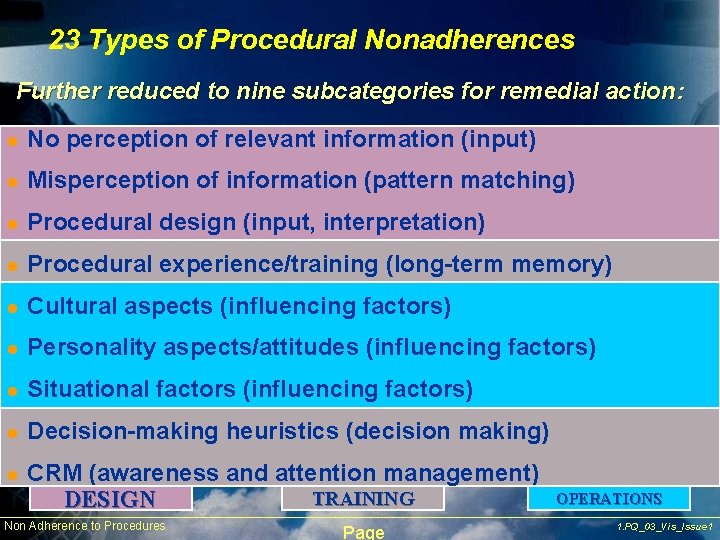
23 Types of Procedural Nonadherences Further reduced to nine subcategories for remedial action: l No perception of relevant information (input) l Misperception of information (pattern matching) l Procedural design (input, interpretation) l Procedural experience/training (long-term memory) l Cultural aspects (influencing factors) l Personality aspects/attitudes (influencing factors) l Situational factors (influencing factors) l Decision-making heuristics (decision making) l CRM (awareness and attention management) TRAINING DESIGN Non Adherence to Procedures Page OPERATIONS 1. PQ_03_Vis_Issue 1
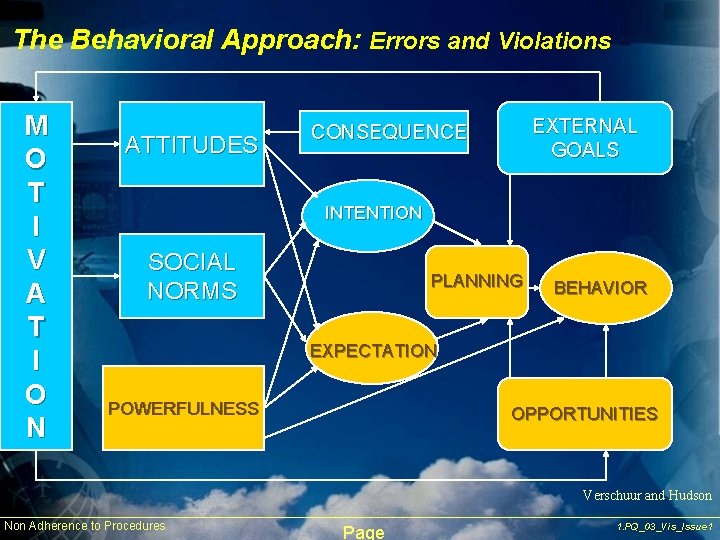
The Behavioral Approach: Errors and Violations M O T I V A T I O N ATTITUDES EXTERNAL GOALS CONSEQUENCE INTENTION SOCIAL NORMS PLANNING BEHAVIOR EXPECTATION POWERFULNESS OPPORTUNITIES Verschuur and Hudson Non Adherence to Procedures Page 1. PQ_03_Vis_Issue 1
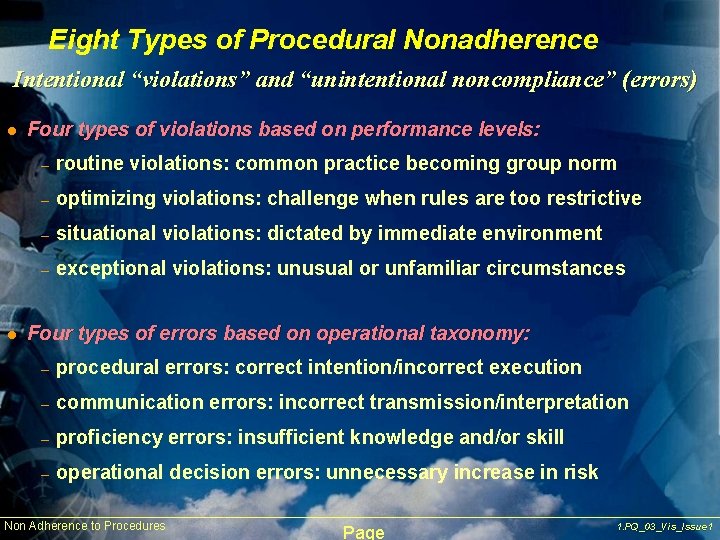
Eight Types of Procedural Nonadherence Intentional “violations” and “unintentional noncompliance” (errors) l l Four types of violations based on performance levels: – routine violations: common practice becoming group norm – optimizing violations: challenge when rules are too restrictive – situational violations: dictated by immediate environment – exceptional violations: unusual or unfamiliar circumstances Four types of errors based on operational taxonomy: – procedural errors: correct intention/incorrect execution – communication errors: incorrect transmission/interpretation – proficiency errors: insufficient knowledge and/or skill – operational decision errors: unnecessary increase in risk Non Adherence to Procedures Page 1. PQ_03_Vis_Issue 1
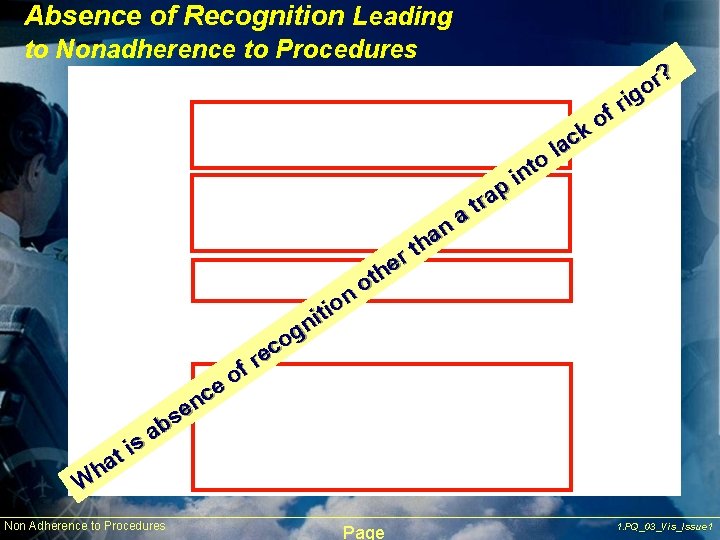
Absence of Recognition Leading to Nonadherence to Procedures a n ha t r e h ot n o i it n g o ec r f o e c n e s b sa i t a h W Non Adherence to Procedures Page to n i p tra f o k c la r? o rig 1. PQ_03_Vis_Issue 1
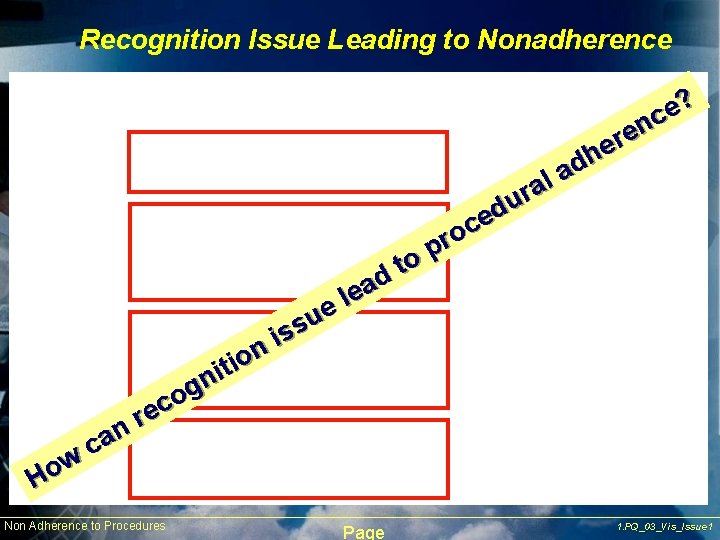
Recognition Issue Leading to Nonadherence w o H n ca n o i t i n g o c re Non Adherence to Procedures e u iss ? e c n e r e h d a al r u d e c o r p o t d lea Page 1. PQ_03_Vis_Issue 1
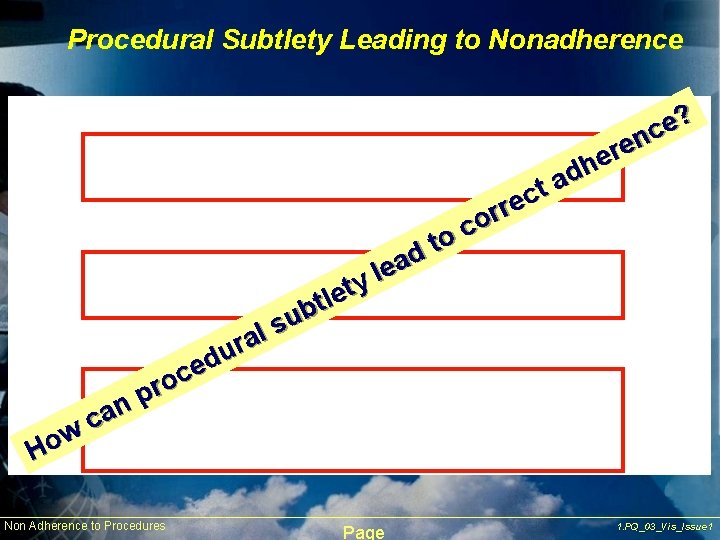
Procedural Subtlety Leading to Nonadherence an c w o H ? e c n e er h d a t c e r r o c o t d a e l y t e l bt u s l ra u d e c o r p Non Adherence to Procedures Page 1. PQ_03_Vis_Issue 1
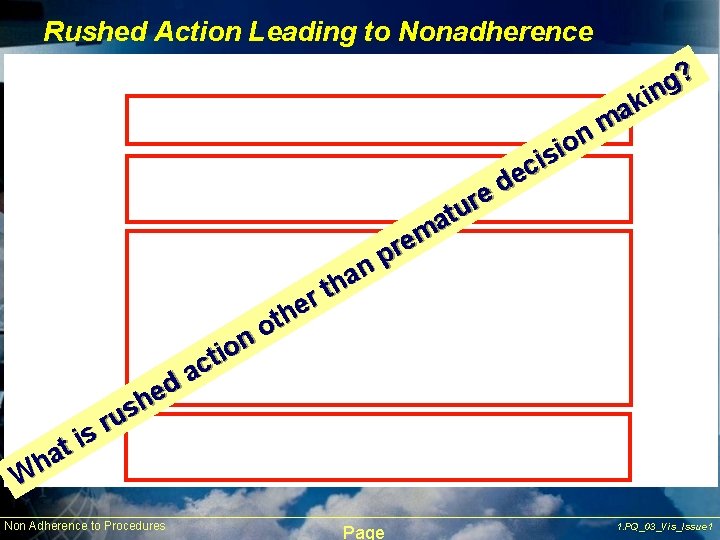
Rushed Action Leading to Nonadherence is t a h W n o i t c a d e h s u r Non Adherence to Procedures n a h t r e oth e r u t a m e pr Page n o i is c de ? g in k ma 1. PQ_03_Vis_Issue 1
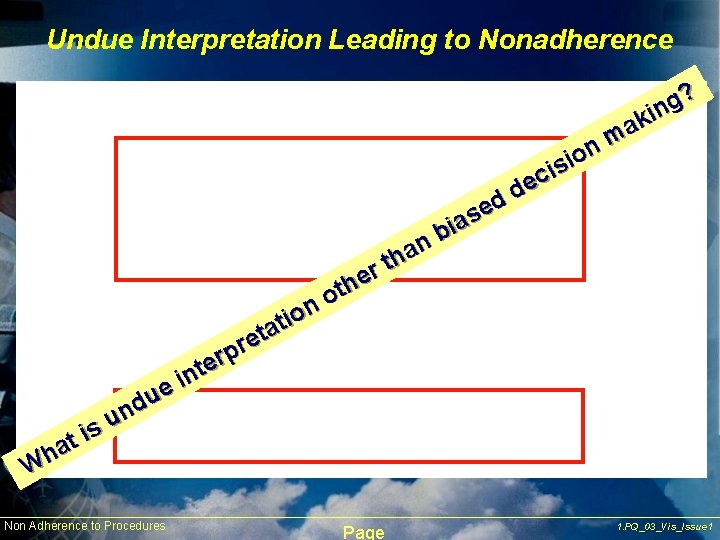
Undue Interpretation Leading to Nonadherence is t a h W e u d n u Non Adherence to Procedures n a h t r e h t o n o i t a t e r p r e t n i Page d e s a i b n o i is c de ? g in k ma 1. PQ_03_Vis_Issue 1
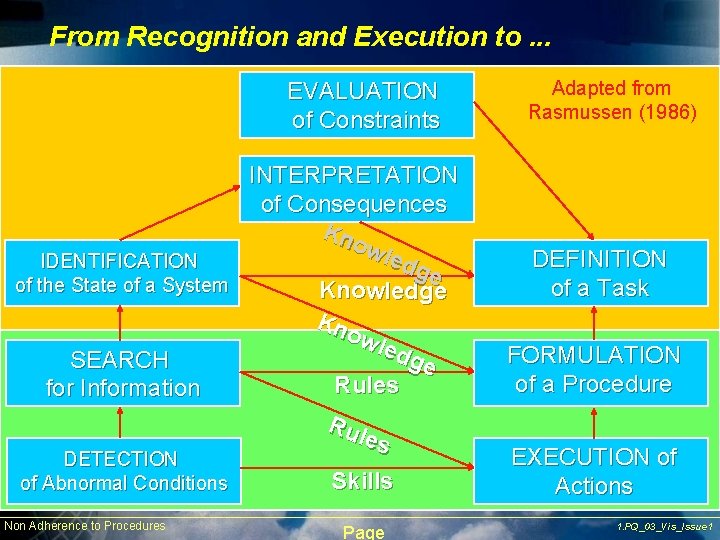
From Recognition and Execution to. . . EVALUATION of Constraints INTERPRETATION of Consequences Kn ow led IDENTIFICATION ge of the State of a System Knowledge Kn ow led ge SEARCH Rules for Information Rul es DETECTION of Abnormal Conditions Non Adherence to Procedures Skills Page Adapted from Rasmussen (1986) DEFINITION of a Task FORMULATION of a Procedure EXECUTION of Actions 1. PQ_03_Vis_Issue 1
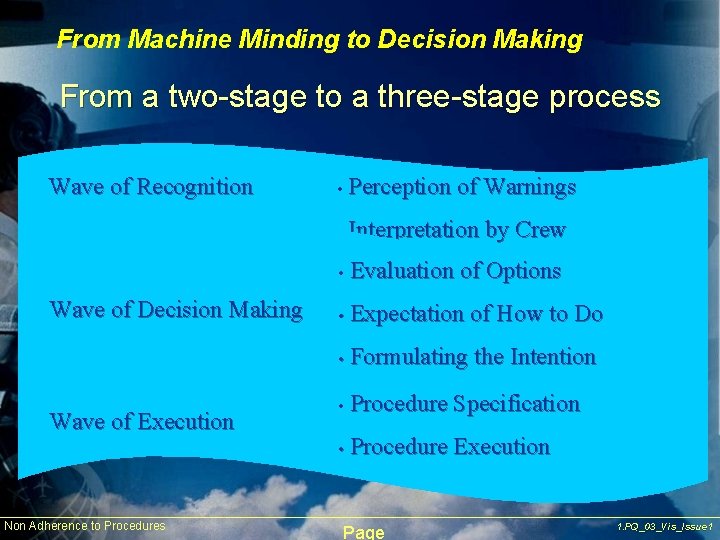
From Machine Minding to Decision Making From a two-stage to a three-stage process Wave of Recognition Wave of Decision Making Wave of Execution Non Adherence to Procedures • Perception of Warnings • Interpretation by Crew • Evaluation of Options • Expectation of How to Do • Formulating the Intention • Procedure Specification • Procedure Execution Page 1. PQ_03_Vis_Issue 1
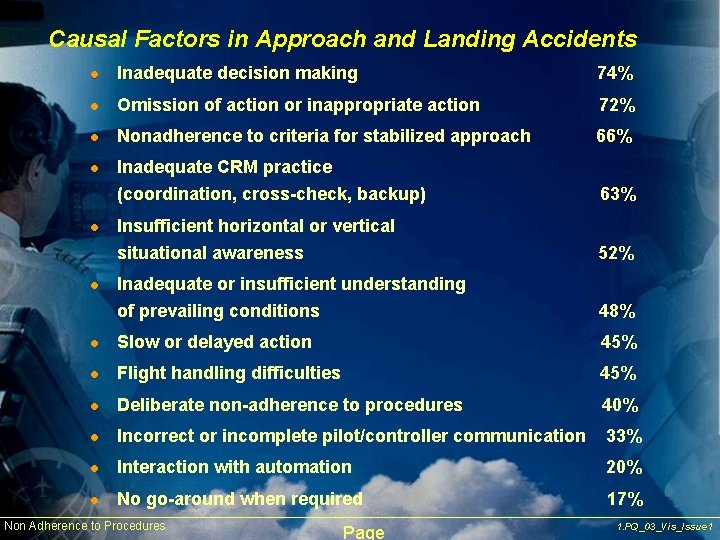
Causal Factors in Approach and Landing Accidents l Inadequate decision making 74% l Omission of action or inappropriate action 72% l Nonadherence to criteria for stabilized approach 66% l Inadequate CRM practice (coordination, cross-check, backup) l Insufficient horizontal or vertical situational awareness l 63% 52% Inadequate or insufficient understanding of prevailing conditions 48% l Slow or delayed action 45% l Flight handling difficulties 45% l Deliberate non-adherence to procedures 40% l Incorrect or incomplete pilot/controller communication 33% l Interaction with automation 20% l No go-around when required 17% Non Adherence to Procedures Page 1. PQ_03_Vis_Issue 1
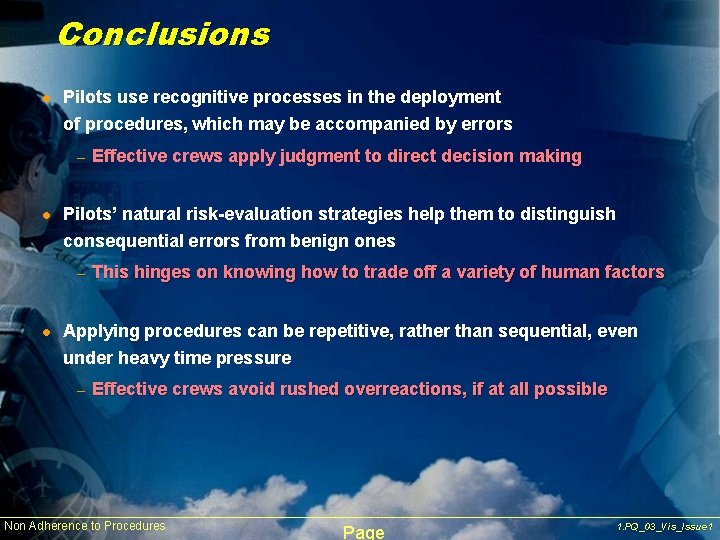
Conclusions l Pilots use recognitive processes in the deployment of procedures, which may be accompanied by errors – l Pilots’ natural risk-evaluation strategies help them to distinguish consequential errors from benign ones – l Effective crews apply judgment to direct decision making This hinges on knowing how to trade off a variety of human factors Applying procedures can be repetitive, rather than sequential, even under heavy time pressure – Effective crews avoid rushed overreactions, if at all possible Non Adherence to Procedures Page 1. PQ_03_Vis_Issue 1
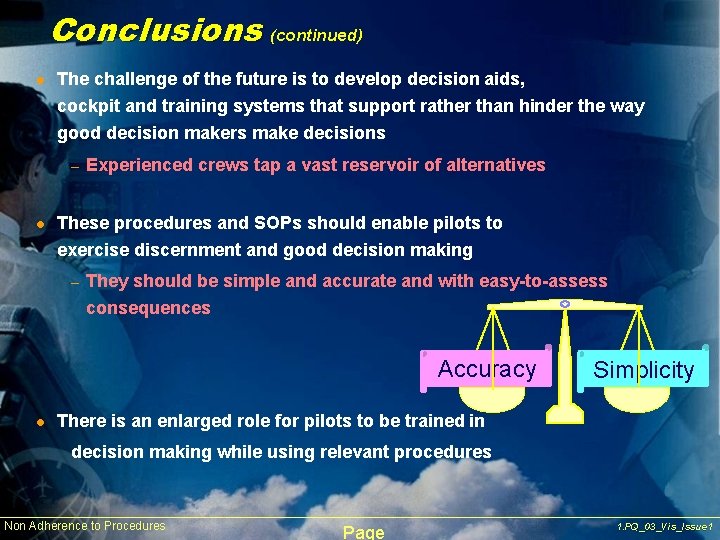
Conclusions (continued) l The challenge of the future is to develop decision aids, cockpit and training systems that support rather than hinder the way good decision makers make decisions – l Experienced crews tap a vast reservoir of alternatives These procedures and SOPs should enable pilots to exercise discernment and good decision making – They should be simple and accurate and with easy-to-assess consequences Accuracy l Simplicity There is an enlarged role for pilots to be trained in decision making while using relevant procedures Non Adherence to Procedures Page 1. PQ_03_Vis_Issue 1