
Standard Operating Procedure SOP for Triage of Suspected





- Slides: 29
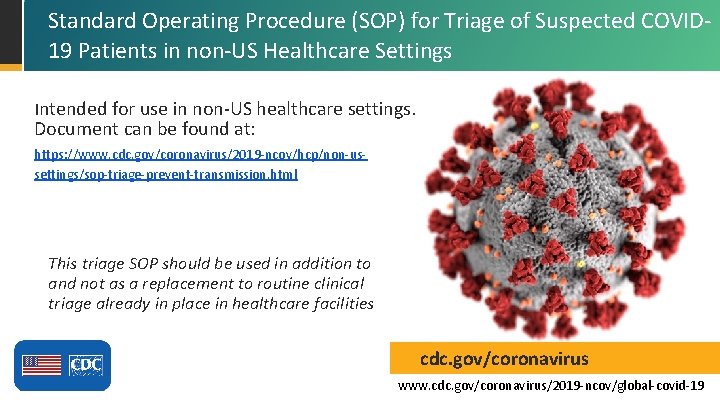
Standard Operating Procedure (SOP) for Triage of Suspected COVID 19 Patients in non-US Healthcare Settings Intended for use in non-US healthcare settings. Document can be found at: https: //www. cdc. gov/coronavirus/2019 -ncov/hcp/non-ussettings/sop-triage-prevent-transmission. html This triage SOP should be used in addition to and not as a replacement to routine clinical triage already in place in healthcare facilities cdc. gov/coronavirus Some slides contain additional information in the Slide Notes. www. cdc. gov/coronavirus/2019 -ncov/global-covid-19
Outline § COVID-19 background § Definition of triage § What patients can do before and upon arrival to healthcare facility § What healthcare facilities can do to minimize risk of infection among patients and healthcare workers § What healthcare workers can do to protect themselves and their patients during triage § Considerations to maintain healthcare delivery as number of COVID-19 cases increases
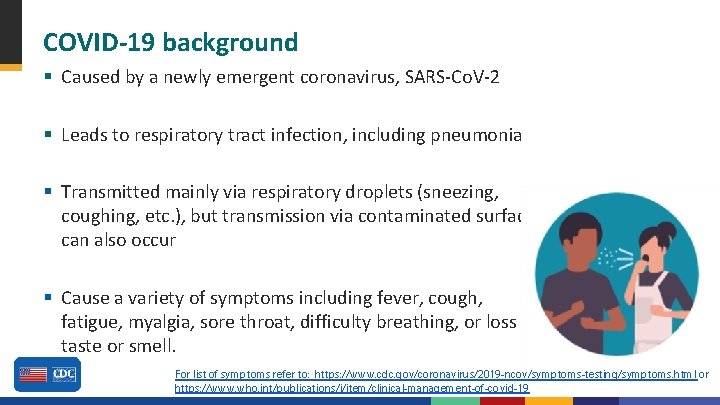
COVID-19 background § Caused by a newly emergent coronavirus, SARS-Co. V-2 § Leads to respiratory tract infection, including pneumonia § Transmitted mainly via respiratory droplets (sneezing, coughing, etc. ), but transmission via contaminated surfaces can also occur § Cause a variety of symptoms including fever, cough, fatigue, myalgia, sore throat, difficulty breathing, or loss of taste or smell. For list of symptoms refer to: https: //www. cdc. gov/coronavirus/2019 -ncov/symptoms-testing/symptoms. html or https: //www. who. int/publications/i/item/clinical-management-of-covid-19
What is triage? § The sorting out and classification of patients to determine priority of need and proper place of treatment § For COVID-19 outbreak, triage is particularly important to separate patients likely to be infected with the virus that causes COVID-19 § Effective triage can prevent transmission of the virus that causes COVID-19 to patients and healthcare workers (HCWs)
What Patients Can Do
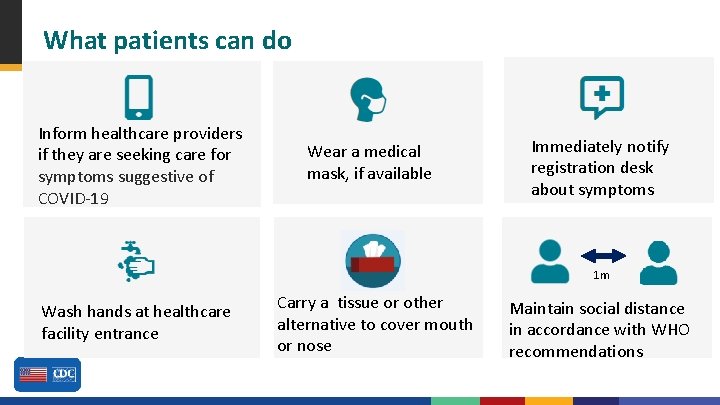
What patients can do Inform healthcare providers if they are seeking care for symptoms suggestive of COVID-19 Wear a medical mask, if available Immediately notify registration desk about symptoms 1 m Wash hands at healthcare facility entrance Carry a tissue or other alternative to cover mouth or nose Maintain social distance in accordance with WHO recommendations
What Healthcare Facilities Can Do
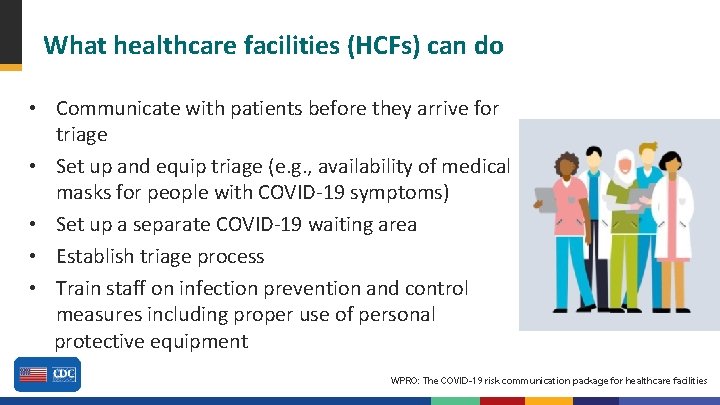
What healthcare facilities (HCFs) can do • Communicate with patients before they arrive for triage • Set up and equip triage (e. g. , availability of medical masks for people with COVID-19 symptoms) • Set up a separate COVID-19 waiting area • Establish triage process • Train staff on infection prevention and control measures including proper use of personal protective equipment WPRO: The COVID-19 risk communication package for healthcare facilities
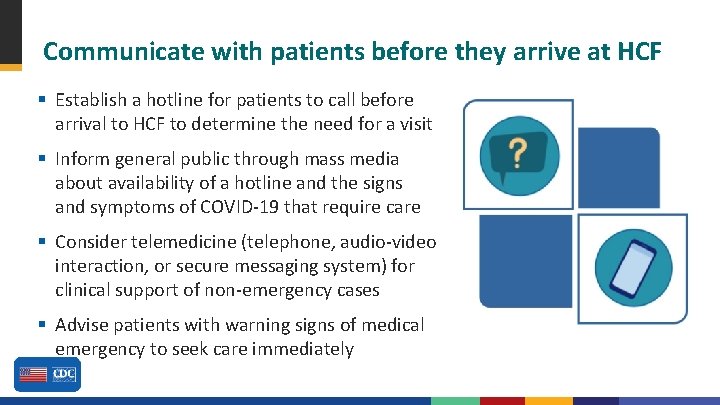
Communicate with patients before they arrive at HCF § Establish a hotline for patients to call before arrival to HCF to determine the need for a visit § Inform general public through mass media about availability of a hotline and the signs and symptoms of COVID-19 that require care § Consider telemedicine (telephone, audio-video interaction, or secure messaging system) for clinical support of non-emergency cases § Advise patients with warning signs of medical emergency to seek care immediately
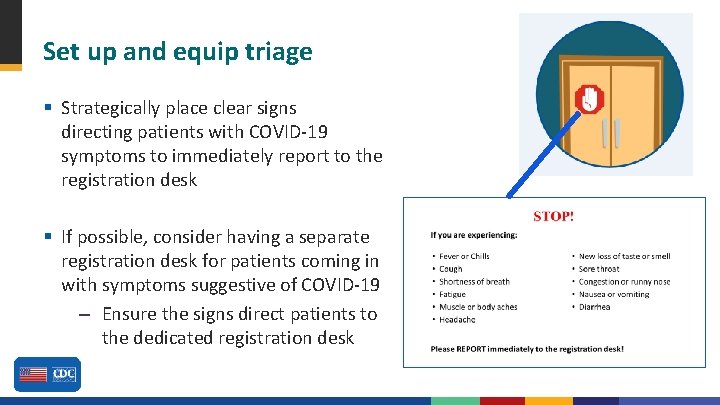
Set up and equip triage § Strategically place clear signs directing patients with COVID-19 symptoms to immediately report to the registration desk § If possible, consider having a separate registration desk for patients coming in with symptoms suggestive of COVID-19 – Ensure the signs direct patients to the dedicated registration desk
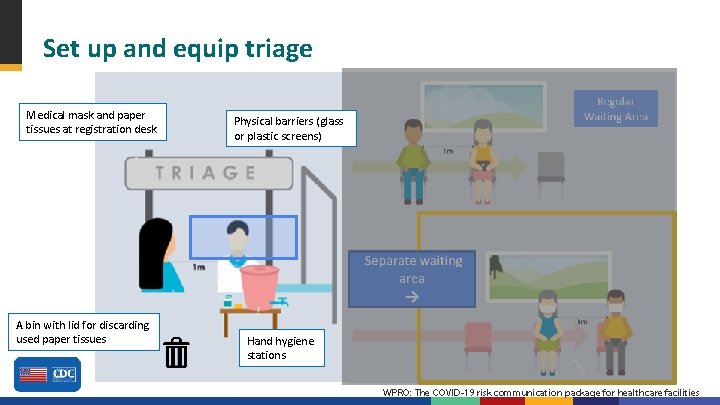
Set up and equip triage Medical mask and paper tissues at registration desk A bin with lid for discarding used paper tissues Physical barriers (glass or plastic screens) Hand hygiene stations WPRO: The COVID-19 risk communication package for healthcare facilities
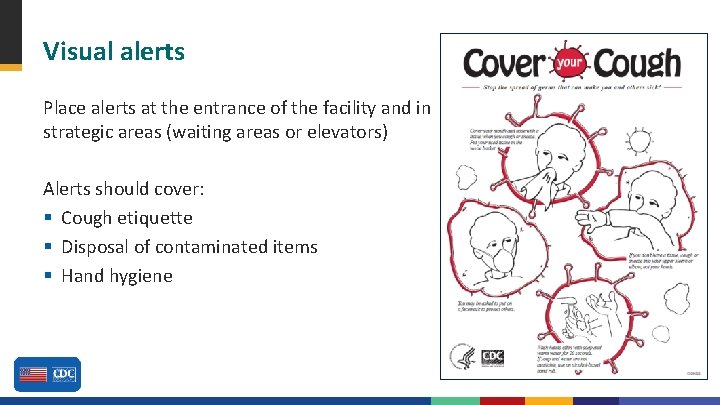
Visual alerts Place alerts at the entrance of the facility and in strategic areas (waiting areas or elevators) Alerts should cover: § Cough etiquette § Disposal of contaminated items § Hand hygiene
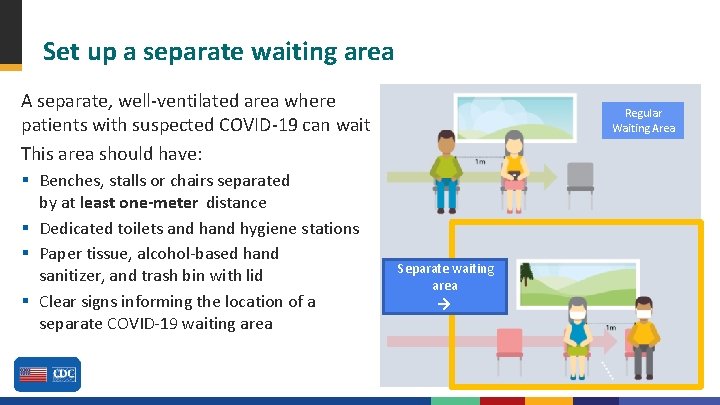
Set up a separate waiting area A separate, well-ventilated area where patients with suspected COVID-19 can wait This area should have: § Benches, stalls or chairs separated by at least one-meter distance § Dedicated toilets and hygiene stations § Paper tissue, alcohol-based hand sanitizer, and trash bin with lid § Clear signs informing the location of a separate COVID-19 waiting area Regular Waiting Area Separate waiting area →
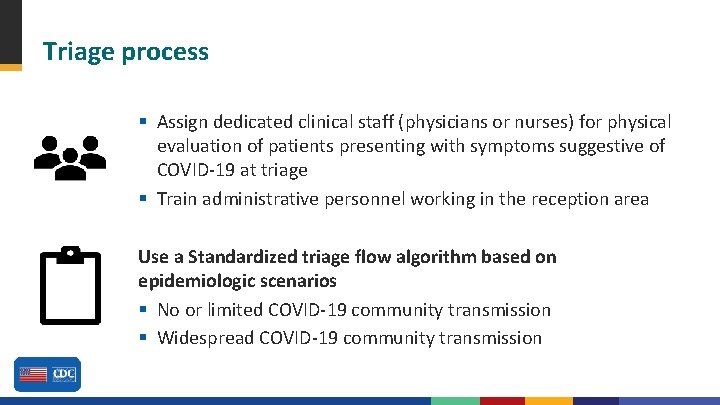
Triage process § Assign dedicated clinical staff (physicians or nurses) for physical evaluation of patients presenting with symptoms suggestive of COVID-19 at triage § Train administrative personnel working in the reception area Use a Standardized triage flow algorithm based on epidemiologic scenarios § No or limited COVID-19 community transmission § Widespread COVID-19 community transmission
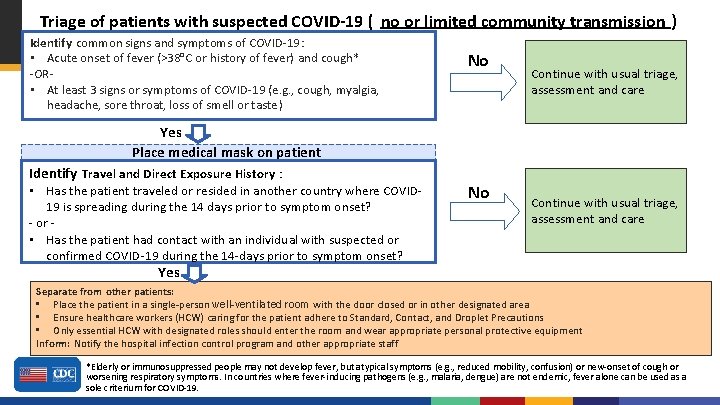
Example of Triage Flow for Countries with No or Limited Community Transmission
Triage of patients with suspected COVID-19 ( no or limited community transmission ) Identify common signs and symptoms of COVID-19: • Acute onset of fever (>38°C or history of fever) and cough* -OR • At least 3 signs or symptoms of COVID-19 (e. g. , cough, myalgia, headache, sore throat, loss of smell or taste ) No Continue with usual triage, assessment and care Yes Place medical mask on patient Identify Travel and Direct Exposure History : • Has the patient traveled or resided in another country where COVID 19 is spreading during the 14 days prior to symptom onset? - or • Has the patient had contact with an individual with suspected or confirmed COVID-19 during the 14 -days prior to symptom onset? No Continue with usual triage, assessment and care Yes Separate from other patients: • Place the patient in a single-person well-ventilated room with the door closed or in other designated area • Ensure healthcare workers (HCW) caring for the patient adhere to Standard, Contact, and Droplet Precautions • Only essential HCW with designated roles should enter the room and wear appropriate personal protective equipment Inform: Notify the hospital infection control program and other appropriate staff *Elderly or immunosuppressed people may not develop fever, but atypical symptoms (e. g. , reduced mobility, confusion) or new-onset of cough or worsening respiratory symptoms. In countries where fever-inducing pathogens (e. g. , malaria, dengue) are not endemic, fever alone can be used as a sole criterium for COVID-19.
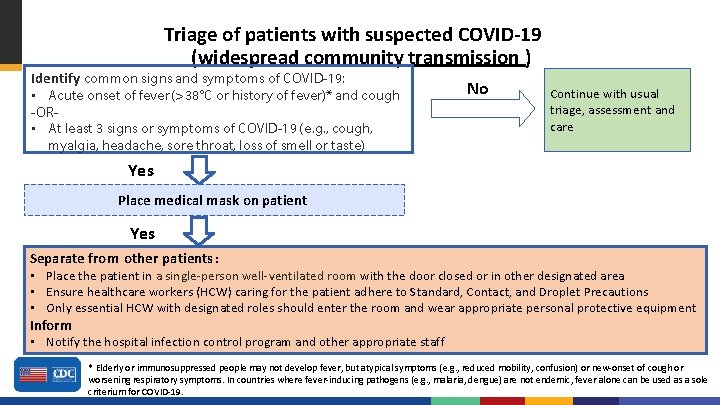
Example Triage Flow for Countries with Widespread Community Transmission
Triage of patients with suspected COVID-19 (widespread community transmission ) Identify common signs and symptoms of COVID-19: • Acute onset of fever (>38°C or history of fever)* and cough -OR • At least 3 signs or symptoms of COVID-19 (e. g. , cough, myalgia, headache, sore throat, loss of smell or taste) No Continue with usual triage, assessment and care Yes Place medical mask on patient Yes Separate from other patients : • Place the patient in a single-person well-ventilated room with the door closed or in other designated area • Ensure healthcare workers (HCW) caring for the patient adhere to Standard, Contact, and Droplet Precautions • Only essential HCW with designated roles should enter the room and wear appropriate personal protective equipment Inform • Notify the hospital infection control program and other appropriate staff * Elderly or immunosuppressed people may not develop fever, but atypical symptoms (e. g. , reduced mobility, confusion) or new-onset of cough or worsening respiratory symptoms. In countries where fever-inducing pathogens (e. g. , malaria, dengue) are not endemic, fever alone can be used as a sole criterium for COVID-19.
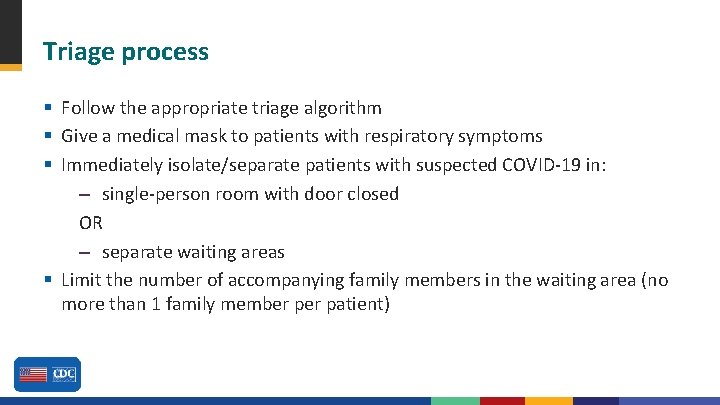
Triage process § Follow the appropriate triage algorithm § Give a medical mask to patients with respiratory symptoms § Immediately isolate/separate patients with suspected COVID-19 in: – single-person room with door closed OR – separate waiting areas § Limit the number of accompanying family members in the waiting area (no more than 1 family member patient)
Cleaning and disinfection of triage area § Clean and disinfect triage area, including separate COVID-19 waiting areas, at least twice a day § Focus on frequently touched surfaces § Disinfect with 0. 1% (1000 ppm) chlorine OR § 70% alcohol for surfaces that do not tolerate chlorine
What Healthcare Workers Can Do
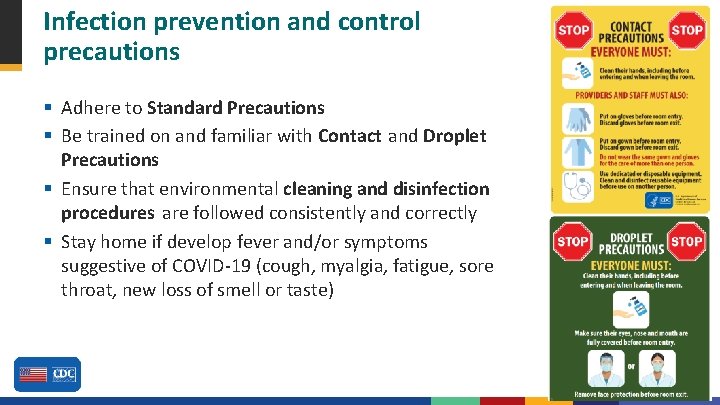
Infection prevention and control precautions § Adhere to Standard Precautions § Be trained on and familiar with Contact and Droplet Precautions § Ensure that environmental cleaning and disinfection procedures are followed consistently and correctly § Stay home if develop fever and/or symptoms suggestive of COVID-19 (cough, myalgia, fatigue, sore throat, new loss of smell or taste)
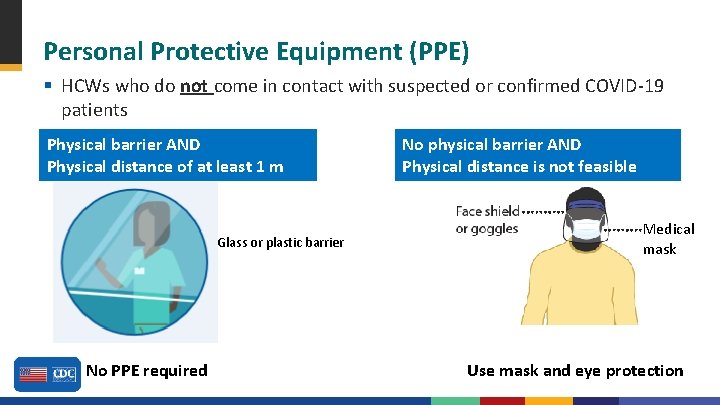
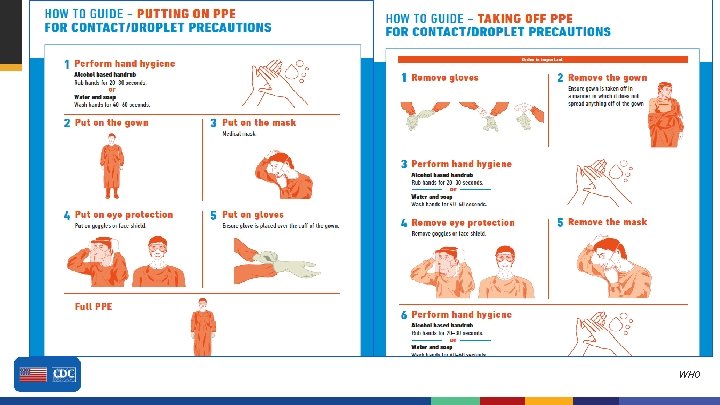
Personal Protective Equipment (PPE) § HCWs who do not come in contact with suspected or confirmed COVID-19 patients Physical barrier AND Physical distance of at least 1 m Glass or plastic barrier No PPE required No physical barrier AND Physical distance is not feasible Medical mask Use mask and eye protection
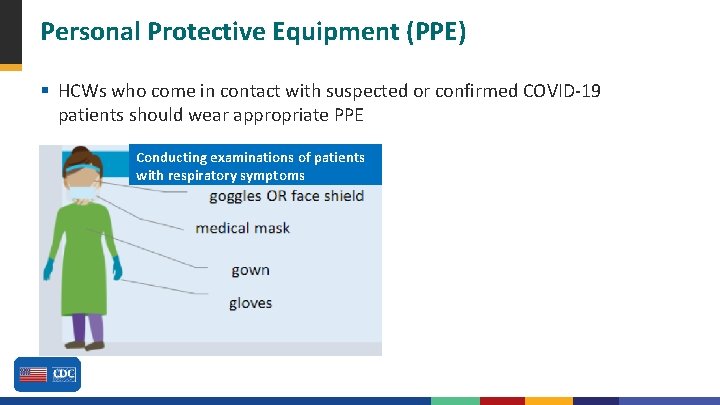
Personal Protective Equipment (PPE) § HCWs who come in contact with suspected or confirmed COVID-19 patients should wear appropriate PPE Conducting examinations of patients with respiratory symptoms
WHO
Important Measures During Periods of COVID-19 Community Transmission
Strategies to avoid overcrowding at triage and preserve PPE § Cancel non-urgent outpatient visits to ensure enough HCWs are available to provide support for COVID-19 clinical care, including triage services – If outpatient visit is critical (such as immunization of infants or pre-natal care for high-risk pregnancy), identify separate/dedicated entrance for these patients – Reinforce telemedicine or other alternative to face-to-face visit § Postpone or cancel elective procedures and surgeries to minimize exposures and to preserve PPE for HCWs caring for COVID-19 patients § Expand hours of operation, if possible, to limit crowding in triage during peak hours
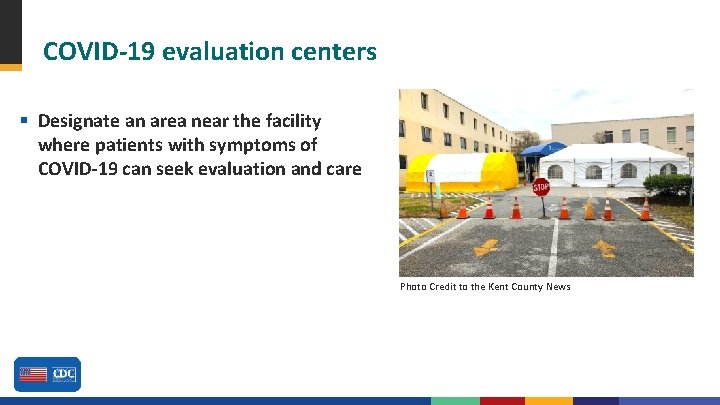
COVID-19 evaluation centers § Designate an area near the facility where patients with symptoms of COVID-19 can seek evaluation and care Photo Credit to the Kent County News
For more information, contact CDC 1 -800 -CDC-INFO (232 -4636) TTY: 1 -888 -232 -6348 www. cdc. gov The findings and conclusions in this report are those of the authors and do not necessarily represent the official position of the Centers for Disease Control and Prevention.