
Standard Operating Procedure Competencies and Minimum Training Standards
- Slides: 53
Standard Operating Procedure Competencies and Minimum Training Standards for Public Safety Communications Training Officer (CTO)
Agenda è § § § Introduction Procedure Other Information Quiz C 06 A 516 D 57374 A 48 A 26 AC 75875 D 82 C 17 Slide 2
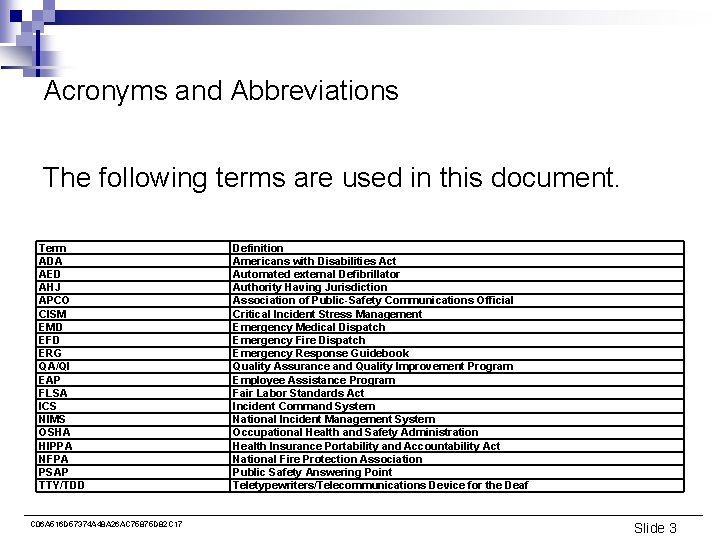
Acronyms and Abbreviations The following terms are used in this document. Term ADA AED AHJ APCO CISM EMD EFD ERG QA/QI EAP FLSA ICS NIMS OSHA HIPPA NFPA PSAP TTY/TDD C 06 A 516 D 57374 A 48 A 26 AC 75875 D 82 C 17 Definition Americans with Disabilities Act Automated external Defibrillator Authority Having Jurisdiction Association of Public-Safety Communications Official Critical Incident Stress Management Emergency Medical Dispatch Emergency Fire Dispatch Emergency Response Guidebook Quality Assurance and Quality Improvement Program Employee Assistance Program Fair Labor Standards Act Incident Command System National Incident Management System Occupational Health and Safety Administration Health Insurance Portability and Accountability Act National Fire Protection Association Public Safety Answering Point Teletypewriters/Telecommunications Device for the Deaf Slide 3
Scope This standard applies to those Agencies that have adopted a formal program for one-on-one training for Telecommunicators. This standard identifies the core competencies and minimum training requirements for Lee Control - Communications Training Officers (CTO). This position is typically tasked with on-thejob training of Lee Control employees on the essential duties and tasks of a Public Safety Telecommunicator with Lee Control Emergency Dispatch Center or within Lee County. C 06 A 516 D 57374 A 48 A 26 AC 75875 D 82 C 17 Slide 4
Purpose To define the core competencies and minimum training requirements of the individual who is generally tasked with one-on-one training of Lee Control employees on the essential duties, tasks, knowledge and skills of a Public Safety Telecommunicator. The purpose of this standard is to provide a consistent foundation for the knowledge, skills and abilities needed to fulfill this critical function. This standard recognizes the need to supplement the core competencies and training identified within this standard with Agency specific information. C 06 A 516 D 57374 A 48 A 26 AC 75875 D 82 C 17 Slide 5
Definitions 1. 2. 3. 4. 5. 6. Agency The Americans With Disabilities Act (ADA) Core Competency Fair Labor Standards Act (FLSA) 1 Knowledge Liability a. Negligence b. Negligent Assignment c. Negligent Entrustment C 06 A 516 D 57374 A 48 A 26 AC 75875 D 82 C 17 Slide 6
Definitions d. Negligent Retention e. Negligent Supervision f. Negligent Training g. Vicarious Liability 7. 8. 9. 10. 11. National Incident Management System/Incident Command System (NIMS/ICS) Public Safety Answering Point (PSAP) Public Safety Communications Center Public Safety Communications Supervisor Public Safety Telecommunicator (Telecommunicator) C 06 A 516 D 57374 A 48 A 26 AC 75875 D 82 C 17 Slide 7
Definitions 12. 13. 14. 15. 16. 17. 18. 19. 20. 21. Public Safety Communications Training Coordinator Public Safety Communications Training Officer (CTO) Quality Assurance (QA) and Quality Improvement (QI) Program Quality Assurance Process Quality Improvement Process Shall Should Trainee Written Directives C 06 A 516 D 57374 A 48 A 26 AC 75875 D 82 C 17 Slide 8
Definitions Agency The hiring authority or also referred to as the Authority Having Jurisdiction (AHJ). The Agency or body that defines the roles, responsibilities, written directives, and performance standards that direct the activity of the CTO. In multi-discipline centers, the Agency governs the operation providing call taking/dispatch and related services to customer agencies; in single discipline centers, a single Agency may direct these services for one or more departments within a service area. Both have the duty to define training appropriateness, content, format, and continuing education requirements. C 06 A 516 D 57374 A 48 A 26 AC 75875 D 82 C 17 Slide 9
Definitions The Americans With Disabilities Act (ADA) A Federal law that requires all Public Safety Answering Points (PSAPs) to provide direct and equal access to emergency telephone services to individuals with disabilities who use teletypewriters (TTY/TDDs) and other communication devices or services. C 06 A 516 D 57374 A 48 A 26 AC 75875 D 82 C 17 Slide 10
Definitions Core Competency The unique traits, requisite knowledge, comprehension, and application of skills, and situational analysis leading to the appropriate response to the caller, coworker, other public safety stakeholders, or event(s) consistent with general practices and locally defined parameters. C 06 A 516 D 57374 A 48 A 26 AC 75875 D 82 C 17 Slide 11
Definitions Fair Labor Standards Act (FLSA) 1 A Federal law, sometimes called the overtime law, that ensures that wages are paid for all hours worked and that all overtime hours, overtime pay and collected unpaid overtime due is paid to wage earners. C 06 A 516 D 57374 A 48 A 26 AC 75875 D 82 C 17 Slide 12
Definitions Knowledge Fundamental understanding one must have in order to perform a specific task. C 06 A 516 D 57374 A 48 A 26 AC 75875 D 82 C 17 Slide 13
Liability Negligence "Failure to use such care as a reasonably prudent and careful person would use under similar circumstances; it is the doing of some act which a person of ordinary prudence would not have done or the failure to do something a person of ordinary prudence would have done under similar circumstances". C 06 A 516 D 57374 A 48 A 26 AC 75875 D 82 C 17 Slide 14
Liability Negligent Assignment Assigning someone to a task or job for which they are not skilled or trained. For example, assigning someone to the position of CTO who has not been properly trained or allowing an employee to perform a function for which they are not qualified. C 06 A 516 D 57374 A 48 A 26 AC 75875 D 82 C 17 Slide 15
Liability Negligent Entrustment Failure to control dangerous equipment or devices entrusted to an employee or allowing an employee to use a piece of equipment for which they have not been trained. Includes allowing a trainee to work the radio or CAD system unsupervised without proper training. C 06 A 516 D 57374 A 48 A 26 AC 75875 D 82 C 17 Slide 16
Liability Negligent Retention Failure to terminate an employee who is clearly unsuitable for the job. C 06 A 516 D 57374 A 48 A 26 AC 75875 D 82 C 17 Slide 17
Liability Negligent Supervision Failure to coordinate, control, or direct trainee conduct that may cause injury. This can include failure to use reasonable care in addressing and documenting misconduct. C 06 A 516 D 57374 A 48 A 26 AC 75875 D 82 C 17 Slide 18
Liability Negligent Training Failure to adequately train or training that is grossly negligent thus creating a risk that the trainee will not act with due regard in the future. C 06 A 516 D 57374 A 48 A 26 AC 75875 D 82 C 17 Slide 19
Liability Vicarious Liability A legal doctrine referring to the imposition of liability on one person for the actionable conduct of another based solely on a relationship between the two persons. For example, the liability of an employer for the acts of an employee. C 06 A 516 D 57374 A 48 A 26 AC 75875 D 82 C 17 Slide 20
Definitions National Incident Management System/Incident Command System (NIMS/ICS) An organized method to define roles, responsibilities, and standard operating procedures used to unify multiple disciplines in order to manage emergency operations under one functional organization. 1 C 06 A 516 D 57374 A 48 A 26 AC 75875 D 82 C 17 Slide 21
Definitions Public Safety Answering Point (PSAP) A facility equipped and staffed to receive emergency and non-emergency calls requesting public safety services via telephone and other communication devices. Emergency calls are first answered, assessed, classified and prioritized. The FCC further defines a primary PSAP as a facility to which 9 -1 -1 calls are routed directly from the 9 -1 -1 Control Office. A secondary PSAP is defined as a facility to which 91 -1 calls are transferred from a primary PSAP. C 06 A 516 D 57374 A 48 A 26 AC 75875 D 82 C 17 Slide 22
Definitions Public Safety Communications Center A public safety entity, which may include a PSAP or be referred to as an Emergency Communications Center, Emergency Dispatch Center, or Communications Center, where emergency calls for service or 9 -1 -1 phone calls culminate, and/or where calls for service are dispatched to public safety service providers. C 06 A 516 D 57374 A 48 A 26 AC 75875 D 82 C 17 Slide 23
Definitions Public Safety Communications Supervisor The individual employed by a Public Safety Communications Center to provide leadership and guidance to employees in order to achieve the Agency’s mission, values, and vision. C 06 A 516 D 57374 A 48 A 26 AC 75875 D 82 C 17 Slide 24
Definitions Public Safety Telecommunicator (Telecommunicator) The individual employed by a public safety Agency as the first of the first responders whose primary responsibility is to receive, process, transmit, and/or dispatch emergency and non-emergency calls for law enforcement, fire, emergency medical, and other public safety services via telephone, radio, and other communication devices. C 06 A 516 D 57374 A 48 A 26 AC 75875 D 82 C 17 Slide 25
Definitions Public Safety Communications Training Coordinator One who administers the training function through the needs analysis, research, planning, curriculum design, implementation, records management, and evaluation processes to enhance emergency communications. C 06 A 516 D 57374 A 48 A 26 AC 75875 D 82 C 17 Slide 26
Definitions Public Safety Communications Training Officer (CTO) One who is responsible for training employees through the delivery of one-onone and on-the-job training in order to develop professional Telecommunicators for the Agency. C 06 A 516 D 57374 A 48 A 26 AC 75875 D 82 C 17 Slide 27
Definitions Quality Assurance (QA) All actions taken to ensure that standards and procedures are adhered to and that delivered products or services meet performance requirements. 2 C 06 A 516 D 57374 A 48 A 26 AC 75875 D 82 C 17 Slide 28
Definitions Quality Assurance (QA) and Quality Improvement (QI) Program An on-going program providing at a minimum, the random case review evaluating call receiving and emergency dispatch performance, feedback of protocol compliance, commendation, retraining and remediation as appropriate, and submission of compliance data to the Agency. C 06 A 516 D 57374 A 48 A 26 AC 75875 D 82 C 17 Slide 29
Definitions Quality Assurance Process A formal assessment process by which actual performance, behavior, and outcomes are compared against established standards to ensure compliance, consistency, and accuracy in the delivery of quality service. C 06 A 516 D 57374 A 48 A 26 AC 75875 D 82 C 17 Slide 30
Definitions Quality Improvement Process Actions taken to improve or correct areas of concern. C 06 A 516 D 57374 A 48 A 26 AC 75875 D 82 C 17 Slide 31
Definitions Shall Within the context of this standard, "shall" indicates a mandatory requirement. C 06 A 516 D 57374 A 48 A 26 AC 75875 D 82 C 17 Slide 32
Definitions Should Within the context of this standard, "should" indicates a recommendation. C 06 A 516 D 57374 A 48 A 26 AC 75875 D 82 C 17 Slide 33
Definitions Trainee A public safety communications employee (new or veteran) being trained in any one of the programs under the direction of the CTO. C 06 A 516 D 57374 A 48 A 26 AC 75875 D 82 C 17 Slide 34
Definitions Written Directives A set of Agency specific policies, procedures, rules, regulations, and guidelines. C 06 A 516 D 57374 A 48 A 26 AC 75875 D 82 C 17 Slide 35
Program Policy 1. 2. 3. A CTO will be assigned to a new employee on a rotating basis as needed. This will take into account when the CTO last trained an employee, the shift assignment, potential schedule issues, and whether the employee is being trained as a call-taker or dispatcher. It may be necessary for a CTO to train multiple times in a row, based on number of new employees at a given time. A CTO will not be assigned more than one employee at a time (unless in the classroom setting) and may ask for time without a trainee if possible. A CTO may be required to attend special meetings, classes or seminars, or training courses as assigned by the Program Manager or the QA / Training Coordinator of Lee Control. A CTO may be removed from this status by the manager for poor performance or disciplinary issues. C 06 A 516 D 57374 A 48 A 26 AC 75875 D 82 C 17 Slide 36
Program Policy 4. 5. 6. A CTO will be required to complete observation reports and other documentation on the progress and performance of the new employee. The CTO will report directly to the shift supervisor for all normal operations, however in regards to training issues the CTO reports to the QA/Training Coordinator. The DOR’s go directly to the QA/Training Coordinator for review. The shift supervisor should work through the CTO for any training concerns of the new employee. This creates a chain of command for the trainee to work through their assigned CTO and maintain a focus on training. A CTO, while assigned to actively train a new employee, shall be paid an incentive equal to ten percent (10%) of base pay. This pay adder is in addition to their regular wages. This 10% adder only applies while performing CTO duties for at least one full consecutive pay period. When a trainee is deemed "released from training" the CTO will no longer receive the incentive pay since the temporary additional duties will cease. C 06 A 516 D 57374 A 48 A 26 AC 75875 D 82 C 17 Slide 37
Program Qualifications 1. 2. 3. 4. CTOs shall be in good professional standing, including no personal improvement plans or corrective actions within 12 month. CTOs shall display patience and good communications skills. CTOs will have two years experience in the position they are training. CTOs will use sick and vacation time in accordance with Lee Control policy. CTOs should demonstrate dependability and will be relied upon to ensure the training of new employees runs smoothly and tasks are seen through completion. C 06 A 516 D 57374 A 48 A 26 AC 75875 D 82 C 17 Slide 38
Program Qualifications 5. 6. 7. CTOs Pro. QA EMD/EFD scores should remain above average compliance in all categories. CTOs will be required to train call takers and dispatchers when needed. CTOs will not be permitted to train only on dispatching or only on call taking. CTOs will be evaluated by the Program Manager and Training Coordinator every two years at the time of recertification, or when necessary due to performance or disciplinary reasons deemed. C 06 A 516 D 57374 A 48 A 26 AC 75875 D 82 C 17 Slide 39
Agenda § è § § Introduction Procedure Other Information Quiz C 06 A 516 D 57374 A 48 A 26 AC 75875 D 82 C 17 Slide 40
Organizational Integrity Scope This chapter discusses the issues related to organizational integrity. Topics include the mission and values of the profession in general and the Agency specifically, as well as the scope of the Supervisor’s authority, confidentiality, and liability. C 06 A 516 D 57374 A 48 A 26 AC 75875 D 82 C 17 Slide 41
Organizational Integrity 1. 2. 3. 4. The CTO shall demonstrate an understanding of Lee Controls mission, values, and vision. The CTO shall comply with the expectations of professional conduct of both Lee Control and Lee County policy. The CTO shall demonstrate a comprehensive knowledge of the duties and essential functions of the position. The CTO shall demonstrate an ability to work within the Agency’s Chain of Command. C 06 A 516 D 57374 A 48 A 26 AC 75875 D 82 C 17 Slide 42
Organizational Integrity 5. 6. 7. 8. The CTO shall demonstrate comprehension and application of the Agency’s policies regarding ethical behavior. The CTO shall ensure the accurate reporting and documentation of records for which they are responsible. The CTO shall foster and create effective working relationships with all personnel within the organization and with individuals and organizations external to the Agency. The CTO shall encourage and support the highest quality of workplace team interaction and behavior. C 06 A 516 D 57374 A 48 A 26 AC 75875 D 82 C 17 Slide 43
General Skills of the Public Safety Communications Training Officers High-performing incumbent CTOs have been identified as demonstrating the following abilities: § § § § Active listening Analysis Coaching/Mentoring Counseling Critical thinking Decision-Making Evaluation and feedback Interpersonal communications Leadership Motivation Multi-Tasking Problem solving Team-Building Technical troubleshooting Written and verbal communication C 06 A 516 D 57374 A 48 A 26 AC 75875 D 82 C 17 Slide 44
Critical components for enhancing professional competence Scope This chapter identifies those components within Public Safety Communications that are critical for enhancing the professional competence of all CTOs (both new and veteran workers). Some of these components have been identified as being necessary for developing, maintaining, and enhancing the knowledge and skills of the CTO. While Lee Control has some responsibility for supporting and facilitating the development of the CTO’s professional competence, this chapter places primary accountability for developing professional competence upon the CTO. C 06 A 516 D 57374 A 48 A 26 AC 75875 D 82 C 17 Slide 45
Critical components for enhancing professional competence 1. 2. 3. 4. 5. 6. 7. The CTO shall complete and maintain mandated training and certifications. The CTO shall take responsibility for their own professional career development by actively seeking opportunities to enhance their job knowledge and skills The CTO shall demonstrate the ability to meet and/or exceed performance standards set by the Agency. The CTO shall actively seek and be receptive to feedback and review of their performance, including issues identified during the Agency’s established quality assurance and quality improvement processes. The CTO shall demonstrate the ability to communicate with superiors, peers, and subordinates in a positive and constructive manner. The CTO shall demonstrate proficiency in Agency operations which may include, but are not limited to, calltaking, dispatching, jurisdictional and geographical boundaries, and other related job duties The CTO shall recommend updates to the Agency’s written directives when appropriate. C 06 A 516 D 57374 A 48 A 26 AC 75875 D 82 C 17 Slide 46
Critical components for enhancing professional competence The CTO shall take responsibility for their own professional career development by actively seeking opportunities to enhance their job knowledge and skills § The CTO shall identify professional goals that can be supported by the Agency. § The CTO shall take advantage of career development opportunities. § The CTO should take advantage of opportunities to network both within the public safety community and within the community in which they serve. § The CTO should review professional publications and resources to enhance professional competence and remain current on trends within the profession. C 06 A 516 D 57374 A 48 A 26 AC 75875 D 82 C 17 Slide 47
Public Safety Communications Training Officer (CTO) Training Requirements This chapter addresses the duties defined for Public Safety CTO. Training shall ensure that the CTO can demonstrate the level of proficiency established by the agency for these duties. C 06 A 516 D 57374 A 48 A 26 AC 75875 D 82 C 17 Slide 48
Public Safety Communications Training Officer (CTO) Training Requirements 1. The CTO shall demonstrate the ability to provide effective training. C 06 A 516 D 57374 A 48 A 26 AC 75875 D 82 C 17 Slide 49
Public Safety Communications Training Officer (CTO) Training Requirements 2. 3. The CTO shall demonstrate the ability to interact effectively with trainees. The CTO shall demonstrate the ability to perform administrative functions as assigned. C 06 A 516 D 57374 A 48 A 26 AC 75875 D 82 C 17 Slide 50
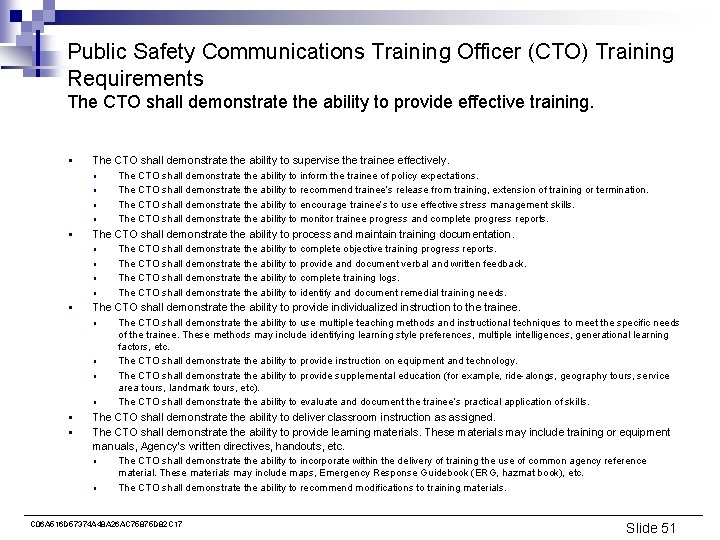
Public Safety Communications Training Officer (CTO) Training Requirements The CTO shall demonstrate the ability to provide effective training. § The CTO shall demonstrate the ability to supervise the trainee effectively. § § § The CTO shall demonstrate the ability to process and maintain training documentation. § § § The CTO shall demonstrate the ability to complete objective training progress reports. The CTO shall demonstrate the ability to provide and document verbal and written feedback. The CTO shall demonstrate the ability to complete training logs. The CTO shall demonstrate the ability to identify and document remedial training needs. The CTO shall demonstrate the ability to provide individualized instruction to the trainee. § § § The CTO shall demonstrate the ability to inform the trainee of policy expectations. The CTO shall demonstrate the ability to recommend trainee’s release from training, extension of training or termination. The CTO shall demonstrate the ability to encourage trainee’s to use effective stress management skills. The CTO shall demonstrate the ability to monitor trainee progress and complete progress reports. The CTO shall demonstrate the ability to use multiple teaching methods and instructional techniques to meet the specific needs of the trainee. These methods may include identifying learning style preferences, multiple intelligences, generational learning factors, etc. The CTO shall demonstrate the ability to provide instruction on equipment and technology. The CTO shall demonstrate the ability to provide supplemental education (for example, ride-alongs, geography tours, service area tours, landmark tours, etc). The CTO shall demonstrate the ability to evaluate and document the trainee’s practical application of skills. The CTO shall demonstrate the ability to deliver classroom instruction as assigned. The CTO shall demonstrate the ability to provide learning materials. These materials may include training or equipment manuals, Agency’s written directives, handouts, etc. § § The CTO shall demonstrate the ability to incorporate within the delivery of training the use of common agency reference material. These materials may include maps, Emergency Response Guidebook (ERG, hazmat book), etc. The CTO shall demonstrate the ability to recommend modifications to training materials. C 06 A 516 D 57374 A 48 A 26 AC 75875 D 82 C 17 Slide 51
Public Safety Communications Training Officer (CTO) Training Requirements The CTO shall demonstrate the ability to interact effectively with trainees. § The CTO shall demonstrate the ability to give constructive feedback to the trainee. § The CTO shall demonstrate the ability to counsel trainees regarding conduct or performance as it relates to training. C 06 A 516 D 57374 A 48 A 26 AC 75875 D 82 C 17 Slide 52
Public Safety Communications Training Officer (CTO) Training Requirements The CTO shall demonstrate the ability to perform administrative functions as assigned. § The CTO shall demonstrate the ability to perform the duties of a Public Safety Telecommunicator and Supervisor as required by the Agency. § The CTO shall demonstrate the ability to represent the Agency at meetings with the public, representatives of other agencies and departments. § The CTO shall demonstrate the ability to participate in the Agency’s Quality Assurance and Quality Improvement processes. C 06 A 516 D 57374 A 48 A 26 AC 75875 D 82 C 17 Slide 53