
Standard Normal Distribution The following frequency distribution represents
Standard Normal Distribution
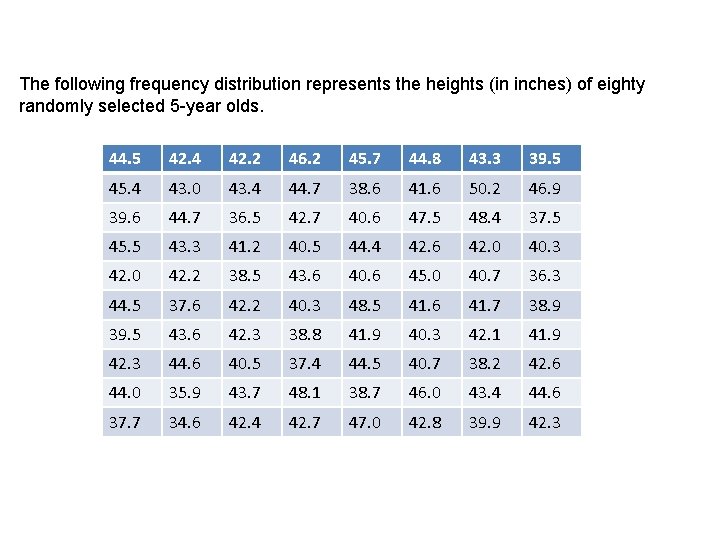
The following frequency distribution represents the heights (in inches) of eighty randomly selected 5 -year olds. 44. 5 42. 4 42. 2 46. 2 45. 7 44. 8 43. 3 39. 5 45. 4 43. 0 43. 4 44. 7 38. 6 41. 6 50. 2 46. 9 39. 6 44. 7 36. 5 42. 7 40. 6 47. 5 48. 4 37. 5 45. 5 43. 3 41. 2 40. 5 44. 4 42. 6 42. 0 40. 3 42. 0 42. 2 38. 5 43. 6 40. 6 45. 0 40. 7 36. 3 44. 5 37. 6 42. 2 40. 3 48. 5 41. 6 41. 7 38. 9 39. 5 43. 6 42. 3 38. 8 41. 9 40. 3 42. 1 41. 9 42. 3 44. 6 40. 5 37. 4 44. 5 40. 7 38. 2 42. 6 44. 0 35. 9 43. 7 48. 1 38. 7 46. 0 43. 4 44. 6 37. 7 34. 6 42. 4 42. 7 47. 0 42. 8 39. 9 42. 3
(a) Construct a relative frequency histogram (a) Draw a normal density curve on relative frequency histogram
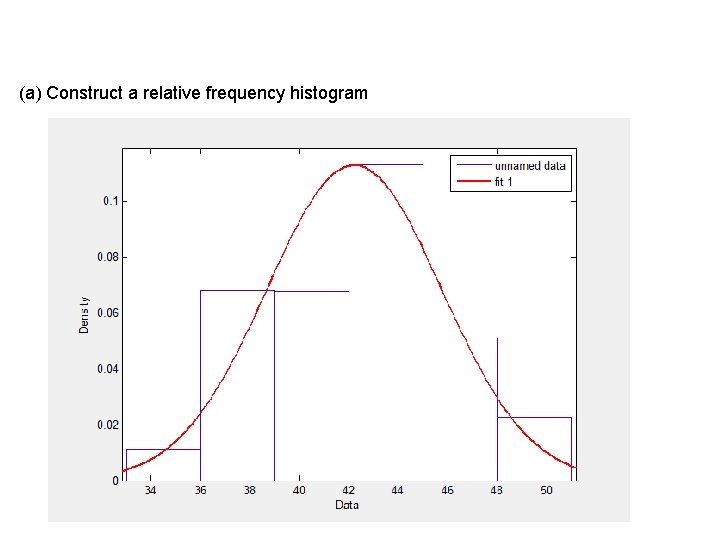
(a) Construct a relative frequency histogram
(a) Construct a relative frequency histogram
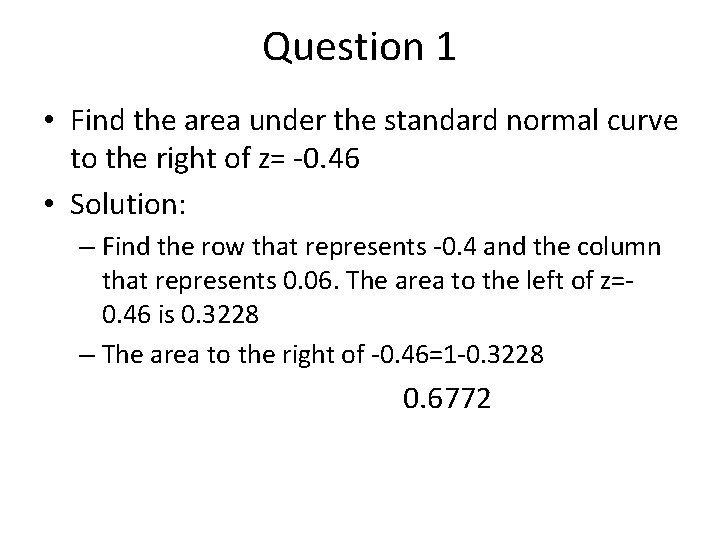
Question 1 • Find the area under the standard normal curve to the right of z= -0. 46 • Solution: – Find the row that represents -0. 4 and the column that represents 0. 06. The area to the left of z=0. 46 is 0. 3228 – The area to the right of -0. 46=1 -0. 3228 0. 6772
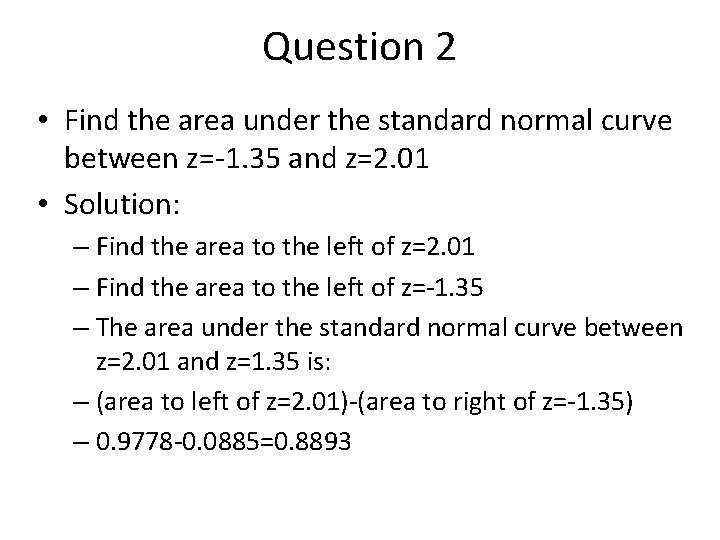
Question 2 • Find the area under the standard normal curve between z=-1. 35 and z=2. 01 • Solution: – Find the area to the left of z=2. 01 – Find the area to the left of z=-1. 35 – The area under the standard normal curve between z=2. 01 and z=1. 35 is: – (area to left of z=2. 01)-(area to right of z=-1. 35) – 0. 9778 -0. 0885=0. 8893
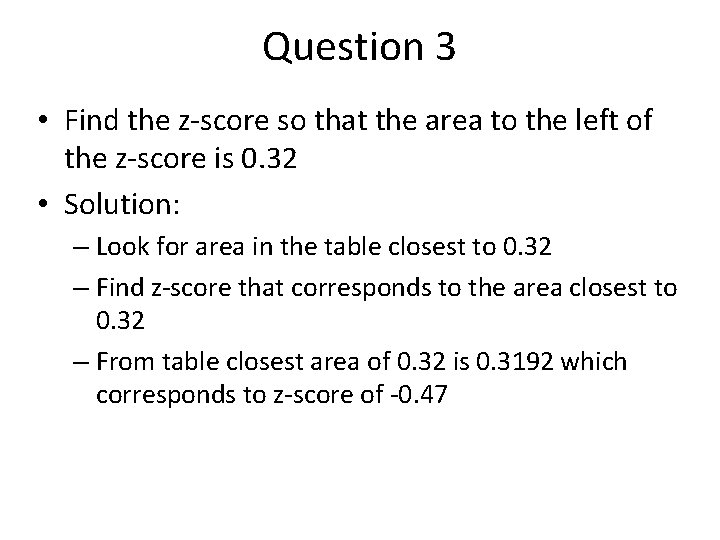
Question 3 • Find the z-score so that the area to the left of the z-score is 0. 32 • Solution: – Look for area in the table closest to 0. 32 – Find z-score that corresponds to the area closest to 0. 32 – From table closest area of 0. 32 is 0. 3192 which corresponds to z-score of -0. 47
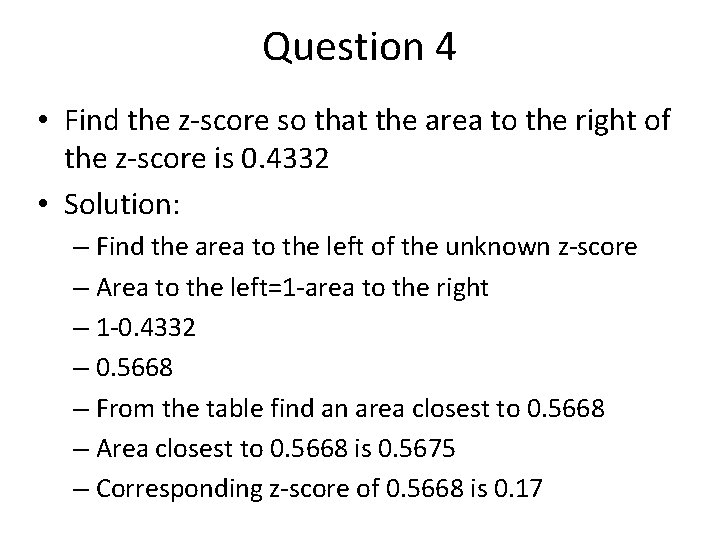
Question 4 • Find the z-score so that the area to the right of the z-score is 0. 4332 • Solution: – Find the area to the left of the unknown z-score – Area to the left=1 -area to the right – 1 -0. 4332 – 0. 5668 – From the table find an area closest to 0. 5668 – Area closest to 0. 5668 is 0. 5675 – Corresponding z-score of 0. 5668 is 0. 17
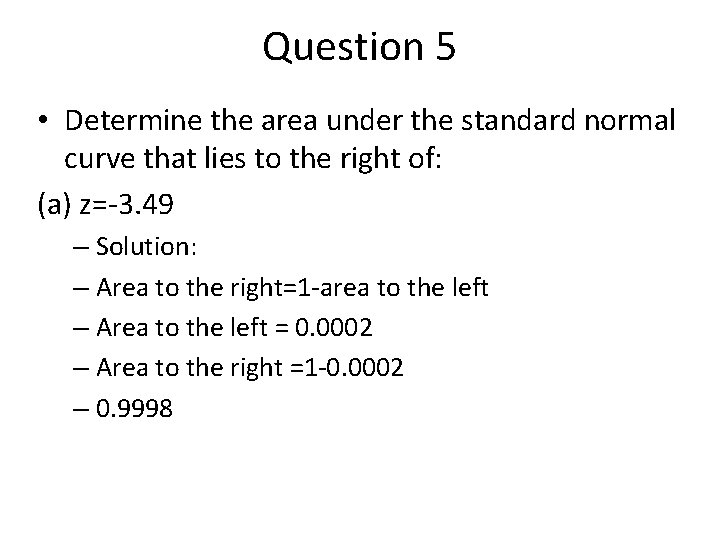
Question 5 • Determine the area under the standard normal curve that lies to the right of: (a) z=-3. 49 – Solution: – Area to the right=1 -area to the left – Area to the left = 0. 0002 – Area to the right =1 -0. 0002 – 0. 9998
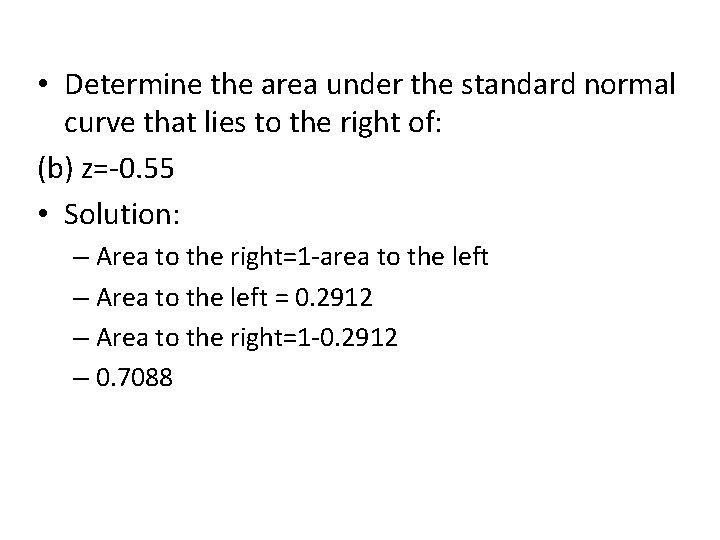
• Determine the area under the standard normal curve that lies to the right of: (b) z=-0. 55 • Solution: – Area to the right=1 -area to the left – Area to the left = 0. 2912 – Area to the right=1 -0. 2912 – 0. 7088
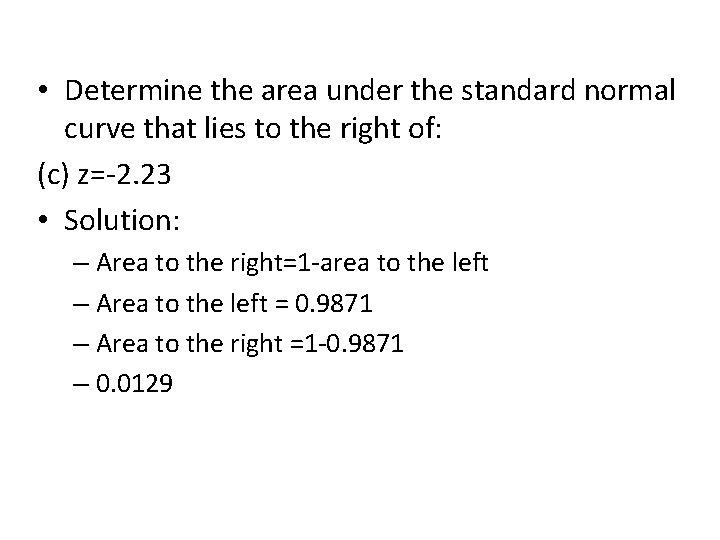
• Determine the area under the standard normal curve that lies to the right of: (c) z=-2. 23 • Solution: – Area to the right=1 -area to the left – Area to the left = 0. 9871 – Area to the right =1 -0. 9871 – 0. 0129
• Determine the area under the standard normal curve that lies to the right of: (d) z=3. 45 • Solution: – Area to the right=1 -area to the left – Area to the left = 0. 9997 – Area to the right =1 -0. 9997 – 0. 0003
Question 6 • The mean incubation time of fertilized chicken eggs kept at 100. 5 F in a still air incubator is 21 days. Suppose that the incubation times are approximately normally distributed with a standard deviation of 1 day. (a)What is the probability that a randomly selected chicken hatches in 20 days • Solution: – Z=(x-µ)/δ= 20 -21/1=-1. 00 – From table the area to the left of z=-1. 00 is 0. 1587
• The mean incubation time of fertilized chicken eggs kept at 100. 5 F in a still air incubator is 21 days. Suppose that the incubation times are approximately normally distributed with a standard deviation of 1 day. (b)What is the probability that a randomly selected chicken egg takes over 22 eggs to hatch • Solution: – Z=(x-µ)/δ= 22 -21/1=1. 00 – From table the area to the left of z=1. 00 is 0. 8413. – Area to left of z=1. 00=1 -0. 8413=0. 1587
• The mean incubation time of fertilized chicken eggs kept at 100. 5 F in a still air incubator is 21 days. Suppose that the incubation times are approximately normally distributed with a standard deviation of 1 day. (c)What is the probability that a randomly selected chicken egg hatches between 19 and 21 days • Solution: • =( -µ)/δ= 19 -21/1=-2. 00 • =( -µ)/δ=21 -21/1=0 • From table the area to the left of =-2. 00 is 0. 0228. • Area to left of =0 is 0. 5000 • P(19<x<21) = 0. 5000 -0. 0228= 0. 4772

CSTEM Web link http: //www. cis. famu. edu/~cdellor/math/ § § Presentation slides Problems Guidelines Learning materials
- Slides: 17