
Standard Model Lesson 1 Measurement of the Z

- Slides: 46
Standard Model Lesson #1 Measurement of the Z e W bosons properties Padova, April 28 th 2014 Ezio Torassa XXIX Ph. D in Physics
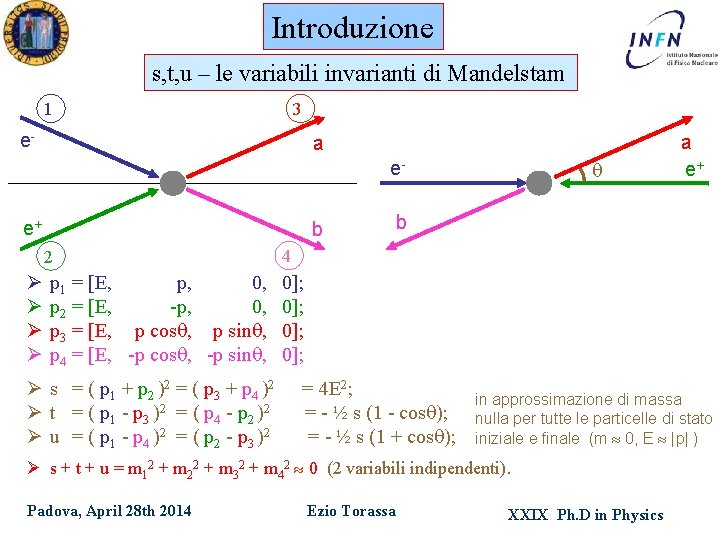
Introduzione s, t, u – le variabili invarianti di Mandelstam 1 3 e- a ee+ b 2 Ø Ø p 1 = [E, p, 0, p 2 = [E, -p, 0, p 3 = [E, p cos , p sin , p 4 = [E, -p cos , -p sin , Ø s = ( p 1 + p 2 )2 = ( p 3 + p 4 )2 Ø t = ( p 1 - p 3 )2 = ( p 4 - p 2 )2 Ø u = ( p 1 - p 4 )2 = ( p 2 - p 3 )2 b 4 0]; 0]; = 4 E 2; = - ½ s (1 - cos ); = - ½ s (1 + cos ); in approssimazione di massa nulla per tutte le particelle di stato iniziale e finale (m 0, E |p| ) Ø s + t + u = m 12 + m 22 + m 32 + m 42 0 (2 variabili indipendenti). Padova, April 28 th 2014 a e+ Ezio Torassa XXIX Ph. D in Physics
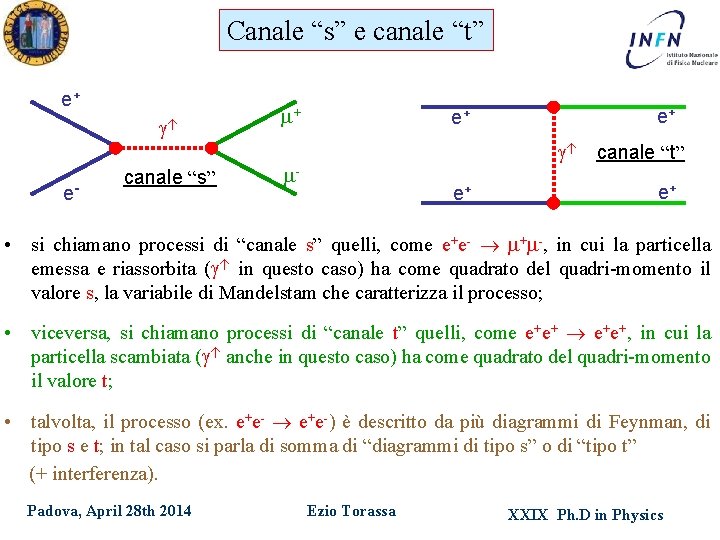
Canale “s” e canale “t” e+ e- canale “s” + e+ e+ canale “t” - e+ e+ • si chiamano processi di “canale s” quelli, come e+e- + -, in cui la particella emessa e riassorbita ( in questo caso) ha come quadrato del quadri-momento il valore s, la variabile di Mandelstam che caratterizza il processo; • viceversa, si chiamano processi di “canale t” quelli, come e+e+, in cui la particella scambiata ( anche in questo caso) ha come quadrato del quadri-momento il valore t; • talvolta, il processo (ex. e+e-) è descritto da più diagrammi di Feynman, di tipo s e t; in tal caso si parla di somma di “diagrammi di tipo s” o di “tipo t” (+ interferenza). Padova, April 28 th 2014 Ezio Torassa XXIX Ph. D in Physics
Luminosity definition and measurement Efficiency (trigger + reconstruction +selection) Integrated luminosity [cm -2 sec -1 ] Padova, April 28 th 2014 Ezio Torassa XXIX Ph. D in Physics
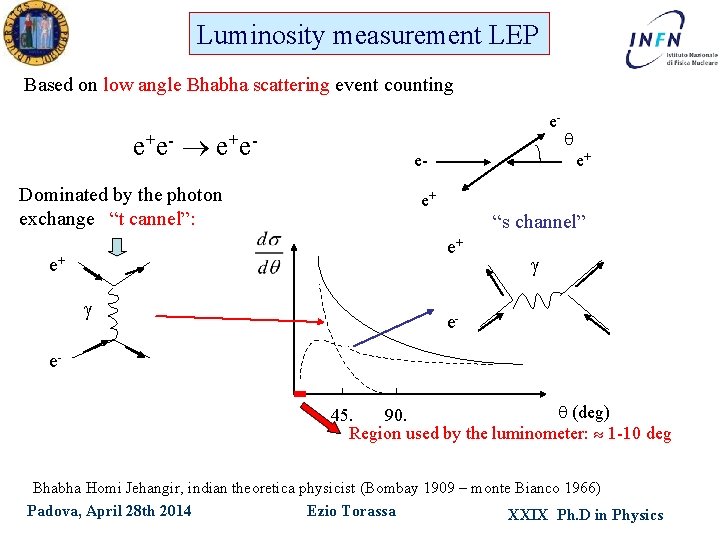
Luminosity measurement LEP Based on low angle Bhabha scattering event counting e +e - e +e Dominated by the photon exchange “t cannel”: e- e+ ee+ “s channel” e+ e+ e- e (deg) 45. 90. Region used by the luminometer: 1 -10 deg Bhabha Homi Jehangir, indian theoretica physicist (Bombay 1909 – monte Bianco 1966) Padova, April 28 th 2014 Ezio Torassa XXIX Ph. D in Physics
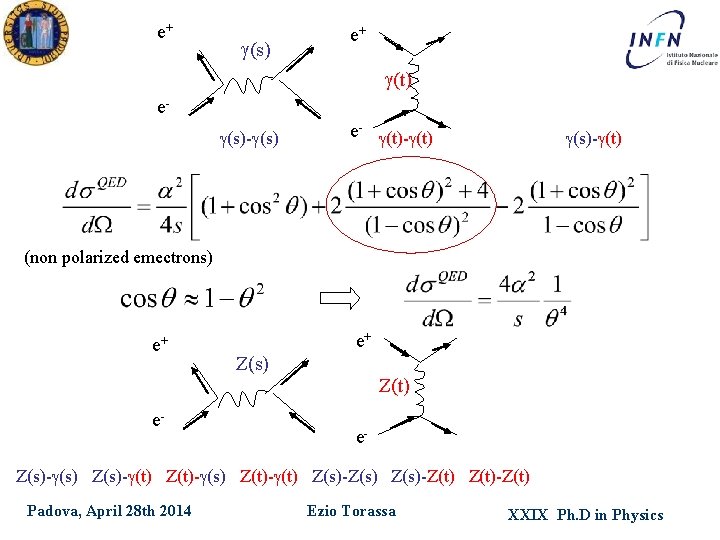
e+ (s) e+ (t) e (s)- (s) e- (t) (s)- (t) (non polarized emectrons) e+ e- e+ Z(s) Z(t) e- Z(s)- (s) Z(s)- (t) Z(t)- (s) Z(t)- (t) Z(s)-Z(s)-Z(t)-Z(t) Padova, April 28 th 2014 Ezio Torassa XXIX Ph. D in Physics
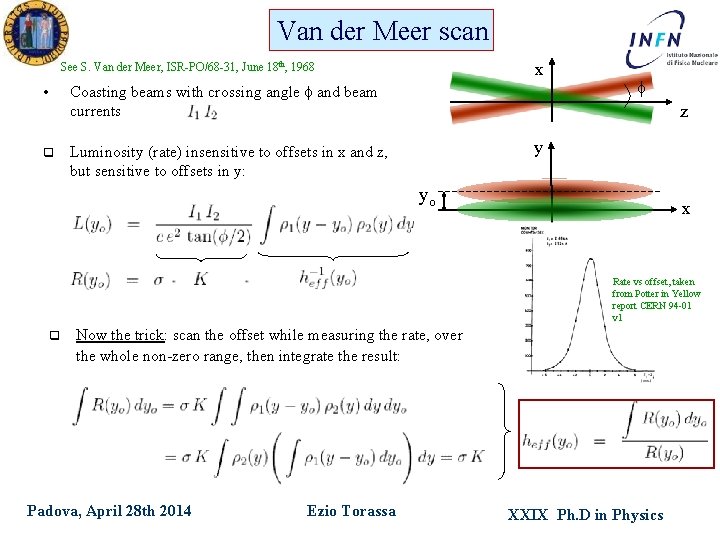
Van der Meer scan x See S. Van der Meer, ISR-PO/68 -31, June 18 th, 1968 Coasting beams with crossing angle and beam currents • q z y Luminosity (rate) insensitive to offsets in x and z, but sensitive to offsets in y: yo x Rate vs offset, taken from Potter in Yellow report CERN 94 -01 v 1 q Now the trick: scan the offset while measuring the rate, over the whole non-zero range, then integrate the result: Padova, April 28 th 2014 Ezio Torassa XXIX Ph. D in Physics
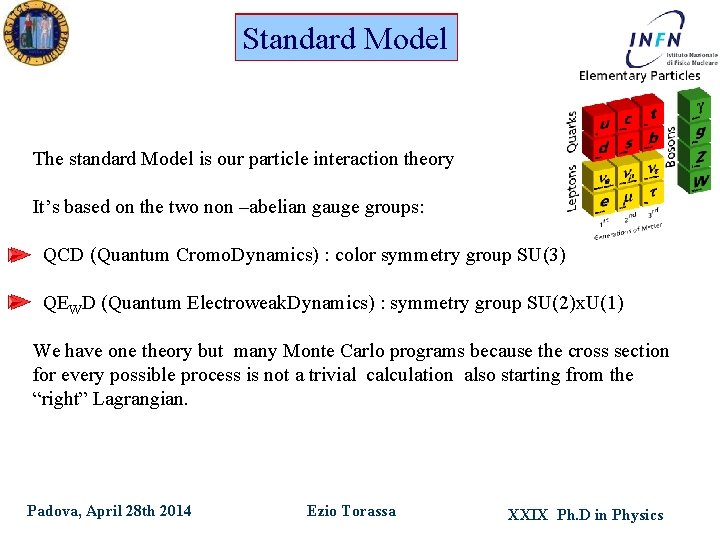
Standard Model The standard Model is our particle interaction theory It’s based on the two non –abelian gauge groups: QCD (Quantum Cromo. Dynamics) : color symmetry group SU(3) QEWD (Quantum Electroweak. Dynamics) : symmetry group SU(2)x. U(1) We have one theory but many Monte Carlo programs because the cross section for every possible process is not a trivial calculation also starting from the “right” Lagrangian. Padova, April 28 th 2014 Ezio Torassa XXIX Ph. D in Physics
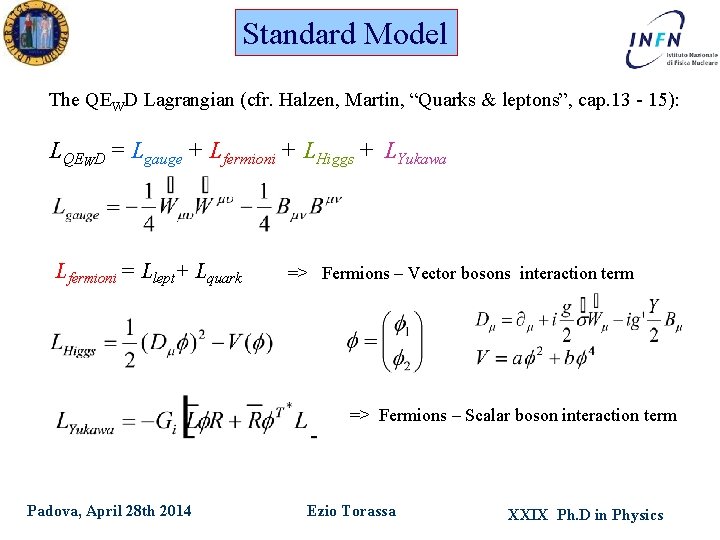
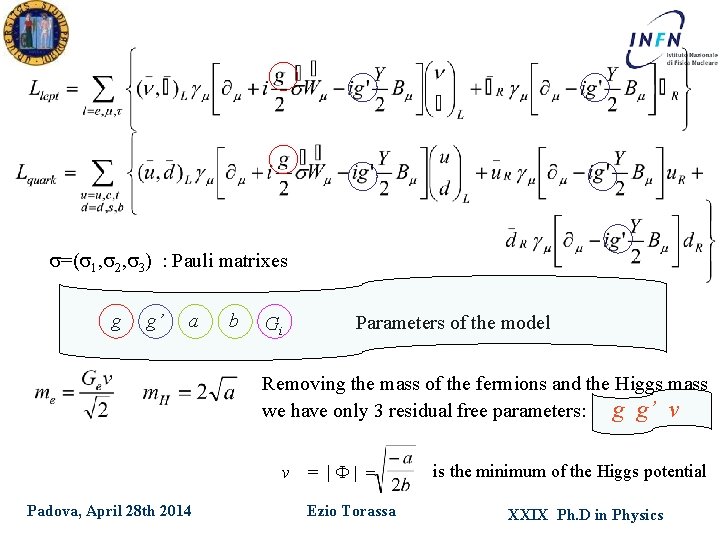
Standard Model The QEWD Lagrangian (cfr. Halzen, Martin, “Quarks & leptons”, cap. 13 - 15): LQEWD = Lgauge + Lfermioni + LHiggs + LYukawa Lfermioni = Llept+ Lquark => Fermions – Vector bosons interaction term => Fermions – Scalar boson interaction term Padova, April 28 th 2014 Ezio Torassa XXIX Ph. D in Physics
s=(s 1, s 2, s 3) : Pauli matrixes g g’ a b Gi Parameters of the model Removing the mass of the fermions and the Higgs mass we have only 3 residual free parameters: g g’ v v Padova, April 28 th 2014 = |F| = Ezio Torassa is the minimum of the Higgs potential XXIX Ph. D in Physics
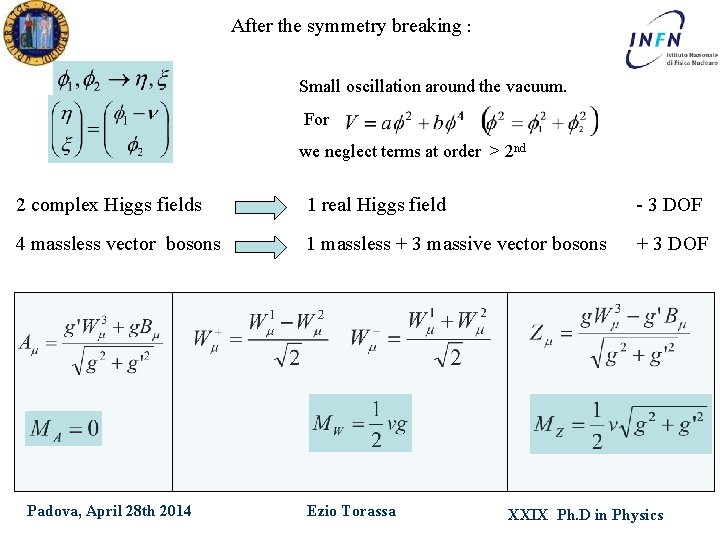
After the symmetry breaking : Small oscillation around the vacuum. For we neglect terms at order > 2 nd 2 complex Higgs fields 1 real Higgs field - 3 DOF 4 massless vector bosons 1 massless + 3 massive vector bosons + 3 DOF Padova, April 28 th 2014 Ezio Torassa XXIX Ph. D in Physics
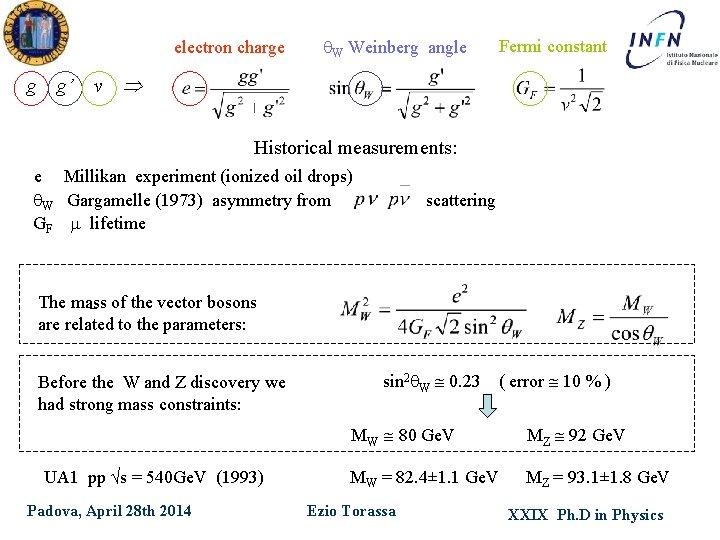
electron charge g g’ v W Weinberg angle Fermi constant Historical measurements: e Millikan experiment (ionized oil drops) W Gargamelle (1973) asymmetry from GF lifetime scattering The mass of the vector bosons are related to the parameters: Before the W and Z discovery we had strong mass constraints: UA 1 pp √s = 540 Ge. V (1993) Padova, April 28 th 2014 sin 2 W 0. 23 ( error 10 % ) MW 80 Ge. V MZ 92 Ge. V MW = 82. 4± 1. 1 Ge. V MZ = 93. 1± 1. 8 Ge. V Ezio Torassa XXIX Ph. D in Physics
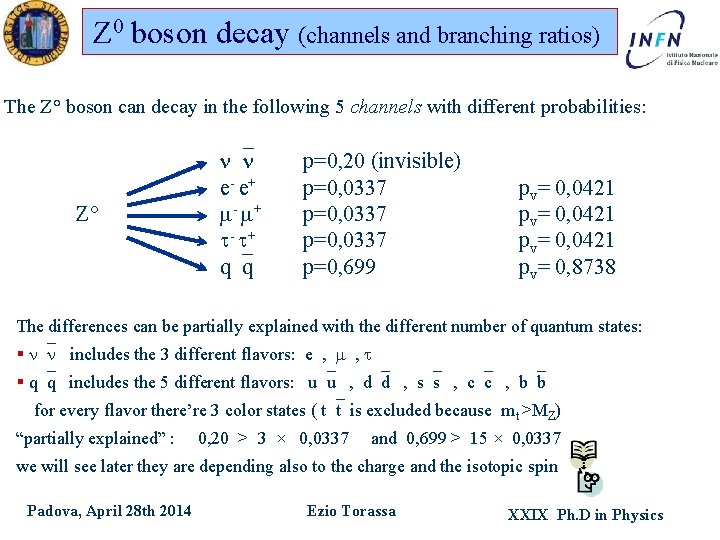
Z 0 boson decay (channels and branching ratios) The Z° boson can decay in the following 5 channels with different probabilities: Z° e- e+ - + q q p=0, 20 (invisible) p=0, 0337 p=0, 699 pv= 0, 0421 pv= 0, 8738 The differences can be partially explained with the different number of quantum states: § includes the 3 different flavors: e , , § q q includes the 5 different flavors: u u , d d , s s , c c , b b for every flavor there’re 3 color states ( t t is excluded because mt >MZ) “partially explained” : 0, 20 > 3 × 0, 0337 and 0, 699 > 15 × 0, 0337 we will see later they are depending also to the charge and the isotopic spin Padova, April 28 th 2014 Ezio Torassa XXIX Ph. D in Physics
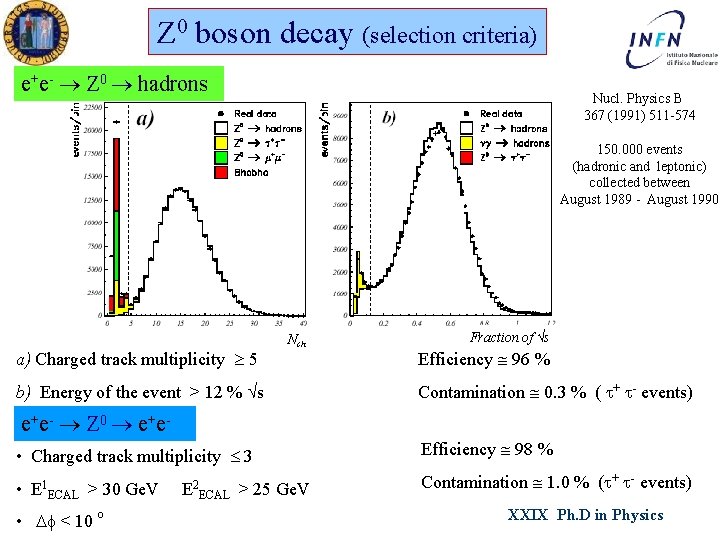
Z 0 boson decay (selection criteria) e+e- Z 0 hadrons Nucl. Physics B 367 (1991) 511 -574 150. 000 events (hadronic and leptonic) collected between August 1989 - August 1990 a) Charged track multiplicity 5 Fraction of √s Nch Efficiency 96 % b) Energy of the event > 12 % s Contamination 0. 3 % ( + - events) e +e - Z 0 e +e • Charged track multiplicity 3 Efficiency 98 % • E 1 ECAL > 30 Ge. V Contamination 1. 0 % ( + - events) E 2 ECAL > 25 Ge. V Padova, April 28 th 2014 • < 10 o Ezio Torassa XXIX Ph. D in Physics
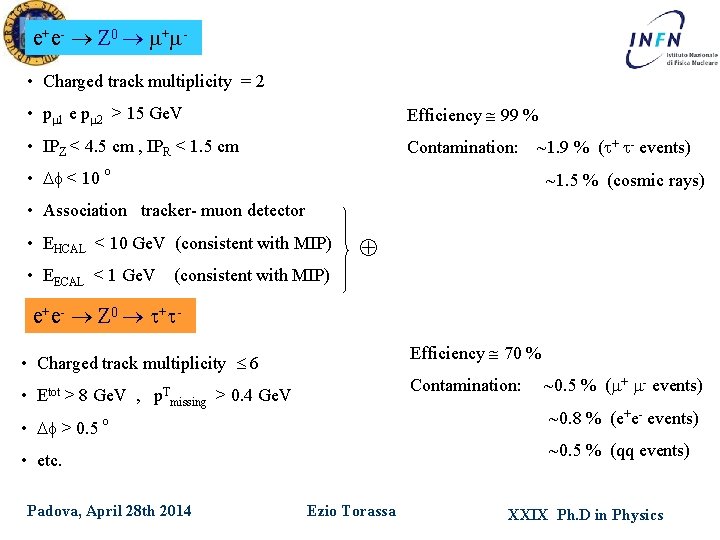
e + e - Z 0 + • Charged track multiplicity = 2 • p 1 e p 2 > 15 Ge. V Efficiency 99 % • IPZ < 4. 5 cm , IPR < 1. 5 cm Contamination: ~1. 9 % ( + - events) • < 10 o ~1. 5 % (cosmic rays) • Association tracker- muon detector • EHCAL < 10 Ge. V (consistent with MIP) • EECAL < 1 Ge. V (consistent with MIP) e +e - Z 0 + Efficiency 70 % • Charged track multiplicity 6 • Etot > 8 Ge. V , • > 0. 5 p. T missing Contamination: > 0. 4 Ge. V ~0. 8 % (e+e- events) o ~0. 5 % (qq events) • etc. Padova, April 28 th 2014 ~0. 5 % ( + - events) Ezio Torassa XXIX Ph. D in Physics
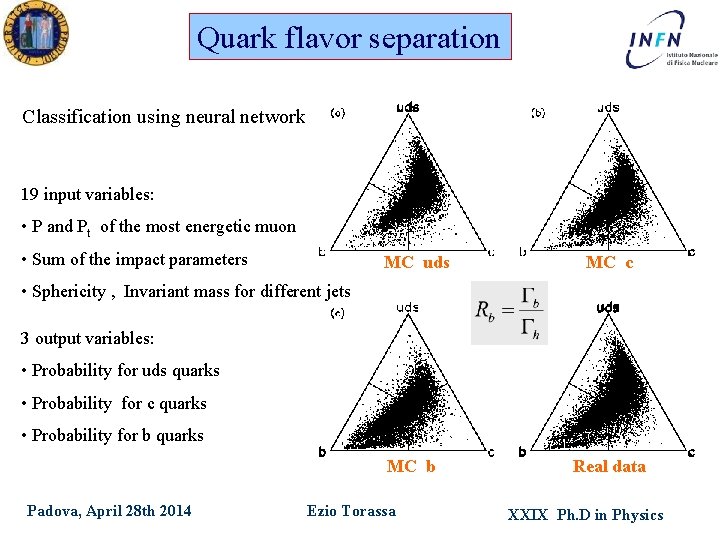
Quark flavor separation Classification using neural network 19 input variables: • P and Pt of the most energetic muon • Sum of the impact parameters MC uds MC c • Sphericity , Invariant mass for different jets 3 output variables: • Probability for uds quarks • Probability for c quarks • Probability for b quarks MC b Padova, April 28 th 2014 Ezio Torassa Real data XXIX Ph. D in Physics
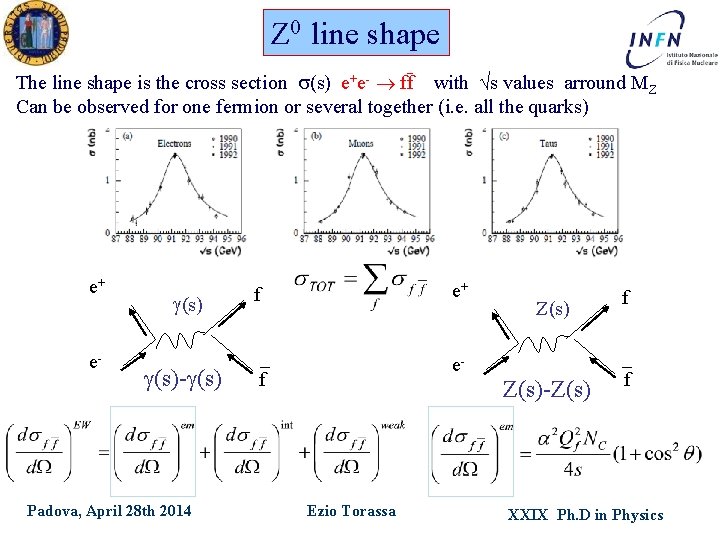
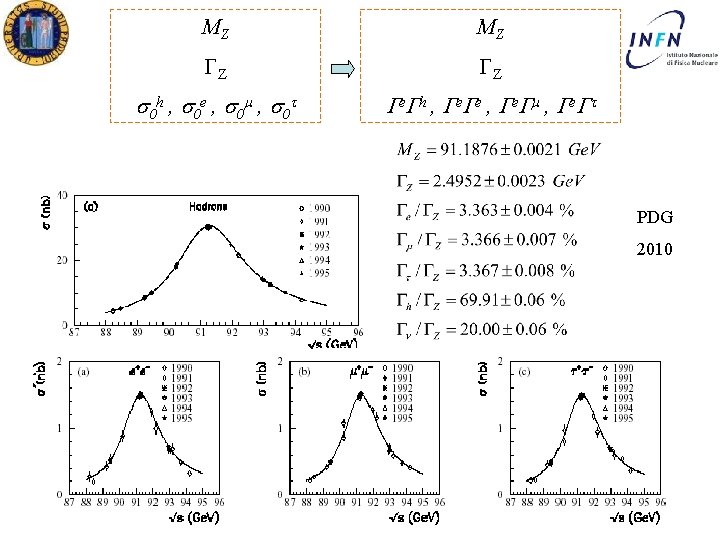
Z 0 line shape _ The line shape is the cross section s(s) ff with √s values arround MZ Can be observed for one fermion or several together (i. e. all the quarks) e+ e- (s)- (s) Padova, April 28 th 2014 f e+ _ f e- Ezio Torassa Z(s)-Z(s) f _ f XXIX Ph. D in Physics
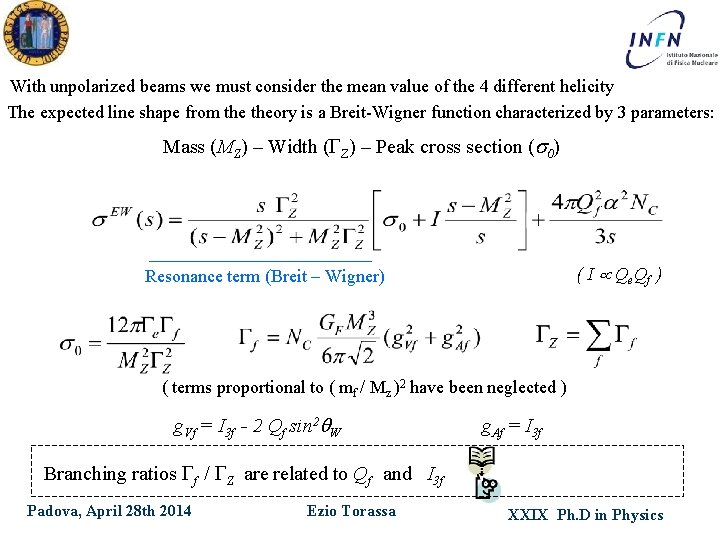
With unpolarized beams we must consider the mean value of the 4 different helicity The expected line shape from theory is a Breit-Wigner function characterized by 3 parameters: Mass (MZ) – Width ( Z) – Peak cross section ( 0) ( I Qe. Qf ) Resonance term (Breit – Wigner) ( terms proportional to ( mf / Mz )2 have been neglected ) g. Vf = I 3 f - 2 Qf sin 2 q. W g. Af = I 3 f Branching ratios f / Z are related to Qf and I 3 f Padova, April 28 th 2014 Ezio Torassa XXIX Ph. D in Physics
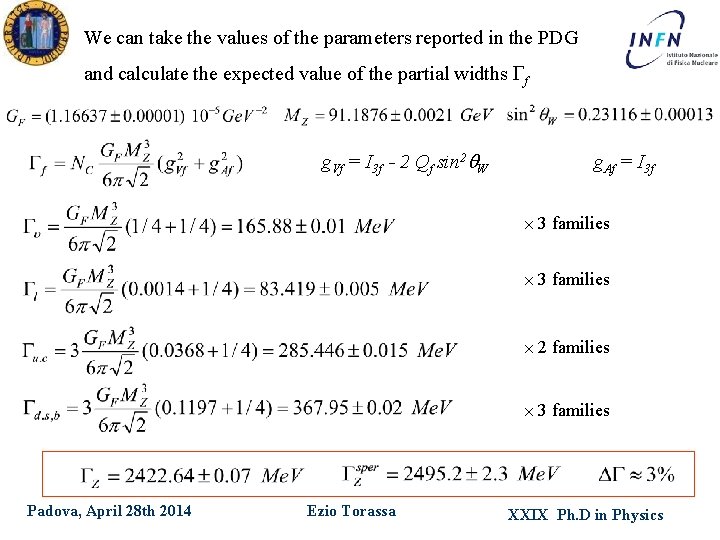
We can take the values of the parameters reported in the PDG and calculate the expected value of the partial widths f g. Vf = I 3 f - 2 Qf sin 2 q. W g. Af = I 3 f 3 families 2 families 3 families Padova, April 28 th 2014 Ezio Torassa XXIX Ph. D in Physics
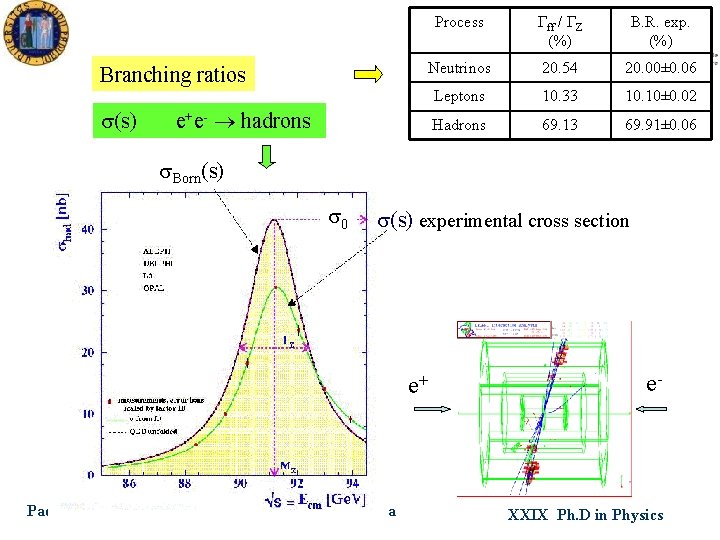
Branching ratios s(s) e+e- hadrons Process ff / Z (%) B. R. exp. (%) Neutrinos 20. 54 20. 00± 0. 06 Leptons 10. 33 10. 10± 0. 02 Hadrons 69. 13 69. 91± 0. 06 s. Born(s) s 0 s(s) experimental cross section e+ Padova, April 28 th 2014 Ezio Torassa e- XXIX Ph. D in Physics
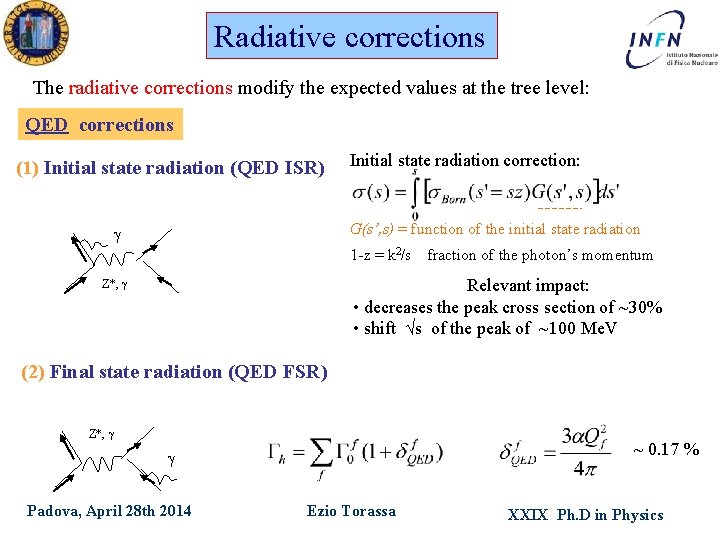
Radiative corrections The radiative corrections modify the expected values at the tree level: QED corrections (1) Initial state radiation (QED ISR) Initial state radiation correction: G(s’, s) = function of the initial state radiation 1 -z = k 2/s fraction of the photon’s momentum Relevant impact: • decreases the peak cross section of ~30% • shift √s of the peak of ~100 Me. V Z*, (2) Final state radiation (QED FSR) Z*, ~ 0. 17 % Padova, April 28 th 2014 Ezio Torassa XXIX Ph. D in Physics
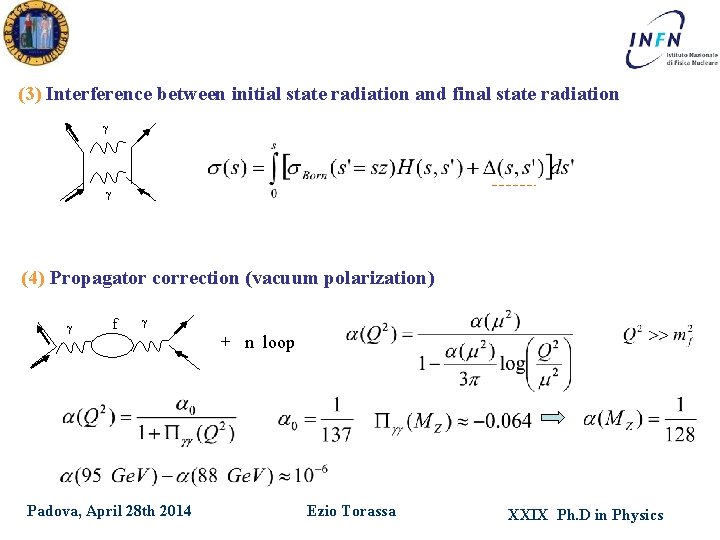
(3) Interference between initial state radiation and final state radiation (4) Propagator correction (vacuum polarization) f Padova, April 28 th 2014 + n loop Ezio Torassa XXIX Ph. D in Physics
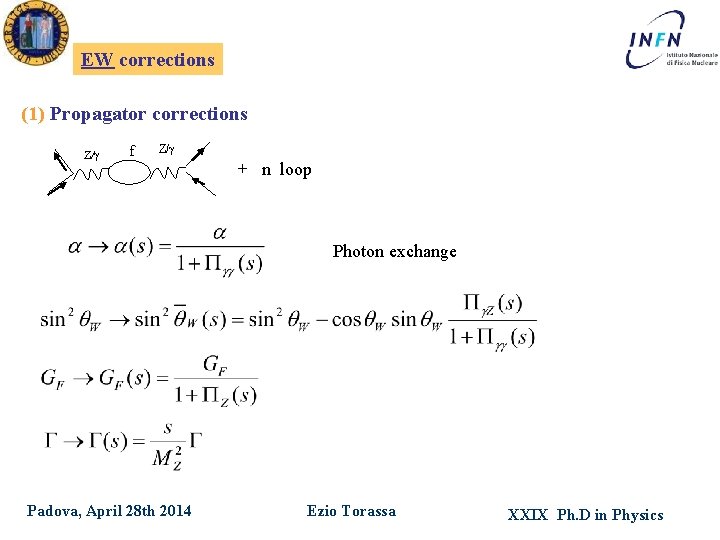
EW corrections (1) Propagator corrections Z/ f Z/ + n loop Photon exchange Padova, April 28 th 2014 Ezio Torassa XXIX Ph. D in Physics
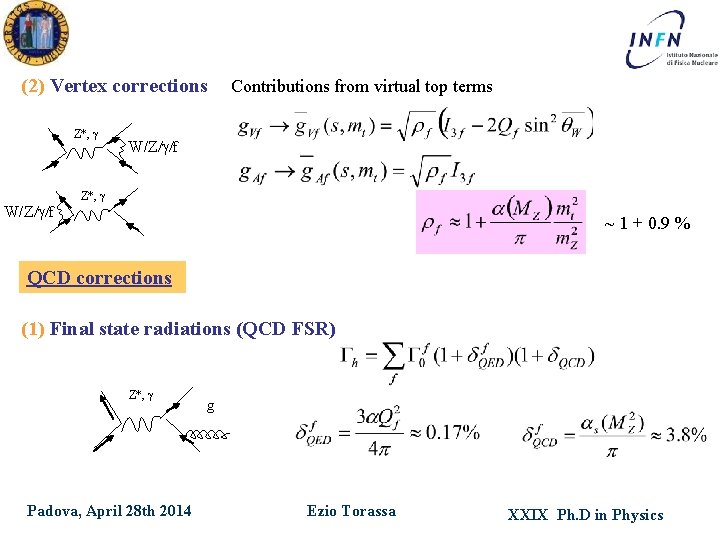
(2) Vertex corrections Z*, Contributions from virtual top terms W/Z/ /f Z*, W/Z/ /f ~ 1 + 0. 9 % QCD corrections (1) Final state radiations (QCD FSR) Z*, Padova, April 28 th 2014 g Ezio Torassa XXIX Ph. D in Physics
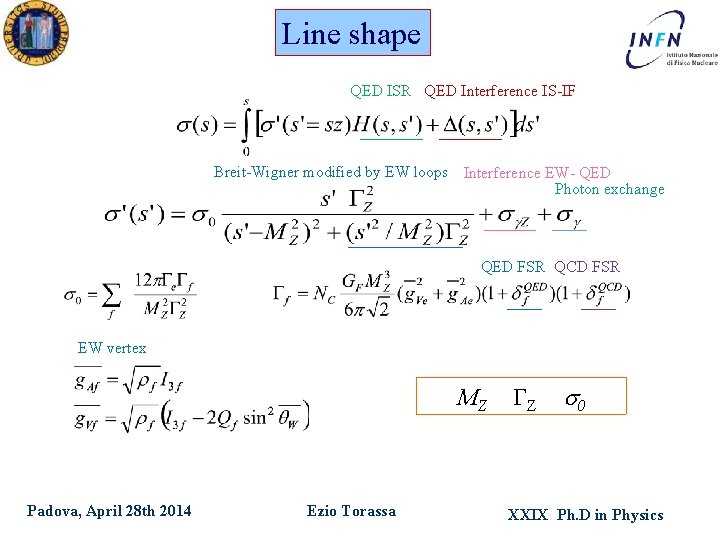
Line shape QED ISR QED Interference IS-IF Breit-Wigner modified by EW loops Interference EW- QED Photon exchange QED FSR QCD FSR EW vertex MZ Padova, April 28 th 2014 Ezio Torassa Z 0 XXIX Ph. D in Physics
MZ MZ Z Z 0 h , 0 e , 0 e h , e e , e PDG 2010 Padova 4 Aprile 2011 Ezio Torassa Padova, April 28 th 2014 Ezio Torassa XXIX Ph. D in Physics
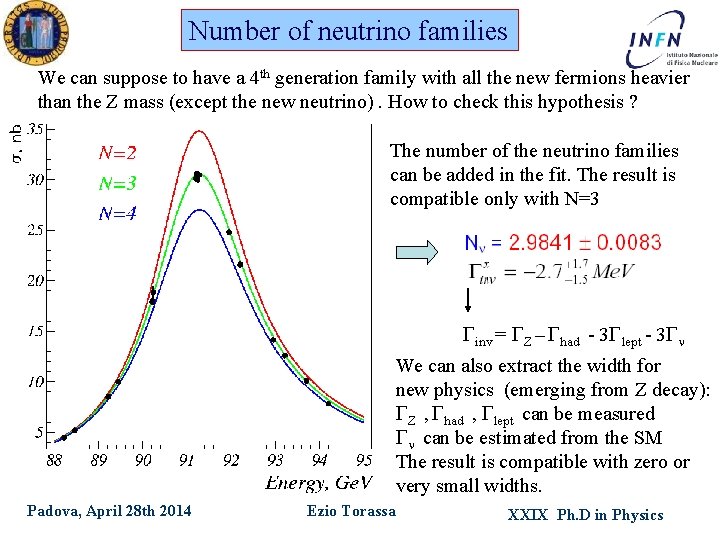
Number of neutrino families We can suppose to have a 4 th generation family with all the new fermions heavier than the Z mass (except the new neutrino). How to check this hypothesis ? The number of the neutrino families can be added in the fit. The result is compatible only with N=3 inv = Z – had - 3 lept - 3 Padova 4 Aprile 2011 Ezio Torassa Padova, April 28 th 2014 We can also extract the width for new physics (emerging from Z decay): Z , had , lept can be measured can be estimated from the SM The result is compatible with zero or very small widths. Ezio Torassa XXIX Ph. D in Physics
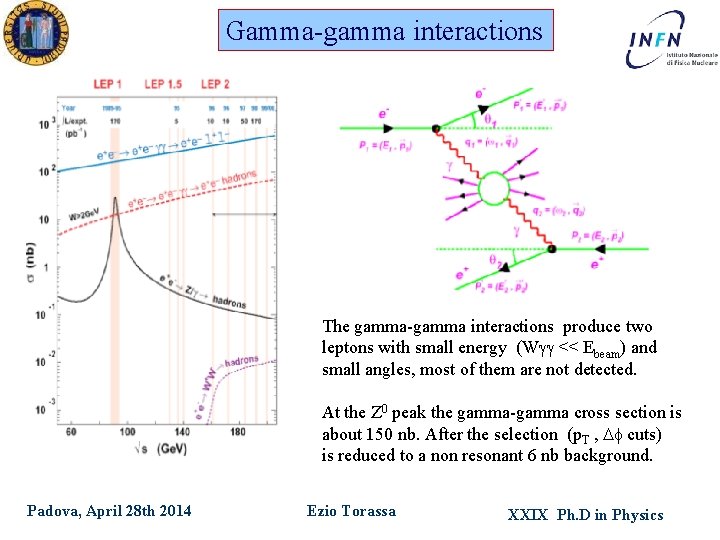
Gamma-gamma interactions The gamma-gamma interactions produce two leptons with small energy (W << Ebeam) and small angles, most of them are not detected. At the Z 0 peak the gamma-gamma cross section is about 150 nb. After the selection (p. T , cuts) is reduced to a non resonant 6 nb background. Padova, April 28 th 2014 Ezio Torassa XXIX Ph. D in Physics
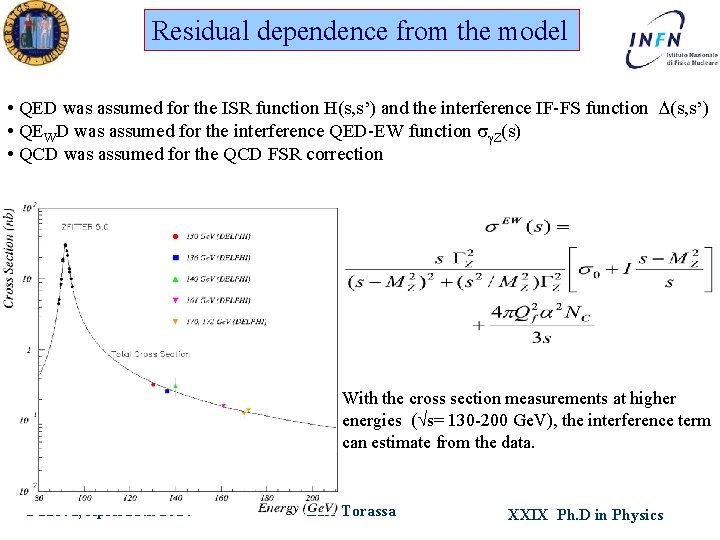
Residual dependence from the model • QED was assumed for the ISR function H(s, s’) and the interference IF-FS function (s, s’) • QEWD was assumed for the interference QED-EW function s Z(s) • QCD was assumed for the QCD FSR correction With the cross section measurements at higher energies ( s= 130 -200 Ge. V), the interference term can estimate from the data. Padova, April 28 th 2014 Ezio Torassa XXIX Ph. D in Physics
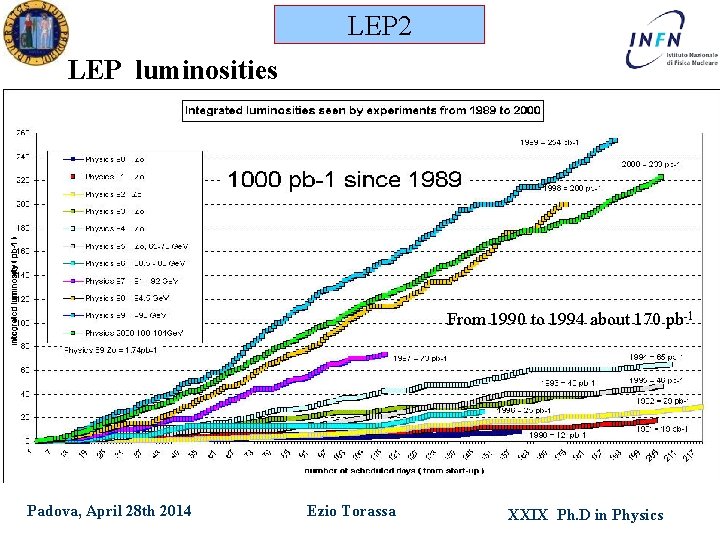
LEP 2 LEP luminosities From 1990 to 1994 about 170 pb-1 Padova, April 28 th 2014 Ezio Torassa XXIX Ph. D in Physics
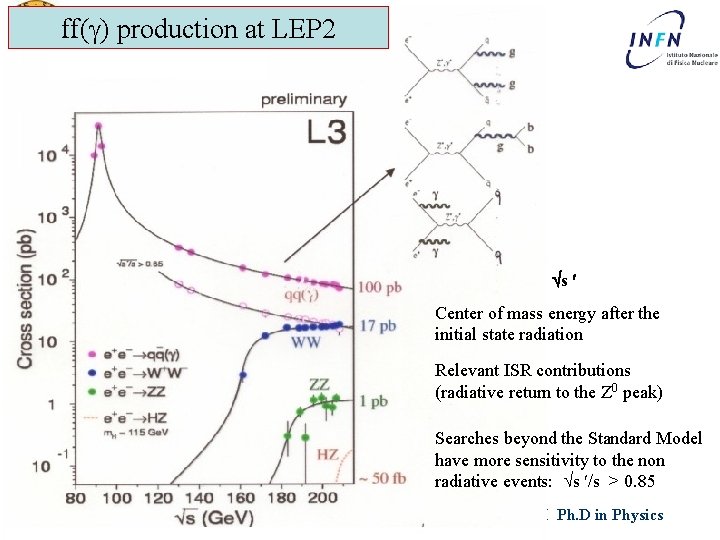
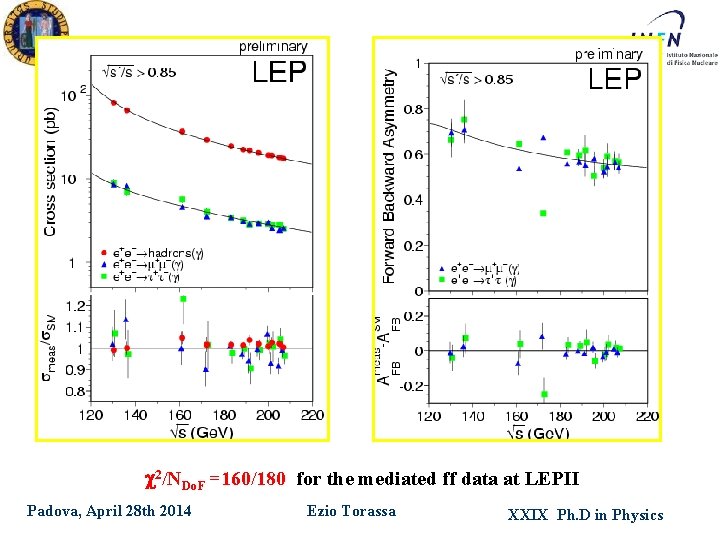
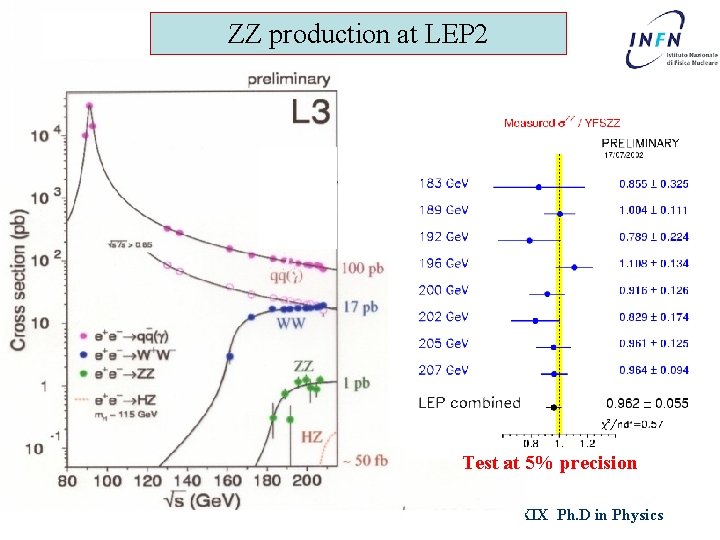
ff( ) production at LEP 2 qq(g) WW ZZ s Center of mass energy after the initial state radiation Relevant ISR contributions (radiative return to the Z 0 peak) Searches beyond the Standard Model have more sensitivity to the non radiative events: s /s > 0. 85 Padova, April 28 th 2014 Ezio Torassa XXIX Ph. D in Physics
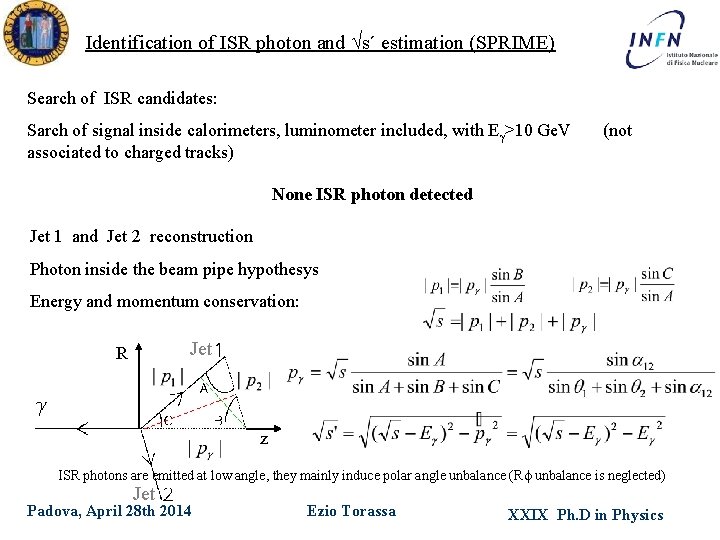
Identification of ISR photon and s´ estimation (SPRIME) Search of ISR candidates: Sarch of signal inside calorimeters, luminometer included, with E >10 Ge. V associated to charged tracks) (not None ISR photon detected Jet 1 and Jet 2 reconstruction Photon inside the beam pipe hypothesys Energy and momentum conservation: Jet R z ISR photons are emitted at low angle, they mainly induce polar angle unbalance (R unbalance is neglected) Jet Padova, April 28 th 2014 Ezio Torassa XXIX Ph. D in Physics
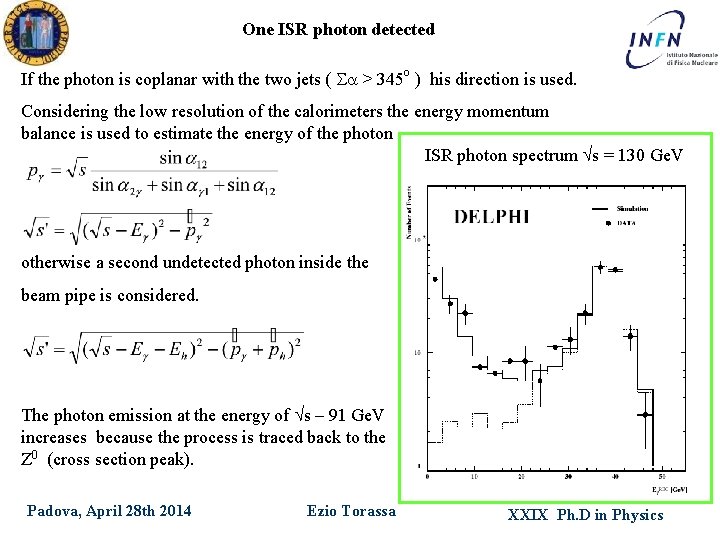
One ISR photon detected If the photon is coplanar with the two jets ( Sa > 345 o ) his direction is used. Considering the low resolution of the calorimeters the energy momentum balance is used to estimate the energy of the photon ISR photon spectrum s = 130 Ge. V otherwise a second undetected photon inside the beam pipe is considered. The photon emission at the energy of s – 91 Ge. V increases because the process is traced back to the Z 0 (cross section peak). Padova, April 28 th 2014 Ezio Torassa XXIX Ph. D in Physics
2/NDo. F =160/180 for the mediated ff data at LEPII Padova, April 28 th 2014 Ezio Torassa XXIX Ph. D in Physics
ZZ production at LEP 2 s. ZZ( s) Test at 5% precision Padova, April 28 th 2014 Ezio Torassa XXIX Ph. D in Physics
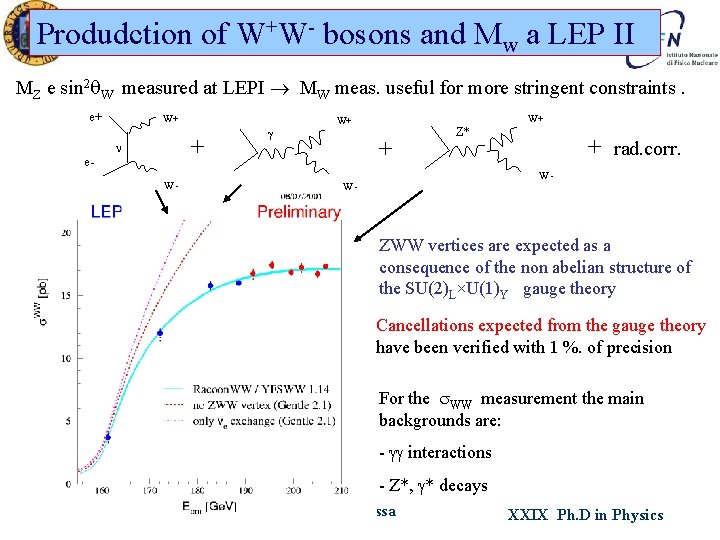
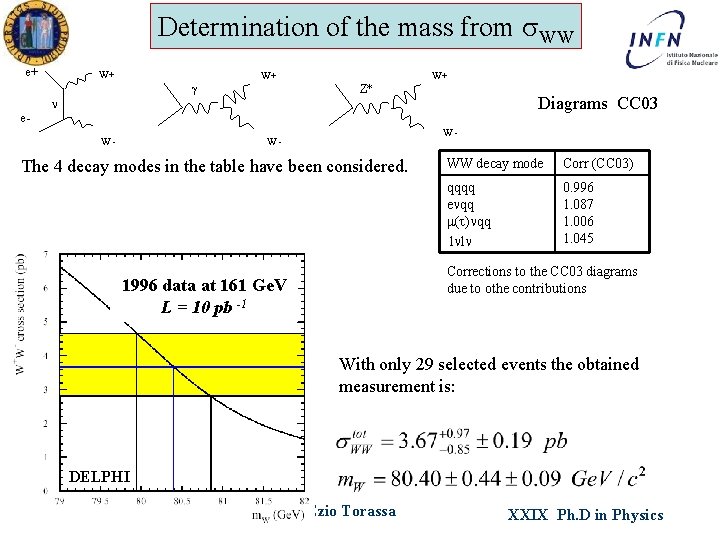
Produdction of W+W- bosons and Mw a LEP II MZ e sin 2 W measured at LEPI MW meas. useful for more stringent constraints. e+ W+ + e. W- W+ W+ + Z* + rad. corr. W- W- ZWW vertices are expected as a consequence of the non abelian structure of the SU(2)L×U(1)Y gauge theory Cancellations expected from the gauge theory have been verified with 1 %. of precision For the s. WW measurement the main backgrounds are: - interactions - Z*, * decays Padova, April 28 th 2014 Ezio Torassa XXIX Ph. D in Physics
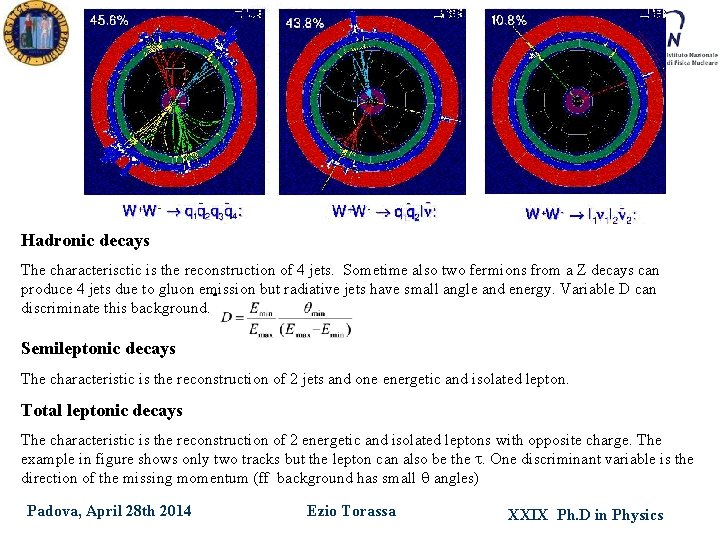
Hadronic decays The characterisctic is the reconstruction of 4 jets. Sometime also two fermions from a Z decays can produce 4 jets due to gluon emission but radiative jets have small angle and energy. Variable D can discriminate this background. Semileptonic decays The characteristic is the reconstruction of 2 jets and one energetic and isolated lepton. Total leptonic decays The characteristic is the reconstruction of 2 energetic and isolated leptons with opposite charge. The example in figure shows only two tracks but the lepton can also be the . One discriminant variable is the direction of the missing momentum (ff background has small angles) Padova, April 28 th 2014 Ezio Torassa XXIX Ph. D in Physics
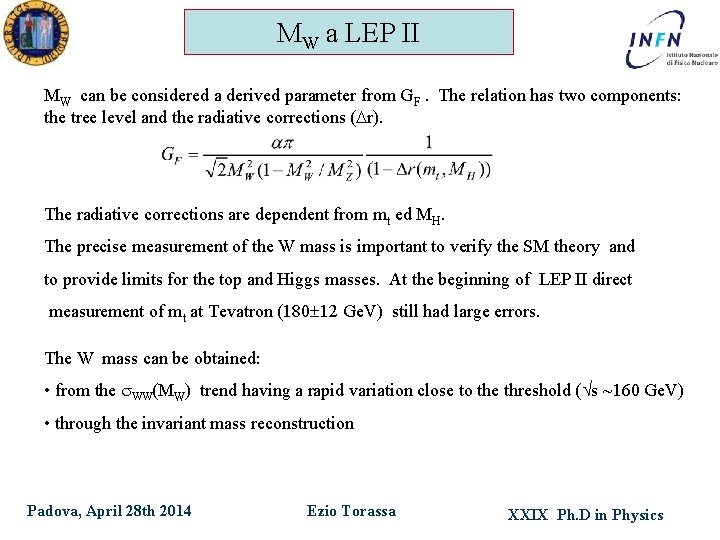
MW a LEP II MW can be considered a derived parameter from GF. The relation has two components: the tree level and the radiative corrections ( r). The radiative corrections are dependent from mt ed MH. The precise measurement of the W mass is important to verify the SM theory and to provide limits for the top and Higgs masses. At the beginning of LEP II direct measurement of mt at Tevatron (180 12 Ge. V) still had large errors. The W mass can be obtained: • from the s. WW(MW) trend having a rapid variation close to the threshold ( s ~160 Ge. V) • through the invariant mass reconstruction Padova, April 28 th 2014 Ezio Torassa XXIX Ph. D in Physics
Determination of the mass from s. WW e+ W+ W+ W+ Z* Diagrams CC 03 e. W- W- W- The 4 decay modes in the table have been considered. WW decay mode Corr (CC 03) qqqq e qq ( ) qq l l 0. 996 1. 087 1. 006 1. 045 Corrections to the CC 03 diagrams due to othe contributions 1996 data at 161 Ge. V L = 10 pb -1 With only 29 selected events the obtained measurement is: DELPHI Padova, April 28 th 2014 Ezio Torassa XXIX Ph. D in Physics
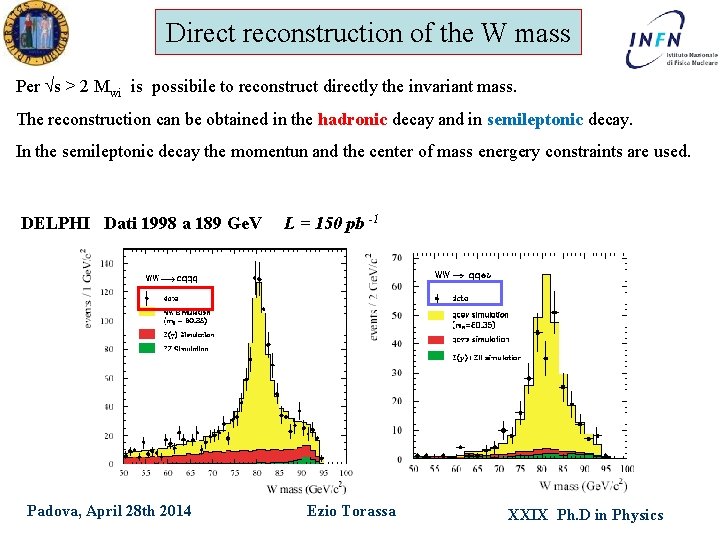
Direct reconstruction of the W mass Per s > 2 Mwi is possibile to reconstruct directly the invariant mass. The reconstruction can be obtained in the hadronic decay and in semileptonic decay. In the semileptonic decay the momentun and the center of mass energery constraints are used. DELPHI Dati 1998 a 189 Ge. V Padova, April 28 th 2014 L = 150 pb -1 Ezio Torassa XXIX Ph. D in Physics
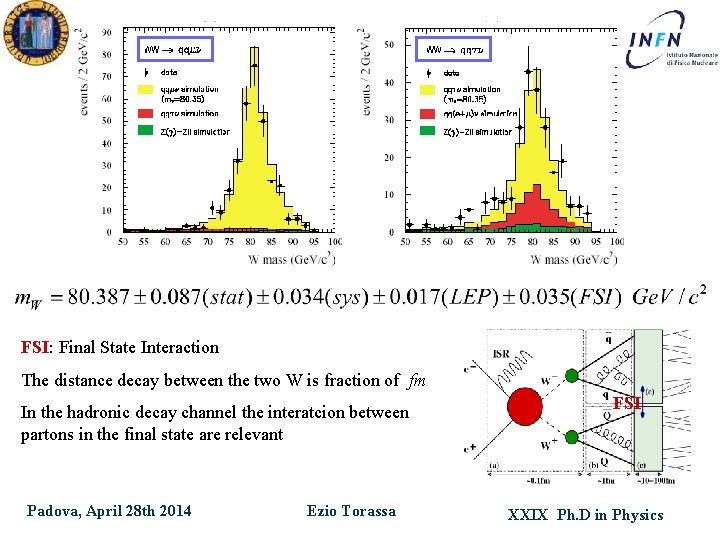
FSI: Final State Interaction The distance decay between the two W is fraction of fm In the hadronic decay channel the interatcion between partons in the final state are relevant Padova, April 28 th 2014 Ezio Torassa FSI XXIX Ph. D in Physics
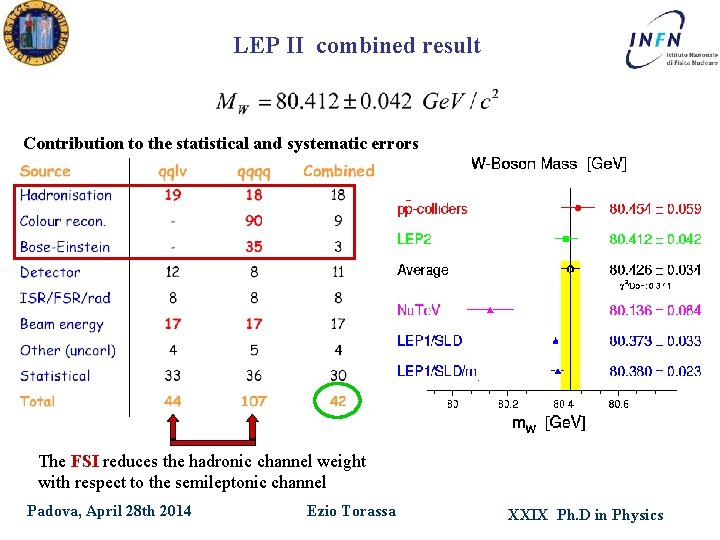
LEP II combined result Contribution to the statistical and systematic errors The FSI reduces the hadronic channel weight with respect to the semileptonic channel Padova, April 28 th 2014 Ezio Torassa XXIX Ph. D in Physics
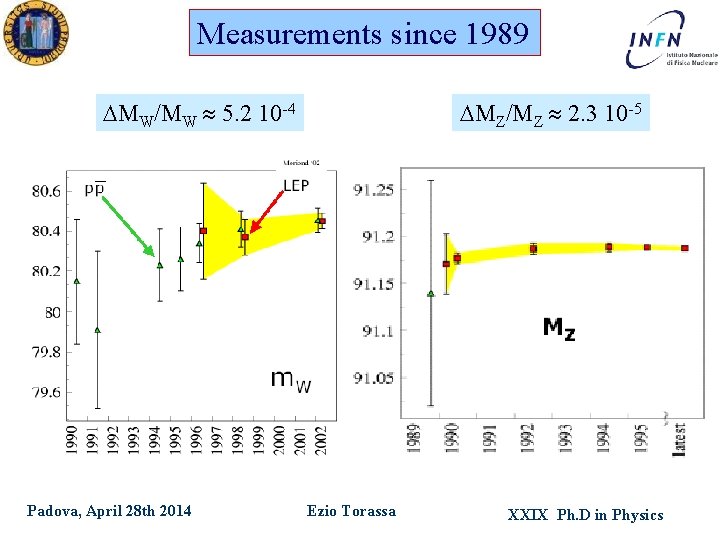
Measurements since 1989 MW/MW 5. 2 10 -4 Padova, April 28 th 2014 MZ/MZ 2. 3 10 -5 Ezio Torassa XXIX Ph. D in Physics
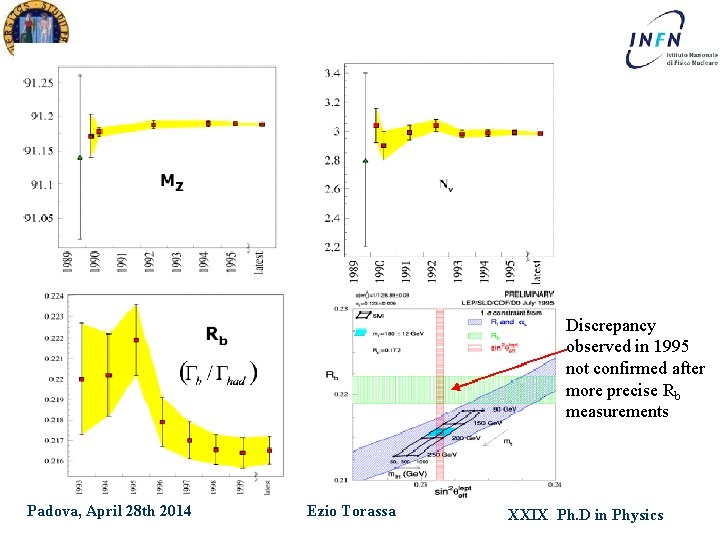
Discrepancy observed in 1995 not confirmed after more precise Rb measurements Padova, April 28 th 2014 Ezio Torassa XXIX Ph. D in Physics
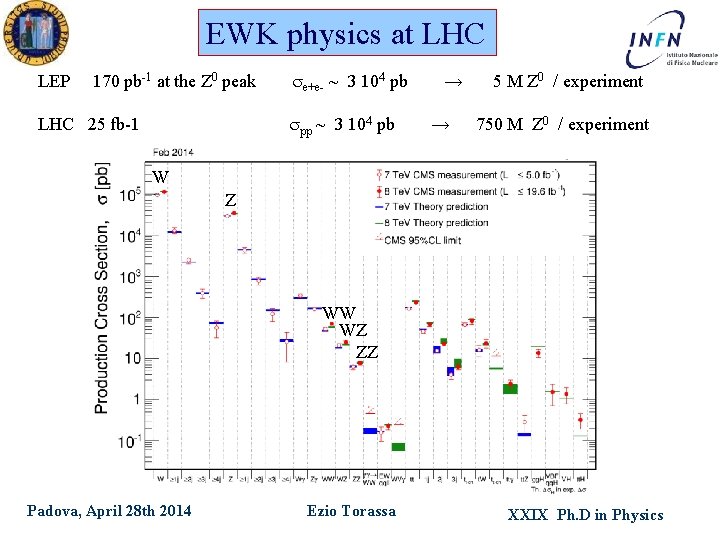
EWK physics at LHC LEP 170 pb-1 at the Z 0 peak se+e- ~ 3 104 pb spp ~ 3 104 pb LHC 25 fb-1 → → 5 M Z 0 / experiment 750 M Z 0 / experiment W Z WW WZ ZZ Padova, April 28 th 2014 Ezio Torassa XXIX Ph. D in Physics
Quarks & Leptons – Francis Halzen / Alan D. Martin – Wiley International Edition The Experimental Foundation of Particle Physics – Robert N. Cahn / Gerson Goldhaber Cambridge University Press Determination of Z resonance parameters and coupling from its hadronic and leptonic decays - Nucl. Physics B 367 (1991) 511 -574 Z Physics at LEP I CERN 89 -08 Vol 1 – Radiative corrections (p. 7) Z Line Shape (p. 89) Measurement of the lineshape of the Z and determination of electroweak parameters from its hadronic decays - Nuclear Physics B 417 (1994) 3 -57 Measurement and interpretation of the W-pair cross-section in e+e- interaction at 161 Ge. V Phys. Lett. B 397 (1997) 158 -170 Measurement of the mass and width of the W boson in e+e- collision at s =189 Ge. V Phys. Lett. B 511 (2001) 159 -177 http: //www. pd. infn. it/~torassa/dottorato/2014/ Padova, April 28 th 2014 Ezio Torassa XXIX Ph. D in Physics