
Standard Model Higgs searches with the CMS detector

- Slides: 20
Standard Model Higgs searches with the CMS detector C. Rovelli (INFN Roma 1) on behalf of the CMS Collaboration EPS, Manchester – July 19 th – 25 th
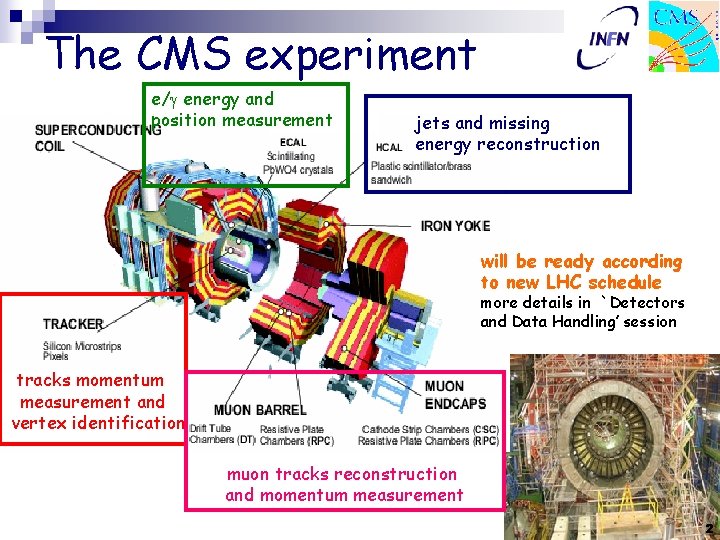
The CMS experiment e/g energy and position measurement jets and missing energy reconstruction ECAL will be ready according to new LHC schedule more details in `Detectors and Data Handling’ session tracks momentum measurement and vertex identification muon tracks reconstruction and momentum measurement 2
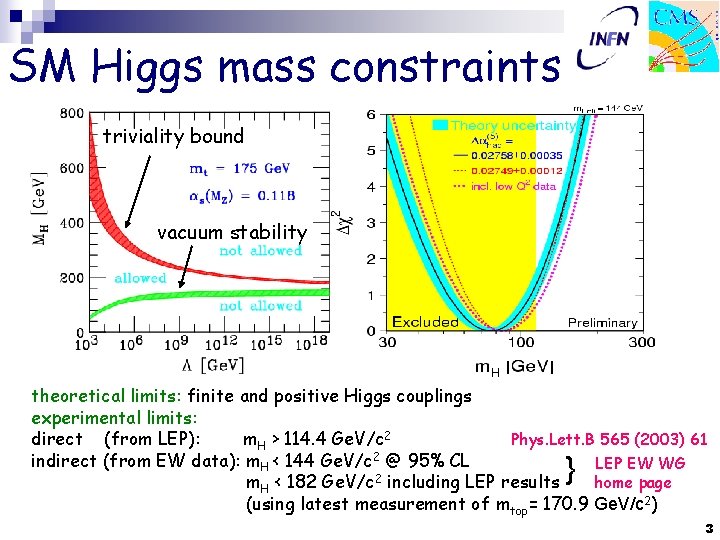
SM Higgs mass constraints triviality bound vacuum stability theoretical limits: finite and positive Higgs couplings experimental limits: Phys. Lett. B 565 (2003) 61 direct (from LEP): m. H > 114. 4 Ge. V/c 2 indirect (from EW data): m. H < 144 Ge. V/c 2 @ 95% CL LEP EW WG 2 home page m. H < 182 Ge. V/c including LEP results (using latest measurement of mtop= 170. 9 Ge. V/c 2) } 3
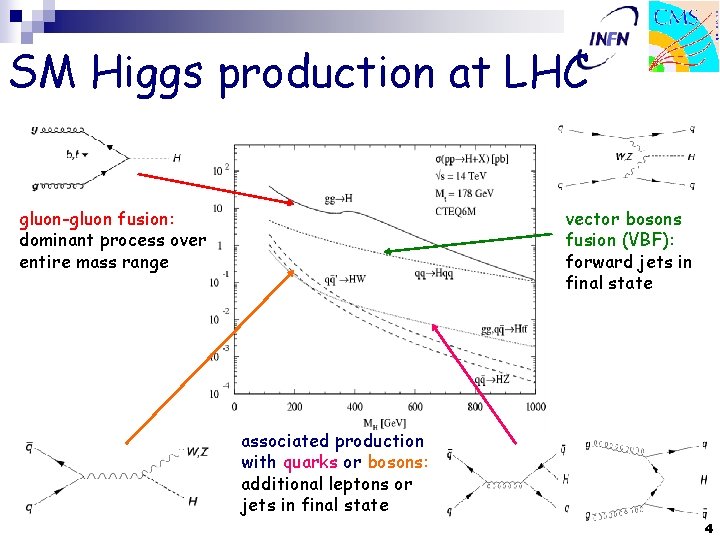
SM Higgs production at LHC gluon-gluon fusion: dominant process over entire mass range vector bosons fusion (VBF): forward jets in final state associated production with quarks or bosons: additional leptons or jets in final state 4
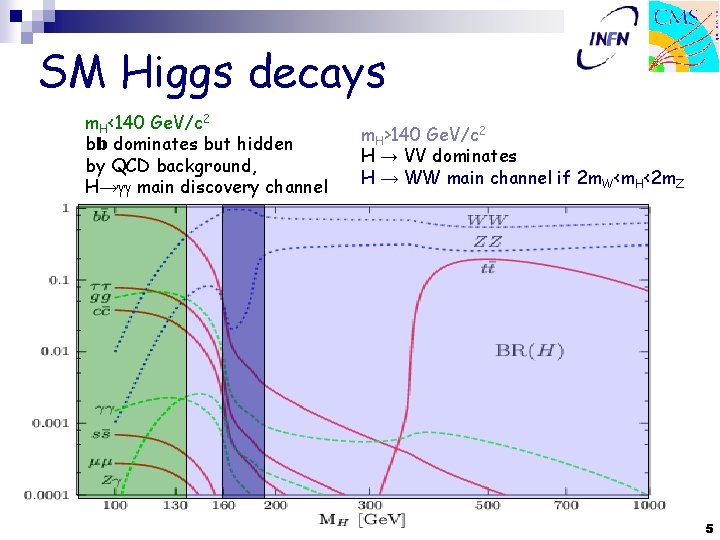
SM Higgs decays m. H<140 Ge. V/c 2 bb dominates but hidden by QCD background, H→gg main discovery channel m. H>140 Ge. V/c 2 H → VV dominates H → WW main channel if 2 m. W<m. H<2 m. Z 5
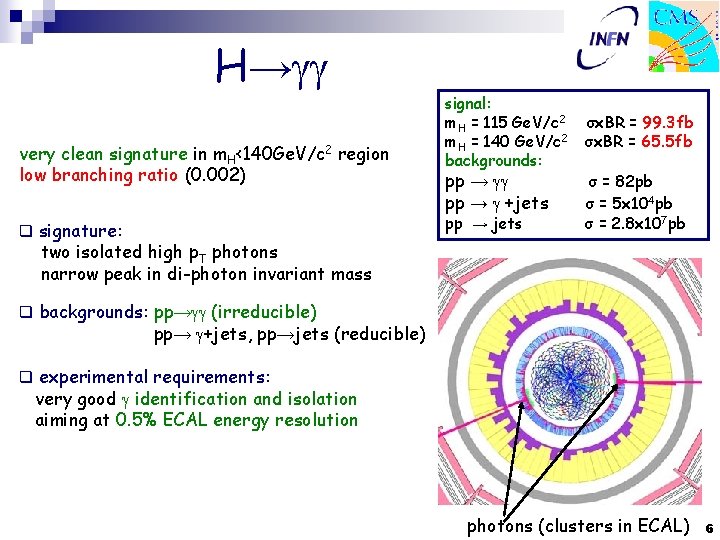
H→gg very clean signature in m. H<140 Ge. V/c 2 region low branching ratio (0. 002) signal: m. H = 115 Ge. V/c 2 m. H = 140 Ge. V/c 2 backgrounds: pp → gg pp → g +jets pp → jets q signature: σx. BR = 99. 3 fb σx. BR = 65. 5 fb σ = 82 pb σ = 5 x 10⁴ pb σ = 2. 8 x 10⁷ pb two isolated high p. T photons narrow peak in di-photon invariant mass q backgrounds: pp→gg (irreducible) pp→ g+jets, pp→jets (reducible) q experimental requirements: very good g identification and isolation aiming at 0. 5% ECAL energy resolution photons (clusters in ECAL) 6
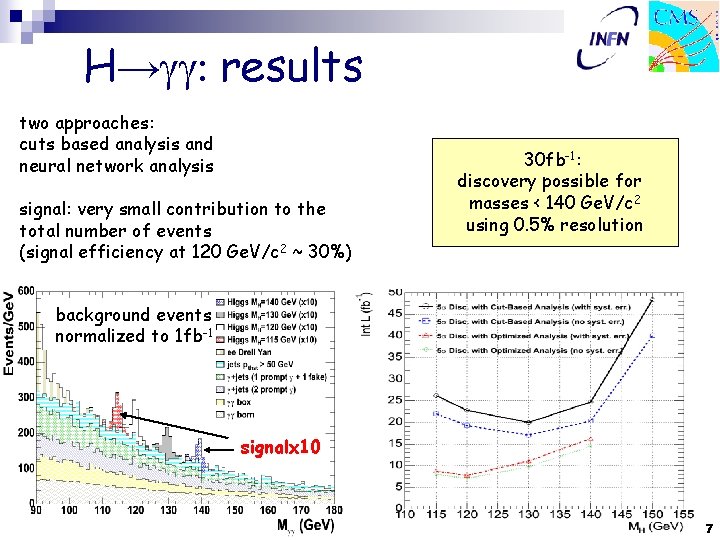
H→gg: results two approaches: cuts based analysis and neural network analysis signal: very small contribution to the total number of events (signal efficiency at 120 Ge. V/c 2 ~ 30%) 30 fb-1: discovery possible for masses < 140 Ge. V/c 2 using 0. 5% resolution background events normalized to 1 fb-1 signalx 10 7
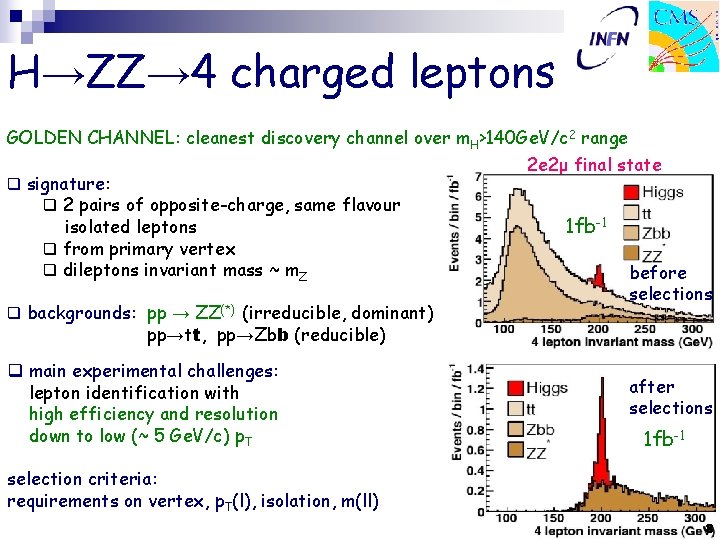
H→ZZ→ 4 charged leptons GOLDEN CHANNEL: cleanest discovery channel over m H>140 Ge. V/c 2 range 2 e 2μ final state q signature: q 2 pairs of opposite-charge, same flavour 1 fb-1 isolated leptons q from primary vertex q dileptons invariant mass ~ m. Z before selections (*) q backgrounds: pp → ZZ (irreducible, dominant) pp→tt, pp→Zbb (reducible) q main experimental challenges: lepton identification with high efficiency and resolution down to low (~ 5 Ge. V/c) p. T after cuts selections 1 fb-1 selection criteria: requirements on vertex, p. T(l), isolation, m(ll) 8
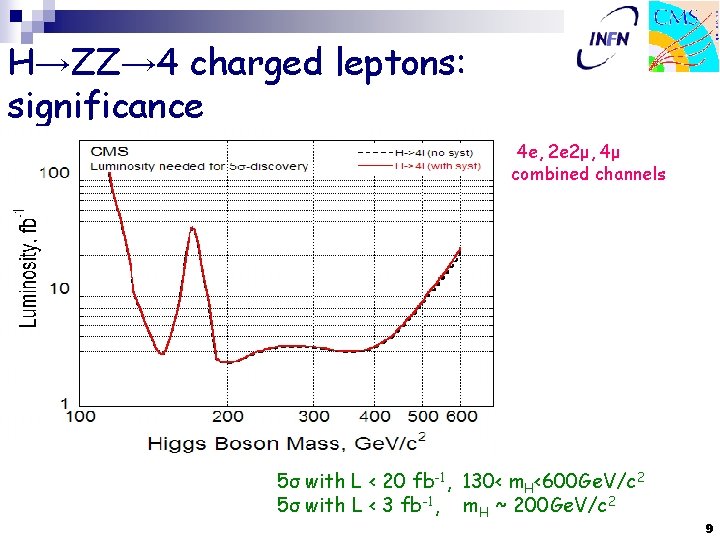
H→ZZ→ 4 charged leptons: significance 4 e, 2 e 2μ, 4μ combined channels 5σ with L < 20 fb-1, 130< m. H<600 Ge. V/c 2 5σ with L < 3 fb-1, m. H ~ 200 Ge. V/c 2 9
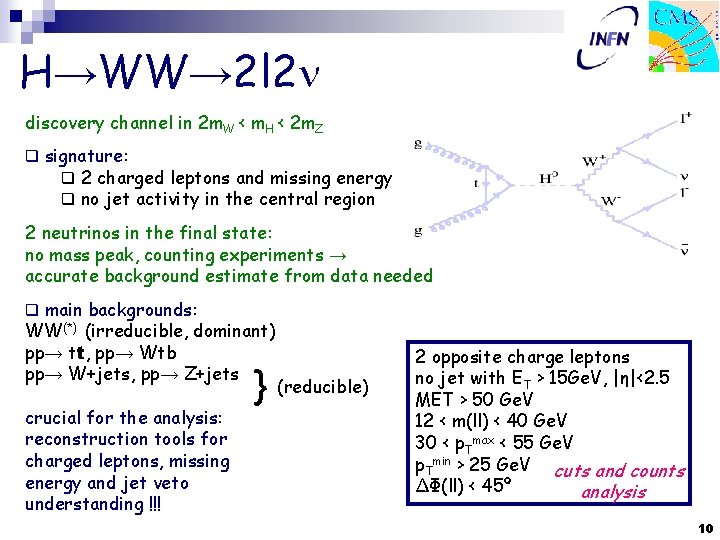
H→WW→ 2 l 2 n discovery channel in 2 m. W < m. H < 2 m. Z q signature: q 2 charged leptons and missing energy q no jet activity in the central region 2 neutrinos in the final state: no mass peak, counting experiments → accurate background estimate from data needed q main backgrounds: WW(*) (irreducible, dominant) pp→ tt, pp→ Wtb pp→ W+jets, pp→ Z+jets crucial for the analysis: reconstruction tools for charged leptons, missing energy and jet veto understanding !!! } (reducible) 2 opposite charge leptons no jet with ET > 15 Ge. V, |η|<2. 5 MET > 50 Ge. V 12 < m(ll) < 40 Ge. V 30 < p. Tmax < 55 Ge. V p. Tmin > 25 Ge. V cuts and counts ΔΦ(ll) < 45º analysis 10
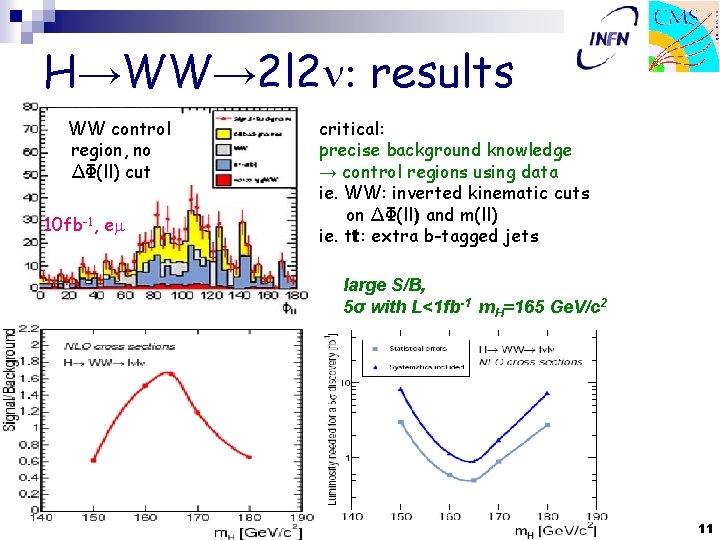
H→WW→ 2 l 2 n: results WW control region, no ΔΦ(ll) cut 10 fb-1, em critical: precise background knowledge → control regions using data ie. WW: inverted kinematic cuts on ΔΦ(ll) and m(ll) ie. tt: extra b-tagged jets large S/B, 5σ with L<1 fb-1 m. H=165 Ge. V/c 2 11
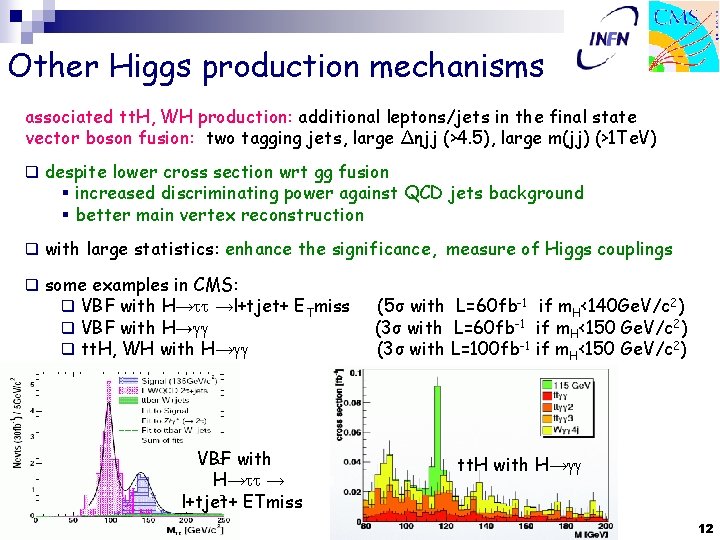
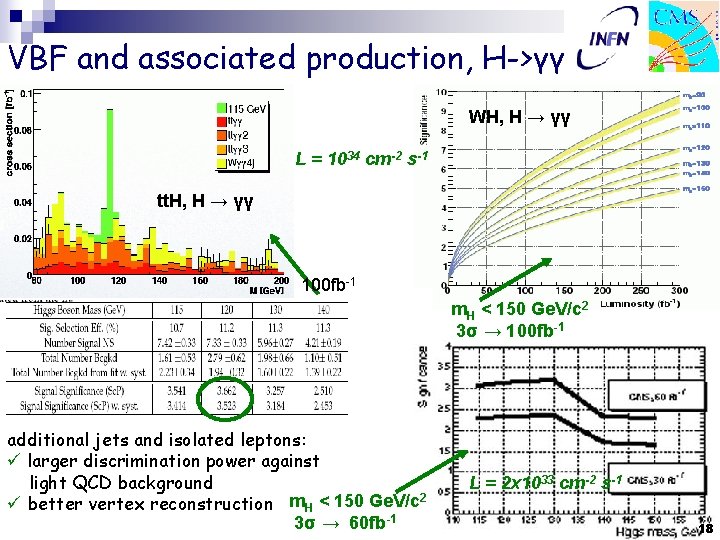
Other Higgs production mechanisms associated tt. H, WH production: additional leptons/jets in the final state vector boson fusion: two tagging jets, large Δηjj (>4. 5), large m(jj) (>1 Te. V) q despite lower cross section wrt gg fusion § increased discriminating power against QCD jets background § better main vertex reconstruction q with large statistics: enhance the significance, measure of Higgs couplings q some examples in CMS: q VBF with H→tt →l+tjet+ ETmiss q VBF with H→gg q tt. H, WH with H→gg VBF with H→tt → l+tjet+ ETmiss (5σ with L=60 fb-1 if m. H<140 Ge. V/c 2) (3σ with L=60 fb-1 if m. H<150 Ge. V/c 2) (3σ with L=100 fb-1 if m. H<150 Ge. V/c 2) tt. H with H→gg 12
Analyses common aspects n n Event generation and simulation: ¨ NLO, NNLO: K factors for σ and events re-weighting ¨ MC used: PYTHIA, Comp. HEP, Alpgen, Top. Re. X, MC@NLO. . ¨ full detector simulation and reconstruction uncertainties taken into account: ¨ theoretical: n ¨ experimental: n n n ¨ pdf, N(N)LO corrections, factorization/renormalization scale lepton reconstruction efficiency and energy scale jets/MET scale misalineament, miscalibration, geometry description (ie. tracker material budget) data driven estimate n n background shape and cross-section in signal region leptons energy scale (via Z, W -> ll) recently published analyses (CMS Physics TDR, vol II: http: //cmsdoc. cern. ch/cms/cpt/tdr) 13
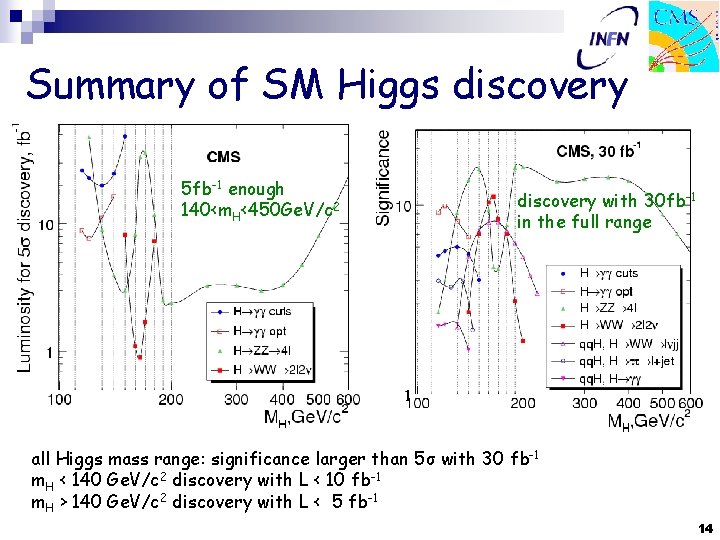
Summary of SM Higgs discovery 5 fb-1 enough 140<m. H<450 Ge. V/c 2 discovery with 30 fb-1 in the full range all Higgs mass range: significance larger than 5σ with 30 fb-1 m. H < 140 Ge. V/c 2 discovery with L < 10 fb-1 m. H > 140 Ge. V/c 2 discovery with L < 5 fb-1 14
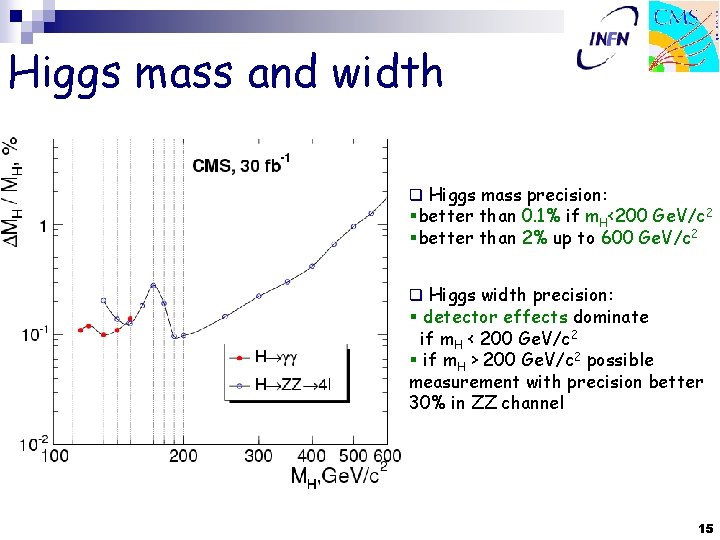
Higgs mass and width q Higgs mass precision: §better than 0. 1% if m. H<200 Ge. V/c 2 §better than 2% up to 600 Ge. V/c 2 q Higgs width precision: § detector effects dominate if m. H < 200 Ge. V/c 2 § if m. H > 200 Ge. V/c 2 possible measurement with precision better 30% in ZZ channel 15
Summary n CMS discovery potential for the SM Higgs boson recently evaluated with full detector simulation n inclusion/development of ¨ ¨ ¨ n systematics errors, both theoretical and experimental background estimate procedures using data NLO computation CMS discovery reach ¨ L < 10 fb-1 in the H→gg channel @ 120 Ge. V/c 2 ¨ L < 3 fb-1 in the H → ZZ channel @ 180 Ge. V/c 2 ¨ L < 1 fb-1 in the H → WW channel @ 165 Ge. V/c 2 n significance > 5σ with L = 30 fb-1 in 120 Ge. V/c 2 < m. H < 600 Ge. V/c 2 range n Higgs mass precision better than ¨ ¨ 0. 1% if m. H < 200 Ge. V/c 2 2% up to 600 Ge. V/c 2 16
BACKUP SLIDES 17
VBF and associated production, H->γγ WH, H → γγ L = 1034 cm-2 s-1 tt. H, H → γγ 100 fb-1 m. H < 150 Ge. V/c 2 3σ → 100 fb-1 additional jets and isolated leptons: ü larger discrimination power against light QCD background ü better vertex reconstruction m. H < 150 Ge. V/c 2 3σ → 60 fb-1 L = 2 x 1033 cm-2 s-1 18
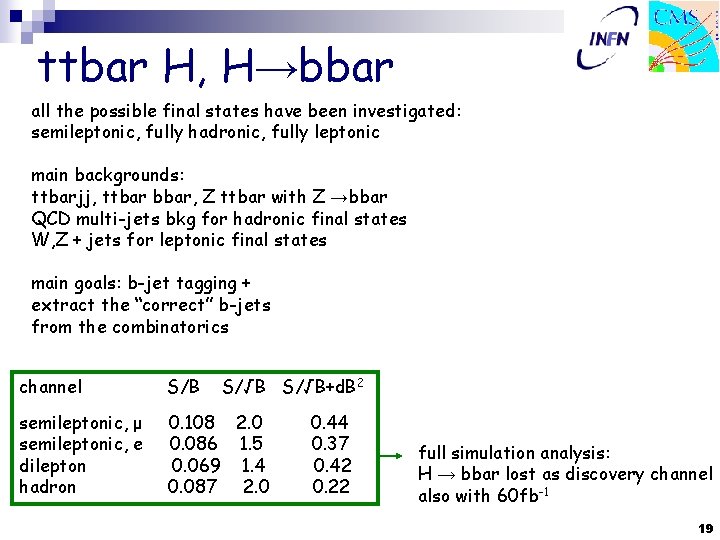
ttbar H, H→bbar all the possible final states have been investigated: semileptonic, fully hadronic, fully leptonic main backgrounds: ttbarjj, ttbar bbar, Z ttbar with Z →bbar QCD multi-jets bkg for hadronic final states W, Z + jets for leptonic final states main goals: b-jet tagging + extract the “correct” b-jets from the combinatorics channel S/B S/√B+d. B 2 semileptonic, μ semileptonic, e dilepton hadron 0. 108 2. 0 0. 086 1. 5 0. 069 1. 4 0. 087 2. 0 0. 44 0. 37 0. 42 0. 22 full simulation analysis: H → bbar lost as discovery channel also with 60 fb-1 19
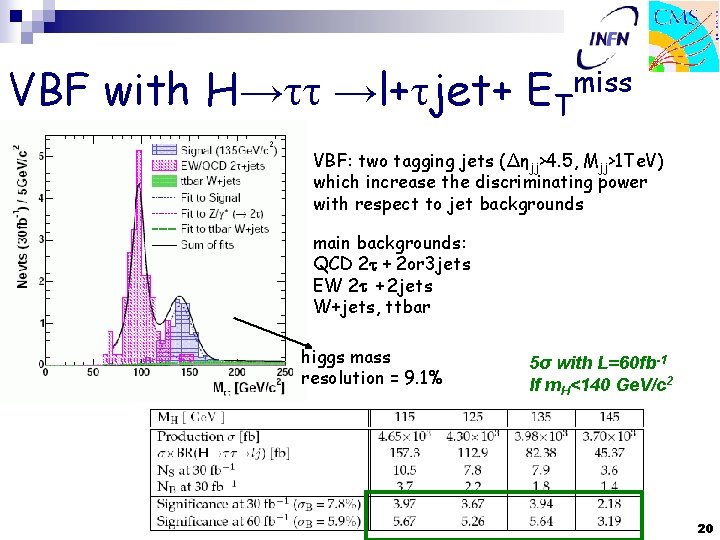
VBF with H→tt →l+tjet+ ETmiss VBF: two tagging jets (Δηjj>4. 5, Mjj>1 Te. V) which increase the discriminating power with respect to jet backgrounds main backgrounds: QCD 2 t + 2 or 3 jets EW 2 t + 2 jets W+jets, ttbar higgs mass resolution = 9. 1% 5σ with L=60 fb-1 If m. H<140 Ge. V/c 2 20