
Standard Model Higgs Boson Searches at ATLAS Stefano
Standard Model Higgs Boson Searches at ATLAS Stefano Rosati INFN Roma On behalf of the ATLAS collaboration 20/07/2007 S. Rosati - EPS 2007
Outline • Introduction – Higgs phenomenology, production and decay modes at LHC • The ATLAS experiment – Main design characteristics • Standard Model Higgs Searches (a selection of channels) – gg-fusion production • H gg • H ZZ* 4 leptons • H WW lnln – Vector Boson Fusion production • H tt • H WW – tt. H (H bb) • Expected significances 20/07/2007 S. Rosati - EPS 2007 2
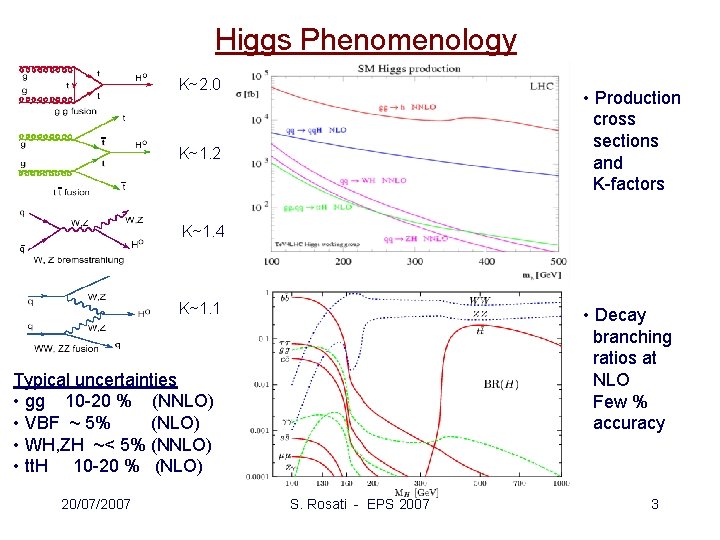
Higgs Phenomenology K~2. 0 • Production cross sections and K-factors K~1. 2 K~1. 4 K~1. 1 • Decay branching ratios at NLO Few % accuracy Typical uncertainties • gg 10 -20 % (NNLO) • VBF ~ 5% (NLO) • WH, ZH ~< 5% (NNLO) • tt. H 10 -20 % (NLO) 20/07/2007 S. Rosati - EPS 2007 3
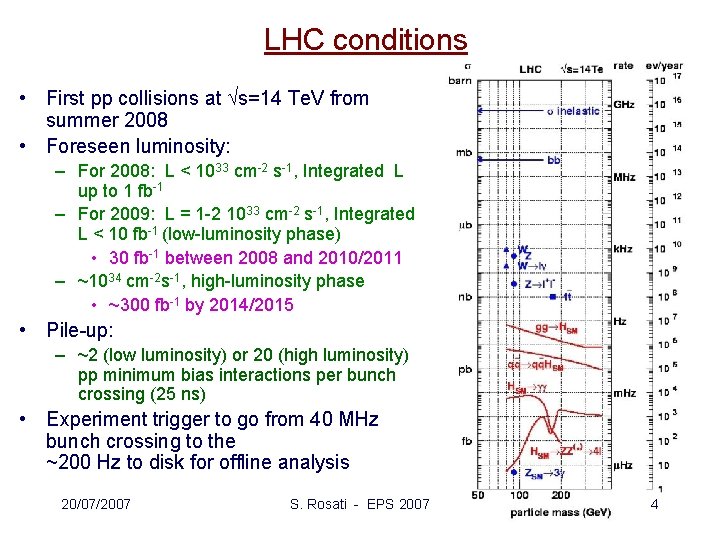
LHC conditions • First pp collisions at s=14 Te. V from summer 2008 • Foreseen luminosity: – For 2008: L < 1033 cm-2 s-1, Integrated L up to 1 fb-1 – For 2009: L = 1 -2 1033 cm-2 s-1, Integrated L < 10 fb-1 (low-luminosity phase) • 30 fb-1 between 2008 and 2010/2011 – ~1034 cm-2 s-1, high-luminosity phase • ~300 fb-1 by 2014/2015 • Pile-up: – ~2 (low luminosity) or 20 (high luminosity) pp minimum bias interactions per bunch crossing (25 ns) • Experiment trigger to go from 40 MHz bunch crossing to the ~200 Hz to disk for offline analysis 20/07/2007 S. Rosati - EPS 2007 4
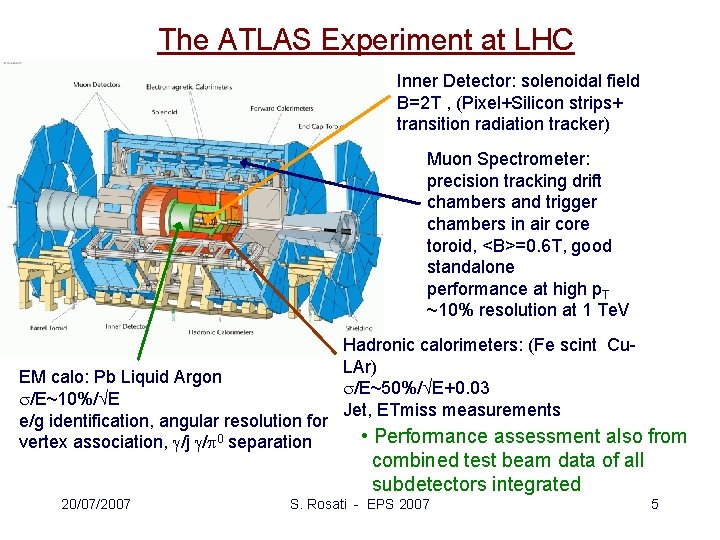
The ATLAS Experiment at LHC Inner Detector: solenoidal field B=2 T , (Pixel+Silicon strips+ transition radiation tracker) Muon Spectrometer: precision tracking drift chambers and trigger chambers in air core toroid, <B>=0. 6 T, good standalone performance at high p. T ~10% resolution at 1 Te. V EM calo: Pb Liquid Argon /E~10%/ E e/g identification, angular resolution for vertex association, g/j g/p 0 separation 20/07/2007 Hadronic calorimeters: (Fe scint Cu. LAr) /E~50%/ E+0. 03 Jet, ETmiss measurements • Performance assessment also from combined test beam data of all subdetectors integrated S. Rosati - EPS 2007 5
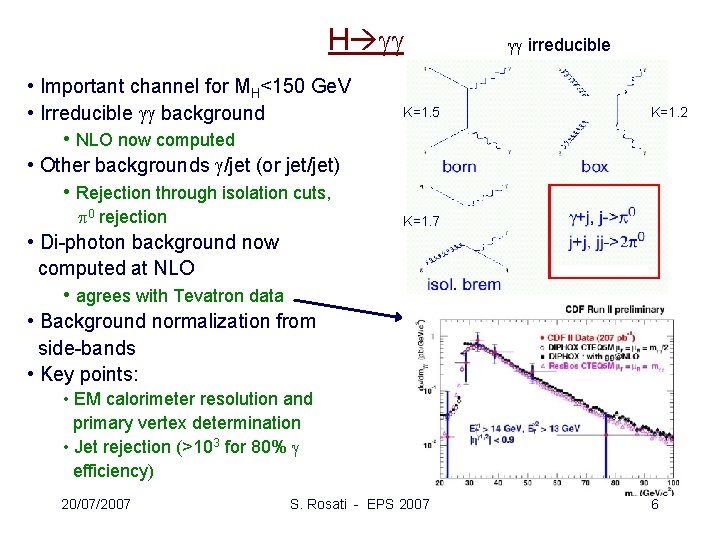
H gg • Important channel for MH<150 Ge. V • Irreducible gg background • NLO now computed • Other backgrounds g/jet (or jet/jet) • Rejection through isolation cuts, p 0 rejection K=1. 5 gg irreducible K=1. 2 K=1. 7 • Di-photon background now computed at NLO • agrees with Tevatron data • Background normalization from side-bands • Key points: • EM calorimeter resolution and primary vertex determination • Jet rejection (>103 for 80% g efficiency) 20/07/2007 S. Rosati - EPS 2007 6
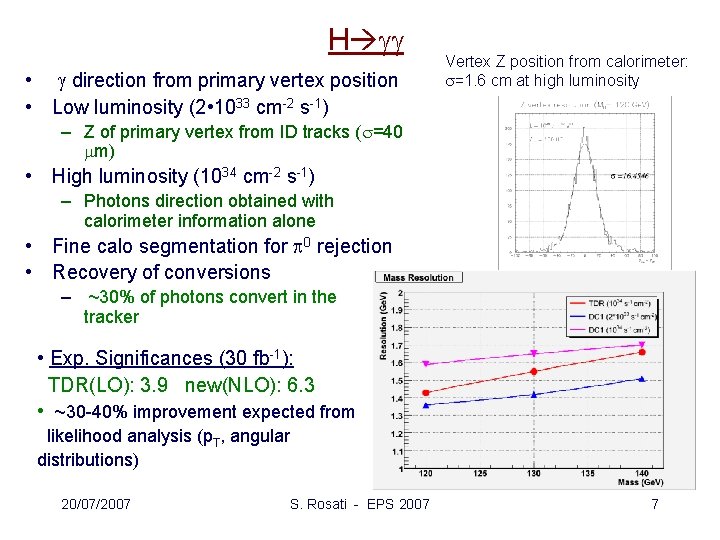
H gg • g direction from primary vertex position • Low luminosity (2 • 1033 cm-2 s-1) Vertex Z position from calorimeter: =1. 6 cm at high luminosity – Z of primary vertex from ID tracks ( =40 mm) • High luminosity (1034 cm-2 s-1) – Photons direction obtained with calorimeter information alone • Fine calo segmentation for p 0 rejection • Recovery of conversions – ~30% of photons convert in the tracker • Exp. Significances (30 fb-1): TDR(LO): 3. 9 new(NLO): 6. 3 • ~30 -40% improvement expected from likelihood analysis (p. T, angular distributions) 20/07/2007 S. Rosati - EPS 2007 7
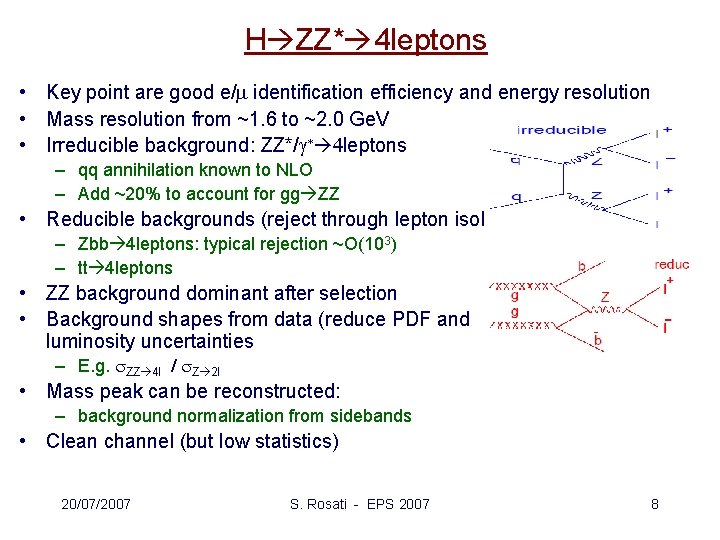
H ZZ* 4 leptons • Key point are good e/m identification efficiency and energy resolution • Mass resolution from ~1. 6 to ~2. 0 Ge. V • Irreducible background: ZZ*/g* 4 leptons – qq annihilation known to NLO – Add ~20% to account for gg ZZ • Reducible backgrounds (reject through lepton isolation, IP cuts): – Zbb 4 leptons: typical rejection ~O(103) – tt 4 leptons • ZZ background dominant after selection • Background shapes from data (reduce PDF and luminosity uncertainties – E. g. ZZ 4 l / Z 2 l • Mass peak can be reconstructed: – background normalization from sidebands • Clean channel (but low statistics) 20/07/2007 S. Rosati - EPS 2007 8
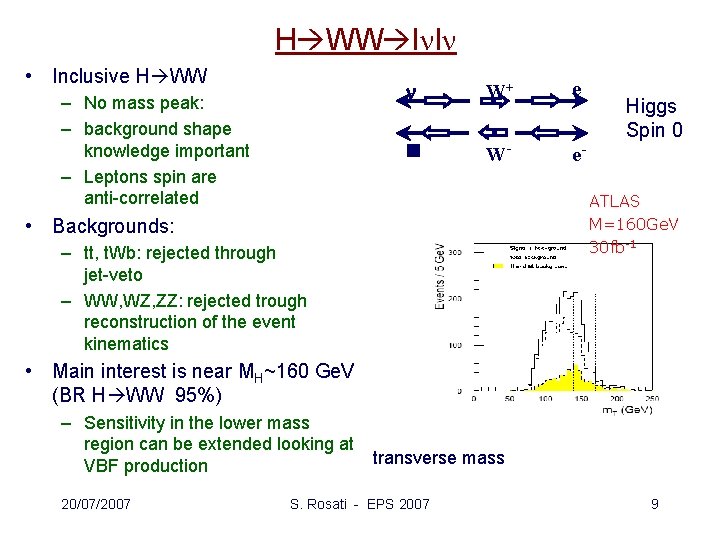
H WW lnln • Inclusive H WW – No mass peak: – background shape knowledge important – Leptons spin are anti-correlated n W+ e n W- e- + Higgs Spin 0 ATLAS M=160 Ge. V 30 fb-1 • Backgrounds: – tt, t. Wb: rejected through jet-veto – WW, WZ, ZZ: rejected trough reconstruction of the event kinematics • Main interest is near MH~160 Ge. V (BR H WW 95%) – Sensitivity in the lower mass region can be extended looking at VBF production 20/07/2007 transverse mass S. Rosati - EPS 2007 9
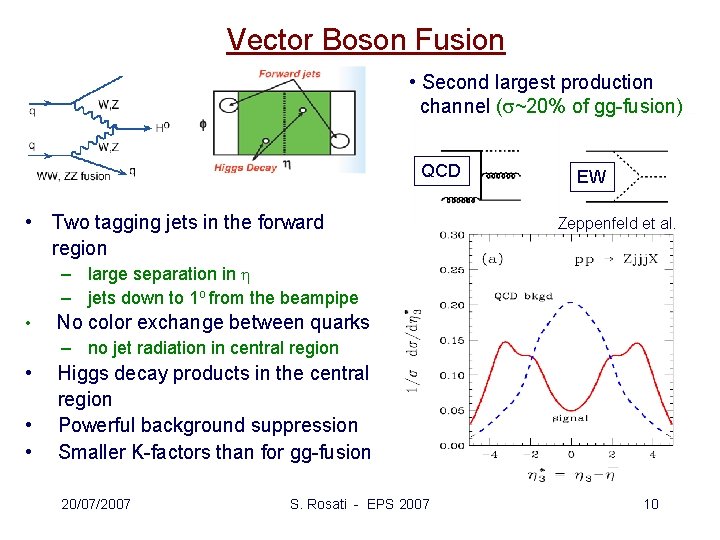
Vector Boson Fusion • Second largest production channel ( ~20% of gg-fusion) QCD • Two tagging jets in the forward region EW Zeppenfeld et al. – large separation in h – jets down to 1 o from the beampipe • No color exchange between quarks – no jet radiation in central region • • • Higgs decay products in the central region Powerful background suppression Smaller K-factors than for gg-fusion 20/07/2007 S. Rosati - EPS 2007 10
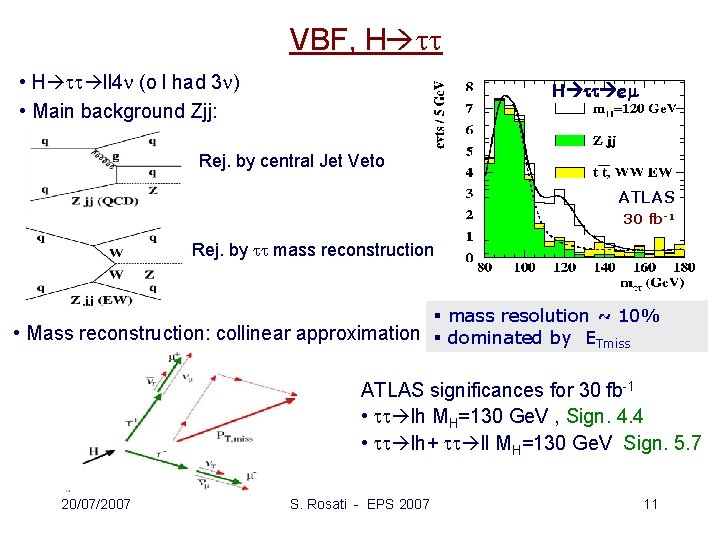
VBF, H tt • H tt ll 4 n (o l had 3 n) • Main background Zjj: H tt em Rej. by central Jet Veto ATLAS 30 fb-1 Rej. by tt mass reconstruction § mass resolution ~ 10% • Mass reconstruction: collinear approximation § dominated by ETmiss ATLAS significances for 30 fb-1 • tt lh MH=130 Ge. V , Sign. 4. 4 • tt lh+ tt ll MH=130 Ge. V Sign. 5. 7 20/07/2007 S. Rosati - EPS 2007 11
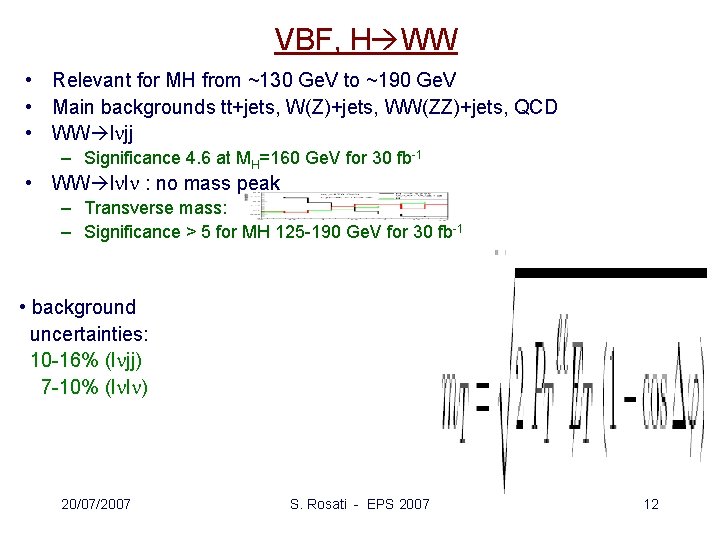
VBF, H WW • Relevant for MH from ~130 Ge. V to ~190 Ge. V • Main backgrounds tt+jets, W(Z)+jets, WW(ZZ)+jets, QCD • WW lnjj – Significance 4. 6 at MH=160 Ge. V for 30 fb-1 • WW lnln : no mass peak – Transverse mass: – Significance > 5 for MH 125 -190 Ge. V for 30 fb-1 • background uncertainties: 10 -16% (lnjj) 7 -10% (lnln) 20/07/2007 S. Rosati - EPS 2007 12
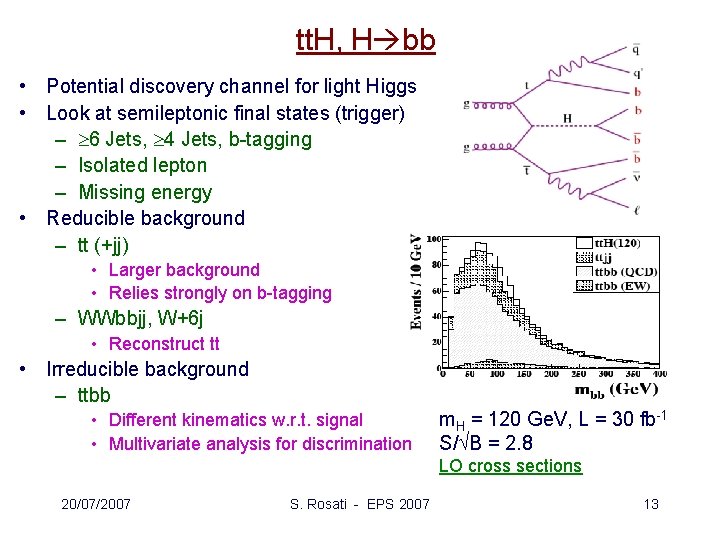
tt. H, H bb • Potential discovery channel for light Higgs • Look at semileptonic final states (trigger) – 6 Jets, 4 Jets, b-tagging – Isolated lepton – Missing energy • Reducible background – tt (+jj) • Larger background • Relies strongly on b-tagging – WWbbjj, W+6 j • Reconstruct tt • Irreducible background – ttbb • Different kinematics w. r. t. signal • Multivariate analysis for discrimination m. H = 120 Ge. V, L = 30 fb-1 S/ B = 2. 8 LO cross sections 20/07/2007 S. Rosati - EPS 2007 13
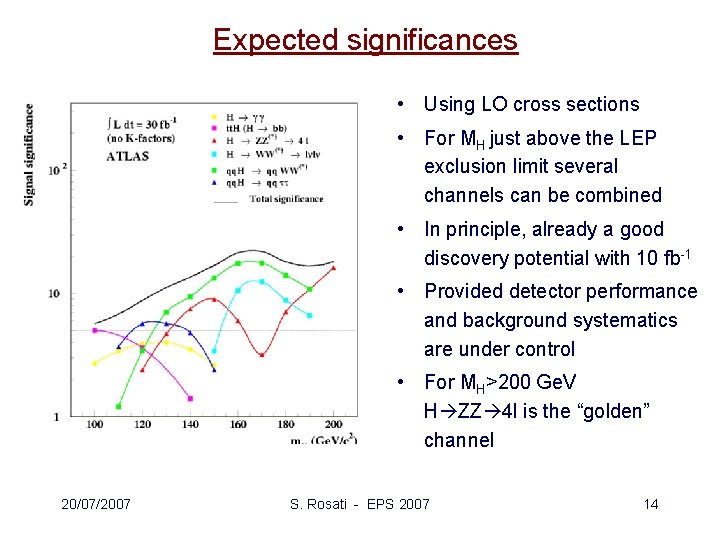
Expected significances • Using LO cross sections • For MH just above the LEP exclusion limit several channels can be combined • In principle, already a good discovery potential with 10 fb-1 • Provided detector performance and background systematics are under control • For MH>200 Ge. V H ZZ 4 l is the “golden” channel 20/07/2007 S. Rosati - EPS 2007 14
Conclusions • Many channels sensitive to SM Higgs discovery have been studied in detail • Sensitivity to the SM Higgs already good with 10 fb-1 • Good understanding of the detector necessary to assess performance from data • Understand background shapes • Early discoveries could be possible in H VV at high mass • Low mass region more challenging – H gg, tt. H, VBF, H ZZ* are the main channels in the low mass region • Work in progress right now: – Simulation of detector as-installed: including complete material description, misalignments, miscalibrations 20/07/2007 S. Rosati - EPS 2007 15
- Slides: 15